Feeds:
Posts
Comments

Posts Tagged ‘musicians’

EWS Little Brute Drive

Summary: Proving the old adage that “big things come in small packages,” the EWS Little Brute Drive is an absolute distortion machine, capable of mild crunch to face melting distortion. Don’t let the “drive” in the name fool you. This ain’t an overdrive – but who cares? 🙂

Pros: Though it has output level and treble controls inside the enclosure, the pedal is set to unity gain, so no need to mess with output volume. You just set the gain knob where you want it, then turn it on. It’ll instantly turn your guitar a fire-breathing dragon!

Cons: None. Absolutely none.

Features

  • Single gain knob. All the way left gives you about the max overdrive of a soft OD pedal like the Timmy. All the way right is evil – very evil – distortion. 🙂
  • True bypass
  • Runs on either a 9V battery or 9V power supply (I use a 1-spot).

Price: ~$129 Street

Tone Bone Score: 5.0 ~ I could barely pull myself away from playing this evening to write this review! I was having way too much fun with this pedal!

I have to admit that I haven’t been too much into distortion pedals in the past, but since I got a Strat, none of my overdrive pedals could give me the kind of creamy crunch that I love for playing rock songs. It’s not a problem with my Les Paul, and though my new Strat does have some higher-output pickups, it’s still not the kind of gain that a Les Paul produces. So I figured that I’d try a distortion pedal. Enter the Little Brute Drive.

After watching some very good videos and listening to some sound clips of the pedal, I knew it would do the job. I wasn’t mistaken. This freakin’ pedal has more gain than anything in my arsenal. I was amazed that at even with the gain all the way down, it was more than the gain that my beloved Timmy produces! But the even cooler thing is that even at the highest gain setting, note separation is incredible! I was concerned about that because my past experience with distortion pedals is that they get really muddy and compressed at high gain settings; not the LBD. The distortion is tight, but it never gets muddy, and the EQ response is pretty flat to boot.

Fit and Finish

Though it is diminutive in size, it’s built like a tank, and it is definitely gig-worthy. It has a nice red powder coating – almost like a warning that this thing breathes fire!

How It Sounds

Make no mistake: This is NOT a low-gain pedal. It is meant for crunch and face-melting. So if  you’re looking for something milder, best stick with an overdrive pedal. But if you’re looking for lots of gain and sustain AND clarity, this is a pedal that will do the job in spades.

I recorded a couple of quick clips to demonstrate the pedal. I had the gain knob set to noon on both clips. I used a Barron Wesley Alpha with humbuckers – though I played both clips in split coil to at simulate a single-coil guitar, and I used my Fender Hot Rod purely clean. With the first clip, I do a comparison riff. The first part is the guitar with no effect, then I switch on the LBD. The second clip is just me noodling.

Yowza! I really had to have a much lighter touch on the fretboard playing this pedal, and since the guitar I was playing is so resonant, I had to mute the strings I wasn’t playing because the pedal picks up EVERYTHING! It’s incredible! And to think that I was able to get that kind of gain with the gain knob set at noon!

Overall Impressions

I love it. ‘Nuff said. The sustain, the drive, and most importantly the note separation and clarity make this pedal a winner.

Read Full Post »

I just got done practicing some new material for tomorrow night’s gig and was about to put my guitar on a stand and call it a night when I started playing a chord progression – just a couple of simple chords. Then I added a bit more to it, and my creativity sort of took on a life of its own. Once I had the full progression down, I immediately recorded it so I wouldn’t forget it, then I layered a lead to explore various melody ideas. Here’s the result of my noodling:

Frankly, it’s nothing special, but it occurred to me that it’s important to noodle because it sometimes takes you to places – a musical dreamland, you might say – that you’d normally not explore, and you discover musical phrasing that your normal alpha-wave, mind on work, mind on life waking mind wouldn’t allow you to think about.

I may never turn that “idea” into a song, but just from that little noodling session, other ideas have surfaced, and I’ll definitely be doing some exploration of those ideas.

Bear in mind that when you’re noodling, you should detach yourself from self-judgment about what you’re playing and especially how you’re playing. It doesn’t matter. The point is to explore. You never know what may turn up.

Read Full Post »

I recently sold one of my guitars “The Ox” (’59 Les Paul replica), and have been getting it ready to ship. Luckily I had a Les Paul box on me that had some of the original packing material in it, so I could use it. The rest, I packed with wadded newspaper. If you’re curious about how to pack a guitar, check out this great video:

Read Full Post »


SWR California Blonde I

Summary: This amp is a classic and loved the world over for its great sound.

Pros: Great acoustic sound, but it’s versatile enough to use as a clean amp for solid-body guitars.

Cons: This is a nit: It’s heavy at 50lbs.

Features:

  • 120 Watts
  • Speakers: 200 Watt 12″ and a 25 Watt high-freq tweeter
  • Instrument Input Jack
  • Stereo Input Jack
  • Tuner Out Jack
  • Balanced Mic Input Jack
  • Gain Controls with LED Overload Indicator and Pull Phase
  • Aural Enhancer Control (Channel 1)
  • Two independent channels
  • Two independent effects loops with independent effects blend knobs for each channel
  • On-board reverb – it’s nice and subtle

Price: ~$300 – $600 Street (if you can find one)

Tone Bone Score: 5.0 ~ I’ve used this amp in a variety of settings, and with a variety of guitars, and it has NEVER let me down. The sound is rich and full, no matter what guitar you put in front of it, but it doesn’t take away from the natural tone of the guitar.

My first exposure to the California Blonde was through a church bandmate who would use it for our services. My initial impressions of the amp were NOT good, mainly because this guy just doesn’t take care of his gear. The knobs were scratchy and the jacks were loose and would occasionally crackle. But one thing was for sure: When he had it working, it had a great tone. I was always impressed by the sound of that amp, and REALLY impressed by its ability to project – it is a LOUD amp.

SWR now has a second edition of this amp, and the original is no longer available, but I got mine through my friend Jeff Aragaki of Aracom Amps who acquired one from an estate sale. He had a bunch of gear to sell, and one of the items was this classic California Blonde.

I wasn’t planning on getting an amp at the sale. I just wanted one of the many guitars he had, and ended up getting my gorgeous Strat. But just for shits and giggles, I checked out the amps. The ‘blonde immediately caught my eye (blondes have a way of doing that to me 🙂 ), so I asked Jeff if we could hook it up. Luckily I had my acoustic in the back of my SUV so I could give the amp a proper test. So we hooked it up, powered it on, I strummed a chord, turned to Jeff and said, “I’ll get this too…” I did play through it for about 15 more minutes to really go through its controls, but from having to adjust my buddy’s ‘blonde in the past, I was pretty familiar with the amp.

Since I purchased it, I’ve used it with my acoustics, as a clean amp for my Strat (and using a distortion pedal with it – it rocks), and just last night, I used it for its intended purpose: as my guitar amp for my outdoor gig, using my Gretsch Electromatic. As I mentioned above, no matter what I’ve thrown in front of it, this amp has delivered the goods.

Fit and Finish

Despite the amp being several years old, it has withstood the test of time. That’s a testament to how solidly built this amp is. Even my buddy’s amp – despite being mishandled – was still rock solid. My amp was and is in absolutely pristine condition. This thing is built like a tank. The enclosure, though made with a combination of plywood and particle board is THICK. Chrome-plated corner protectors adorn all the corners (this amp was made for gigging). No stray joints here folks, the build quality is fantastic.

The tilted control panel is an absolutely nice and convenient touch, allowing for quick access to the knobs. This is much better than the Genz-Benz Shenandoah 150 upright that I’ve played that has a flush control panel. Makes it hard to adjust. The metal speaker grille on the ‘blonde demonstrates again that this amp was meant to be gigged.

The only nit that I have with the amp is that at 50 lbs, it’s really heavy. But that’s understandable and forgivable considering the thick wood of the cabinet and the magnet of the 200 Watt speaker, which must be pretty big (I haven’t taken off the back panel). I’ll trade weight for ruggedness any day; besides, that’s what hand carts are for! 🙂

How It Sounds

The California Blonde has a rich, deep tone, but as I mentioned above, it doesn’t take away from the natural tone of the guitar. And though I mentioned that the amp is loud, the cabinet really disperses sound at a wide angle, creating a three-dimensional effect that makes the sound seem to float in the air.

I used it outdoors at my gig yesterday, and it was fantastic! I ran chorus, delay and reverb through the loop, and I have to say that the effects blend knob is a god-send, allowing me to mix as much or as little of my board signal into the dry signal. Because of how the amp disperses sound, I used very little reverb, and many times just had it off. For ambient tones, I used my MXR Carbon Copy delay set to a mild slap-back. That seemed to work best with the amp.

The tweeter’s effect is subtle, but a very nice addition indeed, as it provides just a touch of shimmer to the tone. I tried the amp with the tweeter switched off, and just turned it back on because I wanted the shimmer. With a Strat, the tweeter is a necessity in my opinion.

Last night, I started out running my guitar signal only through the amp, but then later added some signal into my Fishman SA220 PA so I could get even better sound dispersal. The line out is great on this amp, and reproduces the signal very true to the original. In fact, when I’ve used this amp at church, we run it right into the board, and the sound is very nicely balanced.

Overall Impression

This amp is a workhorse. I really couldn’t be happier with this amp. It totally delivers the goods for me!

Read Full Post »

I recently purchased the gorgeous Strat to the left. It’s the first Strat I’ve played in a long time that I actually like playing. But this past Sunday, I took it to my church gig and played it with one of my Plexi variants – my favorite amp, an Aracom VRX22. I did not like the sound at all! Yikes!

Like all Plexi’s I’ve played, the VRX22 is voiced bright. And for me, it’s a perfect complement to my Les Pauls and deeper voiced guitars like my new Gretsch Electromatic. Not so with a Strat, which is very bright. And even though I cut the highs out, it just didn’t sound right.

So later on that evening, I went into my studio and plugged my Strat into my Fender Hot Rod Deluxe. What a difference! My Hot Rod has a big bottom end, and that is the perfect complement for a bright guitar like my Strat.

It just goes to show the importance of finding the right combination of gear to get your sound. In my case this past Sunday, it took playing through another amp altogether. No amount of EQ or combination of pedals was going to get it “right” for me.

Lesson learned.

Read Full Post »

I’ve been playing at the same restaurant gig for almost ten years every Friday. This is a long gig from 6pm to 10pm. Last week, I was talking to a friend who asked me how I can play such long sets; and several times over the years, people have asked me how I can play four-hour gigs with just a single 10- to 15-minute rest period in between sets.

The answer I give comes in two parts: First, I simply lose track of time. I just love to play and perform, and I start jumping from song to song, not ever keeping an eye on the clock. The second part of the answer is that I’ve got good posture; and it’s something I constantly monitor.

Having good posture; that is, a straight back, ensures that your entire bone structure is being used to support your body. This in turn ensures that your weight isn’t isolated to just a single or a couple of spots.

Look at the pictures of Eric Clapton and Joe Satriani. You think it’s an accident that their backs are straight? Joe being a guitar teacher is probably acutely aware of his posture. Not sure about Clapton, but I put him up there simply because of his longevity. Both of these guys have done monster gigs over the years. It’s not a wonder to me that they’ve been able to perform as long as they have. Their great posture ensures that the wear and tear on their backs will be minimal at worst.

Another thing that I’ve learned over my many years of gigging is to always wear a great pair of shoes. This has become much more important over the last few years, but I’ve always had a thing about wearing comfortable shoes that provide lots of great support. My rule of thumb: Great shoes make for happy feet, and happy feet mean that you don’t get tired as quickly.

As of late, my shoes of choice have been the “Unstructured” line from Clarks. I’ve got the pair to the left, but I also have two other pairs. I absolutely swear by these shoes. They feel so comfortable on my feet, and I can literally stand for hours at a time, and my feet will be happy.

So do yourself a favor: Be aware of your posture and your feet and you’ll be in gig nirvana!

Read Full Post »

AH! HA-HA-HA HAHAHA! <manic laughter>

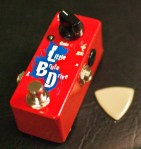
I guess my love affair with overdrive pedals hasn’t waned one bit – even with getting my Timmy. Don’t get me wrong, my Timmy will NEVER leave my board, but this totally cool, ultra-compact “Little Brute Drive” from EWS Japan is nothing short of amazing to me. Lots of overdrive/distortion on tap, right out of the box! And look at the bottom of the picture to the left: It ain’t much bigger than a freakin’ 9V battery! Amazing!

The way I envision using this particular pedal is for when I need heavier distortion than my Timmy, which is a light- to medium-gain device. The Little Brute has a much wider range of distortion; from fairly light to searing. And like the Timmy, the distortion is fairly open and uncompressed from what I could tell from clips. But even more important is that like the Timmy, it’s fairly transparent. I couldn’t detect much tone alteration from the clips I heard. So awesome!

You can fine-tune the output level and tone from inside the box – see the two blue adjustment screws in the picture? But from what I could tell, the factory settings are perfect.

Here are a couple of video clips:

Cost? $129, which is as much as a Timmy, but unlike the Timmy, you can get this online. Here’s a link where you can buy the pedal.

Read Full Post »

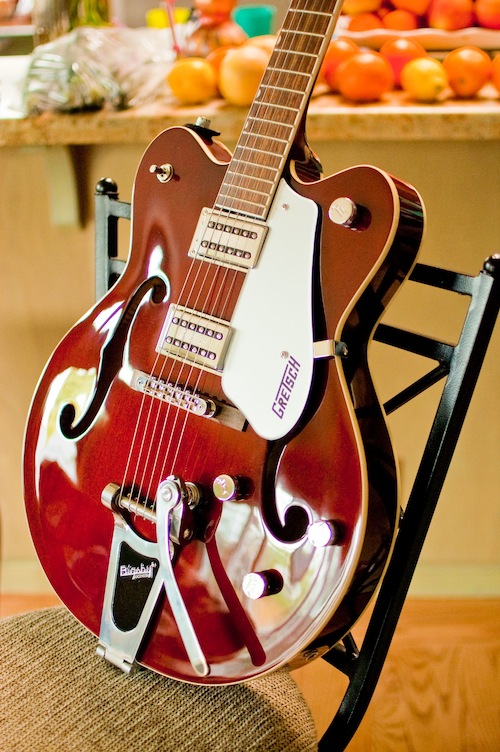
I gotta tell ya… I’ve got a new love, and it’s in the form of my new Gretsch G5122DC Electromatic. I’ve been playing it at my solo acoustic gigs, and I’ve been playing it at my church gigs. It’s an incredibly versatile axe! Clean, it has a very natural, acoustic tone, and even though the pickups have enough gain to push an amp into overdrive, it helps to use a drive pedal to give it that extra oomph. Of course, I use the Timmy that retains my guitar’s tone, and I just LOVE the overdrive tone this guitar produces!

Which brings me to the title of this article: Why have I avoided hollow body guitars for so long? It’s probably because I always equated them to jazz guitars, and I was always pretty much a straight-up, four-on-the-floor rock and folk guy. So it was either an acoustic or a solid- or semi-hollow body guitar for me.

But then I completely overlooked one of my very favorite rock guitarists: Ted Nugent. I forgot that back in the 70’s, that madman used a Gibson Byrdland, and he totally ROCKED THE HOUSE!!! The sounds he could get out of that guitar were incredible!
After having used my own Electromatic for the last few weeks, like I mentioned above, I’m totally in love! Clean, dirty, you name it, the guitar can do it. It is definitely going to be a part of my arsenal from now on.

What about my Les Pauls? Don’t get me wrong, they’re not collecting dust. I’m still playing them, and to be honest, while the Electromatic sounds great in overdrive, the natural  sustain and the balls-out power of my Les Pauls just can’t be matched. But the Gretsch has a completely different sound than my LP’s, and when I need that particular sound, that’s what I’ll play. But to be frank, I probably won’t be using it too much for my rock gigs; that’s what I have the LP’s and my Strat for. But the Electromatic has completely replaced my acoustics at my acoustic gigs. It has an acoustic enough sound to pass for an acoustic guitar, but the tone is so much more smooth and mid-rangy.

If you get a chance, try one out. Its sound will blow you away! And at less than $700, you get a gorgeous-looking and -sounding guitar.

Read Full Post »

The Internet for the most part has been great for guitar! I was just thinking that had it not been for the Internet – specifically, the World Wide Web – I wouldn’t be able to gather all the information I get for this blog. If I get wind of something, I can look at the manufacturer’s web site, get some contact information, and communicate with them. The speed at which this happens can be measured in seconds. Just a decade ago, it wouldn’t have been that easy, and I’d have to rely on the printed trade rags to get information. By the time I’d get that information, what would be the point of writing something? It would already be a couple of months old, as magazines usually run a couple to a few months ahead of schedule. But with the speed and ease of information access on the Web, fresh information is readily at hand.

The Web has also enabled the creation of instant communities of like-minded individuals, freely able to communicate with each other and share their ideas and viewpoints. But there’s a darker side to that as well. The most obvious is that face-to-face communication, where you can hear someone’s tone and/or read the expressions on their face is practically eliminated. This impersonalization can result in some very interesting – or more to the point: Annoying behavior.

I’ve been writing blogs since 1995 – even before the word “blog” was coined. And one insidious thing that I’ve encountered time and again is plain rude behavior. We’ve all seen it on forums, and I’ve seen it on my blogs. People come in and rip on someone or some piece of gear, offering nothing in terms of constructive criticism. It’s almost as if the impersonalization is a license to be a jerk.

Some of the more clever writers spout epithets to discredit others; using metaphor or worse yet, their professional credentials to steer the unwary towards their point of view. I’ve found those people to be the most insidious of individuals, never saying what they truly mean, and always speaking in innuendos and implications.

So why am I writing this? Simply because I believe good manners and honesty are important in everything we do. One of the great things about being a musician is the natural camaraderie among musicians. When I get together with other axe-slingers, it doesn’t matter what each of our skill levels are (I tend to be on the lower end of the scale 🙂 ), there’s support and encouragement, and verbal judgment is left unsaid, though courteous, constructive criticism is always at hand.

But sometimes online, that camaraderie seems to be lost, devolving into harsh criticism with no filters. One of the things I swore when I created GuitarGear.org was to always play nice. It’s tempting to rip on someone or some manufacturer, but what does that do but alienate people and in some cases, spread lots of misinformation?

Hey, I’m not saying that one shouldn’t express their opinions – especially about gear – but I’ve witnessed so many campaigns and crusades to discredit people and manufacturers that I had to speak out about it. I have to admit that even I’ve engaged in that in the past, but I decided that it doesn’t do anyone any good, and especially with this blog, it would be a disservice to my readers. What I came to realize is that what may suck for someone will work more than just fine for another. In other words, there’s really no definitive “right” or “wrong.” There’s just a description of experience.

Read Full Post »

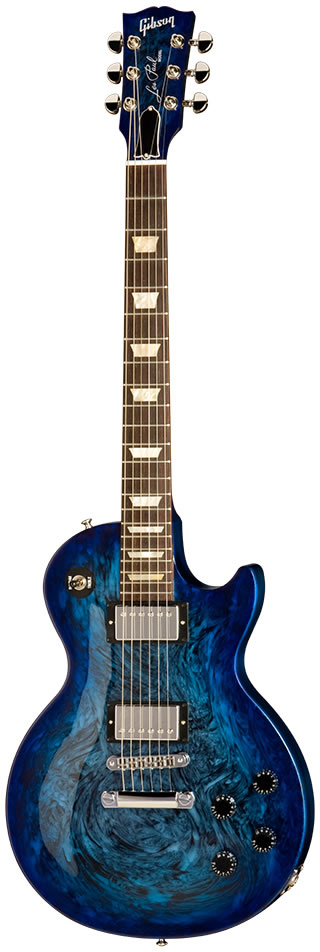
When I think of “Les Paul,” I think of classic burst or even solid finishes (not all). After all, at least for me, the venerable Les Paul is the standard in classic styling. It’s why I’ve never been attracted to the zany color schemes that occasionally appear on the market, like that Silver Burst (f-me, that’s UGLY).

Enter the “Flood” model that comes in swirly blue or green. To me, that ain’t a Les Paul. It may look like one and play like one, but it’s not in a color scheme that I would deem it a Les Paul in my book. Give me a classic Honey-, Desert-, Cherry-, Tobacco-, or Tea-burst any day.

It’s not that I don’t like the paint job. I actually like it, but it’s something that I imagine would be on a PRS or other boo-teek guitar; not a Les Paul. To me, that “Flood” finish denigrates my Les Paul ideal. But just because it’s not for me, it doesn’t mean others won’t like it, like some mac-daddy pimp. I could actually see Freddie Mercury slinging one of these.

It certainly might fit into the 80’s glam rock era with big hair, makeup and spandex pants, where looks were just as important – perhaps even more important – than the music.

Yeah, yeah, yeah, I know… It’s all about the tone. But as a performing artist, I couldn’t ever picture myself wielding one of these axes. I shouldn’t even call it an axe – it’s way too toy-like to me.

Then to top it off, since it’s a “special” model, Gibby is charging a premium for it. It retails at $1549, almost TWICE the price of a regular LP Studio. For goodness’ sake, it’s just a Les Paul Studio with a snazzy paint job!

Okay, rant off…

Read Full Post »

« Newer Posts - Older Posts »