Feeds:
Posts
Comments

Posts Tagged ‘musicians’

I’ve had two Gibson ES-335’s in the past, and I never kept them. It’s not that I didn’t like them; I actually loved my first one, Rusty, and even though I have remorse over parting with Rusty, I suppose I didn’t love either ES-335 enough to hold onto them. And frankly, I didn’t even have an interest in any hollow body or even semi-hollow body guitars until I laid my eyes upon and played my beautiful “Rose.”

There’s really something special about her; especially in the tone department as she can cop natural-sounding acoustic tones to really rockin’ out crunch. To demonstrate this, I created a few clips. Before I go on, personally, I love her clean tones, and I will be using her mostly for this. And note that her pickups are not very high-gain at all. In order to get overdrive, I had to use my Timmy pedal with the gain knob at about 3pm, which is close to wide open. But she plays VERY well with OD pedals as you’ll see. So without further ado, let’s get to the clips!

Bridge Pickup – This is a quick song that features the bridge pickup, which really sounds like an acoustic guitar. Even the lead sounds like an acoustic lead, but it plays like and electric – well, it is an electric. 🙂

Middle Position (both at equal volume) – This gives you the deepness of the neck pickup and the spank of the bridge pickup. With this clip, I copped the Police’s “Message in a Bottle” riff, and added some light chorus.

Neck Position – This by far is my favorite pickup position, though I will probably use the middle position more often. This has an eery, ethereal sound! In this clip, I just closed my eyes and started playing after hit the record button. This tone really inspires me!

Short Song (Rhythm: Middle position, Lead: Bridge position) – Here’s a quick song I put together. Again, both parts are clean, and I played the lead fingerstyle. This is just a purely fun guitar to play!

Rockin’ It – As I mentioned above, the Electromatic needs help to overdrive an amp, but hey! That’s what overdrive pedals are for! Here I’m playing my song “Strutter.” Just before the chorus, I stack my Tone Freak Effects Abunai 2 on top of my Timmy for some serious sizzle. Then I activate my wah pedal just for shits and giggles. Rose can handle it!

By the way, I played all the clips through my trusty Aracom VRX22.

What can I say, but “Wow!” This is an absolutely impressive guitar, and one that I’m so glad that I added to my stable. I’ll be using her mostly in my solo gigs, but she’ll also see some band time as well.

Rock On!!!

Read Full Post »

It pays to be a good customer of a local, independent retailer. When I first saw the Electromatic at Gelb Music in Redwood City, I fell in love with it; unfortunately at the time, I didn’t get it. I came back a few days later wanting to by it, and Jordan (the guitar gear manager) reported that he had sold it. 😦 In fact, he hasn’t been able to hold onto any of the walnut finish Electromatics for more than a couple of days. So I told him that as soon as he got one in to contact me. Well, after a couple of months (which was good because I could set aside some money for it), Jordan finally got one in, sent me an email, and I put a down-payment on it over the phone on Thursday. I picked it up yesterday and immediately used it at my weekly restaurant gig.

Jordan had even set up the guitar for me knowing that I might gig with it on Friday, and set the action and intonation perfectly! But that’s a testament as to why I’d rather deal with small-box retailers than big-box ones like GC. The folks at the small-box retailers get to know you, and over the years, you establish a great relationship with them, if not a friendship. I’ve gotten to know all the great folks over at Gelb, and if you’re in the area, you owe it to yourself to get to know these guys. They won’t steer you wrong! Anyway, enough of that, let’s get on to the guitar, shall we?

So, so pretty…

Usually, I’m less concerned with looks than I am with tone, but the finish on this guitar immediately drew me to her when I first saw her hanging on Gelb’s Gretsch rack. By the way, I’ve already named her “Rose,” for her rose-wine-hue, walnut finish. As with any Gretsch, it’s all about classic styling, but the finish on Rose is simply incredible, as it takes that classic styling and dresses it up with a gorgeous finish that immediately draws your eyes to it. The picture I’ve provided does not do her justice at all. Suffice it to say that the translucent walnut finish gives her a red wine hue that is so alluring – sexy, you might say. Last night, several customers commented on her beauty. I gotta tell you, it was like showing up to a party with the prettiest girl hanging on my arm! 🙂

In any case, I shot a few pictures of her this morning. Rose is AMAZING!!!

This slideshow requires JavaScript.

…sings like an angel…

Playing a G5122DC at Gelb made my decision for me. While it doesn’t have the deep tone of a standard body Gretsch, it still has lots of depth, and as with any Gretsch, the tone is as smooth as silk, no matter what pickup you’re playing. I love the scooped, ringing tones (but not twangy) of the bridge pickup, and the neck pickup has an eery, ethereal, three-dimensional tone that’s perfect for finger-style. I used the middle selector last night quite a bit as well to blend in both pickups for certain songs.

Last night, I was plugged directly into my DigiTech Vocalist Live, that adds some reverb and chorus, then goes directly into the restaurant’s PA board. While it sounded great, coming out of the PA speakers, monitoring was an issue, as the restaurant only has a single 6″ monitor that just doesn’t give a good representation of the sound. But hearing it in the house, I was just blown away! The tone was rich and full, and seemed to fill the room, even at a lower volume. That kind of three-dimensional sound is inspiring! It floats in the air, and feels so close that you can almost touch it.

I’ll be recording clips really soon!

…and I could hold onto her all night!

Rose’s neck is very much like a 60’s Les Paul neck, so playing her felt immediately familiar. I had her set up with 10’s, which are on the light side for “acoustic” playing but provide a real versatility – and heck, with a four-hour gig, lighter strings are just easier to play. 🙂 The guitar is fairly lightweight – probably in the vicinity of 7 to 8 lbs., so prolonged gigging will not be an issue with Rose. Last night, everything about her felt so great. I love the position of the master volume, and with the pickup switch being in a similar position to a Les Paul, switching pickups mid-song was a breeze!

I didn’t quite like the action that Jordan had set on Rose originally, as it appeared to increase towards the bridge, so once I set up my rig, I made a couple of adjustments to the action on both sides of the floating bridge. What a different that made! It actually took me a few minutes to get used to how easy Rose was to play. And being that I’ve been playing this gig with an acoustic, I had to remind myself to really relax my left hand and not dig in. 🙂 That’s actually a good problem to have, and a testament to just how easy this guitar is to play.

Read Full Post »

I was reading a thread on The Gear Page about David Grissom explaining how to play a couple of tunes where he was using a capo. As usual with subjects that are potentially controversial, this thread had lots of posts, and most were replies to those who thought the use of a capo as cheating.

I’ve always been intrigued by this issue. I’ve used a capo for years for both acoustic and electric without even thinking about it. But there have been a few people throughout the years whom I’ve run across who say using a capo is cheating. I have a one word reply to that: Bullshit!

Tell that to James Taylor, or Paul Simon, or Davey Johnstone or even Albert Collins. They’re cheating? Ha! Especially with JT, there are some things that you just can’t do very easily without a capo when playing his tunes.

I look at a capo as a tool to help me play more comfortably. For instance, my Friday night solo acoustic gigs are four hours long. My first set is always at least two hours, and I play a lot of songs that require a capo. While I could play barre chords for almost all the songs, my question is, “Why?” If I have a tool that will let me play chords in the first position, it’s easier on my left hand.

What’s easier to frequently fret for a Bb chord, a standard G-chord shape at Capo III, or using an E-chord shape with a barre chord on the sixth fret? You could argue that doing a barre chord is pretty easy, but try doing that for all the chords in a song on an acoustic guitar. Lots of pain.

Here’s a James Taylor cover I do called “Something in the Way She Moves:”

I play that song in Db, so I play an A chord-shape at Capo IV. The opening riff is an A chord-shape that slides up to an Asus4 (add 6). Without a capo, you can easily pluck the 2nd and 4th strings. But to play that chord accurately according to the original composition, you need to pluck the 1st and the 3rd strings as well, which are open with a capo. Unless you have some super-long fingers (which I don’t have), then playing this chord is virtually impossible if you’re barring on the 4th fret.

So in the case above, the capo simply greases the wheels. A couple of years ago, a dude came up to me at the restaurant and asked how I played that tune. I put my capo on my guitar, to which he said, “Oh… You use a ‘cheater.'” I knew he was joking, but that statement irritated me a bit, so I took off my guitar, held it out to him and said, “Okay, if it’s a cheater, I want you to show me how to play it without a capo. If you can, then not only will I play it your way from now on, I’ll give you all the money in my tip jar,” which had about $50 in it. He politely declined…

Read Full Post »


Fender American Deluxe Stratocaster
Summary: Finally a Strat that I love to play. This one has been upgraded with Kinman pickups and an L. R. Baggs Ctrl-X X-Bridge pickup.Features:

  • Alder Body with 3-Tone Sunburst Finish (my favorite Strat Color)
  • 1-piece Maple Neck
  • 22 Frets
  • Rosewood Fretboard with Abalone Dot Inlays
  • Nut appears to be synthetic tortoise shell – very cool!
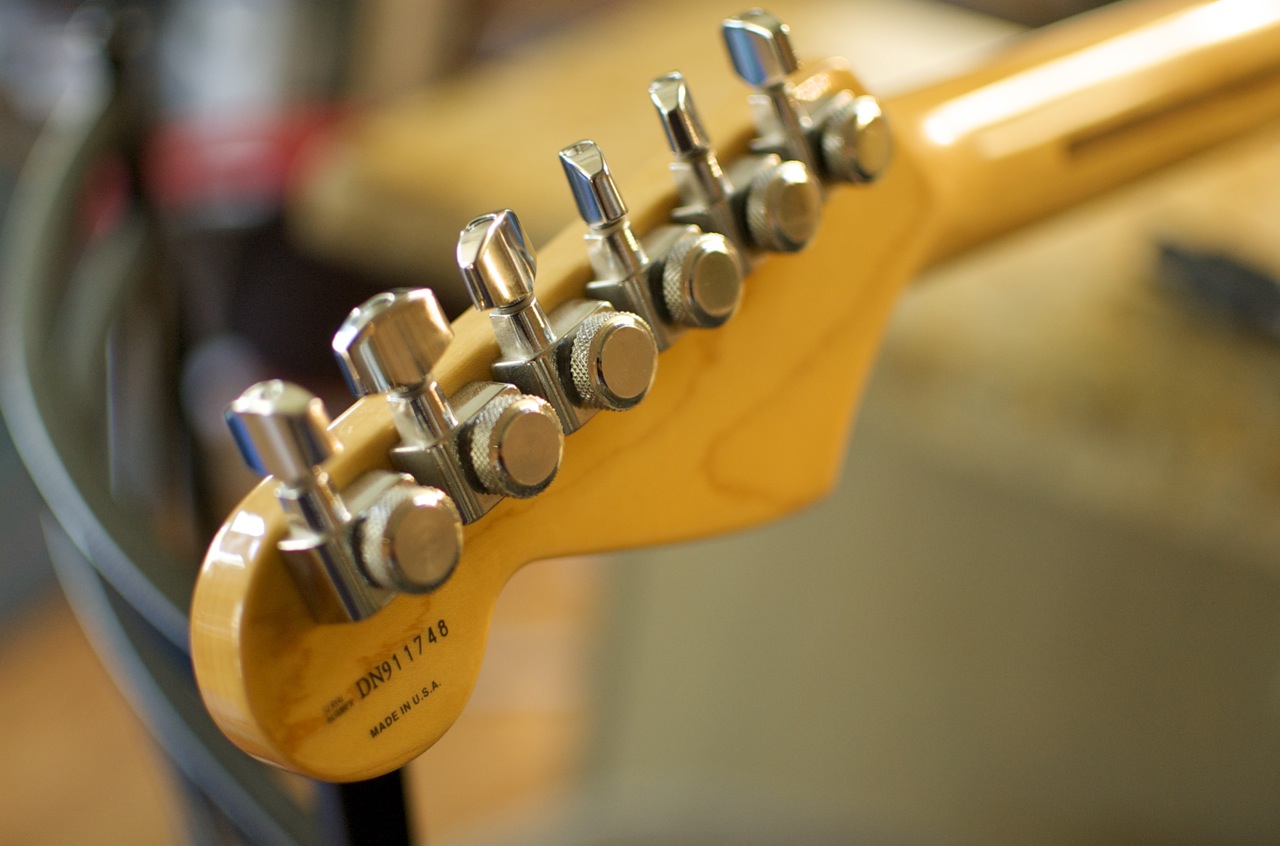
  • Locking Tuners
  • L. R. Baggs Ctrl-X Drop-In Tremolo/Bridge Replacement
  • Kinman Noiseless Pickups
  • 8.5 lbs

Value: ~$1500-$2000

Tone Bone Score: 5.0 ~ Wow! What a tone machine! The Ctrl-X pickup has tons of gain on tap, and will give you plenty of crunch when you need it! The Kinman Noiseless pickups really smooth out the tone, and flatten the significant midrange that tends to be in stock Fender pickups.

I love estate sales because you can find some real gems. A friend of mine happened to get a bunch of stuff at an estate sale recently, and picked up this fine specimen of a Strat. What drew me to it initially was the 3-tone burst, which I love. Of course I had to try it out, so we hooked it up to a cheapo amp, and I couldn’t believe my ears! I was expecting that typical bright Strat sound, but what issued – even from that cheapo amp – was a much smoother tone. The tone definitely spoke “Stratocaster,” but it was in another dimension. Of course, I had to take it home with me to bring into my studio and to gig with this weekend… 🙂

For me, I had all but lost hope with Strats. I just couldn’t find one that really appealed to me. But with the changes in this particular Strat, I’ve regained my faith. This is an absolutely killer guitar!

Fit and Finish

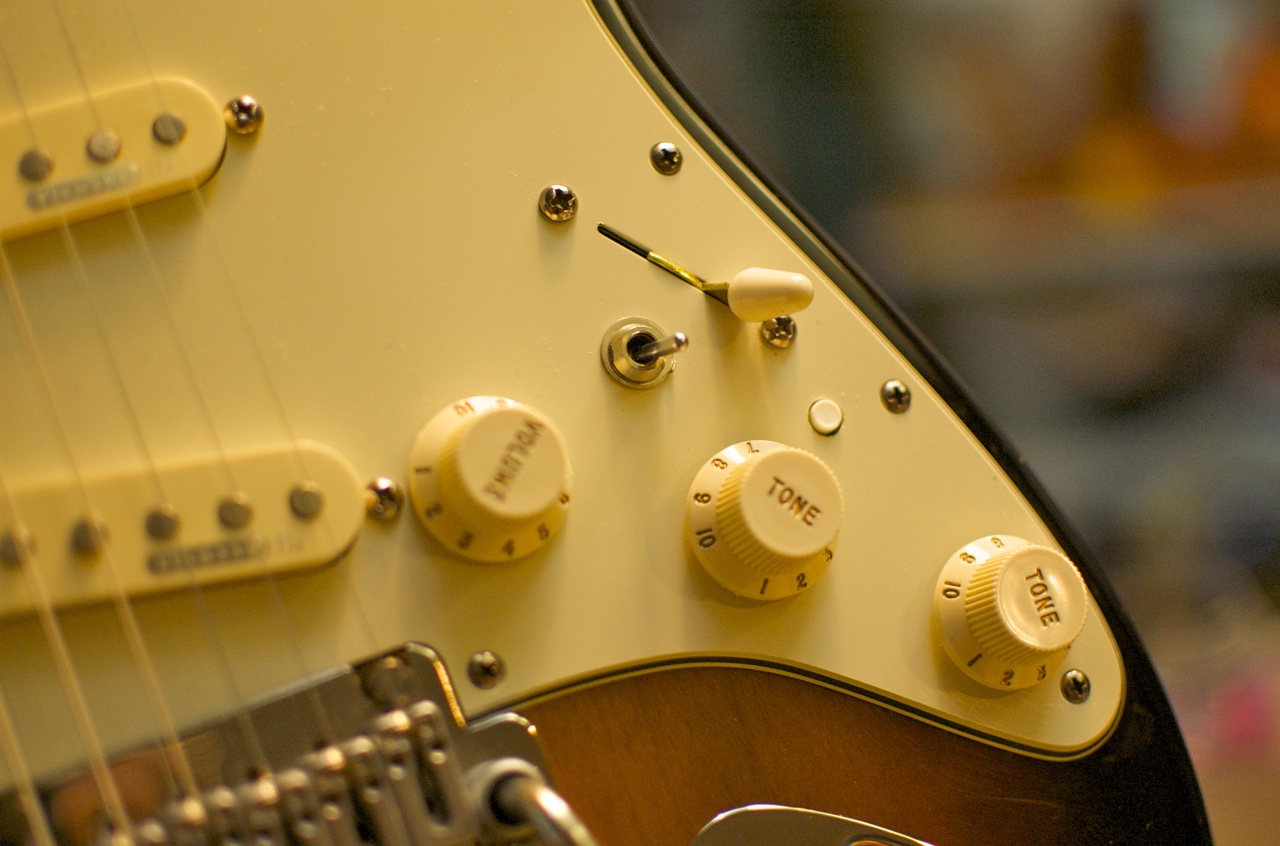
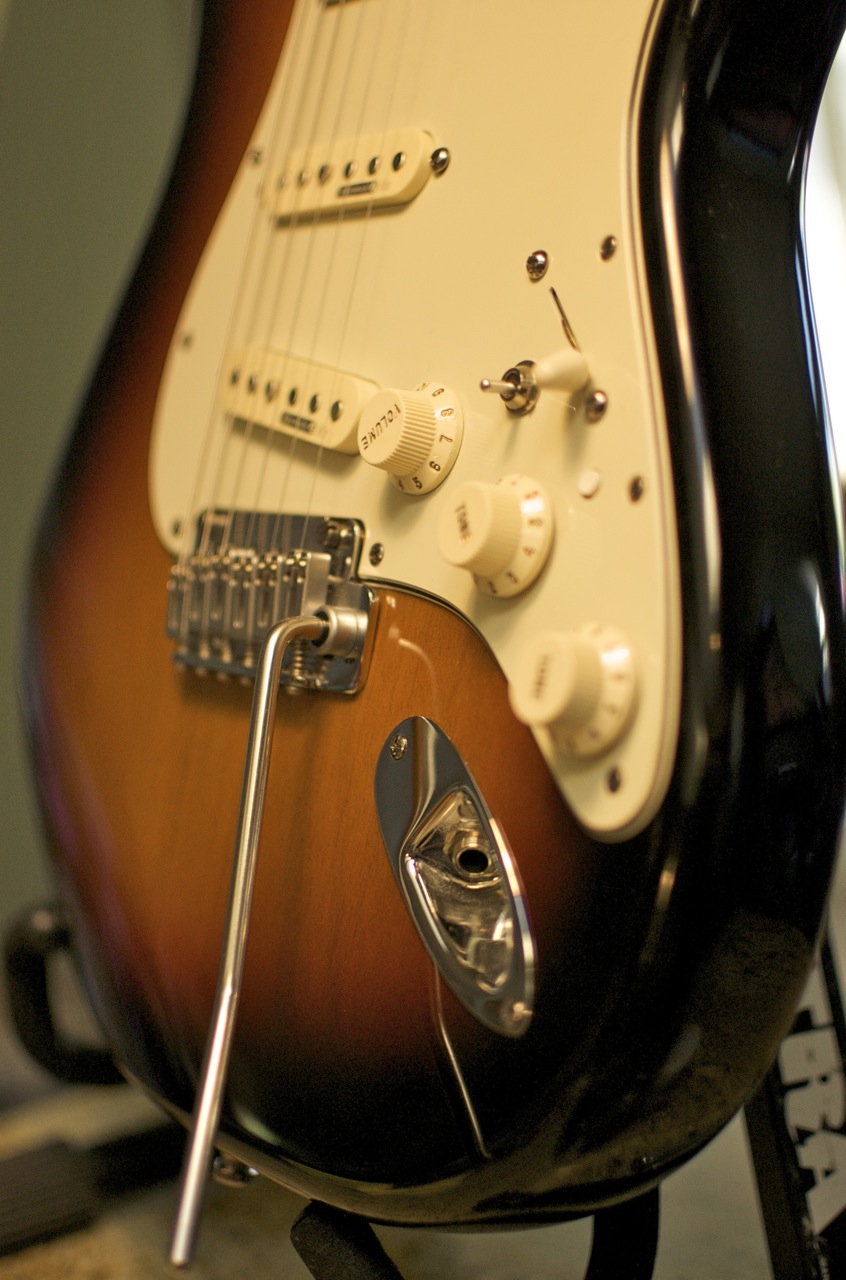
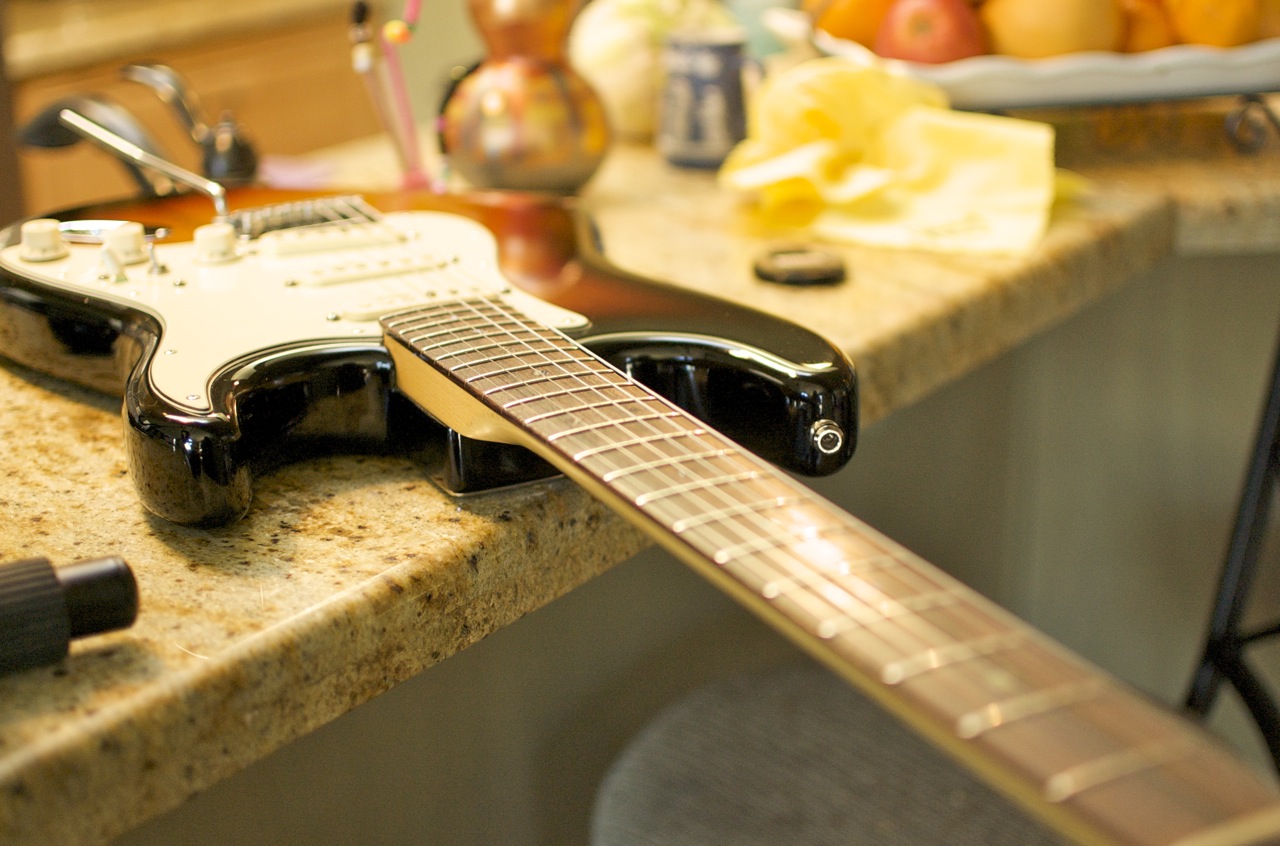
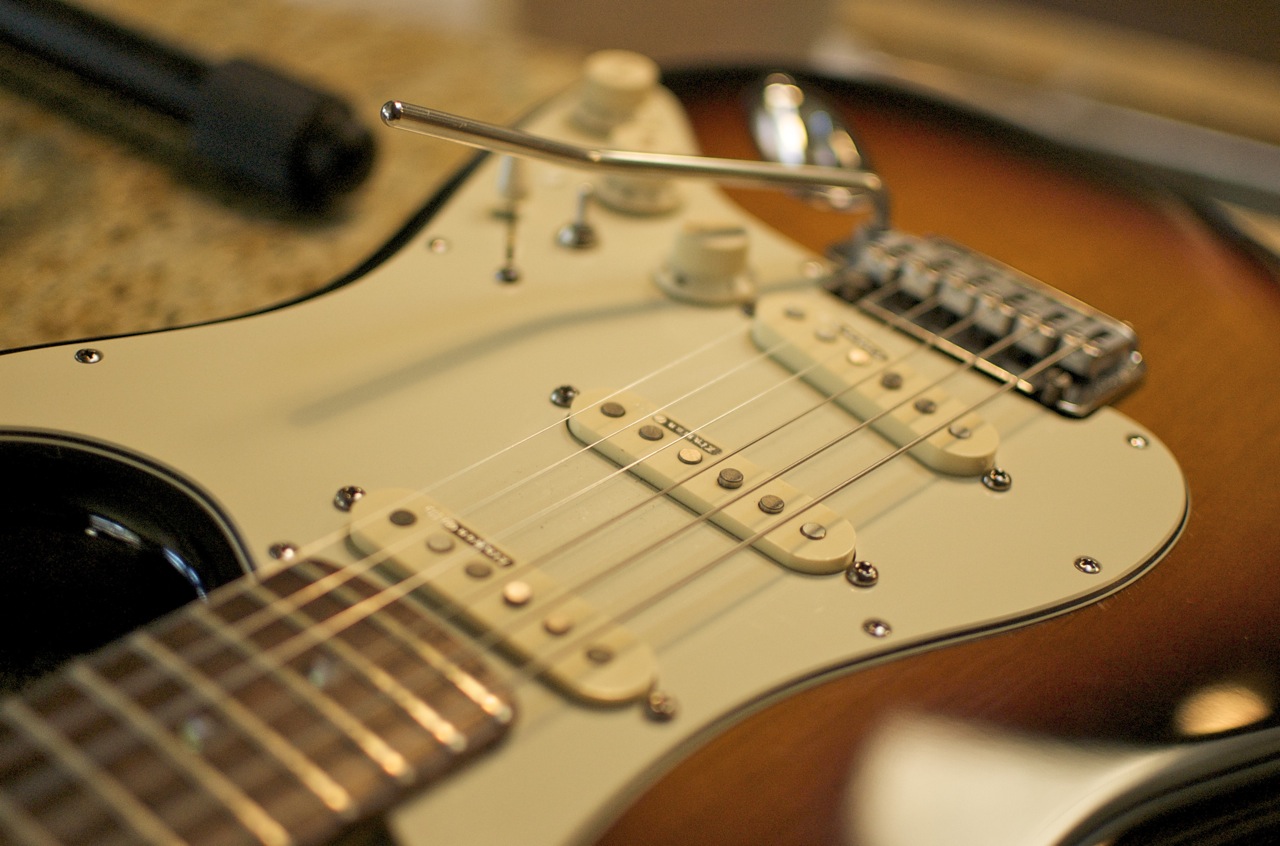
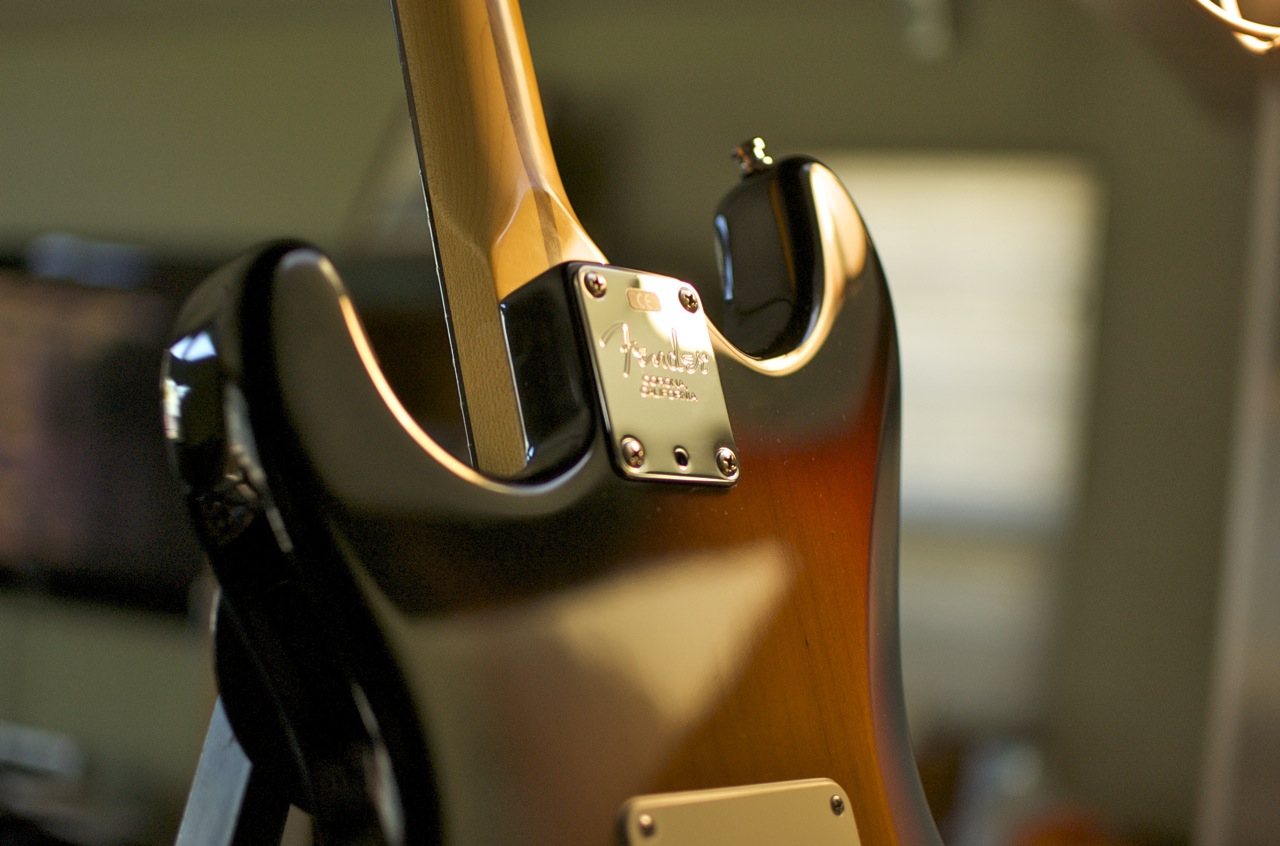
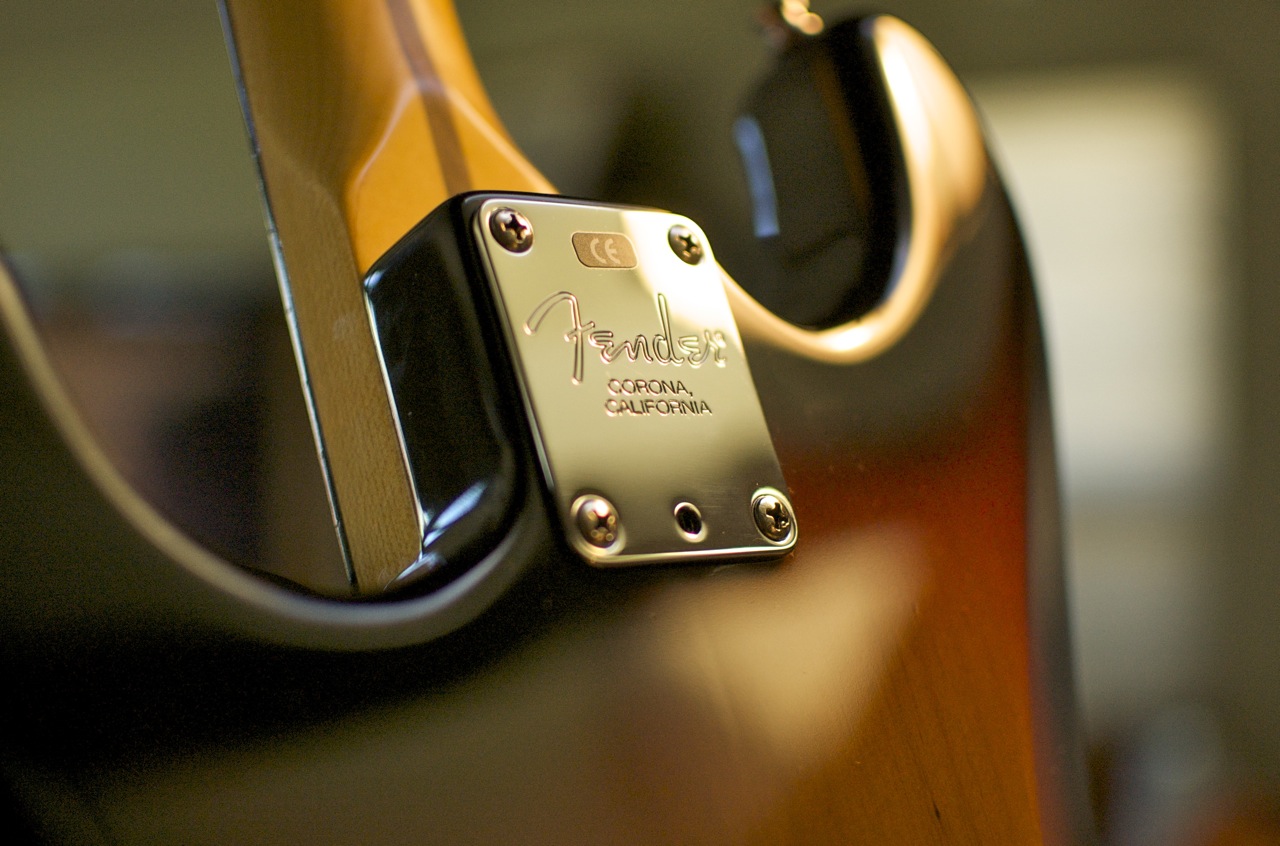
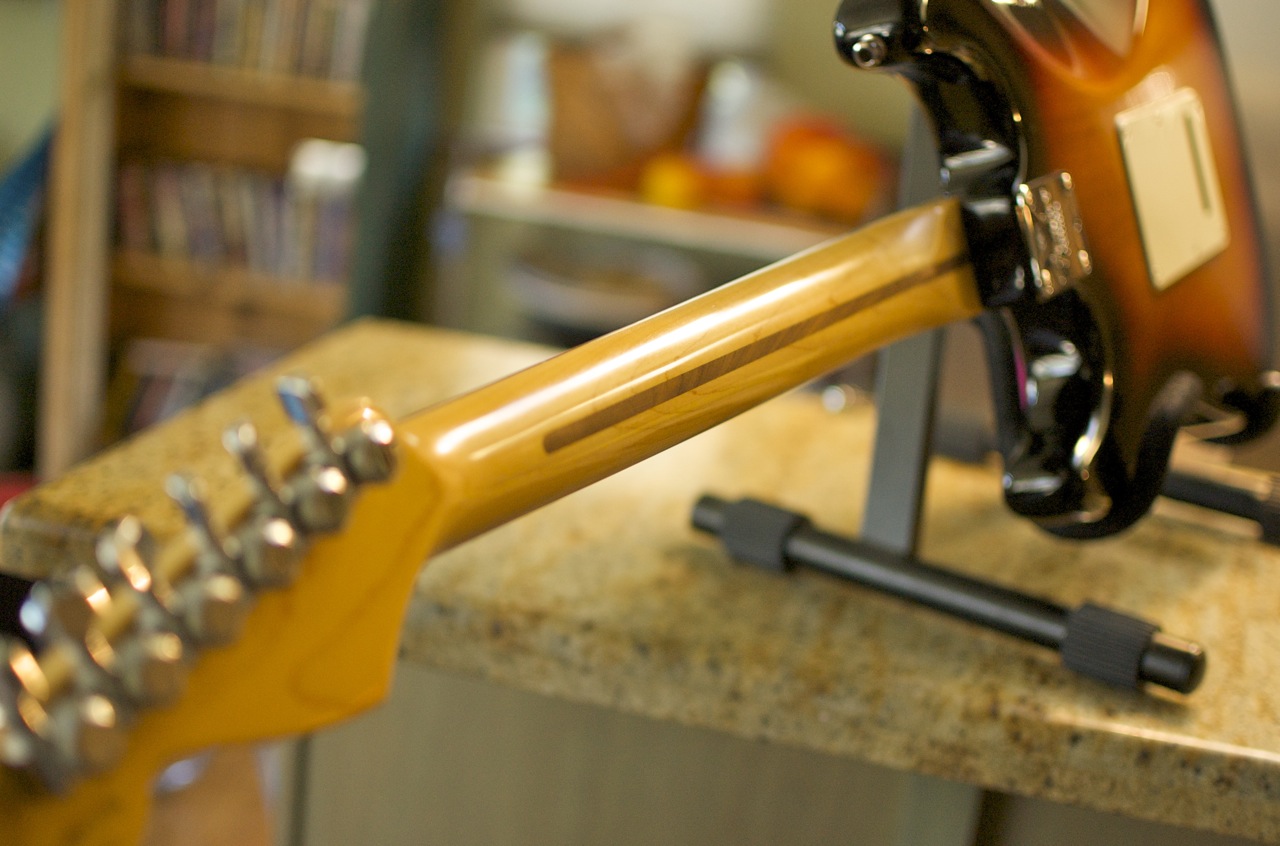
The previous owner tragically passed away a few years ago, and the dude was a total gear nut! As a result, he just didn’t play his gear all that much, and so the guitars that were in his collection were in absolutely pristine shape. This particular Strat has the most signs of usage, but there is absolutely no major scratches, and just a tiny ding on the neck. Other than that, the guitar is perfect. The rosewood fretboard is in particularly great shape, and still retains a gorgeous sheen. The abalone dot inlays are a great touch. Here are some pictures:

Playability

Unlike a lot of Strats that have really narrow nut width, this Strat’s 9.5″ nut radius is perfect. The neck is a gentle C and even with my short fingers, I have no problem reaching the lower strings high up on the fretboard. The shape of the neck is simply terrific, and provides a nice balance between solid-feel and speed. I could play this guitar for hours and never get tired. It’s really a player’s guitar.

How It Sounds

As I mentioned above, it sounds like a Strat, but it has a much smoother tone. This is due to the Kinman Noiseless Pickups that replaced the original “noiseless” ones on the stock Strat (don’t have the stock ones, but don’t want ’em). This Strat also has tones of sustain, which really surprised me. It’s not on the order of a Les Paul, but it sustains a lot more than other Strats I’ve played in the past. The Kinman pickups also add a lot of depth and complexity to the tone, picking up subtle harmonics that give the tonal presentation a real 3-D effect – it’s almost reverb-like. How cool is that?

On top of that, the original owner replaced the tremolo with an L. R. Baggs Ctrl-X system. This adds yet another pickup to the bridge that has all sorts of gain; very humbucker-like, but retaining the single-coil characteristics – there’s just more of it. The Ctrl-X system is cool in that you can switch between going fully magnetic to blend with Ctrl-X or fully Ctrl-X. The full-on Ctrl-X is great for soloing!

To demonstrate the gain differences, here’s clip I recorded this morning (actually, the two clips were included in my previous article that I wrote this morning). But here’s the first:

Finally, here’s the quick song that I recorded this morning that has the rhythm part in fully magnetic mode in the 4th switch position (neck/middle). The lead is played in the first position with the Ctrl-X system:

Both clips were recorded using my Aracom PLX18 BB Trem, a fantastic 18-Watt Plexi clone. I was originally going to record with my Fender Hot Rod because the guitar sounded great through it. But my problem with Strat tone came from switching to vintage Marshall-style amps like my PLX that have lots of midrange. Strats just didn’t sound right to me with these amps. But this one blew me away!

Overall Impression

It’s difficult being a gear freak and having so many avenues to evaluate great gear. I have to have this guitar. Period. It’s completely changed my view of Strats!

Read Full Post »

I started out as a Strat guy. Then when I moved over to vintage Marshall-style amps, just couldn’t stand the reedy, thin sound of my Strat with my amps. It sounded fine clean, but the overdrive sound was horrid. Well I finally came across a Strat that has much more balls than my old one. It’s an American Strat that has been hot-rodded with noiseless Kinman pickups and an L. R. Baggs Ctrl-X upgrade, which places a pickup in the tremolo bridge called the X-Bridge pickup. This includes a three position switch that functions similarly to a Les Paul switch: Fully up is magnetics only, middle is a mix of X-Bridge and magnetics, then all the way down is X-Bridge only, which is produces a fat, gainy tone.

I think that’s the problem that I had with my Strat and other Strats I’ve played. They don’t have enough gain to really push my vintage Marshall-style amps. But with the X-Bridge, I can get enough gain to push my amps to their sweet spots. I should say that that’s only for my non-master volume amps. It works great with my Fender Hot Rod; in fact, I was playing around yesterday and getting gorgeous overdriven tones with that amp using this guitar.

As an example of the effect the X-Bridge has on gain, here’s a comparison clip. The first part is just the magnetics, then the second part is played the same with the same chords and same pick attack. Gives you lots of gain. 🙂

I’ll tell you what: The X-Bridge seals the deal for me.

Next, here’s a short song applying both magnetics and X-Bridge. The rhythm part is played with just the magnetic pickups, and the lead is played with the X-Bridge. I have the amp set with the volume at 6 on Channel 2 of my Aracom 18-Watt Plexi combo and the tone at 3pm (optimum for a Plexi).

Where I had the amp set, it was just at the edge of breakup for the Strat in magnetics only mode. Then when I engaged the X-Bridge, I got a nice gain boost that pushed the amp over the edge. That gives me a nice, light overdrive that adds just a tiny bit of compression and sustain.

This is really profound for me because I had all but given up hope on Strats, even though I love their tone. My old Strat just doesn’t have the balls that this one has. It’s just way too thin and bright; which reminds me that the Kinman pickups are absolutely fantastic! They have a bit deeper tone than a vintage Strat pickups – I have the ’57 Tex Mex in my MIM Strat – and THEY ARE NOISELESS! No more 60Hz hum! 🙂 Frankly, I didn’t know too much about these pickups, but they’re apparently very popular replacements among Strat and Tele players. They’re not cheap at $300 for a set, but they’re well worth the money.

Read Full Post »


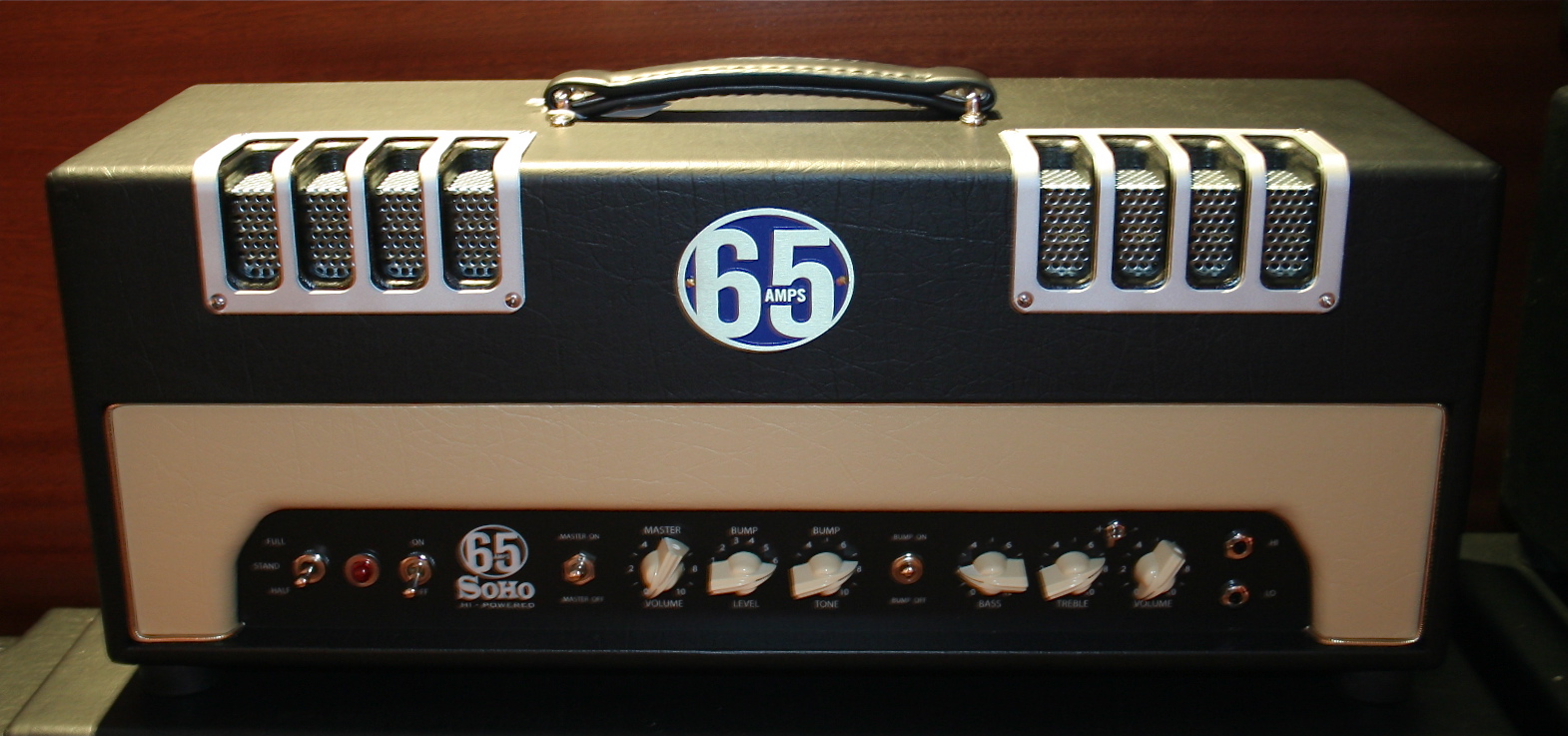
65 Amps Soho
Summary: Super-versatile amp with LOTS of balls. Goes from AC30-like tones to cranked vintage Plexi. While definitely British-style in tone, it has a tone all its own.Pros: One of the very few amps I’ve ever played that REALLY responds to guitar volume knob changes. The Soho, while very versatile is also VERY efficient. The 20-Watt model I heard and tested had the feel of a 50 Watt amp! Very nice.Cons: None.

  • Features:Output: 20 Watts (SoHo) or 35 Watts (SoHo HP)
  • Tubes: Power amp 2xEL84 (SoHo) or 4xEL84 (SoHo HP), Preamp EF86-12AX7
  • Rectifier Tube: EZ81
  • Speakers (combo): Celestion Alnico Blue + G12H30
  • Panel controls: Volume, Treble, Bass, Booster, Bumpâ„¢, Bump Toneâ„¢, Bump Levelâ„¢, Master Voltageâ„¢
  • Extras: Footswitch input jack, dual speaker outs, switch for 8Ω & 16Ω impedance

Price: ~$2400 Street

Tone Bone Score: 5.0 ~ Yowza! I LOVE this amp! It is so versatile and expressive and responsive to input gain. As much as I love my Aracom amps, I think this is an amp that I have to have.

I really shouldn’t go to music stores. But then again, if I didn’t, I’d lose an important source for gear. Last week, I happened to go to my favorite gear store (Gelb Music in Redwood City, CA), and was just hanging out looking at gear. i was also in there to see if they had gotten their latest shipment of Gretsch guitars, as I want to get the Electromatic 5122DC. Unfortunately, it hadn’t come in yet. But Jordan (who’s the guitar dude at Gelb) said that Dan, the designer from 65 Amps was coming in to do a demo from 5-7pm. It was just after 3pm.

Just so happened that Dan had just walked in the door, and Jordan introduced me to him while he was setting up their back room with the 65 Amps they carried. Dan and I got to chatting about gear and gigging, and then I started asking him questions about the Soho, which is an amp that has continually gotten my attention because Andy at ProGuitarShop.com uses one for most of his gear demos. So a cool thing happened: I got a private demo of the Soho from Dan the designer himself.

Now as we were talking, my impression of Dan was that he was a very nice, straight-shooting guy. But I’ve also seen and tested lots of different amps, so I guess I’ve become a bit jaded about boutique amps. But as you’ll soon find out as you read through this article, my jadedness became completely irrelevant in this case…

Dan took me through all the features, and I was completely dumbstruck by the expressiveness and versatility of the Soho while he played. The response to input gain using the guitar volume knob was incredible! I confirmed this when I played through it myself. You can go from clean to dirty with just the knob, then get really nice driving, but not overly compressed hard gain. The tone was incredible!

Now the Soho might look like a two-channel amp from its control layout, but it doesn’t have two channels; rather, it has two modes: Normal and Bump, which gives you a “bump” in tone and gain which is controllable like a separate channel – but it’s not a separate channel. Believe me, it’s very cool!

The “Bump” feature makes the tone of the Soho thick and rich and incredibly expansive. I commented to Dan that when he had it cranked, the amp sounded as thick and loud as a 50 Watt Plexi. He just grinned, as he knew exactly what I was talking about. As I mentioned in the Summary section above, this little amp has BALLS!

Equally impressive is 65 Amps’ trademark “Master Voltage” which is a bit different from a master volume in that like a regular MV it varies the B+ voltage it also keeps the filament voltage up, so you can still break up at lower volumes. Not sure the tech behind this, and who knows, it might be hype. But hyped terminology or not, it works; and it works incredibly well! It acts like an attenuator, giving you all the grind you need at lower volumes, without the extra circuitry.

I didn’t get as much time to play with it as I would like, and I tend to be rather self-conscious in stores when I’m evaluating gear, so I didn’t try too much. But I took it through various things I might do in a gig, and all I have to say is that the Soho is a true player’s amp. It has everything you need to cover gorgeous cleans to hard-driving rock. It’s definitely not a metal machine, but for producing most rock sounds, you can’t do much better. It’s not a small wonder why a great player like Andy over at ProGuitarShop.com uses this amp for his demos.

Here’s another thing: The amp is absolutely unforgiving. You can’t be tentative with your playing when you play through this amp because every mistake will be picked up. I love that about this amp! That’s why I call it a player’s amp because you really have to play. When I first started playing around with it, Dan said, “Give yourself some time Brendan. It takes a little while to get used to…” Man, was he right! I twiddled knobs, found a setting I liked, then just closed my eyes and started to play (closing my eyes helps me lose my self-consciousness – beside if I suck, I know it’s not the gear). 🙂 Luckily, I didn’t flail too badly, and in the process, I fell in love with that amp. It simply rocks! I need to get this amp. Damn! There goes the GAS again!

BTW, here’s a video demo of the amp by Dan:

For more information, visit 65 Amps Soho page!

Read Full Post »

Awhile back, I mentioned that one of the next pedals I was going to get besides my Timmy was an envelope filter. I was really digging the Electro-Harmonix pedals, but then got contacted by Jeff at Source Audio who was saying that they were working on a new guitar envelope filter, following the bass envelope filter they recently released.

If you’re not familiar with Source Audio, they build the SoundBlox line of pedals. What makes these pedals different is that they can be manipulated on the fly with a motion sensor ring called the HotHand Motion Controller ring. I’ve always been intrigued by these pedals, but haven’t had the chance to try any out. Until now. I hopefully will be getting a couple of their pedals for review soon, and I have to tell you, I’m excited!

The envelope filter has a TON of cool sounds, so you can get all sorts of vowel tones out of it. With the motion controller ring, you can even get variable wah sounds! THIS IS COOL STUFF!

In any case, here’s the demo video they just released of the new guitar envelope filter:

Read Full Post »

I was looking around for new gear to talk about and ran across this video at Guitar World:

All I can say is… interesting. As said in the video, the power wire has a tiny amplifier built into the jack that connects to your guitar powered by two long-life batteries.

Not sure how I feel about it, which is why my reaction was a lot more mild. It’s certainly cool, adding more gain to your input signal. According to the R&M Tone Technology web site, the cable comes in 0-6dB gain options. I guess the thinking is that more gain gives you more dynamics, but it also changes the overdrive point of whatever drive pedals you’re using, or if you’re going straight into the amp, where your amp breaks up.

I would actually see this as a benefit for single-coil, or low-output humbucker-equipped guitars, where that extra gain will get you overdrive earlier on. Not sure how I’d like it with hotter pickups such as the ones that are in my Gibson Nighthawk Reissue.

But at $39.00 for a 20 footer and $43 and $47 for 30- and 40- foot cables, it might be worth it to try out. For more information, visit the R&M Tone Technology site.

Read Full Post »

A few years ago, I wrote a post entitled, “Fighting with my guitars.” This was inspired by a post from a now-defunct blog called, IG Blog, where Ig talked about different guitarists “fighting” with various quirks in their guitars and overcoming them to be more expressive. In my most recent post, the discussion turned to this very subject; fighting through quirks in gear.

When I re-read my original post from a few years ago, I chuckled because the way I fight with my guitars is that I actually sort of pick a fight with them. Oh, not by banging them up, but simply by not changing my strings until one breaks. In fact, if a string breaks, I just change that string, and leave the others on.

Part of why I started doing this years and years ago was economics. I just couldn’t afford to do wholesale string changes very often. But now, I prefer well-broken-in strings over new strings because to me they sound smoother (I actually don’t like the brightness of new strings), and more importantly, they make me work harder to get a good tone.

I can do this because my hands just don’t sweat that much. I have friends whose hands sweat so much that they have to change strings after every gig because their strings will start corroding within a few days. But me, I just leave ’em on until one breaks and then I just replace that string. For instance, with my acoustic guitar that I gig with at least twice a week, I finally changed my third string a week ago. The strings on that guitar have been on for over four months! 🙂

Granted, I will do a wholesale change anyway every six months or so to clean up the fretboard and remove pick dust that I can’t get to easily. But my strings for the most part just stay on until they break.

I know, sounds a bit quirky, and it probably is, but it forces me to work hard, and in turn, I feel much more expressive because of the tension that creates.

Read Full Post »

…but can you play.

For those of us that remember back in 1985, during the heyday of MTV, Billy Crystal put out a video featuring his Saturday Night Live persona “‘Nando” called “You Look Marvelous.” In the video, he says, “My father told me, ”Nando don’t be a schnook. It’s not how you feel, but HOW YOU LOOK!'” Well, as I mentioned in a previous article, looking good is one thing, but playing good is entirely different matter. 🙂

I will submit that how you feel is ultra-important to playing well. Again, I’m going to draw a parallel between golf and guitar. Recently, I stepped up to playing with fairly expensive golf balls. Up to that point, I couldn’t really justify playing with “tour” caliber balls because I was just getting back into the game; so I opted with cheap balls that I didn’t mind losing should I hit an errant shot. But I’ve been hitting a lot more consistently as of late, so before my last round, I purchased some balls that cost about $43 per 4-pack. That’s quite expensive. However, the way they felt and in turn made me feel when I hit them compels me to always buy those.

I wrote an article about that on my golf blog. After I wrote it, I saw yet another connection that I could draw from golf to guitar; and that is that how you “feel” when you’re playing totally affects how you play. If you don’t feel comfortable with your gear, you’re going to fidget and f-up. You’re going to be constantly adjusting to find the comfort zone.  If you’re stressed out – as I covered in a recent article – you’re going to mess up, and completely limit your creativity.

So the moral of the story is the exact opposite of “You Look Marvelous.” It’s not how you look, it’s how you feel…

BTW, here’s the original video. It’s hilarious:

Read Full Post »

« Newer Posts - Older Posts »