Feeds:
Posts
Comments

Posts Tagged ‘overdrive’

I had my weekly church gig yesterday. It was storming REALLY badly beforehand, and the thought of lugging my regular rig in the rain was just not appealing to me. It usually consists of my pedal board, a couple of guitars, an amp, a 1 X 12, cab, an attenuator, and a gig bag for cords and tools for spot emergency repairs (never leave home without some tools – I even have a soldering iron because you never know…). With all the rain, I just did not want to do that, so I opted for a solution where I could just make one trip, and that meant leaving my attenuator,  pedal board, and main amp – an Aracom VRX22 – at home. I also wanted to keep things as light as possible, so I wouldn’t have to use my portable hand cart.

So I decided to use my little Fender Champ 600 and my 1 X 12 cab (because the Champ just doesn’t have enough bottom-end). The thing about the Champ is that you have to crank it up all the way to get some decent breakup, which isn’t bad in and of itself, but in a church environment, that could be problematic as even 5 Watts through a 1 X 12 can be loud. So my solution to get some grind? I took the dust off my old TS-808 Tube Screamer, threw it in my gig bag, grabbed my Tele, and went to church!

I have to say that that was one of the most enjoyable sets I had played in awhile. I hadn’t used the TubeScreamer in a LONG time, and I mainly used it yesterday because I didn’t want to “peel” an OD off my board. But I had forgotten just how good a pedal the classic TS sound; that is, if you use it right.

So I have a big admission to make: I’m not sure if I had ever really used the Tube Screamer to its full potential before I replaced it. I loved its tone, but could never get the drive that I wanted with it. So yesterday, knowing that I was playing the Champ, which is all about clean headroom, I cranked the Overdrive knob on the TS, and set the level to just over unity gain, with my guitar volume a little past halfway.

Cranking the Overdrive knob made the Tube Screamer absolutely come alive! To me at least, it has a tasty, mid-rangy tone, and turned up as high as I had it, added tons of sustain that amazingly enough didn’t muddy up my tone. There was just a touch of compression as well. But the best thing about it was that the TS was very responsive to volume knob and pick attack at that higher gain setting. Rolling off my volume cleaned up my signal immensely, and when I’d dig in, I’d get some subtle grind; perfect for playing rhythm. During lead breaks, I’d throw my Tele into the bridge pickup, crank my guitar’s volume, and I’d get a singing lead tone!

Granted, I’ve got some fantastic drive pedals on my board right now that I’d be hard-pressed to remove. But I’ll always have my Tube Screamer for those times when I just want to keep things simple. 🙂

Here’s a clip that I recorded this evening with the Champ 600 and the Tube Screamer. Both rhythm and lead parts were recorded with the Tube Screamer’s Overdrive maxed, and the level set to unity gain, and the Tone knob set to about 3pm – close to max. The rhythm part was finger-picked with my Tele in the neck position, while the lead was played in the middle position. I added just a touch of reverb to each part to smooth out the tones. They can be quite bright on the Champ 600.

Admittedly, the Tube Screamer’s mid-rangy tone isn’t for everyone. But I love it, and the sustain that it adds really does it for me.

With regards to my Champ, for a $149 amp, it really kicks some ass! I didn’t particularly like the tubes that were originally in it, so I tried several. My latest combination is a NOS ’59 GE 12AX7 and a NOS ’53 GE 6V6. That combination works great with the amp. I highly recommend getting some good NOS tubes to put in that amp if you endeavor to buy one. For under $50 you can get those tubes. My 6V6 was a “good pull” that I got for $15! The pre-amp tube cost $30. Totally worth it!

Read Full Post »

Yup, you guessed it… yet another overdrive pedal. I came across this pedal while perusing the forums over at Mark Wein Guitar Lessons. Mark occasionally posts “Pedal of the Day” entries, and this was his latest. I know, lots of people complain about “yet another OD pedal.” But if you stop to think about it, there’s probably a great reason why there are so many OD’s on the market. What comes to mind for me is that no one overdrive can cover everything. Let’s face it, a Tube Screamer or TS-like OD can only take you so far tonally.

Don’t get me wrong: Not all OD’s are created equally. Admittedly, there’s lots of crap out there, which is a fallout of the boutique gear movement. I’ve suspected several boutique gear “manufacturers” of simply building gear based on kits, putting a nice paint job on them, then selling the pedal for hundreds of dollars; which is why I’ve always stressed to folks – try before you buy!

The LovePedal Kalamazoo is no exception to this rule. While it has some very cool features (I’ll list them below), you really never know how a pedal will work with your rig until you put it in your chain. But despite that, I’m really intrigued by LovePedal’s twist on the overdrive with the Kalamazoo.

So what’s to like? As you can see, there are two little knobs called Tone and Glass under the common Level and Drive knobs. I believe this is where the magic of the pedal lies. Tone is a treble content roll-off, while glass is a treble booster that doesn’t affect the lows. These are wired in series, so they interact with each other. From what I could gather from the demo from ProGuitarShops I’ve seen, these two knobs offer up a world of tonal possibilities.

Another thing that appeals to me is that I prefer a more “open” kind of overdrive to let my power tubes do the compression. To me, it sounds more natural that way. The Kalamazoo was designed to create an “open” type overdrive tone. With it, you can slam the front-end of your amp, and make that gain push the power tubes into compression.

And from what I could gather, the Kalamazoo is VERY responsive to input gain, which is demonstrated in the ProGuitarShops video.

Here are the pedal’s features (from the Love Pedal site):

9VDC Input
True Bypass LED Status
Compact Die cast Aluminum Case 4.37″ X 2.37″ X 1.07″

Controls:
DRIVE – Sets the amount of overdrive
LEVEL – Master volume control
TONE – Softens the treble content
GLASS – Increases treble without cutting bass response
STOMPSWITCH – Turns effect ON or OFF

Cost: $199

To top it off, the pedal has a mirror finish! I really dig that! My Creation Audio Labs Mk.4.23 booster has a mirror finish as well. Sweet! And at $199, this is a pedal that will not break the bank!

Here’s LovePedal’s Intro Video:

And here’s ProGuitarShop’s Demo:

For more information, visit the LovePedal site!

Read Full Post »

Debuted at Musikmesse 2010, the Ice 9 is the newest member of the VOX Joe Satriani line of pedals, named after a song with the same title on Joe’s “Surfin’ with the Alien” album. While it uses the same box and layout as the Satchurator, this is a completely different animal. The Satchurator is a distortion box, while the Ice 9 is an overdrive. Okay… so it’s yet another overdrive pedal entry into the already – excuse the pun – saturated overdrive pedal market. But the Ice 9 has some interesting features that are worth noting.

First of all, it has a Vintage/Modern switch. This switch provides different overdrive voicings. According to VOX, the Vintage circuitry models the classic Tube Screamer tones, while the Modern circuitry adds a bit more top-end bit and a bit of compression. In addition to the Vintage/Modern switch, the Ice 9 features a Bass knob for dialing in more bass response; perfect for getting really scooped, modern drive tones. Finally, like the Satchurator, the Ice 9 has the JS line’s signature “More” toggle, which adds a 10dB clean boost when engaged.

Pretty cool features, IMO. The Ice 9 is slated to be shipped in June. I don’t have any pricing information on it yet, but I don’t doubt that it’ll be reasonably priced if the rest of the JS line is any indication. Here are a some videos:

VOX Ice 9 Introduction Video

VOX Musikmess Demo

Musikmesse Demo from PremierGuitar

Read Full Post »

Man, I love it when gear manufacturers build stuff for a cause! Wampler has just re-released their limited run Underdog Overdrive (only 100 were originally made) to help out a friend who has breast cancer, as she can’t pay her doctor bills and apparently can’t get any insurance. All the profits from this re-release are going to help this woman out. It’s great to see this type of generosity!

Here’s a transcript of the press release:


Wampler Pedals has recently re-released their popular “Underdog Overdrive” pedal. Only 100 of the pedals were built originally.

According to Brian Wampler, owner of Wampler Pedals, “A close friend of mine has breast cancer and has no insurance, no family, and the government will not pay any medical costs for her to get the treatment she needs. Now, I’m not rich by any means, but I had to do something to help her. My wife and I came up with the idea of creating a pink pedal that is rich, dynamic, and very tweakable, and donate ALL the profits to her. Out of that limited run, famed country artist Brad Paisley bought one and loved it. A number of guitarists saw the pedal on Brad’s pedalboard and asked me to build one more for them, so I decided to start building more to keep up with demand. We are still donating all the profits to my friend, Ivy East, who is struggling to pay the doctor bills to combat this terrible disease.”

And here’s a video demo of the pedal. Apparently this is one of Brad Paisley’s favorite overdrive pedals:

For more information, visit the Wampler Pedals site!

Read Full Post »

The HAO OD-16, that is…. 🙂

Godlyke Distribution, which represents several boutique pedal manufactures has just released the HAO OD-16 overdrive pedal. Oh yeah… yet another overdrive pedal. But who cares? As the dean of my college once told me, “There’s room in this world for people who are good,” and as far as guitar gear is concerned, there’s certainly room in this world for good gear, and the HAO OD-16 (pr. “how”), promises to be a pedal that will make gear freaks make room for this pedal on their boards.

Designed and built by HAO in Japan, the OD-16 is a very cool take on the traditional overdrive. It’s ostensibly a Tube Screamer type of overdrive, which might ellicit a “so what” kind of reaction. However, with it’s internal voltage doubling circuit that takes a standard 9V and boosts it internally to 16V (hence the numeric designation), what the engineers were after was more headroom, and much more drive. And baby, this thing delivers all sorts of drive! Check out this demo video:

I dig the fact that you can bypass the internal tone pot to get more “bite” out of the pedal, and of course, true bypass is always appreciated. 🙂 Don’t know about you, but that video is causing me some SERIOUS GAS!!! Oy-Vay!!! Great tones – even out of low-res audio from the vid! I think I need to install a lock on my back pocket.

For more information, check out the Godlyke web site!

Read Full Post »

I’ve known about Handwired-Effects for a few weeks now, but didn’t really talk about it too much because their site didn’t have much on it, and they only had a single pedal. But now that they’ve got a few, I felt it was time to talk about them. Handwired-Effects has pretty much come out of nowhere with their pedals. Their initial offering is pretty straight-forward: a chorus, an overdrive, and a limited run “preamp overdrive” custom made for Dario Lorina.

I know… New pedal companies are started all the time so what has piqued my interest in Handwire-Effects? It’s actually not their products but their location that made me raise my eyebrows. Most new pedals seem to come primarily out of the US and Japan. Handwired-Effects is based in Switzerland. In all my years of buying gear, I’ve never used a guitar product made in Switzerland. No, I’m not thinking that these pedals may be better because of the “Swiss watch” thing. 🙂 But it sure is interesting that it’s located there…

Unfortunately, they don’t have any clips of their products, save a poor-quality video of Dario Lorina playing the Dario Lorina custom box at NAMM. We’ll just have to wait and see…

Read Full Post »

I dig the folks over at Catalinbread, and even though I haven’t gotten any of their gear – yet – I do like what they produce. Earlier this month, they released a second version of their WIIO overdrive pedal. Admittedly, I didn’t even know they had a first version, but it’s here.

From what I could gather about the WIIO, it’s supposed to be a Hiwatt in a box – very cool – and apparently, it is designed to be super-responsive to pick attack and volume knob levels; much like an amp. Here’s a demo video I found:

Sounds very nice indeed… 🙂


Read Full Post »

I know, I know… I talk about this pedal A LOT, and I’ve already reviewed it a few times… (here’s the original) But I keep on discovering so many great things about this pedal that makes me want to talk about it. Just when I think I’ve got it dialed in, I find yet another thing that it does that just completely turns me on!

Tonight, I was screwing around with my song Strutter yet again. I’m done writing it, but I wanted to practice, and that song is really fun to practice to; I just mute the lead tracks and have at it. Mind you, all I wanted to do was practice and play “Blondie,” my Squier CV Tele – I didn’t have anything else in mind.

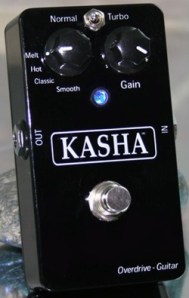
So I hooked up my Aracom PLX18 BB and started playing over the rhythm track. Folks, this amp just oozes classic Marshall “Bluesbreaker” tone as is, but just for shits and giggles, I decided to switch on my KASHA Overdrive to add a little flavor to my tone because I was working on a new song recently where I loved what this pedal did – especially with the PLX18 BB! For that song (which I’m still writing) I didn’t want to add too much gain. All I wanted to do was add some texture. So I thought it might just sound good while I practiced over Strutter. Man, was that a good call!

Here’s an A/B clip of sorts of the first two verses of the song. In verse 1, I’m playing the PLX18BB with nothing added – just a touch of room reverb as an insert in the mix. In the second verse, I switch on the KASHA overdrive (still with some reverb in the mix). The pedal is in the “Hot” channel, and I set the gain knob at 12 o’clock, which just provides a bit of a gain boost (it’s capable of adding up to 15dB of boost in this channel), but this channel also sustains for days, adding a touch of high-end sparkle. Here’s the clip:

Please excuse the little playing mistakes I made… 🙂 It’s nothing really egregious. In any case, when you compare the two verses, the difference in tone is actually subtle, at least to my ears. But from a playing standpoint, the amount of touch-sensitivity and sustain that was added made the second verse so much more musical and so much more inspiring to play. And speaking of subtlety, I think that is yet another mark of a great overdrive pedal. To me, overdrives should be transparent, they should never alter your tone – that’s what fuzz and distortion are for. At the most, they should simply add EQ emphasis, and that’s it. And that’s why I love the overdrives I play through: Tone Freak Abunai 2, GeekMacDaddy Geek Driver, Creation Audio Labs Holy Fire, the KASHA overdrive, TubeScreamer, and believe it or not, a Bad Monkey. They all bring to the table their own little voicings, but none of these alter your basic tone.

Great gear evokes a sense of inspiration – at least in me – that makes me want to keep playing and playing and playing. I just can’t say enough about this pedal. At around $200, it is worth every penny I paid for it. Thanks, John Kasha for coming up with such a fantastic pedal! Now back to playing!

Read Full Post »

I announced the Skull Crusher back in September when it first came out. Based upon the KASHA overdrive (but with some upgraded wiring and electronics), it has since gotten the attention of several prominent guitarists. Now George Lynch is playing through it, and HE LOVES IT! Check out this video:

How’s that for an endorsement. I’ve said all along that the KASHA overdrive is just about the best overdrive I’ve ever played, and I’m not alone in saying that. With guys like George Lynch touting how good the Skull Crusher is, you owe it to yourself to check it out! I know, some people don’t go for the look, but it’s the tone that matters.

For more information, go to The Tone Box site!

Read Full Post »

In a previous post, I asked, “Where have all the overdrives gone?” For the last couple of years, it seemed that a new overdrive pedal would hit the market every week. Then suddenly, about a month ago, it seemed that the well just dried up. Excuse the pun, but did the overdrive market become fully saturated? Looks like it…

It seems I’m seeing another trend, though not quite as profound as I saw with overdrives, and that is the emergence of fuzz pedals. And like overdrives, fuzz pedals seem to come in different varieties. The most basic is the original FuzzFace design which uses two transistors to create a bunch of gain so that practically everything that goes into it gets converted to a square wave. After that, you get pedals like the Zvex Fuzz Factory that gives you control over various aspects of the fuzz tone.

Personally, I haven’t spent that much time with fuzz pedals. It’s not that I don’t like the sound; I do, it’s just that my playing style really hasn’t leaned towards a “fuzzy” type of sound. For those unfamiliar with the fuzz tone, here’s a good demo.

The Difference Between Overdrive, Distortion, and Fuzz Pedals

I’ve been doing a lot of research on getting the fundamental differences between the three types of distortion, and the following is a synopsis of what I’ve found:

  • Overdrive – First is overdrive. This can be used as either a verb or noun, but from a sonic standpoint, overdrive produces the gentlest type of distortion, commonly known as soft clipping. Overdrive and booster pedals produce this type of sound. Using “overdrive” as a verb, it commonly means to overpower the pre-amp tubes of an tube amp, though technically it’s simply overpowering the input. Overdrive pedals simulate this with clipping diodes so you can get that overdriven sound at lower volumes.

    Overdive pedals include: Tube Screamer, Bad Monkey, OCD, Holy Fire, Swollen Pickle, etc.

  • Distortion – Here we get into a bit of a grey area because technically, any pedal that uses a transistor to clip or distort a signal is a distortion pedal, so the Tube Screamer and OCD fall into this realm. But many distortion pedals such as the TS also add signal gain, so they also overdrive the front-end of the amp. The big difference between Tube Screamer types and dedicated distortion pedals is in the type of clipping they produce. Distortion pedals produce a harder clipping of the input signal in their transistors at any volume level.

    Distortion pedals include: DS-1, Metal Zone, Holy Fire, Rat, Saturator, etc.

  • Fuzz – Fuzz is square wave distortion produced by a couple of cascading transistors that amplify the input gain so much that it produces a square wave when looked at in an oscilloscope. The tone of the fuzz typically has a lot of bass, and tons of odd-order harmonics. It’s ugly, but in a good way, and applied properly, can produce some spectacular tones. Jimi and SRV were masters of the fuzz.

    Fuzz pedals include: FuzzFace, Fuzz Factory, Graphic Fuzz

Note that I didn’t want to get too technical here mainly because the technology is less important than the tone. As in all things, you need to hear and play them for yourself to see what you like.

By the way, I found a great wiki article on distortion, which goes into a more technical discussion if you’re interested. Check it out!

Read Full Post »

« Newer Posts - Older Posts »