Feeds:
Posts
Comments

Posts Tagged ‘overdrive’

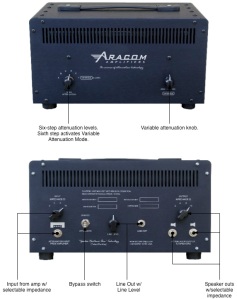
Aracom Amps PRX150-Pro AttenuatorAs many know, I’m a big fan of attenuators. In the past I’ve owned a couple and have tried out several. And with the addition of the Aracom PRX150-Pro to my rig, I’ve finally got a device that is helping me realize all the tonal goodness my amps have to offer. But this entry isn’t about the Aracom attenuator. There are a few attenuators that have entered the market in the recent past including the Faustine Phantom and others that are having the same effect on axe slingers and how they approach their tone.

So what’s the big deal? Most folks know how an attenuator operates. It sits between your amp and your speaker(s), and squelches the output signal from your amp which results in a lower output volume, so you can drive your amp to high gain levels and not shatter your eardrums. That’s the basic premise behind attenuators in general. But up until recently, attenuation came at a price, and that is the loss of tone and dynamics, or completely changed tone at higher attenuation levels; to put it simply, loss of tonal quality. I’m willing to bet that this very thing has kept lots of people from using an attenuator.

But with the new breed of attenuators hitting the market, loss of tonal quality is much less of an issue, if it’s an issue at all. Now you can bring your output volume WAY down, and be assured that the tonal quality you’ve worked so hard to achieve is still there.

So how will this change the way we approach our tone? I would venture to guess that many guitarists have really never known what their amp sounds like fully cranked up – at least for extended periods of time. Sure, if you’re a pro and regularly play huge venues, you know what it sounds like. But for us mere mortals who rarely play in more than a dance club, we’ve never been able to fully experience the cranked up tone of our amps, and that’s where a great attenuator comes into play.

When I hooked up my PRX150-Pro, the first thing I did was to set it on load mode and turn the variable to full attenuation, then dimed the master and volume on my amp to see what it would sound like. I wasn’t prepared for the onslaught of new tones that were suddenly available to me: rich harmonics, tons of sustain, and incredible touch sensitivity. It was as if a whole new world was opened up to me.

With my old attenuator, I rarely went to real high levels of attenuation because it made my tone sound weak and lifeless.  Plus, I didn’t want to burn out my tubes – which I learned the hard way when I cranked my amp while hooked up to the attenuator. But with the Aracom attenuator, I knew I could crank it as high as I wanted to and still be safe. What this means is that I now have access to a wider landscape of tones and dynamics that I can also safely reach. And that’s another feature of the new breed of attenuators: They appear to be much safer to use than the older designs out there.

Here’s an interesting question I got from a buddy of mine: Will I get rid of my overdrive pedals as a result now being able to get the fully cranked tone of my amp? Not on your life! 🙂 I love how they add color to my tone. But I will tell you this: Now that I can crank up my amp to high gain levels without the concomitant high volume levels, I’m actually not using my overdrive pedals as much. Oh, I still use them because they add certain characteristics that aren’t possible with my natural overdrive tone; just not as much as I used to because when I want just straight amp overdrive, I just crank my amp. But when I want to use them, I run them through the clean channel of my amp that has lots of clean headroom, so I can take advantage of the tone that they offer.

So is it a significant change to how we approach our tone? Possibly. I know of some folks who’ve completely stopped using overdrive pedals altogether as a result of using an attenuator, and use a clean boost or even just their volume knob on their guitar to get the lead volume they want. Me? I like to have a few different “brushes” that I can use to create different textures, but in either case, getting that cranked up tone naturally without shattering eardrums is pretty huge.

I think the folks who will gain the most from these great new attenuators are the home studio musicians. Imagine being able to record a screaming guitar solo, and not have the wife or neighbors yelling at you to turn down your volume! I regularly do my recording into the wee hours of the morning, so having an attenuator has been a godsend. But up until I got my PRX150-Pro, I had to wait to record solos until it was day when I could turn up my amp to a gain level that didn’t get me yelled at, as my other attenuators just didn’t give me the tone I needed at high attenuation levels. Even if I used an overdrive pedal, it doesn’t sound good unless it’s working with your amp and pushing your pre-amp tubes, and that takes juice! With a great, transparent, or non-tone-sucking attenuator, you can push your amp hard, and keep your volume under control!

I know of a lot musicians who poo-poo the use of an attenuator. But an attenuator can do wonders for gigging. Want to make the sound guys happy? Here’s another way to look at it: With an attenuator, you can focus on your tone, and not projecting out to the audience. Get enough volume to hear yourself on stage, then let the sound guys do their thing. PA technology has come a long way since the early days of rock and roll, where amps had to be played loud to get the sound out to the audience. Also, if you think about it, speakers are highly directional. If you want to disperse your sound, use the PA.

There’s been an interesting thread that I’ve been lurking on The Gear Page entitled, “Sound guys think I’m too loud.” Someone suggested early on that the original poster could use an attenuator or a smaller amp to reduce their volume. The suggestion of using an attenuator went largely ignored, but as I followed this thread and read all the various insights, using an attenuator is the perfect solution for this.

I’ve heard a lot of the complaints about attenuators in the past, and I’ve also had my issues with them. But with the new breed of attenuators, tone suck is no longer an issue. And that tonal quality will be sure to change how guitarists approach their performances.
Read Full Post »

large-relay-2

large-relay-1

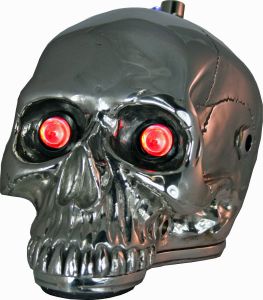
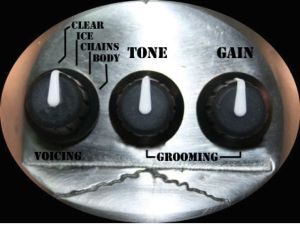
How ’bout a completely different take on an overdrive pedal? Well KASHA is at it yet again, teaming up with Tone Box, Inc., with the brand-new Skull Crusher Drive! Utilizing KASHA’s RockMod technology, the Skull Crusher sports four voicings and a tone and gain knob. Plus with a 10db boost, you have 8 different analog overdrive possibilities in a single pedal!

Sounds hauntingly similar to the KASHA overdrive pedal I just tested last week. It is a bit different, as it has a Tone knob, which is different from the KASHA overdrive. But I can personally attest to the quality of the tone of the KASHA overdrive, so you can bet the Skull Crusher will have that same sweet tone itself!

BTW, my KASHA OD is in production and on its way. I got lucky, and will be getting one of the signed models with a handwritten serial number… Oh goody! Might be able to sell one of these for a grand in 30 years! HA!

In any case, I’ve never seen a pedal like the Skull Crusher before! This is a totally new approach to pedals, adding a visual as well as tonal touch to an effect. The pedal will be distributed by Tone Box, Inc. and will retail for $399.

As for the physical appearance of the box, each pedal is hand-sculpted stainless steel, and comes in four finishes: gun metal, stainless steel, aged and ancient. According to KASHA, there will also be 24K gold and Sterling Silver models as well. Damn! Imagine having a stomp box that’s worth more than your guitar! HAHAHAHAHA!!! I LOVE IT!

Read Full Post »

5 Tone Bones - Gear has stellar performance, value, and quality. This is definitely top of the class, best of breed, and it's a no-brainer to add this to your gear lineup!Kasha KA-ODP-A KASHA Overdrive

Summary: Just about the most amazing overdrive pedal I’ve ever had the privilege to play!

Pros: 4 “channels” provide different and amazing overdrive voices that add “spice” to your tone. No line noise from this pedal at all! Super simple operation.

Cons: None.

Features:

  • 4 channels with separate voicing and gain structure
  • Analog design
  • 10 dB clear boost
  • True bypass switching
  • Very low power consumption (3mA and runs on a single 9V battery)
  • No tone change, only enhances sound
  • Compact standard aluminum chassis (4 3/8″x2 1/4″ x 1 1/4″)
  • AC power jack (uses standard Boss DC power supplies)
  • High gloss mirror black powder coat
  • Hand made in the USA
  • Low noise
  • Crystal Blue LED (high intensity)
  • Weight: 1.5lb

Price: $200 direct from KASHA Amplifiers

Tone Bone Score: 5.0 – I’ve played through enough overdrive pedals to fill a large trunk, and the KASHA Overdrive is simply one of the best I’ve every played!

If you’ve read this blog with any regularity – and I know I’ve said this in the past – I just can’t get enough of overdrive pedals. I just love ’em! But over time, and as there are so many overdrive pedals being released on a regular basis, I’ve started to limit what I take a deep dive into researching. Lately, I’ve only focused on overdrive pedals that offer a “twist” on the overdrive, and not clones. One such pedal that I recently discovered (and now has a permanent place on my board) was the GeekDriver, that while based upon the classic ColorSound Overdriver, has a sound all its own!

And wouldn’t you know it, I came across the KASHA Overdrive, and its simplicity intrigued me so much that I just had to check it out! Here was an overdrive pedal that required no EQ control! For me, that’s a HUGE thing because the implication is that the pedal’s circuit doesn’t require you to compensate for tonal changes that often get introduced with other pedals.

In any case, if you don’t want to read any further, let me just say this, and have it done with:

The KASHA Overdrive kicks ass, and I will be adding it to my pedal board! Even if you’re not in the market for a new overdrive, you owe it to yourself to give this pedal a serious look!

Four channels, Two Knobs, One Switch and a TON of Ways to Enhance Your Tone

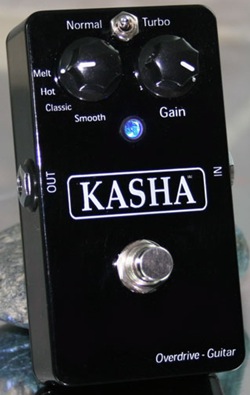
Notice I didn’t say, “tweak” or something similar that would imply that your tone changes once the KASHA OD is engaged. The reason for this is that KASHA built the pedal from the perspective of “voicing” much like an amplifier. Each “channel” on the pedal represents a different “voice.” It’s almost as if you have four amps in a box. In light of that, your input EQ remains the same; but just like plugging into different amps, the KASHA OD offers different kinds of “voicings.”

But it doesn’t just end there with the channels. The gain knob is incredibly expressive and just like an amplifier, provides different characteristics depending upon where you set the sweep. It’s f-in incredible! It’s also really difficult to verbally describe the effect. The closest I can get to an explanation of turning up the gain knob is that it is very similar to turning up the master volume on your amp and the effect that has as more juice is fed into the power tubes. Like I said, it’s hard to articulate…

And then if you didn’t think that the standard gain profile is enough, the “Turbo” switch will kick your amp’s ass even more by giving you a 10dB boost! 10dB may not seem like much, but sonically, it’s HUGE!

How It Sounds

So how does the pedal sound? In a word AMAZING, even when it’s on and you’re not playing anything, because unlike a lot of overdrive pedals, the KASHA Overdrive is dead quiet electronically. No hums, no buzzes, not a single electronic tick. The only noise it makes is when you play your axe through it.

I’ll let you read the documentation on the KASHA web site that describes the different channels – it’s pretty accurate. In lieu of that, I’ll write about my own perceptions of each channel as I experienced them. By the way, I played the pedal through a Fender DRRI and a Fender Princeton Studio, using my Saint Guitars Goldtop Messenger.

Smooth Channel

This channel is a simple boost stage, which ups your gain about 3dB. It’s an ideal channel to use if your amp is already at the edge of breakup, and you want to push it just over the edge to get a little extra bite. Of course, if you add the Turbo, then you get a full 13dB to start really working your pre-amp tubes. The impressive thing about this channel is that it demonstrates the pedal’s transparency. Setting the gain to unity, and switching the pedal on and off, there is absolutely no tonal change whatsoever. Quite nice.

Classic Channel

I loved this channel most of all, and as soon as I made my first strum on this channel, I was completely sold on the pedal. I didn’t have to hear any more. This channel is voiced brightly, and sounds like a friggin’ low-wattage EL-84 amp with all the chimey goodness that kind of amp has to offer. But at the same time, you don’t lose your lows. In fact, the full spectrum of your EQ is retained, but you get this incredibly dreamy, top-end chime that just works its way through your entire body! When I was playing through this channel, I just closed my eyes to listen to that sweet chime.

Hot Channel

Need even more grind? Now you have it. This channel slams your front-end with 11dB of gain, and gives you an added bass shelf. The tone from this channel is absolutely HUGE! And even with the big bass, you never lose any clarity at any time. Do a big power chord, and you’ll rip right through any mix. Pluck a single note and dig in, and that note will sustain – like Santana sustain, baby! And the cool thing is that at no time does your signal compress as often happens with other pedals, and we’re talking starting to get into some serious-ass gain when you’ve got the gain knob and guitar volume completely cranked! Then you hit the Turbo button, and WHOA! Singing sustain that just floats in the air and doesn’t come down!

Melt Channel

Here we’re getting into metal territory as the voicing gets a big, but tight bottom end plus a few more dB’s of gain. And just as with the Hot channel, you don’t lose any tonal clarity at all – you hear every single note, which is all the more amazing in this channel because you’re absolutely slamming the front-end of your amp! You just get a beefy, hairy balls sound that’ll shake the rafters when you’ve got it cranked up! Yeah, “melt” is an appropriate term to be used here because the thick, liquid metal tone in this channel will certainly melt you; of course, in a very good way!

Overall Impressions

Dammit! I wish I had more time to play with the pedal to really take it through its paces, but the store was closing up, and we were playing a bit too loud for the tender ears of the senior citizen sales people, though gracious as they were to let us bring in our own gear. What amazed me the most was how absolutely HUGE the Fender Princeton sounded with this pedal. This is a little 15 watt amp that combined with the KASHA overdrive could be used in a club. No problem cutting through with the KASHA overdrive engaged!

Yeah, I was sold on the Classic channel alone, but I’m just completely twitterpated and ga-ga over this pedal. KASHA claims that not a single person to date has had a bad opinion or offered “improvements” to it, and this includes some very big names in the music business (sorry, not allowed to mention them yet by request of KASHA). Based on even my brief experience with the KASHA Overdrive, I totally believe the claim. THE KASHA OVERDRIVE WILL KICK YOUR ASS!

By the way, I hate KASHA Amplifiers!!! I thought I was temporarily cured of my recent case of GAS, and now the KASHA Overdrive has me salivating, slobbering, and frothing at the mouth with an f-in’ GAS attack!

Read Full Post »


Kasha KA-ODP-A

Awhile ago, I was perusing a forum where one of the members mentioned in a reply that it’s a good time to be a guitarist. There’s so much varied gear out there that guitarists have all sorts of options to choose from. One area of guitar gear that certainly seems to get regular entries is the overdrive pedal.

The OD pedal is something of which I never tire. There are so many great ones out there – I just can’t get enough of ’em. One such pedal that has just recently caught my eye is the KA-ODP-A 4-Channel Overdrive Pedal from Kasha amps. This pedal promises to be something special. Check out its features:

– 4 channels with separate voicing and gain structure
– Analog design
– 10 dB clear boost
– True bypass switching
– Very low power consumption (3mA and runs on a single 9V battery)
– No tone change, only enhances sound
– Compact standard aluminum chassis (4 3/8″x2 1/4″ x 1 1/4″)
– AC power jack (uses standard Boss DC power supplies)
– High gloss mirror black powder coat
– Hand made in the USA
– Low noise
– Crystal Blue LED (high intensity)
– Weight: 1.5lb

Built By an Amp Builder

There’s something about gear that’s built by an amp builder, especially when it comes to pedals or other peripheral devices. Amp builders have an innate understanding of the electronics behind tone, and how peripheral devices interact with their amps. A great example of this is Jeff Aragaki from Aracom Amps and his brand-new attenuatore, the Power Rox PRX150-Pro. Jeff totally gets it with how an amp interacts with a speaker, and the Power Rox is a testament to that. The same may be said of the Kasha overdrive in front of an amp. I had a chance to speak with John (Kasha’s owner and builder) this afternoon about the pedal, and it was clear from our conversation that this guy really understands the interplay between effects and an amp – especially with respect to overdrive.

Kasha has been around awhile, having been building the famous ROCKMOD line of amps since the 80’s, so they know something about amps, and their tone is well-known. Guitarists such as George Lynch and Davey Johnstone (Elton John), and tons of session guitarists have been playing ROCKMODS for years. So when John decided to build an overdrive pedal, he didn’t want to model it off of traditional circuits, so he created his own. The result is the 4-Channel Kasha Overdrive.

What’s very intriguing about this pedal is that it doesn’t have an EQ. John designed the pedal in such a way that it preserves the tone going in and outputs it with some OD “flavor” as John puts it. The thinking is that you don’t need an EQ if you’re not doing anything to the EQ of the signal. Smart.

The Kasha overdrive is a lesson in simplicity, having only two knobs: An overdrive selection knob to choose from one of the four different overdrives, and a gain knob. Very simple. But it also sports a “Turbo” switch at the top which will add a 10db clean boost to slam your pre-amp tubes with even more gain. But despite all that, this thing operates on 3 milliamps and only requires a standard 9V power source! That is incredible! My beloved Holy Fire requires a special 48V power supply! So what John has created is definitely special.

I’m going to be trying this pedal out in the next coming weeks, and I’m excited! I’ll keep you posted!

For more information, go to the Kasha product page (scroll down to the end to see the overdrive)

Read Full Post »

5 Tone Bones - Gear has stellar performance, value, and quality. This is definitely top of the class, best of breed, and it's a no-brainer to add this to your gear lineup!

GeekDriver by the Original Geek

The GeekDriver by the Original Geek

Summary: Is it a booster? Is it an overdrive? No! It’s the GeekDriver.

Pros: From gorgeous, slightly fat boost to searing, face peeling overdrive with tons of overtones and harmonics, this pedal does it!

Cons: None.

Features:

  • Hand-wired and soldered in the US
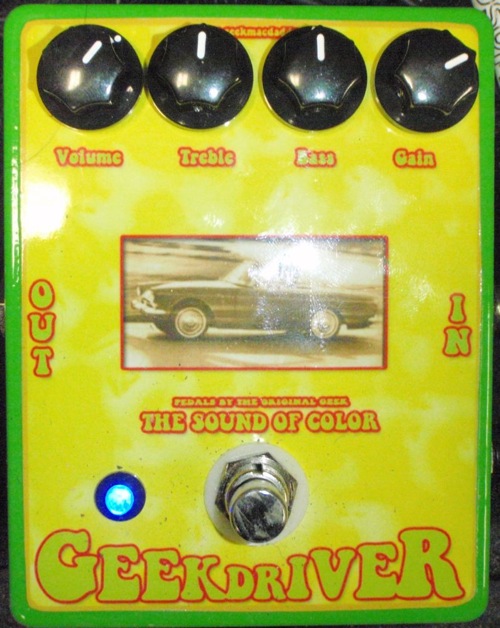
  • Volume, Treble, Bass and Gain Controls
  • Neutrik and Switchcraft jacks
  • True Bypass

Price: $205 direct

Tone Bone Score: 5.0. I’m absolutely blown away by this pedal! I can’t say for sure, but this is a pedal that I’d almost always have on.

I don’t give 5 Tone Bones away lightly. I have to be so totally blown away by some gear that I have to give it my highest rating. When I first heard the GeekDriver on Geek’s Premier Guitar Video, I immediately became intrigued. Then when I finally met the Geek himself at the shop he shares with Tonic Amps, and he demonstrated the GeekDriver in person, I knew I had to have one, so I told him I wanted one, and tonight I picked it up.

What exactly is the GeekDriver?

As the Geek will tell you, the GeekDriver is based upon the ColorSound Overdriver that was popularized by Jeff Beck. At its core, it’s a clean booster, but the Gain knob changes the game significantly, giving you anywhere from mild breakup to ugly, snarling dog overdrive, replete with tons of overtones and harmonics. At high gain levels, it’s like the ugly dog that’s so ugly you can’t help but love it, if you catch my drift.

One thing’s for sure, it’s not transparent, nor is it meant to be. When active it adds a slight compressive fat boost at all volume levels. The effect is incredibly subtle, almost visceral, in that  you “feel” that coloration more than you hear it. This aspect alone made me give this pedal the 5 Tone Bones. The effect is so sensual and appealing. I know I’m using a lot of flowery adjectives here, but it’s because it’s so hard to articulate the emotional effect that compressive boost has on me. When I get that feeling, I know I’m onto something good.

Then you turn the gain up, and in addition to that colored boost, you get layers of overdrive which become this ugly fuzz as you increase the gain that’s total ear candy. But despite the cacophony of distorted signals, the tone is still incredibly defined and articulate. Unlike a pedal like the OCD which can get pretty muddy when you crank the gain, the GeekDriver just oozes thick fuzz, but never gets muddy. Nice.

How it sounds…

In a word, it sounds awesome. It is very hard to describe what it actually sounds like. It’s like a colored overdrive with fuzz attached. In any case here are a couple of clips (BTW, both clips were recorded at bedroom level using my Aracom PRX150-Pro attenuator. That thing ROCKS, retaining all my tone and dynamics):

In this first clip, I was just noodling, switching back and forth a couple times between the clean tone of my amp and the GeekDriver. Note that I set the Gain pretty high on the GeekDriver on the first section to show how ugly it can get – I love that sound!

In this next clip, I start the solo out only with the GeekDriver, with a very light pick attack. In the second part of the solo, I add my Abunai 2 to the chain to demonstrate how delicious the GeekDriver sounds when another overdrive pedal is stacked on top of it.

I believe the GeekDriver was meant to be stacked. I placed it first on my board, then ran my Tone Freak Effects Abunai 2, and my Creation Audio Labs Holy Fire after it. With both pedals, the GeekDriver just FREAKIN’ ROCKED THE HOUSE!!! Oh, it’s sounds f-in’ awesome by itself, but used as a “base” pedal in front of another OD or distortion pedal, and the mix is like nothing you’ve experienced!

Overall Impressions

As you can tell, I freakin’ love this pedal! I’m not surprise why Jeff Beck dug the original ColorSound Overdriver. This is definitely Geek’s unique take on that classic pedal, and what a unique take that is! It may not be for everyone, especially if you’re looking for a transparent boost. But if you’re looking for something totally different from your typical boost or drive pedal, the GeekDriver has a voice all its own. Like I said, it freakin’ rocks the house!

About the Original Geek

Meeting Geek was pure serendipity. I originally was going to Tonic Amps to meet Darin Elingson about his cabs and Fane speakers. I didn’t know the Original Geek shared a shop space with him. That’s serendipity for you.

For those who are familiar with Jeff and his creations, he is known as “GeekMacDaddy,” and for years, his pedals have been by GeekMacDaddy. But his company has gone through a recent name change, and is now known as the “The Original Geek.” But who cares about the name? I certainly don’t. I just know his pedals kick f-in’ ass!

For more information, and to order one, go to http://www.geekmacdaddy.com.

Read Full Post »

GeekMacDaddy British Ball Breaker

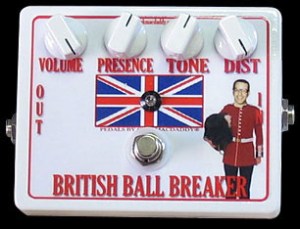
I had such a great evening tonight! Darin from Tonic Amps invited me over to his shop to try some amps through his excellent speaker cabinets (be on the lookout for a review in the next day or so). He has a very cool workshop that he also shares with “GeekMacDaddy,” who makes some absolutely KICK-ASS pedals! I got to try out a few of them tonight, and absolutely fell in love with the British Ball Breaker, which GeekMacDaddy touts as a classic Marshall Plexi in a box. He’s not kidding, either. This is a helluva pedal, with rich, thick, overdriven Marshall tone. Just set your amp on clean, crank the master volume, engage the British Ball Breaker, and you’ll be rewarded with gorgeous Marshall-esque overdrive!!! YOWEE!!!

You gotta check out these pedals! They just rock! In addition, GeekMacDaddy is just about to release another freakin’ fantastic pedal called the GeekDriver that is a totally awesome take on a drive pedal. It sounds awesome by itself, but this pedal was built to be stacked, providing the foundation tone, then driving another fuzz or overdrive pedal. Rockin’!!!

Damn! Two freakin’ awesome pedals that I will have to get – as if I need more! But hey! You know me and overdrive pedals! I just can’t get enough of them!

Here’s a great demo video of both the British Ball Breaker and the GeekDriver from PremierGuitar:

Notice that GeekMacDaddy’s playing through a Tonic Amp! Those amps just rock as well! However, I’m getting ahead of myself!

For more information, go to the GeekMacDaddy site!

Read Full Post »


td_main
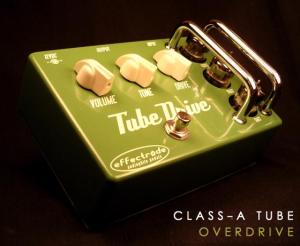
Effectrode has long been known for its tube-driven effects such as the Tube Vibe. But they’ve just released a new overdrive pedal with three tubes that give you up to six gain stages of drive! OMG! Talk about saturation city! Note that this pedal ain’t cheap at $399, but if it delivers on what appears to be very promising features, I might be hard-pressed not to take a serious look at this pedal. It’ll be interesting what people say about this pedal.

Here’s the description of from the Effectrode site:


The Tube Drive, pure class-A tube overdrive pedal featuring three triode vacuum tubes for a total of six gain stages. The drive knob simultaneously controls the gain of all cascaded stages so that they progressively clip allowing the Tube Drive to respond empathically to your pick attack with a graceful breakup characteristic. At lower gain settings this pedal excels at producing authentic blues and mild break-up to add some “dirt” to playing whilst always sounding smooth and musical. Pushing the drive a little higher produces the classic 70’s overdriven tube amp tone and at even higher gains the sound becomes rich in harmonic content without masking the the natural sound of your guitar and amplifier. The Tube Drive allows you to effortlessly climb the gain curve to create sustaining, super-saturated lead tones, inspire you and power your solos beyond escape velocity, through the stratocastersphere soaring into high energy orbit!

Features

  • All Tube gain circuitry: 100% analog, class-A, clipping circuitry based on three cascaded tubes. No silicon in the signal path – guaranteed. This topology gives the Tube Drive fine control over a wide range of gain characteristics from mild breakup to creamy saturation.
  • Bax-Stack “active” tube tone control: The Tube Drive is the only overdrive with an active tube tone control. The Bax-Stack is a real treble boost (and cut) circuit with zero insertion loss, unlike passive tone stacks which can only remove frequency content (“tone-sucking”). The tone range is optimized to work over important frequencies essential for mellow jazz tones to some serious crunch.
  • Low-end coutour switch: Active low boost for a warmer, richer sound. Especially useful with single coil pickups to thicken the sound or when playing at low volumes to compensate for loudness.
  • Orange L.E.D.: Indicates when pedal is engaged.

Very cool! But even cooler are the sound samples. Check ’em out!!!

335 solo

Strat Solo

YYZ solo

Crunch

Saturation

Mild Breakup

Strat Drive

Crunch Too!

Red Barchetta

Sustain

Description and sound clips courtesy of Effectrode Pedals.

Read Full Post »

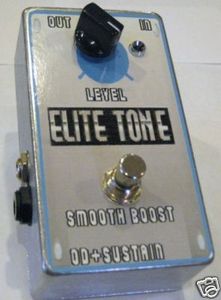
Elite Tone Smooth BoostIf I’ve said it once, I’ll say it again. The market cannot have too many overdrive pedals. 🙂 As you know if you read this blog with regularity, I just love ’em. I know… there’s nothing like the sound of a cranked amp, yada-yada-yada… But to get to the type of amp drive that I like; that is, with both pre-amp and power tubes contributing to the distorted sound, the volume levels will make your ears bleed. Enter the overdrive pedal, which gives you that breakup tone at any volume level! And the reason I love OD pedals so much is because I personally haven’t come across any two from different makers that sound exactly alike. Sure, many cop the tone of some original design – can you say Tube Screamer – but even the “clones” have voices all their own as their manufacturers add features or make the original circuits more efficient.
The brand-new Smooth Boost from Elite Tone promises to be a VERY interesting take on the overdrive pedal. Don’t let the name fool you: This is not a pure booster pedal. Even Elite Tone categorizes it as a distortion/overdrive pedal. Here’s the description from their site:

Brand new offering from Elite Tone a simple subtle unique boost effect pedal. The Smooth Boost features a circuit architecture that supports, enhances and optimizes your existing tone with delicate transparency. This simple yet multifaceted effect, achieves hi fidelity tube like signal boost, compression, sustain, overdrive and even mild distortion. The smooth boost can also be adjusted remotely with guitar volume and produce a lush twangy tube like sound as the volume is rolled back. With the signal maxed it adds mild harmonic overdrive and a touch of distortion.

What really intrigues me about the pedal from the description is the phrase “The smooth boost can also be adjusted remotely with guitar volume…” Wonder if that’s actual mechanical control through a specific input, or it’s functioning like other OD pedals that respond to input gain. I’m going to have to do more research.

Holy GAS Attack, Batman!!! This handmade pedal only costs $99 direct!!!

Dammit! I wish I hadn’t gotten wind of this pedal. It’s bad enough that my natural curiosity makes me want to check this pedal out, especially with that “remote adjustment” bit. But that combined with the price is giving me a serious case of GAS! Crap! 🙂

Anyway, the Smooth Boost includes the following features (from the Elite Tone site):

  • Engineered and constructed all by hand
  • True bypass
  • Battery Included
  • 2.1 mm diameter DC jack adapter (like boss style, etc…)
  • Extremely low ambient noise ( Not audible with effect full on and strings muted in many cases)
  • LED On/Off indicator

Okay… I’m sold. Sight unseen, sound unheard. Well… I am a bit more reasonable than that, but this is VERY COOL! At the very least, I need to find out more about this pedal!

Read Full Post »

Nova Repeater

The Nova Repeater news is a tad old, as it started shipping a couple of weeks ago, but retailers are still only taking pre-orders on it. I’ve been waiting for the Nova Repeater to come out for awhile, ever since I heard about it from Winter NAMM news. As TC Electronic puts it, this pedal is “No frills, with a sound that kills.” It truly is no-frills. There’s no programming of the pedal. It has a few features and that’s it. But what it has that I’ve not seen with other pedals is a feature TC calls, “Audio Tapping.” Essentially, you hold the tap tempo button down, then strum your guitar, and the delay is set based upon the strum. I can’t wait to try out this delay pedal! Here’s a demo video:

Nova Drive

Next up is the Nova Drive, which is an analog overdrive and distortion pedal that is controlled with a digital interface. Not sure how that works, but it does sound very cool. This is the same drive/distortion circuit that is in the Nova System, so if you know about that tone, you know it’s very nice. There are a couple of things that stand out about this pedal for me. First, you can change the order of the drive and distortion, making drive first, distortion second; and vice-versa. Second, you can also run the effects in parallel, which is totally – it provides a completely different dimension in the tone this pedal produces. It also has a MIDI input that you can hook up to a G Major system to program it. Not bad. Anyway, here’s another demo video:

Read Full Post »

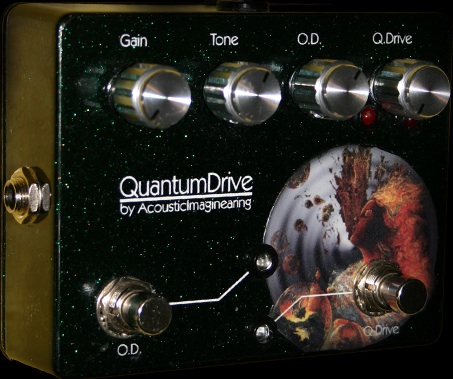
Acoustic Imaginearing Quantum DriveBrand-new from what appears to be a brand-new kind of overdrive/distortion, Acoustic Imaginearing has just released its new QuantumDrive, overdrive/distortion pedal. Folks, this appears to be totally new technology; the first and only that employs quantum mechanics tunneling to produce its distortion sound!

I’m no physicist, so I’ll let you do your own research on what quantum tunneling is. But this is a totally new twist on distortion! Here’s the press release:

The QuantumDrive, A.I.’s flagship product, is a versatile and unique overdrive and distortion unit that uses a patent pending process to dynamically shape the sound of the guitar by means of a quantum tunneling device. Quantum tunneling is a curious physics principle which allows matter to “pass through” other matter which would normally be impenetrable. A.I. has developed a means of using this effect to modify a guitar signal in unique and previously unheard of ways. The quantum distortion appears to add a vowel sound to the signal as well as emphasizing the consonant, fricative guitar distinctiveness. Affecting the edge of the waveform and not just the peaks, the result is a very expressive tone when played “in the zone.” Of course the pedal is also capable of wild and quirky, outside the norm distortions — each distinctive to the instrument processed by the Quantum Drive.

The effect is well suited for both guitar and bass, as bass frequencies are retained without becoming muddy. It has been used by Tony Levin on the latest King Crimson tour.

In addition to the distortion channel, the pedal has a solid overdrive channel, also uniquely designed, that can be used independently or chained together with the quantum channel.

I gotta tell you, I love this kind of stuff! And the fact that this is an overdrive/distortion pedal (you know OD is my favorite kind of pedal) is even better! I’m very excited when inventors add a new twist to something familiar. It just goes to show that there’s no shortage of creativity and innovation in the world!

How It Sounds

There are very limited sound clips available on the site, but the interface to listen to them is a bit screwy. I was able to do a debug trace to figure out the sound clip file names. The following clips were done with a Les Paul with the rhythm pickup into the QuantumDrive and output through a Peavey Classic 30. The clips actually aren’t that good, as the massive amounts of reverb kind of mask what could really be a great sounding pedal. But from what I could here, this is a real open sounding distortion, with just a little fizz. What I like is how the signal tails off.

Light Quantum Drive

Medium Quantum Drive

High Quantum Drive

Note that this pedal also has an overdrive that you can mix with the quantum drive as well.

Where to Buy

You can get this pedal on EBay for $165 as a “Buy It Now” or bid on it for $160 starting bid/$225 Buy It Now (in another auction).

This pedal is so new, they only have two dealers. This is a great find!

Read Full Post »

« Newer Posts - Older Posts »