Feeds:
Posts
Comments

Posts Tagged ‘reviews’

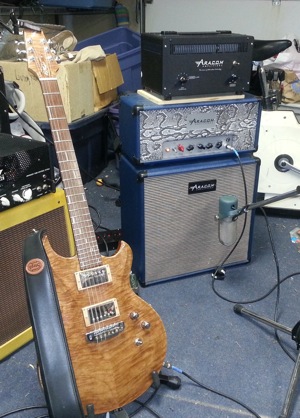
I had a gig last night with my old farts classic rock band. Normally I use either my Squier Classic Vibe Tele or my Taylor T5z or my Gibson R8 Les Paul. But while I was prepping my gear for the gig, I realized that I hadn’t played “Katie May,” my Slash L Guitars Apache in a while; to be honest, I hadn’t played her in years.

She had been sitting in her case since I messed up the neck pickup mount and I never got around to fixing it. And by the time I’d remember to fix her, I didn’t have enough time. But yesterday I said to myself, “Screw it. I’ve got a few hours and I’ll fix the damn mount and do a quick setup.” So, I pulled her out of her case and got to work.

“F$%k!” I grunted when I fixed the mount because it took all of ten minutes to fix it. Setup took a little longer, but not much longer because the neck was perfectly straight, so I didn’t have to adjust for any bow or relief. I didn’t even have to adjust the intonation because it was perfect. In the end, I just cleaned her up and she was ready to go. And no, I didn’t change out the strings because they were in great shape; no corrosion or dings. I figured that if I broke a string during the gig, I’d just switch over to my T5z then do a full string change later.

Arriving at the venue, I set up my rig and did a quick sound check. That was when I realized that I forgot to adjust my pickup heights! But that’s why I carry a Swiss Army Knife. A few turns of the screws and voila! I was ready for the show!

Katie May has always been an absolute dream to play. She has super-low action which makes moving around the neck incredibly easy. But it also means using a much lighter touch. And since I hadn’t played her in a few years, I used our sound check to get used to her. But muscle memory is a good thing because I got the feel of her within a few minutes of playing. And man, did she sing! That gave me a lot of confidence going into the gig.

As far as her sound was concerned, I was inspired last night. There was something about playing her through my Wampler Tumnus overdrive (klone) that just brought out the best in her Lollar Imperials. And yeah, those pups kick some serious ass. They’re incredibly articulate without being at all harsh. Then running the signal through the Tumnus just gets me more of that sound. It was inspirational!

I’m no longer the lead guitarist in the band as our lead guitarist is far better than me and has all the solos memorized for many of our songs. But I do still get to play some solos when it’s just pure improv, which is what I love. When we play our version of John Prine’s “Angel from Montgomery,” I do the solo work on that song.

Our version is much like the Bonnie Raite version, but a little slower and much more haunting. This allows me to use my Mad Professor Deep Blue Delay with just a bit of grit from the Tumnus. In my solos, I do a lot of double stops taking a sad Hawaiian pedal steel approach, then I break those up with mixolydian and harmonic minor runs that reflect the juxtaposition of the hopefulness of the chord progressions and the melancholy of the lyrics; not that I’m thinking of the mode or scale at the time I’m playing. I’m looking back and analyzing my playing tendencies after the fact.

And last night, I was so inspired by how Katie May cried during that song. She has so much built-in sustain from the neck-through design and the Gotoh 510 bridge. She just holds notes incredibly well. Then combine that with the Deep Blue Delay and OMG! It was a recipe for total inspiration!

But for our rockin’ songs, damn! She was so easy to play that I was all over the fretboard last night! I was kind of beside myself while I was playing. But a huge thing about Katie May was that she has as switch to coil tap the pups. So, I could change up her sound by going single coil for some songs which just added to her palate of sounds. After the gig, I remarked to my bandmates that I had forgotten how much I loved playing that guitar. I think she’s going to be my #1 going forward.

Read Full Post »

5 Tone Bones - Gear has stellar performance, value, and quality. This is definitely top of the class, best of breed, and it's a no-brainer to add this to your gear lineup!

Reason SM40 Head

Reason SM40 Head

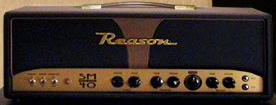
Reason Amps SM40 HeadSummary: Deep, lush cleans, with bright, ballsy and aggressive overdrive. The SM40 is a classic rocker’s wet dream come true.Pros: Touch-sensitive and expressive. The voltage sag in the 5U4 is just enough to create almost a reverb quality as the signal fades. Truly lovely sound!

Cons: None.

Price: $2195

Specs:

• Output: 40 watts RMS @ 10% THD
• (4) EL84 output tubes, in Class A Cathode Biased configuration
• (2) 12ax7 preamp tubes
• 5U4 Rectifier tube
• 3 way Stack switch – Normal, Stack, Bright
• Normal channel – Volume, Tone
• Bright channel – Volume, Tone
• StackMode™ – Bright & Normal channel controls are active, Stack Volume & Hi-Cut
• Oversized extra capacity power supply
• Harmonics Switch – works in the final output stage to change the harmonic structure of the
overdrive.
• Power Switch
• Standby Switch
• Half-power switch
• Independent output jacks for 4,8, 16-Ohm operation
• Footswitch access to all three channels/modes

Tone Bone Rating: 5 – This is a blues and classic rock machine!!!

This review is a long time in coming as I evaluated the SM40 over a month ago, but as they say, better late than never. As many may know, I’ve had a love affair with the SM25 that the Reason guys sent me to review, and that amp will be in my rig (see my review here). In my view, very few amps can match it in versatility. It is an extremely expressive amp that is capable of producing lush, ringing cleans, to searing overdrive. And according to both Anthony Bonadio and Obeid Kahn, the founders of Reason Amps, the SM25 Combo was built specifically with versatility in mind. It is very pedal-friendly, and StackModeTM is the greatest thing since sliced bread!

But sometimes, you just don’t want or need that kind of versatility because with versatility comes compromises. For instance, the SM25’s Normal or clean channel breaks up a little earlier than you’d expect though I actually rarely if ever play at the volume so it’s a none-issue for me. Since I play a variety of styles, versatility is a key factor in my decision on an amp. But that versatility is lost on those who just don’t need it. And mind you, that’s not a bad thing. It’s merely a matter of choice, which is why you have a number of amp options to choose from with Reason Amps. Premier Guitar already covered the SM50, which gives a fair picture of the SM50’s capabilities – though I do have to take issue with Premier Guitar giving it the “Loud As Hell” award. It’s not just a noise-maker. It’s just that you’d swear the SM50 is 100 Watts as opposed to 50 Watts. It’s an extremely powerful and expressive amp with classic EL-34 goodness.

The SM40, on the other hand is a very interesting take based upon EL-84 output tubes. Where the SM25 and SM50 are based on EL-34’s in Class AB fixed-bias configuration, the SM-40 is built around two EL-84’s operating in Class A Cathode Bias configuration. Like the other Reason Amps, the SM40 has two independent channels with the trademark StackModeTM “channel,” that combines the fully amplified signals from both Normal and Bright Channels in a series with an extra gain stage, while retaining both the volume and EQ control that each channel contributes to the combination.

The Story Behind the SM40

I called the Reason guys up to shoot the breeze a bit yesterday, but to also pick their brains about the SM40, Obeid Kahn (Reason’s amp designer) and I had a great conversation about the story behind the SM40. For all intents, and purposes, the SM40 was Reason’s first production amp. Obeid had gone through several prototypes before he finally produced the SM40 which included StackMode. Previous versions had completely independent channels with separate inputs, then evolved into switching between the two, then finally evolved into connecting the two channels in a series. So the SM40 could be considered the eldest sibling in the Reason amp line and the first successful incarnation of StackMode.

How It Sounds

The SM40 is targeted at blues and classic rock players, and it definitely shows that in the way it’s voiced. Moreover, there’s something really special about the clean tone of an EL-84-based amp. It’s naturally chimey and glassy, and guitars that have that natural quality bring that tone out even more. On the Normal channel, the kind of voicing is beautiful; chimey with lots of mid-range, but not overdone. And there’s TONS of clean headroom in this channel, which makes it ideal for use with pedals. Put a booster in front of this channel, and you get that AC-30-like breakup, which is subtle and smooth. Very nice.

The Bright channel, on the other hand, is actually not that much brighter than the Normal channel. In fact, the tonal differences between Normal and Bright are so subtle that you’d think there’s no difference at all. But that’s by design. Unlike the SM25 which was built around versatility, the SM40 is a much more focused machine, which is why you only get volume and tone on any channel or mode, as opposed to the SM25 which includes a 3-band EQ on the Normal channel. The idea behind that makes sense: Players who buy this amp will mostly play a certain style of music and don’t want to be bothered tweaking knobs to dial in their sound. Not that the amp can’t be used in a variety of genres, but players who play this won’t want to stray from the general tone the SM40 produces.

Similarities between the channels aside, the real kicker for me is the StackMode “channel,” which combines Normal and Bright channels in a series, while retaining both volume and tone shaping in both channels. This really opens up a whole new pallette of tones you can produce. It’s super-expressive, and because you’re essentially working with three gain stages in a series, this mode makes the amp incredibly responsive to volume knob and attack. Dime the volume on your guitar, and you can get tons of overdrive. Back it down and pick lighter, and the tone cleans right up. In my tests of both Reason amps, StackMode was pretty much all I used, unless I was playing something where I needed a pure, glassy clean tone for which the Normal channel excels.

An interesting switch labeled Odd/Even resides on the control panel. This is a harmonics switch that works with the phase splitter in the final gain stage. The idea behind it is that at super-high gain, you start getting a “notch” type of distortion. Flipping the switch smooths that out. I actually didn’t notice that much of a difference with the switch in either Odd or Even positions, but maybe that was because I was only 3 feet from the amp, and it was cranked! 🙂 For the most part though, the switch won’t have too much of an effect until you get into really thick overdrive.

Playing It

The SM40 was tested with a Strat copy and a Saint Guitars Benchmark with humbuckers. With the Strat copy, you’re immediately taken to the roots of blues. The chimey vibe really comes out with single coils, and I found myself closing my eyes to take in the sweetness. With the Benchmark, the SM40 grew big balls of steel. Not that you’d do metal with this amp, but humbuckers make the SM40 want to growl. It’s really nice.

Overall Impressions

The SM40 is a sweet amp, and like its sibling, the SM50, it’s really made for the stage. It’s expressive and ballsy, and is meant to be played hard. As both Anthony and Obeid have both told me, this amp is made for active musicians. And while I wouldn’t want to keep people from buying it because it sounds so good, by the same token, I wouldn’t recommend it for bedroom use. You wouldn’t be able to take advantage of its full range of tones.

Read Full Post »

BOSS TU-2 Chromatic Tuner

BOSS TU-2 Chromatic Tuner

BOSS TU-2 Chromatic Tuner
Summary: Basic, no-frills chromatic tuner in a convenient stomp box that can also double as a power source.

Pros: Super-convenient stomp box makes on-stage tuning a breeze. Tuning mode automatically cuts off signal to the rest of your board for relatively “silent” tuning.

Cons: Only has 11 total LED’s, so fine adjustments aren’t possible.

Price: New $99 Street

Features (fr. BOSS site):

  • BOSS world-renowned TU-Series tuner accuracy in a convenient stompbox design
  • Mute/Bypass select for silent tuning with a single stomp
  • 11-point LED indicators and new “stream” meter display tuning discrepancy via speed and direction of LEDs (speed of LED movement gets slower as pitch becomes more accurate)
  • 7-segment LED displays string and note names, easily visible on dark stages
  • Seven easy tuning modes include Chromatic, Guitar Regular, Guitar Flat, Guitar Double Flat, Bass Regular, Bass Flat, Bass Double Flat
  • Tuning mode setting and display style choice stored in memory
  • Adjustable reference pitch from 438 to 445Hz
  • 8-octave tuning range–the widest in its class
  • Footswitchable Tuner Off mode preserves battery life by disabling LEDs

Let’s face it: Tuning is a fact of life when you play any musical instrument. And if you’re like most gigging musicians, you don’t have a guitar tech at your gigs to tune your guitars in between songs. For that, you need a tuner. For years, I used a cheap, hand-held analog tuner with a sweep meter for tuning. It was very accurate and did the job well, but as I started to gig more and more, having to turn the volume down on my amp to tune soon became irritating.

So I decided to get a stomp box tuner, and went down to Guitar Center and bought the TU-2. Now I will be the first to admit that I didn’t do much research before buying the TU-2. I’d recently read an interview with Joe Satriani and he had a TU-2. I figured if something’s good enough for Satch then it’s definitely good enough for me. It was a safe bet then, and it’s a safe bet now. The TU-2 is solid performer that’s fairly accurate, though no LED-based tuner could even possibly suss the accuracy of a strobe or analog tuner. But for what it does, I’m pretty satisfied with it.

Another nice feature about the TU-2 is that it can also act as a power source for up to either other pedals. I power up my board with a Dunlop DC Brick, but once I used up the 6 available 9V ports, I couldn’t add more
pedals without having to get another brick. For one or two pedals, that’s just not a good justification when you’re spending 100-bucks. The TU-2 comes with both a DC-in and a DC-out port. You can use a standard 9V cable to hook up another pedal, but it probably makes more sense to spend  the $12.99 and buy the BOSS PCS-20A power cord, which will route power up to eight pedals. Caveat: The cable runs between connectors are short. BOSS assumes you’ll be using nothing but BOSS pedals, but with tone freaks, that’s rarely the case. But it is a cheap, convenient solution nonetheless.

So what’s my verdict? I wouldn’t have it if I didn’t think it was useful. It’s not in any way, shape, or form something to do cartwheels over, but it’s a solid pedal that gets the job done. At Harmony Central, when you write a review, they ask you what you’d do if it the gear you’re reviewing gets broken or lost. Were I to review this pedal there and answer that question, I’d probably take a serious look at the Korg stomp box tuner that sports more LED’s and is a bit more accurate than the TU-2. The only thing that would probably keep me from switching is the ability of the TU-2 to provide power to other pedals.

Rock on!!!

Read Full Post »