Feeds:
Posts
Comments

Archive for April, 2009

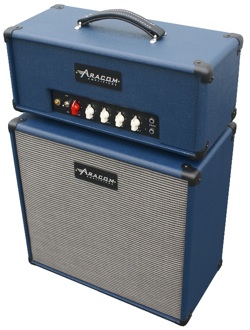
Aracom Amps VRX22 - First in the series

Aracom Amps VRX22 - First in the series

You ever play some gear that from the moment you start playing, you feel like you’ve died and gone to tone heaven? In the last few years, and especially in the last couple since I started writing this blog, I’ve literally played hundreds of different types of gear, covering the spectrum of all things guitar, from guitars to effects to amps. I don’t have enough time to write about all the things I’ve played, but to keep my content fresh, and to satisfy my overwhelming curiosity about different types of gear, I’m constantly trying stuff out.

And in all that time, and through all that gear, I’ve only had some gear totally slay me once: That was when I played the very first prototype of the Aracom VRX22. The back story is pretty cool, so I’ll share it with you…

Several months back, Jeff Aragaki contacted me on my blog asking if he could buy ad space. I replied that I didn’t want to commercialize my site, but if he’d be willing to send me an amp to review I’d put his logo on my “The Dawg Digs” area if I really loved his product. Fortunately for both him and me, he only lives about 40 minutes away, so he delivered what was once called the “RoxBox,” an 18 Watt, EL84-based amp. I had this thing about EL84-based amps for awhile, and was really excited to try a non-brand-name amp; not to mention that I was entirely intrigued by the fact that that hand-wired head cost only $895! That evaluation turned into testing and reviewing several of Jeff’s amps over the next few months from heads to combos with different configurations. Talk about feeling lucky to have so much gear to play with!

Jeff and I have become fast friends. We’re contemporaries not only from our obsession with vintage gear (or any kind of gear for that matter), but we’re almost the same age, and are both local boys from the Silicon Valley. Jeff’s a great guy, and someone I really enjoy spending time with; plus he’s super smart, and I like to be around smart people. 🙂

Anyway, a couple of months ago, Jeff called me up and said, “Hey Brendan, I’ve been working on an experiment with the RoxBox, and popped a couple of 6V6’s in the amp to see what it would sound like.”

“Oh?” I replied, “That sounds quite interesting. I dig 6V6’s a lot. They have a sweet, open distortion when they’re saturated.”

“Yeah, they do,” said Jeff, “Anyway, I was wondering if you’d like to test it out.”

I immediately replied, “Need you ask? Bring it on over!”

A couple of days later, Jeff brought the amp over to the messy garage I call my home studio. We plugged it in, I hooked up my Strat, and Jeff switched on the amp. I took one test strum in the clean channel, stopped and asked, “What did you do? This f-in thing sounds incredible! Let me play a few licks…”

Jeff didn’t say anything. He just smiled, and let me play for awhile. After a few minutes he said, “Okay, try out channel 2, so you can hear the overdrive,” at which point he plugged me into the second channel, then cranked the volume.

The amp literally sang with this beautifully smooth overdrive tone, chock full of overtones and harmonics. The tone was on the bright side, similar to the Reason SM25 that I was testing, but was rich and thick, and ballsy. I just closed my eyes and smiled, luxuriating in pure tonal heaven!

When I came out of my trance, I looked at Jeff and said, “Dude, I think you’re onto something really special here. You know I’ve played tons of different amps, but this one’s special. It’s the best-sounding amp I’ve played of yours to date; and ranks very high on my overall list. Are you thinking of putting it into production?”

“Maybe. I wanted to get your feedback. I still have some stuff to do on it, but I’m really liking the tone of this amp,” Jeff replied.

“Yeah… You’ve just piqued my curiosity.”

Fast-forward a week and I get another call from Jeff. “Hey Brendan! I worked out the power handling of the amp. The one you tested wasn’t outputting at the full 22 Watts, so I made some adjustments and now it’s running at full power. To me, it sounds even better. Anyway, I’m going away on a business trip for a couple of weeks, and I’ll leave it with you to test.”

So Jeff dropped it off a couple of days later, and test it I did. I took it to gigs, recorded some clips with it, and fell in love with it even more. Jeff was right, the power handling adjustments he made turned that amp into a pure tone machine.

When Jeff got back from his trip, we met for lunch, so I could give the amp back, and give him feedback. He asked, “So how did you like the amp?”

I replied, “Uh… the word is love. I’ll keep on testing your other amps, but this is the amp I want to buy. Everything about it is perfect. The clean channel has oodles of clean headroom, and the sag you’ve built into the simulator makes it sound like the amp has a reverb. The drive channel is like nothing I’ve played before. Quite simply, Jeff, this is the perfect amp!”

Jeff just chuckled, and said a very understated, “Glad you like it.”

Since then, I’ve purchased the amp – I got the very first in the series! And while I realize that my excitement about this amp is purely subjective, other people who’ve played this amp – WAY, WAY better guitar players than me – have been just as blown away by its tone. The other day, Jeff asked me to meet him over at Gelb Music in Redwood City to show Jordan, the guitar department manager, my VRX22 (Gelb carries Aracom Amps on consignment – for now 🙂 ). I just chuckled when he plugged a guitar into the drive channel, cranked it up, and let it rip. He didn’t play more than 30 seconds before he said, “This amp rocks! It’s real ballsy and has tons of harmonics. Wow!”

Jordan had to help customers on the floor, so he gave the guitar over to another customer named Chris with whom Jeff and I had been chatting while waiting for Jordan. Chris sat down, and started to rip it up! He played with this hybrid picking technique that was just amazing to observe, and he made the VRX22 absolutely sing! I knew it sounded good, but in the hands of a truly gifted player like Chris, it was other-worldly!

Jordan returned a few minutes later to listen to Chris play. Mind you, it was loud. Chris was plugged into a 65 Amps 2 X12 cabinet and had the amp cranked. Jordan turned to me, and with a quizzical look on his face asked, “This is YOUR amp?”

I just laughed because I knew what he was thinking – he was hoping that it was an inventory amp so he could buy it himself. I said, “Yup. You thinking about getting one for yourself?”

Jordan just smiled and nodded his affirmative. We finally had to turn down the amp, and Jeff and I had to go, and as we were leaving, Jordan asked Jeff, “So what’s the turnaround time for when we order?”

Jeff said, “Between two to four weeks.”

“Cool. That’s just about right. Hey! Thanks for bringing the amp over, guys! Man that thing has f$ckin balls…” with a huge grin on his face, “That’s all we ask…” and he laughed.

I laughed with him. Jordan is a real bad-ass player himself, and when he has this type of reaction, I know he thinks it’s special. I told Jeff he better build two: One for the store, and one for Jordan.

Folks, I realize you might think I’m full of it when I say that the VRX22 is the perfect amp. But Jeff is really onto something with this amp. I’d put it head to head against a Dr. Z MAZ or a Buddha any day. I actually played a Dr. MAZ the other day. It’s a great amp. But guess what? The VRX22 is only $895 for the head! That’s almost half of what other hand-wired, boutique amps cost! Yeah, it doesn’t have a tube rectifier – the VRX22 is designed with a solid state rectifier for extra punch and it has a sag circuit to provide the vintage vibe. And in case you’re concerned that a solid-state rectifier means lower quality, I just have one thing to say: So what? Lots of vintage amps such as classic Marshall Plexi’s and many Fender amps use solid-state rectifiers. Besides, it’s the tone that matters, and compared to the MAZ, which is really nice, expressive amp, the VRX22 has a much bigger sound.

Fantastic sound for an unbelievable price? SOLD!

Disclaimer: I want to make it absolutely clear. Jeff doesn’t pay me to do reviews or pay me to give nothing but positive feedback. He calls me up to say he’s got some gear for me to test, and I test it, then write a review. To date, I haven’t received any bad gear from him, so I haven’t given his gear a less than stellar review. You might think this from the rave reviews I’m giving the VRX22, but just to alleviate any concerns about me having an affiliation with Jeff other than being a friend, remember that I clearly stated that I bought the amp. What I’m sharing is my excitement. And showing it to the folks at Gelb? That was purely a favor. I simply had the fortune of being able to play with the prototypes. It is truly a magical amp!

Click here for more information on the VRX22 and other excellent Aracom amps!
Share your slayer experience!

Read Full Post »

Just got home from my weekly gig at the restaurant where I was really able to put the Tuff-Tone Tri-Tip through its paces. I’ve never played with a Tri-Tip shaped pick, let alone gigged with a Tuff-Tone, so it promised to be interesting – especially if I didn’t like the pick – because like a dummy, I forgot to bring a spare! Fortunately, I didn’t need a spare. The Tuff-Tone worked out great!

Admittedly, I was a little nervous, not because of the Tuff-Tone material itself but because it’s a lot thinner than what I’m used to playing. If you’ve been following my blog, you’d know I’ve been using a V-Picks Snake and also a super-thick prototype Red Bear Tortis as of late. The Snake is 4.1 mm thick and the Red Bear is 4 mm. I believe the Tuff-Tones are only 1.75 mm thick. I really didn’t know if I could make a clean adjustment. All my nervousness was washed away within a few bars of the first song I played. The pick felt so natural in my fingers, I just played without thinking. Whew! That was a relief!

So how did it perform? Practically flawlessly. The Tuff-Tones feel a lot more rigid and dense than their Tortis counterparts, but the material seems to weigh much lighter. That perception could be due to having played with thick, weighty picks. But to be perfectly honest, I really loved playing with this Tuff-Tone. As I mentioned above, it felt very natural in my fingers, and all the accuracy that I’ve come to expect from rigid picks was there from the get go.

Dave mentioned that in blind tests there was no difference between the tones of the Tuff-Tones and Tortis picks produce. But I noticed a definite difference. The Tuff-Tone produces a much brighter, jangly tone than the Tortis picks. Tortis picks, on the other hand, produce a smoother, more evenly balanced tone. Neither is better than the other; they’re just different. For me, when I want a brighter tone, I’ll use a Tuff-Tone. But when I want a fatter tone, I’ll use a Tortis.

I played all sorts of tunes tonight, ranging from full-on strum songs to songs that combined strummed chords and single note runs. I could be as expressive as I wanted with this pick, and that’s really the test. Lighten up your grip and let the pick glide, and the tone it produces is marvelously bright and ringy. Dig in and be greeted with a nice snappy tone. Want to do some quick alternate picking runs? No sweat!

This is a great pick, people, and a pick I highly recommend trying out and adding to your arsenal! I know that kind of goes against the common thought of using one pick for everything, but I’ve come to realize that using different picks will produce different kinds of tones, and different “moods.” It’s kind of hard to explain, but I’m now a multi-pick player.

Read Full Post »

Late last night, I was lurking (and posting) on my favorite gear forum The Gear Page, when I ran across this thread: Stacking ODs? where a player was asking if anyone had stacked any overdrives. I’ve been doing this for years with different pedal combinations, sometimes successfully, sometimes not. Through my experiments, I found that stacking works best on amps that have a much more open distortion character; that is, the power tubes don’t compress too much. For instance, I tried this on an Aracom Custom 45R that KT-66’s in it, and the compression was so intense that it sucked away all the tone. When Jeff swapped out the tubes with 6L6’s, it was a totally different story. However, I’ve gotten the best results with amps based on either 6V6’s or EL84’s. These tubes don’t compress the signal as much when they saturate as their bigger siblings and maintain a much more open distortion character.

To hear what stacked OD’s sound like, here’s a clip I took out of a song I’ve been working on. Here’s the signal path:

Strat -> Tube Screamer -> Holy Fire -> Mk.4.23 Booster -> Reason SM25

The TS overdrive is set at about 2pm, the Holy Fire’s overdrive is set a 12, with distortion just past 2pm, and the Mk.4.23 booster is dimed for an extra 24db of boost. 🙂  The SM25 is StackMode (both channels run in a series with an extra gain stage), with gain at about 12. Here’s what it sounds like:

This is the raw, unmastered track. It’s really aggressive, but as you can see, it’s not super-compressed.

Update

I’m probably going to buy a Catalinbread Dirty Little Secret in the next couple of days. This pedal was made for stacking, much like the Creation Audio Labs Holy Fire. It’ll be interesting to see what it’s like on my board.

Read Full Post »

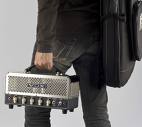
Vox Night TrainHmm… two VOX product announcements in a week. Well, VOX has been coming out with some pretty interesting stuff lately. Think about it: VOX is a venerable amp company, having played a HUGE role in defining the sound of rock and roll. But over the years, despite their trials and tribulations of ownership, VOX has always managed to produce a bunch of different products from guitars to organs, and of course, the Wah-wah pedal. But talk to a guitar player about VOX, and the first thing they think of is amps, and they have a new one: The “Night Train” NT15H.

As VOX puts it, the Night Train was made for the musician on the go, and comes with a power cord and carrying case to support that claim. But it’s how it sounds in the clips that has my attention. Powered by a pair of EL-84s, this is pure VOX goodness, and $499 street, it’s a low-powered amp that is something to seriously consider. I’m going to have to try one out ASAP!

Here are some clips that I got from the VOX site:

Night Train 15 Watt Bright Mode Clean and Gentle Alnico Blues

Night Train 15 Watt Bright Mode Texas Alnico Blues

Night Train 15 Watt Bright Mode Dirty Gain Celestions

Night Train 15 Watt Thick Mode Drop D Celestion 4×12

Night Train 15 Watt Thick Mode Crunch and Rhythm Celestion Greenback

Night Train Triode Thick Mode Hi Gain Leads Celestions

Night Train Triode Thick Mode Humbucker Rhythms Greenbacks

Finally, here’s a video from the NAMM 2009 show.

Read Full Post »

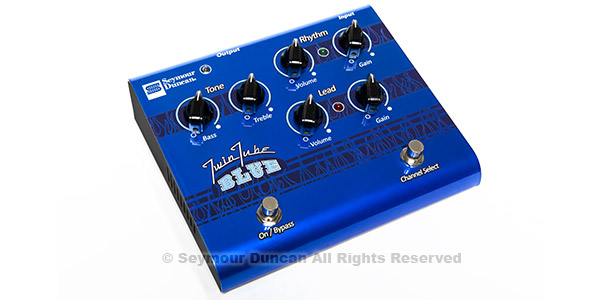
Seymour Duncan Twin Tube Blue Image c/o Seymour Duncan

Seymour Duncan Twin Tube Blue Image c/o Seymour Duncan

Seymour Duncan is known for its outstanding pickups, and I’ve known they’ve made pedals for awhile, but haven’t really paid attention until they came out with the Twin Tube Blue (SFX-11). This is a very cool little preamp/overdrive box that sits – gain-wise – right in the middle between their Twin Tube Classic and their Twin Tube Mayhem.

Run by two 6111 mil-spec, USA Philips-Sylvania tubes, the Blue can get you some nice, pre-amp snap, to sweet, sustained gain. Here’s the description from the Seymour Duncan site:

Too often, inexpensive tube gear runs in “starved plate mode,” where the tubes function like clipping diodes and do not actually amplify. The Twin Tube Blue’s high-plate voltage and 100% vacuum tube signal path allows the tubes to operate at their fullest potential and provide maximum dynamic range. This means you get the most gain and all the smooth tone you expect from a high-quality tube preamp. Two channels provide versatility. Like all Seymour Duncan stompboxes, the Twin Tube Blue is true bypass and features a fully encapsulated toroidal transformer for quiet operation. Heavy duty steel chassis.

Sounds impressive, huh? Here’s a video:

At about $229 street, it’s a bit on the pricey side, but it sure sounds good. Check it out at Seymour Duncan!

Read Full Post »

Imagine a TC Electronic pedal for under $200! That’s right! It’s the Nova Repeater Delay. It has the same great quality you expect from TC Electronic, but at a great price. As TC Electronic puts it, the Nova Repeater is a “no-frills-with-a-sound-that-kills” type of pedal. In other words, it doesn’t have a lot of bells and whistles. You dial in your settings and play. The most useful feature I dig is the tap tempo you can do strumming your guitar! You hold down the tap tempo button, strum your guitar, and the pedal picks up the tempo you strum! Very cool! When you hold down the tap tempo to set your tempo via your guitar, the pedal shuts off the signal to your amp, so you can set your tempo practically noiselessly. The TC Electronic dudes are awesome! Here’s a video:

I’ve been wanting to get a simple delay pedal for awhile now, and this one looks very promising. However, TC Electronic announced this pedal on March 27, 2009, and it hasn’t hit the stores yet! Damn! I was going to lay down the $149 for this sight-unseen! Oh well, guess I’ll have to wait, or get the Catalinbread Dirty Little Secret first… 🙂

Read Full Post »

Guitar AffairActually, GuitarAffair.com has been around for a few months now, but I discovered it when it was still pretty new back in January of this year. GuitarAffair.com is a great take on “try before you buy” with high-end guitars. Owned and operated by Jim Basara (yes, that’s the same Jim Basara who does reviews for Guitar Jam Daily), the site is set up to let people rent high-end guitars for a period of time – but they can keep them if they like them (of course, they have to pay for them). Here’s an excerpt from Jim in an e-mail he sent to me:

There are two parts to my business.  One model is to rent  guitars to business travelers who are guitar enthusiasts and never get to play  because they travel a lot (I used to be one of these guys).  The other  is, of course, to sell guitars.  By targeting business travelers, my goal  is to get boutique instruments into the hands of people with the means to buy  them.  I ship all over the country, so it’s a fairly large pool.  For  the sales piece, if someone rents a guitar and then purchases one, I rebate the rental fee.  This turns the business into kind of a demo program for  those manufacturers I am a dealer for.  And on that note, as a custom  builder, you may be interested in what I’m doing for Gigliotti Guitars…   …for people who are interested in purchasing a Gigliotti,  but want to play one [before buying one outright], I send them a Gigliotti and three  additional necks with the more popular neck profiles.  Each of those  necks is fretted with three different sized fretwire.  This way, the  buyer gets to play the Gigliotti but also feel more comfortable about picking  the neck carve and fret wire…  …I’ve also had interest  from some tier-2 pros who don’t like the hassle of taking their guitars on  commercial planes all the time.

While Jim targets business travelers, the business is pretty much open to anyone who wants to try a guitar out before buying it – or just wants to be able to play some great guitars! Check out the site! It is very cool!

On a personal note, GuitarAffair is one of those ideas I wish I had come up with… I dig it when people latch on to a great idea and expand on it to make living out of their passion. That’s exactly what Jim hopes to do with GuitarAffair.com.

A note about Jim…

Jim BasaraJim has a long history with vintage guitars, having established himself as a vintage gear guru and technician, having learned the ins and outs of guitar tech at Fretworks. He has also been writing reviews for Guitar Jam Daily since day one, which is how I first encountered him. An avid player himself, he has played for several years, and loves to play so much taken guitars with him on trips the world over! The dude knows his stuff!

Read Full Post »

My friend, Vinni Smith of V-Picks is an incredibly talented guitar player, and one of the things that has really sparked our friendship is our love of Peter Frampton’s music. It was hilarious to find out that his favorite guitar solo in the world is the middle lead break in the song “Do You Feel Like We Do?” from Frampton Comes Alive. It has been my all-time favorite guitar solo since I was in junior high way back when. Now, after all these years, Vinni shows how to play the middle and ending solos in the following clips:

In this next solo, Vinni is demonstrating his new pick, the Dimension, while playing with Saint Guitar Benchmark.

Read Full Post »

VOX Tonelab ST

VOX Tonelab ST

I got my first introduction to VOX Tonelab boards when I saw a dude playing one direct into his PA at a casino a couple of years back. I was amazed at how awesome it sounded, and completely changed my opinion of using models in a live situation. Since then, I’ve played with some of the Tonelab series boards and Valvetronix amps, and have generally been pleased with them. But with the Tonelab SE, I think I’m going to take a really good look at this new offering from Vox.

  • First off, it’s nice and compact. It’s their smallest footprint yet!
  • 50 Presets and 50 User programs.
  • 33 amps and a 11 cabinets – more than you’ll ever need to customize your sound.
  • I’ve always dug the fact that it has an on-board expression pedal to adjust a bunch of different parameters – but most of all, to use as a wah (the wah is actually pretty sweet on these units).
  • Finally, at $199 (street), there’s tons of value in this little unit!

For more information, check out the VOX Tonelabe page.

Read Full Post »

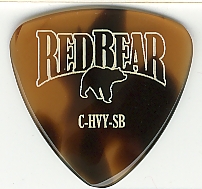
Red Bear Style "C"

Red Bear Style "C"

Imagine a pick shaped like the one to the left, but at 4 mm thick! That’s the Super Thick Gypsy Jazz Pick!

A couple of weeks ago, I was having a conversation with Dave Skowron, maker of Red Bear Trading picks, and said, “You know Dave, I just dig this Gypsy Jazz thick pick that I just bought. But as you know, for electrics, I play with a V-Picks Snake because I love the 4.1 mm thickness.” As background, I had just purchased a standard GJ thickness to replace the Heavy that I gave to a friend so she could try it out. I continued, “Do you have anything that is even close to that thickness? I would love to have that kind of thickness for playing acoustic.”

Dave replied, “Yeah, I have a sheet of the Tortis material that is pretty close to that thickness at about 4 mm. I did something even thicker for a guy once.”

“No, no any thicker, Dave, and I think it would be too much. But if you have a 4 mm thick pick, I’m all over it!”

“Okay, I’ll make up a prototype and send it to you to evaluate.”

All I can say after playing with “the prototype” for a couple of days is I hope that pick goes out of prototype because it is an incredible pick! You know how I love the feel and sound of Tortis, especially on acoustic guitar. In fact, I love the sound of Tortis with acoustic guitar that I won’t play any other type of pick on my acoustic. On electric, I dig my V-Picks Snake for its speed, tone, and thickness. Put all that together in one pick, and what you’ve got is a “Super Pick!”

The thicker you go with picks, the deeper and richer the sound. It’s not that you lose the highs; you don’t. It’s just that the thicker picks also bring out the lows, so what you get in a nice, even tonal presentation. That’s why I dig thick picks! On top of that, there is something magical with the way a Tortis pick interacts with an acoustic guitar’s strings. With me at least, playing a Tortis pick on acoustic evokes a certain visceral feeling that makes me want to close my eyes and just soak up all the tonal goodness. Not only that, Tortis, being made of a natural material, just feels natural. It’s the perfect complement for playing acoustic guitar!

So what about this super-thick Gyspy Jazz gauge? OMG!!! I am in guitar-playing heaven with this pick! It has the thickness of my beloved V-Picks snake, but all the feel and tone that I’ve come to love with my Tortis picks! To just call it “awesome” would be a complete understatement.

I first played the “Super Thick” last Friday at a gig that was primarily acoustic guitar. It started with playing some dinner entertainment music before a re-enactment of Christ’s passion. I was playing my Ovation Celebrity directly into a Genz-Benz 100 Watt upright. When I struck the first chord of the opening song. I actually had to pause and let the chord just ring and hang in the air. It was quiet enough in the room where I was playing that I could hear my guitar, as the amp was there for simple sound reinforcement. I thought my original GJ as awesome at 2.3 mm. What this pick did to the natural tone of my guitar was otherwordly!

I spent most of the day yesterday playing guitar, much to the chagrin of my wife! It feels so incredible!

In any case, if you’re interested in getting one of these, contact Dave Skowron at Red Bear Trading. I’m sure he’ll make one for you. Mind you, this thickness of pick won’t be cheap, but it’ll be well worth the investment!

5 Tone Bones - Gear has stellar performance, value, and quality. This is definitely top of the class, best of breed, and it's a no-brainer to add this to your gear lineup! If I could go higher, I would with this rating. But this pick gets my highest rating!

Read Full Post »

« Newer Posts - Older Posts »