Feeds:
Posts
Comments

Archive for June, 2010

Answer: Just one more!

Awhile back, my wife walked into my garage/studio, and saw me playing my Reason Bambino. She asked, “How many amps do you need?” As usual, my answer was (with a facetious grin on my face), “Just one more, honey.” Her reply to that was, “You’ve got a wall of amps! I don’t see how you could possibly need all of them.” Actually, she was right, and it didn’t help that half of them weren’t mine, as I was doing reviews on some amps at the time.

Still, I felt I owed her an explanation. After all, I do have a lot of gear, and I actually use all of it, with the exception of a couple of my very old guitars that I’m too busy to service. So I followed her into the house and said, “You know, since I don’t have a band, and I’m doing all this recording on my own, when I’m after a certain sound or dynamic, and I don’t have that sound or dynamic well, I have to find it. Ultimately, that means I get more gear.”

Or maybe I’m just an obsessed, sick individual that needs to have shiny new things all the time. 🙂 Heaven knows I’ve fallen victim to impulsive urges. For instance, just the other day, I was looking at Telecasters on CraigsList. Found a really nice black one with a mirror pick guard for $400! The guy didn’t indicate where it was manufactured (I’m “kind” of looking for an American Telecaster or American G&L ASAT). Luckily I called him up and he said it wasn’t an American because I would’ve scooped it up post-haste! Then I thought to myself, “Dude, you gotta stop this!” Dodged that bullet… 🙂

Read Full Post »

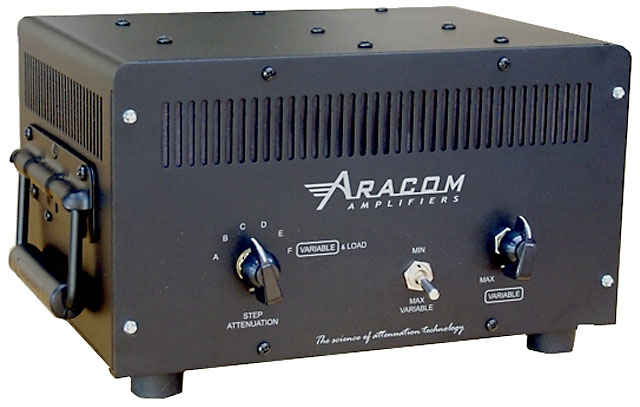
The venerable “Destroy All Guitars” shop has teamed up with Aracom Amplifiers to come up with a new version of the fantastic Aracom PRX150-Pro. Sporting a smaller cabinet (sorry, not reduced weight), and a couple of very cool new features, the $785 PRX150-DAG is the answer to anyone who wants to go to the extreme in transparent power attenuation.

Here are the features:

* Proprietary SRT Power Attenuation Technology
* Six levels of step attenuation, plus a continuously variable attenuation control (bedroom mode)
* 40dB of attenuation–attenuates 150 watts down to .015 watt
* 150 watt power rating
* Independent input and output impedance selector switches:
– from the amplifier and into the attenuator, select from: 2, 4, 8, 16 ohm
– from the attenuator and to the speaker cabinet(s), select from: 2, 4, 8, 16 ohm
– uniquely allows 16 possible Input and Output impedance combinations
* Hi Frequency Cut Filter with a True Bypass Switch
* Features a Load setting and is equipped with a Line Out Jack and Line Out Level Control
* Rack Mount Option
* Handwired in the USA

The two notable features are the Hi-Cut Filter, and the increased attenuation down to -40dB attenuation. With respect to the high-cut filter, some people had mentioned that they heard a high-frequency artifact coming through when they hooked up the original PRX150-Pro. I myself have never heard it, though I suppose anything’s possible. In Jeff Aragaki’s (of Aracom Amps) words:

The PRX150-DAG is equipped with a High Frequency Cut switch, that rolls off the highs above 6KHz, that some users might find useful with amplifiers that have a pronounced high end frequency response. Some guitarists go to great lengths to control the high end response of their amplifier, by carefully selecting speakers, tubes, and other components to roll off the highs. Now with the PRX150-DAG, a guitarist might not need to rely on changing these components; the high cut filter switch allows the flexibility of rolling off the high end or not. The true bypass switch allows the filter to be completely bypassed, providing the full frequency response of the attenuated amplifier to pass through to the speakers.

The other great feature is the Min/Max variable attenuation modes Jeff has introduced. Minimum attenuation mode is the traditional -16dB down to about -30dB variable attenuation, whereas the Maximum variable attenuation mode goes from -27dB to -40dB. With a 100 Watt amp, that’s taking down the output power to .015 Watt!!! Wanna have full dynamic response at bedroom levels with your 100 Watt amp? Look no further!

The Aracom-DAG PRX150-DAG is available exclusively through Destroy All Guitars. Check it out!

Read Full Post »

Alternate title: You can’t judge a book by its cover…

Most people associate John 5 as the guitarist for Marilyn Manson, and being that that’s not everyone’s cup of tea, most folks probably don’t know just how gifted of a musician he is! I myself totally dismissed him until I saw a video of him demonstrating chicken pickin’ on YouTube (sorry, can’t seem to find the original video). I was so taken aback by the disparity between his appearance and his ability to play a style of a guitar that was the antithesis for what he was known for, that I spent the next several hours searching for as many John 5 videos I could find just to confirm that it was indeed him.

In the end, I was totally blown away by his versatility in the genres he could play, but more importantly, I gained an appreciation for his musicality. Make no bones about it: John 5 is the s$%t when it comes to making music, not just playing guitar!

John 5 is also an accomplished songwriter, having contributed tunes to KISS and the Scorpions. You don’t get those kinds of gigs without having your stuff together!

In any case, what got me thinking about John 5 was the fact that I’ve lately been into Tele’s; I mean, really into Tele’s, ever since I got my Squier Classic Vibe 50’s. And gear slut that I am, I’m always looking around for deals. So in my sojourns, I remembered that the Tele is John 5’s axe, so I thought I’d write about how much appreciate his musicianship!

Here’s a GREAT video of John 5 demonstrating some chicken pickin’ techniques:

Read Full Post »

…I’d do it in a snap. After seeing a couple of Vegas shows this past couple of days, I got to thinking that it would be a great job – almost better than the road:

  • You play in front of a different audience every night.
  • You crawl into your own bed after you’re done.
  • Yeah, you don’t get to see too many cities, but you’re not stuck on a bus or flying on an airplane and eating restaurant food each day.
  • With the right show, even if you’re playing the same material night after night, if you’re given some freedom of expression, you could have room to let your solos breath. The two guys I saw (in Cirque du Soleil Mystere and Terry Fator) had lots of places where they could improvise. Totally cool!
  • Because you’re playing every day, your chops are always sharp.

So if I ever get a chance to do a show as a full-time musician – and if it pays well enough to support my family – I’m there!

Now mind you, that I don’t think being on the road is a bad thing. I’d love to do it now and then, but with a family at home, and having traveled quite a bit for business, being away from the family for long periods of time is just not practical – at least for me.

Read Full Post »

Imagine, if you will, playing at least 10 shows a week for a major production. That’s what the guitarist for Cirque du Soleil gets to do. Yeah, you dress up in a costume for each show, but you get to rip it up! I just saw the show this evening (my wfie and I are in Vegas), and the guitarist playing in the band was a monster with great chops!

His chops were excellent, and it appeared he got to do lots of free-reign soloing! Of course, a lot of what he played was by the chart, but there were several parts in the show where it seemed he was able to just run freely. But irrespective of that, I’d love to have a gig like that where I can play every day in one city – it would be my job.

Maybe it might get old, but with a family, it would be tough being on the road all the time. For me at least, with a gig like this, you do two shows a day at 7pm and 9:30pm, you have Thursday and Friday off, and you play five days a week! If it’s a great-paying gig, well, I could hopefully support the family.

Unfortunately, once guys land these kinds of gigs, they rarely, if ever leave. I suppose you’ve got to be in the right place at the right time…

Read Full Post »

…when you’re in Vegas and writing an article in your room – though I am sipping the remains of my wife’s Hurricane.

My wife and I are celebrating our 17th wedding anniversary for a few days in Vegas. This is strictly for relaxation. We’ll be going to shows and having nice meals. It’s a great break.

The cool thing for me is that while I did bring my laptop so I could write in my blog, I don’t have to worry about my duties at work or home, and that’s helped me just empty my mind. Of course, when I clear my mind, I think about playing guitar; or at least writing music. I’m working on the structure of a song right now. I’ve asked my eldest son to write the lyrics because I want a younger perspective on the song. Feedback that I’ve gotten on my latest songs is that lyrics are “mature.” Damn! That’s not necessarily a bad thing, but it certainly narrows my audience. So I’ve turned to my son who actually liked the basic song structure when I played it for him, and we’ll see where it goes.

Read Full Post »

Click to enlarge

“Guitar Player” mag took a recent poll asking: If you could only have a single pedal in  your rig, what would it be? Overwhelmingly, and actually not too surprising to me, most pollsters chose an overdrive pedal. I personally didn’t take the poll, but I would definitely fall into the majority. You know me, I just can’t enough of overdrive pedals!

So much to my great pleasure, Maxon has released the new ST-9 Pro+ Super Tube Screamer Overdrive. Based upon Maxon’s classic “808” circuit, and building upon the original Ibanez ST-9 and its ability to control the amount of “midrange hump,” this “reissue” adds features that have the potential of making this a truly great Tube Screamer-class pedal.

  • First of all, the ST-9 Pro+ sports 9V or 18V operation. 18V mode adds more headroom and warmth. This is controlled by a slider switch in the battery compartment.
  • In addition to the Drive, Level, and Tone Knobs, the ST-9 Pro+ also has a “Mid-Enhance” knob which controls where the mids are boosted. Clockwise moves the boost towards the high mids, while counter-clockwise moves the boost to the lower mids. To me, this is probably the most useful feature, as you can dial in the mid boost to adapt the pedal to different amps.
  • The ST-9 Pro+ also has a switch that selects either “Classic” or “Low Boost.” Low Boost gives a 12dB boost at 100Hz and a 4dB boost a 500Hz. This can be quite useful for fattening up single coil guitars!
  • Finally, the ST-9 Pro+ has true-bypass switching.

OMG!!! I love the features on this pedal! Were I to consider getting another pedal in the Tube Screamer lineage, this pedal would be at the top of my list! However, with a street price of around $206, it’s not a cheap proposition. But with it’s features, it certainly warrants a close look; and based upon my experience with Maxon pedals, their build and sound quality is undeniable. While I don’t use it much any longer, my CP-9 Pro+ compressor is a testament to that quality (I paid $250 used for that pedal), and it’s a pedal I’ll always have. As for the ST-9 Pro+, I’ll see if I can find a place where I can audition it.

Finally, here’s a great demo video that shows off the ST-9 Pro+ quite nicely:

For more information, check out the Maxon ST-9 Pro+ page!

Read Full Post »

If you read this blog with regularity, you know that I love NOS tubes. Who knows? Maybe I’m being a cork-sniffer, but the significant impact NOS tubes have had on my amps has led me to preferring them over new production tubes. Unfortunately, NOS tubes are getting scarcer and scarcer, so I suppose that eventually I’ll  have to get new production tubes.

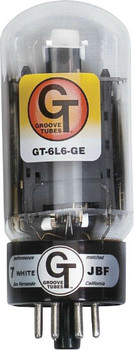
Now a company that I’ve tended to steer away from is Groove Tubes, mainly because they’re just re-labeler of various OEM tubes. They just measure voltage, match ’em up, relabel them and sell them as their brand. Nothing wrong with that, but I haven’t met a Groove Tubes tube that I’ve liked, until I discovered the Groove Tubes GT-6L6GE Re-issues.

Before I go on, I should clarify that I’m not talking about the current production 6L6GE’s, which are assembled overseas. The tubes I’m talking about were made in the USA up until about 2003, as far as I can tell.

What makes these tubes special is that they’re constructed of NOS materials (except the glass), and to the same specs as the original GE 6L6’s of old. Plus they were constructed in Southern California, so the quality is incredible. These tubes rock! To be honest, I’m not sure of all the details of their production, but I got the information from Brent Jesse @ audiotubes.com who recommended them to me.

I bought two sets so I could have a spare set, and have been in tonal heaven with my Hot Rod Deluxe! The cleans are lush and deep, and the overdrive is creamy smooth. I have other GE power tubes, and I’ve gotten used to their smooth distortion. These GT-6L6GE’s are no exception! In addition to their smooth breakup, they also don’t compress much, which is another thing I just dig. I prefer a more open distortion.

I compared these to both JJ’s and regular Groove Tube 6L6GT’s, and these just blow them away. The JJ’s and GT’s have nice, clear cleans, but forget about their tone when cranked up. The tone is harsh and gritty, even if I bias them a little hotter than spec; whereas the 6L6GE’s remind me of the breakup I get from my Plexi clone – without hot biasing! Amazing!

As these are no longer in production (don’t confuse these with the new 6L6GE’s), they’re a bit more expensive than the new production 6L6GE’s; $80 per pair as opposed to $55-$58 a pair. And because they have the same labeling as the new ones, it’s hard to tell them apart. So I recommend that if you want to get a pair, get them from a source you trust. As I mentioned, I get them from Brent Jesse Recording and Audio, and having purchased several tubes from him, I trust him implicitly.

All that said, I will be getting a set of the new production tubes to make a comparison, as they are also made with NOS materials, though assembled overseas. Who knows? They may just sound killer as well!

Read Full Post »


Click to enlarge

Click to enlarge

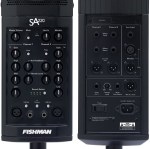
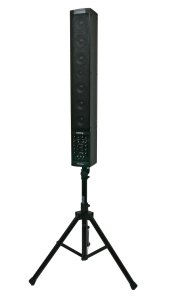
Fishman SA220 Solo Amp

Summary: Compact and weighing in at just 25 lbs., the SA220 Solo Amp is an ideal PA solution for the solo acoustic guitarist/vocalist, but it’s versatile and loud enough to be used as a PA for a band (if you have a couple of them).

Pros: It may not have the Bose name, but I’d put this up against the L1 Compact system any day. With built-in, independent, 3-way EQ, and a variety of other features, if you’re a solo acoustic artist, you owe it to yourself to check this unit out! I got it set up in less than a minute!

Cons: None

Features:

  • Drivers
  • – Six 4″ mid-woofers, patented dual gap, high excursion design, neodymium magnets (200W)
    – One 1″ neodymium soft dome tweeter with level control (20W)

  • Auxiliary Stereo Input with Level control
  • Four Digital Reverb effects with master level
  • Balanced XLR D.I. outputs for both channels and main mix
  • Independent effect loops for Channel 1 and Channel 2 (OMG!!!)
  • Unique Monitor I/O for improved on-stage ensemble monitoring
  • Mute with remote footswitch input
  • Tuner Output
  • Ships with Stand and padded Carry Bag (w/ wheels)
  • Dimensions: 41.5″ H x 5.6″ W x 6.6″ D
  • *Weight: 25 lbs without Stand, 35lbs with Bag and Stand

Price: $999 Street

Tone Bone Score: 5.0 ~ Talk about ease of use! As I mentioned above, I got the SA220 set up in less than a minute! And my Yamaha APX900 sounds absolutely killer through this, not to mention the great clarity of the vocals. This is a winner, folks!

Year over year, I play between 100 to 150 gigs a year, with about half of them as a solo acoustic act. My solo gigs have consisted mainly of my weekly restaurant gig, but I do lots of weddings and special events throughout the year as well. Of late, the restaurant I gig at moved my act outside in a public patio area as the weather is gorgeous.

To make a long story short, even though the restaurant has a decent PA system, I ended up bringing my own PA last week, which was the first week we did the outdoor show. That worked pretty well, and my PA has a great sound. But it also made me realize that the old mixing board, and big 300 Watt speakers was just too much gear to haul around. Even if I ended up using the restaurant’s PA, which is a nice one, I’d still have to lug the board and speakers and stands down from the office upstairs. Enter the Fishman SA220 Solo Amp.

Plug It In and Go!

I finally received my SA220 today after having to wait for a couple of weeks for it to arrive (had to be ordered). So when I got home, I knew I had to try it out to see how it sets up, and of course, to work out kinks before I gig with it. There’s nothing worse than fighting your rig or sound DURING a gig – especially when you’re solo.

The guys at the shop assured me that Fishman’s claims of easy setup were true. I am now a believer! I had the SA220 set up in exactly 42 seconds!!! That didn’t include hooking up my pedal board, guitar, and microphone, but I had the system on its tripod stand and plugged into power, ready to go, in that short amount of time. That just blew me away! Plus, everything you need to get up and running fits into a single carrying unit that consists of two bags: One for the array/PA, and one for the tripod that buckles to the main bag. Talk about convenience! Fishman really had the solo artist in mind when they built this!

How It Sounds

For my audition, I just plugged my guitar into the SA220 directly, and hooked up my microphone. All I can say is that the sound is spectacular! I was actually concerned about the bass response of the unit, but apparently Fishman distributes the bass response among the six main mid-woofers. It may not get boomy with the bass, but the sound is absolutely rich, and vocals are clear and full. Normally, I use a DI to go into a board – and will probably do the same with this unit, but my guitar sounded clear and natural and full plugged in directly without those annoying high-end transients and flattened tone that is so annoying with plugged in acoustics. Admittedly, the ART system in my Yamaha APX900 has quite a bit to do with that, but Fishman really knows how to condition sound.

At first, I had a bit of a problem with feedback, but setting the phase switch and tweaking the anti-feedback knob (it’s a variable frequency notch filter designed to subdue a resonant peak – just turn it to where the feedback gets reduced or eliminated – very cool), and attaching the rubber sound hole cover on my guitar took care of the feedback problem.

Luckily no one was home when I tested the SA220. I set it up outside so I could see how it performed. Damn! Even with just 220 Watts, the SA220 is LOUD!!! I had the Master volume set at around 10 am, and that will be enough to fill the large patio space I’ll be playing in tomorrow! It’s not a stretch to say that the SA220 can cover a lot of venues.

As far as listening angle is concerned, the SA220 disperses the sound incredibly well! Even at extreme angles, where I was almost even with the array, the sound was clear with good volume. Of course, narrower angles are better, but this unit will have no problem playing in the open space I’ll be playing.

Talk About Bang for the Buck!

The sound is great, but I have to tell you, I was ready to get the Bose L1 Compact, which is a great unit, but the mere fact that if I wanted more EQ control and other features, I’d have to spend another $499 really soured my taste for the unit. On the other hand, Fishman has packed all sorts of features into the SA220 that make it hands-down the better value. Independent 3-band EQ for each channel, phase and anti-feedback control, 4 types of digital reverb, a mute switch (that is REALLY handy!), independent balanced XLR outs to go into a board, and my favorite feature: independent effects loop for each channel! You just can’t argue about with what comes built-in on this unit!

Overall Impression

It’s hopefully obvious that I love this unit! For me as a solo artist, it’s a true game changer! It’s light and versatile, and the sound is spectacular. What more could I ask for?

Read Full Post »
Having played with a 1 X 12 for quite some time, which has served me incredibly well for both studio and stage, I had as of late been wanting a bit more bottom end response, especially live, but without sacrificing my ability to naturally cut through the mix when the band is going all out; that is, cut through by virtue of EQ as opposed to volume. I suppose I had just been after a bigger, richer sound.

So I called my close friend Jeff Aragaki of Aracom Amps – actually several times – to talk about what might work well my Aracom Amps. He’s been testing several different speakers and speaker combinations lately, and who better to strategize with than the manufacturer of my amps? Lately he’s been really big into the Celestion line, and as he knew I love that classic alnico magnet sound, our conversations started turning towards the virtues of the Celestion Gold and Celestion Blue speakers.

I myself had never heard either of those speakers before – well, except for a brief time at a guitar shop through a 65 Amps 2 X 12 – but Jeff has been raving about them, and as he and I like the same kinds of tones, I broke my own rule of auditioning gear before I buy it, and asked Jeff if he could put a cabinet together. He said he could construct a custom one for me but that would take some time, or he had a few Aracom re-labeled Avatar cabs in his workshop and he could load a pair of speakers into one of them. From the title of this article, it’s obvious I went with the latter alternative.

For those unfamiliar, Avatar Speakers has been around for quite some time, and the company is fairly well-established in the guitar and bass community. I used to think they’re a manufacturer, but they’re actually a distributor of cabs as opposed to being a direct manufacturer, so they buy in bulk and have insanely great prices on cabinets, and they’re all great quality.

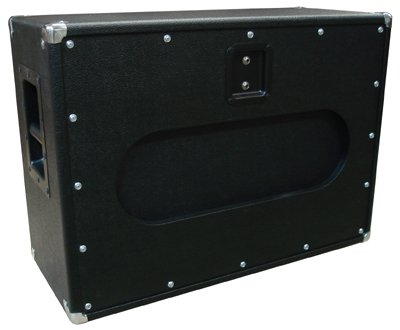
The G212H Custom is a fantastic cabinet, measuring 21″ H x 28.5″ W x 12 ” D, and made of 18mm 13-ply Baltic Birch. It’s not a small cabinet, but that’s a good thing as its size provides a resonance chamber that really brings out the bottom end – even in a semi-open-back configuration like mine, as shown in the photo of the back of the cabinet to the right.

The build quality of the G212H is excellent. The corners have nickel-plated protectors, and the cab itself is extremely sturdy. The grille cloth is actually screwed in, as opposed to being attached with velcro, and that will eliminate buzzing that can happen with velcro-attached grille cloth.

The only pain that I anticipate with this cab would be swapping out speakers, which I probably won’t do often. But the speakers are front-loaded, which many players prefer, but in order to swap, you have to remove at least two of the corner protectors so you can remove the grille cloth frame from the front of the cab. That’s not really too difficult, but it’s a lot more involved than just unscrewing the speakers like you would from a rear-loading configuration.

As far as speakers are concerned, I’ve had the cabinet configured with a Celestion Gold and a Celestion Blue. The Blue has a nice, smooth, early breakup while the Gold provides a bit more bite on the top-end and a really nice bottom-end response. What a combination! The end result is a slightly scooped tone, and that roomy cab creates an almost reverb-like effect. I’ll have sound clips in the next few days.

Overall, I’m just loving the sound that this cabinet produces. I got my wish for a big, smooth sound for sure!

The Avatar G212H Custom gets a 4.75 only because speaker swapping is a bit of a pain. But from a pure performance standpoint, it gets a 5.0.

Read Full Post »

Older Posts »