Feeds:
Posts
Comments

Archive for the ‘amplifiers’ Category

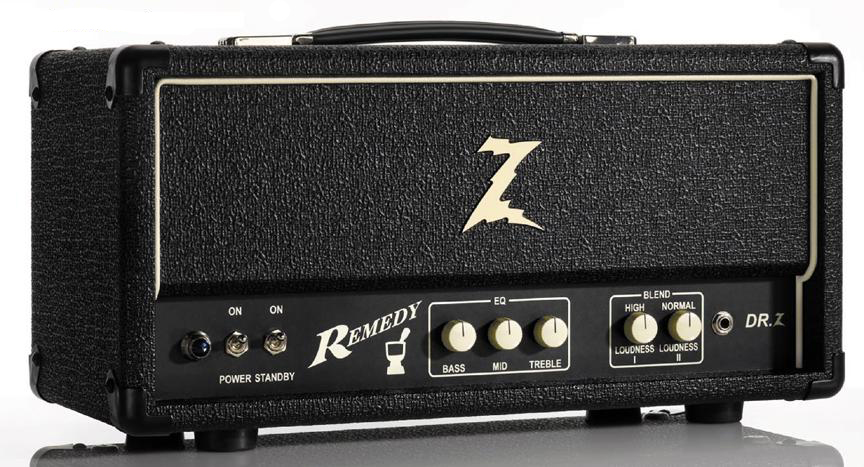
REMIn yesterday’s little adventure at Guitar Player Magazine, I got a chance to play the new Dr. Z Remedy amplifier. This amp is based upon a classic Marshall JTM circuit design, but with a twist: Instead of 4 inputs that allow you to jumper the two channels, the Remedy has a single input and the channels are already jumpered. You then have the ability to blend the amount of high and normal channel amounts via the two loudness knobs.

This amp is a lesson in simplicity. It has a three-band EQ, and the volume knobs for the High and Normal channels, plus Power On/Off and Standby toggles. That’s it. With this amp, you dial in your tone and sound levels, and play!

The amp is powered by a quad set of 6V6’s, and man they sound sweet! The power tubes are JJ’s which have kind of a “hybrid” 6V6 tone – I use these myself, and I love them. They’re brighter-sounding than the classic 6V6, and they’re extremely durable. I’ve never had one of these fail on any of my 6V6 amps, so it’s not a surprise Dr. Z uses the JJ’s for their reliability.

How It Sounds…

In a word, it sounds “big.” A lot bigger than I expected from just a 40 Watt amp. I played a Gibson ’59 Les Paul Special Re-issue through it and was really taken by the big sound that the Remedy produces. For classic rock and blues tones, this is an ideal amp. It responds incredibly well to picking dynamics and volume knob adjustments as well, which is why I mentioned you set your EQ and volume where you want it, then play. You can then adjust the cleanliness or dirtiness with your volume knob or attack. Very cool. You might dismiss the Remedy as another JTM clone as the circuitry is based upon that. But it has a sound all its own. The cleans are lush and defined, and the overdrive is nice and crunchy, and very little to no top-end raspiness. I think that’s an earmark of the 6V6’s. They just don’t get fizzy.

A Great Half-Power Mode

I played around with the half-power switch a couple of times, and it works as expected. But I wanted to find out more about how Dr. Z does his half power mode, so I gave him a call this morning, and found out some interesting things about how he does his half-power mode – very interesting things, indeed. There are a couple of ways I’m familiar with that amp manufacturers introduce half-power modes in their amps. A common way is to shut down half a tube, essentially going from pentode to triode. According to amp builders I’ve spoken with, this is the easiest, but it also changes the tone significantly between the two modes.

The second common way is to adjust the B+ voltage down, then provide some compensation so the correct heater voltages are maintained. This is what Jeff Aragaki does with his amps, and this technique is very transparent.

Dr Z. takes a completely different approach and leaves the front-end alone entirely, and works his magic from the power transformer, something he worked with the late Ken Fisher to produce. I won’t go into details – and Dr. Z didn’t go into a great deal of depth – but he effectively bypasses the power from two of the power tubes then does some other stuff to compensate for the impedance mismatch to half the power. The end result is a very tonally transparent switch from full power to half power, using a method no one else is using; at least according to Dr. Z.

I love stuff like this! I’m no electronics guy, but I love it when people think out of the box to handle common problems, and come up with approaches that no one else thought of, or didn’t try because they thought it was too hard! Kudos to Dr. Z for doing something like this!

I truly wish I had more time to spend with it so I could explore the amp’s capabilities more. Perhaps in the near future I’ll get that chance.
Read Full Post »

Just put in a re-labeled 1960’s-era Mullard ECC83 into my Aracom VRX22 this afternoon. I had a JJ 12AX7 in there, and make no bones about it; that’s a great pre-amp tube. But the difference in tone between the two is immense. Where my JJ had a great tone, one thing that I noticed was that the highs tended to be rather harsh when the tube was overdrive, and I found myself turning my Tone knob left of center – a lot – to bleed off some of the highs.

But after I installed the Mullard, I was absolutely blown away! The overdrive seemed so much more focused, with zero high-end harshness. It was some of the smoothest overdrive I’ve heard, and definitely the smoothest the VRX22 has sounded since I got it. That’s saying quite a bit because I love the tone of this amp immensely, even without the NOS Mullard. Which brings me to the crux of this entry…

As a tube amp aficionado, I’ve gone through lots of pre-amp tubes, and almost invariably, I’ve gravitated towards NOS tubes to get the tone I like. Some people I’ve spoken to say it’s all hype but, at least to me, it’s not. I suppose for some types of tubes, there’s not much of a difference. For instance, I almost invariably use JJ’s for power tubes because they just sound great to me. They’re well-made, and run pretty hot, and they break up nicely.

But with respect to pre-amp tubes, I’ve found a marked difference between NOS and new tubes. I love Mullard and JAN Phillips tubes for pre-amp tubes. They’re just so smooth sounding, smoother than all the new make tubes I’ve played. Plus, they were made during a time when most electronic devices were run with tubes, so the build expertise, equipment and materials for making tubes was abundant. According to my friend Jeff Aragaki of Aracom Amps, the alloys used in NOS tubes are not as readily available nowadays, and that could account for the difference in tone. Not sure if this is true, but it certainly makes sense. The only drawback is the price. That Mullard sells for $129 retail, and that is by no means inexpensive.

But I look at buying NOS tubes very much like buying a great pair of shoes. For instance, I spend almost $200 a pair for my everyday shoes. These are absolutely comfortable, and not only that they last a long time because they’re constructed so well. In fact, it takes me about 4-5 years to really wear them out. This in contrast to lower priced shoes that I’ve worn out within a few months. After a long period of time, I’ll spend more on the cheap shoes. A better case is my father. His shoes cost at least $500. But they last almost 20 years! He just gets them resoled every few years until the shoe repair guy says that it’s not worth it.

NOS tubes are similar. I’ve had the same NOS tubes in my Hot Rod Deluxe for almost five years, and they still sound great! I play that amp a lot. On the other hand, the new Tung-Sol tubes I put in another amp lasted all of two months before they started to lose their character, with one becoming microphonic. Granted, they’re fairly inexpensive tubes and they sound great, but if I have to shell out $25 every couple of months, that starts to add up. NOS tubes, especially the mil-spec tubes that I prefer were made for military usage, which means they had to be well-built and durable. That’s a huge advantage NOS tubes have over newer tubes.

Jeff also shared a story with me today about a friend of his who used to be stationed on an aircraft carrier. He was telling Jeff that when the ship replaced electronic components, they’d dump boxes of tubes – good ones, mind you – over the side of the ship. So the ocean has NOS tubes littering its bottom.

In any case, please do not just take me at my word! 🙂 This is simply my perception based upon my experience. In the end, as I am often apt to mention, you’re judge of what sounds pleasing to you. So only buy what makes sense to you!

Read Full Post »

For a long time, I’ve had this thing for getting a big guitar sound in my recordings. I’ve done a bunch of different things like doubling, overdubbing, signal splitting between two amps, and the like. But recently, I got a couple of pieces of gear that is allowing me to explore yet another way to get a big guitar sound: Re-amping. Re-amping is essentially taking an already amplified guitar signal, and running it through another amplifier. This is not like adding a gain stage because that usually involves multiple pre-amp sections. With re-amping, you’re building on a fully amplified signal that has passed through the power tubes. The result is VERY different in tonal character from just moving the signal through another gain stage.

There are lots of ways to re-amp, so I won’t go into a lot of detail. But I will share how I do it. Ever since I got my Aracom PRX15-Pro, I’ve been contemplating this very thing because of its line out which could be used in a variety of ways; such as running the signal into a PA (since it’s unbalanced, you need a DI box), or taking that line level, and running it into another amp to re-amplify the signal yet again. The cool thing about the PRX150-Pro is that I can simultaneously run an output to a speaker, then the amp that’s doing the re-amping can also have it’s own audio output.

Now here’s something even more cool! I have a Reason Bambino, which also has a line out. It’s a balanced line out, so it can go directly into a board, and doesn’t need to be hooked up to an external cab. The tone coming from the line out of the Bambino is very nice. I suppose that I could’ve miked the Bambino from another cabinet, but I did want to test the line out.

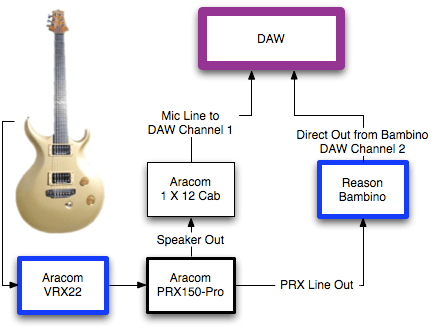
In any case, here’s a diagram of how I had everything hooked up:

VRX22-ReAmp

In a nutshell, I plugged my guitar directly into my Aracom VRX22, which ran into the PRX150-Pro. I hooked up an external cab to the attenuator, placed a mic in front of the cabinet that ran into Channel 1 of my audio interface. Then, I ran the line out of the attenuator to the input of the Reason Bambino. From there, I went directly from the Bambino into Channel 2 of my audio interface.

I set up a clip from a song I wrote and added two tracks that took input from the two channels. I also panned Channel 1 full left and Channel 2 full right. Once I had the levels worked out, I recorded a solo over the existing music. Once the recording was finished, I took the Bambino’s signal slightly out of phase with Channel 1, to make it sound like two guitars are playing simultaneously. The effect is totally cool, and it creates a very in-your-face, big guitar sound! Here’s the clip:

Note that this is a kind of a different way to employ re-amping, which basically runs two amps in a series then out a single output. The way I employed it, the re-amped signal is a component of the overall package.

Read Full Post »

Aracom Amps VRX18 18 Watt Head

Aracom Amps VRX18 18 Watt Head

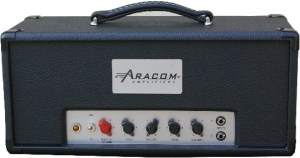
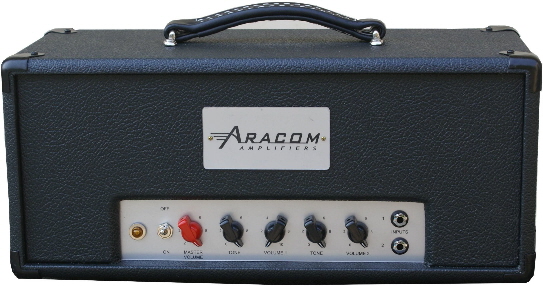
I’m falling in love again with my Aracom VRX18. This was the amp that first got me introduced to Aracom and my good friend Jeff Aragaki. My amp is actually a tweaked version of the stock VRX18 as it sports an EZ81 tube rectifier, plus a tweaked circuit that adds a bit more sag and sustain. The result is just a gorgeous overdriven tone that really brings out the best of the EL84 power tubes.

One thing about EL84 amps is that if they’re done right, they have a distinctive overdrive tone that creates a subtle top-end fizz when they’re overdriven. I’ve played others that drive the power tubes too much, and they sound very harsh and incredibly compressed. Jeff did this amp right, and while the power tubes do indeed compress a bit, the overdrive tone retains its open character, while adding that nice top-end fizziness that EL84 amp lovers have come to appreciate.

The clip below is an excerpt from a slow blues song I wrote. It features my beloved Goldie plugged straight into the Aracom VRX18, and it also features the insane Aracom PRX150-Pro attenuator! Believe it or not, the amp was recorded at just above loud conversation levels! We’re talking less than 1/10 of a Watt, and the amp still retains its tone and dynamics! Anyway, here’s the clip:

Read Full Post »

4.75 Tone Bones - Almost perfect but not quitevoxac4tv VOX AC4TV Amplifier


Summary: For what it brings to the table, this is a great little amp. While it’s mainly touted as a practice amp, you can easily gig with this at small venues, or attach an external cab to it, and you could easily keep up with a drummer!

Pros: Classic VOX ACx cleans, and nice, warm overdrive via the Class A EL4 power section.

Cons: 1/4 Watt setting really narrows the bandwidth. The amp sounds pretty lifeless at this level, but that’s why I have a great attenuator. I would play this at 4 Watts all the time. No need to ever use the built-in attenuator.

Features:

  • Controls: Tone, Volume, OP Level (4W, 1W, ¼ W)
  • In/Out Jacks: Input, External Speaker Jack (¼’)
  • Output: 4 Watt RMS 16-Ohm
  • Speakers: AC4TV – 1 x 10″ 16-Ohm Celestion VX10 custom speaker;
  • Valve/Tube Complement: 1 x 12AX7 (pre) / 1 x EL84 (power)
  • AC4TV Dimensions: 13.78″ (W) x 8.46″ (D) x 14.76″ (H);
  • AC4TV Weight: 19.84 lbs.;
  • Power cable included

Price: ~$249 street

Tone Bone Score: 4.75 – I was very surprised by this little amp. The 10″ Celestion speaker really packs a nice punch, and the controls are dead simple. I would easily add this to my growing stable of amps!

I’ve been on this low wattage amp craze for awhile, and it’s wonderful to see all these great low wattage amps entering the market! Orange has the Tiny Terror, and VOX also has the Night Train. Those amps just mentioned are all pretty much modern styling, but I should qualify my craze. I love the old vintage styled low wattage amps.

It all started out with the Fender Champ 600, which I reviewed awhile ago here. I was looking for a low wattage tube amp that I could get some serious overdrive tone from without making my ears bleed. I immediately fell in love with that amp, and since I’ve had it have only made some minor changes, like putting in NOS tubes. But other than that, this amp has served me quite well, both in the studio and even in small venue gigs (using a 1 X 12 of course).

So it was a very nice surprise to encounter the VOX AC4TV in a store yesterday. This is a sweet looking little amp, with the classic TV type of box harkening back to yesteryear. The blonde vinyl is a very nice touch!

How it sounds…

The AC4TV is little tone monster. This single-ended amp packs quite a punch, despite its diminutive size and 10″ speaker. Surprisingly great tones are to be had with this amp, from your classic VOX EL84 cleans to some very nice crunch and grind when you push it. As a single-ended amp, it’s simple as expected, just a volume and tone knob, plus a selector switch for choosing 4, 1 and 1/4 watt output.

At 4 Watts, the amp puts out a great clean tone. With a Strat it starts mildly breaking up at about noon on the volume knob, and at about 10 o’clock with a humbucker – for that, I used a gorgeous sunburst finish Gibby ES-335 – damn I wish I hadn’t sold mine! Cleans with the ES-335 were incredibly lush as expected from that semi-hollowbody, yet they were also very chimey due to the natural character of the EL84 power tubes. It was a very good combination!

Going into grind, you get that classic EL84 crunch, but it’s obvious VOX must’ve installed a filter cap to prevent the power tubes from over-saturating and creating a compressed, squishy mush. The overdrive remains nice and open, with great dynamics and touch sensitivity.

At 1 Watt, the amp still retains a very nice tone, though the tone bandwidth is slightly narrowed. It’s not bad at all, and at this power setting you can crank the amp up (but keep in mind that sonically, 1 Watt is still pretty loud), but the volume will be fairly reasonable.

The 1/4 Watt setting was not really pleasing at all, though in a pinch, if you really have to be quiet, it’ll do as a reference point for practicing. At this setting, the tone gets muddy and the dynamics are abysmal. Were I to get one of these, I’d get the head and cabinet version so I could use a proper attenuator with this, and keep the amp in its 4 Watt mode to get all the gorgeous tones that the full power setting has to offer.

I any case folks, this is classic VOX tone. The EL84 are bright and chimey as expected, and when pushed, the amp doesn’t produce over-the-top overdrive. It’s nicely controlled and surprisingly smooth.

Overall Impressions

The rating says it all. I love the tones that this amp produces, and I love that classic blonde look. At a street price of $249, it’s a very nicely priced amp to boot! You can use this for practice or, with an external cab, there’s no reason it will not fit right in at a small venue gig. The custom power transformer has a lot to do with the power handling here, and it helps the amp produce a big voice for such a small package. Definitely a thumbs up for the VOX AC4TV!

Here’s a great demo video of the AC4TV from VOX:

Read Full Post »

Aracom Amps VRX18 18 Watt Head

This morning, the guy who’s painting my house came into my garage/studio to ask me a question, and being a guitar player himself said, “Dude… you have a great setup.” So the conversation turned to my favorite topic, and of course, that involves talking about guitar gear. 🙂 During the course of our discussion he talked about how he loves Vox amps, and so I demonstrated my Aracom VRX18, which is actually based upon a classic Marshall 18 Plexi, but it had EL84’s. I wanted to give him a reference tone. He just smiled and said, “That’s yummy.”

He had to get back to work, but after not playing that amp for awhile (probably a couple of months), I forgot how much I love its tone. My VRX18 is quite special in that it’s a custom VRX18 that has a tube rectifier, which is an option when you get one of the VRX series amps. Jeff has it tweaked quite nicely, and the amp has tons of sustain, and gorgeous sag without getting mushy and compressed when driven. That’s probably a reason why I haven’t really used EL84 amps that much. My experience has been that they compress a lot when they’re driven hard.

But not this one… Jeff also adjusted the extra gain channel so it wouldn’t compress the power tubes too much. You get lots of dirt, but you maintain the clarity of your notes. This is a great little amp! In any case, I recorded a clip where I have the Master at 3 o’clock, and the Volume at 2 o’clock. That produces some serious grind, but as you’ll hear in the clip, there’s very little compression.

The drive tone the VRX18 produces is absolutely magnificent! When I recorded the clip, I couldn’t believe all the overtones and subtle harmonics that the amp was producing! Jeff really got the tone nailed with this amp!

In addition to the amp, I played through Goldie, running her straight into the amp, then through the insanely transparent PRX150-Pro attenuator set at variable attenuation mode at about 3 o’clock, then into a custom Aracom 1 X 12. Output volume was just yelling level. 🙂

Here’s a list of the Aracom VRX18’s features as a review:

– Channel 1: Volume and Tone Controls
– Channel 2: Volume and Tone Controls
– Master Volume Control (PPIMV)
– On/Off Switch
– Indicator Lamp
– Hi/Low B+ voltage switch (18/9 watts)
– (2) EL84 Power Tubes
– (2) 12AX7 & (1) 12AT7 Preamp Tubes
– Cathode Biased Power Tubes
– S.S. Rectifier with “sag” circuit
* EZ81 Tube Rectifier – Optional
– Custom Heavy Duty Aluminum Chassis
– Custom “Black” Plexi Front and Back Panels
– ARACOM Power Transformer: hand-wound and interleaved
– ARACOM Output Transformer: hand-wound, interleaved on a paper bobbin
– 4, 8, 16 ohm Speaker Jacks
– Detachable Power Cord (IEC320-C13 Socket)
– External Fuse Holder
– Custom Turret Board (G-10/FR4 Flame Resistant)
– Handwired and Handcrafted in the USA.

This little tone beast is such a value as well! At $895 for the head, it’s an absolute steal, and a real hidden gem in the boutique market, as is the VRX22, which is based on 6V6’s.

For more information, go to the Aracom VRX18 page!

Read Full Post »

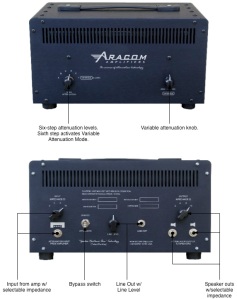
Aracom Amps PRX150-Pro AttenuatorAs many know, I’m a big fan of attenuators. In the past I’ve owned a couple and have tried out several. And with the addition of the Aracom PRX150-Pro to my rig, I’ve finally got a device that is helping me realize all the tonal goodness my amps have to offer. But this entry isn’t about the Aracom attenuator. There are a few attenuators that have entered the market in the recent past including the Faustine Phantom and others that are having the same effect on axe slingers and how they approach their tone.
So what’s the big deal? Most folks know how an attenuator operates. It sits between your amp and your speaker(s), and squelches the output signal from your amp which results in a lower output volume, so you can drive your amp to high gain levels and not shatter your eardrums. That’s the basic premise behind attenuators in general. But up until recently, attenuation came at a price, and that is the loss of tone and dynamics, or completely changed tone at higher attenuation levels; to put it simply, loss of tonal quality. I’m willing to bet that this very thing has kept lots of people from using an attenuator.

But with the new breed of attenuators hitting the market, loss of tonal quality is much less of an issue, if it’s an issue at all. Now you can bring your output volume WAY down, and be assured that the tonal quality you’ve worked so hard to achieve is still there.

So how will this change the way we approach our tone? I would venture to guess that many guitarists have really never known what their amp sounds like fully cranked up – at least for extended periods of time. Sure, if you’re a pro and regularly play huge venues, you know what it sounds like. But for us mere mortals who rarely play in more than a dance club, we’ve never been able to fully experience the cranked up tone of our amps, and that’s where a great attenuator comes into play.

When I hooked up my PRX150-Pro, the first thing I did was to set it on load mode and turn the variable to full attenuation, then dimed the master and volume on my amp to see what it would sound like. I wasn’t prepared for the onslaught of new tones that were suddenly available to me: rich harmonics, tons of sustain, and incredible touch sensitivity. It was as if a whole new world was opened up to me.

With my old attenuator, I rarely went to real high levels of attenuation because it made my tone sound weak and lifeless.  Plus, I didn’t want to burn out my tubes – which I learned the hard way when I cranked my amp while hooked up to the attenuator. But with the Aracom attenuator, I knew I could crank it as high as I wanted to and still be safe. What this means is that I now have access to a wider landscape of tones and dynamics that I can also safely reach. And that’s another feature of the new breed of attenuators: They appear to be much safer to use than the older designs out there.

Here’s an interesting question I got from a buddy of mine: Will I get rid of my overdrive pedals as a result now being able to get the fully cranked tone of my amp? Not on your life! 🙂 I love how they add color to my tone. But I will tell you this: Now that I can crank up my amp to high gain levels without the concomitant high volume levels, I’m actually not using my overdrive pedals as much. Oh, I still use them because they add certain characteristics that aren’t possible with my natural overdrive tone; just not as much as I used to because when I want just straight amp overdrive, I just crank my amp. But when I want to use them, I run them through the clean channel of my amp that has lots of clean headroom, so I can take advantage of the tone that they offer.

So is it a significant change to how we approach our tone? Possibly. I know of some folks who’ve completely stopped using overdrive pedals altogether as a result of using an attenuator, and use a clean boost or even just their volume knob on their guitar to get the lead volume they want. Me? I like to have a few different “brushes” that I can use to create different textures, but in either case, getting that cranked up tone naturally without shattering eardrums is pretty huge.

I think the folks who will gain the most from these great new attenuators are the home studio musicians. Imagine being able to record a screaming guitar solo, and not have the wife or neighbors yelling at you to turn down your volume! I regularly do my recording into the wee hours of the morning, so having an attenuator has been a godsend. But up until I got my PRX150-Pro, I had to wait to record solos until it was day when I could turn up my amp to a gain level that didn’t get me yelled at, as my other attenuators just didn’t give me the tone I needed at high attenuation levels. Even if I used an overdrive pedal, it doesn’t sound good unless it’s working with your amp and pushing your pre-amp tubes, and that takes juice! With a great, transparent, or non-tone-sucking attenuator, you can push your amp hard, and keep your volume under control!

I know of a lot musicians who poo-poo the use of an attenuator. But an attenuator can do wonders for gigging. Want to make the sound guys happy? Here’s another way to look at it: With an attenuator, you can focus on your tone, and not projecting out to the audience. Get enough volume to hear yourself on stage, then let the sound guys do their thing. PA technology has come a long way since the early days of rock and roll, where amps had to be played loud to get the sound out to the audience. Also, if you think about it, speakers are highly directional. If you want to disperse your sound, use the PA.

There’s been an interesting thread that I’ve been lurking on The Gear Page entitled, “Sound guys think I’m too loud.” Someone suggested early on that the original poster could use an attenuator or a smaller amp to reduce their volume. The suggestion of using an attenuator went largely ignored, but as I followed this thread and read all the various insights, using an attenuator is the perfect solution for this.

I’ve heard a lot of the complaints about attenuators in the past, and I’ve also had my issues with them. But with the new breed of attenuators, tone suck is no longer an issue. And that tonal quality will be sure to change how guitarists approach their performances.

Read Full Post »

Reason Amps BambinoCruising the forums this morning, I came upon a statistic that just blew me away; probably more so because I completely missed it when it first came out. But better late than never… Anyway, the guys at Creation Audio Labs did a loudness comparison of various amplifiers in different wattage ranges at the recent Nashville Amps Show. For the 1 – 20 Watt category, the Reason Bambino had a loudness of 120.2 dB through a Greenback!

That’s moving some serious air for an 8 Watt amp, and just goes to show you that’s it’s not necessarily wattage that determines how loud something is. Power handling is the key, and Obeid Kahn of Reason Amps is wizard with power handling.

I’ve been extolling the Bambino not only for it’s great tone, but also for how loud it can go. Friends have said an amp this small will never move enough air to gig with; I’ve proven them wrong time and again, but mostly through verbal argument. But now, with a number to back up the argument, I can confidently say that this amp can do it! I regularly use it for gigging with my 1 X 12 cabinet, and have absolutely no problem hearing myself over the drums. But let’s be clear: I’m not using the amp to project my sound out to the audience. I’m using it more as a direct stage monitor, of which it is PERFECTLY suited. I get my sound out to the audience by plugging directly into the PA board from the balanced line out, or miking my cabinet.

I’ve mentioned this before, but I’ll say it again. Going lower wattage with your amp(s) is really a change in performance setup philosophy. Those who’ve embraced this understand that you really only need stage volume nowadays with the much better PA system technology that’s out there. Even moderately sized PA’s work better than stuff twenty to thirty years ago. The important thing to them is to be able to get their cranked up tones without peeling the skin off their faces and turning their eardrums into a liquid mess. Take for instance Matthew Followill of the Kings of Leon, a band that is really gaining popularity and starting to play a lot of arenas. I was amazed to read in an interview that he plays through a 50 Watt Ampeg Reverb Rocket. As he said in his interview, “I’m a big fan of smaller amps turned all the way up, instead of big amps turned up halfway…”

Circling back to the Bambino, it is a great, versatile amp that is really starting to turn heads; not just from its tone, but how well it can project its voice!

Read Full Post »

dylan_brock Just went to see a fantastic SF Bay Area band called LUCE (pr. “loose”) last night at the Little Fox Theatre in Redwood City. This is a medium sized club with a decent sized stage. Their music is in the Alt-Pop realms, even close to Folk Punk, but who cares? They make great music!

In any case, I had a chance to rap with Dylan Brock, LUCE’s guitarist. That dude can PLAY! He was playing through a Hiwatt Custom 20 through a matching Hiwatt 2 X 12 cab (didn’t get what speakers he had). Granted, the venue wasn’t an arena, but he was plenty loud with just 20 Watts! The sound guy used what looked like a Senheiser e609 amp mic on his cab to run through the PA, and his tone was simply killer!

It just goes to show that you don’t need a lot of wattage to get your sound out. He just needed stage volume, and the sound guy did the rest! I always speak about the virtues of playing with low wattage amps. The thinking is that when you can work your power tubes into your tone equation, very good things happen. Dylan totally proved that point last night!

If you want to hear more about them, check out LUCE on iTunes!

Read Full Post »

guitars3

Right now, it is an absolutely AWESOME time to be a guitarist! There is so much great gear out there nowadays, that it’s hard to choose what to get. But the great thing is that there is SO MUCH to choose from! For example, look at all the great overdrive pedals that are out there right now. It is freaking amazing, I tell ya!

Some might think that there’s too much gear out there right now. That may be, but it also means that if you spend the time evaluating gear, you’ll most probably find exactly what you’re looking for – at least for now. 🙂

I say “at least for now” because if you’re a gear freak like me, it’s not too long that you want to add something to your rig to enhance your tonal palette. It’s a bad disease, this gear addiction, but it is oh-so-incredible.

But back to the topic at hand, with this much gear, you might think that the likelihood of making a bad choice is also fairly large. But the interesting thing that I’ve found is that most of the gear out there is really high quality, and not only that, at great prices.

Take, for instance, handmade, hand-wired boutique amps. Traditionally, boutique amps have sold for thousands of dollars. But there are some boutique manufacturers out there that are creating great-sounding, high-quality, hand-wired amps for a reasonable price. Most of these are “entry-level” amps meant to establish the manufacturer’s sound and quality, and to provide inroads to their flagship products. A good example of this is the recently released Reason Bambino, an 8/2 Watt tone machine. Priced at $699 and packed with tons of features, this is one of those must-have amps for the studio, and for small venues; not to mention that the tone this amp produces is simply to die for!

Then there are manufacturers like Valve Train Amps and Aracom Amps who simply make reasonably priced, hand-wired amps. Period. Their philosophy is that great tone doesn’t have to cost a lot. And while they’d probably admit that their margins are lower compared to their more expensive brethren, they’ll be the first to say that they want to get their gear into as many players’ hands as possible. With Aracom’s VRX series, that has been the case. Jeff has found a real magical tone with the VRX series (they come in 18 and 22 Watts EL84/6V6 respectively). The heads are $895, and they sound absolutely KILLER! He has been selling these things as fast as he can create them!

But I believe the greatest stuff is coming from the pedal makers. There are absolutely killer pedals out there! And it seems each week brings yet another promising pedal to the industry. There are so many, I can’t keep up with them! Off the top of my head, here are some stellar pedals that have recently come out that are worth a look: TC Electronic Nova Repeater, The Original Geek GeekDriver, Kasha Amps Overdrive, Effectrode Tube Driver, Catalinbread Dirty Little Secret, Tone Freak Effects Abunai 2. Yeah, yeah, I’ve mentioned OD pedals. Well, you know how much I love ’em. 🙂 My personal favorite right now is the GeekDriver, and it will always be on my board. It’s not really an overdrive, and it’s not completely a booster. It’s something in between, and it’s freakin’ awesome, especially when it’s used to drive my Abunai 2, or Creation Audio Labs Holy Fire. As Geek explained to me, the GeekDriver was meant to be stacked. Very cool! And at $205, it is not out of this world.

Even things such as strings and picks are out there for us to enjoy! As far accessories are concerned, they actually start getting a bit more pricey at the “boutique” level, but they are so worth it! I swear by Wyres Strings and V-Picks and Red Bear Picks. Especially with the picks, I’ve paid up to $30 for a single pick, but they last a long time with care, and not only that, they feel so good in your hand that you don’t even notice that they’re there. And that’s what a great pick will do for you.

I could go on talking about great gear that out there, but I’ll just say this one more time: It’s a great time to be a guitarist!

Read Full Post »

« Newer Posts - Older Posts »