Feeds:
Posts
Comments

Archive for the ‘amps’ Category

4 Tone Bones - Excellent gear, that exceeds expectations of its performance, value, and quality. Strongly consider purchasing this. Fender® Champion 600

Price: $149 (street)

Summary: Great tone can come in small packages, and the Fender Champ is a great example of this. Simple and straight-forward, it’s easy to use, and even easier on the pocketbook. Not really meant to be used as something you’d gig with (though you could easily add an extension cabinet), it’s a great amp for practicing and for the home studio recording artist looking for a low-wattage solution.

Pros: Vintage looks and great sound and quality for a small price.

Cons: You sacrifice a bit of low-end for the diminutive size.

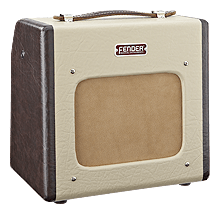
Fender Champion 600 Re-issue

Recording in a home studio presents various challenges to the DIY recording artist. But no other challenge is greater than controlling the output volume of amps, especially if you want to push them into breakup. To get even a small amount of breakup, you’ve got to increase gain to push the pre-amp and/or power tubes; and invariably, this is accompanied by a boost in output volume. There are various ways to deal with this from creating amp enclosures to using attenuators or even installing tube adapters to use lower wattage output tubes, and they all work reasonably well. Another approach is to simply get a smaller wattage amp in the 5 – 15 Watt category. Most have much smaller speakers than their larger counterparts, so their output volume is naturally lower, plus with the smaller wattage, it’s easier to overdrive them at lower volumes, thus producing breakup without shaking tiles loose.

Among the 5 Watt amps available, the two seemingly most-popular amps are the Fender® Champion 600 and the Epiphone Valve Junior Combo. I recently had the chance to try out the Champ.

Vintage Roots, Great Sound: Bargain Price

First of all, let’s be real honest: The Champ is a $200 amp, sporting a single volume knob and a standby switch. That’s it. This is not an amp that you compare to a boutique amp in any respect, so don’t try to compare it to something like a Carr mini-Mercury – they’re in two completely different classes! A re-issue of the original 1950 Fender Champion, it employs modern mass-production techniques as opposed to the hand-wired, point-to-point construction from which most boutique amps are built. But for what you pay for this amp, and for the quality of sound that it produces, you just can’t go wrong. Bear in mind that the Champ is a no-frills amp whose sole purpose in life is to amplify the natural sound of your guitar. It’s not meant for gigging with a full band. On the other hand, it creates really nice tone (albeit with a little loss of the bottom-end). As long as you don’t try think of this amp as any more than what it is, it’ll make you pretty happy.

Looks

This is a very retro-looking amp, with the original two-tone brown on beige tolex design. It actually looks like a mini television! and the leather handle is a real nice touch – though I’d be careful not to strain the handle too much… It’s a little weird to see a single volume knob, but that just tells you that this is a no-frills amp, as I mentioned before.

Sound Quality

I’ve already mentioned that the Champ produces really nice tone, and even though I missed the bottom-end that you’d get with a larger speaker, the quality of the sound that it does produce is stellar. Besides, in a recording application, you can always tweak the bottom-end a bit with EQ, but I digress. I tested the Champ out with a G & L Comanche, a Strat, and a Les Paul Standard. As expected, the amp reacted very differently with each of the different guitars, but surprisingly, it retained the character of each guitar, which I thought might be lost because of its diminutive size. The Strat played clean and smooth, and position 4 (center/bridge) was twangy and ringy as expected. What surprised me even more was with the Strat, I couldn’t get the amp to break-up until I cranked the volume past 9 (it goes up to 12). There’s lots and lots of clean headroom with single coils, so if you want to get break-up, you’d be best served using an overdrive pedal of sorts.

It was far easier to get amp to break up with the Comanche and Les Paul, as expected. It was a bit more difficult with the Comanche as it uses the hybrid Z-coil pickups, but it was still easier to get breakup than with he Strat. The LP broke up nicely with volume at about halfway, and the volume knobs pegged.

From a distortion standpoint, the Champ produces distortion similar to a Fender Deluxe. It’s not creamy smooth, but it’s also not too gritty – though it does get really ugly at high volumes – probably due to speaker distortion, which is never nice. But dialed in just right, the Champ produces really subtle breakup which is very ringy and pleasant.

Being that you can’t really do much tone shaping with the amp itself, it’s up to you to throw whatever boxes you need to achieve the tone you’re after. But that shouldn’t be too much of a problem for most folks. Besides, in lots of cases, you may not want to put any boxes in your signal chain before this amp. Here’s a decent-sounding YouTube video that demonstrates how the Champ sounds. I think you’ll be surprised:

Value

For the money, it’s hard to go wrong with the Fender Champion 600. A cheaper alternative would be the Epiphone Valve Junior which costs only $129.00 for the head. I’ll be writing a review for that as well in the very near future, but if you’re looking for that nice, Fender clean tone in a low-wattage application, but don’t want to shell out several hundred dollars for even a small deluxe, the Champ is a great way to go!

Update: As you can see at the top, the price listed is $149. Fender dropped the price after I wrote the article. Of course, I paid the original $200+ for the damn amp, but there you have it…

Read Full Post »

5 Tone Bones - Gear has stellar performance, value, and quality. This is definitely top of the class, best of breed, and it’<p><p>s a no-brainer to add this to your gear lineup! The THD web site says of the Yellow Jackets, “It’s like having a new amp…” and that’s an understatement! Pull your old tubes, pop in the converters, then plug in the EL-84’s and listen to your amp sing! Sometimes great things just come real easy! Read on….

If you follow this blog, you know that I just recently did a write-up of the THD Yellow Jackets. At the time though, they were just on order, and I hadn’t played with them yet. Well, they arrived today, and of course, I just couldn’t wait to get them installed. I opened up the packing box which revealed a little plastic box floating amidst a packing popcorn. I quickly pulled it out, opened up the box, and pulled out the instructions… er… what little of them there were. They basically just said, pull out your old tubes, plug in the converters, then plug in the EL-84 tubes that come with the converters. Turn your amp on, and play. That’s it. It took me all of three minutes to get the converters and new tubes installed.

In nervous anticipation, I plugged my Epi Explorer into my amp and switched it on, strummed a G chord on my clean channel and… No change. Just the same sweet sound produced by my pre-amp tubes. Then I switched to my drive channel and WAS TOTALLY BLOWN AWAY!!! You see, as much as I love my Hot Rod, the drive channel has been somewhat useless for me. Even with new 6L6GC tubes, the clipping was very rough and gritty. It was okay for some songs, but was just not pleasing to me, so I did the next best thing: I bought a couple of overdrive boxes to get that sweet pre-amp distortion.

But with the Yellow Jackets installed, I finally have a useable drive channel! The distortion is smooth, and it seems like the touch sensitivity has increased ten-fold! Not only that, it sounds like the converters introduce a little compression which really helps define the tone, and all this at bedroom levels!Mind you, installing the Yellow Jackets doesn’t reduce your volume (I think I might have mentioned that they do – my bad – they don’t). What they do is get the amp into breakup a lot earlier, so you can slather on the drive and distortion without having to shake the walls of your house! For home studio musicians, and most of us who play in small venues, being able to get great distortion tone at low volumes is akin to searching for the Holy Grail. I’ve tried all sorts of things from upping the input gain on my DAW to using modelers. In either case, the result is less than desirable. But with the Yellow Jackets, I’ve found the elusive grail, and I’m lovin’ it!

As I mentioned in the previous write-up, I ordered the Triode version of the Yellow Jackets. This essentially reduces my output to 5 Watts. Don’t be fooled – my amp’s still freakin’ loud. But what I’ve found in the last couple of hours playing with my three main electrics is that my amp is much more versatile. I can still crank up the volume, but I can get a lot more varied tones at lower volumes, and that is always a good thing.

By the way, you can’t buy the Yellow Jackets from THD directly, but you can get them for a great price at The Tube Store. I got mine for $99.95 (that includes two converters and two EL-84 tubes).

Read Full Post »

THD Yellow JacketOne of my first posts on GuitarGear.org was entitled, “Turn that F&%kin’ Thing Down!!!.” In that post, I introduced the Dr Z. Air Brake attenuator. Yes, I’m still using it, but I continued to search for that volume sweet spot. Even with an attenuator, my volume’s still pretty loud, but it’s much more controllable now than when I didn’t have the attenuator. However, an attenuator can only take you so far, because it is essentially a power resistor. It doesn’t reduce your power in any way. But all that’s changed…
Introducing the THD Yellow Jacket

I discovered this in the latest issue of Premier Guitar in the DIY amp column (don’t remember the original column title, sorry). Essentially, the Yellow Jacket is a combination adapter/tube replacement for 6V6, 6L6, EL34, and 7591 tube amps. Using lower-output EL34’s the output wattage of your amp is significantly reduced, thus lowering your amp’s volume. The following comes right off the THD web site:

What are Yellow Jackets®?
Yellow Jackets® Converters are a type of specialized adapters which permit the use of EL84/6BQ5 power tubes in place of 6V6, 6L6, EL34, and 7591 types.

How do they work?
They give you simple Class-A operation from any amp.Yellow Jacket® Converters not only rearrange the pin locations of the tubes, but also provide the necessary current limiting on the screens and cathode as well as blocking the amplifier’s grid bias voltage, while configuring the EL84 in a Class-A, Self-adjusting cathode-bias circuit. In other words, there are no adjustments to make and no modifications necessary, you simply plug the Yellow Jackets® into the amp’s output tube sockets, (in cathode-bias amplifiers) screw the ground wires under one of the output tube socket mounting screws, plug the provided EL84’s into the Yellow Jackets®, turn on the amp and play.

How will they change my amplifier?
It’s like getting a whole new amplifier! In Champ and Deluxe type amplifiers, the Yellow Jackets® output is smooth, strong and more even than with the stock 6V6s. When the Yellow jackets® Converters are installed in larger amplifiers intended for 6L6s or EL34 output tubes, the high plate and screen voltages are reduced as well as current limited to protect the EL84 and to drop output power. When a pair of Yellow Jackets® are used in a Marshall 50 watt or similar amplifier, the overall power drops to about 20 watts and takes on more of the character of an old Vox AC30. The distortion is smoother and more even and the output is both substantially reduced and more compressed due to the Class-A nature of the Yellow Jackets®. In a 100 watt amp like a Twin Reverb or Marshall 100, either two or four Yellow Jackets® can be used. If only two are used and the other two sockets are left empy, the output is dropped to about 20 watts. With four in place, the amp puts out about 40 watts and takes on a whole new warmth and richness.

In the cases of the YJ7591 converters, the overall ouput power remains the same, but the sound becomes fuller and the extinct 7591 are replaced with common and inexpensive EL84 tubes. In old Ampeg Reverb Rockets and the like, you experience a warmth and sweetness that you could never get with the now unavailable 7591 tubes.

Will they hurt my amp?
No! Yellow Jacket® converters are safe for all amplifiers and transformers. As all Yellow Jacket® Converters internally limit voltage and current they put no extra strain on amplifiers’ power and output transformers or internal components. Using the Yellow Jackets® in higher powered amplifiers actually reduces the strain on the transformers and internal components because it reduces the overall wattage of the system. Furthermore, the heater (or filament) current of the EL84 is lower than that of the 6L6, EL34 or 7591, so the Yellow Jacket® will reduce the strain on the filament windings of the power transformer as well.

I called THD about the Yellow Jacket to find out what was appropriate for my amp. Most Yellow Jackets come in two flavors: a Standard that lowers your output by 50-70%, and a Triode version that lowers your output by 70%-90%. I went with the Triode version for my Hot Rod so I could essentially have a 5Watt amp. According to the guy at THD, the great thing about the Yellow Jacket is that you don’t lose your tone. Just reduce your power. The Triode version also has a smoother distortion and earlier breakup – at lower volumes, which is what I want for my home recording, and playing Church.

So if you’re in search of lowering your volume but not having to invest in a smaller amp, look no further! The THD Yellow Jacket is it!

Read Full Post »

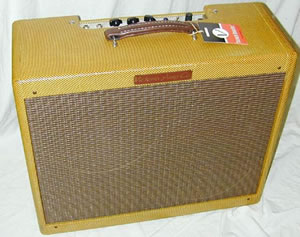
Victoria Amplification Double DeluxeTalk about getting a “clean” tone, and invariably, some Fender amp will be mentioned, especially the models from the 50’s like the Twin. By far, “Fender clean” is the clean tone that has been emulated for decades by amp manufacturers the world over. Unfortunately, if you want that clean tone from the 50’s, you’ll have to get a used Fender amp from a vintage shop – and they’re not cheap. Enter Victoria Amplification. As Mark Baier (owner of Victoria Amps) says on the company site’s “About Us” page:
In 1993, I set out to faithfully recreate the crown jewels among the many classic amplifiers developed by Leo Fender. The tweed amps of the late ’50s defined the sound of rock and blues on vinyl and on stage, but they had also become increasingly scarce, and well beyond the reach of most working musicians.”

And recreate the sounds of those amps he has! So much so, that one might be inclined to say that his amps are even more “Fender than Fender,” as each amp is meticulously hand-wired point-to-point. Most Fender amps today rely significantly on solid state technology, especially for amps in the 40+ Watt range; for instance, using solid-state rectifiers to convert AC-DC current. Granted, solid state rectifiers are considered to be more “reliable” and don’t suffer from voltage sag like a tube rectifier. However, that voltage sag can actually be a real plus when using a tube rectifier as the sag can act like a compressor/sustainer as the voltage builds in the rectifier when you strike a note on your guitar. Thus, amps with tube rectifiers tend to sound “warmer” than their solid-state brethren.

I recently had the chance to plug into a “Double Deluxe,” and I have to say that I am now in love! In testing, I played the Double Deluxe with a Fender Custom Shop ’57 Re-issue Strat (I didn’t have enough time on my lunch break to plug other guitars into it). The first thing I noticed was the touch sensitivity of the amp, even at low volumes. Cranking the volume knob on the guitar produced a singing clean tone, with just the hint of breakup. With my own Fender Hot Rod Deluxe, to achieve this at lower volumes means I have to use a drive pedal. But this little amp, responds well to input gain; I think the tube rectifier has a lot to do with this, though it doesn’t matter. It just sounds great!

The Double Deluxe also responds well to attack. Light finger picking produces beautiful ringing tones, while a heavier, driven attack produces a pleasing, even-toned crunch that is like candy for the ears. Unlike a lot of newer Fender models, the Double Deluxe responded very well to tone settings (there’s just a single knob), which was very impressive, as I could dial in the tone for fatter, thinner, or balanced tone presentation. No matter how you set the tone or attack the guitar, the Double Deluxe retains note definition, and doesn’t muddy up at all.

The 2 – 12″ Jensen P12Q vintage speaker re-issues also have a lot to do with how great this amp sounds. These are generally very warm speakers that don’t squeak with lots of high-frequency harmonics when pushed. Rather, what you get is a very complex sound that you can tweak with the tone knob; and here’s an interesting thing: This amp has no reverb, but you could swear that there’s reverb built in! That’s a testament to the beautiful complexity of sound that this amp generates.

Operating the Double Deluxe is pure simplicity. Plug into one of the inputs (normal or bright – the amp has four inputs so you can jumper between the two “channels;” hence the “Double” in “Double Deluxe”), set the volume according to the input you’re using, then dial in the tone with the single knob. How much easier could it get? You might be thinking that you need individual control over lows, mids, and highs, but this amp just doesn’t need it. Just set the tone knob to what’s pleasing to you and play.

Here are some specs (taken off the web site):

  • Completely hand-wired point-to-point
  • 5E3-type circuit. Class A cathode bias push-pull operation. (40 Watts by default)
  • Tube complement:1-5AR4, 4-6V6GT, 1-12AX7, 1-12AY7
  • 2-Jensen P12Q speakers
  • Cabinet Dimensions (HxWxD, Inches) 20.5 x 24.5 x 11
  • List Price: $2695.00 / ~$1900-2000 (street)

Note that you can swap the 5AR4 rectifier with 5Y3 rectifier to reduce the amp’s output to 30Watts. Very cool.

When I first saw the list price of this amp on the Victoria Amplification web site, I gulped. I thought these amps were accessible. But I looked around, and you can get one for less than 2 grand, so I was calmed immediately. And for the price, what you get is a lot of amp that you can use for all sorts of applications.

Over the past couple of years, I’ve played lots of different amps from big manufacturers to small boutique shops. And among the tweed amps I’ve tested, Victoria Amps Double Deluxe is at the top of my list. If you’ve got a distributor near you, I suggest taking a trip there as soon as you can. You won’t be disappointed!

Read Full Post »

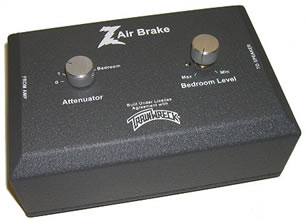
Dr. Z Air Brake

About six months ago, I wrote a little ditty about the Dr. Z Air Brake, but I thought I’d revisit this essential piece of equipment once again. The Air Brake is a power attenuator; in other words, it reduces the amount of signal from your amp that reaches the speaker, thus reducing your audible output. Before I go any further, the big question is: Why would you want to reduce the amount of signal going to your speaker from your amp. There’s actually a very good reason: Overdrive.

With tube amps, especially those with multiple-stage gain, you can’t achieve that warm clipping (read: creamy distortion) without upping the drive to your power tubes. Unfortunately, that also means you have to crank your amp, as achieving those nice distortion characteristics is a function of both drive and gain. The net result in turn can shatter your eardrums in an enclosed space, or worse yet, have your family or neighbors scream at you for playing too loud in your garage. A power attenuator allows you to drive your power tubes into clipping but do so at a significantly reduced volume. For home studio enthusiasts like myself that usually record late into the night, this means you can work on recording projects without the fear of waking up my family or pissing off the next door neighbors (which I have done many times).

There’s a good FAQ about power attenuators and how they work here. I won’t go into the technical details, but suffice it to say that with a power attenuator, you can play at acceptable volume levels while still being able to drive your amp. With that let’s get into the Dr. Z Air Brake features.

The Dr. Z Air Brake is incredibly easy to use, though in addition to the unit, you’ll need a couple of good-quality audio cables with 1/4″ plugs. If your amp’s output goes straight to your speaker and is then soldered to the speaker leads, you’ll have to do some splicing and soldering, though most tube amps today use a 1/4″ output jack. Once you’ve got the unit hooked up, you have five levels of attenuation: 0 through 4 and Bedroom. The “0” setting is total bypass, while the 1-4 settings impose approximately -2.5dB attenuation with each position by default. If you open the unit up, you can actually increase or decrease the amount of attenuation at each position by moving the leads along the resistors (this is explained in the accompanying manual – it’s a single sheet of paper). The “Bedroom” setting is what sold me on the unit. When you have the Attenuator knob set to “Bedroom,” the “Bedroom Level” knob comes into play. This provides variable signal attenuation down to 1 Watt (for sub-100 Watt amps) at the maximum level, though at this amount of attenuation, your tone really changes because the speaker cone doesn’t move enough air, thus producing a VERY thin (read: ugly) tone. I usually set my Bedroom Level knob to about 10-11 o’clock, the play with my drive and volume knobs on my amp until I’ve dialed in a good tone. Frankly, it doesn’t get much easier than this.

In addition to the variable bedroom level control, I chose the Dr. Z Air Brake after evaluating and reading various reviews, and speaking with other folks who have one. The most popular attenuator at the time I was reviewing attenuators was the THD Hot Plate. I tried one out at a shop, but didn’t like the sound that came out of it all. It literally changed my tone. The Dr. Z Air Brake, on the other hand is much more transparent, even at bedroom levels. As far as gigging is concerned, since I play a lot of small venues, it’s a real helpful piece of equipment because it allows me to drive my amp when I play with my band without stepping on the band’s overall output.

CAVEAT EMPTOR

Many people buy attenuators thinking that once they’ve attenuated their signal, they can drive their power tubes to their highest levels. It’s true, you can do this. But you’ll also burn through your tubes pretty quickly, or worse yet, you’ll damage your amp’s electronics. I’ve heard about this happening especially with resistive attenuators. People crank their drive, and after a few minutes start smelling something burning as their amp’s internal electronics fry. Also, driving your power tubes into super saturation doesn’t do anything but cause a lot of ugly distortion. When you drive your power tubes, the tone you should expect is a smooth distortion, as the intermixing sound waves weave together beautifully. Adding even more power creates a much larger contrast between the peaks and valleys of the distorted wave, and what you end up getting is a very “dirty” sounding distortion that is not in any way pleasing to the ears. So beware if you’re in the market for an attenuator!

In closing, if you’re like me, and play in a variety of small- to medium-sized venues, a power attenuator can be your friend. For me, mine is always hooked up. It has saved me from a lot of headaches and eliminated complaints!

ROCK ON!

Read Full Post »

If you’re looking for the ultimate in clean tone, go no further. Fender is the clean standard, bar none, and the Twin Reverb is the definitive clean amp. Like the original, it is a no-frills, no fuss amp, providing 85 watts of beautiful clean tone. There is no drive channel with this amp, folks. You get a normal mode and a reverb/vibrato mode. That’s it. But the clean tone that comes out of this amp is absolutely heavenly! I played two guitars with it: Custom Shop Strat, and a Les Paul Standard Double Cutaway.

With either guitar, I couldn’t get the amp to break up unless I cranked the volume on the guitars and amp to max – then it got really ugly. So when I say this is the definitive clean amp, I really mean it. For those of you who want distortion coming from saturated tubes, you’re out of luck here, but that’s not bad. One of the reasons this amp has had such success is that it takes pedals very easily. In fact, you might consider it to be a “tone canvas” that provides the base clean tone which you can color in a variety of ways using pedals.

The big difference between the Reissue and the original is that the reissue uses a solid state rectifier as opposed to using a tube rectifier. This might turn off tube amp purists, but I can see the logic of using a solid state rectifier: It keeps the cost of the amp way down, and you know what? I doubt that you could actually notice a difference.

Another thing… typical of Fender amps, the Twin Reverb is LOUD! The 2 X 12’s move a lot of air, so be forewarned! All in all, the Twin Reverb is a great, tone-shapeable amp, definitely worth a look!

Read Full Post »

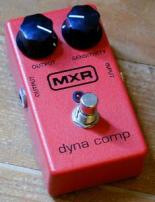
379_image_med_mxr-dynacomp.jpgI’ve been searching for a decent compression/sustainer for a long time, and I’ve tried out a bunch over the last year. Surprisingly enough, it wasn’t until recently that I decided to check out the MXR DynaComp. The DynaComp has been around for a long time, and has several faithful followers. Unfortunately, I’m not one of them. It’s not that this is a bad pedal – it’s pretty rugged, very simple to use, but it just doesn’t have what I need for the type of music that I play, which at the moment is bluesy and I use minimal overdrive. But I digress. This won’t be a long review. I’ll just give you my assessment…

I tried this out with a LP Double Cutaway and an American Standard Strat. For amps, I used a Fender Twin Reverb and a Marshal JCM 600 combo. Here’s what I found:

For clean playing, if you want a transparent box, this is not the box for you. It colors your tone quite a bit, even at lower compression levels. This is okay, if that’s your aim, but for me, since I prefer a bright sound, the amount of squeeze with this box was just too much for my tastes (though my dad who was with me liked how it sounded with the LP DC running clean through the Fender Twin). On the positive side, there was lots of headroom with this pedal, and no noticeable signal noise unless I cranked the intensity.

Where this box did shine was with the JCM in the high gain stage. The DynaComp really added a nice level of definition when used with heavy distortion (Note: my dad’s 75 year old ears couldn’t take the loud distortion so he waited outside the sound room :)). That was something I really dug about this box. The JCM 600 is one of those Marshall classics that has lots of crunch. The DynaComp smoothed that out a bit, but didn’t ruin the tone in the process. Nice.

Overall, this is a nice pedal if you regularly play in overdrive mode. But as I said, if you’re looking for a transparent compressor to use in your clean channel, I’d look elsewhere.

Read Full Post »

A few months ago, I was in a rush to get to a gig. I didn’t keep good track of time running errands beforehand, and had to make a mad dash home to pick up my gear. Once home, I frantically loaded up my mini-SUV with my gear, took a quick “make-sure-everything’s-there” look, hopped into the driver’s seat, and sped off.

Now, as many gigging musicians know, rushing to a gig is a recipe for disaster: You’re stressed when you get to the venue; that stress in turn makes you rush even more once you get there; and when you’re rushing, you tend to forget things. That gets you even more pissed, and the net result is that nothing goes very smoothly.

Such was the case on that fateful day of rushing to my gig. In the corybantic state I was in while loading my car, I had overlooked loading something that is central to my setup: My gear bag where I carry all my pedals, cords, extra picks and my tuner. While unloading my vehicle, I didn’t even notice that it was missing. I felt rushed, yes, but I also felt confident that I had all my stuff, and could just set up, go through sound check, and be ready to perform. It was when I went to set up my gear that I suddenly realized my gear bag was not present. Talk about being pissed! I had to leave the building to regain my composure.

Once I calmed down, I went back inside, gave a small chuckle of futility, and asked my band members to help me out. Luckily we always have extras of stuff, so I borrowed a couple of cables, plugged in my amp and guitars, then went outside to lock up my car. As I was closing the tailgate, I looked inside the cargo area of my mini-SUV, and lo and behold, sat two of my pedals: my trusty Boss Chorus, and my TS-808 Tube Screamer. I had taken them out to jam with a friend the night before, and laziness kept me from putting the pedals plus my power snake back into my gear bag! All was not lost. I was still missing three pedals, but hey! Two are better than nothing.

With glee, I returned to my setup and inserted the pedals into my signal chain, and we got ready for sound check. I was a little dubious about how things would sound without my full array of pedals, especially my BBE Sonic Stomp that really helps contour the lows in my amp, but once my amp warmed up, I couldn’t believe the clarity of sound that was coming through my amp! I was in absolute heaven! Granted, I had to tweak the EQ a bit, but I was beside myself with how good my amp sounded. So what started out as a potential gig-breaker, turned into a blessing in disguise.

Now, I only play with the chorus and tube screamer in my signal chain, though I may add a tube reverb in the near future to get different reverb effects in addition to the stock spring reverb in my amp. But I’m in no rush (excuse the pun). In any case, I’ve learned a couple of valuable lessons:

  1. Always give yourself a lot of time to prepare for a gig.
  2. More is not necessarily better with respect to effects. This is a point I need to discuss a bit…

With respect to item 2, I bought all my effects when my amp was new. While I loved the way it sounded out of the box, I felt that it had some rough edges, so I smoothed them out by adding pedals to my signal chain to compensate. But after playing with this amp for over a year now, I think the reason it sounds so good without the pedals is because the speaker cone is broken in from frequent use. So a third lesson can be gleaned from all this: Spend the time to break in your amp. Depending upon how much you play, this could take weeks, or it could take months.

A final lesson I’ve learned is this: So much of your tone comes from your fingers – how you articulate the strings on the fretboard. Trust your fingers!

For me, I probably could’ve removed half of my pedals months ago, but didn’t know any better. Now I do. At this point, my tone has really evolved to a place where I’m absolutely happy, and that just drives me to get even better as a guitarist.

Read Full Post »

I was in a rush the other day to make it to the pre-service rehearsal at my church. I was farting around and didn’t keep track of time, and realized that though I could make it to rehearsal, I wouldn’t have that much time to set up my usual rig for Mass. I normally bring a couple of guitars, my amp (a modified Fender Hot Rod) and run through 5 effect pedals (Tube Screamer, Boss Chorus, Boss Delay, DigiVerb, and a BBE SonicStomp – and no, I don’t have them mounted on a board – yet). The guitars are A/B’d through a Morley ABY box.

As I said, I didn’t have much time, so I just loaded up my amp, Pearl (my beloved Strat), and my Tube Screamer into my little SUV,  and sped off to church. With so little equipment, I was able to bring it all into the church in one trip, and set up in 5 minutes. Being the leader of the band, it was imperative that I get set up quickly so I could run rehearsal.

Once I got set up, we started rehearsal. As we got further into it, one thing struck me: I wasn’t missing the tone from my other pedals! It helped that none of the songs in the set didn’t require any texturing (some of my songs were written to take advantage of a deep chorus). But just the raw tone coming from the amp (along with some spring reverb), sometimes combined with the edginess of the Tube Screamer, was incredibly pleasing to my ears, and it has made me really re-think the necessity of having a bunch of pedals. Not that I would do away with them altogether, but I’ve now decided to take a much more minimalistic approach to my tone. Actually, it’s sort of a relief, because it means I won’t be buying more gear in the immediate future – though as I’ve written in the past, I do have serious GAS.

But the GAS notwithstanding, there’s a lot to be said about just producing raw tone. Try it out, you may be very pleasantly surprised.

Read Full Post »

In a previous post, I mentioned that I may not get a boutique amp after making mods to my Fender Hot Rod Deluxe. But after playing several boutique amps over the past few months, I’ve changed my mind. There are a couple of reasons for this:

  1. First, a boutique amp has a distinct tone. You might think that the distinctiveness is limiting. But it’s not. To me, boutique amps represent the ideal tone right out of the box. For instance, I played a VersaTone 57 from Faustine Amps the other day. It had the tone I’ve been after: Smooth bass, thick mids (but not overpowering), and beautiful, harmonically-laden highs that seemed to float in the air. When driven, the resulting distortion was absolutely smooth as silk, with no high-end break-up. To achieve this tone with my Hot Rod, I’ve had to swap tubes, re-bias the power amp tubes, and throw a few effects at it. And I still get a high-end break-up, which means I have to bring the amp back into the shop to have a couple of resisitors changed. In essence, with bench time and equipment, I will have spent just a couple of hundred bucks short of what I would’ve paid for a VT-57.

    Mind you though, because boutique amps are very distinctive, you have to play a lot of them before you make a decision. I’ve tried out at least 20 different amps, and I’ve finally narrowed my search to two amps, and this search has taken a few months.

  2. Secondly, almost all boutique amps are completely hand-wired. Mass-produced amps such as my Hot Rod use a PCB board to route all the electronics – it’s efficient and cheap. The advantage of hand-wiring is that if you happen to blow a resistor or a capacitor, you can simply swap it out for a new one. On the other hand, you have to replace the entire PCB board if you blow a resistor since it resides on the board itself. Not fun. From what I understand, the typical life for a Hot Rod is about seven years under regular use. There are hand-wired amps from 40 years ago that still function great. For instance, I know a guy who still plays his ’65 Fender Twin Reverb. Back then amps were completely hand-wired, and he’s just made simple repairs over the years. So the point is that boutique amps are designed and built to last for decades, not just a handful of years.

So what about my Hot Rod Deluxe? Frankly, I still love it, and because I’m so satisfied with how it sounds, I’ll continue to play it until it dies. That may be 10 years from now, it may be a couple of years from now. When that happens, I’ll go with a boutique amp. But not before.

Read Full Post »

« Newer Posts - Older Posts »