Feeds:
Posts
Comments

Archive for the ‘Amps/Amplification’ Category

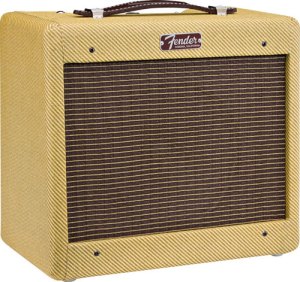
Fender Champion 600 Re-issueAs much as I have been ranting about Fender gear pricing as of late, and their latest “supposed” price drop (who knows for how long), my Champ 600 has been a tried and true companion in my studio ever since I got it. I’ve even used it at small venue gigs hooked to a 1 X12 cab, and it has performed wonderfully! This is a great amp!

Anyway, As I was doing a bit of research on the Fender price drop, I happened to go to GuitarCenter.com and couldn’t believe the pricing of the Champ 600 there! At $149, this is even cheaper than what I got it for two years ago!

Folks, this is phenomenal! While diminutive in size, this amp packs tone! You want classic Fender tone at a lower volume for home recording or just futzing around, this is the amp to get! And because it’s a low wattage amp, you can push it and not worry that your eardrums will start to bleed.

For my own purposes, this has been one of most pedal-friendly amps I’ve ever owned, so I retubed it with a NOS JAN-Philips 12AT7 and a JJ 6V6 to get maximum clean headroom out of the amp. Now, I have to open up the amp full to get even mild breakup. But that’s why I have my OD pedals. My thought behind this is that I want to get as pure character out of my OD’s as possible, so playing through a really clean amp will accomplish that.

So what’s the point of all this? As I mentioned above, this is a GREAT amp, and at $149, it’s a steal. Go get one at GC today!

Here’s a sample I recorded with the amp hooked up to my 1 X 12 extension cab:

Disclaimer: I’m not in any affiliate program with GC, so I get nothing out of announcing this. 🙂

Read Full Post »

Fender-'57-Champ-Reissue

I’ve had a love/hate relationship with Fender over the years. When I’ve loved Fender, I’ve really loved them, and when I’ve hated them, I’ve really hated them. Right now, I’m really hating them. I’m just aghast at the prices they’re charging for their new gear! This Champ ’57 Reissue from the Fender Custom Shop lists at $1295 with a street price of $999! This for a 5 Watt amp with a diminutive 8″ speaker.

Make no mistake: The parts for this cost less than $400! This pricing is absolutely outrageous. Yeah, I’m familiar with its history, blah, blah, blah. And even though I’m no electronics dude, and couldn’t possibly construct an amp myself, I know a few manufacturers who build hand-wired amps with more power and GREAT sound for even less!

Take for instance, the Aracom VRX22. This is a hand-wired, 22 Watt amp that simply kicks freakin’ ass, and the head sells for $895! Then, there’s the upcoming release of the Reason Bambino. This is an 8 Watt amp that will sport that distinctive Reason sound. This head costs $699! It’s my next amp.

I’m sorry folks, this is the same issue that I had with the Fender Roadworn series of guitars. I’m not really in to reliced guitars, but there’s no way I could justify paying $999 for a freakin’ MIM guitar, especially when I paid less than $400 a couple of years back for my MIM Strat.

MAYBE Fender’s production costs are much higher than the smaller run manufacturers (not likely), which is how they justify the price-point for this amp. But this amp is nothing special from my point of view, and as I mentioned above, the parts for this cost less than $400. Lots of people have built 5F1-based amps. Look at the Valve Train Amps Concord. This is a 6 Watt point-to-point, hand-wired combo with a 10″ speaker. It sells for less than $500.

Go ahead, you can argue all you want about the classic sound and history of the Fender ’57 Champ reissue. But to me, Fender’s just again trying to trade on nostalgia. If that’s what floats your boat, more power to you – and mind you – I’m not questioning the quality or the tone of this classic. It has done much to contribute to the sounds of rock and roll. I just want to make it very clear that there are clear alternatives out there that may not have the name but undoubtedly have great tone, and watt-for-watt, and dollar-for-dollar have A LOT more value.

Note that I have the Champ 600 and it is one of my all-time favorite amps. But it has limited usability outside of my home studio. And that’s another thing that bugs me about the ’57 re-issue. It’s a hefty price to pay for an amp that would see limited if any use outside of my studio.

Like I said, if this floats your boat, and the price of this classic reissue, more power to you. For me, I demand a lot more value for the money I pay.

Recent Update

I’m still not sold on this amp, even though I have indeed played it, and it has some real vintage mojo. The sounds it produces are fantastic, but I still can’t justify buying it for the price Fender wants for it. Besides, I’ve seen some late-50’s originals that sell for the same price on EBay! I would buy one of those before I’d buy the re-issue.

Read Full Post »

What’s handmade, black and gold, and has the potential to catapult you into tonal heaven without breaking the bank and more importantly busting your eardrums? Simple: The soon-to-be-released Reason Amps Bambino! This article is the first news glimpse of this brand-new 7 Watt amp from the Reason guys that has all the tonal goodness you expect from a Reason amp but at volume level that won’t make your ears bleed, and almost as importantly, is easily within the financial reach of most cash-strapped gear sluts.
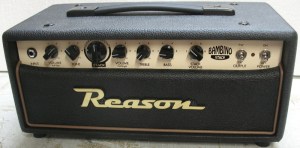
Reason Amps Bambino
When I first reviewed the Reason SM25 and the Reason SM40, I knew that what I was hearing was something special. These amps weren’t clone designs, and didn’t sound like anything that I had played before. Yes, they were based on classic 6V6 and EL84 power tubes, but the thing with those amps was that the power handling was magic, and either of these amps sounded way louder than you would expect with low to medium wattage amplifiers. Make no bones about it, what Obeid Kahn has figured out in the power transformer section of his amps is totally proprietary and SICK! Even as well as I’ve gotten to know Anthony and Obeid, that’s a subject they hold close to their chests.

So imagine my excitement when they shared with me several months ago that they were coming out with a brand-new low wattage amp. I wasn’t allowed to say anything about it at the time because Obeid was still working out the design, and hadn’t decided on the power tube he was going to use. All they would tell me was that it would be a sub-$700 amp that would have all the tonal goodness you’d expect from a Reason amplifier. Yeah, really definitive
 â˜ș

But as luck would have it, I happened to give the Reason guys a call to see how they were doing, and much to my extreme pleasure, Anthony mentioned that they were almost ready to release the new amp, and that they were calling it the Bambino. After Anthony described the amp’s features, I started salivating. I LOVE LOW-WATTAGE AMPS! And this amp’s features totally kick the shit out of a lot of the low-wattage amps on the market, boutique and production alike. So let’s go over the features, shall we?

Reason Bambino Specs

Preamp Tubes: Three 12AX7’s

Power Tubes : Two 6AQ5’s in a push-pull configuration.

Output Power: 7 Watts, switchable to 1 Watt

Channels:
Normal – British cleans to Vox-like top-end. Includes a “thick” setting via pull-switch to get thick “Beano-like” grind.

Bright – Very American, SoCal type of bright and scooped tone, with smooth overdrive when pushed. Bass knob scoops the mids when you dime it, and the pull switch will add extra shimmer to the top end.

StackModeTM – As with all amps in the Reason Amps family, the Bambino also sports StackMode, which runs Channel 1 into Channel 2 plus an extra gain stage in a series. Want to get over-the-top grind? StackMode is it!

Sounds basic enough, but wait! There’s more!

Built-in Speaker Load Box Simulated Line Output with Level Control – The line output is not just another line output.  It starts with a fully inductive speaker impedance simulator, which then goes onto a complex frequency shaping network that simulates the sound of a classic 2×12 speaker cabinet.  The fully balanced TRS Œ” connection allows for connection to any recording devices or slave amplifiers. Can you say “re-amp” anyone? â˜ș You can also use this output to perform true silent recording. Of course, nothing beats a speaker moving air, but when you need a straight guitar sound to record, now you have it.

Separate Headphone Output – Want to practice and not wake up the significant other? No problem, mahn!

If you’ve followed this blog for awhile, you know how much I love Reason Amps! They don’t pay me anything for telling their story – all you have to do is play a Reason Amp and you’ll be hooked! And at the price-point that the Bambino is coming in at, there is NO reason (excuse the pun) that you shouldn’t seriously consider this amp when it’s ready for shipping!

Not Your Daddy’s Oldsmobile

It would be so easy to dismiss this amp as yet another boutique amp. But you’d be wrong. One of the reasons I dig Reason amps so much is because they have a sound all their own. It’s also the reason I dig Aracom Amps so much. Manufacturers like these don’t settle for making copies of classic designs. They’re true innovators, taking the classic designs, improving on them, and adding their own special touches. The net result is that you get amps that have tones that are uniquely theirs.

And on top of that, Obeid Kahn is one of the leading amp designers around, the meticulous care and innovative spirit he has put into his designs is evident in the amps he has produced over the years, and with Reason Amps, that skill and innovation are at their paramount. These amps are special!

Stay tuned for more! I hope to get a test amp when they have one available! But for now, check out the Reason Amps site for any updates.

Read Full Post »
My friend Jeff Aragaki, of Aracom Amps is an incredible inventor. Today he brought over a new unit that among other things, allows me to re-amp my amplified signal into another amp. I’ve heard of this being done before – it’s not new. I just never had the means to do it until today. The clip I recorded – and excuse me for the sometimes sloppy areas – is my Prestige Heritage Elite plugged into my Aracom VRX22 into Jeff’s new invention, then out to my little 1 X 12 cabinet and re-amped through my Fender Hot Rod Deluxe. Re-amping through the Hot Rod allowed me to take advantage of its reverb, but with two amps going at the same time, it totally fattened up my sound without making it murky. Freakin’ incredible. Anyway, give it a listen!

Read Full Post »

I was sniffing around the Internet for some juicy tidbits of information, and ran across a great demo by Johnny Demarco demonstrating the various capabilities of this awesome amp! I have a Cube 60, and this amp totally kicks its ass with built-in tap tempo delay, a looper, and 10 amp models. I’ve always contended that the Cubes are just fantastic amps, and the Cube 80x is simply a great amp. And at $349 street, you just can’t beat it for the price. Here’s the video:

That video was a great demo of the amp’s capabilities, but I really dig this one done by Alex Hutchings at Musikmesse 2009. He’s a great player!

Read Full Post »

I can just imagine the heat from the flames I’d get on the forums if I said this, but this is something I just can’t hold back any longer after reading so many threads on the Ultimate Attenuator. I’ve spent a lot of time studying how different attenuators work, and I’ve come to the conclusion that despite its popularity, this is not an attenuator that I’d even consider getting, even if it’s at a reasonable price – which it isn’t. I have a lot of different reasons for not liking this attenuator, but the biggest issue to me is the fact that with the UA, the amp is no longer reacting with the speaker and vice-versa. The UA has a cheap, solid-state amplifier built into its circuitry to re-amplify the amp’s signal after it has passed through the 32 ohm fixed resistor. At that point, the speaker is interacting with the solid-state amp. How that can pass for transparency is beyond me.

Then there’s the fixed resistor. Don’t even think about running a 2 or 4 ohm output into that attenuator. You’re risking serious damage to your amp if you do that. The impedance mismatch there is so high, it has the potential to fry your power tubes or worse. As an add-on, you can get the 16/32 ohm switch, or get one of Ted Webber’s impedance matchers. But then you’ve already spent $750 – that’s just nuts!

I use the Dr. Z Airbrake which uses a rheostat type of resistor to provide variable attenuation. People have complained that at high attenuation levels it sucks tone. It does indeed, but for normal usage, just above loud conversation volume, it is very transparent, and I would daresay that it’s much more transparent than the UA because the amp and speaker are still reacting to each other as there is no “middle-man” solid-state re-amplifier.

I’m probably going to piss people off with this little rant, but so be it. I freely admit that I’m no electronics expert, but I do have the intelligence to understand a thing or two about amps, and a re-amplified attenuated signal – at least to me – isn’t going to be transparent.

Read Full Post »

Fender Champion 600 Re-issue
There are lots of mods out there that are aimed at improving the performance of a Fender Champ 600. And if you’re a proud owner of one as I am, you’ll know some of those mods such as this one that replaces the output transformer with a much better one from Mercury Magnetics. From what I’ve heard, this is one very nice mod and creates a much better output. There are also various transistor and resistor mods available as well. But for one such as myself that is scared to death of working with electrical components, there are a couple of easy and safe ways to drastically improve your Champ’s tone – all without doing modifications on any electrical component.

  • First, replace the stock 12AX7 with a different tube. For me, I love the NOS JAN-Philips 12AX7. But if I want a bit earlier breakup, a JAN-Philips 5751 works awesome as well.
  • Run the amp into a larger cabinet. The stock speaker is diminutive, and keeps the amp from being used in any live situation – even with a small band. There’s just not enough volume. But plug into a 1 X 12, and now you’ve got some volume! Throw in a couple of pedals, and you’ve got yourself a killer little setup.

See? No smell, no mess, though I do have to say that replacing the stock pre-amp tube is a bit of a pain as the tube has a protector around it, and it’s not all that easy to remove. But once you’ve got the protector off, it’s a simple matter of plucking the old tube and putting in the new one.

Read Full Post »


Aracom Amps VRX22 - First in the series

Aracom Amps VRX22 and Aracom 1 X 12 Mini-cab

I know, I know… I’ve been singing the praises of this amp and cab for the last couple of months since I got them. But folks, what Jeff Aragaki of Aracom Amps has put together in the VRX22 is simply magic. I just can’t say enough about how much I love this amp. It doesn’t matter what guitar I plug into it, the VRX22 delivers the goods.

A New Option for the VRX22

I have the standard production model, the first in the series. In its stock mode, I wouldn’t change a thing. But I know there are some vintage gear and tube amp buffs out there that would frown upon the fact that the VRX series in stock configuration has a solid state rectifier. For me, it makes not a bit of difference; I just love the tone.

But for those that require a tube rectifier, Jeff also offers an option of a GZ34 or 5AR4 tube rectifier in place of the solid state rectifier. An A/B test didn’t reveal a tonal difference, but for the purists out there (and by no means do I mean this derisively), this is certainly an option, and a reason why you should consider this amp in your amp evaluations. And here’s another consideration: All Aracom Amps are hand-wired, and cost FAR LESS than equivalent amps. For instance, the VRX line in stock configuration costs $895! That’s unheard of in the boutique market!

Have a Cab, Will Travel

But on top of all that, the 1 X 12 mini-cab that Jeff custom built for me is simply magical as well. Jeff went against the common wisdom of not using a cube shape and porting and such, and built a simple cube shape with a width that exactly matches the width of the amp (about 19″ wide). Amazingly, this cabinet is incredibly resonant. The reason for this is that instead of using 3/4″ board, Jeff opted with 1/2″ board. This resonates a lot more with the speaker, and provides a bass response that adds depth to the output. Granted, I also have an absolutely kick-ass Jensen P12N Alnico speaker, but that cabinet even sounds good with just about any speaker you put in it. Like I said, amazing.

To further demonstrate the versatility of the VRX22 and the Aracom 1 X 12 mini-cab, I recorded a short blues clip using three different guitars, all running straight into the VRX22 with no effects. There are to overlapping rhythm parts panned left and right, and a solo in the middle. For the left pan, I used my gorgeous Prestige Heritage Elite (“Sugar”) plugged into the VRX22. For the right pan, I used my Strat (“Pearl”) plugged into my Fender Champ 600 and ran the speaker out into the 1 X 12 (I didn’t think the Champ could sound this good wow!). For the lead, I used “Sharkie,” my PRS SE II Soapbar with P-90’s in the bridge position straight into the VRX22.

Sorry for the slight mistake in the solo; or as my buddy Phil calls it, a “clam.” But overall, I was just amazed how good Sharkie sounded on that clip. I added a touch of reverb to that track, but made no modifications to the guitar signal at all. It was the guitar plugged straight into the amp.

As I’ve said in the past, I’m not affiliated at all with Aracom. I’m just a faithful customer, and just can’t sing the praises enough for the job Jeff has done!

For more information, visit the Aracom Amps web site!

Read Full Post »

ValveTrain Amps Concord 6 Watt In addition to drive pedals, I love low wattage, single-ended amps, and there are lots of ’em out there. For instance, one of my favorite amps is my Fender Champ 600. I use it in my studio, but also gig with it in small venues – to be clear, I have to hook it up to an external cab to get some volume.

Just recently, I discovered the Concord from ValveTrain Amplification. This is a little 5 Watt amp based on a classic Fender 5 Watt design (I believe this is what Valve Train specializes in). It is a single-ended amp with a single 12AX7 and a 6V6 power tube; pretty similar to a Fender Champ 600. However, there is a difference… a huge difference between the Concord and the Champ.  The Concord is completely hand-wired. Not only that, this little hand-wired amp only costs $499 street!

That’s an incredible price, and something I definitely have to consider…

Here’s video of how it sounds:

[youtubehttp://www.youtube.com/watch?v=TkprPwSz7YY]

I’ve heard of some people buying this amp sight unseen, and not being satisfied with its overdrive tone. But make no mistake about an amp like this: The design was never made for tons of high-gain distortion. For instance, my Champ breaks up nicely when I have the amp open all the way, but it never gets over-the-top with the breakup. It’s just not meant to do that, and I suspect that it’s the same thing with the Concord. Furthermore, you just can’t expect to get that high-gain distortion with an 8″ speaker. 🙂

Anyway, for more information go to the Valve Train site.

Read Full Post »

I admit it: I’m an incurable GEAR SLUT! I jones for vintage and vintage style gear, as the music I play leans toward the blues and classic rock. And to satisfy that never-ending craving, I pore over the Internet and various magazines in search of all sorts of gear; hence, the existence of GuitarGear.org where I share with you, dear reader, the things that I come across.

Now in my search for gear, I occasionally buy things. They tend to be vintage-style modern gear because I just don’t have the money to buy real vintage gear; and that usually means I gravitate towards boutique gear; but not just any boutique gear. Remember, I don’t usually have all that much money to afford the real high-end stuff, so I spend a lot of my scouring my information resources to find boutique gear that I can afford. That’s what gravitated me towards Aracom Amps.

When I saw the price of a VRX series amp, my jaw dropped! Here was a hand-wired, vintage-style tube amp for $895!!! When I finally hooked up with Jeff Aragaki (founder of Aracom), and got a chance to play the VRX18, he shared that one of the ways he was able to keep the cost down was by using a solid-state sag simulating rectifier circuit. When I heard the words “solid-state,” the purist in me started reeling a bit. But then that amp sounded so freakin’ good that I didn’t give a flying you-know-what about the rectifier!

And that’s the point of this article. When you’re looking for and buying gear, don’t let yourself be swayed by an instrument’s or equipment’s pedigree or “all-tubeness” or lack thereof. LISTEN to the fuckin’ thing, and see if it turns you on! If it sounds good, and it works for YOU, then that’s all that matters, in my not so humble opinion on the subject. 🙂 If I had let the purist in me take over, I would’ve never ended up with my VRX22! And for the record, I’ve listened to many, many, many amps, with and without tube rectifiers, and the circuit that Jeff Aragaki employs in the VRX series simulates the sag of a rectifier tube so well, I can’t tell the difference. And if there is one, it’s probably so minute that it doesn’t matter anyway. I’ll put that amp up against any other boutique amp in the same wattage range, and it’ll sound just as good, if not better. And I paid less than half the price of a similarly configured amp!

Give the following clip a listen. I’m playing my Strat plugged straight into the clean channel of the VRX22. In some sections you could swear that the amp has a reverb, but that’s the solid-state rectifier simulating the sag of a tube rectifier. Also, this is the raw recording of the amp: No EQ, no filtering. The master volume was flat out, with the gain control around midway. My mic was about about 10″ away pointed directly at the center of the speaker cone.

I originally recorded that clip with my Prestige Heritage Elite. But that guitar has so much inherent sustain, it would’ve been cheating. 🙂 A Strat on the other hand doesn’t have that much sustain, so it brings out the sustaining quality of the amp much better. The result is just amazing.

And as to the tube vs. solid state rectifier issue, at least in the Aracom VRX series, it doesn’t make one whit of difference, especially when you’re playing live at gig levels. When I’m gigging, I almost never use reverb unless it’s a song where I can really isolate my guitar. Sag gives the effect of reverb, but at loud gig levels, you’ll never hear it.

Another great example of buying what sounds good to you is my friend Vinni Smith of V-Picks. That dude is one of the best guitarists I’ve ever known, and he gigs all the time! You know what he plays through? A freakin’ Roland Cube 30 cranked all the way up and miked into the PA. When he told me that, I almost flipped. Here was a true pro guitarist,  playing through a $200 amp!

So don’t be taken in by pedigree. Buy what sounds good to you, and what you can make sound good. After all, 90% of your tone is in your hands.

Read Full Post »

« Newer Posts - Older Posts »