Does a pick really make a difference? For years, I’ve read about guitarists using custom picks made from tortoise shell or other special materials, seen all the ads from handmade pick manufacturers, and eschewed even the thought of getting one of them because I just couldn’t justify spending up to $40 for a freakin’ guitar pick! For instance, when I’d see an ad for one of these, I’d ask myself, Who in their right f’-in mind would get one of these? It’s just a gimmick – it’s all bull! It don’t make a damn bit of difference.
I couldn’t be more wrong. Playing with a great, handmade pick makes a difference; a HUGE difference in how you play and how you sound.
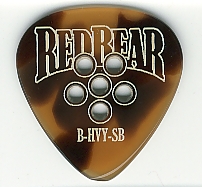
For the last 30 years, I’ve been using medium Dunlop Tortex picks – the orange ones. They’re cheap, and they get the job done. They’re strewn all over my studio, in my pockets, in my laundry – all over the place. And I don’t care if they break, scratch or if I lose them. They’re replaceable and of little consequence. Not any longer. Once I started playing with a Red Bear pick, I’m never going back to cheap picks unless it’s absolutely necessary (for instance, if I happen to break a good pick and need to get another).
So what’s the story? A good friend of mine was so very kind, and gave me a gift certificate for Christmas to a great guitar store in Palo Alto, CA called Gryphon Stringed Instruments. It’s a shop that specializes in acoustic guitars, but has all sorts of stuff, like parts. It just so happened that I needed to replace the pickup selector switch on my Epiphone Explorer, and as luck would have it, Gryphon had the switch in stock – what better way to spend at least part of my gift certificate?!! So I drove down to Gryphon, got the switch, then started looking at other stuff to spend on my gift certificate.
I got a few packs of strings for both electric and acoustic, and started looking at picks. It then occurred to me that they might have handmade picks. So I asked the fellow behind the counter if they had any, and he said they carried Red Bear picks. Then I asked the operative question, “I’ve read about handmade picks in the guitar rags, but like most people, don’t see what’s so special about them. So what’s so special?” He simply replied, “Once you play with a great pick, you won’t want to play with the cheap ones any longer. It’s hard to explain. They feel so much better, and you just play better with a great pick.”
Folks, that wasn’t a selling job. The look on the guy’s face said it all. But still, I was a bit incredulous, and he must’ve seen the look of disbelief on my face, so he said, “You’re welcome to try one out on any of our guitars. You’ll see the difference.” So I picked out a shape and bevel that I liked, grabbed mid-range Martin off the rack, sat down on a stool, and went through an instant transformation to complete and utter bliss! The pick felt so great in my fingers, and it glided smoothly over the strings. The sound that was produced was so milky smooth, I couldn’t believe my ears!
I thought it had a lot to do with the guitar – it was a nice one. But, being the good guitar gear tester and gear freakomaniac, I always have picks in my pocket, so I did an A/B test. With my standard Tortex, the guitar still sounded good, but not nearly as good with the Red Bear striking its strings. It was uncanny, to say the least! I was dumbfounded, and completely awestruck that a pick – a pick, for God’s sake – could make a guitar sound so good! I must’ve been grinning when I returned to the counter because the guy just said, “See what I mean?” I replied, “Oh yeah… I knew this was something special when strummed with the pick the first time. And doing those lead riffs was effortless.” The sales guy just grinned…
Needless to say, I had to have one, so I bought two, at $20 apiece. It was so well worth it! I had a gig last night and was able to use my new Red Bear, and was in heaven ALL NIGHT LONG! I was so enamored with how my acoustic sounded, that I played as many songs as I could with the pick, and played with the pick on songs I’d normally fingerpick.
So let me attempt to describe what it’s like to play with a great pick. First of all, it just feels great. It doesn’t slip. Next, handmade picks are thick. They don’t flex at all, but they glide over the strings so easily that it makes it easy to play – almost too easy. And because of their thickness, they force you to hold them lightly, and the expression you can get in your playing dynamics by holding the pick looser or tighter is nothing short of amazing. A great pick also makes the strings ring much better.
But the most important thing is that all those things together make it inspiring to play, bringing you into that other-worldly state of pure expression. It’s amazing that a pick can do that, but I’m now a believer. I won’t be going back to cheap picks – EVER.
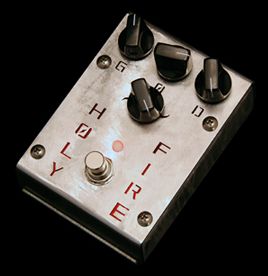
Summary: Overdrive and Distortion and tons of gain in one box that will NOT alter your tone. Has built-in wave shaping that responds to attack and input gain that simulates overdriving the front end of an amp.
Pros: Possible to achieve all sorts of clipping from swampy grind to searing distortion rife with harmonics, overtones and feedback, and it can do all this at ANY volume – freakin’ amazing!
Cons: Operationally, none. But its circuitry is so special that it requires a special 48V DC adapter – it will not run from a standard 9V or 18V power supply like Dunlop DC Brick. But for what it brings to the table, that’s a small price to pay.
Price: $195 direct
Knobs:
– “G” Gain
– “O” Overdrive – Soft clipping circuit – has built-in wave-shaping to react to input gain much like the front-end of a tube amp. Higher levels evoke increased wave-shaping ensuring even distortion throughout the EQ spectrum.
– “D” Distortion – Square wave form distortion
– Hi-cut (variable sweep hi-cut, fully open gives you all the tone, dialed back scales back the hi-freqs)
Tone Bone Rating: 5 This stuff is magic.
The guys at Creation Audio Labs must be wizards – or at least half wizard – because they’ve created what I consider to be the only overdrive/distortion pedal that does what it’s supposed to do, and doesn’t alter the tone of your amp! Mind you, there are times when you want that. For instance, to me, the classic overdriven mid-range hump of a Tube Screamer is an incomparable sound, and something I will always have on my board because I like the way it changes my tone. But in a lot of other circumstances, all I want is grind or all out distortion, and I don’t want my tone changed. That’s where the Holy Fire overdrive/distortion comes into play.
This is truly a magical pedal. Not only does it look awesome with that brushed metal exterior, and glowing red “Holy Fire” letters, it kicks the freakin’ pants off pretty much anything that’s out there that claims tone transparency in my opinion. And I don’t say this lightly. Remember, if you’re a regular reader of this column, I’ve got a real penchant for overdrive and distortion boxes – especially overdrive boxes. So when I say a pedal totally kicks ass, I mean it! You might not see too many reviews on them here, only because I only take the time to write about gear I love and would put in my chain. This is a pedal that will be taking up space on my board! And at $195 direct from Creation Audio Labs, this is a must-have box!
What’s so special about it? Actually, the question should be: What’s not to like? You get the best of both worlds here: Completely transparent overdrive or beautifully compressed distortion. Playing just with the overdrive and the distortion completely rolled off, you can get that classic, mildly crunchy, gritty grind to rip-roaring rattle that’ll make you think your amp’s bottles will shake off. Conversely with the overdrive turned all the way down and sweeping the Distortion knob, you can go from sweet and mild distortion, to heavily compressed gut-wrenching distortion replete with harmonics and overtones that’ll make you feel you’re getting scalped! But the best settings combine certain amounts of both. When you find your sweet spot, it’s epiphany time!
Imagine all this in one little stomp box! And the kicker is that your amp will still sound like your amp! Mind you, I didn’t read any reviews of this pedal before I got one for review. I didn’t want to taint my assessment of the pedal. The VERY first thing I noticed as I twiddled with the knobs is that my test amps never lost their voicing (I used three amps: An Aracom RoxBox combo, a Reason SM25, and my trusty Fender Hot Rod Deluxe). In all cases, the amp I was playing still sounded like my amp except it had grind and/or distortion. And no matter what output volume I had, the pedal operated the SAME WAY!!! So imagine the versatility this pedal brings to the table! I’m going to do a test later on with my Fender Champ 600, and see what wonders the Holy Fire will conjure when I lay down some tracks. It should be interesting as well as rewarding. So whether you’re on stage or in the studio. If you need breakup in your sound, this pedal will do it.
But wait there’s more!
On top of all I discussed, the pedal is sensitive to input gain, and has what’s called “wave shaping” that responds to higher input gain and acts like you’re overdriving the front-end of a tube amp. When you hit the pedal hard with either a booster or diming your guitar’s volume, or just picking hard, the pedal’s LED changes to a yellow color indicating that you’re overdriving the pedal. The magic behind this is that wave shaping evenly distorts the input signal across the EQ spectrum, so all your input tone is completely retained. The damn thing works too! It ain’t no marketing gimmick! So just as you’d expect when you do the same things with an amp, the Holy Fire will do it as well. Like I said, it’s magic.
I should make mention to a very cool effect that happens when you turn the distortion knob past 2 o’clock. The circuit actually starts compressing the signal, so you lose a little volume, but you get a very fat signal. In my opinion, that’s where the magic occurs with the distortion. After playing around with lots of combinations, I ended up just diming the distortion knob altogether, then just layering in varying amounts of overdrive and gain. Truly candy for the ears here, folks. With that, I’m going to post a couple of YouTube vids here so you can see and hear for yourself.
There are different schools of thought around this subject, but I thought I’d throw in some of my own thoughts, since I’ve been at it awhile. Note that I won’t be talking about techniques necessarily, though I will include some tips and tricks… So without further ado…
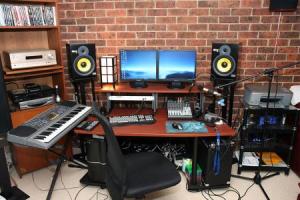
First, let’s establish something here: You don’t need to buy super-expensive gear to sound good, and you don’t need a lot of equipment. I’ve found that in a lot of cases, while more expensive gear will afford you convenience features, and a better sound quality, for the home studio enthusiast, a lot of times this gear is overkill. I’ll go into some details below, but in my opinion, recording technique is far more important. So with that said, let’s start talking about what I think are essential pieces of equipment:
Computer Equipment/Software
You probably already have a computer, but it should be configured to handle digital recording. While drive speed is important, it isn’t necessarily critical. My MacBook Pro’s hard drive spins at 5400 rpm, and I have no problems recording stuff. But what you do need is space. I’d recommend getting two hard drives: one for programs, and the other dedicated to saving data. It’s just a cleanliness thing. Also, get as much RAM as your machine can handle. I’ve got 4GB on my machine. That’s even more important than a hard drive. You don’t need a super-poweful machine either, but dual-core machines really work well.
Okay, Mac or PC? Go with what you’re comfortable with. There are lots of programs out there; among them is a neat little program that works great on both PC and Mac called Audacity – it’s free! Todd Rundgren recorded a lot of his latest album using Audacity, so it’s definitely doable.
What about ProTools?
I’ve got it. It’s great. But the learning curve is super steep. In fact, when I first started recording, I spent more time learning how to use the damn software than getting my ideas down and that just frustrated me to no end; so much so, that I lost my taste for recording for several months – I just didn’t want to mess around with the software! I just wanted to get my freakin’ ideas down! I’m not saying it’s bad, but it’s complicated, and you’ll have to spend a lot of time learning the ins and outs of the program. With the home studio, what you’re after is getting your ideas down with reasonable quality – and fast. That, at least, is my opinion. In light of that, I use GarageBand to get all my ideas down. It has built-in rhythm loops so I don’t have to use a click track, and there are lots of add-ons, both free and affordable, that you can use in GB. The sound quality is excellent, and it even has some mastering presets that work amazingly well!
Digital Interface
There are lots out there. I happen to use the DigiDesign MBox 2, which has two analog inputs, MIDI, and a couple of others I don’t use. Very handy little box. But there are lots of solutions out there in the $300-$400 range. Most use USB, though FireWire is probably the optimum – it also costs more.
Microphones
Now this is just my opinion, but you’ll need at least two mics: One ribbon mic, and one dynamic mic. I have a Nady RSM-200 ribbon that cost me less than $200, and it works superbly! I also swear by my trusty Sennheiser 835 stage mic, which is a workhorse similar to the Shure SM-58, but I think it’s warmer and has a much flatter EQ response than the SM-58 which can get kind of boomy.
MIDI Controller
Being also a piano player – not nearly as good on this as I am on guitar – having a keyboard to trigger MIDI and add MIDI-based instruments is another essential. You can go the small route (2 octave) or go the full-size keyboard route. I use an M-Audio full-size stage keyboard myself only because it doubles as my MIDI controller as well as my gigging keyboard. It was also cheap at $300 new. Nice.
From my standpoint, this is all you need as far as essential equipment for recording. Now let’s get into some techniques and some nice-to-haves:
Always record acoustic guitar using mics – and use two of ’em. Sounds obvious, doesn’t it? I’ve tried going direct into my computer, and the sound is horrible. But using two mics works great. I usually place my ribbon mic about six inches from the sound hole, then place my dynamic mic pointed at a 45 degree angle at about the 3rd fret to capture sounds coming off the neck. Also, to take advantage of the ribbon mic’s rear pickup, I have a board, or hard, reflective surface placed about two to three feet in front of me to reflect sound back. It gives just a sligh reverb effect that really fills out the recorded tone.
If you can swing it, get a couple of low-wattage amps. In particular, I use a Fender Champ 600, which is a 5 Watt amp with an 8″ speaker. Another one I’ve used, but don’t own is the Epiphone Valve Jr.. What a nice little amp! Since you’re recording at bedroom levels, a small amp that puts out less volume works wonders. Now here’s the trick I’ve found to recording with these small amps. You can make that sucker sound HUGE by close-mic’ing the amp. I use a dynamic mic pointed at an angle along the cone of the speaker, and place it no more than 2″ away from the grille cloth. Then I use a variety of overdrive and distortion pedals to get grind or searing distortion, then in my software boost the low frequencies. The end result is that it sounds like I’ve just recorded a full-size stack! You have to play with your settings, but it’s definitely achievable. The other nice thing about using a small amp for recording is that the naturally bright voicing really works well in a digital recording environment.
For vocals, always use a pop filter. I’m an experienced singer, and even though I have great mic technique, nothing is worse on a recording than picking up those oral transients that your mouth makes when making consonant sounds. Pop filters cost less than $20 and believe me they’re a life saver.
While we’re on the subject of vocals… Avoid using a compressor on vocals as much as possible. When you’re singing a louder phrase, move away from the mic. It’s that simple. Compression is good to a point, but there’s a lot to be said about having volume dynamics in your vocals. You get a lot more emotion coming through when you have it. If volume is pretty much the same throughout a song, it’s well… boring in my opinion, no matter how good a singer you are.
Avoid EQ as much as you can. Dial in the EQ on your instruments before you record, then only do wholesale volume adjustments later to make mix corrections. What you’re trying to do is capture the natural sound the instrument makes as closely as possible. The only exception I make to this is when I’m recording a low-wattage amp and want to boost the lows. Otherwise, I just do volume adjustments for the mix.
These are just a few things I’ve learned over the last few years of doing this. I’m sure I’ve missed some stuff, so if anyone else wants to add to this, please feel free!
What? Less gear? I must be speaking blasphemy, especially considering I’m such a gear freak – especially with my proclivity for pedals. But there’s also a practical side to this, as I am also a gigging musician. And especially when I do solo gigs, having less gear means less trips to the car. So as much as I can consolidate, I do. I was thinking about this because Christmas time through the New Year is usually a very busy time for me as far as gigs are concerned. For the past month, I’ve had at least three gigs each weekend, playing parties and other events. So you can see that I’m fairly sensitive to lugging gear.
So here I am in a coffee shop this morning, having put the finishing touches on my latest gear review on Aracom Amps RoxBox. In the article I mentioned that Channel 2 suffered from being flat at lower volumes, and that I ultimately solved the problem by running the amp through an attenuator between he power amp and speaker. I’ve had to do that practically every tube amp I’ve tested, so it got me to thinking: Why don’t more manufacturers just add these to their amps? I suppose production cost has a lot to do with it, but amp makers such as Faustine Amps have a -18db reactive attenuator built into their Harlequin line of amps and the Fender Princeton Studio also has a built-in attenuator as well. It’s a cool feature, and one that will allow you to get power tube saturation at lower output volumes.
Let me explain what I mean by way of a diagram:
As you can see, the traditional master volume circuit contains an attenuator between the pre-amp and the power amp. This means that you can crank the pre-amp and get pre-amp distortion, while limiting power to the power amp; thus limiting output volume. But it also means that in many cases, you won’t get power amp distortion unless you crank the master, which tends to be too loud, especially in small clubs and restaurants. But in the second illustration, with a second attenuator between the power amp and the speaker, it is now possible to crank the master volume to get power tube saturation while limiting overall output. I currently do this with the use of a Dr. Z Air Brake. But going back to the topic of this article, it’s just another piece of gear that I have to bring with me to a gig. Ugh!
In addition to production cost, there is a danger of possibly burning out the power tubes if you really overdrive them. I’ve done it to my Fender Hot Rod, by turning the attenuator to maximum attenuation, and diming the Drive knob for too long a time. Not good.
As I mentioned above, Faustine does this with their Harlequin line of amps (not sure about the others), and while -18db of attenuation may seem like a lot, it’s actually not that much – it takes the edge off. There must be a happy medium, say -24db or maybe -30db? Who knows? But whatever… this is a case where less gear is much better!
Summary: The RoxBox is an ideal small to medium size venue amp. Don’t let it’s diminutive size fool you. This amp is LOUD, and packs a real punch. Oodles of clean headroom in Channel 1 and capable of super-sinister drive in Channel 2 due to the “hidden” extra gain stage. Very pedal friendly.
Pros: Crystal-clear clean tone in either channel, though the second will break up earlier. Switchable from 18 Watts down to 9 Watts, so you can use this on stage and in the bedroom. Master volume kicks ass, and acts very similar to an effects loop attenuator. At 18 Watts, it’s loud enough to blow your ears off! Very pedal friendly.
Cons: Only a nit, but I wish this thing had a spring reverb. Also, overdrive can be a bit harsh at lower volumes, especially with single coils, though it’s gorgeous at louder volumes and moderate volumes using hubuckers.
Combo Cabinets
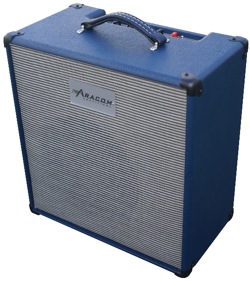
Standard Tolex: Navy Blue Levant (as tested)
– Dimensions
1×10 Combo: 18″w x 19h x 10″d
1×12 Combo: 18″w x 19h x 10″d
– Weight
1×10 Combo: 36 lbs
1×12 Combo: 39 lbs
Tone Bone Score: 4.75 On value alone, this would get a 5, but the mildly harsh breakup at lower volumes gives it just a slight mark off. Still, it’s a great amp!
Jeff Aragaki, the owner and designer/builder of Aracom Amps is on a mission to transition from his telecommunications business entirely into his amp building business. I’d say that based upon playing just this one amp (both the head and combo versions), and having a look at a couple of other amps in his line (which I will probably review in time), he’s well on his way to successfully completing that mission. And Jeff’s not alone in this quest. A few folks I know here in the Silicon Valley have preceded Jeff, moving from their high-tech careers into the music equipment business; and while they may not have become super-wealthy off these new endeavors, they’re certainly living their dreams.
It’s like that in the Silicon Valley which, for decades has been a hotbed of innovation and dream-chasing. And while its star has faded somewhat as the global technology leader and the market has opened up allowing more players to the tech scene (China and India, for instance), the spirit of innovation and going after your dreams upon which “The Valley” was built remains alive and well, as evidenced by guys like Jeff. And true to Silicon Valley form, what these guys produce is quality stuff, and Aracom amps definitely follows suit!
When Jeff and I first hooked up, I was really excited about his 18 Watt RoxBox. First of all, I just dig the EL-84 tone, and secondly, I was amazed that he could offer this amp for less than a grand, and it’s a hand-wired amp, for goodness sake! I knew I had to check it out. And lucky for me, the city where Jeff lives is a half-hour away (if the traffic’s good), so two days after I first spoke with him, he personally delivered a head and a combo. I’ve been playing with both since (though I was so excited, I let my buddy borrow the head for a couple of days to see how he likes it). I’ve tested both amps in the studio as well as at gigs, but I’m writing this review about the combo. If you want to hear how the head sounds, check out this clip:
My Tests
For my tests, I used my Strat, my PRS SE Soapbar II with P-90’s, and a Saint Baritone Messenger that I’m also testing. The amp performed excellently with all three guitars, but was especially responsive to the baritone which has active humbuckers in Channel 2. But before I get ahead of myself, let first me go over the amp’s features apart from its technical specs.
Controls and Equipment
The RoxBox features two independently voiced channels, each equipped with a volume and tone knob. The Tone control functions similarly to a high-freq sweep. It also has a Master volume which is available to both channels. The Master volume is very cool as it functions as an attenuator between the pre-amps and the power tubes, so you can slam the front of the amp with tons of input gain to get that sweet, mid-rangy pre-amp distortion while keeping the output volume at bedroom levels. Great for edgy blues and classic rock tones. The combo I tested also sports an Eminence Red Fang Red Coat 12″ speaker. Operating at 30W, this sucker has a lot of balls! As expected, the sound was a little harsh when I first tried it out, but after several hours of playing, it’s starting to break in and the tone is starting to become a lot more smooth. Now with that out of the way, let’s get into some details.
Channels
Channel 1 would be considered a normal channel, while Channel 2 is a drive channel that will break up a lot earlier. But with Channel 1, the name of the game is “clean.” With my Strat plugged in, this channel has so much clean headroom that I had to really dig into the strings to produce even a slight amount of grind. My PRS with P-90’s and the Saint Messenger could only produce moderate amounts of grind when the volume was dimed. That’s pretty impressive, and definitely not what I expected. With so much clean headroom, Channel 1 is VERY pedal friendly.
Channel 2 on the other hand definitely breaks up early and is voiced just a tad brighter than Channel 1. But it also has a lot of clean headroom as well. With my Strat, I had to turn the volume knob past 7 to get some decent grind, and had to peg my guitar volume. Believe me, that’s not a bad thing either. On the other hand, My PRS SE Soapbar II and the Saint Messenger had no problems producing grind. I could get breakup at around 4 with the Messenger, and around 5 with the PRS.
To get earlier breakup, Channel 2 actually has a third “hidden” pre-amp gain stage in series behind the pre-amp you plug into with fixed settings. It’s voiced a bit hot, and as Jeff puts it, it’s like having a built in tube overdrive. The end result is you get breakup a lot earlier. I have to say that while I like Channel 1’s tone, for pure versatility, Channel 2 really does it for me, as it is lively and responsive to changes in attack and guitar volume. And putting a booster in front of this Channel really brings on the growl that this channel is capable of producing.
How It Sounds
Tonally, this is definitely an EL-84 amp. It’s bright and chimey, and with the Red Fang, it also has lots of balls. For sweet, clean tones, Channel 1 produces a lush clean tone, and my Strat in the Neck/Middle position sounds gorgeous through this channel. As I mentioned, it’s a bit brighter than Channel 1, which made me tweak my guitar tone knobs a bit, but not so much so that it’s unusable. And where this amp really shines in the tone department is when it’s moving lots of air. Plugged into Channel 2 with the volume turned up around 12-2 o’clock, and the Master past three, the amp simply sings its heart out, though at those volume levels in an enclosed space like a home studio, the assault on your eardrums can get a bit uncomfortable.
And while I don’t want to say anything negative because I truly dig this amp, I have to say that at lower to moderate volumes with a Strat, a driven Channel 2 (Volume around 8, Master around 2) seems a little flat sounding. At this level, the pre-amps are distorting with little contribution from the power tubes. Don’t get me wrong: It’s not bad sounding, it’s just a bit uninspiring. But turn the master up so that the second gain stage starts clipping and the power tubes start getting hit, and the world is made right again. I did, however, find a couple of workarounds to this. The first was easy: Just engage my Tube Screamer to add to the grind produced by the pre-amps at lower volumes; instant sweetness. Also, slamming the front-end with input gain from my booster worked wonders as well. The best solution I found that will also engage the power tubes was to use my Dr. Z Air Brake Attenuator. The world definitely became right with that in the signal path.
Versatility
The RoxBox is very versatile and is comfortable on both the stage n in the studio. I really dig the master volume on this because that’s really what makes this amp so versatile. And one feature that is mentioned in the specs but something I’ve found incredibly useful is that the amp is switchable from 18 Watts to 9 Watts with the flick of a toggle switch underneath the amp chassis. For home studio use, this is a godsend as the lower wattage allows the tubes to saturate earlier, which means you can get grind at lower volume levels. Some people think this means lower volume – it doesn’t – for any variable wattage amp. All it means is that the amp breaks up earlier. But having this capability means that you can gig with it at 18 Watts, then bring it into your home studio and get some great tube distortion without keeping the neighbors up late at night while you’re wailing on your guitar.
Also, as opposed to having a single output jack for external speakers, the RoxBox sports three, for 4, 8, and 16 ohm extension cabs.
Overall Comments
This is an amp that I’ll definitely be considering to add to my arsenal because of its tonal similarity to the classic Vox AC15, plus its gorgeous and plentiful clean headroom in Channel 1, but also for its value. At $995 for the combo the tonal versatility you get for the price is well worth the expense. If I had a nit, it would be the same nit I have with the Reason SM25, and that is the absence of a nice spring reverb. But that is just a nit because both amps sound great without it – it would just be icing on the cake.
Fuzz pedal? Me? GoofyDawg? I know, I know… I’m an overdrive and overdrive/distortion pedal kind of guy. I usually prefer soft clipping pedals that throw just a hint of clipping and lot of input gain at an amp to make the amp’s tubes saturate and overdrive. And up until this point, I haven’t even discussed any fuzz pedals. But after hearing some of the sound clips from the new Algal Bloom from FH(fx), I have to say that I’m now rethinking my predeliction for overdrive pedals only. But don’t let me do the talking. Check out the clips on the Fuzzhugger.com site!
This pedal looks awesome! And from what I could tell from the sound clips, it’s capable of producing some gnarly fuzz and, as the guys at Fuzzhugger.com say, “[the Algal Bloom’s] name is inspired by its tone – thick and destructive – but very alive.” From the sound clips, I’d say that’s a pretty accurate description of the Algal Bloom.
It’s weird isn’t it? I’m normally not into that kind of sound, but it’s so ugly, it’s lovable! I had a little dog like that when I was growing up. It was a mix of Chihuahua, Toy Poodle, and Wire-haired Fox Terrier. Ugliest freakin’ dog you ever saw – like a little rat. But I loved that dog! He was smart and playful and so loving! Sorry, reminiscing… not that I could say that about the Algal Bloom, but there’s something about how it sounds that I just dig! Check it out!
Just wanted to share some initial sound bites that I created with a couple of new pieces of gear. The first is a Saint Guitars Messenger Baritone. Before now, I had never played a baritone, and really didn’t know what to expect. But after playing around with it for a few days, I have to say that I just love how this thing sounds. Baritones have been getting more and more popular as of late due to their very low, natural tone, and several metal players have started using them because of this. But I truly believe that a good test of a guitar or an amp is how it sounds clean. Played clean, you can’t hide mistakes. So here’s a clip that I created this morning to demonstrate the beautiful, clear tone the Messenger Baritone creates.
The guitar was played through the Normal channel of a Reason SM25 amp. As you can hear, the tone is deep, but surprisingly chimey due to the bright-sounding walnut body and neck, Adam Hernandez’ tone wood of choice. It took awhile to get used to playing the wider frets, but once I got a handle on it, I just started loving how this guitar plays and sounds!
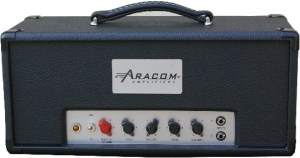
Aracom Amps RoxBox 18 Watt Head
Aracom Amps RoxBox 18 Watt Head
You know me, in addition to just digging on overdrive pedals, I love low-power amps! When Jeff at Aracom initially contacted me, I had never even heard of Aracom amps! And I pride myself on knowing about these things! Yikes! So when I perused his site, I was immediately taken by the RoxBox. And after just a day of using it, I have to say that I LOVE THIS LITTLE AMP!!! First, because it’s a low-wattage amp, which makes it very versatile, and secondly because it comes equipped with EL-84 power tubes! There’s a brightness in the EL-84 tubes that just makes my soul reverberate, and I just dig the sounds that this amp can produce. But just as with the Messenger above, the big test for me is how the amp sounds clean. And baby, it sounds great clean! The sound bite I have here uses the same clip above, but layers on a lead part using just my Strat played through Channel 1 of the RoxBox. Channel 1 has TONS of clean headroom, and even ‘buckers have a hard time making this channel grind. This will definitely score well with the pedal freaks like myself. Anyway give it a listen:
This little amp is nothing short of impressive, and priced at $895 for the head, it’s also an incredible value!!! Kudos to Jeff at Aracom for creating an attainable hand-wired amp! Looks like I’m going to be shelling out bucks for both the Reason SM25 AND the Aracom RoxBox.
I love writing this blog. Not only do I get to share my passion for guitar and guitar gear, in the couple of years since I started this blog, I’ve met and encountered some really great folks who also share the same passion. After all, it’s why you visit, and I thank you for all the support you’ve given me! When I started GuitarGear.org, I didn’t have any idea of where I’d go with it. I just started writing; not very often at first, but then it just kind of took on a life of its own as I found other great gear blog sites, and started interacting with the general blogging community, and the people I’d meet on other sites would visit my site. That’s what has kept me going, and it’s just an amazing thing!
Of course, it’s really cool to review gear, whether I own it or test it, then share my findings with folks. And speaking of reviewing gear, in this article, I’m introducing what looks to be a real promising, new amp company, called Aracom Amps! They have a whole line of reasonably affordable, hand-wired amps modeled mostly after classic Marshal amps. From what I could tell from the sound samples, these are very nice sounding amps, and the few reviews I’ve been able to find have all been exceedingly favorable. So like I said, there’s a lot of promise in this relative newcomer to the custom, hand-wired amp space.
Jeff from Aracom contacted me the other day to see if he could buy some ad space on my site. I replied that I had never even considered doing that because I didn’t want to commercialize the site. The most commercial thing I’ve done to this point is to put “click-throughs” to Musicians Friend on some of my review pages so people could buy gear directly, but I never actually expected to make any serious money from the site. However, I did tell him that at the very least, I’d review some gear for him, and if I really loved it, like I do with Reason Amps and Saint Guitars (by the way, I just got a new baritone yesterday to test, and IT ROCKS!!!), I’d make a banner for him and put it on my site.
So I am now awaiting delivery of what I think is a very, very cool EL-84 based 18 Watt amp called the RoxBox. It’s completely hand-wired on turret board, and it comes in a head version (which is what I’ll be initially reviewing), and in two different combos: A 1 X10 and a 1 X 12. Nice. It has two individually voiced channels with independent volume and tone control, and is also switchable down to 9 Watts. So this promises to be a very versatile little amp. To say I’m extremely excited about receiving this amp is putting it mildly. The reason why I’m so excited is because the most you’ll pay for one of these is $995.00!!! Imagine that! A hand-wired amp for less than a grand! It’s unheard of! And all Jeff’s amps are very reasonably priced.
Head Cabinet
Standard Tolex: Black Levant. See options below for other colors.
– Dimensions: 19″w x 8h x 8.25″d
– Weight: 23 lbs
Combo Cabinets
Standard Tolex: Black Levant. See options below for other colors.
– Dimensions
1×10 Combo: 18″w x 19h x 10″d
1×12 Combo: 18″w x 19h x 10″d
– Weight
1×10 Combo: 36 lbs
1×12 Combo: 39 lbs
Introductory pricing:
Rox Box Head $895
Rox Box Combo with 10″ Jensen ALNICO Speaker $995
Rox Box Combo with 12″ Jensen Ceramic Speaker $995
Pretty impressive!
I had a great conversation with Jeff this morning about his amps’ price points, and he said that considering today’s economy, he wanted people to be able to buy his amps, and since he does all the work himself, and has done a tremendous job with planning his manufacturing (for example, all his amps use the exact same chassis template), he can keep the price down. With the RoxBox, he was able to keep the price point down further by using a solid-state rectifier that simulates a rectifier tube’s voltage sag rather than using a tube rectifier. Now before you dismiss this, remember that the venerable Fender company has been using solid state rectifiers in their amps for decades, and no one complains about their gorgeous sound! But besides that single piece of solid state componentry, everything else is hand-wired and tube-based.
I don’t know why I love overdrive pedals so much, despite my recent discovery of the beauty of using a clean boost. I just do. I can’t help myself. So when I hear about new drive pedals appearing on the market, I’m keen to check ’em out and better yet, see if I can play ’em; but that’s besides the point of this entry… 🙂
Anyway, I just found out about a brand-spankin’-new company called Fairfield Circuitry, who’s just come out with a new overdrive pedal called “The Barbershop.” In their own words,
“Have you ever sat in a barber’s chair wishing your tone was as slick as your freshly shaved upper lip? With the Barbershop Overdrive on your pedalboard, you could keep your moustache and sound good doing it.”
That’s pretty amusing! But the sound of this pedal, at least from the samples provided on the product page, is absolutely serious. According to the Fairfield Circuitry spec sheet, this is an original design and completely handmade from JFET’s. It has three controls: Drive for driving the gain, Sag (which I find very cool) to control voltage into the internal amplifiers, and Volume to control output volume without changing the effect. The Volume control is a very cool feature – it’s like a Master Volume on an amp. I dig it!
The Barbershop is the first of three pedals to be produced by Fairfield Circuitry. Two more will be coming out in the near future, but there’s very little information on these right now. In any case, check out the site for yourself!
And by the way, this pedal, though handmade is actually quite affordable: $175 CAN. That converts to $141.68 US! Not bad at all!
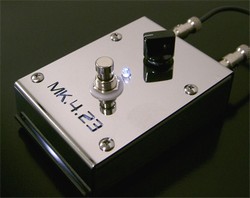
Summary: Truly flat EQ response, zero coloration, clean boost pedal that takes your tone and gives you more, much more of it. Can be used as a simple clean booster, or can slam the front of your amp with up to 24dB of gain.
Pros: Does only one thing: It boosts your signal, giving you more cleans, or slamming your preamp tubes into sweet, singing, sustaining distortion. No bells and whistles, just a single volume knob. Super cool stainless steel finish, with backlit lettering.
Cons: None.
Price: $149 direct
Specs:
From zero to +24 dB of transparent boost
No tone coloration
No signal distortion
No phase reversal
True bypass with quiet switching
Ultra quiet 9v power supply included
Want a pure boost pedal? One that just does what it’s supposed to do? Simple to use? Doesn’t add its own “character” and just gives you more of your own tone? Look no further. I don’t say these words lightly either. All those things are true!
When Anthony Bonadio of Reason Amps first told me about the Creation Audio Labs Mk 4.23, I was really taken by the emotion in his voice when he described the pedal, and his claim that it was the best boost pedal he’d ever used. That’s saying a lot coming from a man who rarely uses pedals. And when he offered to send his to me to try with the Reason SM25 amp I recently reviewed, I just couldn’t wait until it arrived. It arrived today, and now I understand why he feels the way he does about the Mk 4.23.
Playing it through the Normal (clean) channel of the SM25, it does what it’s supposed to do: It boosts your clean channel. It was what I expected, so it was a bit boring, though I was impressed by the fact that there was no snap, crackle, pop when I kicked it in, and it just simply gave me more of my clean tone. But where this pedal really shined was when I kicked in the Bright and StackMode channels of the amp.
Talk about a visceral response! I can’t even describe the feelings I experienced as the pedal slammed the preamp tubes, and made the amp produce sweet, singing sustain that lasted for days! I always knew that the amp could produce incredible distorted tones, but with the boost engaged, I could hear additional harmonics and overtones issuing from the amp that up until that point I had never heard! On top of that, I never lost a bit of tonal clarity, even when I had the volume knob dimed and was creating that scooped, snarling dog buzz. That’s certainly a testament to the quality of the amplifier and complex and sophisticated sounds it can produce, but it’s also a huge testament to Mk 4.23 that can push the amp into that organic, high-gain overdrive. OH MY FREAKIN’ GOD!!!
I tested the pedal with humbuckers and single coils, and it was interesting to hear the difference in how the pedal performs with both. With humbuckers, the volume boost is less dramatic, as humbuckers send a lot of gain by default. But the effect was by no means displeasing. Where I didn’t get a significant volume boost, I got a lot more gain, driving the preamp tubes even harder. The sound was absolutely delicious! In fact, it drove the amp into feeding back, even a lower volumes! How cool is that?!! The guitar I used has tons and tons of sustain, but with the amp slammed, the sustain went on and on and on. And with that much gain, the compression from the power tubes just gave the signal balls of steel. But wait! There’s more!
With my Strat, the volume boost effect was dramatic; perfect for pushing your volume into great lead levels to get over the top of a mix. I didn’t get as much drive into the preamp tubes, but I wasn’t expecting that in any case. And yet again, the booster just took my tone, and simply gave me more of it.
So as you can tell, I REALLY like this pedal. I love what it does in a big way. But here’s another thing to love about this pedal: Its price. Creation Audio Labs got tired of using middle men and retailers that would price the pedals out of many players’ budgets, so they decided to only go direct. So what used to be a $260 pedal is now only $149. Buy it direct from Creation Audio labs!
In closing, after I return this pedal to Anthony, I’m going to buy this pedal. After just using it for just a short time, I’m confident in saying that this is a pedal that will always be on my board.

 There are different schools of thought around this subject, but I thought I’d throw in some of my own thoughts, since I’ve been at it awhile. Note that I won’t be talking about techniques necessarily, though I will include some tips and tricks… So without further ado…



 Guitar Gear