Feeds:
Posts
Comments

Archive for the ‘gear reviews’ Category

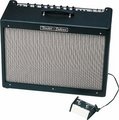
Fender Hot Rod DeluxeAfter having my Fender Hot Rod Deluxe for a few years now, I finally decided to swap the stock speaker for an Eminence Red Coat “The Governor,” which is a moderately-priced ceramic speaker. What’s difference now? The Hot Rod Deluxe is a very mid-rangy amp in the first place, but at higher gain, the tone became a little flabby. In fact, when I knew I was going to play at gig volumes I had to dial down the bass to about 9 or 10 o’clock, and set the mid and high around 3pm to get a more crisp sound. I was able to alleviate a bit of that flabbiness with better tubes than the stock Groove Tubes, but I always suspected that the speaker had a lot to do with the flabby bottom end. I don’t know why I waited to do this simple, simple modification. It literally took 10 minutes to swap it out.

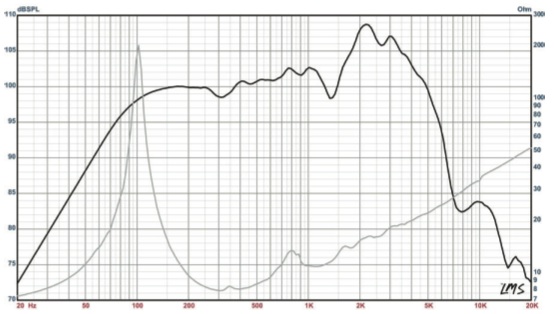
So why the Eminence Governor? Mainly because I wanted a nice mid-range focused speaker that had a smooth bottom end, and slightly sparkly highs. I had also played the Governor in a couple of different amps, and was really impressed with its brighter voicing. Here’s a frequency response chart for the Governor:

The Governor Frequency Response Chart

As you can see from the chart, the bottom end portion of the curve is a nice, smooth line. In the mid-range, the frequency response is fairly complex, then in the highs, you get some nice peaks in the 2-3 kHz range, finished off with some subtle motes above 10 kHz. The tone in the amp reflects this well. The bottom end is there, and very tame, and the mid- and high-freq response creates a gorgeous, and spacious tone. I’ll probably have some clips in the next few days, but here are clips directly off the Eminence site:

Clean

Heavy Distortion

Overdriven

All in all, this has got to be the most significant improvement to my Hot Rod’s tone!

Read Full Post »

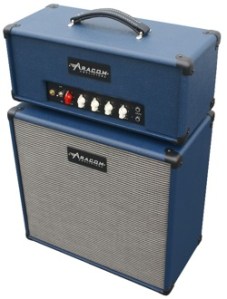
Aracom Amps VRX22 - First in the series

Aracom Amps VRX22 - First in the series

You ever play some gear that from the moment you start playing, you feel like you’ve died and gone to tone heaven? In the last few years, and especially in the last couple since I started writing this blog, I’ve literally played hundreds of different types of gear, covering the spectrum of all things guitar, from guitars to effects to amps. I don’t have enough time to write about all the things I’ve played, but to keep my content fresh, and to satisfy my overwhelming curiosity about different types of gear, I’m constantly trying stuff out.

And in all that time, and through all that gear, I’ve only had some gear totally slay me once: That was when I played the very first prototype of the Aracom VRX22. The back story is pretty cool, so I’ll share it with you…

Several months back, Jeff Aragaki contacted me on my blog asking if he could buy ad space. I replied that I didn’t want to commercialize my site, but if he’d be willing to send me an amp to review I’d put his logo on my “The Dawg Digs” area if I really loved his product. Fortunately for both him and me, he only lives about 40 minutes away, so he delivered what was once called the “RoxBox,” an 18 Watt, EL84-based amp. I had this thing about EL84-based amps for awhile, and was really excited to try a non-brand-name amp; not to mention that I was entirely intrigued by the fact that that hand-wired head cost only $895! That evaluation turned into testing and reviewing several of Jeff’s amps over the next few months from heads to combos with different configurations. Talk about feeling lucky to have so much gear to play with!

Jeff and I have become fast friends. We’re contemporaries not only from our obsession with vintage gear (or any kind of gear for that matter), but we’re almost the same age, and are both local boys from the Silicon Valley. Jeff’s a great guy, and someone I really enjoy spending time with; plus he’s super smart, and I like to be around smart people. 🙂

Anyway, a couple of months ago, Jeff called me up and said, “Hey Brendan, I’ve been working on an experiment with the RoxBox, and popped a couple of 6V6’s in the amp to see what it would sound like.”

“Oh?” I replied, “That sounds quite interesting. I dig 6V6’s a lot. They have a sweet, open distortion when they’re saturated.”

“Yeah, they do,” said Jeff, “Anyway, I was wondering if you’d like to test it out.”

I immediately replied, “Need you ask? Bring it on over!”

A couple of days later, Jeff brought the amp over to the messy garage I call my home studio. We plugged it in, I hooked up my Strat, and Jeff switched on the amp. I took one test strum in the clean channel, stopped and asked, “What did you do? This f-in thing sounds incredible! Let me play a few licks…”

Jeff didn’t say anything. He just smiled, and let me play for awhile. After a few minutes he said, “Okay, try out channel 2, so you can hear the overdrive,” at which point he plugged me into the second channel, then cranked the volume.

The amp literally sang with this beautifully smooth overdrive tone, chock full of overtones and harmonics. The tone was on the bright side, similar to the Reason SM25 that I was testing, but was rich and thick, and ballsy. I just closed my eyes and smiled, luxuriating in pure tonal heaven!

When I came out of my trance, I looked at Jeff and said, “Dude, I think you’re onto something really special here. You know I’ve played tons of different amps, but this one’s special. It’s the best-sounding amp I’ve played of yours to date; and ranks very high on my overall list. Are you thinking of putting it into production?”

“Maybe. I wanted to get your feedback. I still have some stuff to do on it, but I’m really liking the tone of this amp,” Jeff replied.

“Yeah… You’ve just piqued my curiosity.”

Fast-forward a week and I get another call from Jeff. “Hey Brendan! I worked out the power handling of the amp. The one you tested wasn’t outputting at the full 22 Watts, so I made some adjustments and now it’s running at full power. To me, it sounds even better. Anyway, I’m going away on a business trip for a couple of weeks, and I’ll leave it with you to test.”

So Jeff dropped it off a couple of days later, and test it I did. I took it to gigs, recorded some clips with it, and fell in love with it even more. Jeff was right, the power handling adjustments he made turned that amp into a pure tone machine.

When Jeff got back from his trip, we met for lunch, so I could give the amp back, and give him feedback. He asked, “So how did you like the amp?”

I replied, “Uh… the word is love. I’ll keep on testing your other amps, but this is the amp I want to buy. Everything about it is perfect. The clean channel has oodles of clean headroom, and the sag you’ve built into the simulator makes it sound like the amp has a reverb. The drive channel is like nothing I’ve played before. Quite simply, Jeff, this is the perfect amp!”

Jeff just chuckled, and said a very understated, “Glad you like it.”

Since then, I’ve purchased the amp – I got the very first in the series! And while I realize that my excitement about this amp is purely subjective, other people who’ve played this amp – WAY, WAY better guitar players than me – have been just as blown away by its tone. The other day, Jeff asked me to meet him over at Gelb Music in Redwood City to show Jordan, the guitar department manager, my VRX22 (Gelb carries Aracom Amps on consignment – for now 🙂 ). I just chuckled when he plugged a guitar into the drive channel, cranked it up, and let it rip. He didn’t play more than 30 seconds before he said, “This amp rocks! It’s real ballsy and has tons of harmonics. Wow!”

Jordan had to help customers on the floor, so he gave the guitar over to another customer named Chris with whom Jeff and I had been chatting while waiting for Jordan. Chris sat down, and started to rip it up! He played with this hybrid picking technique that was just amazing to observe, and he made the VRX22 absolutely sing! I knew it sounded good, but in the hands of a truly gifted player like Chris, it was other-worldly!

Jordan returned a few minutes later to listen to Chris play. Mind you, it was loud. Chris was plugged into a 65 Amps 2 X12 cabinet and had the amp cranked. Jordan turned to me, and with a quizzical look on his face asked, “This is YOUR amp?”

I just laughed because I knew what he was thinking – he was hoping that it was an inventory amp so he could buy it himself. I said, “Yup. You thinking about getting one for yourself?”

Jordan just smiled and nodded his affirmative. We finally had to turn down the amp, and Jeff and I had to go, and as we were leaving, Jordan asked Jeff, “So what’s the turnaround time for when we order?”

Jeff said, “Between two to four weeks.”

“Cool. That’s just about right. Hey! Thanks for bringing the amp over, guys! Man that thing has f$ckin balls…” with a huge grin on his face, “That’s all we ask…” and he laughed.

I laughed with him. Jordan is a real bad-ass player himself, and when he has this type of reaction, I know he thinks it’s special. I told Jeff he better build two: One for the store, and one for Jordan.

Folks, I realize you might think I’m full of it when I say that the VRX22 is the perfect amp. But Jeff is really onto something with this amp. I’d put it head to head against a Dr. Z MAZ or a Buddha any day. I actually played a Dr. MAZ the other day. It’s a great amp. But guess what? The VRX22 is only $895 for the head! That’s almost half of what other hand-wired, boutique amps cost! Yeah, it doesn’t have a tube rectifier – the VRX22 is designed with a solid state rectifier for extra punch and it has a sag circuit to provide the vintage vibe. And in case you’re concerned that a solid-state rectifier means lower quality, I just have one thing to say: So what? Lots of vintage amps such as classic Marshall Plexi’s and many Fender amps use solid-state rectifiers. Besides, it’s the tone that matters, and compared to the MAZ, which is really nice, expressive amp, the VRX22 has a much bigger sound.

Fantastic sound for an unbelievable price? SOLD!

Disclaimer: I want to make it absolutely clear. Jeff doesn’t pay me to do reviews or pay me to give nothing but positive feedback. He calls me up to say he’s got some gear for me to test, and I test it, then write a review. To date, I haven’t received any bad gear from him, so I haven’t given his gear a less than stellar review. You might think this from the rave reviews I’m giving the VRX22, but just to alleviate any concerns about me having an affiliation with Jeff other than being a friend, remember that I clearly stated that I bought the amp. What I’m sharing is my excitement. And showing it to the folks at Gelb? That was purely a favor. I simply had the fortune of being able to play with the prototypes. It is truly a magical amp!

Click here for more information on the VRX22 and other excellent Aracom amps!

Share your slayer experience!

Read Full Post »
Just got home from my weekly gig at the restaurant where I was really able to put the Tuff-Tone Tri-Tip through its paces. I’ve never played with a Tri-Tip shaped pick, let alone gigged with a Tuff-Tone, so it promised to be interesting – especially if I didn’t like the pick – because like a dummy, I forgot to bring a spare! Fortunately, I didn’t need a spare. The Tuff-Tone worked out great!

Admittedly, I was a little nervous, not because of the Tuff-Tone material itself but because it’s a lot thinner than what I’m used to playing. If you’ve been following my blog, you’d know I’ve been using a V-Picks Snake and also a super-thick prototype Red Bear Tortis as of late. The Snake is 4.1 mm thick and the Red Bear is 4 mm. I believe the Tuff-Tones are only 1.75 mm thick. I really didn’t know if I could make a clean adjustment. All my nervousness was washed away within a few bars of the first song I played. The pick felt so natural in my fingers, I just played without thinking. Whew! That was a relief!

So how did it perform? Practically flawlessly. The Tuff-Tones feel a lot more rigid and dense than their Tortis counterparts, but the material seems to weigh much lighter. That perception could be due to having played with thick, weighty picks. But to be perfectly honest, I really loved playing with this Tuff-Tone. As I mentioned above, it felt very natural in my fingers, and all the accuracy that I’ve come to expect from rigid picks was there from the get go.

Dave mentioned that in blind tests there was no difference between the tones of the Tuff-Tones and Tortis picks produce. But I noticed a definite difference. The Tuff-Tone produces a much brighter, jangly tone than the Tortis picks. Tortis picks, on the other hand, produce a smoother, more evenly balanced tone. Neither is better than the other; they’re just different. For me, when I want a brighter tone, I’ll use a Tuff-Tone. But when I want a fatter tone, I’ll use a Tortis.

I played all sorts of tunes tonight, ranging from full-on strum songs to songs that combined strummed chords and single note runs. I could be as expressive as I wanted with this pick, and that’s really the test. Lighten up your grip and let the pick glide, and the tone it produces is marvelously bright and ringy. Dig in and be greeted with a nice snappy tone. Want to do some quick alternate picking runs? No sweat!

This is a great pick, people, and a pick I highly recommend trying out and adding to your arsenal! I know that kind of goes against the common thought of using one pick for everything, but I’ve come to realize that using different picks will produce different kinds of tones, and different “moods.” It’s kind of hard to explain, but I’m now a multi-pick player.

Read Full Post »

Red Bear Style "C"

Red Bear Style "C"

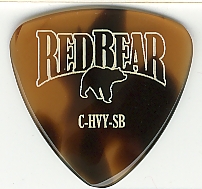
Imagine a pick shaped like the one to the left, but at 4 mm thick! That’s the Super Thick Gypsy Jazz Pick!

A couple of weeks ago, I was having a conversation with Dave Skowron, maker of Red Bear Trading picks, and said, “You know Dave, I just dig this Gypsy Jazz thick pick that I just bought. But as you know, for electrics, I play with a V-Picks Snake because I love the 4.1 mm thickness.” As background, I had just purchased a standard GJ thickness to replace the Heavy that I gave to a friend so she could try it out. I continued, “Do you have anything that is even close to that thickness? I would love to have that kind of thickness for playing acoustic.”

Dave replied, “Yeah, I have a sheet of the Tortis material that is pretty close to that thickness at about 4 mm. I did something even thicker for a guy once.”

“No, no any thicker, Dave, and I think it would be too much. But if you have a 4 mm thick pick, I’m all over it!”

“Okay, I’ll make up a prototype and send it to you to evaluate.”

All I can say after playing with “the prototype” for a couple of days is I hope that pick goes out of prototype because it is an incredible pick! You know how I love the feel and sound of Tortis, especially on acoustic guitar. In fact, I love the sound of Tortis with acoustic guitar that I won’t play any other type of pick on my acoustic. On electric, I dig my V-Picks Snake for its speed, tone, and thickness. Put all that together in one pick, and what you’ve got is a “Super Pick!”

The thicker you go with picks, the deeper and richer the sound. It’s not that you lose the highs; you don’t. It’s just that the thicker picks also bring out the lows, so what you get in a nice, even tonal presentation. That’s why I dig thick picks! On top of that, there is something magical with the way a Tortis pick interacts with an acoustic guitar’s strings. With me at least, playing a Tortis pick on acoustic evokes a certain visceral feeling that makes me want to close my eyes and just soak up all the tonal goodness. Not only that, Tortis, being made of a natural material, just feels natural. It’s the perfect complement for playing acoustic guitar!

So what about this super-thick Gyspy Jazz gauge? OMG!!! I am in guitar-playing heaven with this pick! It has the thickness of my beloved V-Picks snake, but all the feel and tone that I’ve come to love with my Tortis picks! To just call it “awesome” would be a complete understatement.

I first played the “Super Thick” last Friday at a gig that was primarily acoustic guitar. It started with playing some dinner entertainment music before a re-enactment of Christ’s passion. I was playing my Ovation Celebrity directly into a Genz-Benz 100 Watt upright. When I struck the first chord of the opening song. I actually had to pause and let the chord just ring and hang in the air. It was quiet enough in the room where I was playing that I could hear my guitar, as the amp was there for simple sound reinforcement. I thought my original GJ as awesome at 2.3 mm. What this pick did to the natural tone of my guitar was otherwordly!

I spent most of the day yesterday playing guitar, much to the chagrin of my wife! It feels so incredible!

In any case, if you’re interested in getting one of these, contact Dave Skowron at Red Bear Trading. I’m sure he’ll make one for you. Mind you, this thickness of pick won’t be cheap, but it’ll be well worth the investment!

5 Tone Bones - Gear has stellar performance, value, and quality. This is definitely top of the class, best of breed, and it's a no-brainer to add this to your gear lineup! If I could go higher, I would with this rating. But this pick gets my highest rating!

Read Full Post »

5 Tone Bones - Gear has stellar performance, value, and quality. This is definitely top of the class, best of breed, and it's a no-brainer to add this to your gear lineup!

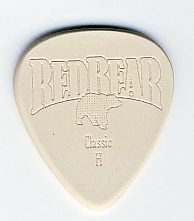
Red Bear Trading Tuff-Tone Classic H

Red Bear Trading Tuff-Tone Classic H

Red Bear Trading Tuff-Tone Picks

Summary:Made from an entirely new pick material, Tuff-Tone picks provide the same, high-quality sound you expect from Red Bear picks, but are much more durable than standard Tortis picks.

Pros: Get ’em wet, put ’em in your pocket with all your keys and change, put ’em in the washer and dryer. They won’t break or warp.

Cons: None.

Price: $10 direct from Red Bear Trading

Tone Bone Rating: 5.0 – The totally unique sound and feel of a Tuff-Tone pick makes it a winner in my book.

I love it when I get gear in the mail, and I especially love it when it’s a padded envelope from Red Bear Trading. I came home early from work yesterday afternoon to get ready to go to a gig in the early evening, and much to my extreme surprise and pleasure, a padded envelope from Red Bear Trading what waiting for me on the kitchen table. I immediately opened the envelope, poured out the contents into my hand and out dropped three pick packages: Two Tuff-Tone picks (a Tri-Tip and B-Style – both heavy gauge), and a super-super thick C Style Tortis measuring 4mm. I’ll be covering the Tortis in another review, so I’ll just mention it here.

I’ve been anticipating receiving these Tuff-Tone picks ever since I spoke to Dave Skowron – maker of Red Bear Picks – about them a few weeks ago, after I saw the announcement on his site. Rather than have me paraphrase the announcement, here’s an excerpt:

After a few years of research and development we have finally come up with a material which is an alternative to our standard pick material. The requirements we sought for this new line of picks were simple – deliver the same great tone and have the same comfortable feel as or regular picks while possessing unbeatable strength and warp-resistance. We feel that we have found that material. After months of beta-testing by some of the industry’s top players, we are ready to roll out the new line. The tone and feel have been confirmed in our tests. These picks are as good sounding as our standard line. They last and last, and are basically worry-free. In blind tests they were indiscernible from our standard line.

I have to disagree with Dave on the last line of the paragraph. To me at least, they aren’t indiscernible from the standard line. They’re similar in tonal response, in that they produce sound very quickly, but they are resoundingly not the same. I’ll get into more detail about this in just a bit. Where they are indiscernible is in their build quality. One of the things that has always impressed me about Red Bear picks is Dave’s attention to detail with respect to the build quality of his picks. To date, I have never received a single pick from Red Bear with any flaws. The bevels have always been perfect. Dave takes quality seriously, and all the picks I’ve had and evaluated have been flawless…

What about the sound?

In a word, awesome! But as I mentioned above, Tuff-Tones aren’t tonally indiscernible from the standard Tortis picks. Frankly, to me at least, they have a sound all their own. The material is much harder than Tortis, and to me sound just a bit brigher tonally. Or maybe I shouldn’t say brighter. The tone they produce is much more “chimey.” They produce the same rich tone you’d expect from standard Tortis, but I believe they bring out the high frequency tones much more than Tortis picks. If I were to make a comparison, tonally they sit right in the middle between a standard Tortis Heavy and a V-Picks heavy; the V-Picks heavy being the bright side.

But even then, these picks are tonally distinct, and no recording is going to capture the sound properly. I actually tried this morning, and it just didn’t work, probably due to my microphones, which double as stage mics, so the EQ tends to stay in the midrange. I could hear the differences in my amp, but just couldn’t capture the sound – sorry. You’ll have to buy a couple to see what I’m talking about. 🙂 Which you should – these picks rock!

How they feel…

Make no bones about it; not only are they tonally distinct they have a totally unique feel. Unlike Tortis or V-Picks picks, these aren’t glossy at all. They have a flat finish, and a rougher, almost tackier feel. But they feel so good! When I first held one of the Tuff-Tones I got, I was a little doubtful about them because of how they felt. I was wondering if they’d be slower. I’ve been so used to playing gloss-finish picks, that these were like sandpaper by comparison (mind you, that’s just flowery language – they actually have a smooth finish). But all my concerns were laid to rest when I started to play. Like Tortis and V-Picks picks, they just glide across the strings. I really love how they feel!

Even at the heavy gauge, which is 1.7mm, these have got to be the most rigid picks I’ve ever played. I love that about these picks. They really don’t give, so they give you immediate tactile feedback while you’re playing.

Overall Impressions

Talk about being torn! I love these picks. I kind of lean towards brighter tone, and these totally give it to me. But I also love the super-rich tones of my Tortis picks, and the chimey tones that my V-Picks Snake gives me. I’m chuckling right now because I would have never thought I’d look at a pick as a tone-shaping device. Most people just use a single pick – I was the same until I discovered the virtues of using high-end picks. But the thing with high-end picks is that they each bring something different to the table with respect to tone and feel, helping you dial in just the right kind of tone for the song you’re playing. I now look at picks much like a painter looks at brushes. I now have yet another brush to add to my collection of tone “brushes.”

Read Full Post »

I don’t post as often as I’d like on thegearpage.net, but I certainly lurk there at least three or four times a day. For the last couple of days, TGP has been down due to a hardware failure of some sort. While it was down, I realized just how much I liked visiting that site. I’m not really friends with anyone there yet, but it’s a place I definitely enjoy visiting. It’s a great community!

I’m pleased to announce that TGP is back once again, and running like nothing happened! That’s awesome! Now I can while away the hourse once more… 🙂

Read Full Post »

Amplitube Fender EditionMore often than not, the way I end most of my days is to strap on an axe, plug into one of my amps, and just noodle or jam to a jam track I put together. But tomorrow, I’m doing an outdoor gig that requires the use of my amps (had to drop them off tonight), and even though I have a little Fender Champ 600 for practice and recording, I was more in the mood for a bigger sound.

It was then I remembered my copy of IK Multimedia’s Fender Edition! I could plug directly into my DAW, spark up AmpliTube X-Gear, Amplitube’s excellent standalone and plug-in modeling software, and jam away! And with 12 different amps and boatload of presets to play with, I could get any sound I wanted! So I lost myself for over an hour of playing and trying out a bunch of different models and presets. It was truly marvelous and a great way to cap the end of a great day!

When I finally came up for air, I realized the power and allure of using these amp plug-ins from AmpliTube. They’re certainly not the real thing, but they’re so close to real, it almost doesn’t matter. Imagine going to a gig, and all you lug with you is a laptop, a DAW, and a couple of cords. You plug straight into the board and output through the PA. Then all you do is monitor your tone through your stage monitor.

IK Multimedia has tools to make it even easier to do exactly this. AmpliTube Fender – or any modeling software they make for that matter – is fully controllable via MIDI. So IK Multimedia has a product called StompIO, a USB stage controller that gives you full control over “Powered by AmpliTube” plug-ins, such as AmpliTube Fender Edition. Want to switch to a different amp? Add some chorus? Add a little dirt? It’s all available via the StompIO! The coolness factor of this is way huge, and at least for someone like me, it has some interesting ramifications.

For one thing, I play mostly small venues, so the more simple I can keep it, the better. Also, except for real purists, most people just can’t tell the difference that you’re playing through a model or a real amp. For instance, last year, I went up to Lake Tahoe and was sitting in a bar at a Casino, and there was this excellent male/female duo playing classic rock covers. The lead singer was a real excellent guitarist, so during one of their breaks, I went over to talk to him and see what gear he was playing. Amazingly enough, I discovered that his amp wasn’t an amp at all; it was a VOX ToneLab that he ouputted straight into his mixing board! I consider myself to be pretty good at making the distinction between a model and the real thing, but as the dude explained it, with all the ambient crowd and general bustle of the casino, it would be tough to tell he was using a modeler. It didn’t matter to me just the same, because the guy was such a damn good guitarist who could make his guitar absolutely sing. So for someone like that, he could make pretty much make anything sound great!

He shared that for larger gigs, and for playing solos in the recording studio, he still used a real amp – there’s just no substitution. But for tracking rhythm parts, and for playing in the casino, there was a lot to be said about the gear he didn’t have to bring with him. And that’s the point of something like AmpliTube Fender Edition. The less gear I have to lug around, the better! Of course, there’s no substitution for a real amp. Even though software can come close – incredibly close – to sounding like a real amp, there’s nothing like playing through the real thing.

But that said, when I want to go on a song writing trip, I can now pack everything I need to record my ideas in one bag, and all I’ll have to do is bring a couple of guitars! When I return home to lay down the tracks for good, I’ll just keep the rhythm tracks I recorded with the software models, and layer solos using a real amp.

Cool? You betcha!

Read Full Post »

Jensen P12N 50 Watt Alnico Speaker

Jensen P12N 50 Watt Alnico Speaker

Wow! I can’t believe that in all this time, I haven’t reviewed a speaker! I’ve focused so much on amps and guitars, and pedals, and other kinds of gear, yet I haven’t even touched upon this particular subject. I suppose it’s because a speaker isn’t something you actually see – it’s a part. Now I’ve made mention of how much I like particular speakers in a combo or a cab, but never a speaker itself. I’m going to remedy that now.

The cool thing about testing gear for someone, namely Jeff Aragaki of Aracom Amps is that in order to effectively give feedback on the gear you’re testing, you have to play it in different configurations. I’ve played a lot of Jeff’s amps through various combos and cabinets to get a feel of how his amps sound.

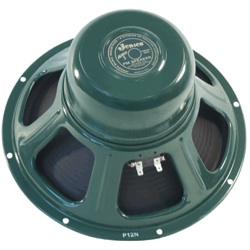
When I was testing the Aracom VRX22 prior to its release, Jeff installed a Jensen P12N in a cabinet for me to try out. In short, it was love at first strum! The P12N has to be one of the most musical speakers I’ve ever played through. It has a real punchy midrange that is balanced by a real smooth low-end response. The highs are present, but not overdone. The tone is – for lack of a better word – versatile.

To me, that versatility is its strength. The cleans are pure and chimey, whether you’re playing single coils or humbuckers, and the overdrive tone, again, at least to my ears, is to die for.

The P12N is actually a re-issue of the famed P12N from back in the ’60’s. Some claim that it’s shadow of the original with respect to tone, but tone is such a subjective thing. For instance, there are those that rave about the Celestong Blue. I’ve played through that speaker, and frankly wasn’t all that impressed by it. It could’ve been the amp/cabinet/speaker combination just didn’t work very well. In spite of that, it was nice, but just not all that special to me.

On the other hand, the P12N in the custom cabinet I got from Aracom sounds so incredibly smooth and lustrous. Granted, it helps that before Jeff installed it in my cabinet, it had already seen many hours of use: About two weeks straight from me alone, and several test runs from a variety of guitarists playing everything from blues to modern alternative rock. In short, the speaker cone was already somewhat broken in. As an aside, I hate breaking in new speakers. To me they’re all harsh-sounding out of the box. But I can tell that with my P12N, if it sounds sweet now, in a few months to a year, it’s going to sound even better!

How It Sounds

In a closed back cabinet, the bass response really shines, but never overpowers. And with an overdriven amp through a closed back cabinet, the distortion is tight and ballsy, yet not so thick that you lose clarity. In my custom Aracom 1 X 12 cabinet, when it’s closed, sometimes I think I’m playing through a much bigger amp. The tone is just so tight and well-defined. And for rockin’ songs, the P12N in a closed cab well, rocks!

With an open back cabinet, the P12N brings on the chime, especially with single coils. It’s 11:15 right now, and I actually started writing this article around 10pm. But I kind of got carried away jamming on my Strat with the back opened on my cabinet. The tone was so voluminous; much more open, and it was like each note just kind of hung in the air. The overall tone also brightens up significantly, with a definite emphasis on the midrange, which I love.

So which do I prefer? Closed back or open back? Actually, neither. Each brings its own unique qualities to the table, which now obviates the need for me to get a second cabinet from Jeff so I can play both simultaneously, which would sound totally awesome. 🙂

But, be aware that this speaker is not cheap. At retail, the lowest I’ve seen it is $220. But I do have to say that it is worth every single penny! Mind you, that is with the bell cover. I’m not sure about the tonal differences between having a bell cover versus not having one. All I know is that the P12N with the bell cover sounds absolutely dynamite!

Here’s a clip that I recorded to demonstrate the VRX22, but the P12N was used in all guitar parts. The rhythm parts were played through an open-back 1 X 12 cabinet, while the lead was played with the back of the cabinet closed:

5 Tone Bones - Gear has stellar performance, value, and quality. This is definitely top of the class, best of breed, and it's a no-brainer to add this to your gear lineup!

For how awesome this speaker sounds, it gets a 5 Tone Bones! For more information, visit the Jensen site.

Read Full Post »

Yeah, yeah, I know… My last few posts have pretty much centered around this amp, but hey! I just can’t contain my excitement about how good it sounds! This afternoon, I brought it to my weekly church gig to try it out in a live situation. I already loved it in my little home studio, but you just don’t get to really know what am amp can do until you play it live.

Today was one of the first days that I didn’t use my pedal board all that much. In fact, I only used my chorus on one soft song, and then only used my booster at the very end of last song to throw the gain over the top to finish off the service. Other than that, I just played the amp straight. Most of the songs I played were through Channel 1, and with my Strat, the VRX22 delivered gorgeous, bell-like tones that seemed to hang in the air, with so much presence that you could almost touch them – it doesn’t even have presence knob to up the mids and highs! Switching over to Channel 2 for a couple of numbers, I was rewarded with layers of open and complex overdrive that were so very smooth; none of that phasing in and out that you often get with lesser amps at high gain. It stayed nice and even. And the sustain and touch sensitivity at high gain was just to die for – all on a Strat, no less!

When I slammed the front-end with my booster pedal, I was in compression heaven! But luckily the 6V6’s don’t compress so much that they make the amp lose volume. The compression is noticeable, but the gain tone stays fairly open. It tightens up, but not too tight.

I’ve tested several Aracom amps, and they’re all very sweet sounding. But the higher wattage amps need tons of volume before they really start sounding good. The VRX22 is so versatile. With a 1 X 12 cabinet, it can be used with ease in small to medium-sized venues, like clubs and small halls. For larger venues, a bigger cab will get you the volume you need. On top of that, both the amp and cabinet are pretty light in weight, making lugging to and from a gig real easy!

All in all, I’m just tickled to death with this amp! You gotta check this amp out at the Aracom site!

Read Full Post »

Aracom Amps VRX22 - First in the series

Aracom Amps VRX22 - First in the series

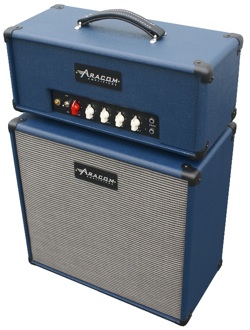
Just got my brand-spankin’-new Aracom VRX 22 amp, and I’m just lovin’ it! The blue tolex is absolutely gorgeous, and the amp sounds freakin’ fantastic through my 1 X 12 cabinet with a Jensen P12N speaker!

Yesterday, I wrote about how I was anticipating the delivery of my amp, and I have to tell you that there’s nothing like having the real thing sitting in front of you! I was so inspired after Jeff Aragaki dropped of the amp that I re-recorded the sound bite I originally created, to demonstrate just how good the amp sounds!

In the new clip, I recorded my Strat and Saint Guitars Benchmark through Channel 1 and panned the Strat to the left and the Benchmark to the right to isolate their individual clean sounds. Then I recorded the Benchmark wailing out of Channel 2, with the Volume at about 8, and the Master right in the middle. I closed up the back of the cabinet completely to get more bass response as well. Anyway, here’s the clip:

Read Full Post »

« Newer Posts - Older Posts »