Feeds:
Posts
Comments

Archive for the ‘gear reviews’ Category

Dr. Z Air Brake

About six months ago, I wrote a little ditty about the Dr. Z Air Brake, but I thought I’d revisit this essential piece of equipment once again. The Air Brake is a power attenuator; in other words, it reduces the amount of signal from your amp that reaches the speaker, thus reducing your audible output. Before I go any further, the big question is: Why would you want to reduce the amount of signal going to your speaker from your amp. There’s actually a very good reason: Overdrive.

With tube amps, especially those with multiple-stage gain, you can’t achieve that warm clipping (read: creamy distortion) without upping the drive to your power tubes. Unfortunately, that also means you have to crank your amp, as achieving those nice distortion characteristics is a function of both drive and gain. The net result in turn can shatter your eardrums in an enclosed space, or worse yet, have your family or neighbors scream at you for playing too loud in your garage. A power attenuator allows you to drive your power tubes into clipping but do so at a significantly reduced volume. For home studio enthusiasts like myself that usually record late into the night, this means you can work on recording projects without the fear of waking up my family or pissing off the next door neighbors (which I have done many times).

There’s a good FAQ about power attenuators and how they work here. I won’t go into the technical details, but suffice it to say that with a power attenuator, you can play at acceptable volume levels while still being able to drive your amp. With that let’s get into the Dr. Z Air Brake features.

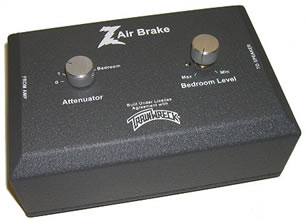
The Dr. Z Air Brake is incredibly easy to use, though in addition to the unit, you’ll need a couple of good-quality audio cables with 1/4″ plugs. If your amp’s output goes straight to your speaker and is then soldered to the speaker leads, you’ll have to do some splicing and soldering, though most tube amps today use a 1/4″ output jack. Once you’ve got the unit hooked up, you have five levels of attenuation: 0 through 4 and Bedroom. The “0” setting is total bypass, while the 1-4 settings impose approximately -2.5dB attenuation with each position by default. If you open the unit up, you can actually increase or decrease the amount of attenuation at each position by moving the leads along the resistors (this is explained in the accompanying manual – it’s a single sheet of paper). The “Bedroom” setting is what sold me on the unit. When you have the Attenuator knob set to “Bedroom,” the “Bedroom Level” knob comes into play. This provides variable signal attenuation down to 1 Watt (for sub-100 Watt amps) at the maximum level, though at this amount of attenuation, your tone really changes because the speaker cone doesn’t move enough air, thus producing a VERY thin (read: ugly) tone. I usually set my Bedroom Level knob to about 10-11 o’clock, the play with my drive and volume knobs on my amp until I’ve dialed in a good tone. Frankly, it doesn’t get much easier than this.

In addition to the variable bedroom level control, I chose the Dr. Z Air Brake after evaluating and reading various reviews, and speaking with other folks who have one. The most popular attenuator at the time I was reviewing attenuators was the THD Hot Plate. I tried one out at a shop, but didn’t like the sound that came out of it all. It literally changed my tone. The Dr. Z Air Brake, on the other hand is much more transparent, even at bedroom levels. As far as gigging is concerned, since I play a lot of small venues, it’s a real helpful piece of equipment because it allows me to drive my amp when I play with my band without stepping on the band’s overall output.

CAVEAT EMPTOR

Many people buy attenuators thinking that once they’ve attenuated their signal, they can drive their power tubes to their highest levels. It’s true, you can do this. But you’ll also burn through your tubes pretty quickly, or worse yet, you’ll damage your amp’s electronics. I’ve heard about this happening especially with resistive attenuators. People crank their drive, and after a few minutes start smelling something burning as their amp’s internal electronics fry. Also, driving your power tubes into super saturation doesn’t do anything but cause a lot of ugly distortion. When you drive your power tubes, the tone you should expect is a smooth distortion, as the intermixing sound waves weave together beautifully. Adding even more power creates a much larger contrast between the peaks and valleys of the distorted wave, and what you end up getting is a very “dirty” sounding distortion that is not in any way pleasing to the ears. So beware if you’re in the market for an attenuator!

In closing, if you’re like me, and play in a variety of small- to medium-sized venues, a power attenuator can be your friend. For me, mine is always hooked up. It has saved me from a lot of headaches and eliminated complaints!

ROCK ON!
Read Full Post »

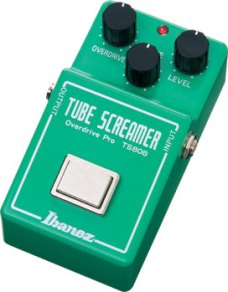
Ibanez TS808 Tube ScreamerSince I recently did a review on the Fulltone OCD, I thought that I’d do a review on the much-revered TS808. As many in the know, this is the pedal that defined Stevie Ray Vaughn’s sound. But it’s not the reason why this pedal is so special. The Tube Screamer has a unique, transparent tone; the keyword being “transparent.” Want to add drive and breakup to your tone – just switch it on. What you’ll get is a warm-sounding overdrive that is like candy for the ears.

Like the OCD, this is not a distortion box. It’s an overdrive box. The difference between overdrive and distortion are important, because they involve different approaches to the electronics. Click here for a good discussion. Overdrive boxes are known as “soft clipping” devices where gain is inversely proportional to input signal. Usually the boost is in the midrange with the high and low ends slightly cut off. The Tube Screamer is a pure midrange booster, and produces a beautiful, warm tone. The OCD on the other hand also boosts in the middle, but has added electronics that add sustain and boost harmonics and overtones. With the OCD, you can get a FAT, almost compressed tone. With the TS, you just get a boost – but that’s not a failing in the least!

As with the previous review, neither pedal is better than the other. They both have their uses. When I want lots of sustain – especially with solos – I’ll use the OCD. But for general broken-up rhythm, I’ll use the TS, but that’s not necessarily a de facto standard…  In any case, let’s discuss some features…

Note to metal players: This is not the pedal for you, if you’re looking for a real hairy kind of distortion. Think of this box as a driver to achieve pre-amp distortion. That tends to be on the brighter side. This box will not produce a fat tone, so buyer beware!

But if you’re looking for warm type of pre-amp breakup, this box is for you! It couldn’t be easier to use, either. Just three knobs: Overdrive, Tone, and Level. To get the tone you like, just fiddle with the knobs until it sounds right to you. Generally, I set the tone knob to 12 o’clock, which is pretty neutral (though the tone knob really doesn’t have that much dynamic range), set the overdrive to 10 – 12 o’clock, then set the level to slightly louder than the volume of my amp with the box switched off.

As far as build quality is concerned, it’s an all-metal casing. I gig with this box a lot so its hefty weight and solid build is a boon to gigging. And unlike the normal toggle switch you find on most boxes, the TS is (de)activated with a square switch. It’s not only aesthetically pleasing, it’s also really functional. The only beef I have with the box is that the light source of the LED is set kind of deep, so you have to be practically right over the box to see if it’s switched on or off.

Finally, the Tube Screamer is not cheap. A “Re-issue” like mine will set you back ~$169.00, while vintage boxes run up to $450.00. All I can say is that the money you spend is entirely worth it!

Read Full Post »

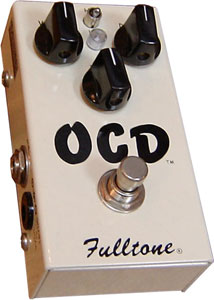
Fulltone OCD Drive Pedal
There have only been a few times in all the years that I’ve been playing guitar that I’ve had an epiphany with a pedal, where after just playing a few notes, a light bulb would go off in my head, and I’d exclaim, “That’s the sound I’m after!” The Fulltone OCD did that to me this afternoon. I just love when that happens! Here are some of the features of this little beast:

  • First off, it has a true bypass switch, so when it’s off, it’s off, and you don’t have to remove the battery if you’ve got it plugged into a 9 volt power source.
  • Volume knob – speaks for itself. But here’s a real treat: The volume knob can give you up to 30dB of boost!!! Need a clean booster? Here it is, plus you can get that sexy, smooth distortion out of it as well. Special note for my friend IG over at igblog: Here’s your clean booster, and you get a freakin’ amazing distortion box to boot!!!
  • Tone knob – according to the manual (and I confirmed this as well), the tone knob only affects the high frequencies, but you can use it to sweeten up a lead or get a more squishy, punchier sound – very cool.
  • Drive knob – again self-explanatory. It’ll give you more or less distortion depending up on the position you set it to.
  • HP/LP switch. This is unique to this pedal. Set it to (H)igh (P)eak and you get glorious sounding bottom end and increased dynamic range, plus more distortion throughout various volume levels. Set it to LP, turn down the drive, and the pedal acts as a clean booster with the volume knob.

How it sounds

  • Whether you’re in HP or LP mode, the thing that I noticed the most was the amount of sustain it added to the notes I was playing. One thing that can be a bit of a frustration for me when playing my Strat is when I bend a high note (above the 12th fret), there’s just not much sustain in the guitar itself (of course, unless I crank my amp). But the OCD adds a lot of sustain with hardly any tonal interference (that makes your sound really muddy).
  • As far as distortion is concerned, the OCD will not muddy your tone – especially at lower volumes, and you get all the juicy, complex harmonics that you get out of a cranked amp. With the OCD, your tonal clarity is retained, even with heavy distortion, AND you get those overtones and harmonics – EVEN AT BEDROOM LEVELS!!! Think of the OCD’s distortion as an extension and enhancement of your tone. It’s very much in character with a box like the Ibanez TS-808, another overdrive box that I have that I love for its transparency.
  • With the OCD, you also get the touch sensitivity you’d expect out of a cranked amp. That’s yet another amazing thing about the OCD, it’s sensitive as all get-out even at lower volumes.
  • I haven’t confirmed this, but from other reviews I’ve read, and from the dude that sold me the pedal (I trust him mightily), the more voltage you run through the OCD, the better it sounds. I only have a 9 volt power supply, but it’ll take up 18 volts, though I’ve read that 12 volts is probably the best.

In a nutshell, if you’re looking for a distortion box that will make your good tone sound even better, this box is for you. That said, before Mike Fuller released this box, there was A LOT of hype surrounding it. Once it was released, a lot of players were disappointed, thinking that this would be the be-all, end-all of distortion boxes. It’s not. It has a different character; actually, a VERY unique character, that will endear it to some, and ward off others, especially those who are expecting a real low-end oomph. The OCD has that, but that’s not its strength. As I mentioned, it’s a tone enhancer, that will break up your signal as much or as little as you want. It won’t pour on oodles of low-end, especially if your setup is on the thin side.

An important note: The OCD works best with a single channel Class A amp, or on the clean channel of a multiple gain stage amp. It does not sound good when used in the drive channel, which already breaks up your tone. That said, if you do use it with a drive channel, either let it do the driving, and turn your amp’s boost down, or turn down the OCD’s distortion, and pump up the volume knob on the box. Otherwise you’ll get a very rough (read: ugly) distortion. A lot of folks have complained about this pedal clipping too much with their amps. Most likely, they’ve tried to use it in the way I described above.

Comparisons? Well, I’m never one to say this box is better than this box, unless the tonal quality is perceptibly that much better. The closest box I can think of to compare the OCD to off the top of my head would be the box I mentioned above: The TS-808 Tube Screamer. But where the Tube Screamer is more of a midrange booster, and it produces a much more crunchy tone, the OCD has much smoother distortion characteristics, and has way more inherent sustain than the Tube Screamer. Which one is better? Neither. For me, they both have their uses, though I’ll have to admit that the Tube Screamer will most likely be my go-to box for crunchy rhythms, and the OCD will be used for leads and more funky rhythm parts played high on the neck.

Sometimes, it’s just in the stars…
I stayed home from work today to take care of my toddler who has an ear infection. He’s been cranky all day with a fever, and of course, the incessant annoyance of the inner ear infection. So to calm him down, and help him take a nap, I took him for a drive. I wasn’t actually intending to go to my local guitar gear shop but I ended up exiting the freeway on the street that the shop was on, and just happened to drive in the direction of the shop (I really wasn’t meaning to go there, dammit! 🙂 ) Anyway, as I was driving, I noticed the “Guitar Showcase” sign, and turned into the parking lot. I figured I could browse around in the nice, air-conditioned space, which would be great for my little boy with a fever. So I put the baby in the stroller and entered the store.

Once I entered the store, I noticed that Peter, who sold me my Fender Hot Rod Deluxe was working behind the counter, so I struck up a conversation with him. He’s a touring musician, so I asked him how the gigging was going, and we swapped stories. Then it occurred to me to ask him about a good drive/distortion pedal that I could use in conjunction with my TS-808 (which he also sold me and also plays through). He said, “Man, here it is: The Fulltone OCD. This’ll do the job for you. You can use it as a clean boost, but you’ll get the sweetest, creamiest distortion you’ve ever heard. Other pedals, can sometimes make your tone turn muddy, but this will break up your signal and retain your clarity.” Peter knows what I play through, and the guitars that I have, so he knows how important my tone is. With that, I replied, “You know, I wasn’t banking on buying any gear today, but based on what you’re saying, I’ve got to try this pedal out.”

So Peter hooked me up to a Hot Rod Deluxe. I played one simple phrase: An ascending minor scale in E. Actually it was more like 4 notes with a bend and vibrato at the end, and my jaw just dropped!!! I couldn’t believe the sexy tones that came out of this little box! It was like the sea had parted and the way was made clear! Then Peter twiddled the knobs a bit, then told me to play some funky rhythm line, and it’s like the song just came to life! I swear, within a minute of playing through the OCD, I just turned to Peter and said, “Sold. I’m gonna play a bit more, but you can start writing up the order. I’m not leavin’ the store without one.” So, I am now the proud owner of a Fulltone OCD.

Read Full Post »

If you’re looking for the ultimate in clean tone, go no further. Fender is the clean standard, bar none, and the Twin Reverb is the definitive clean amp. Like the original, it is a no-frills, no fuss amp, providing 85 watts of beautiful clean tone. There is no drive channel with this amp, folks. You get a normal mode and a reverb/vibrato mode. That’s it. But the clean tone that comes out of this amp is absolutely heavenly! I played two guitars with it: Custom Shop Strat, and a Les Paul Standard Double Cutaway.

With either guitar, I couldn’t get the amp to break up unless I cranked the volume on the guitars and amp to max – then it got really ugly. So when I say this is the definitive clean amp, I really mean it. For those of you who want distortion coming from saturated tubes, you’re out of luck here, but that’s not bad. One of the reasons this amp has had such success is that it takes pedals very easily. In fact, you might consider it to be a “tone canvas” that provides the base clean tone which you can color in a variety of ways using pedals.

The big difference between the Reissue and the original is that the reissue uses a solid state rectifier as opposed to using a tube rectifier. This might turn off tube amp purists, but I can see the logic of using a solid state rectifier: It keeps the cost of the amp way down, and you know what? I doubt that you could actually notice a difference.

Another thing… typical of Fender amps, the Twin Reverb is LOUD! The 2 X 12’s move a lot of air, so be forewarned! All in all, the Twin Reverb is a great, tone-shapeable amp, definitely worth a look!

Read Full Post »

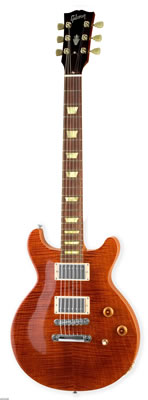
lpdc.jpgYou ever come across an instrument that just speaks to you? It whispers to your soul, “Hold me, play me, make me sing.” I’ve only had that happen to me three times before, and I own all three guitars. The Les Paul Double Cutaway (“DC”) is yet another one of those guitars that does that. After playing several of these over the past few months, I’m determined to get one by year end.
The DC is a simply a great-sounding guitar, with a much smoother sound than an LP standard, which can probably be attributed to its chambered body as opposed to the LP’s solid body. The chambered body also makes it much, much lighter than an LP. Also, it only has two knobs: Volume and Tone to control both pickups and a 3-position switch.

Tonally, I place this guitar smack dab between the ES-335 and the Les Paul. It’s not as smooth as the ES, but it’s also not as “big” in tone as an LP. For me, it’s the perfect balance.

Read Full Post »

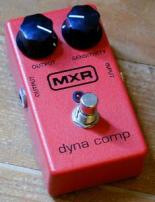
379_image_med_mxr-dynacomp.jpgI’ve been searching for a decent compression/sustainer for a long time, and I’ve tried out a bunch over the last year. Surprisingly enough, it wasn’t until recently that I decided to check out the MXR DynaComp. The DynaComp has been around for a long time, and has several faithful followers. Unfortunately, I’m not one of them. It’s not that this is a bad pedal – it’s pretty rugged, very simple to use, but it just doesn’t have what I need for the type of music that I play, which at the moment is bluesy and I use minimal overdrive. But I digress. This won’t be a long review. I’ll just give you my assessment…
I tried this out with a LP Double Cutaway and an American Standard Strat. For amps, I used a Fender Twin Reverb and a Marshal JCM 600 combo. Here’s what I found:

For clean playing, if you want a transparent box, this is not the box for you. It colors your tone quite a bit, even at lower compression levels. This is okay, if that’s your aim, but for me, since I prefer a bright sound, the amount of squeeze with this box was just too much for my tastes (though my dad who was with me liked how it sounded with the LP DC running clean through the Fender Twin). On the positive side, there was lots of headroom with this pedal, and no noticeable signal noise unless I cranked the intensity.

Where this box did shine was with the JCM in the high gain stage. The DynaComp really added a nice level of definition when used with heavy distortion (Note: my dad’s 75 year old ears couldn’t take the loud distortion so he waited outside the sound room :)). That was something I really dug about this box. The JCM 600 is one of those Marshall classics that has lots of crunch. The DynaComp smoothed that out a bit, but didn’t ruin the tone in the process. Nice.

Overall, this is a nice pedal if you regularly play in overdrive mode. But as I said, if you’re looking for a transparent compressor to use in your clean channel, I’d look elsewhere.

Read Full Post »

I just noticed something: This blog is called Guitar Gear, but I haven’t reviewed much gear! That’s going to change right now! The first piece of equipment I’m going to introduce is the BBE Sonic Stomp.

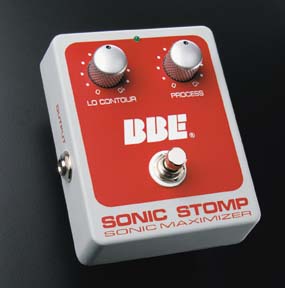
sonic_stomp_4in.jpgBased upon BBE’s very successful line of “Sonic Maximizers” – the Sonic Stomp actually uses the same technology from its 482i rack mount unit – this is a very unique pedal, and I’m going to go as far as saying this: YOU MUST HAVE THIS PEDAL. It’ll be the best $99 you’ve ever spent. So what makes it so special?
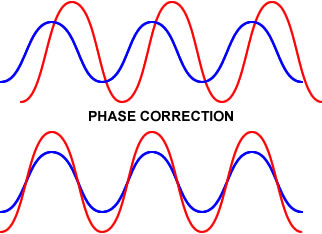
Without going into technical details, the Sonic Stomp corrects phase differences that occur between low and high frequencies coming out of an amp’s speakers; technically called “envelope distortion;” the net effect being that dramatic phase differences between low and high frequencies can produce what we perceive as a “muddy” or in some cases a “muted” sound. By time-aligning the frequencies, the signal is restored to a more accurate state, thus producing a much clearer, cleaner tone, and this is the gist of what the BBE Sonic Stomp does.

Now here’s the catch to this box. Unlike other pedals that either add drive or modulation to your signal, this pedal does signal correction, and in most cases you won’t even notice that it’s on! However, you’ll miss it when it’s off. It’s hard to articulate what that difference is. Let’s just say that with this pedal on, your already good tone just sounds that much better.

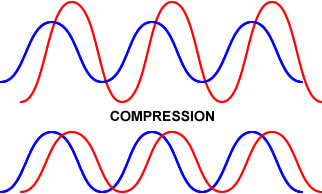
Now don’t confuse what this pedal does with a compressor. A compressor flattens gain, limiting the louder sounds and loudening the quieter ones (with makeup gain), thus creating a perceptibly fatter tone. This is very different than phase correction. See the figures below:

phase.jpg comp.jpg

I realize this is a fairly simplistic perspective, but as you can see, phase correction aligns the waves without acting on their amplitudes, whereas compression corrects amplitude but doesn’t work on phase.

So why might people confuse the two? Simply because when you correct phase, tonal qualities that you didn’t realize existed suddenly come to life. For instance, before I got this box, my amp had a real big, boomy tone. When I introduced the Sonic Stomp into my chain, my amp lost some of its boominess, which resulted in a much richer tone. It’s easy to mistake this as tone fattening as the lows got smoothed out and there seemed to be much more midrange, but I wouldn’t call it fattening – it’s more tone clarification – and this box it great at that!

So if you’re thinking about getting a tone shaping box, give the BBE Sonic Stomp a good look.

Read Full Post »

A friend of mine recommended that I try out a T5. He was raving about how cool it looked, and how you could switch from acoustic sound to a full-blown electric. I was a little dubious, considering that that’s really just modeling, and frankly, it was nothing new to me). Parker Guitars did this with “The Fly” well over a decade ago. But to be fair, I went down to my local GC to check one out and see what all the hype was about. So, under the guise of “Honey, I need to run some errands. I’ll be back in a couple of hours,” I ventured to my local GC, and played it for over an hour. The following is the result of that session with the Taylor T5:

Oops! Before I start on the actual review, I played the T5 through three amps: A Fender Acoustasonic Junior, a Fender Hot Rod Deluxe, and a Roland Cube 30.

Fit and Finish:

All Taylor guitars look great, and the T5 is a real beauty. I played a T5 with a beautiful royal blue finish – very sexy. The T5 also lives up to the Taylor standard of construction – all their guitars are very well-built. As far as acoutrements are concerned, personally, I’m not a real fan of low-profile knobs (when I’m in the middle of a song and want to make an adjustment, I want to be able to feel the knob – ooh, that didn’t sound good), but the knobs on the T5 fit in with its design nicely.

Feel and Playability:

The T5 has a nice narrow neck – very similar to my Strat and Ovation Acoustic/Electric – which I love, so moving around on this neck was amazingly easy and very comfortable. Acoustic players who are accustomed to wider necks will need a little time to get a feel for the neck, but should adjust pretty quickly. I had an easier go of it myself from playing my Ovation. When I first got that guitar, I had a bit of a break-in curve, but now it’s the type of neck I prefer.

Sound:

I know that I may piss some people off when I say this, but as far as sound was concerned, I was a bit disappointed. Based upon my conversation with my friend who raved about it, and lots of glowing reviews I read on Harmony Central and Musicians’ Friend, I was expecting a lot more with respect to tone – especially since the T5 starts at $1999, and goes up from there. I used the same evaluation process on the three amps I played the T5 on: On both amp and guitar, I started out by setting all the tone knobs to the mid settings. Guitar volume was set to midline, and since I was in a shop, I had to set the Fenders pretty low (they use logarithmic volume pots), while the Cube 30’s gain could be cranked while leaving the volume at a comfortable level. From there, I played the guitar in three different ways: 1) Fingerpicking; 2) strumming (using a straight sweep strum, and a percussive, attacking strum); 3) Then just playing various lead patterns in clean and high-gain modes.

Played clean with fingerpicking and lead playing, the T5 was very nice on all the amps; great clarity and sustain, though I really had to pump up the bass and turn down the treble on the amps to achieve a rich sound – especially on the Hot Rod Deluxe which, even with brightness off, plays pretty bright. Strumming in clean mode was pretty ugly on the Fenders – the guitar sounded like an acoustic plugged into an amp – very flat sounding, and no amount of EQ tweaking or reverb helped. Plus, when using a percussive strum pattern (think Michael Hedges), I would get an annoying popping sound. Probably has to do with the very touch-sensitive pickups, added to the touch sensitivity of the Fender amps. On the Cube 30 though, since I could apply some chorus, the tone cleaned up quite nicely, and helped dissipate the high end. If I was to use the T5 clean with a straight tube amp or acoustic amp, I’d run it into a compressor, a chorus, and then run the entire signal thorough a sonic maximizer – and possibly add an EQ pedal to texture the sound better.

In high-gain mode on the Hot Rod, the T5 actually sounded very nice. Even though I had to play at a lower volume, I could crank the drive and get a real nice distortion out of the T5. I think this is where the body vibration from the hollow body comes into play. It actually sounded a lot like my ES-335 in that mode; very pleasing to the ear, with a big, rich sound. With the Roland Cube 30 in the modeling channel, the T5 performed great with the gain at about midway, using the all the non-acoustic amp models. In the acoustic model on modeling channel, the T5 actually sounded VERY good, but then again, that’s a modeled sound.

Overall:

The Taylor T5 is a pretty nice guitar. Would I pay two grand and up for it? I don’t think so. I look at this guitar as being similar to a Line 6 Variax 700, which has a lot more features and guitar models built into it, and costs more than half the price less (I know, the T5 is NOT a modeling guitar)! Then again, I wouldn’t buy a Swiss Army Knife type of guitar period, mainly because even though it may sound real close to what it’s modeling, it’ll never get the exact voicing that the original gives you. For instance, if I want a thin, single coil sound, I’ll use my Strat. If I want a richer, boomier presentation, I’ll use my ES-335 (I’m also in the market for a Les Paul Double Cutaway, which I just adore). For acoustic/electric work, I’ll use my Ovation shallowbody.

Read Full Post »

The Dr. Z Air BrakeAfter many years of using solid state amps, I finally started looking at tube amps; specifically, boutique tube amps. I’ve looked at and played several from folks like Dr. Z, Mesa, King Amplification and a bunch of others. But boutique amps are VERY EXPENSIVE. And upon the recommendation of a very knowledgeable acquaintaintance (mentioned previously), I purchased a Fender Hot Rod Deluxe to tide me over until I could afford the $2500-$3500 for a boutique amp.

But no matter what boutique tube amp I decide to buy, one thing that struck me about about tube amps is that they’re LOUD!!! Yeah, I know, a lot of that comes from the types of volume pots installed on many amps, but irrespective of that little issue, tube amps just rock the house with their tonal clarity and their ability to punch through a mix. Unfortunately, they can get so loud that they squash the rest of your band (let alone shatter the eardrums of your audience), and that’s the bad part because most tube amps, especially Mesas and Marshalls just don’t sound right until they’re cranked and really pushing their power tubes. But in small to medium-sized venues, you’ll have people running for the door!

So I went looking for a solution where I could push my power tubes but not break windows (or in a specific personal instance, not have the next-door-neighbor calling me at 1 am to “turn my f&*king amp down”). In any case, the answer lay in a box called a power attenuator. There are several types, and I won’t bore you with technical details, but the gist of a power attenuator is just that: it attenuates the signal coming from your amp. You simply place it between your amp and your speakers and it outputs a lower signal – thus lower volume. What this means is that you can crank your amp to the level that you’d like and achieve an overdriven tone, but do it at a significantly reduced volume level.

The hot ticket right now seems to be the THD Hot Plate. But there are others out there as well. Personally, I like the Dr. Z Air Brake because it has a very simple set up (just two knobs), and is much more versatile right out of the box than the Hot Plate. This is because it automatically adjusts to the proper impedance of your amp; whereas you have to get a specific Hot Plate model that matches your amp’s impedance level. Choose the wrong one and you could be in a world of hurt! So I’ll be going with the Air Brake.

However, since I have a home studio, I will also be purchasing the Weber Mass 100 because it has a EQ’d DI direct output that I can run directly into my MBox 2. That’s very useful for studio work, but way too complicated for stage work. Besides, even though I only play with 4 effect pedals (BBE Sonic Stomp [you gotta get this – or better yet, get a rackmount sonic maximizer], Ibanez TS-808 Tube Screamer, Boss DD-3 delay, and Boss CE-5 chorus), I have more than enough knobs to twiddle with, and the Air Brake is simple enough to use on stage – two knobs. I tend to be a set it and forget it kind of guy and only like to channel switch to my gain stage or switch the TS-808, so the less I have to play around with, the better.

Anyway, if you’re a guitar player who’s in search of maintaining your tone but saving your eardrums – as well as those in your audience – then a power attenuator is the thing for you.

Read Full Post »

« Newer Posts