Feeds:
Posts
Comments

Archive for the ‘guitar effects’ Category

Click on the picture to see an enlarged view.

VOX Time Machine Delay Pedal


Summary: If you’re looking for a super-quiet, dynamic and versatile delay that will cover a lot of territory, look no further. The Time Machine rocks!

Pros: Absolutely quiet, with no line noise at all. It is so easy to dial in great delay sounds with the Time Machine, it’s almost scary. I like the fact that it has more features than a basic delay pedal, but not so many that you spend all your time tweaking. Oh yeah… It sounds absolutely fantastic!

Cons:None.

Features:

  • Controls:  Level, Delay Range, Time, Feedback, ON SW, Tap & Modern/Vintage SW, Hi-Fi/Lo-Fi SW
  • In/Outputs: 1 x  INPUT, 1 x OUTPUT, 1 x DRY OUT, 1 x DC9V
  • Max Delay Time: 5800 milliseconds via Tap-Tempo, 1000 milliseconds via Delay control
  • Input Impedance: 1M-ohms
  • Output Impedance : 1k-ohms
  • Power Supply:  9V alkaline battery(6LF22/6LR61) or AC adapter(sold separately)
  • Current Consumption: 60mA
  • Dimensions: 143(W) x 121(D) x 58(H) mm / 5.63”(W) x 4.76”(D) x 2.28”(H)
  • Weight: 600g /1.32 lbs (without batteries)
  • Included Items: 9V alkaline battery (included)
  • Options: 9V AC adapter (not included)

Price: $199 street

Tone Bone Score: 5.0 ~ This pedal has ended my search for a delay. It really is as good as it’s advertised.

I tend to be a little wary of “signature” pedals because I’m really not one who wants to sound like someone else; besides, I’m not nearly as capable on the guitar as said artists. But now and then, I come across signature gear that forces me to take a good, long look: Not just because of the name behind it, but simply because it’s just a great piece of gear! Such was the case with the VOX Time Machine. When it first came to market, I have to admit that I was excited because I know that Joe Satriani is a real tone freak, and I figured that any kind of gear in which he has design input is bound to be pretty good. But the flip side of that is that I’ve had experience with other signature pedals that were really geared towards the artist and their playing style specifically, and frankly, that stuff has left me frowning. Not so with the Time Machine, which took me completely by surprise!

I’ve been in the market for a delay for almost a couple of years, when I gave away my crappy Boss DD-5 that had such perfect and precise delay that it just felt processed. It was nothing like my former DD-3 that actually sounded pretty good, but I lost that pedal after playing in an orchestra for a musical theatre gig (I didn’t have a board at the time, and only carried a couple of pedals). Needless to say, during that time, I’ve evaluated several delays, but none have really caught my fancy. They were either too dark sounding, as in the case of most analog delays, or they sucked tone, as in the case of many digital delays I’ve tried. My surprise with the Time Machine is that in either mode, modern or vintage, my basic tone was retained! But I’m getting a bit ahead of myself.

In my search, I came up with some criteria that had to be fufilled 100% before I’d even consider buying one. Here they are:

  • First, I wanted Tap Tempo. I’ve always hated having to bend over to tweak knobs; but moreover, I wanted to be able to match tempos with my drummer on the fly.
  • Secondly – and I know this is purely subjective – I wanted a good balance between tweakable settings and ease-of use. In other words, I wanted to have the flexibility to dial in a number of delay settings but not have so many that I’d be spending all my time tweaking knobs.
  • Thirdly, I didn’t want to ever have to refer to a reference manual to make sure I was using the pedal correctly. The “don’t make me think” rule had to apply. I should be able to dial in great tones in a matter of a few minutes, if not earlier.
  • Finally, and most importantly, the pedal could not suck tone, and had to be reasonably transparent. In most cases, I don’t mind a pedal putting an emphasis on a particular EQ range (like my Kasha overdrive does), but it should never remove a range or “feel” like it narrows the bandwidth of the signal.

There are lots of delay pedals I’ve evaluated that were particularly good in most areas, but none until I played the Time Machine ever fulfilled all four criteria. That’s how great this pedal is!

It’s Mean When It’s Green

I love the shiny, green apple finish of the Time Machine. Of course, the paint job doesn’t make the pedal. But the Time Machine is built like a tank, and is certainly gig-worthy. I imagine that JS had that in mind when providing his design input. The chicken head knobs give the pedal a cool vintage vibe, but not only that make it very easy to see where you’re at with your settings. The stomp switches are nice and smooth, and the pedal engages without producing any noise.

How I Did My Evaluation

I didn’t just test the Time Machine in isolation. I’ve learned that one of the best ways to evaluate pedals is to do A/B tests against other pedals of like kind to make a comparison. So I compared the Time Machine against a Way Huge Aqua Puss and a TC Electronic Nova Repeater at my favorite shop, Gelb Music in Redwood City, CA. My thought was to compare it against an analog and another digital delay. Sorry, but no clips because I was in a shop.

All my tests in the shop were done with a Fender Custom Shop Tele, plugged into the pedals (hooked together so I could quickly make a comparison without swapping), and into an absolutely superb-sounding and -looking Dr. Z Maz 38 with draped in blonde tolex. Mm mm good. 🙂 I chose a midrange wattage amp because I wasn’t interested in creating grind. I’ve never been one to use delay with overdrive – maybe a little. But in this case, I wanted to have an ample amount of clean headroom to work with, and the Maz 38 worked perfectly for that (for the record I REALLY want a Dr. Z Remedy).

Aqua Puss and Nova Repeater

I will most likely have reviews on the Way Huge Aqua Puss and TC Electronic Nova Repeater in the near future, but I’ll give you a quick run-down of the pedals. If you’re looking for a dark, swampy, blues delay. The Aqua Puss delivers that in spades. It has this certain ethereal quality that made me think of drifting on a boat in the middle of the Everglades. I actually really liked the pedal, but I was after something else entirely with my delay search – much more versatility – and the Aqua Puss was a one-trick pony. It does what it does exceptionally well, but don’t ask for much in terms of usability in a variety of styles.

I was very sadly disappointed with the Nova Repeater. It packs a TON of features in its box, but for me, I was a little concerned that were just too many features. But despite that, it was easy to get a usable delay tone almost right away. The folks at TC Group certainly know how to pack in features, but they make them readily accessible, and very easy to understand. I actually had my heart set on getting this pedal after reading many reviews and listening to clips and watching video; and I almost purchased it a couple weeks ago. But I’m glad I compared it head-to-head with the Time Machine.

The Time Machine may not have all the features as the Nova Repeater, but out of the box, it wins hands-down in the tone department. The Nova Repeater sounded bland and dry – processed – when played in an A/B test between it and the Time Machine. And I detected a distinct loss in both highs and lows; in other words, bandwidth narrowing. That was not at all pleasing. That said though, the Repeater is still a great pedal, and apparently there’s an internal pot to calibrate the tone to your rig, so that’s a plus. But frankly, I’m not one to tweak that deeply. I probably would’ve still bought it if I didn’t do the A/B test. The tone is usable and really not as bad as I may have painted it, but it’s not as good as the Time Machine’s tone in my opinion.

Playability

If it’s any area where the Time Machine simply shined above the other pedals was how absolutely responsive it was to picking dynamics. Play lightly, and the delay is super-subtle; you almost feel as if it’s not there. Dig in a bit, and the pedal responds. I did a few lead lines to experiment with this, and was totally blown away. I set the Level control so I’d really have to dig in to get the delay effect, but for most runs, picked or legato, what I got was a more ambient effect – almost like reverb. Wow! That kind of pick response is probably what sold me the most.

In addition to dynamics, I just loved how easy it was to dial in various settings. The knobs are very nicely NOT over-sensitive, so moving a knob doesn’t result in dramatic changes in the effect. The net result is that you can get into a general area on the sweep of a particular knob, and make a couple of slight changes to zero in. How many pedals have we played where just turning a knob ever-so-slightly drastically changed the effect? It’s probably why I’ve liked my Boss CE-5 chorus for so long, and even though I’m currently bidding on a CE-2 on EBay, if I don’t win the auction, all won’t be lost because the CE-5 has a nice, consistent sweep on its knobs.

How It Sounds

Like I mentioned, the Time Machine is simply transparent. The Modern mode is truly transparent – at least to my ears – while the Vintage mode darkens the tone ever so slightly and adds some subtle modulation (it’s chorus-like) like you’d expect with an analog delay. But unlike many analog delays that I’ve played, the darkening with the Time Machine does more of a lower-mids EQ emphasis, whereas I’ve felt that analog delays cut highs. The Aqua Puss certainly felt like it was cutting highs, though it definitely compensated for it with some overall great tone. Back to the Time Machine, the net result is that in vintage mode, the tone becomes slightly more rich and lush.

I liked both modes equally well, though I’d probably tend to use the Vintage mode when playing absolutely clean, as it also adds a tiny bit of hair to the signal. It’s almost imperceptible, but it’s there. I loved doing some simple chord comps up on the neck in Vintage mode.

Modern mode, on the other hand, is like the Swiss Army Knife of the Time Machine, making it capable of fitting into any style of playing, from syncopated rhythms ala The Edge, to heavy chunk where you want to have a bit of slap-back.

The Time Machine also has a toggle switch for Lo-Fi and Hi-Fi modes, in addition to the Modern and Vintage modes. Hi-Fi apparently maintains tonal transparency, whereas Lo-Fi includes High- and Lo-cut filters. The difference between the two fidelity modes was subtle at best. I didn’t detect much of a cut in either highs or lows when engaging Lo-Fi; the EQ changes ever so slightly, but the bandwidth didn’t change at all. Again, I feel like it’s more of an EQ emphasis rather than a removal of portions.

Overall Impressions

I’m glad I took so much time to find a new delay pedal. As you can tell from my review, I love the Time Machine. It fulfilled all my criteria for what I wanted in a delay pedal. To me, it has enough adjustable settings to keep any tweaker happy, but it’s also super-easy to quickly dial in the right amount of effect. But not only that, it just sounds damn good!
Read Full Post »

I know, I know… I talk about this pedal A LOT, and I’ve already reviewed it a few times… (here’s the original) But I keep on discovering so many great things about this pedal that makes me want to talk about it. Just when I think I’ve got it dialed in, I find yet another thing that it does that just completely turns me on!

Tonight, I was screwing around with my song Strutter yet again. I’m done writing it, but I wanted to practice, and that song is really fun to practice to; I just mute the lead tracks and have at it. Mind you, all I wanted to do was practice and play “Blondie,” my Squier CV Tele – I didn’t have anything else in mind.

So I hooked up my Aracom PLX18 BB and started playing over the rhythm track. Folks, this amp just oozes classic Marshall “Bluesbreaker” tone as is, but just for shits and giggles, I decided to switch on my KASHA Overdrive to add a little flavor to my tone because I was working on a new song recently where I loved what this pedal did – especially with the PLX18 BB! For that song (which I’m still writing) I didn’t want to add too much gain. All I wanted to do was add some texture. So I thought it might just sound good while I practiced over Strutter. Man, was that a good call!

Here’s an A/B clip of sorts of the first two verses of the song. In verse 1, I’m playing the PLX18BB with nothing added – just a touch of room reverb as an insert in the mix. In the second verse, I switch on the KASHA overdrive (still with some reverb in the mix). The pedal is in the “Hot” channel, and I set the gain knob at 12 o’clock, which just provides a bit of a gain boost (it’s capable of adding up to 15dB of boost in this channel), but this channel also sustains for days, adding a touch of high-end sparkle. Here’s the clip:

Please excuse the little playing mistakes I made… 🙂 It’s nothing really egregious. In any case, when you compare the two verses, the difference in tone is actually subtle, at least to my ears. But from a playing standpoint, the amount of touch-sensitivity and sustain that was added made the second verse so much more musical and so much more inspiring to play. And speaking of subtlety, I think that is yet another mark of a great overdrive pedal. To me, overdrives should be transparent, they should never alter your tone – that’s what fuzz and distortion are for. At the most, they should simply add EQ emphasis, and that’s it. And that’s why I love the overdrives I play through: Tone Freak Abunai 2, GeekMacDaddy Geek Driver, Creation Audio Labs Holy Fire, the KASHA overdrive, TubeScreamer, and believe it or not, a Bad Monkey. They all bring to the table their own little voicings, but none of these alter your basic tone.

Great gear evokes a sense of inspiration – at least in me – that makes me want to keep playing and playing and playing. I just can’t say enough about this pedal. At around $200, it is worth every penny I paid for it. Thanks, John Kasha for coming up with such a fantastic pedal! Now back to playing!

Read Full Post »

I announced the Skull Crusher back in September when it first came out. Based upon the KASHA overdrive (but with some upgraded wiring and electronics), it has since gotten the attention of several prominent guitarists. Now George Lynch is playing through it, and HE LOVES IT! Check out this video:

How’s that for an endorsement. I’ve said all along that the KASHA overdrive is just about the best overdrive I’ve ever played, and I’m not alone in saying that. With guys like George Lynch touting how good the Skull Crusher is, you owe it to yourself to check it out! I know, some people don’t go for the look, but it’s the tone that matters.

For more information, go to The Tone Box site!

Read Full Post »

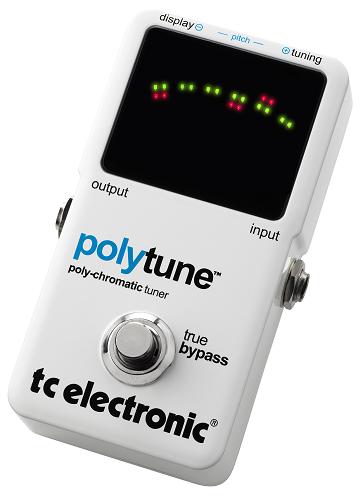
Could this be the last tuner pedal you’ll ever need?

I don’t see how I missed this! I scour the ‘net daily for new stuff, especially from companies that are known to create really high-quality stuff – like TC Electronic. These Scandinavians are incredible inventors, and I haven’t seen or played one one thing of theirs that I didn’t like – though I could rarely afford it. But they’ve come out with a new tuner – yes, a tuner, of all things – that is completely different from any other tuner on the market. It’s called the “Polytune.” As its name implies, it is a polyphonic tuner; that is, the tuner can detect all your strings at once, and you can see which ones aren’t in tune at the click of a foot switch. Unlike traditional tuners that require you to check each string individually, with the Polytune, you strum your open strings. The LED’s will show you which strings are in tune and which aren’t.

In my experience, more likely than not, at any given time only one or two will be out of tune. So imagine the time you save by NOT having to check and tune each string – only the ones that need it! Check out this video to see how it works!

And at $99 bucks… SOLD!!!

Here are some features:

  • 0.5 cent accuracy
  • Standard size box
  • Tune by strumming
  • Can automatically switch between chromatic and polyphonic tuning (it will detect if you’re hitting a single string)
  • Customizable preference settings
  • Has a 9V output jack for powering other pedals
  • True bypass
  • Adjustable reference pitch from 435Hz to 445Hz
  • Supports drop tuning all the way down to B!
  • Works with 4 and 5 string basses as well

It may not have the accuracy of a TurboTuner, but who the hell gives a flying f$%k! .5 cent accuracy is nothing to shake a stick at, and the fact that you can see the tuning of all your strings at once is incredible! Can  you say KICK ASS!!! I’ve never even seen this thing and I want to give it 5 Tone Bones! Check out the TC Electronic web site for some detailed information!

Could this be the last tuner I’ll ever want? Until someone comes out with something better – and at a better price, for that matter, probably not. I want to get one right now. Unfortunately, they’re only available for pre-order. Hmm… oh well, I supposed I can wait. 🙂

Read Full Post »

stagetrix-pedalfastener

Click for full size view

I wrote about StageTrix Pedal Risers awhile ago, and how they elevate the back row of your board to make your pedals more accessible. I’ve been using them since, and they really are a godsend! I did mention that they already came with the fastener already installed, so all you have to do is place the riser.

I really like the fastener they’re using. For one, the material is thinner than most kinds you buy at a store, which means it shapes well to contours. Another thing – and more importantly, in fact – is that the glue StageTrix uses on the fastener can withstand up to 200 degrees Fahrenheit. That’s the best thing. We’ve all had the experience of getting velcro glue on our fingers. It’s a gooey mess! Well, that’s solved with the Pedal Fasteners.

For $9.95, you get a pack of three (click on the picture to get a full size view). You can install a fastener with the middle, or you can remove the middle part, and only use the fastener on the edge of  your pedal. Very cool stuff!

For more information, check out the StageTrix Products site!

Read Full Post »

I love my Strat. It’s a cheapo MIM version, but it has a great sound. But ever since I started using it with the KASHA Overdrive pedal, it sounds even more like a Strat to me! I know, that sounds a little cuckoo, but that Classic channel on the KASHA Overdrive really brings out that jangly tone that defines the Strat tone; that’s to my ears, at least…

The other day, I was messing around with a dominant seventh ditty in A as I was trying to pick up some improv techniques from Chuck D’Aloia’s Blues with Brains video. I originally just recorded my Strat running through a reverb, then into my amp. It sounded pretty good, but I wanted to get a bit more top-end bite, but not a lot of drive. So I switched my KASHA Overdrive on and my jaw dropped! Here’s what I came up with…

That pedal just brings out the best in a Strat. I swear, now that I’ve been using it with my Strat for the last couple of days, I think it’ll always be on when I perform with my Strat. It really sounds great!

BTW, both rhythm and lead parts were played with the Kasha overdrive pedal. For the rhythm part, I was in the Classic channel to get that jangly Strat sound from position 2, while I was in the Hot channel for the lead in the neck pickup. So sweet sounding!

Read Full Post »

KASHA KA-ODP-A
I finally got some time to record a couple of clips of the absolutely wonderful KASHA Overdrive tonight, and I am just so blown away by how it sounds! This little box is like having 4 differently voiced amps in a little box! I’m not going to spend too much time praising it because I’ve already done that a couple of time here, so let’s get into the clips, shall we?

The first clip is slow, slow blues clip in Am. The chord progression is actually adapted from one of Chuck D’Aloia’s “Blues With Brains” video lessons. If you’re looking to get more into the blues, I highly recommend this set of lessons. It’s the best $40 bucks you’ll ever spend! In any case, I used the chord progression to test out the KASHA Overdrive, and to practice some of the concepts I learned tonight.

Anyway, there are two parts to the clip. The rhythm part was recorded with the KASHA Overdrive in Smooth with the gain set at 12 o’clock. This acts just like a clean boost, and at 12 o’clock it’s at unity gain. The first part features the Classic “channel,” and the second part features the Hot channel. Give it a listen:

The second clip has no backing track, and features the Melt channel with a simple chord riff. Excuse the sloppy playing, but instead, focus on the articulation of the notes. I had the Gain pushed up to about 3pm, which is almost all the way up. But even at a really high gain setting, you can still hear the individual notes. THIS IS AMAZING! And man, the touch sensitivity in this channel is to die for!

By the way, both clips were played through the clean channel of my Aracom VRX22, and recorded at conversation levels using the incredible Aracom PRX150-Pro attenuator. To me, this is the absolute king of attenuators. Oh! Almost forgot that I used my beloved Goldie to record the clips.

Read Full Post »

tonebox

When I wrote my original announcement of the Skull Crusher, it was absolutely brand new, and not surprising at all, it was met with a mixed response. But as I mentioned in my announcement, get beyond the looks, and this pedal is a KASHA overdrive with an EQ knob, and I LOVE how that sounds. Apparently, so do the guys from Ratt, as shown in this video taken over the weekend at the Jack FM 2009 concert in southern California this past weekend:

And here’s a video of the VERY talented PhilX playing the Skull Crusher live and doing a demo in the studio:

Lots of guys panned the look of the pedal, but I think it looks incredible! And knowing that it has the absolutely wonderful KASHA overdrive guts makes this pedal a winner in my book.

Read Full Post »

KASHA KA-ODP-A

OMG!!! Just gigged with my brand-new KASHA Overdrive last night, and I was in tonal heaven! Even though I’d done a pretty good test on it in my original review, there’s nothing like using gear in a live situation. So here are my observations:

  • Incredible Dynamics – The one thing that is readily apparent is how this pedal responds to pick attack and volume knob changes. It is so amp-like, it’s uncanny! I set the pedal up in unity gain with just normal strums on my guitar. But if I dug in a bit more, the pedal responded just like an amp with a bit more punch and volume. Frankly, the volume swell surprised the hell out of me. It’s not huge, mind you, but the response is so amp-like, it really does take you by surprise. I totally dug that while gigging last night!
  • Plays Well With Other Overdrive Pedals – I love stacking overdrives, and the KASHA OD performs beautifully in this role. I set it up as a based OD pedal, then stack it with my Tone Freak Effects Abunai 2. Those two together are an awesome combination!
  • Lots of Tonal Variety – While my favorite channel on this is the Classic channel that adds a chimey mote to your tone, I also played in the Hot channel as well, and the grit and grind was super-sweet. But add to that the dynamic response of the pedal, and what you’ve got is a pedal that has a lot of inherent tonal variety. Last night, I ran it mostly through the clean channel of my amp. But later, I screwed around with it a bit more in my studio, with my amp set at the very edge of breakup. This is where the pedal just warms my heart! With its touch sensitivity, when my amp is set up at the edge of breakup, I can take my tone from gritty and grimy to sweet and chimey with just a touch of dirt simply by modifying my attack or adjusting my volume knob.
  • Open Distortion Characteristics – No matter what channel you use with the KASHA Overdrive, the overdrive never gets compressed. It just gets dirtier. The cool thing about that is that any kind of compression will then come from your power tubes. I’ve rarely liked that compression in pedals, save for my Abunai 2, which compresses in a very pleasing way, but for most overdrive pedals, I don’t want that at all, and thankfully, the KASHA Overdrive remains very open, no matter how hot you go on the channels.
  • Simple Design – Probably one of the best features of this pedal that I appreciate is its straight-forward design. Notice that it doesn’t have an EQ control. It doesn’t need it. It takes your signal, adds a voice to it, and that’s it! Set your EQ on your guitar and/or amp to where you want it, then set the gain knob on the pedal, and just play. What could be more simple?

All in all, I’m pretty much done with my search for an overdrive pedal. I knew it from the first time I played this; and combined with my other OD’s, I can pretty much say – at least for quite awhile – I’m set in the overdrive department!

I’m an overdrive pedal freak, and I can safely say that this is the best overdrive pedal that I have ever played! It’s hard to believe that this little black monster does what it does. I’m totally blown away by it, and I’ve only gigged with it once! I can’t wait to really start using it in all its modes!

For more information, go to the KASHA web site!

Read Full Post »

Wanna slam the front-end of your amp with up to 50dB of gain, then be able to add some distortion? Then look no further than the Way Huge Angry Troll. I don’t have much information on it yet, but it’s a simple two knob affair. The left-hand knob controls the variable boost, while the right-hand knob provides 6 positions of “Anger” from no anger (clean boost) to a full fist. Here’s ProGuitarShop.com’s video demo.

Read Full Post »

« Newer Posts - Older Posts »