Q-Balls, that is… Introducing the new RIDDLE: Q-Balls from Electro-Harmonix, an envelope filter for guitar. The RIDDLE also has a brother for bass called the ENIGMA: Q-Balls.
So what exactly is the RIDDLE? As EHX put it, the RIDDLE is an “envelope controlled filter for guitar.” Synthesizer players have long known the beauty of adjusting a signal’s envelope or volume profile by emphasizing or limiting certain frequencies to create wholly unique sounds. Now, apparently, that is available for guitar with the RIDDLE. Check out this very cool demo video:
Damn! He did all that with an acoustic guitar!
I’ve grown to appreciate EHX over the last couple of years as they’ve come up with some really cool, thinking out-of-the-box pedals, like the Q-Tron, and of course, the POG. Yeah, they have your basic overdrive, distortion, delays, reverbs, etc., but stuff like the RIDDLE that open up the tonal possibilities of your guitar are quite commendable.
I’m not sure if the RIDDLE is something I’d use, but I’m writing about it here just because of its cool factor. Maybe I’ll take some time this weekend to see if I can’t check it out at a store.
I know what you’re thinking: Oh no, another boutique gear snob. But that couldn’t be further from the truth. I’ve bought brand-name stuff in the past, and will continue buying it if I like it. However, given a choice between two similar types of gear, and similar pricing, I will invariably go with the boutique gear maker, and not because of the usual reasons such as: handmade, handwired, higher quality, etc.
The main reason is because I can have a personal relationship with the manufacturer. When I call them up, I almost invariably speak to the owner/builder of the gear I’m interested in or buying. I can hear their stories behind their gear, and most importantly, get their insights on how to apply their gear in the best way possible.
For instance, I just got off the phone with Jim Wagner of WCR Guitar Pickups, whose Godwood pickups I wrote about wanting yesterday. I have a few guitars that have ‘buckers in them, but I was actually thinking about swapping my Duncans out of Goldie once I get her. But Goldie’s ‘buckers are coil-tapped, so I was wondering if I’d be able to use the Godwoods with her. Instead of consulting with one of the online forums, I decided to give WCR a call.
Jim has a really engaging manner, and when I mentioned that I wanted the Godwood set, he actually recommended getting the “American Steel” set which includes one Crossroads pickup and a Godwood. He said it is his most popular set because it gives folks the benefit of having these two great pickups in their guitars.
That’s another thing I like about dealing directly with a manufacturer. They totally believe in what they’re doing, and stand by their work. Customer service isn’t relegated to a call center overseas. I get to deal with the maker – you can’t get better information than that!
And consider this: A lot of boutique manufacturers these days are cutting out the traditional middleman. You have no choice but to deal directly with them. But considering the personal relationships you can establish, and the much higher level of support and customer service, you’d be a fool to not seriously consider going boutique when looking for your next piece of gear!
In any case, if you’re interested in doing your latest tweak, you should consider WCR Guitar Pickups. I just can’t wait to get my set!
Dammit! Every time I think I’ve covered all aspects of my tone, I come across or remember one more thing that ignites the GAS in me. This time it’s pickups; but not just any pickups. These are handwound pickups from WCR, a little company in Soulsbyville, CA, and owned by a guy named Jim Wagner. Jim has been winding his own pickups since the early 90’s, and has made a name for himself with the gorgeous tone his pickups produce. For Jim – according to his web site – it all started out with him searching for that classic PAF tone. But he was unwilling to pay the massive amounts of money for classic PAF’s, so he decided to make his own, and he has turned that into what appears to be a fairly successful business with a good following of artists.
I discovered WCR pickups awhile back when I was having one of my long gear conversations with Vinni Smith of V-Picks. In the conversation, he started talking about Schroeder guitars, and of course my curiosity got the better of me, so I looked them up. I discovered that Schroeder equips all their guitars with Jim Wagner pickups. Unfortunately, I only went so far with my surfing, and never went to his site until Vinni mentioned in a Twitter tweet (say that three times fast) that he was taking delivery of a brand-new Schroeder guitar. Curiosity got the better of me again, and I went back to the Schroeder site. This time though, I clicked through to WCR Pickups, and started listening to clips.
I shouldn’t have done that. 🙂
I randomly clicked on the various models of pickups Jim makes. Then my breath got taken away by the sound of his Godwood pickups. What tone! What clarity! What sustain! I HAD TO HAVE THESE!!! Listen to the clips, and you’ll see why I’m jonesing for these.
So now my GAS is fully ignited, and I’ll spend the next few months scraping together what little funds I have to get yet another piece of gear. I know, I’m incurable!
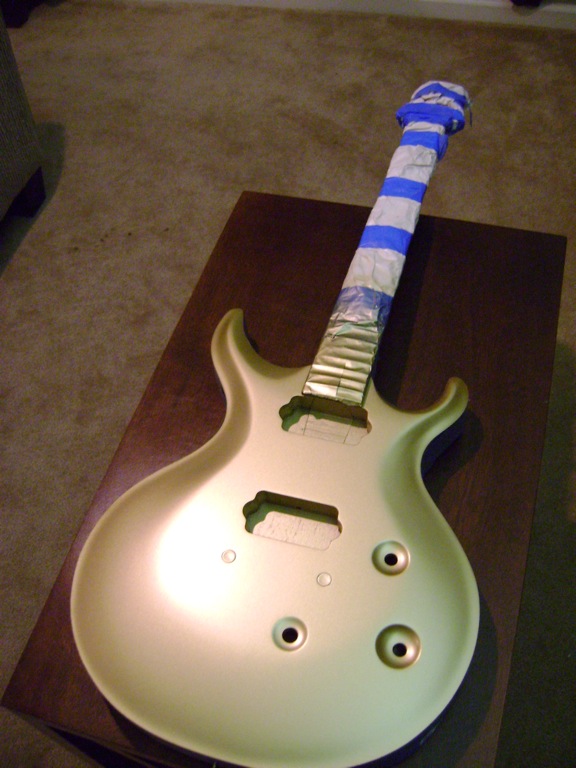
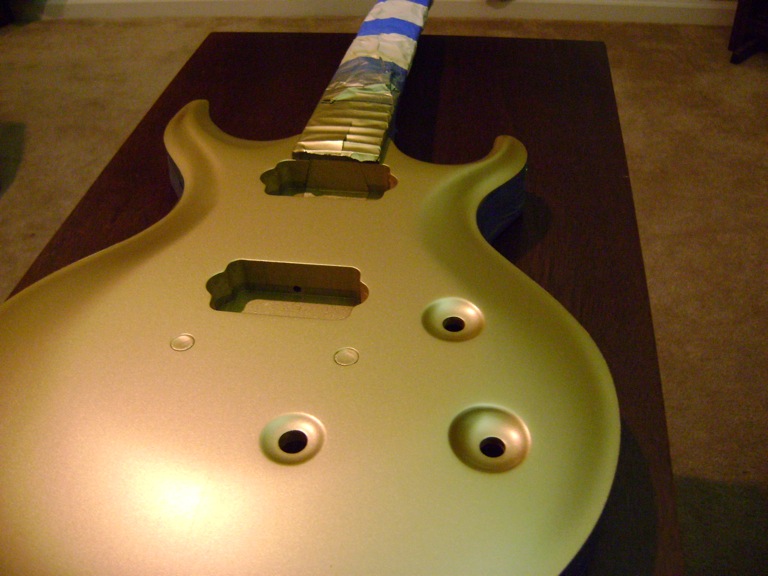
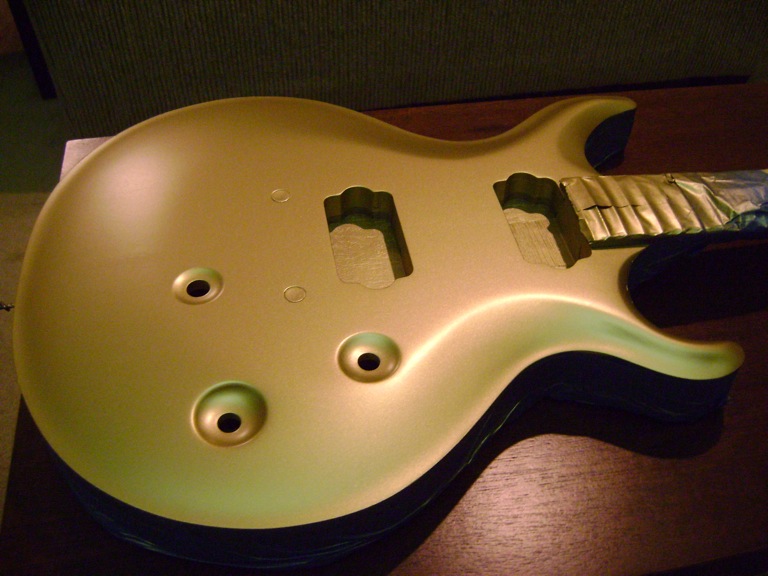
Goldie’s ready for her clear coat! OMG! I just can’t believe it! We are so close now! Had a bit of a setback because Adam, in addition to being a luthier is also a professional forest firefighter. What a guy! Anyway, enjoy the pics!
For more information about Saint Guitar Company, see their site! FYI, Adam’s come up with a Vintage series. I believe this is going to be a semi-hollowbody, with real classic styling.
If I’ve said it once, I’ll say it again. The market cannot have too many overdrive pedals. 🙂 As you know if you read this blog with regularity, I just love ’em. I know… there’s nothing like the sound of a cranked amp, yada-yada-yada… But to get to the type of amp drive that I like; that is, with both pre-amp and power tubes contributing to the distorted sound, the volume levels will make your ears bleed. Enter the overdrive pedal, which gives you that breakup tone at any volume level! And the reason I love OD pedals so much is because I personally haven’t come across any two from different makers that sound exactly alike. Sure, many cop the tone of some original design – can you say Tube Screamer – but even the “clones” have voices all their own as their manufacturers add features or make the original circuits more efficient.
The brand-new Smooth Boost from Elite Tone promises to be a VERY interesting take on the overdrive pedal. Don’t let the name fool you: This is not a pure booster pedal. Even Elite Tone categorizes it as a distortion/overdrive pedal. Here’s the description from their site:
Brand new offering from Elite Tone a simple subtle unique boost effect pedal. The Smooth Boost features a circuit architecture that supports, enhances and optimizes your existing tone with delicate transparency. This simple yet multifaceted effect, achieves hi fidelity tube like signal boost, compression, sustain, overdrive and even mild distortion. The smooth boost can also be adjusted remotely with guitar volume and produce a lush twangy tube like sound as the volume is rolled back. With the signal maxed it adds mild harmonic overdrive and a touch of distortion.
What really intrigues me about the pedal from the description is the phrase “The smooth boost can also be adjusted remotely with guitar volume…” Wonder if that’s actual mechanical control through a specific input, or it’s functioning like other OD pedals that respond to input gain. I’m going to have to do more research.
Holy GAS Attack, Batman!!! This handmade pedal only costs $99 direct!!!
Dammit! I wish I hadn’t gotten wind of this pedal. It’s bad enough that my natural curiosity makes me want to check this pedal out, especially with that “remote adjustment” bit. But that combined with the price is giving me a serious case of GAS! Crap! 🙂
Anyway, the Smooth Boost includes the following features (from the Elite Tone site):
Engineered and constructed all by hand
True bypass
Battery Included
2.1 mm diameter DC jack adapter (like boss style, etc…)
Extremely low ambient noise ( Not audible with effect full on and strings muted in many cases)
LED On/Off indicator
Okay… I’m sold. Sight unseen, sound unheard. Well… I am a bit more reasonable than that, but this is VERY COOL! At the very least, I need to find out more about this pedal!
I was noodling around the other day, and came up with a riff. The riff turned into a jam track, then the jam track turned into a full song. I’m still working on the song, but thought I’d post it for folks to give it a listen. Here it is:
Here’s what I used:
Rhythm Part: Clean Strat in Neck/Middle position. My Aracom VRX22 in the Clean channel, with the Master cranked and volume at halfway. Used a Red Bear Trading Tuff-Tone pick to get that percussive sound out of the chords.
Part 1 Solo: Strat in Neck Position into my MicroVibe and the same amp settings. Also, used the Tuff-Tone pick to get a more percussive attack to the notes.
Part 2 Solo: Strat in Bridge Position into MicroVibe. Amp was set on Channel 2 with the Master dimed and volume at 6 for some nice, but not over-the-top breakup. I love that 6V6 breakup! Here I used my V-Picks Psycho to smoothen out the attack and give the bright bridge pickup a bit of extra oomph.
Part 3 Solo: Strat in Neck position, nixed the Vibe, into the clean channel with Master and Volume fully dimed. Used the Psycho here as well, but used a percussive attack.
In order to get those kind of high power settings from the amp, I used a soon-to-be-released Aracom attenuator that’s like NOTHING I’ve played through before! This thing is completely transparent because it maintains reactance between the amp and speaker; something that a lot of attenuators have a problem with (please don’t get me started on the UA, which I think is the biggest bunch of hype I’ve ever run across as far as attenuators go).
Another word about the VRX22. When the Master is fully open, and the power tubes are getting lots of juice, this amp just oozes all sorts of tone. And as the rectifier circuit kicks in, this amp feels as if it has built in reverb! As you can tell, I love this amp! Check it out at: http://www.aracom-amps.com.
I know that you might think I’m a bit nutso for using different picks; obviously in a live situation I’d probably only use one. But the in the studio where I can do pretty much anything I want, using different picks to affect my tone is totally cool. Check out Tuff-Tone picks at http://www.redbeartrading.com and the Psycho pick at http://www.v-picks.com. I swear by these two brands, and while I don’t work for either of these companies, like the Aracom Amps, they’ll always be part of my “rig.”
Summary: Need a quick, portable way to get your guitar ideas down on track, with an incredibly easy-to-use USB interface for performing live through software models? Look no further. Amplitube Fender Studio will get you rocking in minutes!
Pros: The inclusion of Fender Studio SE, RiffWorks T4 and Amplitube X-Gear, provide you with a full-featured experience to develop and track your song ideas, and are well worth the price of admission!
9’/2,5m length cable with integrated audio interface
1/4” jack connector MONO IN
1/8” mini-jack Headphone STEREO OUT (suitable also for Amp/Powered Speaker OUT)
USB 1.0/2.0 connector
Activity LED
Volume UP/DOWN buttons
USB bus powered
16 bit A/D -D/A converter
44KHz/48KHz Sampling Frequency
Ultra-low latency ASIO and Core Audio Drivers
Hi-Z direct Guitar and Bass-IN (suitable for any instrument with line out also)
Price: $99.99 (street)
Tone Bone Score: 5.0. Being constantly on the go as I am it can get frustrating having to wait all day to get a riff or song idea down. With the Amplitube Fender Studio, I can quickly hook up my axe, switch on my laptop, and get an idea down before I lose it!
I’ve been getting some pretty cool gear and software from IK Multimedia as of late, and so far, I’ve been nothing short of impressed with what I’ve evaluated. I totally dug AmpliTube Fender, and the StealthPedal blew me away with its high-fidelity signal processing. So it was with great anticipation that I’d do a review of Amplitube Fender Studio with the StealthPlug. I wasn’t disappointed in the least!
Amplitube Fender Studio: Be Anywhere, Record Your Axe Anywhere
I received AmpliTube Fender Studio with the included StealthPlug a few days ago (it’s always nice to come home to find a delivery box), immediately opened the box, plugged the StealthPlug into the USB port of my laptop, plugged my headset into the StealthPlug, fired up AmpliTube X-Gear, chose an amp, and started to play. Just as I expected, the device worked as advertised; and also as I expected, it worked with practically no latency. I immediately thought, “Man, I could gig with this…” But I’m jumping ahead… As fortune would have it, I could only spend a few minutes playing as I had to leave, so I unhooked everything and placed the StealthPlug in the pocket of my gig bag.
This morning, I loaded up my axe into my car, wanting to practice a little at lunchtime, as my work has kept me from playing regularly for the last several days. As I was driving into work, just letting my mind wander as I traveled down the freeway, out of nowhere I got a song idea. I played it over in my head for a few minutes, then anguished a bit because like many song ideas I’ve had in the past, I would have to wait until I got home to get the idea tracked; more often than not, by the time I got home, I’d lose the idea. Then I remembered that I had put the StealthPlug in my gig bag!
I immediately exited at the next exit and found a good place to park. I jumped out of the car, with laptop in hand, opened up my rear hatch, pulled my axe and the StealthPlug out of my gig bag, hooked up to my laptop, opened up GarageBand, created a new track, and hit record. I had the song idea down in less than five minutes. Sorry, I’m still working on the song, so I don’t have a clip. But the point of this is that the StealthPlug enabled me to get my song idea down soon after I got the idea. It meant that the idea didn’t get relegated to another “one that got away.”
Performance
I needn’t go into any diatribe of the StealthPlug’s fit and finish nor how it sounds. How it sounds is based upon what amp and effect models you apply in your software. But here’s one thing I did notice, and it’s a huge thing: I could barely detect any latency at all while I played through the StealthPlug, even when recording in GarageBand, which can be a real resource pig. That kind of instantaneous response is absolutely to die for! I suppose the near-zero latency of the StealthPlug probably has a lot to do with the simplicity of the signal route. It’s a USB cable, for goodness’ sake! But that bodes well for using the StealthPlug in a live situation. I’ve often wanted to use my computer in a live situation using nothing but software models for amps; especially in my church gig where controlling output volume is essential. The only thing that has kept me from doing this is latency. Even tiny amounts of latency can throw you off while you’re playing. But with the StealthPlug’s near-zero latency, I think I’m going to have to give it a go.
Funny thing, I perused the web for other reviews, and all seemed to have a much more tepid response to this wonderful piece of gear; especially with respect to latency. Mind you, I have 4 GB RAM in my Mac, so that probably has a lot to do with my lack of latency, since the computer rarely has to go to the hard drive once things are loaded.
Another thing I tried with the StealthPlug was running it from my pedal board, to see how it would react, and see how the amp models I have on my laptop would react. After tweaking some levels, I was amazed at how well it worked! Admittedly, the tone produced seemed a little thin in the highs, but a little EQ to boost the highs remedied that right quick. But there are other ways to employ the StealthPlug. Here a few ways you can use it.
Amplitube Fender Studio: It Simply KICKS ASS!
So I’ve established that I dig the StealthPlug… On a standalone basis, I’d give it a 5.0 Tone Bone score by itself because of the effect it had on my songwriting, but used within the context of the included Fender Studio software well, the whole package gets a 5.0! And it’s due to a little software package called Riffworks T4 that’s included with Fender Studio. I had heard of Riffworks by following Todd Rundgren who recorded his latest “Arena” album using the full version of this software.
Basically, Riffworks, as the name implies, is a software where you can create layered riff loops. Unlike programs like GarageBand or Ableton or the like, you construct songs in Riffworks by linking together riff loops that you can create. I won’t go into a lot of detail about it here, but I will say that it makes songwriting very very easy. For those of you familiar with digital recording, riffs are built using a “loop recording” methodology; that is, a phrase is played over and over again with a new “layer” added with each iteration of the loop. It’Add to the fact that Fender Studio and X-Gear or whatever amp plug-in you have on your computer is readily available in the software, and creating music is absolute freakin’ breeze. Here’s a clip that I recorded just a few minutes ago using Riffworks with Fender Studio:
For the rhythm part, I used ’59 Bassman model, then applied a Riffworks Filter and Shaper to it to give it that “vibey” sound. For the lead, I used driven ’57 Deluxe model. But for this, I ran my guitar into my pedalboard first, then into the StealthPlug. I only used a single pedal, and that’s my beloved Tone Freak Effects Abunai 2 to add some slightly compressed and sustaining overdrive to the signal. The result was magnificent!
Once I was done with recording in RiffWorks, I outputted the clip to a WAV file, then imported it into GarageBand, so I could add a bassline. If I had a bass handy, I could’ve done everything in RiffWorks, but alas, I can only use MIDI for now. But here’s the cool thing: The StealthPlug was my only audio interface into my computer! How incredible is that? And I just had my headphone attached to the StealthPlug, and it all worked amazingly well. Talk about having a portable studio! All I need is a couple of guitars, the StealthPlug and my laptop! Save the guitars, all I need will fit into my laptop bag. Granted, I wouldn’t have access to my pedalboard if I was on the road, but adding effect plug-ins to Amplitube if I need them is not a problem.
Overall Impressions
Amazingly enough, response to the StealthPlug has been just okay… Not sure what that’s all about. But for me, I have a recording solution wherever I go. I don’t need to bring amps, just my laptop and a couple of guitars when I want to get away for a remote songwriting adventure. And RiffWorks plus Amplitube gives me everything I need!
As much of a gear slut that I am, I’ve realized that I’ve completely overlooked one incredibly important piece of gear at GuitarGear.org that can have a huge effect on your tone: The guitar cable. Actually, I’ve shied away from this subject, much like I shied away from talking about speakers. Why? Because like speakers, there’s really no definitive way to classify cables as “good” or “bad,” no matter what materials are used. It’s a very subjective thing; that is, you have to use your ears to make the determination of what sounds good to you and what doesn’t.
Lots of manufacturers and gearheads will spout off terms regarding cable materials and electronics, and while those things are important, ultimately they’re only contributing factors and not one single thing will make one cable better over another. As I said, use your ears.
What’s in a cable?
A cable consists of four basic, discrete elements: A conductor, a dialectric, a jacket, and the plugs. The conductor is what transports your electrical signal end-to-end through the cable. Most conductors are made of copper, though some are coated with silver. There are pure silver conductor wires that some audiophiles swear by, but they are typically incredibly expensive. A colleague of mine wired his entire home stereo system with pure silver wire, costing him hundreds of dollars. But he swears by the purity of sound that this conductor produces. Regarding copper, the more pure the copper, the better the signal conductance, so in a sense, a cheap wire using cheap copper, will probably not sound as good as one that’s made from more pure copper.
The dialectric is a sheathing around the cable and is an essential component in that as the electrical signal flows down the cable, a large amount of the signal travels along the outside of the conductor. As you might think, some of that signal may “bleed” off, and indeed that is what happens. This is where the dialectric comes into play. It basically absorbs the electrons that break off the flow, then puts them back into the flow. Different materials are used as dialectrics, though teflon tends to be regarded as the best dialetric material.
The jacket is the visible layer of the cable that you see but typically, just underneath the jacket are insulators and shielding, to protect from transmitting signal out or letting external signals in.
Finally, we have the plugs. These are made up of a variety of materials from unplated brass to gold, nickel or silver plating. Each of these materials provide a different tone. Mind you, gold is not necessarily the best conductor, but it does provide excellent protection against corrosion, which will have a serious effect on your signal.
So what’s the big deal about capacitance?
Capacitance is probably the most common term bandied about by alleged pundits of cables. Essentially capacitance is a measurement of how much signal a conductor stores. At first blush, a lower capacitance number should indicate a much more efficient signal. But from what I’ve come to understand, capacitance, while important, is only part of the picture with respect to the overall tone of a cable. Throwing about this term without context is akin to throwing about a frequency response curve for a speaker. In that case, it gives you an idea of where the tone is delivered, but until you put that speaker in a cabinet, you’ll never know how it really performs. It’s a similar thing with capacitance. It’s only part of the whole picture. For me, though I mean no disrespect, I tend to ignore people who bandy about capacitance as something that should affect one’s decision to purchase a cable.
I asked a friend about this, and he said that yes, capacitance is an important consideration, but if a dialetric material is used that’s fairly absorbent and doesn’t return electrons back into the flow, what you’ve gained in capacitance, you’ve lost in the dialectric. I’ll be the first to admit I’m no electronics wizard, but that seems plausible enough to me.
So what do I look for?
Ultimately, for me it boils down to tone. I’ve recently taken a real liking to Monster Standard 100 cables. To my ears, they provide a great balanced tone. No, they don’t have gold plating or any silver, but it’s a good, versatile, all-around cable that I think sounds great. They also have great shielding which is really important in protecting against RF. But that’s me – to my ears they perform great. However, after trying out both the Acoustic and Rock models recently, I’m seriously considering of making an investment in those cables. I know there are others out there. I just have to find a place to try them out.
As much as I have been ranting about Fender gear pricing as of late, and their latest “supposed” price drop (who knows for how long), my Champ 600 has been a tried and true companion in my studio ever since I got it. I’ve even used it at small venue gigs hooked to a 1 X12 cab, and it has performed wonderfully! This is a great amp!
Folks, this is phenomenal! While diminutive in size, this amp packs tone! You want classic Fender tone at a lower volume for home recording or just futzing around, this is the amp to get! And because it’s a low wattage amp, you can push it and not worry that your eardrums will start to bleed.
For my own purposes, this has been one of most pedal-friendly amps I’ve ever owned, so I retubed it with a NOS JAN-Philips 12AT7 and a JJ 6V6 to get maximum clean headroom out of the amp. Now, I have to open up the amp full to get even mild breakup. But that’s why I have my OD pedals. My thought behind this is that I want to get as pure character out of my OD’s as possible, so playing through a really clean amp will accomplish that.
So what’s the point of all this? As I mentioned above, this is a GREAT amp, and at $149, it’s a steal. Go get one at GC today!
Here’s a sample I recorded with the amp hooked up to my 1 X 12 extension cab:
Disclaimer: I’m not in any affiliate program with GC, so I get nothing out of announcing this. 🙂
Sorry, no pics today folks… But I did speak with Adam this afternoon, and he said the guitar is ready to go into color coating. I kind of jumped the gun last time I wrote an entry on this… I thought it was going in for finishing! Actually it was going in for its base coat. When Adam got it back, he had to block sand it down. It took awhile because he had a family emergency that he had to take care of the last couple of weeks. But the guitar’s close to being done now – real close. The color coating will go on, cure for a bit, then the first coat of gloss will be applied to the top, block sanded down, then the final thin coat of gloss will be applied. Hopefully I’ll have the guitar in a couple of weeks! I’m so jazzed!!!
In case you’ve missed the previous pics, either click on the “Goldie” tab above, or just click here.
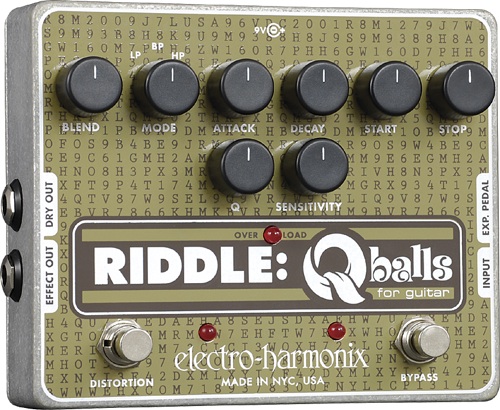 Q-Balls, that is… Introducing the new RIDDLE: Q-Balls from Electro-Harmonix, an envelope filter for guitar. The RIDDLE also has a brother for bass called the ENIGMA: Q-Balls.
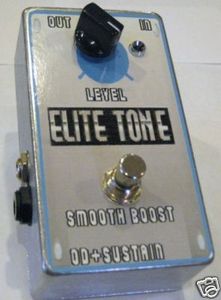 If I’ve said it once, I’ll say it again. The market cannot have too many overdrive pedals. 🙂 As you know if you read this blog with regularity, I just love ’em. I know… there’s nothing like the sound of a cranked amp, yada-yada-yada… But to get to the type of amp drive that I like; that is, with both pre-amp and power tubes contributing to the distorted sound, the volume levels will make your ears bleed. Enter the overdrive pedal, which gives you that breakup tone at any volume level! And the reason I love OD pedals so much is because I personally haven’t come across any two from different makers that sound exactly alike. Sure, many cop the tone of some original design – can you say Tube Screamer – but even the “clones” have voices all their own as their manufacturers add features or make the original circuits more efficient.

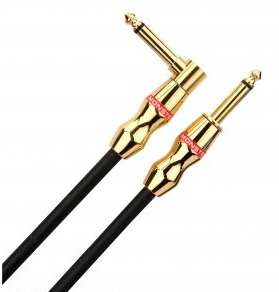 As much of a gear slut that I am, I’ve realized that I’ve completely overlooked one incredibly important piece of gear at GuitarGear.org that can have a huge effect on your tone: The guitar cable. Actually, I’ve shied away from this subject, much like I shied away from talking about speakers. Why? Because like speakers, there’s really no definitive way to classify cables as “good” or “bad,” no matter what materials are used. It’s a very subjective thing; that is, you have to use your ears to make the determination of what sounds good to you and what doesn’t.
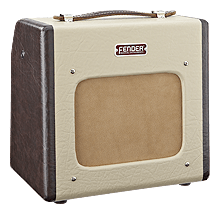 As much as I have been ranting about Fender gear pricing as of late, and their latest “supposed” price drop (who knows for how long), my Champ 600 has been a tried and true companion in my studio ever since I got it. I’ve even used it at small venue gigs hooked to a 1 X12 cab, and it has performed wonderfully! This is a great amp!
 Guitar Gear