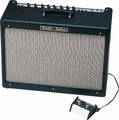
If you’ve had your ear to the ground about the oncoming Fender price hike well, it’s real, and it’s here. I was in a shop today, and a brand new Fender Hot Rod Deluxe – the exact same amp I own that I got for $599, for a whopping $839, with a list of $1200! For cryin’ out loud! This amp is NOT a boutique amp. While a tube amp, it has a solid state well, everything. All the electronics are on PCB boards, and the damn thing’s not even assembled in the USA!
If I was looking for my first tube amp, at these prices, I’d ignore Fender, and get something like an Orange Tiny Terror, or an Aracom RoxBox. The Tiny Terror costs $550 new, and RoxBox head is $895. I’ve played both, and they both sound way better (at least to my ears) right out of the box than the Hot Rod, which I had to spend even more money on mods and better tubes than the stock GrooveTubes that come with it.
Make no bones about it: Fender amps at this level ain’t boutique, not in the slightest, but they’re approaching boutique amp prices. Well, I guess it’s the sign of the economic times.
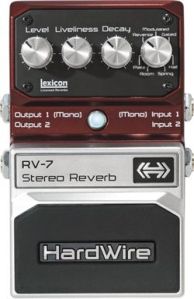
Summary: With seven (7) licensed Lexicon reverb models, this is one bad-ass reverb pedal, and a great value proposition given the relatively inexpensive price of $149.99 for a true bypass pedal. With the Hardwire series, Digitech has really hit a home run!
Pros: Just about the best-sounding spring and plate reverbs I’ve ever heard in a digital reverb. Capable of subtle reverb, to thick, rich and wet surf.
Cons: None. I dig this pedal!
Price: $149.99 street
Features (from Digitech):
Reverb Types
Room – Fast decaying reverb; great for a touch of ambience
Plate – Renowned studio reverb heard on classic recordings
Reverse – Reverb in reverse; gradually crescendos to full volume
Modulated – Lush, modulating, reverb ideal for chords
Gated – Unique reverb with abrupt decay; good for percussive playing
Hall – Large, encompassing reverb with warm decay
Spring – Classic “surf” reverb; great for Rockabilly too!
Tails On/Off Switch – When on, reverb tails are not cut off in bypass
True Bypass circuitry preserves your tone in bypass
Constant high-voltage operation for tonal quality and noise reduction
HardWire Pedals include the following stage accessories
Stomplock™ knob guards lock your tone in place and prevent tampering or accidental knob adjustments onstage
Green gaffer tape helps you locate the pedal in adverse stage lighting
Custom-cut Velcro® pads attach and lock your pedals to your pedalboard
Tone Bone Rating: 5.0 – I did a review of this awhile back, but I finally bought one, and I am oh so pleased with how it sounds!
Yeah, yeah, say what you will about Digitech being known for “consumer” grade pedals, and I’m as much of a boutique pedal snob as the next guy, but there’s no denying the quality workmanship that has gone into the Digitech Hardwire series of pedals. And yes, I know, I reviewed this pedal before, but that review was based upon a test at my local Guitar Center, while competing against the flailing of a wanker sitting next to me, trying to look cool and and trying to play metal licks and failing horribly. Okay, enough of the ranting… Y’all know how I feel about wankers… (search GG for “wankers”).
And say what you will about a digital effect box, but the fact the RV-7 has seven licensed Lexicon reverb voices inside give this pedal LOTS of credibility in my book. As I mentioned in my previous review, I’ve used a Lexicon rackmount for vocals at my Church, and have absolutely loved the reverb effects it contains. Though digital, Lexicon has figured it out, so it’s no surprise that they’re pretty much the standard for digital reverb.
In any case, despite the conditions I had to play within during my initial test, the RV-7 blew me away. Honestly, at the time, I didn’t think Digitech was capable of making a truly great-sounding pedal. Make no mistake, I’ve had Digitech pedals in the past, and they’re all quite functional, but I would never give them a “best in class” rating. They tend to offer great value for the money you pay – which isn’t much for their standard stuff; at least until I discovered the Hardwire series – especially the RV-7!
Since I reviewed the RV-7, I’ve tried several, and even came close to buying an EH Holy Grail. It too is a great sounding reverb, but there was something about its room reverb model which just didn’t do it for me. It’s a great pedal though, but I still liked the RV-7 better.
Recently, I had the chance to go to the local music shop near my work (B Street Music in San Mateo, CA) to perform an A/B test between the Holy Grail and the RV-7. Head-to-head the pedals were pretty close in performance, but the RV-7 beat the Holy Grail with the types of reverb voices it offered, plus the room reverb model on the RV-7 was superb! While the Holy Grail just edged out the RV-7 with the spring reverb, I found I could dial in a great sounding spring reverb with the RV-7 just the same, so that, combined with the awesome room reverb was what sold me. But let’s get into some specifics…
Fit and Finish
All the Hardwire pedals are solidly built with a cool, flat metallic finish. These pedals are very well-built, and surprisingly heavy – definitely gig-worthy. The RV-7 has a purplish, flat metallic finish on the body with a flat silver switch plate that has a nice rubber pad with the Hardwire logo. The pedal featurs a cool, light-blue LED indicator light. The RV-7 has four control knobs: Level, Liveliness, Delay, and a Voice selector knob. The first three knobs are not smooth sweep knobs. They have – for lack of a better term – micro-notches that really add to the whole industrial vibe that the Hardwire pedals have going on. When you look at the pedal, what’s not to like? 🙂 Of course, how it sounds is where it’s at, isn’t it?
Controls
Level – Controls the Wet/Dry amount. Fully clockwise is 100% wet.
Liveliness – This is actually hi-cut filter to add or reduce the amount of high-end freqs that come through
Delay – Controls how long the reverb effect decays after striking a note or chord
Voice Selector – pretty self-explanatory
How It Sounds
In a word, AWESOME! I used it in my weekly acoustic gig this evening, and was thanking the heavens for such a great pedal. My guitar maintained its clarity, no matter how much I upped the level knob. It must have a slight pre-delay built in; whatever, the fact that I could clearly hear the notes and chords I was playing and not having them washed out by the effect was truly an inspiring experience. Add to the fact that it is true bypass, so when it’s off, it’s really off, is yet another reason to love this pedal; no hum, no buzz.
To be fair, I have no idea what to do with the reverse reverb other than to add some interesting effect with single notes in a song. But other than that, I’m really digging this pedal!
Sound Samples
Here are some sound samples I quickly created… Please excuse the recording quality. I just recorded in an open room with no filtering. BTW, I used a Strat with a prototype Aracom RoxBox 18 Watt Amp with a Jensen 1 X10 speaker. In almost every case, all the dials were at 12 o’clock, except for the Hall and Spring, where I set Level and Decay to about 2pm. I prefer a more subtle reverb effect, but as you’ll hear, the RV-7 is crystal clear, and produces a very nice reverb effect.
I’ve always associated Orange Amps with metal until I actually played a Tiny Terror. What a great amp! It’s got nice, bright EL-84 tone, and for $550 new, it’s a great little amp! Hmmm…. looks like I should do a review of it… 🙂
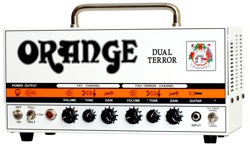
But Orange is taking the amp a step further and has just announced the Dual Terror, which is a 30 Watt, dual channel amp that is switchable down to 15 and 7 Watts! Oooo… From the announcement I read, it looks like this will be a real versatile amp! Can’t wait to test one out. FYI, here’s a copy of the press release I just got from Orange….
Orange Amplification launches ‘Dual Terror’
British amplifier manufacturer, Orange Amps launched the Tiny Terror amp in 2006 and has already sold over 30,000 units, making it one of the most in-demand amps in the world. The concept of the Tiny Terror was simple: squeeze every drop of Orange’s unique signature tone into a lunch-box sized amp to create 15 watts of unmistakable Orange Class A Tone weighing only a few kilos – and at a price every guitarist can afford.
Orange can now announce the next generation of the Tiny Terror concept – the ‘Dual Terror’: a twin channel, 30-watt head, switchable from 30 to 15 or 7 watts giving more choice and options shrunk into a size that belies its power!
The 30 watt Class A dual channel amp incorporates the unique Tiny Terror channel and a new ‘Fat Channel’ bringing a new ‘fatter’ chunkier sound, whilst keeping the classic Tiny Terror sound.
The power options make this a truly versatile amp, capable of dominating at bigger venues and subtle enough to be perfect for recording, studio work and home playing. Switchable between 30, 15 and 7 watts and switchable between 4 and 2 output valves, the combinations of options provide for unmatched levels of performance and flexibility.
The Dual Terror OS-DT30-H is built to the usual Orange high quality standards, using top quality components and its roadworthy rugged construction (supplied with padded gig bag ) is everything you’d expect from an Orange amp. The proven ‘Orange Terror’ concept of combining portability, versatility and delivering most importantly a great sound, is all here.
The original Tiny Terror has legions of fans, with users including Gary Moore, Mark Knopfler, Steve Jones, Eddie Van Halen, Andy Dunlop, Kaiser Chiefs and Eddie Kramer. The new Dual Terror will have even wider appeal to professional users and enthusiasts alike.
For further information contact:
USA info@orangeusa.com or outside USA info@omec.com
I just dig it when I find a great guitar and amp combo! Featured in this Jam Track are the Saint Guitar Company Messenger Baritone and the Aracom Amps Custom 45R, both of which I’ve reviewed previously. (Messenger Review | Custom 45R Review). The Custom 45 has a really beefy low-end and a slight scooped tone, and the Messenger, while a baritone, has this incredibly bright-sounding voice. The two complement each other particularly well! Here’s the Jam Track:
You have just over 6 minutes to play around with this one. For the rhythm part, I used a fairly basic rock beat, but I also added some Latin drums underneath to take the edge off the heavy downbeat. And by the way, there’s no bass in this track at all. All of that is provided by the Messenger!
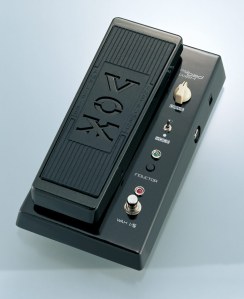
Ever since I tried out the VOX Satchurator a few months ago, I’ve been waiting for the this wah pedal to arrive. If it is anything close to the quality of sound that the Satchurator produces, I know that this is going to be a great pedal. The pedal features two modes: Mode 1 is classic VOX wah; while Mode 2 features the ability to variably adjust the gain and voicing profiles of the wah to dial in a variety of tonal possibilities.
One thing I take note of when evaluating pedals is if I can reproduce the manufacturer’s or endorser’s claims about a particular feature. For instance, when Satch touted the “More” switch on the Satchurator, during my tests, I was expecting more volume when my amp was clean, and more balls when my tubes were saturated. The pedal definitely lived up to that claim.
With the Big Bad Wah, VOX states, “Designed to Joe Satriani’s custom specs is the design of the pedal pot itself, delivering a smooth, musical tone throughout the entire sweep of the pedal.” This is huge, because I’ve found in my evaluations of different kinds of wah pedals that when you back off the pedal, your output becomes a bit muddy, so you end up never fully backing off because the wah will just suck your tone. Or seemingly to protect against this, manufacturers will narrow the sweep range, so the wah becomes much less dramatic. I found this to be the case with Morley Steve Vai Bad Horsie, which was very musical throughout its sweep range, but overall, didn’t have that dramatic of a sweep as compared to others I tried. So I ended up just getting a Dunlop Cry Baby, and despite its shortcomings, I’ve come to love it.
But I’ve always loved Satch’s wah tone, not because I want to necessarily sound like him, but because it’s just a killer tone, and highly expressive. And as with the Satchurator, Joe was involved in every aspect of the design process, so the Big Bad Wah promises to be of the exacting standards for which Professor Satchifunkilus is known. Once the Big Bad Wah is available in stores, which should be soon, considering the announcement of its release was made at NAMM, you can be assured I’ll be running down to the local shop to try one out!
Some online retailers like Sweetwater, are doing pre-orders for $219. That’s not a bad price to pay, especially for a signature pedal. And I dig the fact that Joe really wanted all his signature pedals to be affordable and within the reach of a wide range of people. In any case, all this combined makes for me taking a serious look at the Big Bad Wah
Summary: A great take on the classic Marshall JTM45, with some extra goodies like tube-driven spring reverb, a fantastic master volume (post phase inverter), half power switch (40 to 20 Watts), and bright and bite switches to add hi and hi-mid EQ bumps for more tonal contouring.
Pros: Very versatile amp with a tonal palette that can serve up gorgeous clean tones to thick, super-compressed power tube distortion.
Cons: Heavy – weighs in at 60lbs.
Price: $2195 street (as tested with 1 X 12 Combo)
Specs:
Pre-amp tubes: (3) 12AX7, (1) 6BM8
Power Amp Tubes: (2) 6L6GC or KT66 (as tested)
Rectifier: (1) GZ34 (5AR4)
Reverb Tank: Accutronics Long TankHi/Low B+ voltage switch (40/20 watts)
On/Off Switch
Standby Switch
Indicator Lamp
Custom Heavy Duty Aluminum Chassis
Custom Wound Transformers
Impedance Switch: 4, 8, 16 ohm
(2) Speaker Jacks
Custom Handcrafted Turret Board
Handwired
Tone Bone Rating: 4.75 – Sweet amp with lots of tonal variety, but very heavy at 60 lbs. in a 1 X 12 combo! I would definitely get casters for this amp.
One thing I’ve learned about reviewing gear is to never have preconceptions about what something might sound like, especially with guitars and amps, regardless of what the manufacturer might say. When Jeff Aragaki of Aracom Amps dropped his latest amp off at my house, then explained that it was modeled off a Marshall JTM45, but with a few enhancements, despite my normal resistance to those suggestions, I still made a few assumptions about what the amp would sound like. Mistake. I was expecting a Marshall tone; it’s there, but it’s also different. But let’s get into some detail, shall we?
Fit and Finish
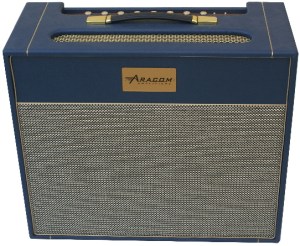
All Aracom amps are very well built and constructed. The amp I tested uses the cabinet shown above, but is covered in green tolex, and the same acoutrements as the cabinet above. The cabinet itself is very sturdy and very resonant. The metal grille at the top of the amp is a nice touch, as you can see into the chassis and see the tubes all lit up. I dig that kind of stuff. Jeff uses all high-quality material from the chassis to the knobs, and everything is well laid out.
How It Sounds
This is one awesome-sounding amp! I was actually expecting a real scooped tone, but was very surprised that the amp is actually voiced quite evenly through the EQ range, with just a tad bit of lower-mid range. This gives the tone a darker, almost fatter feel. But still, the cleans are rich and crisp, not chimey like an EL-84 would sound. The huge KT-66’s this amp packs probably account for that.
The reverb is subtle – very subtle – but I really like the effect it has. It definitely won’t do surf. It was as if Jeff wanted to add the reverb as a nice decoration for the amp’s tone. If you’re looking for a deep ‘verb, this won’t do it, but the reverb it does give you, for lack of a better word, just “fits.” Here’s a sound sample that I recorded with my Strat playing the amp clean in the Normal channel with all the EQ’s set to their midpoints:
By the way, the clip is the raw recording, with no EQ or mastering or level adjustments (which accounts for a bit of the distortion as I didn’t apply a limiter). As you can tell, the clean tone is sweet and well, clean. And it has TONS of clean headroom in the Normal channel.
As far as distortion is concerned, before this, I had never played with a KT-66-based amp, so I didn’t quite know what to expect, but this amp can produce some serious distortion. When saturated, the KT-66’s really compress the tone, and the compression comes on with even just a bit of breakup. It’s a great sound, but it’s difficult to cut through a mix with that amount of compression. But hitting the bite switch adds a bit of high-mid-frequency gain, so that compensates for the compression by sort of shifting the EQ up a bit.
The bite switch works with both channels, but the bright switch only works on the Normal Channel. This switch boosts the upper-mids and highs. Don’t expect a ringy sound out of this – it’s more like an instance presence control, though the amp sports a sweepable presence knob as well.
I wish I had a sound sample for my test with a Saint Guitars Baritone Messenger. Even though it’s a baritone, the walnut gives it a fairly bright tone, and that is really complimented by the Custom 45R. I was enjoying myself so much with the baritone, I totally forgot to record a clip! Maybe later… In any case, this amp just LOVED the Baritone! The Messenger also sports two Duncan active ‘buckers, and the drive they produce really made the amp growl with a real savage tone. It was very heavy, and I was just diggin’ it! Yowza!
Overall Impressions
While I really like the tone of this amp, and am having a lot of fun playing with it, admittedly I still lean towards that chimey EL-84 tone or that “Fender” tone that 6L6’s produce. The Marshall-esque tone never has been for me, but if I were to be on the lookout for an amp with that type of tone, I’d definitely give this amp some serious consideration.
Ever since Fender announced the new Roadworn Series of guitars, I’ve been lurking the gear forums and googling for information about them and trying to get a feel for what people think about them. It’s still early in the game, but not surprisingly, opinions are fairly evenly split. Lots of people like them, lots of people don’t. I’m part of the latter crowd.
From my point of view, if I was going to play a beat-up-looking, “roadworn” guitar that’s broken in, I’d rather have done the breaking in myself, or have had it done by someone else – like my first electric guitar that my little brother gave me. It was an Ibanez Strat copy and it looked like a piece of shit! The paint was cracked and flaking in areas, the electronics were completely screwed up due to the jury-rigged wiring jobs my brother did on it. But when I had it working, that little bad boy could sing! Even my brother inherited from one his band mates. In other words, this guitar has a history, and it plays and feels like it has a history.
My problem with the Fender Roadworn series is that these are brand new guitars that are made to look like they have a history, but they’re fresh off a friggin’ production line! They have no history! Oh yeah, I can hear a Fender rep saying, “We ‘wore out’ some of the most common areas where guitars get worn, and added some other cosmetic blemishes to produce a guitar that looks and feels like its been played for 20 years.’” What a crock of shit! Sorry, not buying the rationale, nor the guitars. Besides, to me, it’s how the guitar sounds and plays whether it’s new or used that counts.
I suppose if you have to have a replica of a famous guitarists axe, hey! More power to you! But in the end, you’re the one playing it, and you ain’t gonna sound like the guitarist whom which the guitar was modeled.
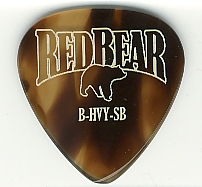
Summary: Thick, meaty hand-made pick from Red Bear Trading. You might think a pick doesn’t really matter until you play one of these picks. They’re totally awesome!
Pros: Thick and tactile, this heavy pick gives you instance response as soon as you strike a string. Chords seem to ring out better. Don’t be fooled by the thickness – the beveling makes this pick glide across the strings!
Cons: None
Price: $20
Okay, I admit it, I am now a true believer in hand-made picks! I wrote a review about Red Bear picks a few weeks ago. In the article I asked, “Does a pick really make that much of a difference?” After nearly a month playing with a Style B Medium, and now a Style B Heavy, I can undeniably say that it makes all the difference in the world! In this short span of time, I’ve become a better player, and while I attribute that to quite a bit of practice, I have to attribute a lot of my recent improvements in both tone and attack to the pick I’ve been using. I don’t say this lightly: These picks have totally changed my life with respect to my guitar playing!
When you first hold one of these picks, your first reaction is: Damn! This thing is thick! And while its smooth texture kind of sticks to your skin, it absolutely glides over your strings. And because of its thickness, it produces sound much faster than conventional nylon picks that need to be before they make a sound. The sound the picks produce is also much more crisp.
For instance, playing my Ovation acoustic/electric, I’ve never heard it ring the way it rings – and it’s because of the pick. I’ve had that guitar for over 15 years now, and it quite frankly has never sounded this good! It always sounded awesome to me because of its thick tone. But when I strum it with one of these picks, it now has a gorgeous chime! F-in’ A!
At first blush, you might think that paying $20 for a pick is just way too much. But how much would you pay for good tone? We guitarists spend literally thousands on guitars and amps and racks and pedals and other accessories every year! But most of us tend to play them with inferior plectrums, never knowing what we’re missing by making a relatively small investment compared to the vast sums we spend on other gear. Sure, our standard picks are cheap, and it’s okay to lose them, but there is absolutely NOTHING that compares to the tone you can produce with a hand-made pick. And once you play with a great pick, you’ll never go back to the cheapo picks again.
To be honest and fair, Red Bear is not the only one who makes handmade picks. But Dave is the only plectrum maker who uses TortisTM, a polymer made from animal protein that looks and feels EXACTLY like tortoise shell. Dave has mastered cutting and shaping of the material, something no one else who has tried to work with it has been able to do.
What’s so special about this material? If you speak with people who have played with tortoise shell picks, they’ll tell you about how good it feels to play with one. But by the same token, to play with tortoise shell means that a sea turtle had to be sacrificed to create the pick. On the other hand, Tortis feels like real tortoise shell. In fact, when Dave first sent out his first prototypes, people told him he was full of shit when he said the picks weren’t tortoise shell! That’s how natural these feel!
As I mentioned in the previous article, Dweezil Zappa swears by these! And for good reason. The sound they produce, and how they make your playing much more precise is an absolute inspiration! For more info, and to order them, go to Red Bear Trading!
If you live in the SF Bay Area, and especially near Palo Alto, you can also get them at Gryphon Stringed Instruments.
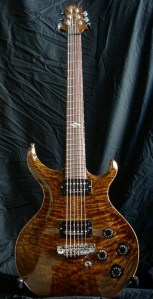
Imagine, if you will, that guitar to the left, in a glossy, goldtop finish. That will be the guitar that Adam Hernandez of Saint Guitars will be building for me. It was by no means an easy decision to make. As a tester for Saint Guitars, and ostensibly a rep for Saint Guitars (I’ve been careful about keeping that separate from this site – though news about it will be out within the next few weeks), I love every single guitar I’ve gotten my hands on. I dig Adam’s approach to guitar-building, and of course, I simply love his designs.
But despite the relationship, I was a little wary of actually purchasing one. Why? There are lots of factors, which I’m going to share here. But first, the juicy back story…
As some of you may know, I’m a huge fan of G & L Guitars, especially the Comanche line. Yngwie Malmsteen calls the Strat a perfect guitar, but I believe the Comanche improves on it even further, especially with its Z-coil pickups that still offer that gorgeous single-coil feel, but with much more output.
For the last few months, I had been saving my pennies to purchase a Comanche from my local G & L dealer. I’ve been skrimping and scraping every extra buck I could because I just had to have one. It’s an incredible guitar that just speaks to my soul. And about a month ago, I had enough to get my beloved guitar. Then Adam contacted me via e-mail a few days before I was all set to buy the guitar and said he wanted to construct a guitar for me based upon this “dream” goldtop I had described to him a month before that when he asked me what I think would be my dream guitar.
Now you might think I just up and dropped all my plans to get a Comanche. I didn’t. I’ve been very drawn to the Comanche for a long time, but as I’ve shared, I also love Saint guitars. In fact, though I received the e-mail early in the morning, I sat on it for the whole day, and didn’t reply until late that night. In short, I was seriously conflicted, and for several good reasons, which is why I’m sharing this experience. And perhaps by sharing this experience, I can shed some light on helping you make your own choice in whether or not to go with a custom-made boutique guitar.
Most people who come to GuitarGear.org have a serious and virtually incurable case of GAS. Several have custom guitars – a few even have a few Saint guitars to their name. So there is no doubt that what you ultimately get is high-quality, and tailored to your specific tonal requirements. But the conflict in my mind was something entirely different than cost, quality, build, tone, etc.. I know what Saint Guitars sound like, and they’re some of the most gorgeous-sound guitars I’ve ever played; cost would be an issue, but if I made the decision, I’d make it happen; rather, it was dealing with the “known” versus the “unknown.”
So, to boutique or not to boutique? That is the question I posed as the title of this article. If it wasn’t cost or quality or tone that was the issue, what do I mean by the “known” versus the “unknown.” I’m going to bullet-point the known issues first:
First off, the Comanche was a known quantity to me. I have played several over the last couple of years, and while each is slightly different – after all you’re dealing with wood which is by no means uniform from instrument to instrument – they’ve all generally fallen within the same range of playability and tone.
And because I’ve spent a lot of time playing that model of guitar, I knew how I’d fit it into my stable and what it could do for my tone, and how I’d use it in my compositions and performances.
The Z-coil pickup is what I believe to be Leo Fender’s finest achievement. Even though Leo was known for creating the Strat, what a lot of people don’t know is that he didn’t play guitar – at all. He didn’t even tune them until late in life! He was all about the pickup, and he built the Strat around his pickup invention. So there’s a bit of history behind the Comanche.
So what about the “unknowns?”
Being that a custom-made is a unique creation, I don’t have a precedent from which to follow. There aren’t any previous guitars made with the EXACT specs my guitar would have. In other words, I don’t have any similar models from which to reference.
I suppose there are reasonable facsimiles, and since I’ve had the fortune to test Saint guitars, I know how well they’re made, but the guitar I have in mind isn’t made of walnut, which is Adam’s choice of wood. It’s a solid mahogany body with a maple neck – similar to a Charvelle I played a few days ago – very nice playing guitar.
Also, with a custom guitar, what I found was that I really had to think and on top of that do research on tone woods and pickups and hardware. That’s something that I wouldn’t have to do with a Comanche. I’ve just had to play a bunch to find the one that I like. That kind of leads back to the first point that there are no previous guitars with my exact specs from which to reference.
But despite all that, I’m still going to have Adam build me my guitar. The uniqueness certainly plays into it, but I’ve been playing long enough now that I have a good idea of how a guitar sounds with a particular type of tone wood, so tone is not quite as unknown as I might have originally thought. But I think the thing that probably was the scariest thing for me was having to specify the different pieces. In other words, all the effort I’d have to put into getting the guitar created. And even though it’s a bit of a moving target, here are the specs I so far:
Finish: Glossy Goldtop
Body: Double-cut Mahogany
Neck: Maple
Fretboard: Ebony
Headstock: Maple
Summary: Nice, simple, and versatile studio/practice/small venue amp with sporting happening EL-84 tones.
Pros: Sweet and chimey EL-84 tones with Class A circuitry; simple and straightforward to use. Switchable between 5Watts and 3Watts, ensuring usability in just about any smaller venue. 3W mode kicks ass for getting power tube saturation at a reasonable volume.
Cons: I wish it had a Master Volume, but that’s just a nit.
Price: $349 street (used to be $249 when it first came out! Damn! Shoulda gotten one then.)
Specs:
• Single-ended Class A circuit
• All tube signal path
• One 12AX7/ECC83 dual-triode preamp tube and one EL84/6BQ5 pentode output tube
• Pentode (5W rms) Triode (3W rms) switch
• Solid-state rectifier
• DC filament power supply for all tubes
• 3-band EQ
• 16-gauge (1.5 mm) thick, folded and spot welded steel chassis
• Double-sided custom color PCB with 2 oz. copper
• 15-ply, 18 mm thick, void-free birch plywood construction
• Custom-designed 12″ Eminence Blackheart speaker
• 16 ohm, 8 ohm, and 4 ohm speaker outputs
Tone Bone Rating: 4.75 – Very musical and expressive amp. Nice cleans, with a decent amount of headroom.
I first heard about Blackheart amps back in 2007. They were so new that very few people knew about them. And while a local shop was listed as a dealer, only the owner knew about the amps, and they didn’t carry them in stock! Blackheart Engineering is sort of an overseas spinoff from Crate which produces cool, yet affordable tube amps. As a home studio enthusiast, I keep my ear to the ground about low-cost, low-wattage combo amps. When I first heard about the BH5-112, I was excited. I thought it was a bold move for Crate, and a smart one, considering Crate is a huge manufacturer with huge lineup of gear; adding even something cool like the Blackheart line would just get lost in the mix. But Blackheart was pretty low-key. No ads, spotty coverage on the Internet.
So it was a very pleasant surprise to see a few Blackhearts at a local shop yesterday, and among them, the Little Giant. I was actually there to play that G & L Tribute Comanche I wrote about last week; the last time I was at the shop, they didn’t have any Blackhearts, so I wasn’t expecting to see them at all. But with them there, I naturally had to try one out, and luckily they had the Little Giant.
Fit and Finish
This little amp has a real cool vibe going on. I really like the cabinet that Blackheart uses. It’s a closed back cab, and for an amp made overseas, it’s appears to be very well constructed. There were no apparent flaws in the tolex layering, and Blackheart logo on the front is killer. I dig the white vinyl trim used on the front around the grille cloth. Real boutique styling at a pretty affordable price!
The control layout is simple: An input jack on the left, volume and three-band eq knobs, an indicator light and an on/off switch, making it simple to plug in, dial in your tone, and start rockin’.
How It Sounds
I’ve really come to love the EL-84 tones, especially when they’re saturated, and the Little Giant doesn’t disappoint when delivering its sound. With the EQ knobs at 12 o’clock, the natural tone of the amp leans toward a slightly scooped tone with a bright voicing. Even with the specially-made Eminence 1 X 12, it’s bright, but it does retain a taut low-end that really smooths out the tone. Quite pleasing. I only tested the amp with that Tribute Comanche, but it didn’t matter. When I test an amp, I play it clean for a lot of my tests to see if it will deliver the natural tonal character of the guitar, and the Blackheart Little Giant fulfills its mission.
The amp is very responsive to volume knob and pick attack. With the volume set at about halfway, and cranking the guitar volume, I was able to get that AC30-like response: Clean and shimmery, with just the slightest bit of breakup when you dig in. Very pleasing to the ears.
Amazingly enough, even though its power rating is a minuscule 5 Watts, with the 12″ speaker, this amp can put out some volume! Hence its name “Little Giant.” It probably couldn’t keep up with a drum set and a band going all out, but it can pack a good enough punch to work well in a small venue where lower volume is critical, and it definitely could be put to great use in a studio!
Overall Impressions
What can I say? I dig this amp, much like I dig the Fender Champ 600. But unlike its Fender cousin, the 12″ speaker really lets the amp breath. And speaking of volume, I was quite impressed with the volume control. Unlike many amps that practically max out by 6, the sweep covered by the Little Giant’s volume knob is nice, even and more importantly, wide. Two thumbs up!s
Here’s a video (excuse the dude’s misinformation about Class A amps – damn! That’s even worse than my faux pas about modes 🙂



 Guitar Gear