Feeds:
Posts
Comments

Archive for the ‘Guitars’ Category

I was surfing around YouTube looking for Steve Winwood songs to listen to (listened to the full “Arc of a Diver” album), and happened upon this INCREDIBLE high-def video of Steve Winwood and Eric Clapton playing live at Madison Square Garden last year doing a bunch of stuff from their Blind Faith days and from their solo careers. This is a must-see…

My favorite tune is at 1:52:00 – that’s at one-hour and fifty-two minutes. It’s “Can’t Find My Way Home.” Then from there, the duo do some of my all-time favorites. In any case, the sound quality is superb, and I watched/listened to the entire vid. It’s worth the watch!

What struck me about watching this video, and has always struck me about Steve Winwood is his absolute musical genius, and how he can play multiple instruments; not just being ABLE to play, but REALLY play them. It has always amazed me. With respect to guitar, he’s so so smooth… well… what can you expect when you have Eric Clapton as a mentor. 🙂

Enjoy!

Read Full Post »

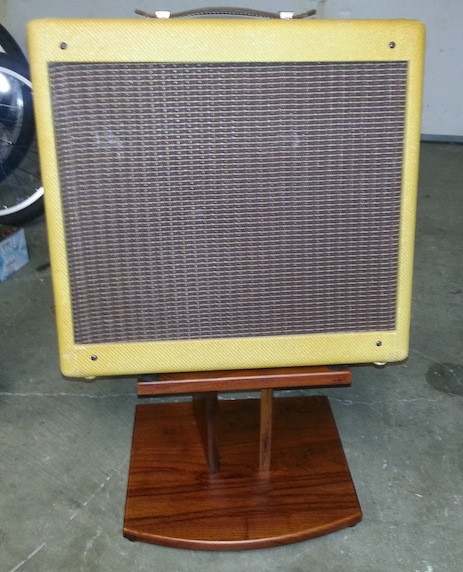
ampendage3Shown to the left is my venerable 1958 Fender Champ… Well, it’s my ’58 Champ chassis in a custom 1 X 10 combo cab that my good buddy, Jeff Aragaki of Aracom Amps built.

Up until recently, I hadn’t really played it much. For one thing, I have a bunch of other amps. But mainly, it’s because that amp would hum after about 1/2 hour of playing. It’s okay on stage, but practically useless in my studio.

Originally, I thought it just might be the old circuitry – for goodness’ sake, it’s 55 years old – even though I had Jeff Aragaki replace the old oil-filled, paper caps with newer ones. I also thought it was a grounding issue because the amp uses a two-prong plug. But I had played another ’58 in a shop that was whisper quiet.

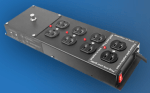
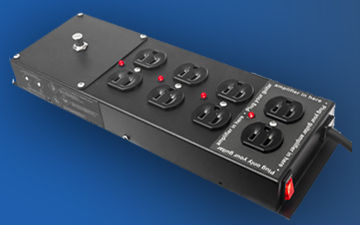
rocknstompnThen a couple of months ago, I got the RocknStompn power strip. I’ve been diggin’ it for how it turns my gear on in the proper order, so I never get any pops from things turning on in the wrong order. But as an added bonus, the unit includes two Ferrite cores in its circuitry to help filter out electromagnetic noise, plus the internal PCB board has a capacitor specifically designed for noise filtering. The net result is nicely filtered power going into the gear plugged into the power strip.

I loved what the power strip did to quiet down a couple of my sensitive pedals, like my ToneCandy Spring Fever Reverb unit. So I figured that if it could help quiet those pedals, it just might help with the Champ. So I switched out amps and hit the foot switch, all the while crossing my fingers, and then the Champ came to life.

From past experience, I knew it would take time for the hum to appear. But after two-and-a-half hours of playing. It never happened. The amp was dead quiet! Just to confirm that it was the power strip doing its filtering, I plugged the amp into a regular power strip, and lo and behold, the hum was there.

That was about three weeks ago. I’ve been using the Champ since then for everything from a little studio work to my regular gigs with nary a buzz or hum coming out of her. This is huge because this amp has such a bright, sweet tone, and it with no EQ controls, I get the natural character of whatever I plug into it. On top of that, it has tons of clean headroom, so when I need dirt, I just use either an overdrive or distortion box. It’s the perfect clean platform for using pedals in a lower-volume application!

That said, as I entitled this article, there ain’t nothin’ like clean power! The RocknStompn power strip has made a HUGE difference for me. When I have one less thing to worry about with respect to my gear, that’s always a good thing!

Read Full Post »

I listened to a recent interview with Huey Lewis on the WTF podcast, who’s on a promotion tour for the 30th anniversary of Huey Lewis and the News’ “Sports” album. Can’t believe that it has been that long since that album was released. I still have the original vinyl that I bought all those years back. What a great album! Reminds me that I should get a digital copy… oh well, so much music, so little time.

In any case, I was absolutely fascinated by the interview; initially because I wanted to see what he has been up to all these years, but then got completely engrossed in his story. But it was something that he said at around 18 minutes into the podcast. The host, Marc Maron, and Huey were talking about Huey playing the harmonica. Marc was trying to get a gauge of how good of a harmonica player Huey was. Huey’s response absolutely floored me:

You gotta have something to say, and you only need the chops to say what you need to say. <background agreement from Marc> It depends on what you want to say.

That statement struck me like a ton of bricks! For years, I’ve felt exactly like that about playing music. My feeling has always been if I can say what I need to say with the chops that I have, then that’s what I focus on; saying what I need to say, and not worry about other people possibly having more to say. Of course, saying the same thing over and over gets old pretty fast, so I occasionally spend a lot of time expanding my musical vocabulary, such as my recent foray a few months ago into studying modes more closely.

To me, having something to say is absolutely central to my playing. A friend of mine and I were talking last night about our approach to guitar. He’s a really awesome blues guy. During our conversation, I mentioned that I have a hard time just noodling or playing licks or leads without something to play against. Call it a weakness, but I just don’t know that many standard licks. I play what I’m feeling in the music I’m playing over.

Then the thought struck me that that’s kind of like my personality. Unless I have something to say, I usually just keep my mouth shut. I shared that with my friend and we both laughed because he could relate.

Kudos to those who can just rip out solos on the fly. I with I could do that. But for me, I need to have something to say…

As for Huey Lewis, like many, I wondered what happened to him and his band since their heyday. Turns out, they never left the scene. They’ve just been playing as a band all these years, and still going strong. People talk about the Who and Stone and U2 and all these HUGE bands that have stayed together. Huey Lewis and the News deserve that kind of recognition for staying together this long.

Read Full Post »

Answering The Question

…which, of course is the question almost every guitar gear slut gets from their significant-other: How many guitars do you need?

To which, of course, the only correct answer is:

JUST ONE MORE

To be completely honest, after I got my lovely, practically perfect Slash L Guitars Katie May, I’ve been pretty set for guitars. Besides Katie May, I’ve got two Les Pauls, three Strats, a Gretsch, a Tele, a PRS SE II Soapbar, and a few other guitars I don’t play; not to mention a few acoustics and a bass. Out of all of my electrics, I’ve been playing Katie May the most simply because she is by far my most versatile guitar. I can get super-heavy to light and jangly tones from her.

But the other day, I was re-arranging a song I wrote called “Never Trade In Her Life” and though I used Katie May for the main electric rhythm part, I needed a different sound for the lead, and she unfortunately wasn’t giving it to me, no matter what amp I used. It’s not that she sounded bad, but she was just way too smooth, and I needed something on the much more open, dirty side of things. So I pulled out my American Deluxe Strat and my world was made right. 🙂

After I got the final recording down, it occurred to me that I was glad that I had my Strat, then took the thought even further to rationalize the number of guitars I have. I’ve told my wife that each one of my guitars has a different voice. It sounds like me playing, but each guitar has a different tonal expression that I can feel and hear. I know, it may sound lame, but there’s a lot to it. For instance, my R8 Les Paul has a very cool and smooth tone; almost like a cello. On the other hand, my ’59 Les Paul Replica has a bright, midrangy tone that’s perfect for classic rock. Katie May also has a smooth tone, but it’s also a bit more hollow sounding than my Les Pauls.

There are even differences between my Strats. My American Deluxe has the classic Strat sound, but it has higher-output pickups, Kinman HSX to be exact, that give it lots of growl when they’re cranked up. And it’s a dirty, single-coil sound that I can’t with any other guitar.

But as I mentioned above, I’m pretty set for guitars right now. But I know that perhaps in a few years, I’m going to be writing some music and will want a different tone that the guitars in my stable can’t produce. So it’ll be back to getting just one more guitar to capture that particular sound. 🙂

Funny thing is that when I play live, I only take two guitars; one of which stays in the car as a backup. That’s purely practical. I don’t have a roadie, so I want to take as little gear with me as possible. If I ever go on the road, I suppose I’ll bring a few for different songs, but in general, I’d still take a practical approach to the gear I bring. In the studio, on the other hand, I can use what I want…

Read Full Post »

First off, Happy Mothers Day to all the mothers around the world!

A couple of years ago, I wrote a song for mothers called “Never Trade In Her Life,” attempting to capture the essence of the busy mother who’s constantly on the go, swamped by the life around her; half wishing she could be free and single, but knowing that the love of and for her family keeps her where she is. When I first laid down the song, it was purely acoustic with some drum and bass added – I think I even had some piano in it. But I updated the song today for Mothers Day, removing the piano, and adding electric guitars and backup vocals. Then I completely re-mixed the entire song to make the sound a bit fatter without losing dynamics. Here’s the final result:

And here are the lyrics:

NEVER TRADE IN HER LIFE

Verse 1
She’s living in a world full of complication
Spinning in her mind like a merry-go-round
and she feels her life could use some renovation
to see the world rushing past her vision

Verse 2
She finds it hard to find some motivation
Coffee and a smoke help calm her down
She reads through all her status line to prove her isolation
But then she smiles…
It’s not so bad after all…

Chorus
She just wants to have some fun
go out in the sun
shoot her worries out the barrel of a gun
See them speed away into the distance
She knows there’s a place in her heart
that needs a restart, to find a new direction
but then she sighs… she’ll never trade in her life

Verse 3
She knows that it’s a passing agrivation
Pictures of her kids bring back her smile
She looks into her world in fascination
and then she cries
with all the love in her heart

Bridge
She remembers all the times
when she was young
and she was free…
But she knows the life she’s chosen for herself
was meant to be…

You might’ve noticed that after the line in the first verse, “spinning in her mind…” there was a little, distant shriek. That was little boy who was four years old at the time who was running through the house playing with his sister. Rather than remove it from the recording I decided to keep it to subliminally add to the mental and emotional chaos the subject was feeling. 🙂

For the electric guitar parts, I kept things VERY simple. There’s a basic rhythm track where I’m comping some two-string chords underneath the verses. This was done with my Perry Riggs Slash L “Katie Mae” custom guitar plugged directly into my custom Aracom VRX18 All the dirt is coming from the amp.

The lead guitar part was played with my Fender American Deluxe Strat plugged into a Circus Freaks Tattooed Lady Overdrive, then into my 1958 Fender Champ. The Tatooed Lady is providing all the grit and grime, plus lots of sustain. I decided to go this route so I could take advantage of the great tone controls of the pedal as the Champ has no tone circuit, and tons of clean headroom. Talk about fun! 🙂

Anyway, I’d like to again wish all mothers out there a wonderful and blessed Mothers Day!

Read Full Post »

rocknstompnFrom now through the end of June, you can get a $100 rebate on a RocknStompn power supply. Normally, selling at $379.00, it’s a fantastic deal with the rebate!

TO TAKE ADVANTAGE OF THE REBATE

1. Click here to purchase the unit on Amazon.com

2. Say something nice about the unit on Amazon.

3. Send a copy of your invoice to Kimball Magee mentioning GuitarGear.org.

More Than Just a Power Strip

I know what you might be thinking, that “it’s just a power strip.” Well, it has lots of features that make it so much more that that. First off, it has LOTS of capacity for surge protection, so you’ll be protected from surges. You can also adjust the timing of each outlet row’s activation. It also sports two ferrite cores on the AC line to provide noise filtering.

I’ve been using mine for just short of a couple of months, and it has become one of those necessary pieces of gear without which, I won’t leave for a gig. For instance, I’ve got some pedals (one in particular) that are extremely sensitive to dirty or fluctuating power. Before I got the RocknStompn, I used regular, off-the-shelf power strips, you know the ones you can get off the shelves at RiteAid. Well, those work well for big spikes, but do nothing for tons of fluctuation, and practically nothing for noise. But with the RocknStompn, I get a nice, clean charge where even my finicky, noise-sensitive pedals operate nice and quiet. Though I’m not electrician, Kimball – the RocknStompn creator – communicated to me that the use of two ferrite cores on the AC help filter out the noise. All I can say in my layman’s vernacular is that it works.

Now I realize that this might seem like a fairly high price to pay, but here’s my personal rationale: I’ve literally spent thousands of dollars on my gear. Last year, I had almost 200 gigs. In some of those places – especially a 110-year-old winery – the power was either extremely dirty, or I got some occasional spikes. It truly worried me. So having some level of protection between my gear and the power source is absolutely comforting. What’s that peace of mind worth? Well, a few hundred bucks to me isn’t too steep a price to pay…

For more information, go to the RocknStompn web site!

Read Full Post »

Les Paul Stars of the 60’s

I don’t normally forward stuff that I read in other sources, but I thought I’d forward this particular article I read on Gibson’s site. The article covers 10 Les Paul Players of the 60’s and their histories with the venerable Les Paul. Here they are:

  1. Eric Clapton
  2. Freddie King
  3. Jeff Beck
  4. Jimmy Page
  5. Hubert Sumlin
  6. Keith Richards
  7. Paul Kossoff
  8. Peter Green
  9. Michael Bloom
  10. George Harrison

I’m not one of those super-fans that know every niggling detail about a particular player, so the real surprise for me was George Harrison. I always thought he played an archtop in the 60’s. I had no idea he played a Les Paul. Oh well… the things you find out. 🙂

Read Full Post »

What’s in a Name?

Goofydawg here and back from a rather longish hiatus of having a total hip replacement. My goodness! It is an incredible feeling to walk with a normal gait and at speed that I haven’t been able to walk at for almost a couple of years! Yeah, yeah… People always ask why I didn’t do it earlier, but the cold hard fact was that I had to deal with getting my cardiac and pulmonary systems in order first so I wouldn’t die on the table. So after many many months of Lipitor and two different types of blood pressure meds, I got my system back into balance enough to have the surgery. And just two-and-a-half weeks past my surgery, I’m operating without any assistive devices (walker, cane) whatsoever, and not only that, I’ve been able to wean myself of all my pain meds except for one that I use for sudden pain! Nice!

Okay, that out of the way… One of my other life-long passions other than guitar is fine wine, in particular fine Pinot Noirs, Syrahs and Zinfandels. I don’t drink a lot of wine (though I do a lot of tastings over the year), so I usually have no more than two cases in my possession at any time (though I have stash in my nice, cool, dark walk-in closet where I hold the ones I won’t drink for years). With that passion of course, I subscribe to various periodicals and newsletters that I keep around the house. In particular, I keep my K & L Wines newsletter in my bathroom for nice bathroom reading. 🙂

This morning while I was perusing my latest copy of the K & L newsletter, I read a column on the 2010 Burgundy’s that are just now hitting the market. It was the word “Burgundy” that sparked the idea of this article.

Over the years, Burgundy has held several connotations for me. Some thirty years ago, when I first started getting into wine and had no idea about different varietals and regions, whatever, the word “Burgundy” equated to cheap, jug wine that parents would provide at parties. My first taste of red wine was actually a sip of that kind of “Burgundy” when I was 16 years old. I remember thinking to myself, “People actually like this shit?” Little did I know that it was cheap imitation, which in later years couldn’t be termed that because of legal restrictions. Of course, fast-forward to today, and thinking about true Burgundy, made in the Burgundy region of France from the noble Pinot Noir grape, gives me the equivalent giddy, butterflies-in-the-stomach reaction to GAS.

The point of all this is that over time or with education, what a name or term may connote changes. For instance, I used to equate the Yamaha brand with cheap Japanese stuff. But now, Yamaha acoustics are my preferred brand; yup, over other venerable labels such as Martin or Taylor. Why? Simply because Yamaha electronics are second-to-none in my experience. They sound the most natural to me plugged in. Their raw, natural acoustics may not be quite as rich as those others, but since I primarily play amplified, I’ll take a Yamaha over any one of those any day!

Why is any of this important? I bring it up simply because it’s very easy to get locked into a certain way of thinking about different things based upon our current perceptions. Think about all the gear out there. We all have our brand preferences, such as my preference for Yamaha acoustics on stage. But I didn’t develop that preference in a static way. I had to do painstaking research when choosing my stage acoustic. I shared this before; I literally spent months evaluating guitars, and while I had the money to spend on a guitar five times its price, I chose my trusty APX900 much to even my surprise.

I do realize that some things, no matter how much I might try to keep an open mind, remain just cheap or bad (no, for the sake of keeping to my policy of playing nice, I won’t name names). But one thing I’ve learned in the years I’ve been writing this blog is that my perceptions on many things have changed because I became personally informed about them.

Challenge your perceptions sometime. You may be surprised by what happens!

Read Full Post »
Jazzy Jam Track

I was bored sitting around the house yesterday, and since I always have a guitar on hand, I just started messing around with some chord changes. Before I knew it, I had strung together a cool, jazzy chord progression with a bit of a latin flair. So, IK Multimedia StealthPlug in hand (I always carry one in my computer bag), I plugged it in, opened GarageBand, then laid down the track. Here are the chords first:

[Bm7] [E7] [Amaj7] [Bbdim]
[Bm7] [E7] [F#m] [F#m7]
[Dmaj7] [Fdim] [F#m7] [E] [Dmaj7]
[Bm7] [C#7b9] [F#m]

[Dmaj7] [Gmaj7] [Amaj7]
[Dmaj7] [Gmaj7] [Amaj7]
[Dmaj7] [Fdim] [F#m7] [E] [D]
[Bm7] [E7] [Amaj7] [Bbdim]

Now here’s the track (you’ll have to loop it if you want to jam to it):

As you can see from the chart, the track is in two parts. I always like having a verse-chorus type of arrangement with my jam tracks so improvising doesn’t become monotonous.

In any case, When I improvise over it, I found that starting with an E Lydian for the first few notes works great for me, but starting on the A on the 7th fret. After that, I just let my fingers do the talking. 🙂 That’s how I’ve been improvising lately. I start with a mode to get a groove going, then I just feel it afterwards. What I’ve found is that the mode provides a theme or a backdrop to the picture I want to paint, then what follows after I let the mode go follows that basic theme. It’s a way for me to think about what I’m playing without over-analyzing it. 🙂

About the IK Multimedia StealthPlug

This wasn’t meant to be a review of the StealthPlug, but I thought I’d give it some props just the same. This little $99 gadget has been a traveling companion now for the past few years, since IK sent me one that was packaged with some AmpliTube software. Since then, I’ve always kept it in my computer bag. The reason is that it provides a very convenient guitar to computer interface that works great with most recording software. I use it with GarageBand to knock out ideas when I’m on the road or, incapacitated as I am right now, not able to get into my garage/studio without assistance.

And the new GarageBand, with all it’s great plug-ins makes recording guitar so very nice because you can easily shape the tones to fit your needs. For instance, the bass part was recorded using my acoustic guitar, but brought down a full octave with the pitch shift plug-in. Isn’t technology cool?

Anyway, enjoy and ROCK  ON!

Read Full Post »

So you’ve watched all the vids, learned all the scales by heart, and the only thing left to do is play them faster and more fluid because you feel you’re just slogging along and you feel your solos are choppy. Well, here’s the secret: PRACTICE. That’s it! No joke.

Of course, there are exercises that help with developing speed. But those are just exercises not meant to be musical though some may seem so. Yngwie Malmsteen has some excruciating exercises that he uses to develop speed. For awhile there, he was the king of speed. But more importantly, his playing was absolutely fluid. His secret? PRACTICE. 🙂

What brought this subject up was a discussion I was having with my son yesterday. He’s studying computer science, and I’m a software architect so it’s cool to mentor my own kin for a change. He’s currently learning design patterns, which is a particular specialty of mine, as I’ve been applying them to my own designs for years. Especially with respect to object-oriented programming, using design patterns really helps in making designs much more sensible and organized.

But one of the things I mentioned to my son yesterday was that in all my years as a software engineer and engineering manager, I’ve observed that roughly 95% of the people I’ve interviewed learned design notation like UML in school but have NEVER employed it professionally. To a person, their excuse has been that it slows them down.

What a crock of S$%T! In fact, the fastest developers I’ve ever worked with are those who work out the problem first, then code. Moreover, because they’ve worked out the problem first their code tends to be significantly less buggy than those who just pound out code. I’ve taught many of those developers I’ve worked with. At first, they flail with their designs, but after a couple of weeks they become better at it and faster. Then as they gain more experience, not only are they faster at coming up with a design, their coding, which at that point becomes a mere formality, is super-fast.

Here’s a great example. Back in 2007, I took on a team of developers to build our company’s very first single-page web application. The initial project lead had estimated that the project would take 13 months to complete. But teaching my team members proper design techniques, and having them practice it on a daily basis, we got the first usable version of the product out in less than four months! And it only took that long because we didn’t have a back-end developer until three months into the project! We started the project in October, and were completed with the front-end application before Christmas shutdown!

The point to this was that practice made the team and its individuals faster, but it also made their work style much more fluid. And the same applies to guitar. Speed and fluidity can only be achieved by committing oneself to practice. Yes, it’s a rather pedestrian and utilitarian affair, but there’s no way around it. You just gotta practice.

Read Full Post »

« Newer Posts - Older Posts »