Feeds:
Posts
Comments

Archive for the ‘Guitars’ Category

What’s handmade, black and gold, and has the potential to catapult you into tonal heaven without breaking the bank and more importantly busting your eardrums? Simple: The soon-to-be-released Reason Amps Bambino! This article is the first news glimpse of this brand-new 7 Watt amp from the Reason guys that has all the tonal goodness you expect from a Reason amp but at volume level that won’t make your ears bleed, and almost as importantly, is easily within the financial reach of most cash-strapped gear sluts.

Reason Amps Bambino
When I first reviewed the Reason SM25 and the Reason SM40, I knew that what I was hearing was something special. These amps weren’t clone designs, and didn’t sound like anything that I had played before. Yes, they were based on classic 6V6 and EL84 power tubes, but the thing with those amps was that the power handling was magic, and either of these amps sounded way louder than you would expect with low to medium wattage amplifiers. Make no bones about it, what Obeid Kahn has figured out in the power transformer section of his amps is totally proprietary and SICK! Even as well as I’ve gotten to know Anthony and Obeid, that’s a subject they hold close to their chests.

So imagine my excitement when they shared with me several months ago that they were coming out with a brand-new low wattage amp. I wasn’t allowed to say anything about it at the time because Obeid was still working out the design, and hadn’t decided on the power tube he was going to use. All they would tell me was that it would be a sub-$700 amp that would have all the tonal goodness you’d expect from a Reason amplifier. Yeah, really definitive… ☺

But as luck would have it, I happened to give the Reason guys a call to see how they were doing, and much to my extreme pleasure, Anthony mentioned that they were almost ready to release the new amp, and that they were calling it the Bambino. After Anthony described the amp’s features, I started salivating. I LOVE LOW-WATTAGE AMPS! And this amp’s features totally kick the shit out of a lot of the low-wattage amps on the market, boutique and production alike. So let’s go over the features, shall we?

Reason Bambino Specs

Preamp Tubes: Three 12AX7’s

Power Tubes : Two 6AQ5’s in a push-pull configuration.

Output Power: 7 Watts, switchable to 1 Watt

Channels:
Normal – British cleans to Vox-like top-end. Includes a “thick” setting via pull-switch to get thick “Beano-like” grind.

Bright – Very American, SoCal type of bright and scooped tone, with smooth overdrive when pushed. Bass knob scoops the mids when you dime it, and the pull switch will add extra shimmer to the top end.

StackModeTM – As with all amps in the Reason Amps family, the Bambino also sports StackMode, which runs Channel 1 into Channel 2 plus an extra gain stage in a series. Want to get over-the-top grind? StackMode is it!

Sounds basic enough, but wait! There’s more!

Built-in Speaker Load Box Simulated Line Output with Level Control – The line output is not just another line output.  It starts with a fully inductive speaker impedance simulator, which then goes onto a complex frequency shaping network that simulates the sound of a classic 2×12 speaker cabinet.  The fully balanced TRS ¼” connection allows for connection to any recording devices or slave amplifiers. Can you say “re-amp” anyone? ☺ You can also use this output to perform true silent recording. Of course, nothing beats a speaker moving air, but when you need a straight guitar sound to record, now you have it.

Separate Headphone Output – Want to practice and not wake up the significant other? No problem, mahn!

If you’ve followed this blog for awhile, you know how much I love Reason Amps! They don’t pay me anything for telling their story – all you have to do is play a Reason Amp and you’ll be hooked! And at the price-point that the Bambino is coming in at, there is NO reason (excuse the pun) that you shouldn’t seriously consider this amp when it’s ready for shipping!

Not Your Daddy’s Oldsmobile

It would be so easy to dismiss this amp as yet another boutique amp. But you’d be wrong. One of the reasons I dig Reason amps so much is because they have a sound all their own. It’s also the reason I dig Aracom Amps so much. Manufacturers like these don’t settle for making copies of classic designs. They’re true innovators, taking the classic designs, improving on them, and adding their own special touches. The net result is that you get amps that have tones that are uniquely theirs.

And on top of that, Obeid Kahn is one of the leading amp designers around, the meticulous care and innovative spirit he has put into his designs is evident in the amps he has produced over the years, and with Reason Amps, that skill and innovation are at their paramount. These amps are special!

Stay tuned for more! I hope to get a test amp when they have one available! But for now, check out the Reason Amps site for any updates.

Read Full Post »

Just announced today, Stage Ninja (http://www.stageninja.net) has just released a line of guitar straps made from 100% recycled material. No, it’s not paper, folks. 🙂 Actually the specific materials are recycled bicycle tubes, racing tires, and hemp. Because the straps are made of rubber, they stretch a little – up to 1/8″ – which is kind of like having built-in shock absorption. That’s kind of cool, and starting at $49.99, that’s not a price that’ll break the bank.

Now the company claims that the natural tackiness of the rubber makes it like having strap locks. But I’ve learned my lesson: Never leave home without strap locks! I don’t care how “sticky” something might be. Unless it’s locked on, it will eventually come off. But that’s just an aside… 🙂

Considering that Stage Ninja is located in Indianapolis, it’s no small surprise that they would take advantage of the used racing tires that must be piled up outside of the Indy speedway. What a way to capitalize on throw-aways! But it’s also responsible manufacturing. On principle I have to get one of these.

Why get so excited about a guitar strap? Simply because I dig product that are the result of thinking out of the box. Yes, it’s just a guitar strap, but made out of material that was never even envisioned to be used this way!

There’s not much information on these as of yet, and retailers do not have them in stock just yet. But they should be arriving soon!

For more information, check out their web site: http://www.stageninja.net.

Read Full Post »

Nova Repeater

The Nova Repeater news is a tad old, as it started shipping a couple of weeks ago, but retailers are still only taking pre-orders on it. I’ve been waiting for the Nova Repeater to come out for awhile, ever since I heard about it from Winter NAMM news. As TC Electronic puts it, this pedal is “No frills, with a sound that kills.” It truly is no-frills. There’s no programming of the pedal. It has a few features and that’s it. But what it has that I’ve not seen with other pedals is a feature TC calls, “Audio Tapping.” Essentially, you hold the tap tempo button down, then strum your guitar, and the delay is set based upon the strum. I can’t wait to try out this delay pedal! Here’s a demo video:

Nova Drive

Next up is the Nova Drive, which is an analog overdrive and distortion pedal that is controlled with a digital interface. Not sure how that works, but it does sound very cool. This is the same drive/distortion circuit that is in the Nova System, so if you know about that tone, you know it’s very nice. There are a couple of things that stand out about this pedal for me. First, you can change the order of the drive and distortion, making drive first, distortion second; and vice-versa. Second, you can also run the effects in parallel, which is totally – it provides a completely different dimension in the tone this pedal produces. It also has a MIDI input that you can hook up to a G Major system to program it. Not bad. Anyway, here’s another demo video:

Read Full Post »

My friend Jeff Aragaki, of Aracom Amps is an incredible inventor. Today he brought over a new unit that among other things, allows me to re-amp my amplified signal into another amp. I’ve heard of this being done before – it’s not new. I just never had the means to do it until today. The clip I recorded – and excuse me for the sometimes sloppy areas – is my Prestige Heritage Elite plugged into my Aracom VRX22 into Jeff’s new invention, then out to my little 1 X 12 cabinet and re-amped through my Fender Hot Rod Deluxe. Re-amping through the Hot Rod allowed me to take advantage of its reverb, but with two amps going at the same time, it totally fattened up my sound without making it murky. Freakin’ incredible. Anyway, give it a listen!

Read Full Post »

5 Tone Bones - Gear has stellar performance, value, and quality. This is definitely top of the class, best of breed, and it's a no-brainer to add this to your gear lineup!
stroborack
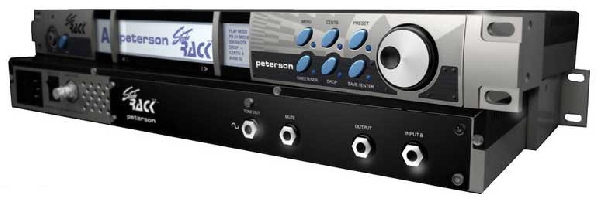
Peterson VS-R StroboRack

Summary: Super-accurate, super-sophisticated, yet super-easy-to-use. With point-one cent accuracy and built-in temperament and sweeteners, plus a huge display, accurate tuning is a breeze with this unit!

Pros: The big display makes tuning extremely easy, and the built-in sweeteners (I’ll get into that in a bit) ensure that once you’re tuned you sound great.

Cons: None, at least from the standpoint of features and capabilities. But as I’m not really a rackmount guy, lugging this around would mean having to get an enclosure. But in the studio, IT IS THE BOMB!!!

Features:

  • 0.1 Cent Accuracy
  • Large, Backlit Virtual Strobe™ Display
  • Exclusive Sweetened™ Tunings For Electric Guitar, Acoustic Guitar, Bass, Dobro®, Baritone, Steel Guitar, Electric Violin- total of 34
  • Buzz Feiten Tuning System® Presets
  • 8 User-Programmable Sweeteners
  • 25 Presets
  • Built-In Mic
  • Mute Button & Remote Jack
  • Tone Out Jack
  • All Metal Construction
  • Neutrik® Jacks
  • 12V BNC Output For Gooseneck Light (not included)
  • Built-In Power Supply (No Wall Wart.)

Price: $359 (street)

Tone Bone Score: 5.0. I’ve used a lot of tuners, and this by far is the most accurate I’ve ever used. Despite it being a rackmount, my use of it in the studio has proven

I used to never be into rackmount gear, let alone sophisticated tuning equipment. But the Peterson StroboRack has me reconsidering both those things, especially in my workshop/studio where tuning accuracy is incredibly important.

I received the StroboRack a few days ago, and since I set it up (which required all of two minutes to plug in the cords), I can see why so many people love these tuners. It’s a completely different way to tune an instrument. Instead of lining up a needle or LED, or even using the “strobe” effect on a TU-2, you tune by making the “checkerboard” pattern on the LCD stop moving. If it moves the left, you’re flat. If it moves to the right, you’re sharp.

Tuning with one of these things does take a little getting used to. First off, I had to really lighten my touch with the tuning keys, and also had to make sure I didn’t put any pressure on the neck. At .1 cent accuracy, even a slight pressure throws off the tuning. But once I got used to it, tuning was a breeze!

Do you take sugar with that?

The StroboRack includes what are called “sweeteners” for specific types of instruments. I’m not sure I understand this idea completely, but it has to do with setting the right intervals between notes – compensating for the type of instrument – so that the tuned instrument doesn’t just sound great tuned up, but when you actually chords, the chords are much more tonally accurate. Apparently a lot of math goes into calculating these sweeteners.

All I can say is that my guitars tuned up with the StroboRack, actually sound better than when tuned up with my little TU-2. It probably has a lot to do with the high degree of accuracy, but I have a feeling it has a lot to do with the “GTR” sweetener. For instance, I did an A/B comparison of tuning with the StroboRack vs. my TU-2. I took my time to get the most accurate tuning I could with both tuners. When I struck an E chord after tuning up with my TU-2, I had to make a couple of minor adjustments to my G and B strings – it wasn’t that the chord sounded bad, it just seemed to sound a bit “off.”

On the other hand, the E chord struck after tuning with the StroboRack with the GTR sweetener engaged sounded absolutely right on!

Fit and Finish

The StroboRack is encased in a nice, heavy-duty aluminum casing. It is really built like a tank, so I have no doubts that it could survive the rigors of the road. But I do advise getting an enclosure for it. It’s still a precision instrument, and should be handled with some care.

Overall Impressions

To say The Dawg digs this unit is an absolute understatement! Last night, I used it to set the intonation on a new guitar I got, and I have to tell you, the big display and scrolling checkerboard really made it easy. I know, a lot of folks would say, “But it’s just a tuner.” Well yeah… but the accuracy it affords you – especially you tone freaks out there – just can’t be beat. This is a unit that I will definitely be adding to my rig!

At $359 street, it’s not a cheap proposition by any means, but hell! We gear sluts spend tons of money each year on gadgets to make us sound better. One would think that sounding better also means being in tune. Of course, Peterson has several other tuners, like the StroboStomp that doesn’t have all the features of the rack unit, but it uses the same “Virtual Strobe Technology” as the StroboRack, so you know you’ll get the accuracy you need.

Mind you, I didn’t try out all the other features like outputting to two outputs, which is pretty cool, or using the XLR jack to go into a board. Those are great features, but frankly, they’re secondary to what’s important with this unit: Accurate tuning.

Read Full Post »

There are some things in life that you just can’t pass up. About a week ago, my friend Jeff Aragaki of Aracom Amps mentioned people finding great vintage gear in pawn shops. I kind of stored that tidbit away for future reference, mainly because there aren’t any pawn shops really close to where I live. But today, I happened to park in front of a pawn shop (I work about 20 miles from where I live), and after lunch, on a whim, decided to go in. This was a little pawn shop that mostly specialized in jewelry, but they had a number of amps and guitars as well.

I wasn’t overwhelmed by the selection of gear; mostly no-name brands that I had never heard of, and as far amps were concerned, cheapo solid-state practice amps. But tucked in behind some guitars was a Fernandes Strat-copy that caught my eye. It had a nice, white finish with a maple neck (I LOVE maple necks), and it was obviously well-used from where I could see it. The shop owner walked up, and I asked to inspect the guitar. I was really impressed by the workmanship. I had heard of Fernandes guitars being very high-quality for a great price, but upon seeing the workmanship up close for the first time, I was very impressed. And even though this guitar was well-used, I could tell it was taken care of because of only minor scratches and dings on the body.

The tag on the guitar said it was for sale for $115 (sorry… if you came from the gear page, I mistakenly listed it at $125), and I asked if she’d take $100 including tax, and she agreed. Unfortunately, they didn’t take plastic in any form, so I had to decline on the guitar. But that was a good thing because it gave me some time to do some research. From what I could glean, this Strat-copy is a late-80’s (’86 and later) model of this guitar. What’s ultra-cool about this one is that it’s pure white. Almost all the pictures I saw today of late-80’s Fernandes Strat-copies were either tobacco burst or a solid that was other than white. This made the guitar a bit more unique. This was confirmed by a former Fernandes endorser that I hooked up with on The Gear Page.

In any case, I got this guitar for a steal!!! I’m going to fix it up, swap out pickups, give it a good cleaning and setup. Don’t know if I’m going to keep it, but no matter. It was a great deal!

So if you have a chance, take a peak into a pawn shop sometime. Oh wait! Another place you could look is at estate sales. A few years ago, I met an older gentleman and acoustic guitarist who SCORED a 1940’s Martin for a couple of hundred bucks at an estate sale, and had it appraised at around forty-grand! Amazing! Talk about a steal!

Read Full Post »

Jam Center

Wow! Amazing what taking a few days off can do! I spent last weekend in Las Vegas deflating from the rigors of everyday life, and when I came back, made a conscious effort to play as little guitar or writing as possible. Sometimes you just need to take a break. But I’m back now, refreshed, restored, and fully recovered.

So yesterday, not feeling like writing any music – actually not feeling very creative at all – I just picked up my guitar and started noodling. Within a few minutes, I wanted to play to something, so I did a search on “jam tracks” and the first search result was a link to a place called Jam Center. Intrigued, I clicked the link and was taken to the site.

There really wasn’t much there; just a navigation bar on the left that listed “Jam Machine Keys.” I clicked the Key of A, the page reloaded and the following “machine” appeared on the page:

jamcenter_player

Cool, I thought, this looks really promising. I clicked on “COOL” and was rewarded with a nicely produced jam track. I slung my guitar and started playing… Two hours later, I still hadn’t gone through all the keys and all the jam tracks, I was enjoying myself so much!

Yeah, there are lots of different sites offering jam tracks out there, but what I like about this particular site is that instead of just playing MP3s in another tab or window that eventually end, the jam tracks are arranged in a loop, and not only that, many of the jam tracks have two different “feels” to them. Usually, the first part of a track will have a mellower feel, then jumping into the second half of the track, the feel gets more intense. Having this type of variation makes you play differently. So not only can you practice your technique, you can practice changing your tones and attack. What I found very useful with having two different feels to a track was it allowed me to practice switching pedals and pickup selections. How cool is that!

One thing I forgot to mention was that when you click on a style on the machine, text appears on the machine suggesting the type of scale to play like “A Harmonic Minor” or “E Blues.” It’s a small thing yes, but it’s cool to have a starting place. For instance, in one of the tracks, the suggestion came up with “A Mixolydian.” I’ve never been that much into modes and such, even though I’ve studied them, but as an interesting and added value, the site has some great graphic examples of the different modes.

I looked up “A Mixolydian” and was greeted with the pattern, and started playing the pattern over the jam track. That was really cool; a way to immediately use a mode over a piece of music, as opposed to having to intellectualize. What that sparked was using different modes starting with different tonics or root notes over the different keys. Some didn’t work at all, but it sure helped me understand how modes can open up a whole different world when jamming.

Anyway, check this site out. It’s a great tool!

Read Full Post »

ignore

IGNORE EVERYBODY

I just finished reading Hugh MacLeod’s fantastic book, “Ignore Everybody,” recommended by my blog-buddy, Ig, of the now-defunct, but well-loved igblog. He said I would love it, and of course, I did. Thank you, Ig!

What’s it about? Mostly it’s about taking personal ownership of your creativity, wherever it comes from, and in whatever shape it takes. Everyone has some sort of creativity inside of them, being it writing, playing music, drawing, painting, what have you. The challenge in life as Hugh MacLeod asserts is owning that creativity, recognizing that it’s yours, giving yourself permission to express it, and not fall into the trap that your creativity should be directed towards what other people say it should be.

I know, it sounds a bit brash and slightly anarchistic, but that’s creativity. You own it. It’s yours. Hell, MacLeod made it big by writing cartoons on the back of business cards! People thought he was crazy, but that’s how he wanted to express himself.

The things MacLeod says in the book are practical; not pie-in-the-sky New Age, metaphorical, metaphysical bullshit. The advice is in your face, and with many of his cartoons interspersed throughout the book, incredibly entertaining.

I was just thinking, what does this have to do within the context of this site? Well, we gear sluts buy acquire as much gear as we do to feed our passion for tone. Guitar is our creative outlet. Reading Ignore Everybody has put an exclamation point on why I play guitar, why I write this blog, and why I spent the countless hours each week sifting through the Internet and trade rags in search of new, compelling gear. I can’t really explain why I love doing what I do. I just love it. And I want to share it.

I encourage you to get this book. It’s a quick read. I started reading it last night, and finished it about half an hour ago. I guarantee it’ll inspire you! And no matter what your particular form of creativity is, you’ll gain a lot of insight into expressing it.

5 Tone Bones - Gear has stellar performance, value, and quality. This is definitely top of the class, best of breed, and it's a no-brainer to add this to your gear lineup!

Read Full Post »

In my quest for gear to review, I literally spend hours each week poring over the Internet and trade rags, looking for cool, new stuff, and I get especially excited when I come across familiar gear that’s expressed in completely new ways, such as the Quantum Drive from Acoustic Imaginearing that uses quantum tunneling to provide distortion. But a couple of weeks ago, I ran across a brand-new guitar company up in Washington called “Woody B Internal Combustion Guitars,” that is doing something so totally unique it has the potential of completely changing how we as guitarists approach tone. I don’t say this lightly. What Woody has invented is nothing short of amazing, and I am extremely excited to have run across this new guitar.

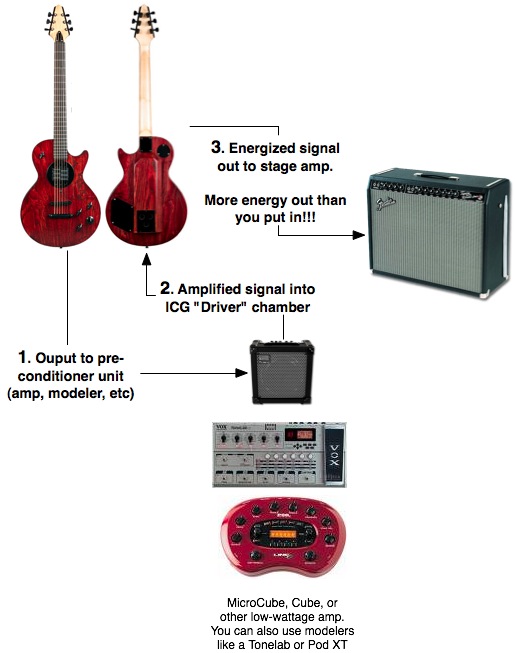
What makes these guitars so revolutionary is Woody’s invention: The Internal Combustion Drive System. This consists of a speaker transducer and special baffles and tone ports that direct added resonance to the strings and body. Essentially, the Drive System is a resonance chamber that builds up the guitar signal (with the help of a pre-conditioner that I’ll get into later) before it goes out to your main amp. According to Woody, whom I had the pleasure of speaking with for quite awhile yesterday, this is a guitar where you can feel your tone resonating throughout the guitar’s body.

So how does it work? Here’s a diagram. I’ll discuss it below:

internalcombustion

That signal is returned via a special plug that Woody provides that I assume returns the “conditioned” signal as a line-level output (though with a Cube, you should be able to use the Recording Out). The signal then passes into the Drive System, where it’s run through the speaker transducer and allowed to resonated withing the chamber. The signal is buffered, then sent out to your main stage amp.The way it works in principle is actually quite simple. You first send your output to a pre-conditioning unit. This could be a low-wattage solid state amp, or even a valve amp. This is also where you add effects, so you could run this into your pedal board, then into the low wattage amp. The net result is that the guitar outputs more energy than was put in, providing for what Woody calls a much fatter, fuller tone than you would get from other guitars.

In addition, adding to the natural resonance are copper bars that run through the body to the neck, creating a direct coupling between the neck and the guitar. Very cool. Woody B also uses very high-grade woods with four to choose from: Swamp Ash, Alder, Mahogany, and African Black Limba (I dig the Black Limba, myself).

For those of you “in the know,” you might ask, “Moog already did something like this.” Yes and no. Yes, from the perspective that the Moog guitar uses a pre-conditioner. But no from the perspective that Woody has taken a completely different approach to the electronics in the Drive System. First of all, where the Moog has around 3000 parts to produce its sound, and I believe requires external power, the ICG Drive System has only twelve parts. Furthermore, the Drive System is completely passive, not requiring any external power source. Finally, the Moog guitar costs in the neighborhood of $6000, whereas you can get into an Internal Combustion Guitar for as low as $1700. Woody is really trying to keep the price below or as close to $2000 so his guitars are attainable by a wider audience.

Here are some videos that Woody has put together:

Folks, this stuff is so awesome! I can’t wait to try one out! For more information, go to Woody B Internal Combustion Guitars.

Read Full Post »

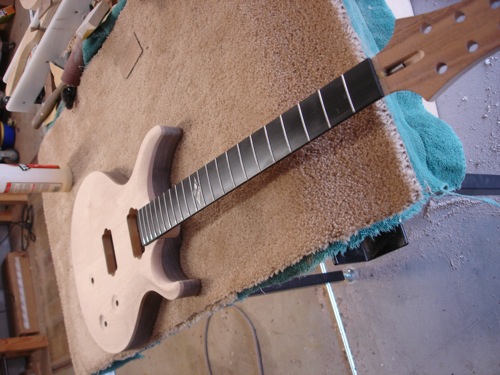
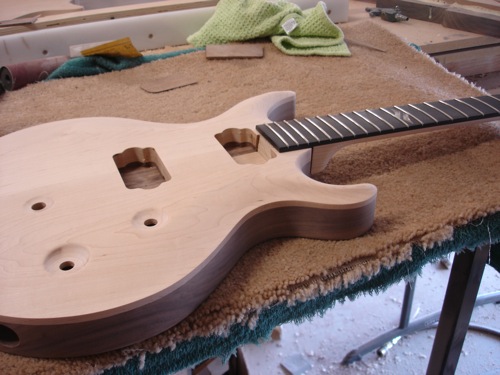
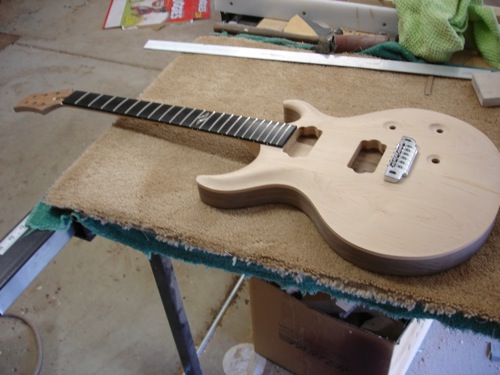
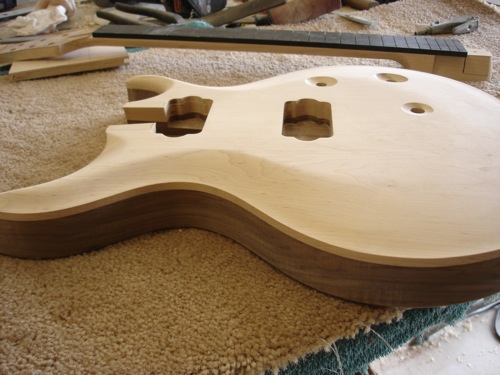
Talk about being blown away! I talked to Adam Hernandez of Saint Guitars the other day just to shoot the breeze and let him know I posted an announcement about his new web site. He in turn thanked me, then absolutely blew me away saying that Goldie was ready for finishing and would be done before the weekend! OMG!!! He sent me some progress pictures from just before finishing. BTW, the finish is vintage Les Paul gold…. Again, OMG!!!

In any case, here are pictures of my guitar right before it went into finishing. I just can’t wait to play her!

I know I probably sound like a broken record and maybe a walking billboard for Saint Gutiars, but these are special guitars. Anyone who has played one of these will attest to that. And to have one of my own is just incredible. Adam and Jon just rock the house with their guitars!

They are also coming up with a new “Vintage” model. I don’t know all the details, but it looks like a semi-hollowbody with a trapeze-style bridge. Very retro!

I just have to say this…

I know there are a lot of people out there who have lots of gear, and who trade their axes after a certain amount of time. That’s totally cool. I’ve spoken to some folks who are concerned about the resale value of these guitars. Because this is such a small company, there aren’t a lot of Saints out there, so there’s no price precedence. But in reply to that all I have to say is that from my perspective, Goldie isn’t a guitar that I’d ever consider trading away or selling. Why would I when she was made to my exact specifications?

For sure, Goldie won’t be the last guitar I ever buy. I’m way too much of a gear freak, slut, maniac, what-have-you, to settle with my collection; it’s a living breathing thing. But Goldie will always be special because she’s the very first custom guitar I’ve ever had, but also she’s the very first Saint Guitar I’ve owned.

Read Full Post »

« Newer Posts - Older Posts »