Feeds:
Posts
Comments

Archive for the ‘instruction’ Category

Hi! This is my first post on guitargear.org. I’d like to thank mr goofydawg for allowing me the chance to contribute here. I want to delve into theory and there’s no better place to start than the beginning. In this first post, I’m going to start with some basic terminology and the fundamentals. First, let’s talk about tonality and the octave.

We begin with a single note. A note is generated by some vibrating mass at a steady frequency. The vibrations cause air to move and the frequency of the vibration determines the pitch that is perceived by our ears. Consider a length of string pulled taught. When it vibrates, it produces a note. When we shorten the length of the string by exactly half, the string will vibrate at a pitch one octave higher than it did at the original length. The tonality of our musical language is defined by the number of notes that occur between these two notes – the fundamental, and its octave. In Western (European and American) music – the system likely to be the most familiar to readers of this blog – we divide the octave into 12 notes. Check out your guitar. The 12th fret is the octave, dig it?

You may have heard of one or more microtonal systems. The term microtonal is obviously relative to our 12-tone system and indicates that there are more notes in an octave than we have. These and macrotonal systems (ones having fewer than 12 notes) are used in Eastern (Asiatic) music. Our discussions here will all relate to our Western tonality.

Now that we’ve discussed notes, let’s move on to chords. A chord is the effect of multiple distinct notes. This is one thing that caused me some confusion in my early theory days. When I say distinct notes, I mean notes that have the same name, without regard to the octave. In a open G chord like the one shown here, the notes, lowest to highest, are G B D G* B* G**. The G and B notes with the single stars are up 1 octave from their previous occurrences within the chord. The double-starred G is up 2 octaves. So, we are strumming 6 notes, but still this is considered a 3-note chord – G, B and D. 3-note chords are called triads and, with them, we define our chordal tonalites like major, minor and others. As an aside, 2-note chords are called doublestops.

Our final topic for today will be scales. Scales are sequences of notes. For all intents and purposes scale, mode and key are interchangeable terms. In Western music, scales typically consist of 7 distinct notes. The notes in the scale are given a number and a name. The names aren’t terribly important to non-theorists so I won’t bore you with them here, but check this link if you’re curious. These numbers are also used to identify chords within the key. A chord that has the tonic as its root note will be called the “1” chord, etc. You may likely have heard of “the old I – IV – V” chord progression – think Louie, Louie or Wild Thing – and now you know the origin of the name.

In music there are certainly absolutes. Middle C vibrates at exactly 261.626 hertz, but for the purposes of studying theory, it’s helpful to think of these concepts in relative terms. This goes back to referring to chords or notes by number rather than name. You’ll start to understand the relationships between these concepts much more quickly and you’ll be able to apply the concepts to a wider array of musical situations.

OK everyone – that’s all I’ve got for tonight. I’m hope you’re still with me and that this was helpful and informative. In the next post, I’m going to dig into chord theory, the beautiful simplicity of the triad and the ambiguity of the doublestop! Cheers!
Read Full Post »

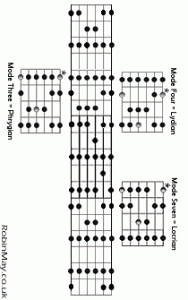
modesfig2

Note: This isn’t going to be an instructional piece… just a sharing piece… mostly…

I’ve been playing guitar for over 35 years, but it hasn’t been until the last couple of years – actually the last few months – that I’ve really started focusing on scales and modal theory. Chord theory I had down cold, but I really didn’t focus on the scales part of the equation. I figured that if I could get some lead patterns and tricks down, I’d be in pretty good shape; and for awhile, that worked just fine.

But then I realized that in many of my recordings, I was using the same patterns and tricks, albeit in different keys and in different combinations, but the same stuff nonetheless. This prompted me to rethink how I approached playing solos, so I started out by learning major and minor scale patterns. I got a couple of books to help me along, and I proceeded to practice them.

But in the back of my mind was this idea of modes. I’d heard them bandied about for years, and pretty much ignored them partially out of the thought that as a rhythm player, they weren’t too important; though that really masked an innate fear that modes were WAY beyond my ability to grasp. But during this past weekend’s study/practice session, I realized that modes are not difficult at all! The names of the modes just scared the livin’ crap out of me! 🙂

Think about it: The mode names are all in Greek: Ionian, Dorian, Phrygian, Lydian, Mixolydian, Aeolian, and Locrian. From my previous life as a bio-sciences major, terminology in Greek or Latin would evoke feelings of anxiety similar to, “Oh shit! More frickin’ terms to memorize just to regurgitate later on.” 🙂 Such was the case when faced with modes.

I now feel a little foolish about my anxiety with modes. Once you understand what they represent, they’re totally easy to play!

Here’s my explanation in a nutshell, just in case you too have the same anxiety about modes as I did:

  1. Modes are simply starting points within the scale of a particular key.
  2. For instance, if you’re playing in the key of C and want to play in the Mixolydian mode, you’d start and end on the 5th degree of the C scale which is G.
  3. Now don’t get confused here: You don’t play a G scale. You merely start at G, and play the notes of the C scale, so: G A B C D E F G

So what’s the big deal? Lots of players don’t give a whit about this stuff. For me as a teacher, this stuff is pretty important. But from a player’s standpoint, it gives you a much deeper understanding of the fretboard, and also, playing in a mode gives you a different tonal center to play from, which actually has an effect on how a solo sounds and feels.

I found that a great example of this is to play the Lydian mode. The Lydian mode starts on the 4th degree of a scale. Going back to the C scale, this means that the Lydian will be F. If you’re familiar with chord theory, a chord with an added 4th is notated as Csus4. The sound of this particular chord connotes a feeling that the chord must be resolved – it’s not something you’d finish with; you’d typically use a “sus4” chord before either the major root chord or minor root chord. In our case of a C chord, we’d do something like: Csus4 – C. In playing in the Lydian mode, you’ll evoke a sense that you have to resolve your scale somehow. After all, starting and ending on the 4th creates a feeling that your phrase is unfinished. The point of all this is that where you start will have a huge effect on the general coloring of what you’re playing.

Note that this discussion only brushes the surface of modal theory. For a much deeper discussion, check out Guitar Noise or this excellent article that I found on Modes of the Major Scale.

Read Full Post »

New Year's ResolutionI normally don’t make New Year’s resolutions. Haven’t done it in years. I’ve always felt there was something innately dishonest about making resolutions like “I’m going to be a better person,” or “I’m going to do something nice for someone everyday.” Not that those aren’t noble pursuits, but in a lot of cases, they demand an enormous amount of self-discipline, self-sacrifice and changes in normal behavior that most of us can’t persevere. We’re good for a few days or maybe a couple of weeks, but something will happen and it all goes to pot.
In lieu of lofty resolutions, I’ve instead set concrete goals that in order to achieve, require changes in behavior and changes in thinking. I’ll share some of these goals here:

  • I will continue on my five-year plan of getting on the road and touring. I’m just starting my third year in the plan, and it’s going pretty well. I’ve release an album, and am working on my second one; a few of the songs of which I’ve entered into an international songwriters competition. I don’t expect to win, but the feedback that I get will be invaluable. Furthermore, going on the road will require that I get in shape, so I have been eating better and getting exercise in anticipation of going back on stage. I love to eat, so this has been a tough thing for me, but I’ve lost 25 lbs so far, so I’m well on my way.
  • I will study more music theory; especially scalar modes. I already started doing this a few months ago, but really want to master it in the coming year. First, because I want my improvisation to be better, and with an understanding of the intervalic nature of music, I’ll be able to move around the fretboard much easier. I don’t want to necessarily learn patterns that I chain together, I want to get to the point where I can jam in any key, and be confident that the next note I hit works well harmonically and musically with what I’m improvising. Also, mastering scales and modes will make me a better teacher. Don’t get me wrong, I have a very firm intellectual understanding of music theory, and can actually cold read charts, but in actual execution, I feel I’m lacking, so my aim is to meld the two.
  • I will have a custom amplifier built for me. I’m currently working with Jeff Aragaki of Aracom Amps to build me an amp around his RoxBox 18 Watt design. I’m “going off the reservation” with this one because I want a different speaker than what he offers, a bigger cabinet and a reverb tank, plus a built-in resistive attenuator for low volume applications. If you haven’t checked out the RoxBox, I suggest you do. It’s a great 18 Watt design that’s also a great value stock.
  • I will purchase a Reason amp. Not sure which will come first: Having Jeff finally construct my amp, or purchasing a Reason. I love the SM25 I have right now, but since I’m a StackMode freak, I’m also leaning towards the SM40 head. We’ll see.
  • I will have Adam Hernandez at Saint Gutiars build me a guitar. I’m so grateful to be able to test Adam’s guitars. We’ve already talked about what I might like in a guitar, but I really want one of my own.
  • As far as GuitarGear.org is concerned, I will rebuild the site to make it a lot easier to find things. I’ve already started doing this, but I really need to rethink the design of the site. I will probably go to a three-column layout so I can get more things “above the line” that is, the part of a page that you first see when a web page loads. Right now, the site is a bit narrow, so lots of things fall below the line that I’d like people to see; especially the companies I personally endorse.

Okay, that’s it for me. Anyone willing to share?

Read Full Post »

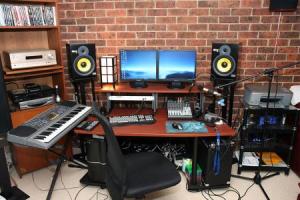
Home Studio There are different schools of thought around this subject, but I thought I’d throw in some of my own thoughts, since I’ve been at it awhile. Note that I won’t be talking about techniques necessarily, though I will include some tips and tricks… So without further ado…

First, let’s establish something here: You don’t need to buy super-expensive gear to sound good, and you don’t need a lot of equipment. I’ve found that in a lot of cases, while more expensive gear will afford you convenience features, and a better sound quality, for the home studio enthusiast, a lot of times this gear is overkill. I’ll go into some details below, but in my opinion, recording technique is far more important. So with that said, let’s start talking about what I think are essential pieces of equipment:

Computer Equipment/Software

You probably already have a computer, but it should be configured to handle digital recording. While drive speed is important, it isn’t necessarily critical. My MacBook Pro’s hard drive spins at 5400 rpm, and I have no problems recording stuff. But what you do need is space. I’d recommend getting two hard drives: one for programs, and the other dedicated to saving data. It’s just a cleanliness thing. Also, get as much RAM as your machine can handle. I’ve got 4GB on my machine. That’s even more important than a hard drive. You don’t need a super-poweful machine either, but dual-core machines really work well.

Okay, Mac or PC? Go with what you’re comfortable with. There are lots of programs out there; among them is a neat little program that works great on both PC and Mac called Audacity – it’s free! Todd Rundgren recorded a lot of his latest album using Audacity, so it’s definitely doable.

What about ProTools?

I’ve got it. It’s great. But the learning curve is super steep. In fact, when I first started recording, I spent more time learning how to use the damn software than getting my ideas down and that just frustrated me to no end; so much so, that I lost my taste for recording for several months – I just didn’t want to mess around with the software! I just wanted to get my freakin’ ideas down! I’m not saying it’s bad, but it’s complicated, and you’ll have to spend a lot of time learning the ins and outs of the program. With the home studio, what you’re after is getting your ideas down with reasonable quality – and fast. That, at least, is my opinion. In light of that, I use GarageBand to get all my ideas down. It has built-in rhythm loops so I don’t have to use a click track, and there are lots of add-ons, both free and affordable, that you can use in GB. The sound quality is excellent, and it even has some mastering presets that work amazingly well!

Digital Interface

There are lots out there. I happen to use the DigiDesign MBox 2, which has two analog inputs, MIDI, and a couple of others I don’t use. Very handy little box. But there are lots of solutions out there in the $300-$400 range. Most use USB, though FireWire is probably the optimum – it also costs more.

Microphones

Now this is just my opinion, but you’ll need at least two mics: One ribbon mic, and one dynamic mic. I have a Nady RSM-200 ribbon that cost me less than $200, and it works superbly! I also swear by my trusty Sennheiser 835 stage mic, which is a workhorse similar to the Shure SM-58, but I think it’s warmer and has a much flatter EQ response than the SM-58 which can get kind of boomy.

MIDI Controller

Being also a piano player – not nearly as good on this as I am on guitar – having a keyboard to trigger MIDI and add MIDI-based instruments is another essential. You can go the small route (2 octave) or go the full-size keyboard route. I use an M-Audio full-size stage keyboard myself only because it doubles as my MIDI controller as well as my gigging keyboard. It was also cheap at $300 new. Nice.

From my standpoint, this is all you need as far as essential equipment for recording. Now let’s get into some techniques and some nice-to-haves:

  1. Always record acoustic guitar using mics – and use two of ’em. Sounds obvious, doesn’t it? I’ve tried going direct into my computer, and the sound is horrible. But using two mics works great. I usually place my ribbon mic about six inches from the sound hole, then place my dynamic mic pointed at a 45 degree angle at about the 3rd fret to capture sounds coming off the neck. Also, to take advantage of the ribbon mic’s rear pickup, I have a board, or hard, reflective surface placed about two to three feet in front of me to reflect sound back. It gives just a sligh reverb effect that really fills out the recorded tone.
  2. If you can swing it, get a couple of low-wattage amps. In particular, I use a Fender Champ 600, which is a 5 Watt amp with an 8″ speaker. Another one I’ve used, but don’t own is the Epiphone Valve Jr.. What a nice little amp! Since you’re recording at bedroom levels, a small amp that puts out less volume works wonders. Now here’s the trick I’ve found to recording with these small amps. You can make that sucker sound HUGE by close-mic’ing the amp. I use a dynamic mic pointed at an angle along the cone of the speaker, and place it no more than 2″ away from the grille cloth. Then I use a variety of overdrive and distortion pedals to get grind or searing distortion, then in my software boost the low frequencies. The end result is that it sounds like I’ve just recorded a full-size stack! You have to play with your settings, but it’s definitely achievable. The other nice thing about using a small amp for recording is that the naturally bright voicing really works well in a digital recording environment.
  3. For vocals, always use a pop filter. I’m an experienced singer, and even though I have great mic technique, nothing is worse on a recording than picking up those oral transients that your mouth makes when making consonant sounds. Pop filters cost less than $20 and believe me they’re a life saver.
  4. While we’re on the subject of vocals… Avoid using a compressor on vocals as much as possible. When you’re singing a louder phrase, move away from the mic. It’s that simple. Compression is good to a point, but there’s a lot to be said about having volume dynamics in your vocals. You get a lot more emotion coming through when you have it. If volume is pretty much the same throughout a song, it’s well… boring in my opinion, no matter how good a singer you are.
  5. Avoid EQ as much as you can. Dial in the EQ on your instruments before you record, then only do wholesale volume adjustments later to make mix corrections. What you’re trying to do is capture the natural sound the instrument makes as closely as possible. The only exception I make to this is when I’m recording a low-wattage amp and want to boost the lows. Otherwise, I just do volume adjustments for the mix.

These are just a few things I’ve learned over the last few years of doing this. I’m sure I’ve missed some stuff, so if anyone else wants to add to this, please feel free!

Read Full Post »

teachwombat-banner

One of GuitarGear.org’s readers recently plugged his guitar instructional site, Teach Wombat, in one of my articles about moving into a new chapter of my guitar life. I normally don’t like random product plugs, but being a teacher, I’m always looking for teaching aids and resources, so I checked out the site, and it definitely showed promise. A little later after Ken left his comment, like a good businessman, he offered to let me review his material, so I did, and all I have to say is, “WOW!” This stuff is GREAT! Ken’s primary product, the Guitar Teacher’s Toolkit includes over 100 professionally produced handouts covering the C-A-G-E-D system and scalar modes, plus a bunch of other awesome diagrams.

As a new guitar teacher, producing my own handouts has been a very laborious and tedious task, but with the Guitar Teacher’s Toolkit, I’ve got pretty much everything I need for teaching. It even comes with blank neck diagrams for ad hoc instruction!

But I wouldn’t limit this just to teachers. Players of all levels and skill will find lots of value from the diagrams and can use them as quick references. Hey! For $12.00, you can’t miss! So do yourself a big favor and go to TeachWombat.com today and buy Ken’s Guitar Teacher’s Toolkit!

Read Full Post »

« Newer Posts