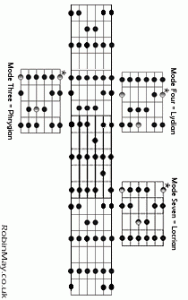
Note: This isn’t going to be an instructional piece… just a sharing piece… mostly…
I’ve been playing guitar for over 35 years, but it hasn’t been until the last couple of years – actually the last few months – that I’ve really started focusing on scales and modal theory. Chord theory I had down cold, but I really didn’t focus on the scales part of the equation. I figured that if I could get some lead patterns and tricks down, I’d be in pretty good shape; and for awhile, that worked just fine.
But then I realized that in many of my recordings, I was using the same patterns and tricks, albeit in different keys and in different combinations, but the same stuff nonetheless. This prompted me to rethink how I approached playing solos, so I started out by learning major and minor scale patterns. I got a couple of books to help me along, and I proceeded to practice them.
But in the back of my mind was this idea of modes. I’d heard them bandied about for years, and pretty much ignored them partially out of the thought that as a rhythm player, they weren’t too important; though that really masked an innate fear that modes were WAY beyond my ability to grasp. But during this past weekend’s study/practice session, I realized that modes are not difficult at all! The names of the modes just scared the livin’ crap out of me! 🙂
Think about it: The mode names are all in Greek: Ionian, Dorian, Phrygian, Lydian, Mixolydian, Aeolian, and Locrian. From my previous life as a bio-sciences major, terminology in Greek or Latin would evoke feelings of anxiety similar to, “Oh shit! More frickin’ terms to memorize just to regurgitate later on.” 🙂 Such was the case when faced with modes.
I now feel a little foolish about my anxiety with modes. Once you understand what they represent, they’re totally easy to play!
Here’s my explanation in a nutshell, just in case you too have the same anxiety about modes as I did:
- Modes are simply starting points within the scale of a particular key.
- For instance, if you’re playing in the key of C and want to play in the Mixolydian mode, you’d start and end on the 5th degree of the C scale which is G.
- Now don’t get confused here: You don’t play a G scale. You merely start at G, and play the notes of the C scale, so: G A B C D E F G
So what’s the big deal? Lots of players don’t give a whit about this stuff. For me as a teacher, this stuff is pretty important. But from a player’s standpoint, it gives you a much deeper understanding of the fretboard, and also, playing in a mode gives you a different tonal center to play from, which actually has an effect on how a solo sounds and feels.
I found that a great example of this is to play the Lydian mode. The Lydian mode starts on the 4th degree of a scale. Going back to the C scale, this means that the Lydian will be F. If you’re familiar with chord theory, a chord with an added 4th is notated as Csus4. The sound of this particular chord connotes a feeling that the chord must be resolved – it’s not something you’d finish with; you’d typically use a “sus4” chord before either the major root chord or minor root chord. In our case of a C chord, we’d do something like: Csus4 – C. In playing in the Lydian mode, you’ll evoke a sense that you have to resolve your scale somehow. After all, starting and ending on the 4th creates a feeling that your phrase is unfinished. The point of all this is that where you start will have a huge effect on the general coloring of what you’re playing.
Note that this discussion only brushes the surface of modal theory. For a much deeper discussion, check out Guitar Noise or this excellent article that I found on Modes of the Major Scale.
 I normally don’t make New Year’s resolutions. Haven’t done it in years. I’ve always felt there was something innately dishonest about making resolutions like “I’m going to be a better person,” or “I’m going to do something nice for someone everyday.” Not that those aren’t noble pursuits, but in a lot of cases, they demand an enormous amount of self-discipline, self-sacrifice and changes in normal behavior that most of us can’t persevere. We’re good for a few days or maybe a couple of weeks, but something will happen and it all goes to pot.
 Guitar Gear