Feeds:
Posts
Comments

Archive for the ‘Music’ Category

How gear performs in the studio is one thing, how it performs in a public venue is an entirely different matter. Unless it’s just not practical, I almost always take gear I’m testing to a gig because to me at least, that’s the best test of gear as gigs are so unpredictable – you never know what might happen, and good gear will almost always be adaptable to the changing environment of a gig.

So how did the Nighthawk perform? In a word, spectacular!

In my recent review of the Nighthawk, the word that came to mind for me to describe the guitar was “comfortable,” and that was completely evident when I played it at my church gig this evening. The Nighthawk is comfortable in every way imaginable; from its light weight to its playability, and its ability to fit into any genre of music.

Now before you poo-poo that a church gig is not a “real” gig, guess again. I’ve played in a variety of venues over they years, and playing at church is one of the most challenging venues to play.

The reason for this is that the music at a church service isn’t the same style from song to song. Since I do kind of a “rock” service, we usually start and end with rockin’ songs with copious amounts of overdrive. But in the middle or meat of the service, we have to back it off a bit. Sometimes it’s bluesy, softer, classic rock with a bit of overdrive, but a lot of the songs are much softer: ballads and slower tunes that require playing clean. So versatility is absolutely crucial with the gear that I use for the service, and the Nighthawk delivers the versatility I require in spades.

For this particular service, I kept my rig very simple. For my amp, I used my trusty Aracom VRX22 hooked up to my Aracom PRX150-Pro attenuator, then out to my custom Aracom 1 X 12 cab with a Jensen P12N. In front of the amp, I used just one pedal: my Boss TU-2. πŸ™‚ I normally bring my entire board that has a variety of drives and modulation effects, but this time I wanted to capture the raw tone of the guitar, and all I could say after the service was, “WOW!”

The Nighthawk can produce some very nice grind with the P-90 and Burstbucker 3, but it can also produce rich and pristine cleans; cleans that’ll just make you close your eyes and soak up all the tonal goodness. The P-90 produces lush, fat cleans, while the BB 3 – as expected – produces bright cleans. But engaging the middle selector position allows you mix the two in varying quantities and this lets you dial in all sorts of clean tones, from super fat to ringing. The thin body of the Nighthawk is exceptionally resonant, providing great sustain and tonal complexity, producing an almost reverb-like effect. I was absolutely floored by the gorgeous clean tones I was able to dial in. It was purely inspiring!

For more overdriven tones, the middle pickup again makes this guitar so versatile. In fact, I played most of the service in this position, and simply varied the amount of neck and bridge pickup volumes to get the overdrive tones I wanted. For our more rockin’ tunes, I switched the amp to the drive channel. On the Nighthawk, I dimed the treble pickup, and when I wanted more heavy crunch, would just dial in more P-90. It was so cool! Dialing in more P-90 didn’t result in significantly more volume; a slight amount, but nothing significant. When I got to a lead break, it was a simple flick of the toggle to the treble pickup, and I could get that classic Les Paul treble pickup tone! F$%kin-A!

Interestingly enough, the Nighthawk isn’t a bright guitar. In fact, its tone is the deepest of any guitar I’ve gigged with, save my old ES-333, which was both darker and boomy. But that darker tone isn’t a bad thing at all because the Nighthawk has BIG HAIRY BALLS. There is nothing subtle about its tone. It’s incredibly expressive and in your face, whether you’re playing clean or dirty, and it forces you to engage in a never-ending musical conversation while you play it. You can’t be timid with this guitar. It won’t let you. There were times when I was playing where I would normally hold back, but with the Nighthawk in my hands, it seemed to coax me to go outside my comfort zone and do things I wouldn’t normally do. Damn! If I were single and the Nighthawk was a woman… no, I better not go there. πŸ™‚

As you can tell, I quite simply dig this guitar. I know, I say that about a lot of gear, and it’s genuine. But there’s gear that I dig and there’s gear that I REALLY DIG, like Blondie, my Squier CV Tele, and all my Aracom equipment. The Nighthawk definitely falls into that REALLY DIG camp!

By the way, not that it really matters a lot to me because I didn’t even think about what number guitar I got in the limited run of 350, but to my very pleasant surprise, I discovered that I have #29 in the lot. Like I said, I didn’t even think to check this, but a member on the My Les Paul forum asked me what number I got – it was first time I looked. Not sure if this really means anything because I’m not really a collector – I’ll never sell this guitar. But it’s still kind of cool to get a low number.

There’s a certain magic about the Nighthawk that harkens me back to the first Harry Potter movie when he went to the wand shop. The shopkeeper told Harry (paraphrasing), “The wizard doesn’t choose the wand. The wand chooses the wizard.” And in the case of this guitar, despite the fact that I was going to pull the trigger on an R9 Les Paul, this guitar reached out and chose me. I have absolutely no regrets about passing over the LP in this case, and I’m looking forward to the magic the Nighthawk and I can create!

Read Full Post »

Click on the picture to see an enlarged view.

Gibson Limited Run Nighthawk 2009


Summary: After a 10 year hiatus, Gibson returns the Nighthawk to market, with a slightly different look and electronics. Make no bones about it; this guitar is SWEET!

Pros:Looking for a super-light but versatile guitar? Look no further. The Nighthawk has it all, and can do it all from swampy blues to all out RAWK! Its thinline body makes it absolutely comfortable to play, and the neck is perfect!

Cons:None.

Features:

  • Style: Contoured single-cutaway
  • Top: AAA Maple
  • Body: Bound mahogany
  • Neck: Set mahogany
  • Scale length: 24-3/4″
  • Neck profile: ’60s thin
  • Fingerboard: Rosewood
  • Fingerboard radius: 12″
  • No. of frets: 22
  • Nut width: 1.69″
  • Neck pickup: P-90 single-coil
  • Bridge pickup: BurstBucker 3 humbucker
  • Controls: Volume, Volume, Tone, 3-way toggle pickup selector
  • Hardware: Chrome
  • Tuners: Kluson
  • Bridge: Tune-O-Matic
  • Tailpiece: Stopbar
  • Finish: Lacquer
  • Case: Hardshell
  • Other: Certificate of Authenticity.

Price: $1400-$1700 street

Tone Bone Score: 5.0 ~ Talk about love at first strum! The Nighthawk is like a cross between an SG and a Les Paul, and I can’t say enough about how great this guitar plays and sounds!

When I have enough time to go to my favorite shop near work, like any gear freak, I’m like a kid in a candy store; especially this little place in Redwood City, CA called Gelb Music. I’ve known the guys there for a number of years, and they’ve always steered me in the right direction. Unfortunately for me, they also know that I have a HUGE weak spot for non-mainstream gear. Such was the case when I walked into the shop today to ogle some Les Pauls. They’ve known that I’ve been jonesing for one for awhile, but they must have a sense about what appeals to me, because one of ’em will say, “Dude, those Pauls are nice, but you gotta check out this…” And in “checking it out,” I’ve since ended up with a MIM Strat, a Roland Cube 60, a Squire Classic Vibe Tele, an Ibanez GSR200 Bass and numerous pedals.

So here I was, minding my own business, admiring the Les Pauls hanging from the ceiling, when Tommy did the “dude you gotta check this out,” I told him, “Tommy, don’t do this to me. You know what happens when you do that.”

“I know, man,” he replied, “And I know you’ve been looking at the Pauls, but you gotta check this out [pulling down this gorgeous honey-colored Gibby from the hanger]. It’s the most playable f-in guitar in the shop, and dude! The tone this thing produces is incredible. Here. Check out the neck!” Handing me the guitar in the process.

I was immediately overtaken by the light weight of the guitar. If that axe weighed 6 lbs, I’d be surprised (a look at the Gibson Nighthawk site lists the average weight at 4.6 lbs). Then as I moved the guitar into a playing position, I noticed how absolutely perfect the neck is. I love that 60’s thin neck! It’s a shallow “C” with a slightly wider profile. It’s faster than all get-out, and oh so comfortable to play! But I’m getting a bit ahead of myself…

Fit and Finish

This is one beautiful guitar! The bookmatched figured maple top is absolutely stunning, and the transparent amber lacquer brings out the three-dimensionality of the wood grain. The high gloss of the lacquer further enhances the effect – it’s like liquid sunshine. To provide definition both body and neck are bound with a white binding.

Speaking of wood, the light mahogany is flawless and all the joints and seams are perfect.

The Nighthawk 2009 is quite a bit different from the original that came out in 1993, even though it retains the same body shape. The original seemed to be Gibson’s answer to the HSS Strat, and had a 5-way pickup selector. With this version, Gibson has gone with a BFG setup with a P-90 in the neck and an awesome BurstBucker 3 in the bridge. The pickup selector switch is now a 3-way toggle and has been moved to the upper bout like a Les Paul (which I love). The neck sports a solid mahogany base with a rosewood fretboard and medium-jumbo frets with a scale length of 24 3/4 inches – just like a Les Paul.

The hardware provides an added touch of vintage feel to the look of the guitar, from the Kluson tuners and chrome Tune-o-matic bridge and stop tail piece, to the gold top hat volume and tone knobs. Even though the Nighthawk 2009 is a limited run guitar, it’s clear that Gibson didn’t just want this to be novelty guitar where they could get away with using cheap materials. Everything about this guitar screams high-quality down to the little details. I’m impressed!

In fact, at a distance, you might easily mistake this guitar for a different Les Paul model. I certainly did when I saw Billy Joel in concert. His guitarist was slinging this gorgeous Gibson that looked like a Les Paul. But it kind of confused me with its body shape and three knob setup. I kept on wondering, “Did Gibson create a new model Les Paul?” I’ve since been corrected.

Playability

There’s one word that comes to mind when I play this guitar: Comfortable. My favorite guitars have always been those that sound, play, and feel comfortable, and the Nighthawk is all about comfort. The 60’s thinline neck with wide profile is so easy to play. I found myself not worrying at all about where my fingers were and just playing. The action is low and fretting notes is so easy. But with the medium-jumbo frets, wiggling your fingers creates some very nice vibrato without even bending the strings! The pickups are in the perfect place for where I strum, which is right between them, so no chance of banging my finger on a pickup in a hard strum as well.

To me, this is a player’s guitar. I know that some people have complained that it doesn’t faithfully reproduce the original. But I believe that the original was just too quirky and didn’t really have player ergonomics in mind. For instance, the pickup selector switch. I dig that it’s in the classic Gibson position. It is so much more accessible – I don’t even have to look to switch pickups.

The Les Paul scale length on the Nighthawk makes bending – even the slightly brittle shop strings which I will replace today – a breeze. The setup is perfect and there’s nary a string that frets out or dulls. Like I said, this is a player’s guitar.

How It Sounds

Gibson states, “Today’s version is still all about a guitarist keeping his options open. With two volume controls, a master tone knob and two heavy-duty pickups, guitarists can experiment with endless sounds.” In other words, the Nighthawk is all about tonal diversity, capable of producing super-smooth and sexy cleans to all out snarling dog drive. I’ve played the guitar a little less than a couple of hours, and I’m absolutely blown away by the tones this guitar produces.

The big surprise is the P-90 in the neck. I was expecting it to be bright, but it’s thick and ballsy, with a real emphasis on the lower mids. It might get lost in the mix when played dirty, but the cleans is where this pickup really stands out. The voicing is creamy smooth, and very acoustic sounding.

The treble pickup is classic Les Paul, but just a tad darker which I absolutely love! The Burstbucker 3 produces a rich tone that’s full of harmonics and overtones, without being overly bright.

But the real magic comes in mixing the two pickups in the middle position. Holy crap!!! Talk about tonal complexity! The guys at the shop said that the middle position was their favorite, and I now see why. I immediately fell in love using this setting.

As far as volume balance is concerned, both pickups put out about the same volume, so there’s not this big gain boost when you switch to the treble pickup like you’d get from a Les Paul. I’m thinking Gibson did this to emphasize using the middle position, and blending the pickups together. Nice.

In any case, I got ambitious and put some sound clips together:

Neck Pickup

Clean

Dirty Lead

Rock Rhythm

Both Pickups

Clean

Dirty Lead

Rock Rhythm

Treble Pickup

Clean

Dirty Lead

Rock Rhythm

All clips were played with the Nighthawk (with both volume knobs set at about 7 and tone at 10) plugged straight into my Aracom VRX22 which then ran into my Aracom PRX150-Pro attenuator then out to a 1 X 12 cab with a Jensen P12N. I used a Sennheiser e609 instrument mic, and recorded directly into GarageBand with no volume leveling.

Overall Impressions

I’m still getting acquainted with this axe, but with all the tones that it can produce, I can easily see it becoming my go-to axe, and it isn’t just initial infatuation speaking. This guitar – at least to me – is so sexy from its looks to its sounds! If you get a chance to play one, you’ll see what I mean.

As a limited run, there are not many out there. In fact, some online stores no longer carry them. But you can still find some at online retailers, and if you’re lucky, your local shop will have one. Give it a try!

For more information, please check out the Nighthawk site!

Read Full Post »

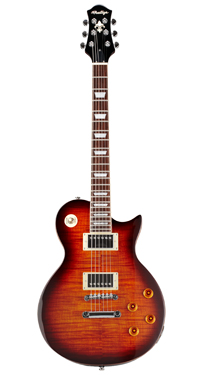
As you may know, I own a Prestige Guitars axe – actually one they no longer have in their current model lineup (though they list it in their models area) – the Heritage Elite, which I call “Sugar” because she actually smells sweet in addition to sounding sweet. The Heritage Elite is a very ornate take on a Les Paul copy; a lot of people actually don’t like how busy all the decorations are, which might account for why it’s not on their current model lineup. But the tone and sustain are wonderful, so that guitar is a keeper for sure. But I suppose in an effort to be a bit more “true to form,” Prestige has come out with a new axe, called the “Classic,” that I am sure will turn heads.
The Classic is a very nice take on a classic Les Paul design. It features a AAA flame maple top, on a super-light, carved, mahogany body and mahogany neck with a rosewood fretboard. As with the Heritage, it sports the classic Seymour Duncan 59/JB Neck/Bridge pickup combination, independent volume and tone knobs, and a 3-way selector switch. Not sure what the bridge is, but when I last spoke with Prestige, they were moving away from Gotoh Tone-o-matic to GraphTech. Sure looks like a Gotoh to me, but I’d have to see it up close to tell.

When I look at the picture, if it weren’t for the lower horn, I’d swear this was a Les Paul! I dig the mother of pearl inlays on the fretboard, and the graceful lines of the body; speaking of which, the back is contoured, so in addition to being light, it is apparently incredibly comfortable as well. Great combination!

Here are specs from the Prestige Site:

  • 24 3/4” scale length
  • 1 11/16” nut width
  • Carved mahogany, maple bound body
  • AAA Grade flame maple top
  • Mahogany neck
  • Bound rosewood fingerboard
  • Mother of pearl trapeze fingerboard inlay
  • Mother of pearl prestige logo & decal
  • Seymour Duncan SH1-59 (neck) SH4-JB (bridge) humbucker pickups
  • 2 Vol. / 2 Tone / 3-way toggle controls
  • Grover tuners
  • Tune-o-matic bridge & Stop Bar
  • All chrome hardware
  • Available in natural sunburst finish

And to top it of, here’s a Guitar World video demo of the Classic:

Even with the low quality video, you can hear how that guitar just sings. It has a sweet sound, but can also get really aggressive. That’s one of the reasons I love playing my Sugar, which is a great guitar. But I might just have to get me one of these classics to gig with… OMG! More GAS!!!!

For more information, check out the Prestige Guitars product page!

Read Full Post »

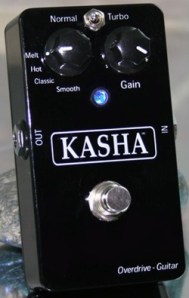
I know, I know… I talk about this pedal A LOT, and I’ve already reviewed it a few times… (here’s the original) But I keep on discovering so many great things about this pedal that makes me want to talk about it. Just when I think I’ve got it dialed in, I find yet another thing that it does that just completely turns me on!
Tonight, I was screwing around with my song Strutter yet again. I’m done writing it, but I wanted to practice, and that song is really fun to practice to; I just mute the lead tracks and have at it. Mind you, all I wanted to do was practice and play “Blondie,” my Squier CV Tele – I didn’t have anything else in mind.

So I hooked up my Aracom PLX18 BB and started playing over the rhythm track. Folks, this amp just oozes classic Marshall “Bluesbreaker” tone as is, but just for shits and giggles, I decided to switch on my KASHA Overdrive to add a little flavor to my tone because I was working on a new song recently where I loved what this pedal did – especially with the PLX18 BB! For that song (which I’m still writing) I didn’t want to add too much gain. All I wanted to do was add some texture. So I thought it might just sound good while I practiced over Strutter. Man, was that a good call!

Here’s an A/B clip of sorts of the first two verses of the song. In verse 1, I’m playing the PLX18BB with nothing added – just a touch of room reverb as an insert in the mix. In the second verse, I switch on the KASHA overdrive (still with some reverb in the mix). The pedal is in the “Hot” channel, and I set the gain knob at 12 o’clock, which just provides a bit of a gain boost (it’s capable of adding up to 15dB of boost in this channel), but this channel also sustains for days, adding a touch of high-end sparkle. Here’s the clip:

Please excuse the little playing mistakes I made… πŸ™‚ It’s nothing really egregious. In any case, when you compare the two verses, the difference in tone is actually subtle, at least to my ears. But from a playing standpoint, the amount of touch-sensitivity and sustain that was added made the second verse so much more musical and so much more inspiring to play. And speaking of subtlety, I think that is yet another mark of a great overdrive pedal. To me, overdrives should be transparent, they should never alter your tone – that’s what fuzz and distortion are for. At the most, they should simply add EQ emphasis, and that’s it. And that’s why I love the overdrives I play through: Tone Freak Abunai 2, GeekMacDaddy Geek Driver, Creation Audio Labs Holy Fire, the KASHA overdrive, TubeScreamer, and believe it or not, a Bad Monkey. They all bring to the table their own little voicings, but none of these alter your basic tone.

Great gear evokes a sense of inspiration – at least in me – that makes me want to keep playing and playing and playing. I just can’t say enough about this pedal. At around $200, it is worth every penny I paid for it. Thanks, John Kasha for coming up with such a fantastic pedal! Now back to playing!

Read Full Post »

I’m not a metal player, not even a real fan of metal, or I should say the real heavy stuff, and being more of a middle-of-the-road kind of guy in real life, have never really gotten into the fashion. That doesn’t mean it’s bad to me, it’s just not, well, me. So my appreciation of metal and the metal culture and style has always been somewhat on the periphery at best. But I do have to say that some of the styling cues are so over the top, I find them very intriguing.

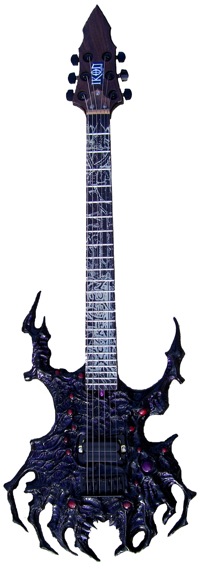
This morning I received a press release about a new company called Ikon Custom Guitars. The picture of the guitar that accompanied the press release gave me a bit of pause. It was one of those moments where you think, “That has to be about the fugliest goddam guitar I’ve ever seen, but at the same time, it’s cool. By the way, this company is so new that their web site isn’t even complete – it’s just a splash page.

The guitar shown here is called the Arachnoid 1. When you take a close look at it, it really looks like a spider. In fact, the first impression I got was Gene Simmons meets the Lord of the Rings. Here’s an excerpt of the press release copy:

Guitar Strikes Fear in Community

Custom guitar builder, Ikon Customs takes guitar building to a new level with unique custom body shapes and materials…all without sacrificing the tones and performance of the instrument.

Houston TX Β February 10, 2010 – Ikon Custom Guitars is introducing its first production models to the guitar market.Β  The Arachnoid 1is 100% hand built in the USA using traditional and innovative techniques.Β  After years of effort to challenge conventional appearances and styles of guitars, Ikon Customs feels it has finally reached a new pinnacle in guitar design, appearance and manufacturing.

The body of the Arachnoid 1 is constructed of a poplar wood core for strength and tone and a proprietary resin compound that allows the builders to sculpt and shape finished bodies into new and innovative designs.Β  The resin compound took many prototypes and years to finalize before committing to final production.Β  In addition to the proprietary compounds, Ikon Customs also builds bodies using other materials such as fiberglass, carbon fiber and Kevlar.Β  Founder and President, Marc Anthony H. Bertone feels that with these new materials, his design concepts will be limitless.

The Arachnoid 1 is available in three models:

Arachnoid1 Weaver:

  • Red Oak neck and fretboard
  • Dyed fretboard, printed graphic “tatooed” on
  • Poplar headstock with a walnut veneer
  • Death Dealer high output passive pickup
  • Top loading fixed IKON USA Bridge
  • IKON Grip USA locking tuners
  • Proprietary resin formula over Poplar body
  • Adjustable aluminum nut
  • Custom airbrushed paintjob
  • Available in Flat, Satin or High Gloss finish
  • chrome, black or gold hardware
  • 25.5″ scale, 24 jumbo frets, available in flat or 20″ radius
  • MSRP: $999

Arachnoid1 Recluse:

  • Maple, Walnut, Bloodwood or Purpleheart neck and fretboard
  • Inlaid Aliencult Skull logo
  • Poplar headstock with Carbon Fiber or exotic burl veneer
  • Death Dealer high output pickup or Stealth active pickup
  • Top loading fixed IKON USA Bridge
  • IKON Grip USA locking tuners
  • Proprietary resin formula withΒ  hand-laid fiberglass over Walnut body
  • Adjustable aluminum nut
  • Custom airbrushed paintjob
  • Available in Flat, Satin or High Gloss finish
  • chrome, black or gold hardware
  • 25.5″ scale, 24 jumbo frets, available in flat or 20″ radius
  • MSRP: $1999

Arachnoid1 Widow:

  • Cocobolo or Bocote (or any other exotic wood; subject to availability and may affect final pricing) neck and fretboard
  • Inlaid Aliencult Skull logo, LED glowing fret markers
  • Poplar headstock with Carbon Fiber or exotic burl veneer
  • Death Dealer high output pickup or Stealth active pickup
  • Top loading fixed IKON USA Bridge
  • IKON Grip USA locking tuners
  • Proprietary resin formula withΒ  hand-laid fiberglass and carbon-fiber over Walnut body
  • Adjustable aluminum nut
  • Custom airbrushed paintjob; ours or your choice of colors
  • Available in Flat, Satin or High Gloss finish
  • chrome, black, gold or any painted color hardware
  • 25.5″ scale, 24 jumbo frets, available in flat or 20″ radius
  • MSRP: $2999

About Ikon Customs

Established in 2006 with the intent of changing the world of guitars and musical instruments, Founder and President Marc Anthony H. Bertone set out to find new and unique approaches to designing musical instruments that defied tradition and style.Β  What started as a hobby in the garage has now turned into a lifetime pursuit and career.Β  www.ikoncustoms.com

On a final note…

While I’m intrigued by the offering, weird body shapes for guitars aren’t anything new. Halo Guitars was doing that for a long time, though they seem to have gone back to selling more traditional styles – go figure. So I do wish Ikon luck. Hopefully Marc Anthony Bertone will achieve a following.

Read Full Post »

or… Doc Brown in Back to the Future saying, “I finally invented something that works!” Speaking in reference to the Flux Capacitor. Nah, it’s nothing of the sort, but it is by no means less cool. The Flux Density Modulation Speakers are a new approach to attenuation where the attenuation happens right at the speaker! Giving you up to -9 dB attenuation, while keeping your tone, that is what I call cool, and something I must check out! You know me, I’m an attenuator fan, and something like this has me absolutely GAS-ing! From what I could tell from the videos below, the tone is really preserved. Now, mind you that -9 dB of attenuation won’t get you down to conversation levels, but it’ll sure provide enough attenuation to take the bite off the volume. If you need to go lower, hell! Get an Aracom attenuator, and get it down REAL LOW! Check out the NAMM vids!

and from GuitarWorld…

Read Full Post »

I’ve been using the Aracom PLX18 BB Trem in my studio for the past couple of months, and it is simply a great amp. As I’ve written in the past about this amp, I’ve made some modifications to it such as replacing all the stock pre-amps with NOS (the JJ EL84’s are killer in this amp, so no need to even look for NOS for these), and replacing the stock speaker with a Fane Medusa 150.

As most GuitarGear readers know, my go-to gigging amp is my beloved, customized Aracom VRX22. But every now and then, I like to take my other amps out for a spin. For this evening’s church gig, I took the PLX18. Based upon tonight’s experience, it looks like I’m going to gig with this amp a lot more.

One thing that I’ve come to love about Jeff Aragaki’s amp designs, is that he has got the vintage Marshall mojo down. Mind you, he doesn’t make clones. He takes the original circuit designs and innovates on top of them. The PLX18 BB started out as a classic “Bluesbreaker” design, but with improvements to the circuit to make it much more efficient. The result is a real smooth-sounding amp that – like the amp it is modeled after – has tons of clean headroom, and needs to be absolutely cranked to get grind. But when it grinds, it’s so rich and smooth and dynamic, you just close your eyes and let your fingers do the talking!

Such was the case tonight. About a year ago, I re-arranged a classic Catholic hymn and gave it a bluesy, folk-punk vibe (think a cross between Death Cab and Clapton). I know, it sounds like a weird mix, but amazingly enough, it works. People know the song really well, but this arrangement gets them nodding their head in time – it’s cool to see! In any case, I also arranged it so that there was plenty of room in between verses for little solos. It’s a somewhat slow song, so you can’t go overboard, but the phrasing really lends itself to a lead played with an amp just at the edge of breakup, with lots of bends and vibrato.

And it helps to have an amp that has a lot of natural sustain. The PLX is just so damn good at that! I played the amp in the “clean” channel that I had almost cranked up all the way, since that’s where a vintage Marshall sounds great, and of course, it was plugged into my attenuator so I could crank it and still have a manageable volume level. The PLX is so responsive to attack and volume knob adjustments that it makes playing just a dream. Throughout the song, I just closed my eyes and got into pure expression mode. It was one of those occasional experiences where the tone just takes you right into the Zone! When you’re in the Zone, you just can’t do wrong. Hearing the PLX sing with my Squier CV Tele – I just floated away in absolute bliss.

For our closing song, I actually didn’t play, and gave “Blondie” over to my guitar cohort Dave so I could thump out on bass. For that song, I activated the wonderful Kasha overdrive pedal, in the Hot channel to really slam the amp with gain. The great thing about the Kasha overdrive is that it’s a really transparent overdrive pedal, and allows you amp to do it’s magic. With the OD engaged, the PLX took on this incredible character. It’s a bright amp by nature, but the tone became really jangly and ringy, with just a touch of compression coming from the EL84’s. It helps that I replaced the original JJ pre-amps with the NOS ones. In any case, talk about creamy smooth but articulate overdrive! Listening to that just got me thumpin’ out on the bass! We had a lot of fun with that song. Kind of felt like the White Stripes as we only had two instrumentalists (though it was two guitars, or a bass and guitar – no drums). It was raw and edgy, but oh so cool! You gotta just dig moments like this!

As I’ve mentioned, the PLX18 BB Trem is Jeff’s oldest amp design and unfortunately, his least-known amp. It’s tough to compete in the market when there are so many boutique, vintage Marshall-style amps on the market. I’ve played many, but the PLX18 BB is special. Others who own one of these will attest to just how special this amp sounds. Even though it’s not quite as versatile as the VRX22 that can get me over-the-top gain, for what it does, I can’t think of a better amp. Mind you, this ain’t just a one-trick pony. For blues, classic rock, and country, it’s simply killer. So if you’re looking for that classic “Bluesbreaker” tone at a price that won’t break you at the same time (the head is $1345, and the combo – which I have is $1750), I encourage you to check this amp out! And if you do get it, you won’t regret it in the slightest!

As far as equipping it, pay the extra for NOS pre-amps (the JJ EL84’s are just fine – I actually prefer them), and even though Jeff recommends an Eminence Red Fang Alnico to be paired with the PLX18 BB, for my personal tastes, I prefer something with a bit tighter bottom end; hence, the Fane Medusa that I swapped in. If you still want bright tone, then an Eminence Governor works insanely well, and will give you nice mids and high-mids, and I hear the Celestion Gold sounds killer in the the combo! YMMV…

For more information on this wonderful amp, check out the Aracom Amps site!

Read Full Post »

13 years old and can play like Paul Gilbert! This kid rocks the house! He’s the real thing fo-sho! Not just your mechanical prodigy, this kid has feel. Check it out!

Read Full Post »

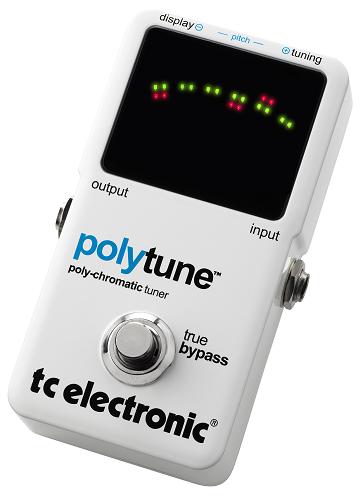
Could this be the last tuner pedal you’ll ever need?

I don’t see how I missed this! I scour the ‘net daily for new stuff, especially from companies that are known to create really high-quality stuff – like TC Electronic. These Scandinavians are incredible inventors, and I haven’t seen or played one one thing of theirs that I didn’t like – though I could rarely afford it. But they’ve come out with a new tuner – yes, a tuner, of all things – that is completely different from any other tuner on the market. It’s called the “Polytune.” As its name implies, it is a polyphonic tuner; that is, the tuner can detect all your strings at once, and you can see which ones aren’t in tune at the click of a foot switch. Unlike traditional tuners that require you to check each string individually, with the Polytune, you strum your open strings. The LED’s will show you which strings are in tune and which aren’t.

In my experience, more likely than not, at any given time only one or two will be out of tune. So imagine the time you save by NOT having to check and tune each string – only the ones that need it! Check out this video to see how it works!

And at $99 bucks… SOLD!!!

Here are some features:

  • 0.5 cent accuracy
  • Standard size box
  • Tune by strumming
  • Can automatically switch between chromatic and polyphonic tuning (it will detect if you’re hitting a single string)
  • Customizable preference settings
  • Has a 9V output jack for powering other pedals
  • True bypass
  • Adjustable reference pitch from 435Hz to 445Hz
  • Supports drop tuning all the way down to B!
  • Works with 4 and 5 string basses as well

It may not have the accuracy of a TurboTuner, but who the hell gives a flying f$%k! .5 cent accuracy is nothing to shake a stick at, and the fact that you can see the tuning of all your strings at once is incredible! CanΒ  you say KICK ASS!!! I’ve never even seen this thing and I want to give it 5 Tone Bones! Check out the TC Electronic web site for some detailed information!

Could this be the last tuner I’ll ever want? Until someone comes out with something better – and at a better price, for that matter, probably not. I want to get one right now. Unfortunately, they’re only available for pre-order. Hmm… oh well, I supposed I can wait. πŸ™‚

Read Full Post »

Your guitar, that is…

I dig cool, off-the-wall stuff. Remember the Harmonic Capo I wrote about? I actually never got one, but that never reduced its cool to me. But this new, cool thing is something I’m definitely going to have to check out. It’s called the Guitar Hanger, made by the guys at The Guitar Hanger company. As the name implies, this little contraption literally lets you hang your guitar, much like you would a shirt or a pair of pants. Check out the video:

Right now, I’ve got all my guitars in my studio in their cases or gig bags, lined up along a wall, taking up valuable floor space. But with guitar hangers, I can free up A BUNCH of floor space. With guitar hangers, you could do something like this:

How cool is that?!!!! For more information, go to the The Guitar Hanger web site!

Read Full Post »

« Newer Posts - Older Posts »