Feeds:
Posts
Comments

Archive for the ‘musicians’ Category

If you’ve never heard of him, Greg Koch is one of the finest guitarists around. A Fender clinician, he spends much of his time extolling the virtues of Fender guitars. This dude can play! Amazingly enough, there doesn’t appear to be an arrogant bone in his body. Greg is really the consummate showman as you’ll see in the video below.

As I said, that dude can play! But as you saw in the video, he shows his skill in a completely non-arrogant way – it’s pure entertainment. That’s what makes Greg Koch a Top Dawg!

Read Full Post »

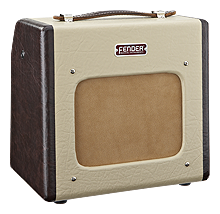
Fender Champion 600 Re-issueI forgot how much fun this little 5 watter is to play! I just put in new tubes to make it have more headroom, as this is an incredibly pedal-friendly amp. The tubes I got were as follows: NOS JAN-Philips 12AT7 and a JJ 6V6. The idea behind this is that the 12AT7 has about half the gain of a regular 12AX7, so it won’t push the power tube as hard as a 12AX7. The JJ 6V6 has tons of gain, and is much harder to break up; thus, I hoped to attain more clean headroom with this combination.

While I like the breakup of the Champ 600, it’s a little weak, but the clean tone is spectacular with this amp. And hooking it up to a 1 X 12 extension cab really expands the depth of the tone it produces. Combine that with a couple of pedals, and the result is like candy to the ears.

Some people might frown upon this diminutive amp, but I used it throughout my first album, and for good reason: It’s so damn versatile! I can play pretty much any style with this amp, and miked properly, can make it sound much bigger than it actually is. And at $200 bucks (that’s what I paid for it), it was a total steal!

Here’s a simple clip I recorded using one of GarageBand’s “Magic Garage Band” backing tracks. It’s a slow blues in E. The first part of the song is played with the neck pickup of my Prestige Heritage Elite, into my Tone Freak Effects Abunai 2, into my Hardwire RV-7 Reverb, then into the Champ and out my custom Aracom 1 X 12 extension cab with a Jensen P12N (damn! that totally sounds like name dropping! Yikes!). In second half of the song, I switch to my bridge pickup and stack my Tube Screamer on top of the Abunai 2. Oh my freakin’ gawd! This was fun. In any case, here’s the clip:

Sorry for the mistakes. I actually didn’t care because I was having so much fun! And by the way, I played the lead parts with my brand-spankin’-new V-Picks Psycho pick, a 1 3/4″ wide, 5.85 mm thick monster of a pick. I’m in tone heaven right now! You just gotta check this pick out!

And I almost forgot! I just can’t believe who incredibly awesome these Wyres strings sound and play. They’re so pliable, so resonant, and they sustain so well that they send my inspiration through the roof! Like the Psycho pick, I just can’t enough of these absolutely wonderful strings!

Read Full Post »

5 Tone Bones - Gear has stellar performance, value, and quality. This is definitely top of the class, best of breed, and it's a no-brainer to add this to your gear lineup!

IK Multimedia Stealth Pedal

IK Multimedia Stealth Pedal

Summary: It’s official, IK Multimedia’s StealthPedal has just been released! The new StealthPedal is a lesson in packaging up familiar components to produce something totally unique. This is the first of its kind: A USB-powered guitar audio interface/software controller that you can use for recording or playing live as well as controlling any “Powered By Amplitube” software (or any MIDI-controllable software). With the StealthPedal, IK Multimedia completes the picture in providing an end-to-end computer-based guitar performance and recording solution.

Pros: Truly plug and play, it is automatically recognized by “Powered By Amplitube” software, and requires very little configuration.

Cons: None

Price: $199 Standard Bundle / $399 Deluxe Bundle

Specs:

• USB powered audio interface and pedal controller
• 2 balanced / unbalanced audio inputs (hi-Z or line level)
• 24 bit A/D and D/A conversion
• 44.1/48 kHz operation
• 2 balanced audio outputs
• Headphones output
• Volume control
• Built-in expression pedal and MIDI foot-switch
• Multiple LEDs can operate as Tuner or Level indicators with AmpliTube
• External double switch and expression pedal inputs
• Classic, rugged metal Wah-style construction
• High-quality, low-noise input stage (109dBA /104dB RMS S/N ratio)
• Control all “Powered by AmpliTube” software/plug-ins

• Control any MIDI controllable software/plug-ins

• Standard Bundle includes AmpliTube 2 Live standalone and plug-in, AmpliTube X-GEAR, Ampeg® SVX UNO standalone and plug-in, Sonoma WireWorks Riffworks™ T4, and AmpliGrooves Loops by Sonic Reality
• Deluxe Bundle: AmpliTube 2, Ampeg SVX, AmpliTube X-GEAR, Sonoma WireWorks RiffWorks t4, AmpliGrooves
• Compatible with all the most popular DAW software supporting ASIO and Core Audio drivers on PC and Mac
• Endless software expandability with AmpliTube modules

Tone Bone Score: 5.0 – I love enabling technologies that make anything that I do easier, but also add a ton of value. That can definitely be said of the new StealthPedal from IK Multimedia. A quick glance at picture of the unit, and you may think: Okay, just another pedal-style software controller. It is that, but it is also so very much more!

The StealthPedal is also an extremely easy-to-use, full-functioning analog-digital audio interface that you can use for recording or running modeling software live through your computer. And with 24-bit analog-digital, digital-analog conversion, and 44.1/48 kHz operation, you can count on the SteathPedal to produce high-fidelity sound in the studio an on the stage.

The StealthPedal looks just like a mere expression pedal from the top view. But look at the sides and the input and output jacks belie its humble appearance. On the left side of the pedal are ¼” jacks for right and left output, an 1/8” for headphones, another ¼” jack for a dual-switch external switching unit (extra), and the USB jack. On the right side of the pedal are ¼” jacks for inputs, a volume control knob, and a ¼” jack for plugging in another expression pedal. In other words, this “pedal” packs a punch and is so much more than what it appears!

Wah, wah, wah

It took me awhile to figure out that I had too early versions of X-Gear / Amplitube Fender to be automatically recognized the StealthPedal. My bad entirely. But once I had the right versions installed, adding software stomp effects and controlling them via the StealthPedal was a total breeze! The software automatically assigns the StealthPedal to control the first effect with some default behavior. For instance, with a wah effect plugin, the foot pedal is assigned to the wah effect and the switch is assigned to bypass. But you can change behavior simply by clicking the “setup” button at the top-right of the application window. It can’t get much simpler than that!

In the Studio

But before I even tried using it to control the included Amplitube software, I wanted to see how it performed as an audio interface. In this usage, I was totally blown away! Whereas other audio units such as those from DigiDesign require a software driver to operate (yes, even on the Mac), at least on the Mac, the StealthPedal follows Apple’s lead in design: Plug it in and it just works! So in a very real way the StealthPedal is aptly named as it just does what it does without you knowing how – or having to know how it works! Note that you do need a driver for Windows. But on my Mac, the process to be up and running took less than 5 minutes! That’s incredible!

Launching GarageBand, I just went into the preferences, and selected the StealthPedal as my input and output devices. I ran an unbalanced line from my mic pre-amp into the first input jack of the StealthPedal, added and setup a new track, hit record and started jamming on my guitar that was plugged into my amp. The StealthPedal worked as expected – actually a lot better than I expected because I was expecting only “okay” signal quality, considering the price point of this unit. Boy, was I wrong. The recorded signal was just as clean as my MBox 2, with no apparent shading of any kind. That put a smile on my face. And another thing that really blew me away was that lag was virtually non-existent. There was tiny bit, but nowhere in the realm of the lag that I normally get with my MBox 2. Amazing!

Then plugging my guitar directly into the StealthPedal, I fired up the Amplitube Fender plug-in, selected an amp, and started playing. This was truly the first time I could switch on track monitoring and not get thrown off from the lag!

What’s Not Obvious Is Usually Where the True Power Lays

Think about this carefully because it’s important: The real impact of the StealthPedal is not necessarily in its features, but in what it provides as a solution. As I mentioned above, the StealthPedal completes the picture for IK Multimedia to provide an end-to-end computer-based guitar performance and recording solution. I don’t say this lightly. Not only do they have totally kickass amp and effects modeling, with the StealthPedal, they now have a high-quality, high-fidelity guitar audio interface and software controller! Add to the fact that the StealthPedal requires ZERO setup to use (Mac only, sorry folks), and you’ve got a complete solution for all your computer-based guitar audio. And because the StealthPedal was built to work specifically for “Powered By Amplitube” products, you never have to worry about compatibility problems! I don’t know about you, but that’s just incredible to me. But wait there’s more!

Because it is a MIDI controller, the StealthPedal can also be used with other amp sim software via MIDI. So this just isn’t a solution for the AmpliTube user, it can be used by virtually all recording guitarists, and other musicians as well!

Overall Impressions

What can I say? I dig the StealthPedal! In the next couple of weeks, I’m going on a trip. Guess what’s coming with me? A guitar, the StealthPedal, a mic pre-amp, a mic, and a couple of cords. That’ll be enough to record any song, and besides the guitar, all that will fit into my computer bag!

Read Full Post »

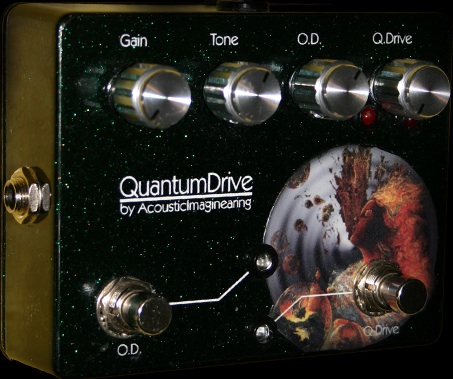
Acoustic Imaginearing Quantum DriveBrand-new from what appears to be a brand-new kind of overdrive/distortion, Acoustic Imaginearing has just released its new QuantumDrive, overdrive/distortion pedal. Folks, this appears to be totally new technology; the first and only that employs quantum mechanics tunneling to produce its distortion sound!

I’m no physicist, so I’ll let you do your own research on what quantum tunneling is. But this is a totally new twist on distortion! Here’s the press release:

The QuantumDrive, A.I.’s flagship product, is a versatile and unique overdrive and distortion unit that uses a patent pending process to dynamically shape the sound of the guitar by means of a quantum tunneling device. Quantum tunneling is a curious physics principle which allows matter to “pass through” other matter which would normally be impenetrable. A.I. has developed a means of using this effect to modify a guitar signal in unique and previously unheard of ways. The quantum distortion appears to add a vowel sound to the signal as well as emphasizing the consonant, fricative guitar distinctiveness. Affecting the edge of the waveform and not just the peaks, the result is a very expressive tone when played “in the zone.” Of course the pedal is also capable of wild and quirky, outside the norm distortions — each distinctive to the instrument processed by the Quantum Drive.

The effect is well suited for both guitar and bass, as bass frequencies are retained without becoming muddy. It has been used by Tony Levin on the latest King Crimson tour.

In addition to the distortion channel, the pedal has a solid overdrive channel, also uniquely designed, that can be used independently or chained together with the quantum channel.

I gotta tell you, I love this kind of stuff! And the fact that this is an overdrive/distortion pedal (you know OD is my favorite kind of pedal) is even better! I’m very excited when inventors add a new twist to something familiar. It just goes to show that there’s no shortage of creativity and innovation in the world!

How It Sounds

There are very limited sound clips available on the site, but the interface to listen to them is a bit screwy. I was able to do a debug trace to figure out the sound clip file names. The following clips were done with a Les Paul with the rhythm pickup into the QuantumDrive and output through a Peavey Classic 30. The clips actually aren’t that good, as the massive amounts of reverb kind of mask what could really be a great sounding pedal. But from what I could here, this is a real open sounding distortion, with just a little fizz. What I like is how the signal tails off.

Light Quantum Drive

Medium Quantum Drive

High Quantum Drive

Note that this pedal also has an overdrive that you can mix with the quantum drive as well.

Where to Buy

You can get this pedal on EBay for $165 as a “Buy It Now” or bid on it for $160 starting bid/$225 Buy It Now (in another auction).

This pedal is so new, they only have two dealers. This is a great find!

Read Full Post »

Was just perusing Musician’s Friend and ZZounds, and noticed that prices on Fender guitars have dropped a bit. Is this a temporary price reduction, or is it a sale? Who knows? Amps are still at the same higher price (a Hot Rod Deluxe is still $800+), but the guitars have dropped anywhere from $50 to $100 from previous prices.

Who knows if this is just a marketing ploy or not, or maybe Fender realized that the severe price hike only served to piss people off and sales got hurt. For me, this slight drop isn’t going to make me run out and go buy a new Strat or Tele. There are enough very good used Strats and Teles that go for a great price that these new prices just don’t provide enough motivation for me to buy.

But there it is, prices are lower, however slightly, and that’s never a bad thing!

Read Full Post »

Wyres Strings

5 Tone Bones - Gear has stellar performance, value, and quality. This is definitely top of the class, best of breed, and it's a no-brainer to add this to your gear lineup!Up until recently, I had never heard of Wyres Strings until I was in a nostaligic mood, and looked up the great French acoustic guitarist, Pierre Bensusan, went to his site, and saw this page, where he was endorsing Wyres Strings. Intrigued, I looked up the Wyres string company on the web, and looked at the various pros who are using them to get an idea of what kind of musicians have used these strings. What I discovered is that the range of musical styles where these strings are used is very wide, ranging from acoustic to hard rock. That was a good sign. I’ve found other “specialized” string companies who only have appeal in a specific genre of music. Not so with Wyres.

Emboldened with this knowledge (and my incessant curiosity), I contacted Nick Walton, owner of Wyres strings to get his story and to see if I could review some strings. I already believed them to be great strings if the great Pierre Bensusan was endorsing them (and according to Nick, this wasn’t due to some “pay me and I’ll endorse your strings” type of deal. Here’s Pierre’s testimony:

Dealing with strings has generally been for me a source of compromise and often frustration. For more than 30 years, I have been waiting for the right medium, embracing top quality but also longevity, fluidity, touch and beauty of-sound. I came across Wyres Strings and found the answers to all my concerns. These strings are just phenomenal, they are handmade, sound extremely well, feel great under the fingers, allow for an extensive use of their sustain to “work” the touch, the tone and the history of the note, they do not break and, icing on the cake, thanks to a very subtle coating which doesn’t not take any harmonics away, they last for ever ! I feel completely relieved and will always remain really impressed with this performance.

Wyres Strings surpass any other brand on the market today! I am proud and honored to collaborate to a Signature set with Nick Walton and his company. A dream came true.

Note that Pierre wasn’t prompted or coached to say what he said. Coming from a master composer and guitarist such as Bensusan, that is quite and endorsement! Okay, let’s get into details, but first, let me say this:

These are hands-down the best guitar strings I have ever played!!! The sound, feel, and playability are amazing! Like Bensusan, I will never use another string manufacturer. I love these! I know, people swear by pure nickel, and admittedly, they are fine strings, but they are also expensive. As a gigging musician with a family to feed, pure nickels are a luxury I can’t afford, but I can afford to spend a few bucks more on high performance strings. And the fact that they’re coated and will last longer than a normal string makes them even more economical. But that’s not my main motivation. These strings sustain for days, and they have tons of tone – but I’m getting ahead of myself.

Handmade and Coated, And They Feel FANTASTIC!!!

All Wyres strings are handmade and hand-wound by skilled craftsmen. They come in both coated and uncoated versions, but the coated are by far their best sellers. Coating is done with a special process that actually lubricates the string as you play, which apparently results in a longer lasting string from both a mechanical and tonal perspective.

Personally, I’ve never been a fan of coated strings. I’ve always found them to be very brittle feeling and over-bright. I tried Elixirs a few times, and couldn’t stand the sound, plus, I felt as if they were cutting into my fingertips because they feel sticky. Wyres feel that way at first, but after a just a short while, the coating starts working into the pores of the strings, and your fingers just glide.

I gigged with these strings last night for the first time, actually playing a bit of roulette by stringing up with these never-before-played strings right before I left for my gig. As expected, when I first put them on, they were as bright-sounding as any new string. But the thing I immediately noticed was that they were very full-sounding as well. I knew that these were very special strings. I was very excited to play with them.

I strung the strings tighter than standard tuning so they’d be stretched by the time I started my gig. By the way, the strings I played are the 12 – 54 version, hence the model TP1254 – they’re equivalent to “lights”). And once I got to my gig and tuned up, and struck my first chord, a huge smile just formed on my face. They sounded absolutely incredible (which I’ll get into), but almost more importantly, they had a great feel, despite the fact that I could still feel the coating. After a few numbers – I set up my opening set list so that I’d play songs that ensured I’d play up and down the fretboard, either with a capo or barre chords – the strings started to settle, and feel really good. I found that I didn’t have to dig in hardly at all to get notes to resound, and doing little runs with subtle microtonal bends was a breeze! The strings felt almost like electric guitar strings. They were pliable and incredibly resonant – the feel of these strings really got me into a groove!

How They Sound

I guess the proof is in the pudding. I’ve played great feeling strings that just sounded dead. But these strings produce gorgeous tones, and as I mentioned they’re incredibly resonant. The sustain from these strings is like nothing I’ve experienced, short of really expensive sets I’ve tried in the past that cost an arm and a leg. In my solo gig, I play a variety of styles from jazz standards to claw-and-hammer fingerstyle songs. No matter what style I played, these Wyres were the best sounding guitar strings I’ve ever played. It’s no small wonder why Pierre Bensusan endorses these strings (though he plays with a set of 13’s, which I’ll review once I wear this current set of 12’s out).

Overall Impression

Obviously, the 5 Tone Bones I assigned to these strings speaks to how much I love them! For me, I won’t be using any other strings from now on. Like Bensusan, I’ve found my string of choice. Now get this: These strings go for $14.95 to $17.95; about the same as what you can get a set of Elixirs for. But these strings kick the shit out of Elixirs, hands down – at least for me. And considering that these strings are nowhere near the brittleness of Elixirs, and they’re handmade, I’ll go with these, thank you. No more machined strings for me!

Read Full Post »
T-52-AMy good friend Jeff recently lent me his Nash Tele – a T-52. He’s one of those guys who’s totally into that relic look. Me on the other hand? Give me a nice shiny guitar any day! And even if I found an old guitar at an estate sale, I’d have it cleaned and brightened – though to retain its value, I wouldn’t do anything other than to freshen it up). But as you can’t judge a book by its cover, so it goes with guitars. Just because a guitar looks beat up and old, in the end, it’s how it sounds and plays that really matters, and the Nash Tele I just got done playing with is a total joy to play, with very nice tones to boot!


One thing that really impresses me about the guitar is how fast the neck is. It is so easy to move around on the neck that I was making tons of mistakes at first because I was able to play with a lot of speed. A lot of that has to do with how easy it is to play a note. Just lightly press, and the guitar starts to sing! Of course, there’s not much sustain, but that’s to be expected out of a Tele or tele-like guitar.

Just in case you missed all the excitement, I had written an article about the Fender Roadworn series awhile back. I basically said in the article that I just really don’t get the relic thing, and that I’d rather to the “relicing” myself. If that’s your thing, more power to you – what inspires us is what makes us great. But cosmetics aside, it’s also how a guitar feels and it enables you to express yourself. So even though I don’t get the relic thing, just based on playability and sound, I could easily own one of these. They are very nice guitars!

4.75 Tone Bones - Almost perfect but not quite

Rating Summary:Surprisingly enough, my little ding didn’t come from my not “getting it” with the relic look. The guitar I tested had a weird buzz in the second string, and it wasn’t due to fret buzzing either. It didn’t really show up when the guitar was plugged into an amp, but it was really evident. Otherwise, the guitar played and sounded great!

Read Full Post »

I can just imagine the heat from the flames I’d get on the forums if I said this, but this is something I just can’t hold back any longer after reading so many threads on the Ultimate Attenuator. I’ve spent a lot of time studying how different attenuators work, and I’ve come to the conclusion that despite its popularity, this is not an attenuator that I’d even consider getting, even if it’s at a reasonable price – which it isn’t. I have a lot of different reasons for not liking this attenuator, but the biggest issue to me is the fact that with the UA, the amp is no longer reacting with the speaker and vice-versa. The UA has a cheap, solid-state amplifier built into its circuitry to re-amplify the amp’s signal after it has passed through the 32 ohm fixed resistor. At that point, the speaker is interacting with the solid-state amp. How that can pass for transparency is beyond me.

Then there’s the fixed resistor. Don’t even think about running a 2 or 4 ohm output into that attenuator. You’re risking serious damage to your amp if you do that. The impedance mismatch there is so high, it has the potential to fry your power tubes or worse. As an add-on, you can get the 16/32 ohm switch, or get one of Ted Webber’s impedance matchers. But then you’ve already spent $750 – that’s just nuts!

I use the Dr. Z Airbrake which uses a rheostat type of resistor to provide variable attenuation. People have complained that at high attenuation levels it sucks tone. It does indeed, but for normal usage, just above loud conversation volume, it is very transparent, and I would daresay that it’s much more transparent than the UA because the amp and speaker are still reacting to each other as there is no “middle-man” solid-state re-amplifier.

I’m probably going to piss people off with this little rant, but so be it. I freely admit that I’m no electronics expert, but I do have the intelligence to understand a thing or two about amps, and a re-amplified attenuated signal – at least to me – isn’t going to be transparent.

Read Full Post »

4 Tone Bones - Excellent gear, that exceeds expectations of its performance, value, and quality. Strongly consider purchasing this.

Hamer XT Sunburst

Hamer XT Sunburst

Hamer XT Sunburst Flametop

Summary: Modeled after the Hamer USA Studio, this Chinese-made axe is an affordable alternative to its American cousin. Featuring a solid mohagany body and neck with flame maple top and rosewood neck, the XT Sunburst has a naturally bright voice that’s both versatile and expressive. Very nice build quality.

Pros: Sweet, gorgeous voice at mild breakup levels, but is quite comfortable doing high-gain, which is probably where it’s best applied. This would be a great starter electric guitar!

Cons: Not much inherent sustain, especially in the upper registers where the guitar seems to lose gas. Hamer headstock is huge (that’s just a personal nit)!

Price: $349-$399 street

Specs: See web site

Tone Bone Score: 4.0 – This is not a bad guitar, and it would definitely be something I’d consider as a starter instrument for one of my kids. It’s a nice-looking and with a little work, a nice playing guitar that would be perfect for which to start out a new guitarist.

In addition to being an incredible amp builder, Jeff Aragaki of Aracom Amps is as much a gear slut as I am, probably more so with guitars. Recently, he made the purchase of a Hamer XT Sunburst that he let me test. I had only played USA Hamer’s in the past, so this was to be my first experience with one of Hamer’s Chinese-made guitars.

Fit and Finish

Taking the XT Sunburst out of its gig bag, I was struck by its looks. It is a very beautiful guitar, and the burst finish really accentuates the flame maple top. It is also extremely light in weight, which is a huge point in its favor. Hamer calls it an “archtop,” but it’s more of a carved top, with gorgeous lines. The body wood is made of two pieces mahogany that look like they came from different parts of the tree. It’s not bad, it’s just kind of funky looking. Overall though, the finish is quite nice.

The neck is an extremely shallow C-shape neck. It felt pretty good in my fretting hand, and made it easy to get around the neck with ease. I love the short neck butt of this guitar, which allows you to reach real high notes without first having to do hand-stretching exercises.

Playability

Here’s where the poor setup that I mentioned above came into play. The action was set pretty high, and lowering the action just a fraction immediately caused some string buzz which means that there’s a bit of a bow in the neck. I confirmed this with a quick spot check. It’s not my guitar so I didn’t want to adjust the truss rod. The high action made it difficult to move with speed across the strings. But mind you, it’s not so bad that the guitar is unplayable. I would suspect that with a good setup, this guitar has the potential to play very nicely.

Sound

Tonally, this is a very nice-sounding guitar. I just wish there was more of it. The thin body and neck don’t provide enough resonance to hold notes for very long, so if you’re looking for a guitar that will sustain for a long time, this ain’t it. The saving grace is the very beautiful voice it does have. Here’s a clip I quickly recorded:

The guitar was plugged straight into the drive channel of my Aracom VRX22. Volume was set at just the edge of breakup. The guitar was recorded dry, and I added just a touch of reverb after the fact.

Like I said, the XT Sunburst has a sweet, bright voice.

Overall Impressions

For a sub-$500 guitar, it’s not bad at all, and as a start guitar, it would be perfect. And as long as you keep your expectations aligned with what this guitar has to offer, it’ll serve you well. I did get a chance to plug it into my pedal board, and playing it through a compressor/sustainer or an overdrive pedal that adds some sustain will work wonders with this guitar. It does play nice with pedals, which is a saving grace.

Read Full Post »

Tone Freak Effects Abunai 2I’ve been playing my Prestige Heritage Elite so much lately that I forgot how fun it was to get funky with my Strat. So this morning, I plugged my Strat into my board, switched on the Abunai 2, and found a sweet spot that would give me just a bit of grind when I played single notes with nice grit when I dug in or played chords. Then I started playing this little funky riff that I just laid down.

I just can’t get over how good this pedal sounds with any guitar! With my Strat, I’ve always tended to play it much more clean than my other guitars. The ’57 Tex Mex pickups – at least to my ears – have never sounded very good with overdrive. I’ve always felt the drive was harsh. But the Abunai 2 really smoothens out the drive, and now I’m diggin’ playing with some real grit on my Strat.

By the way, if you missed the first clip I recorded using my Heritage Elite, here it is below:

My Aracom VRX22 just loves this pedal as well. Some might argue that with such a great amp that has a fantastic overdriven sound that I should be using the natural overdrive of the amp. In answer to that, sometimes I want a completely different overdrive character than what my amp has to offer, and an overdrive pedal through the clean channel of an amp has a totally different character than the drive channel.

Also, in a home studio environment where I have to keep the volume down, an overdrive pedal allows me to get some snarling-dog overdrive without having to crank my amp. And with a pedal like the Abunai 2 that simulates voltage sag and tube compression so well, I can get that cranked amp tone at bedroom levels!

Anyway, I hope you enjoy the clips!

For more information on the Abunai 2, and for other Tone Freak Effects pedals, please visit the Tone Freak Effects web site!

Read Full Post »

« Newer Posts - Older Posts »