Feeds:
Posts
Comments

Archive for the ‘overdrive’ Category

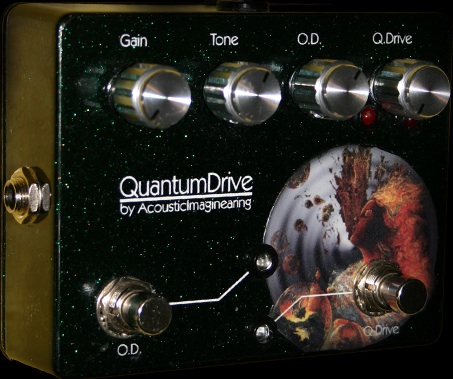
Acoustic Imaginearing Quantum DriveBrand-new from what appears to be a brand-new kind of overdrive/distortion, Acoustic Imaginearing has just released its new QuantumDrive, overdrive/distortion pedal. Folks, this appears to be totally new technology; the first and only that employs quantum mechanics tunneling to produce its distortion sound!

I’m no physicist, so I’ll let you do your own research on what quantum tunneling is. But this is a totally new twist on distortion! Here’s the press release:

The QuantumDrive, A.I.’s flagship product, is a versatile and unique overdrive and distortion unit that uses a patent pending process to dynamically shape the sound of the guitar by means of a quantum tunneling device. Quantum tunneling is a curious physics principle which allows matter to “pass through” other matter which would normally be impenetrable. A.I. has developed a means of using this effect to modify a guitar signal in unique and previously unheard of ways. The quantum distortion appears to add a vowel sound to the signal as well as emphasizing the consonant, fricative guitar distinctiveness. Affecting the edge of the waveform and not just the peaks, the result is a very expressive tone when played “in the zone.” Of course the pedal is also capable of wild and quirky, outside the norm distortions — each distinctive to the instrument processed by the Quantum Drive.

The effect is well suited for both guitar and bass, as bass frequencies are retained without becoming muddy. It has been used by Tony Levin on the latest King Crimson tour.

In addition to the distortion channel, the pedal has a solid overdrive channel, also uniquely designed, that can be used independently or chained together with the quantum channel.

I gotta tell you, I love this kind of stuff! And the fact that this is an overdrive/distortion pedal (you know OD is my favorite kind of pedal) is even better! I’m very excited when inventors add a new twist to something familiar. It just goes to show that there’s no shortage of creativity and innovation in the world!

How It Sounds

There are very limited sound clips available on the site, but the interface to listen to them is a bit screwy. I was able to do a debug trace to figure out the sound clip file names. The following clips were done with a Les Paul with the rhythm pickup into the QuantumDrive and output through a Peavey Classic 30. The clips actually aren’t that good, as the massive amounts of reverb kind of mask what could really be a great sounding pedal. But from what I could here, this is a real open sounding distortion, with just a little fizz. What I like is how the signal tails off.

Light Quantum Drive

Medium Quantum Drive

High Quantum Drive

Note that this pedal also has an overdrive that you can mix with the quantum drive as well.

Where to Buy

You can get this pedal on EBay for $165 as a “Buy It Now” or bid on it for $160 starting bid/$225 Buy It Now (in another auction).

This pedal is so new, they only have two dealers. This is a great find!

Read Full Post »

Tone Freak Effects Abunai 2I’ve been playing my Prestige Heritage Elite so much lately that I forgot how fun it was to get funky with my Strat. So this morning, I plugged my Strat into my board, switched on the Abunai 2, and found a sweet spot that would give me just a bit of grind when I played single notes with nice grit when I dug in or played chords. Then I started playing this little funky riff that I just laid down.

I just can’t get over how good this pedal sounds with any guitar! With my Strat, I’ve always tended to play it much more clean than my other guitars. The ’57 Tex Mex pickups – at least to my ears – have never sounded very good with overdrive. I’ve always felt the drive was harsh. But the Abunai 2 really smoothens out the drive, and now I’m diggin’ playing with some real grit on my Strat.

By the way, if you missed the first clip I recorded using my Heritage Elite, here it is below:

My Aracom VRX22 just loves this pedal as well. Some might argue that with such a great amp that has a fantastic overdriven sound that I should be using the natural overdrive of the amp. In answer to that, sometimes I want a completely different overdrive character than what my amp has to offer, and an overdrive pedal through the clean channel of an amp has a totally different character than the drive channel.

Also, in a home studio environment where I have to keep the volume down, an overdrive pedal allows me to get some snarling-dog overdrive without having to crank my amp. And with a pedal like the Abunai 2 that simulates voltage sag and tube compression so well, I can get that cranked amp tone at bedroom levels!

Anyway, I hope you enjoy the clips!

For more information on the Abunai 2, and for other Tone Freak Effects pedals, please visit the Tone Freak Effects web site!

Read Full Post »

5 Tone Bones - Gear has stellar performance, value, and quality. This is definitely top of the class, best of breed, and it's a no-brainer to add this to your gear lineup!

Tone Freak Effects Abunai 2

Tone Freak Effects Abunai 2 Overdrive Pedal

Summary: In Japanese, “abunai” means dangerous, and this pedal’s overdrive tones are indeed dangerous – at least to your other overdrive pedals. With three switchable clipping configurations, you can dial in a myriad of overdrive characteristics that’ll suit any situation, be it live or in the studio.

Pros: The magic’s in the three-way clipping configuration switch. Super simple to use, and very easy to dial in the kind of overdrive character you want.

Cons: None

Price: $199 (through dealers – check out the Tone Freak Effect Contact Page)

Specs:

  • Controls: Drive, Tone, Level
  • 3 clipping configurations
  • True Bypass
  • Neutrik jacks
  • Teflon coated, silver stranded wire
  • Mil-spec PCB
  • Metal film resistors
  • Metal film capacitors
  • Hand assembled

Tone Bone Score: 5.0 – As I shared with Dereck Tabata (maker of Tone Freak pedals), with the amount of gear that I run across, I’m rarely blown away by pedals. But I was completely blown away by the Abunai 2. Step aside Tube Screamer, there’s a new sherriff in town.

One rainy friday night several months ago, I was sitting in an Armadillo Willy’s eating my dinner and surfing the web, while waiting for my son’s hockey practice at the rink across the parking lot to end. I was doing what Internet geeks like myself occasionally do: Search for available domain names, and reserve them, just in case I want to build a site or point them to this blog. In this case, I did a google search on “tone freak.” The first listing was for Tone Freak Effects; an effects manufacturer I had not even heard of at that point.

Being the gear slut that I am, I just had to mosey on over to the Tone Freak site, and check out what they had to offer. And much to my extreme pleasure, they had a bunch of overdrive pedals, my favorite kind of effect! I immediately reached over to my laptop bag and pulled out my ear buds so I could listen to clips. The first set of clips I listened to were recorded with the Abunai 2. From the very first clip, I felt that this pedal was something special. It wasn’t a Tube Screamer tone – it was something altogether different. It had a much “ballsier” sound than a Tube Screamer, but seemed to clip very similarly – at least in the middle position.

Well I got one in for review just yesterday, and from the moment I hooked it up to my board and started noodling, I was in love!!! And by 2am this morning, I was spent, which accounts for why I’m doing a review of the Abunai 2 the very next day. I just couldn’t stop playing (though after the first hour I did stop to take a break and write a First Impressions article)! So today I’m a bit fuzzy and a little worse for wear, but grinning from ear-to-ear because I just spent the previous evening in absolute overdrive bliss! I know some gear is good when it can consume my attention for hours on end. This is the perfect overdrive pedal!

Features and Ease-of-Use

The features are listed in the summary section above, but the most special feature of this pedal is the three-way mini-toggle set between the drive and volume knobs. This controls the variable clipping section which gives you symmetrical, asymmetrical, and no clipping to open up lots of different overdrive tones. As far as ease-of-use is concerned, this pedal’s easy to use. Select the clipping configuration you want, adjust level, gain, and tone, and you’re off to the races!

Interestingly enough, I wanted to get some background information on the pedal before I received it, so I had a nice conversation with Rob at Tone Merchants about the Abunai 2. He indicated that I’d have to spend a lot of time dialing in just the right overdrive tone I wanted, but once I got it, I’d be totally happy. Call me lucky, but I set everything in the middle position to start with, spent maybe 20 seconds twiddling the knobs, and found a sweet spot. I suppose it also all depends on how discerning or nit-picky you are… I’ll just call it luck for my experience. 🙂

How It Sounds

Many words come to mind with respect to how the Abunai 2 sounds: Killer, Inspirational, Ballsy, F-in’ Incredible! All of the above. To date, this is the best-sounding overdrive pedal I’ve ever played, and I’ve played a lot. You know how taken I was with the OCD, but even that lost out to the Holy Fire, which is yet another killer overdrive/distortion that will never leave my board – actually I shouldn’t say “never” because that’s exactly what I said about my Tube Screamer. It’s not transparent – at least not nearly as transparent as the Holy Fire – but the tone it produces is so damn sweet, who the hell cares about transparency? But that said, the tone of your amp doesn’t really change a lot. It just takes on a slightly different character, and that difference is simply wonderful

No matter what toggle position you go with, the Abunai 2 serves up lots of sustain that gives the resultant tone a very 3-dimensional quality. It’s in your face, but at the same time it’s very spacious – even when it’s simulating tube compression!

In case  you missed the previous article where I described how each position sounds, let me rehash it here. Note that I’m not going to try to identify which position refers to symmetrical, asymmetrical or no-clipping; only what it sounds like to my ears.

Middle

The middle position sounds much like a classic overdrive tone. It’s an open type of distortion tone with a nice grind that’s never harsh. This could be the closest you get to a Tube Screamer tone, but it’s significantly different from that tone. This is a great toggle position for playing dirty rhythm parts.

Left

To my ears, this position sounds much like the tone you get as your power tubes start to saturate. You get a bit more voltage sag, resulting in more sustain and compression, but the overdrive tone still remains fairly open. And like an amp whose power tubes are starting to saturate, you get a slight volume drop. So far, this has been my favorite toggle position for leads.

Right

This position simulates fully saturated power tubes adding tons of compression, tons of sustain, and the expected drop in volume as a result -it’s spongy. I compensated for this by adding some clean boost to get the volume back to unity gain. But despite that, notes are clear, and the dynamics are still incredible.

Here’s a sound clip I recorded at around 1am this morning. I played both parts using my Prestige Heritage Elite. For the rhythm part, I set the toggle in the middle position, rolled off the drive to about 10 am, set the gain to unity, and placed the tone dead-center. I had both my ‘buckers engaged for this part. For the lead, I used the left toggle position, upped volume to about 2pm, set the Tone wide open, and set the Drive to about 1pm. The lead was played through my bridge pickup.

I tracked the rhythm part in a single take, and then loop recorded the lead so I could just jam. I’m not sure what iteration the loop was in when I finally stopped. All I know was that it was about 2am, and I took the last “take” and exported the clip to an MP3.

Overall Impressions

As I mentioned above, my head’s fuzzy, I’m a little worse for wear, plus my fingertips hurt from playing so long last night. But what the hell! I was in complete tonal bliss! The Abunai 2 is an absolute dream come true in overdrive tone! This is a pedal that you just have to check out if you’re in the market!

Read Full Post »

5 Tone Bones - Gear has stellar performance, value, and quality. This is definitely top of the class, best of breed, and it's a no-brainer to add this to your gear lineup!

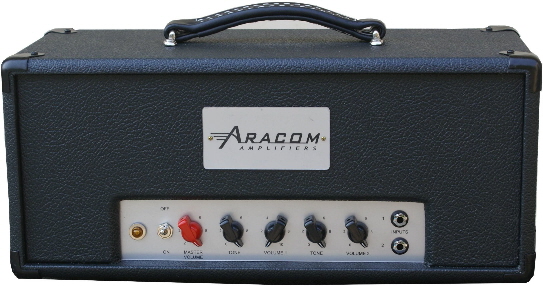
Aracom Amps VRX18 18 Watt Head

Aracom Amps VRX18 18 Watt Head

Aracom Amps VRX18 Watt Head

Summary: Based on the original “RoxBox” (no longer available), the VRX18 sports an improved master volume inherited from the VRX22, and a reworked, smoother overdrive profile.

Pros: As dynamic and expressive as its 22 Watt sibling, the VRX22, but oozing that bright, chimey EL84 goodness. When driven, produces a nice, tight overdrive.

Cons: None.

Price: $895 direct

Specs:

– (2) EL84 Power Tubes
– (2) 12AX7 & (1) 12AT7 Preamp Tubes
– S.S. Rectifier with “sag” circuit
– Hi/Low B+ voltage switch (18/9 watts)
– On/Off Switch
– Indicator Lamp
– Custom Heavy Duty Aluminum Chassis
– Custom Wound Transformers
– 4, 8, 16 ohm Speaker Jacks
– Custom Handcrafted
Turret Board
– Handwired
– Weight: ~35 lbs

Head Cabinet
Standard Tolex: Black Levant. See options below for other colors.
– Dimensions: 19″w x 8″h x 8.25″d
– Weight: 23 lbs

Also available in 1 X12 and 1 X 10 combos (or Jeff can custom build one to your liking)

Tone Bone Score: 5.0. When I can swing it, I’ll be getting this amp to complete the VRX Series!

Jeff Aragaki, founder and builder of Aracom Amps, always chuckles when I tell him that he’s onto something with his VRX (short for Vintage Rox) series amps. With the VRX22, he seemed to have stumbled onto a sweet spot that produced an amp that has an incredible and beautfully balanced tone that bring out the best tonal aspects of the 6V6 tube. He’s done it yet again with the updated RoxBox 18, now renamed the VRX18, but incorporating many of the same features he built into the VRX22.

I just purchased the VRX22, having fallen in love with the tone that it produces, and I’ve fallen love yet again, but now with the VRX18. I’m like a hopeless romantic that loves two women for their individual virtues, but in this case, the women don’t mind – they can co-exist with each other. Okay, bad analogy… 🙂

I originally reviewed the RoxBox 18 back in December. At the time, I totally dug its tone, but took marks off because of the mildly harsh breakup at lower volumes. There’s nothing harsh about the tone of this amp now – at any volume! It’s a great amp to play, and as expected, it’s pedal friendly, and responds really well to overdrive pedals. Also, I played four guitars through it, and it sounded incredible with all of them!

I won’t go into a lot of detail, since I already covered pretty much all the descriptive information I needed to in the original review, so I’m going to cover some important things I’ve learned about the VRX 18 and the VRX series in general. But first, as opposed to doing this last, here’s a short clip featuring the VRX18 to show you how kick-ass it sounds:

For this clip, I used a Strat with just the middle pickup, plugged directly into the VRX18. I just dig that EL84 grind! I had the Channel 2 volume dimed, and the master volume at halfway in full-power mode. It was very loud, much to the chagrin of my wife. 🙂 But I needed to capture at least some of that EL84 compression.

What’s cool about the EL84 is that it compresses nicely when pushed, but still seems to retain a certain openness in its overdrive. This is unlike something like a KT-66 that compresses so much when pushed you lose volume.

The Best Master Volume in the Business

I don’t say this lightly when I say Jeff has the best master volume in the business. I’ve played many amps. But when Jeff created the VRX22, he did something with the master volume that is pure magic. It has a nice, even volume sweep that seems to act independently of the channel volume. This means you can crank the channel volume to get some serious grind, but control the output via the master, and it won’t suck your tone! I’ve found this to be a real problem with other amps. That master volume is incorporated into the VRX18.

The Best Half-Power Switch in the Business

A lot of manufacturers use a pentode/triode switch to achieve half-power settings in their amps. I’ve played several amps with this feature. But in half power mode with the pentode/triode configuration, I’ve noticed a distinct tonal difference between the two modes in amps configured this way. It’s not that the tone is bad. In fact, many I’ve played around with sound great in half-power mode. But it’s like two different amps.

Jeff Aragaki takes a different approach and instead adjusts the B+ voltage to maintain the usage of all pins in the power tubes. I’m not an electrician, and can’t even begin to explain this technically, so I’ll just say it this way: When you switch to half-power mode in any Aracom Amp, the amp doesn’t change its tonal characteristics. It sounds and plays the same!

The Difference Between Old and New

In addition to the great master volume Jeff incorporated into the VRX18, the first thing I noticed was that it was nowhere near as easy to get this amp to overdrive in channel 2 as it was with the original RoxBox 18. This is not a negative thing at all because as I mentioned in my original review, the overdrive was pretty harsh at lower volume levels. I spoke to Jeff about this, and he said that based upon my original tests and review, he decided to mellow out the extra gain stage in the VRX18 so you could get a nice overdrive tone at any volume level.

You won’t get over-the-top gain with the VRX18. But for that, I have a simple fix-all: Get a great booster pedal like a Creation Audio Labs Mk.4.23 (again, the best booster on the planet), and SLAM the front-end of the amp. 🙂

But all that said, if you’re in a venue where you can dime both master and channel volumes, you will be rewarded with gorgeous harmonics and overtones and luscious feedback!

Overall Impressions

Like I said, this is my next amp… It just rocks the house! And at $895 for the head, you could get both the VRX22 and VRX18 for under the price of a single boutique amp! This isn’t a sales pitch. The value proposition of the VRX series is something that should be seriously considered. You’re not getting a production line amp that’s built overseas. With the VRX series of amps, you’re getting a US-made, handwired amp for under a grand!!!

Admittedly, I was a little skeptical when I first ran across Aracom Amps. But I’m now a believer, and a faithful customer!

Read Full Post »

Creation Audio Labs Mk.4.23 Boost

Creation Audio Labs Mk.4.23 Boost

If you read this blog with any regularity, you’d know that I have this thing about overdrive and distortion pedals. Not that I’m a shredder or let alone a virtuoso at guitar. I just love tone, and there’s something about overdrive that never fails to bring a smile to my face. But ever since I started playing with some great amps, and now that I’ve got a great new speaker in my Hot Rod, I’ve been relying less on overdrive for my grind tone, and much more on the natural breakup of my amps. Enter the Creation Audio Labs Mk.4.23, what I consider to be the best clean boost on the planet.

A lot of pedal manufacturers claim to have transparent boosters, and I’ve tried several that come close, but the Mk.4.23 totally delivers true transparency. You get the natural tone of your guitar and amp – just a lot more input gain that will send your pre-amp tubes into saturation. Mm-mm-good! I already wrote a review of this pedal, but thought I’d do a follow-up on how I’ve been using it over the past few months.

I’ve been using the Mk.4.23 in a few different ways (in order of how much I apply it):

  1. First, I use it by itself with the volume dimed on the pedal into my drive channel to slam the front-end of the amp, and seriously overdrive it. In this mode, I usually don’t use any other effect in front of it, though I might use a compressor with my Strat to fatten up the tone. That way I know that I’m getting my guitar’s and amp’s true tone.
  2. Then I use it by itself to boost my clean channel when I need just a bit more volume when I’m doing a clean lead break to get over the band. In this mode, the volume’s set just past unity gain. I also set the volume knob on my guitar to about it’s midpoint so I can fine-tune the volume via my guitar.
  3. Finally, I use it in conjunction with one or more overdrive/distortion pedals to add even more gain to what the other pedals have to offer. Using it this way doesn’t really add any appreciable volume, but the effect is that the overdrive tone gets super thick and raunchy. It’s not all the pretty when playing chords, but single notes absolutely scream!

For such a simple pedal, the Mk.4.23 has really changed the way I approach achieving different tones. For more information, check out Creation Audio Labs’ web site!

Read Full Post »

Late last night, I was lurking (and posting) on my favorite gear forum The Gear Page, when I ran across this thread: Stacking ODs? where a player was asking if anyone had stacked any overdrives. I’ve been doing this for years with different pedal combinations, sometimes successfully, sometimes not. Through my experiments, I found that stacking works best on amps that have a much more open distortion character; that is, the power tubes don’t compress too much. For instance, I tried this on an Aracom Custom 45R that KT-66’s in it, and the compression was so intense that it sucked away all the tone. When Jeff swapped out the tubes with 6L6’s, it was a totally different story. However, I’ve gotten the best results with amps based on either 6V6’s or EL84’s. These tubes don’t compress the signal as much when they saturate as their bigger siblings and maintain a much more open distortion character.

To hear what stacked OD’s sound like, here’s a clip I took out of a song I’ve been working on. Here’s the signal path:

Strat -> Tube Screamer -> Holy Fire -> Mk.4.23 Booster -> Reason SM25

The TS overdrive is set at about 2pm, the Holy Fire’s overdrive is set a 12, with distortion just past 2pm, and the Mk.4.23 booster is dimed for an extra 24db of boost. 🙂  The SM25 is StackMode (both channels run in a series with an extra gain stage), with gain at about 12. Here’s what it sounds like:

This is the raw, unmastered track. It’s really aggressive, but as you can see, it’s not super-compressed.

Update

I’m probably going to buy a Catalinbread Dirty Little Secret in the next couple of days. This pedal was made for stacking, much like the Creation Audio Labs Holy Fire. It’ll be interesting to see what it’s like on my board.

Read Full Post »

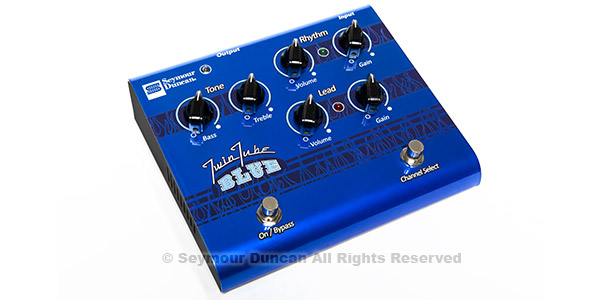
Seymour Duncan Twin Tube Blue Image c/o Seymour Duncan

Seymour Duncan Twin Tube Blue Image c/o Seymour Duncan

Seymour Duncan is known for its outstanding pickups, and I’ve known they’ve made pedals for awhile, but haven’t really paid attention until they came out with the Twin Tube Blue (SFX-11). This is a very cool little preamp/overdrive box that sits – gain-wise – right in the middle between their Twin Tube Classic and their Twin Tube Mayhem.

Run by two 6111 mil-spec, USA Philips-Sylvania tubes, the Blue can get you some nice, pre-amp snap, to sweet, sustained gain. Here’s the description from the Seymour Duncan site:

Too often, inexpensive tube gear runs in “starved plate mode,” where the tubes function like clipping diodes and do not actually amplify. The Twin Tube Blue’s high-plate voltage and 100% vacuum tube signal path allows the tubes to operate at their fullest potential and provide maximum dynamic range. This means you get the most gain and all the smooth tone you expect from a high-quality tube preamp. Two channels provide versatility. Like all Seymour Duncan stompboxes, the Twin Tube Blue is true bypass and features a fully encapsulated toroidal transformer for quiet operation. Heavy duty steel chassis.

Sounds impressive, huh? Here’s a video:

At about $229 street, it’s a bit on the pricey side, but it sure sounds good. Check it out at Seymour Duncan!

Read Full Post »

Catalinbread Dirty Little SecretI always love being able to get great tone at a bargain. It’s not that I’m cheap. I’ll pay top-dollar for great gear, but when potentially great gear comes at an incredibly affordable price, the Dawg’s ears perk up, and his nose starts sniffing around to see where he can play some gear.

Such was the case when I first came across this little pedal company located in Portland, Oregon called Catalinbread. I had run across the name on a couple of gear forums, but didn’t get a chance to check out their site until today when I read their press release in Harmony Central Effects News. After I read the press release, I had to check out Catalinbread’s site, and much to my pleasure, Catalinbread offers several, very cool pedals.

One thing that makes them stand apart is their diminutive size. As noted in ProGuitarShop’s Catalinbread company page, “One of the defining features of Catalinbread effects pedals is the size. Catalinbread pedals are half the size of your standard MXR. That’s right, take a Phase 90 and cut it in half vertically and you’ve got the basic size of Catalinbread’s pint-sized pedals.” But, as they say, size isn’t everything. Apparently Catalinbread’s pedals pack a lot of sonic punch.

The other thing that makes Catalinbread pedals stand apart is their price. Their most expensive pedal that I found was US$179.95. Several of their pedals are under US$120.00! Mind you, these are handmade pedals! That’s so awesome! Catalinbread is definitely taking the stand of selling gear at lower prices to get it into players’ hands. Creation Audio Labs does this with their awesome pedals, and Aracom Amps does it with their VRX line. This ain’t trivial stuff, either. This is great, handmade gear at a great price!

Can you keep a secret?

The Dirty Little Secret could be construed as another “amp in a box” pedal. But from what I’ve heard from sound clips, it’s far from that. Catalinbread claims to have built into the box amp-like touch sensitivity that accurately respond to your playing dynamics and volume input; so much so that you feel like you’re playing in front of an amp, and not through a pedal. But there are several videos on the DLS product page that bears this out. Check out that page here.

Of course, only a live test will reveal if that is true, but I’m intrigued enough to go try one out if I can. The only problem with that is there are none to be found. This pedal’s so scarce that you can’t even order one on the Catalinbread’s web site! I have a feeling they’re being sucked up as fast as the company can produce them. Even retailers who were hawking the pedals awhile ago have either removed their sale pages or replaced their “buy now” link with ‘Email us about ordering.”

Well… my brother lives up in Portland. Maybe I’ll have him look these guys up!

Read Full Post »

I recently started a friendship with Vinni Smith at V-Picks – what a cool dude! Not only does he make great picks, but that man can make an axe sing! Anyway, I was e-mailing him this evening about how his “The Snake” pickup has changed my life, and it got me to thinking about specific pieces of gear that have had a drastic effect on how I approach the guitar. I’ll share them here in kind of a loose chronology:

1. The Kyser Capo

Yeah, lots of people call ’em “cheaters,” but screw ’em. I couldn’t play lots of songs without one. But the Kyser capo in particular really changed my approach, especially after I saw James Taylor playing with one. For years, I used a standard nylon strap type of capo that just basically stayed in place. But then I saw JT playing with a Kyser. I always wondered how he did his mid-song key changes. I used to think he just changed his hand position and played barre chords. But I’ll be damned if he didn’t just slide the capo up, then just played open chords in another key. That was it! I was sold.

2. Ovation Celebrity Deluxe

After my beloved “Betsy” (a Yamaha FG-335 acoustic) broke in a terrible fall, I immediately went in search of a new guitar. I played all sorts in this used gear store and came across this gorgeous sunset burst Ovation. I wasn’t much of an Ovation fan – thought they were really tinny sounding. But when I played this one, it had a much deeper sound than the Ovations I’d played up to that point, and it was a shallow body, no less. When I plugged it into an amp, it sounded even better! That guitar got me into amplified sound. So of course, in addition to buying the guitar, I also got a small Roland 25 Watt practice amp. What a life changer that was.

3. Fender Hot Rod Deluxe

This was my very first tube amp, and an amp that I still use because of how good it sounds… er… I’ve had some modifications done to it, but nevertheless, being my first tube amp, it exposed me to a whole new world of tonal possibilities. Up to that point, I’d played only solid state amps from a Roland JC-12o to a Line 6 Flextone III to a Roland Cube 60 (which I still have – it’s an awesome amp). The Hot Rod showed me the wonders and beauty of tube amp distortion which is nothing like what you get with solid state amps.

4. Ibanez Tube Screamer

There are overdrive boxes, and there are overdrive boxes. But the Tube Screamer is THE classic overdrive box, and the oldest pedal on my board. I’ve of course fallen in love with other OD’s like the Creation Audio Labs Holy Fire, but the Tube Screamer had a real huge effect on how I looked at tone and established what pleases me the most with respect to breakup. It’s a great pedal (though I’m really psyched about testing the Tone Freak Effects Abunai 2).

5. Blizzard Pearl Fender 60th Diamond Anniversary Stratocaster

I love that classic, vintage sound, and this guitar delivered it from the moment I played it. Yeah, it’s made in Mexico, it cost me less than $400 new, but I chose it over Strats five times its price. Why? Because it kicked the shit out of the other guitars. It was THE guitar that convinced me that it’s not the price you pay but the tone you produce that matters. Since I’ve gotten her, I play “Pearl” every day. She’s the first guitar I go to when working on a new song. What a wonderful instrument.

6. Saint Guitar Company “Baby Blue” Benchmark

This isn’t my guitar, and I no longer have it in my studio, but this was the very first guitar that was made to my personal specifications. There is nothing like playing a guitar that’s made to order. The experience is surreal, and started me down this path of playing a custom guitar. Adam’s going to be building me one in the next few months – I’m keeping that one. 🙂

7. Reason Amps SM25 Combo

Even though I love my Hot Rod, the SM25 marks a time when I’ve gotten super-serious about my tone. I’d played a bunch of amps, but this amp showed me that sometimes you do have to pay to get stellar tone – and it’s worth every penny. Lots of manufacturers have created amps that run their channels in series, but I haven’t come across one amp yet that does it as well as Obeid Kahn and Anthony Bonadio. They’ve come up with an amp, cab, and speaker combo that’s like nothing I’ve played before – and I’ve played some awesome amps.

8. Creation Audio Labs Mk.4.23 Clean Boost

I used to think clean boosts were just to help punch a solo through the mix. I didn’t know that they could be used to slam the pre-amps of a tube amp to produce super-overdrive in an amp that no distortion or overdrive pedal can give you. But this one’s very special in that it adds no tonal artifacts of its own – it’s uncanny. What it does is boost the natural sound of your guitar, and when slamming the front-end of amp, gives you the true overdriven tone of your amp. This is a piece of gear that I cannot do without any longer, and it now has a permanent place on my board.

9. Red Bear Picks

I never thought I’d buy a handmade pick, nor pay $20 for one no less. But Red Bear Trading TortisTM picks truly changed my life. I now use Red Bears exclusively for playing acoustic guitar. They sound great with electric as well – I’ll get to that below when I talk about V-Picks – but no pick I’ve ever played has made my Ovation sound so good. These picks look and feel like natural tortoise shell, but they’re made from a polymer of milk protein. No matter, they’re awesome picks!

10. Aracom Amps RoxBox 22 Watt (soon to be released)

This diminutive amp oozes 6V6 goodness. It’s still kind of in the prototype phase so I can’t really write too much about it, but I think my friend Jeff Aragaki has hit a real sweet spot with this amp. Get this: It’s hand-wired, though it uses a solid state rectifier, and it costs less than $1000! The profound thing about this is you can indeed get boutique caliber gear at a great price. But for me personally, this amp is the very first boutique amp I’m buying. Oh, I’ll eventually get the Reason SM25 to run in parallel with this one, 🙂 but this amp is special because it’s the first boutique amp I will ever have owned.

11. V-Picks “The Snake”

As I mentioned above, I’ve befriended Vinni Smith, and I just dig the dude! He knows so much about guitar, and we’ve shared a lot of the same experiences, and love the same kind of music (his favorite guitar solo is the lead break in the middel of Frampton’s Do You Feel Like We Do – my favorite as well). When we first met, Vinni sent me a large sample of his picks, which I compared head-to-head with my Red Bear picks. Of course, I love my Red Bear Classic B-style Heavy, but when I played the comparable V-Picks Standard on my electric guitars, I just couldn’t believe this sound and action I was getting! So I decided to use my Red Bears for acoustic – as I said, nothing sounds better than a Red Bear on acoustic. But for electric, it was going to be V-Picks all the way. Then during a conversation we were having a couple of weeks ago, Vinni told me he’d send me his Snake picks. These are a whopping 4.1 mm thick, with a different bevel than his others. Since I’ve gotten them, I’m never going to use anything on electric guitar than the Snake! I use the rounded for a smoother, fatter tone, and use the pointy for bright attack tones – especially when I’m doing stuff on the bridge pickup! These two picks have totally changed my approach to playing electric. Thick picks in general did that, but these are the thickest I’ve played, and they absolutely ROCK THE HOUSE!

12. May 30, 2010 – I know, a bit late on the uptake here with this one, but life-changing nonetheless, and that is my Aracom Power Rox PRX150-Pro attenuator. This is the first attenuator that I’ve used that truly stays transparent down to bedroom levels. It is the only attenuator that accurately gives me my cranked up tone at low volume levels, and it is absolutely wonderful! I know there are others out there, but knowing that they’re modeled after existing attenuator designs that I know don’t sound very good at low volume levels, it was a no-brainer for me to choose this one. As Doug Doppler said to me in a recent visit to his home, “This thing has saved my ears!” Even Joe Satriani uses one of these units and loves it! That’s how good it is!

Okay, that’s it for me… Anyone care to share what gear has changed their lives?

Read Full Post »
Tone Freak Effects Abunai 2

Tone Freak Effects Abunai 2

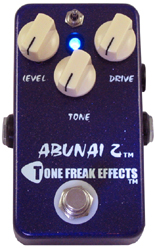
When I stumbled upon Tone Freak Effects as I described in a recent article, I didn’t let on that with the Abunai 2, there might be a Tube Screamer killer in my midst. As you may know if you’re a regular reader here at GuitarGear.org, I love my Tube Screamer. It is the one overdrive pedal that has stayed on my board for years. That creamy-smooth distortion with the mid-range bump just stirs me to the core. I use it all the time, even though I’ve been playing GREAT amps that break up beautifully.

So it is with incredible excitement and anticipation that Dereck over at Tone Freak Effects is sending me an Abunai 2 to evaluate. I’m always a bit dubious about overdrive pedals, and always make the comparison to my beloved Tube Screamer when I run across new ones. But the more I listen to the sound clips, and read reviews on the web about the Abunai 2, the more I’m thinking that if this pedal performs as well as the clips suggest, my Tube Screamer may have some serious competition.

Here are a couple of clips, both through a Suhr Badger:
Clean

Pushed

Impressive, huh?

The thing that REALLY turns me on about this pedal is that it has three switchable clipping configurations in addition to the gain, drive and tone knobs. That kind of versatility is extremely intriguing to me. We shall soon find out in the next couple of weeks.

Read Full Post »

« Newer Posts - Older Posts »