Feeds:
Posts
Comments

Archive for the ‘Tone’ Category

A couple of issues ago, Guitar Player mag published an interesting article entitled, “The Homogenization of Rock Guitar Tone” in which they interviewed a few top rock producers, and posed the question (paraphrased): Have we reached the point in guitar tone, where there’s nothing new to be heard?

Interesting question that… and if we were to look at what’s popular on the radio, I’d have to say that I haven’t heard anything new or really individual in a long while. I suppose that’s why I still listen to classic rock and classic heavy metal. Guitars played such a prevalent role in the era between the late 60’s and mid-80’s. Once glam rock, then grunge took over the airwaves, the once garden of guitar tones suddenly became a monotonous desert. That has continued today with most popular music. The guitars all sound the same – highly compressed, scooped, and over-processed.

You have really look to the indie rockers to hear some really good, individual guitar tone nowadays. But that’s not bad. It’s cool discovering new bands and great guitar work. For instance, even though he’s been around awhile, I recently discovered Warren Zanes. This is no-frills rock guitar with very little if any processing on the guitars. It’s the purity of the guitar sounds that I just love.

So I guess the crux of this entry is that I agree with the GP article to a point; at least from the standpoint of pop rock, but I certainly believe there’s hope for guitar. And while there are artists like Warren Zanes, good guitar tone will be alive and well in the future.

And if you’re reading this blog, you’re also one of the guitar faithful who will always be in search of great tone.

Rock on!

Read Full Post »

Fender Hot Rod Deluxe

My Hot Rod started making a bit of a humming sound a couple of weeks ago, and I figured out that it was one of the preamp tubes. So instead of replacing the bad one, I decided to replace all of ’em. Not knowing what was best, I called up The Tube Store because I knew they’d know what would work best in my amp. After a nice, long conversation with Paula, I got two Tung-Sol 12AX7 and one Jan-Phillips 12AY7 – all three for about $49. I put one TS in my first stage, put the JP in the second stage, and the other TS in the phase inverter. What are the results? A lot more clean headroom in my clean channel, and a much smoother distortion in my drive channel. I had already tamed my drive channel a bit by getting THD Yellow Jackets and using EL-84’s in place of the 6L6’s I put in last year. But combined with the JP, we’re talking sweet, beautiful sound!

I’d heard of the virtues of NOS (New Old Stock) tubes, but I’m now a true believer! If you’ve got one of the Hot Rod series amps and are looking to tame your drive channel, and get a sweeter clean sound, do yourself a favor and replace your preamp tubes. You’ll welcome the change!

Read Full Post »

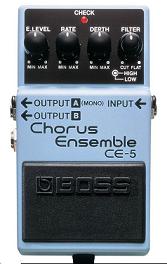
BOSS CE-5 Chorus EnsembleWhen it comes to chorus sounds, Roland/BOSS is pretty much the standard for the last twenty or so years. The CE-2 has especially been very sought-after used pedal 1) for its simplicity and; 2) for it’s analog design. I owned a CE-2 back in the 80’s, and have since kicked myself since I traded it for other hardware – that I don’t use at all anymore! Since then, BOSS has gone through a couple of renditions with the Chorus Ensemble line, and now offers the CE-5 Chorus Ensemble. A pedal that even though digital, sounds pretty darn good.

The CE-2 was a simple affair: Just two knobs for rate and depth, and a single output. With the CE-3, Boss introduced a “stereo-like” affair with two outputs, and three knobs, introducing a “Stereo Mode” knob to control how the outputs generated their sound. The CE-5 does away with the Stereo Mode knob and replaces it with an Effect Level knob, and a dual knob used for Hi- and Lo-cut filters.

In my opinion, the Hi/Lo Cut knob is what makes this pedal special. With it you can really shape your chorus sound from bright and smooth to dripping wet. All in all, you can’t go wrong with this pedal; and for less than $80, it’s a deal.

Starting with this review, I’m going to start giving summary ratings at the bottom of each review, similar to what you’d see in one of the trade rags.

BOSS CE-5 Chorus

  • Price: $129 (<$80 street)
  • Pros: Very versatile. Can produce a wide range of sounds
  • Cons: Can take awhile to dial in the sound you want
  • Summary: Great sounding chorus at a great price

Read Full Post »

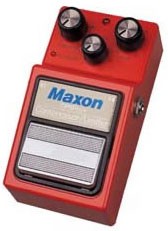
Maxon CP-9 Pro+ CompressorThe last review I wrote was on the Demeter Opto Compulator, a great compressor that I had the chance to A/B a couple of weeks ago. In the review, I said that that was the comp I was going to buy, but that was until I did a side-by-side comparison with the Maxon CP-9 Pro+ today. Now it looks like the winner of my search for a good, transparent compressor is the Maxon CP-9 Pro+. But I’ll have to admit, I’m very torn between the two.

When I heard Buford play through the Demeter, I loved its transparency. The compression is so subtle, you hardly notice that it’s there. But my side-by-side comparison with the CP-9 really got me hooked on it instead of the Demeter – for now (I’ll explain in a bit). Let’s look at the features, shall we?

Like the Demeter, the Maxon CP-9 Pro Plus is fairly straight-forward to use. It has three knobs to the Demeter’s two, adding a threshold knob to the ratio and makeup gain knobs, and this is what got me hooked on this pedal. I really liked having that threshold knob to control when the compressor kicked in – that made this pedal much more versatile in my eyes. I set it to about 10-11 o’clock, set about 2.5 to 1 ratio, then set the gain to match the uncompressed signal volume as closely as possible. What this pedal did for the Strat’s sound that I was playing was very sweet. The tone stayed the same, it was just fatter. And for low-volume applications, this is EXACTLY the effect I was looking for. It’s not as subtle as the Demeter, but it’s still transparent as all get out.

Since the shop I tried the CP-9 at also had a Demeter as well, I decided to try out the Compulator for myself, since I didn’t get to play Buford’s guitar that night at the casino. So here’s my feedback. The Demeter is incredibly subtle in its compression. It squeezes your signal just right, but in the quiet environment where I was testing, I noticed a distinct, but very pleasing high-end shimmer that was produced by the Compulator that I couldn’t hear in the crowded environment in which I first heard the Compulator. Talk about ear candy! Unfortunately, what I’ve been looking for is a compressor that doesn’t add any artifacts. It just squeezes. So I was faced with a bit of a dilemma: Go with the Maxon’s versatility, or go with the Demeter’s subtlety and beautiful high-end shimmer. I’ve decided to go with versatility for now.

Mind you, these two compressors are very different beasts. The Demeter employs an optical circuit for compression, while the CP-9 uses a Voltage Controlled Amplifier (VCA) and a RMS sensor. Click here for a great article covering that various electronic approaches to compression. The reason I mention this is because the different approaches yield different sonic results. Optical comps tend to be the most subtle of the compressors, while the VCA type compressors offer the most versatility and highest attack response. That said, it’s possible to use different types of compressors to achieve specific types of tone. Oy Vay!

I’m not sure if I’ll ever get the Demeter, though it will always remain in the back of my mind. And even though I was totally blown away by that high-end shimmer, my practical side made me err on the side of versatility.

Read Full Post »

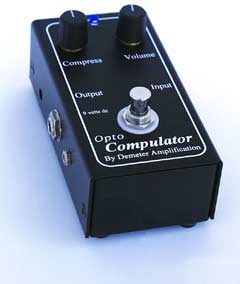
Demeter Opto CompulatorI was at a casino last weekend, sitting in a bar with a couple of friends and listening to this great duo play classic rock hits. During one of their breaks between sets, I went to the stage to talk to the guitarist (he had a cool name: Buford) and checked out his gear. He had a fairly simple setup: Just two effect boxes going into a Vox amp modeler that then went straight into his mixing console. What caught my eye though were his two effect pedals, both by Demeter (pronounced Deh’ meh tur) Amplification. One was Demeter’s FUZ-1 Fuzzulator drive box, and the other was the Opto Compulator. I knew a bit about the Fuzzulator, but I wanted to know more about the Compulator, as I’ve been considering purchasing a compression pedal for some time. So I asked him a few questions about the box. Here’s how the conversation went:

What’s your main application for the compressor?
Even though this is a pretty small stage, we’re playing in a fairly open environment at low volume. When I need to play distorted, I’ve got to fatten up my signal a bit, so I can cut through the crowd noise. Distortion always thins out your tone a bit, so this helps me compensate for that.

Doesn’t a compressor affect your overall tone?
In general, yeah. But this has got to be the most transparent compressor I’ve ever used. With this box, I maintain my tone, but just give it a slightly fatter delivery. And like I said before, in this environment, I need a fatter signal to cut through the crowd noise. I’ve played with a bunch, and this one is the absolute best I’ve ever had.

So what’s so special about the Compulator?
Like I said, it’s really transparent, and the compression effect is so subtle, most people wouldn’t even notice – I hardly notice it myself, but I know when it’s not on. And maybe there’s a bit of me being used to the sound. Other than that, it’s real easy to use. You have two knobs: The left-hand knob controls the amount of compression you want to dial in, and the other knob controls the gain. You also have a little trim dial on the side that you can adjust with a small screwdriver to trim the volume up or down – but I’ve never had to use it.

Can I do an A/B comparison from a slight distance away?
Sure thing. Step back about 20 feet, and I’ll show ya.

So I stepped back, and he played some chords and riffs with it on, and with it off. I’ll be damned! He was right. His tone was the same, but had just a tad fatter quality! Now that’s transparency! And that demonstration convinced me on the spot that the Compulator is the box I’m going to buy.

About compression…

For a good article discussing the general concepts of audio compression, click here. It doesn’t go into into the heavy technical details of compression, but it definitely helps to demystify how it works. For a more comprehensive and technical discussion, click here.

COMP-1 Opto Compulator Features

  • Compress Knob – controls amount of gain reduction up to 30dB.
  • Volume Knob – increases/decreases the output volume (aka “makeup gain”).
  • Trim Pot – very nice feature to adjust the unit’s preamp gain. If you plug a hot instrument into the unit, you could get distortion. You can knock down the input gain to avoid that.
  • Powered by a 9 volt battery, but also has a standard 9V jack.
  • Street Price: Generally around $199.00 (do a Google search)

My prospective usage

I normally play in very small, low-ceiling venues, so compression has not been a big issue for me. However, when I play with my band at my church, I have to play at fairly low volumes, which makes playing in distortion a huge challenge, because in order to hear the effect, I have to turn up my volume. That usually makes me stomp on the mix. With a fatter signal, I should be able to punch through the mix much more effectively without having to pump up my volume too much (or as much as I have been 🙂 ).

After hearing this unit, I’m convinced this is the right pedal. And getting input directly from a guy who swears by it and was willing to demonstrate how it worked had me sold.

Read Full Post »

Dr. Z Air Brake

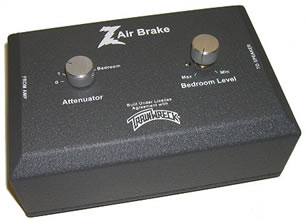
About six months ago, I wrote a little ditty about the Dr. Z Air Brake, but I thought I’d revisit this essential piece of equipment once again. The Air Brake is a power attenuator; in other words, it reduces the amount of signal from your amp that reaches the speaker, thus reducing your audible output. Before I go any further, the big question is: Why would you want to reduce the amount of signal going to your speaker from your amp. There’s actually a very good reason: Overdrive.

With tube amps, especially those with multiple-stage gain, you can’t achieve that warm clipping (read: creamy distortion) without upping the drive to your power tubes. Unfortunately, that also means you have to crank your amp, as achieving those nice distortion characteristics is a function of both drive and gain. The net result in turn can shatter your eardrums in an enclosed space, or worse yet, have your family or neighbors scream at you for playing too loud in your garage. A power attenuator allows you to drive your power tubes into clipping but do so at a significantly reduced volume. For home studio enthusiasts like myself that usually record late into the night, this means you can work on recording projects without the fear of waking up my family or pissing off the next door neighbors (which I have done many times).

There’s a good FAQ about power attenuators and how they work here. I won’t go into the technical details, but suffice it to say that with a power attenuator, you can play at acceptable volume levels while still being able to drive your amp. With that let’s get into the Dr. Z Air Brake features.

The Dr. Z Air Brake is incredibly easy to use, though in addition to the unit, you’ll need a couple of good-quality audio cables with 1/4″ plugs. If your amp’s output goes straight to your speaker and is then soldered to the speaker leads, you’ll have to do some splicing and soldering, though most tube amps today use a 1/4″ output jack. Once you’ve got the unit hooked up, you have five levels of attenuation: 0 through 4 and Bedroom. The “0” setting is total bypass, while the 1-4 settings impose approximately -2.5dB attenuation with each position by default. If you open the unit up, you can actually increase or decrease the amount of attenuation at each position by moving the leads along the resistors (this is explained in the accompanying manual – it’s a single sheet of paper). The “Bedroom” setting is what sold me on the unit. When you have the Attenuator knob set to “Bedroom,” the “Bedroom Level” knob comes into play. This provides variable signal attenuation down to 1 Watt (for sub-100 Watt amps) at the maximum level, though at this amount of attenuation, your tone really changes because the speaker cone doesn’t move enough air, thus producing a VERY thin (read: ugly) tone. I usually set my Bedroom Level knob to about 10-11 o’clock, the play with my drive and volume knobs on my amp until I’ve dialed in a good tone. Frankly, it doesn’t get much easier than this.

In addition to the variable bedroom level control, I chose the Dr. Z Air Brake after evaluating and reading various reviews, and speaking with other folks who have one. The most popular attenuator at the time I was reviewing attenuators was the THD Hot Plate. I tried one out at a shop, but didn’t like the sound that came out of it all. It literally changed my tone. The Dr. Z Air Brake, on the other hand is much more transparent, even at bedroom levels. As far as gigging is concerned, since I play a lot of small venues, it’s a real helpful piece of equipment because it allows me to drive my amp when I play with my band without stepping on the band’s overall output.

CAVEAT EMPTOR

Many people buy attenuators thinking that once they’ve attenuated their signal, they can drive their power tubes to their highest levels. It’s true, you can do this. But you’ll also burn through your tubes pretty quickly, or worse yet, you’ll damage your amp’s electronics. I’ve heard about this happening especially with resistive attenuators. People crank their drive, and after a few minutes start smelling something burning as their amp’s internal electronics fry. Also, driving your power tubes into super saturation doesn’t do anything but cause a lot of ugly distortion. When you drive your power tubes, the tone you should expect is a smooth distortion, as the intermixing sound waves weave together beautifully. Adding even more power creates a much larger contrast between the peaks and valleys of the distorted wave, and what you end up getting is a very “dirty” sounding distortion that is not in any way pleasing to the ears. So beware if you’re in the market for an attenuator!

In closing, if you’re like me, and play in a variety of small- to medium-sized venues, a power attenuator can be your friend. For me, mine is always hooked up. It has saved me from a lot of headaches and eliminated complaints!

ROCK ON!

Read Full Post »

…that makes you sound good. It helps to have great gear, but it’s the player that counts. Don’t believe me? Check this out…

I saw this street musician playing in San Francisco a couple of weeks ago playing a crappy Fender Squire Telecaster, and a beat up amp that also doubled as his vocal PA. Guess what? He sounded amazing! The tiny amp was really tinny sounding, and his voice wasn’t always on key, but his guitar technique was nothing short of incredible. How could I tell this? Not just by watching, but by listening to how he squeezed out every bit of sustain from each note he played; how he transferred his passion from his heart into his guitar. The raw emotion in his playing was almost palpable. That got me thinking about my own playing…

Several months ago, I wrote an article called, “I’ve got GAS and I’ve got it bad!” At the time, I was on a buying binge, getting a new guitar, some effect pedals… just gearing up in general. Then a couple of months ago, I just up and stopped using more than half the pedals I bought. I attributed a lot of this to my Hot Rod Deluxe finally breaking in, but when I saw that guy playing on the street, it got me to thinking that it might’ve been something more; something inside of me that stopped me from buying more gear, and hooking up a bunch of pedals to my rig.

Now, I think that what happened was that I returned to a place that I forgot about: My heart. When I first made the move from primarily acoustic to primarily electric guitar, I was a bit uncomfortable playing. There was a lot more to think about in shaping my tone than before, and I was admittedly self-conscious about my technique. But I eventually reached a level of comfort. That’s when the seas parted, the skies opened, and a voice from Heaven burst forth proclaiming, “Now go forth and PLAY your guitar!”

There’s a big difference between just playing chords and notes, and playing with your heart. It’s not just how you approach your instrument, it’s how you FEEL your instrument and adjust to the subtle nuances within a song. It’s the difference between simply being musically mechanical and being truly musical. I forgot that, or rather, I was distracted from that for awhile, and the thing is, to be truly musical, you don’t need effects or great gear. Yes, that stuff provides added enhancement, but no one or no thing can give you musicality. That comes from you.

I’ve returned to that place where I can really feel what I’m playing, and I’m really loving what I’m hearing – and a bit surprised that I’m actually pleased with how I’m sounding now. And though I’ll most probably buy more gear in the future, it will be with the intent of enhancing my music. I’ll take a much more utilitarian approach and not get trapped into having a piece of equipment because it’s considered by others to be top-of-the-line. I fell into that trap once. I won’t do it again.

So you don’t have to spend a lot of money to sound good. Just look at that guy on the street. He knocked my socks off. But to bring even more legitimacy to this argument, let’s look at some great players who took average or less than average gear and did incredible things with them:

There are two guys I think about immediately: Willie Nelson and Eric Clapton. Willie played this old classical guitar that had an “extra hole” in it that his “Daddy bought me.” Clapton bought three second-hand Strats for $100 each, mixed and matched necks and bodies and produced “Blackie,” his signature guitar that sold for over $1 Million at auction. In each case, these guys took marginal equipment and built careers on them. So tell me it’s not the player… 🙂

I’d love to hear your thoughts…

Read Full Post »

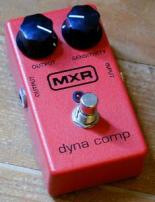
379_image_med_mxr-dynacomp.jpgI’ve been searching for a decent compression/sustainer for a long time, and I’ve tried out a bunch over the last year. Surprisingly enough, it wasn’t until recently that I decided to check out the MXR DynaComp. The DynaComp has been around for a long time, and has several faithful followers. Unfortunately, I’m not one of them. It’s not that this is a bad pedal – it’s pretty rugged, very simple to use, but it just doesn’t have what I need for the type of music that I play, which at the moment is bluesy and I use minimal overdrive. But I digress. This won’t be a long review. I’ll just give you my assessment…
I tried this out with a LP Double Cutaway and an American Standard Strat. For amps, I used a Fender Twin Reverb and a Marshal JCM 600 combo. Here’s what I found:

For clean playing, if you want a transparent box, this is not the box for you. It colors your tone quite a bit, even at lower compression levels. This is okay, if that’s your aim, but for me, since I prefer a bright sound, the amount of squeeze with this box was just too much for my tastes (though my dad who was with me liked how it sounded with the LP DC running clean through the Fender Twin). On the positive side, there was lots of headroom with this pedal, and no noticeable signal noise unless I cranked the intensity.

Where this box did shine was with the JCM in the high gain stage. The DynaComp really added a nice level of definition when used with heavy distortion (Note: my dad’s 75 year old ears couldn’t take the loud distortion so he waited outside the sound room :)). That was something I really dug about this box. The JCM 600 is one of those Marshall classics that has lots of crunch. The DynaComp smoothed that out a bit, but didn’t ruin the tone in the process. Nice.

Overall, this is a nice pedal if you regularly play in overdrive mode. But as I said, if you’re looking for a transparent compressor to use in your clean channel, I’d look elsewhere.

Read Full Post »

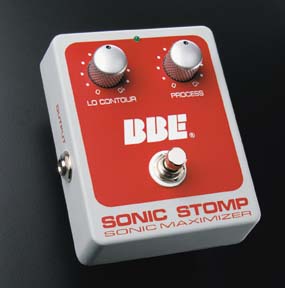
I just noticed something: This blog is called Guitar Gear, but I haven’t reviewed much gear! That’s going to change right now! The first piece of equipment I’m going to introduce is the BBE Sonic Stomp.

sonic_stomp_4in.jpgBased upon BBE’s very successful line of “Sonic Maximizers” – the Sonic Stomp actually uses the same technology from its 482i rack mount unit – this is a very unique pedal, and I’m going to go as far as saying this: YOU MUST HAVE THIS PEDAL. It’ll be the best $99 you’ve ever spent. So what makes it so special?
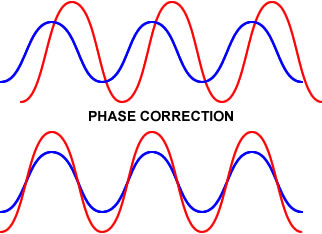

Without going into technical details, the Sonic Stomp corrects phase differences that occur between low and high frequencies coming out of an amp’s speakers; technically called “envelope distortion;” the net effect being that dramatic phase differences between low and high frequencies can produce what we perceive as a “muddy” or in some cases a “muted” sound. By time-aligning the frequencies, the signal is restored to a more accurate state, thus producing a much clearer, cleaner tone, and this is the gist of what the BBE Sonic Stomp does.

Now here’s the catch to this box. Unlike other pedals that either add drive or modulation to your signal, this pedal does signal correction, and in most cases you won’t even notice that it’s on! However, you’ll miss it when it’s off. It’s hard to articulate what that difference is. Let’s just say that with this pedal on, your already good tone just sounds that much better.

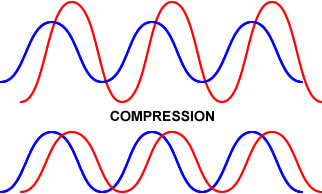
Now don’t confuse what this pedal does with a compressor. A compressor flattens gain, limiting the louder sounds and loudening the quieter ones (with makeup gain), thus creating a perceptibly fatter tone. This is very different than phase correction. See the figures below:

phase.jpg comp.jpg

I realize this is a fairly simplistic perspective, but as you can see, phase correction aligns the waves without acting on their amplitudes, whereas compression corrects amplitude but doesn’t work on phase.

So why might people confuse the two? Simply because when you correct phase, tonal qualities that you didn’t realize existed suddenly come to life. For instance, before I got this box, my amp had a real big, boomy tone. When I introduced the Sonic Stomp into my chain, my amp lost some of its boominess, which resulted in a much richer tone. It’s easy to mistake this as tone fattening as the lows got smoothed out and there seemed to be much more midrange, but I wouldn’t call it fattening – it’s more tone clarification – and this box it great at that!

So if you’re thinking about getting a tone shaping box, give the BBE Sonic Stomp a good look.

Read Full Post »

5735-13-photo.jpgLike many guitarists, I have fantasies of playing guitar with a big name, like Sting for instance. I also have dreams of having technique like Hendrix, Satch, SRV, Eric Johnson, or Vai. But the reality is that I’ll probably never achieve their level of technique. So short of that, the best I can do is learn as much technique as possible, but incorporate that technique into my overall sound.

Notice the word “my” in the sentence above. That’s something that I stress to a lot of young guitarists, especially my own son. In a recent conversation, where we were discussing chords and intervals, I stopped and said, “Son, while it’s important to learn all this music and guitar theory, remember that your ultimate goal is to create your own sound. You say you want to play as fast as Henry Li or Yngwie Malmstein. That’s great – but just remember one thing: Learn the technique to play as fast as those guys, but make the sound your own. If you want to be a more than just a ‘good’ guitarist, you’ll want to sound like yourself, and not like somebody else.” The glazed expression the he returned prompted me to say, “I know you don’t get what I’m saying right now, but give it a few years, and you’ll know what I’m talking about.”

I can’t stress enough how important getting your own sound is. And I’ll say this: For some, like myself, it has taken a lifetime to achieve, and I’m still tweaking my sound! But keep at it, and eventually you’ll get to a space where your sound is distinctly you.

Read Full Post »

« Newer Posts - Older Posts »