|

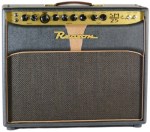 Reason Amps SM25 25 Watt Combo Amp |
Reason SM25 25 Watt Combo Amp
Summary: Incredibly expressive and versatile amp that can deliver a wide range of tones from glassy, sparkly cleans, to lewd, rude, and crude distortion, all in a single cabinet!
Pros: Killer tones in all channels. Amp is voiced bright by design, which makes it great to use in the studio. StackModeTM is the best thing since sliced bread, and is THE secret sauce that makes Reason Amps stand out from the rest.
Cons: No effects loop, which would be handy for placing reverb and other modulation effects after the amplified signal. Just a nit.
Price: $2395
Specs:
• Output: 25 watts RMS @ 5% THD
• 1 X 12 Eminence Red Coat Driver
• (2) 6V6 output tubes, in Class AB Fixed Biased configuration
• (4) 12ax7 preamp tubes
• GZ34 Rectifier tube
• 3 way Stack switch – Normal, Stack, Bright
• Normal channel – Volume, Treble, Middle, Bass
• Bright channel – Volume, Tone
• StackMode™ – Bright & Normal channel controls are active, Stack Volume & Hi-Cut
• Oversized extra capacity power supply
• Power Switch
• Standby Switch
• Independent output jacks for 4,8, 16-Ohm operation
• Footswitch access to all three channels/modes |
When I discovered the Reason Amplifier company a few weeks ago, I was so intrigued by what they had to offer that I immediately contacted them. I had the fortune of getting in touch with Anthony Bonadio, one of the founders of Reason to talk to him about his exciting new company and his new line of amps. That conversation led to him sending me an SM25 25 Watt combo to review; and since I’ve had it, I haven’t gotten much sleep from playing with it late into the night. Now you might say that I’m just excited about playing a new amp. Yes, that certainly has a lot to do with it. But what Reason has come up with in their amplifiers is so incredibly brilliant and unique that I’ve been spending all my free time trying to discover the subtle intricacies of this tone machine. There’s a lot to talk about, so let’s get started!
“Dahr-ling, you look mahvelous!”
The Reason founders, Anthony Bonadio and Obeid Kahn, are both vintage gear freak-o-maniacs, and the retro styling of the entire Reason amp line is a testament to that passion. The SM25 sports a black tolex cabinet with light brown trim around the grille cloth, and a thick leather handle with what appears to be brass accoutrements. Between the control surface and grill cloth is a prominent tolex-covered cross board sporting the Reason logo which, by the way, is very cool, very retro as well. The control board looks like burnished brass with black, bold lettering for labels. And to add to that retro vibe, chicken head knobs are used for all the controls. This amp, and all Reason amps for that matter, just ooze vintage mojo. Just looking at the amp, I can’t help but grin that grin you get when you see something so far-out COOL!
It’a hard to discern the actual size of the amp from just a picture. So make no mistake about its size: This is not a diminutive 25 Watt amp. In fact, it’s about as big as a Fender Twin, though not as deep. The shipping weight said 32 pounds, but from feel and comparison to my Fender Hot Rod, it weighs almost as much. But that’s not a bad thing. A beefy cabinet creates a lot of resonance if done correctly, and believe me, it’s done correctly with this amp.
How It Sounds
All Reason amps, including the SM25 are voiced bright. You don’t get beefy lows out of this, and that’s by design. Now before you dismiss that, on stage and in the studio, that bright voicing will ensure your guitar cuts through the mix. I recently played it at one of my regular gigs, and where my amp oftentimes gets lost in the mix, forcing me to pump up my volume, I had no problem cutting through, and mind you, I barely had to push my volume. The bright voicing let my guitar tone sit in the mids and highs. My sound guy even commented on how well he could hear my guitar without me pushing the volume like I usually do during a solo break; though admittedly, like any lead guitarist, I usually don’t mind being louder than everyone else. 🙂
In the studio, using the amp for recording is like being in heaven. The bright voicing combined with the rich tones the amp produces is simply candy for the ears. From a practical perspective, brightly voiced amps also record much better. For home recording I’ve had to stop using my big amp because it’s just too boomy, no matter how I set the EQ. I’ve had to use smaller, brighter amps because they cut through a mix much better. But since I’ve had the SM25, I’ve recorded two songs with it, and like I said, I’m in heaven. I now have a bright voice to cut through the mix, but rich tones as well. It’s the best of both worlds!
The SM25 is also incredibly touch-sensitive and responsive to the subtlest manipulations I made on my guitar. In fact, when I first started playing with it, I was a bit embarrassed by how I sounded. For my all my tests, I played along to some jam tracks I’ve produced for practicing different styles, and recorded what I played through the amp. When I played back what I had recorded, I was appalled at how crappy I sounded! All my mistakes came through! I couldn’t hide whatever bad habits or bad technique I had behind effects, like I normally would. In short, this amp has forced me to play better because it’s so unforgiving when you make a mistake. But hey! It’s never a bad thing to be shown your weaknesses. That’s how you grow and improve!
Multiple channels, lots of tone shaping possibilities…
The SM25 comes with two channels: Normal and Bright. But it also sports a third “channel” called StackModeTM that’s essentially the Normal and Bright channels run in a series with an extra gain stage, while retaining volume and tonal control over the Normal and Bright channels. To me, StackMode is Reason’s secret sauce, but I’ll get into that in a bit. I’ll first describe the independent channels.
The Normal channel sports a volume knob and a three-band EQ. The volume knob is also a push-pull knob, and pulling it out adds some extra high-freq boost to bring out the super high frequencies. The effect is that once you set up your EQ, pulling out the knob adds some extra high-freq shimmer and sparkle. It’s subtle, but absolutely delicious. Comparatively speaking, the Normal channel sounds like your classic, jangly American clean tone, but with the high-freq boost, you get a bit of the sharpness of the British clean – nice.
The Bright channel is well, bright. It too has a push-pull volume knob for extra high-freq boost, and it has a single tone knob to back off some of the brightness. The Bright channel is also the more “ballsy” of the two, and really kicks in some pretty high gain. It’s quite lovely, in my opinion, and it’s perfect for doing the traditional solo break that will cut right through a mix with ease.
Channels? We don’t need no stickin’ channels!
But for me, the real attraction of this amp, and actually any amp from Reason for that matter, is StackModeTM. In all my years of playing, I’ve never come across anything quite like it. On the surface, you might think this is just another channel on a multichannel amp. It is in a way, because of its independent gain stage. But that’s about as close a comparison that you can make to other multichannel amps. Unlike other multichannel amps where all the channels are independent, StackModeTM input doesn’t come directly from the guitar. The guitar’s signal is routed through the Normal and Bright channels first, then fed into the StackMode channel. And the volume and EQ settings on the Normal and Bright channels are still active!
Because volume and EQ are retained in the Normal and Bright channels in StackModeTM, the tone shaping possiblities are incredible. What you adjust in Normal or Bright affects the final output. You can crank up the volumes on the first two channels and achieve uber gain, with thick, rich distortion. Or you can dial it back a bit and take a more balanced approach. The point is that you can do a lot of tone shaping to your needs while in StackModeTM. And here’s the kicker: The amp still retains its touch and guitar volume sensitivity in StackModeTM.
What does this mean? Well, I soon discovered that StackModeTM was the only channel I’d probably ever use, unless I had to go super clean, whereas I’d just switch to the Normal channel. The amp in StackModeTM is so responsive to picking attack and volume knob levels that I found I just didn’t need to do any channel switching at all once I dialed in my settings for the Normal and Bright channels. It’s that good!
One other thing, the volume knob on the StackModeTM channel is a very good Master volume. When I’m playing late at night, I can turn the volume down on the StackModeTM channel, and still retain the characteristics of the settings I made in the first two channels. It’s just softer. How cool is that? So that’s why entitled this section, “Channels? We don’t need no stinkin’ channels.” Once you have your settings dialed into StackModeTM, you’ll never want to get out of it! So for me, the SM25 is effectively a single channel amp with adjustable stages.
My Tests
In any case, for my tests, I used four different guitars: A Strat, a PRS SE Soapbar II with P-90’s, an Epiphone Korina Explorer and a Saint Guitars Benchmark, both with humbuckers. I’ll talk about how each guitar sounds separately below.
Fender Strat
Obeid Kahn is known in the industry as a “Strat man,” and this amp really sounds great with a Strat. I’ve got the vintage re-issue Tex Mex pickups in mine, and slathering on reverb, you can get some awesome Dick Dale-like tones. But it doesn’t necessarily sound like a Fender amp. In fact, the clean tone is like a cross between a Fender and a Marshall. It’s creamy smooth, but bright and sparkly at the same time. The big cabinet adds to the resonance, and the ever so slight voltage sag that you get from the rectifier adds to the sustain and resonance. This is boon when you’re playing with a Strat because they do not sustain well at all. I could get country twang to hard-driving distortion with uber sustain with my Strat.
PRS SE Soapbar II
P-90’s are hot pickups by nature, and it doesn’t take much to push any amp into overdrive, and when it does this, it’s a preamp overdrive lover’s wet dream! With the SM25, the 12AX7’s just sing with sweet, smooth overdrive goodness. There’s nothing harsh about the sound this produces in the SM25, but one thing I did notice with the tone was that unlike other amps I’ve played with my SE Soapbar II, even though the amp is bright, the sound the amp produces with it is big and bold, without being boomy. It’s crystal clear, and doesn’t wash out the higher notes in a barre chord, which often happens with more boomy amps. All in all, I just dug that halfway between single coils and humbucker sound my P-90’s produced with the SM25.
Epiphone Korina Explorer
This is a real rock guitar, with a warm ballsy tone. Plugged into the SM25, I was amazed at how the amp responded to this guitar, and I was able to spew out some thick distortion and singing sustain with the volume knobs on the amp dimed to the hilt. I’m not a metal player, and technically, with the bright voicing of the Reason amps one wouldn’t think they’d be suitable for metal, but the lewd, rude, and crude drive I could produce with the Explorer plugged into the SM25 was scary! But in a good way. And when I scooped the EQ, yikes!
Saint Guitars Benchmark
Of all the guitars I used for testing the SM25, the amp seemed to love the Benchmark the most. This guitar was spec’d with Blues and Classic Rock in mind, and through the SM25, I’ve never heard it sing like this. I could go from deep, dreamy clean to rabid dog distortion, and the whole time, the SM25 maintained a tonal clarity and character; never muddying or washing out. It was other-worldly, to say the least.
Made for the Road and the Studio
Anthony Bonadio cautioned me during a previous conversation that he didn’t want to alienate people from buying the amps when he said, “Our amps are really intended for the gigging and session musician.” In other words, Reason amps aren’t really meant for the bedroom musician. These amps want to move air, and that’s no exception with the SM25. In fact, when cranked, it’s a hell of a lot louder than my 40 Watt Fender Hot Rod Deluxe, and that’s a loud amp! It just wants to project its voice. Premier Guitar even gave its bigger brother, the SM50, its “Loud as Hell” award. But in my opinion, the real test of an amp is how good it sounds throughout its entire range of volume. That’s a mark of versatility, and in spite of what Anthony claims is the focus of Reason’s line of amps, you actually can play these amps at bedroom levels and still produce kick-ass tone!
A lot of amps don’t sound good unless they’re cranked, but at lower volumes they just peter out and lose their character. But at least with my experience with the SM25, it sounds great at ANY volume. Considering that all Reason amps are built around the exact same circuitry, I can safely say that this probably applies to the entire line. So don’t be fooled by the “loud as hell” moniker. These amps are incredibly versatile amps that are comfortable be played in lots of different venues under a variety of conditions.
My Overall Take
I think you can guess that I just love the SM25. For a musician like me who plays small to medium venues, and whose studio is located in a carpeted garage, this amp is a dream come true. It’s expressive with all my guitars, and it’s so versatile that I can use it wherever I play.
As I shared with Anthony recently, StackModeTM is it for me. It’s the secret sauce that sets Reason amplifiers apart from the competition! For more information, go to the Reason Amps web site. And if your local dealer has some in stock, I encourage you to go there and play around with one. You will not be disappointed; in fact, you’ll be blown away!
Read Full Post »



 Guitar Gear