Feeds:
Posts
Comments

If you’re Voyage-Air Guitars, it can…

When these guitars first came out, I was a little dubious about them. Sure, they offered a travel convenience with the folding neck, but at around $500 at the time, I kind of felt that what I’d be paying for was a premium for the hinging technology attached to a cheap guitar; no matter the repute of the luthier behind the guitar nor the artist endorsements that the manufacturer may have (which I’ve found are often dubious in many cases).

But Voyage-Air Guitars has been around for awhile now, and they have a much wider selection of guitars, including a Premium Series line which are actually quite nice. In particular, their VAOM-2C is a guitar that has caught my eye. This is their top-of-the-line model with a cutaway, and it seems to have everything I like in an acoustic guitar: East Indian Rosewood back and sides, Sitka spruce top, and solid mahogany “C” profile neck; plus a bright, rich, full tone from what I could gather from clips and videos.

Premier Guitar was very impressed with this guitar, giving it a 5.0 rating, which is a VERY rare designation.

Here’s their video review of the VAOM-C1, which was the preceeding model to the 2C:

By the way, I DIG that carrying case that not only has room for the guitar, it also has amp storage space to carry a mic, cables, and even a laptop!

There’s a VAOM-C1 over at Gryphon Stringed Instruments. I’m definitely going to check it out!

My good buddy Phil and I each received a Guitar Center gift card for doing the soundtrack for one of his friends for a flash mob that her company was doing for a convention. The gift card arrived in time for Christmas, and it is literally burning a hole in my pocket. I could get a few pedals, I could get another nice Classic Vibe Tele (the semi-hollowbody)… But I think what I’ll do is layaway a DV Mark Little 40 L34 amp.

I dig this amp. Since I first discovered it a couple of months ago, I’ve played with it a few times at Guitar Center, and the more I play it, the more I want it. It has a great feel and tone, and the built-in features make this one heck of a versatile amp. The Continuous Power Control – which allows you to vary the output power of the amp – aside, I dig that I can put in a different power tubes, from 6V6, 6L6 and EL34’s to get different sounds; and the amp will automagically bias them and keep them at their optimum settings! NIIIICE! Here’s a nice video demo of the amp.

One of the guitarists in my church band recently got a Carr Mercury, which is a great little amp. In addition to sporting vintage styling, it has some great power scaling from 8 Watts down to 1/10 Watt, a three-position boost to vary the drive to the single EL34 power tube, and a very nice and liquid reverb. All in all, it sounds pretty killer. Add my bandmate’s Barron Wesley custom guitar, and it’s a great tone combo!

But as he plays next to my rig, which consists of a Les Paul going into an Aracom PLX18BB Trem (“PLX”) which is a clone of the very simple Marshall 18 Watt Plexi, I felt the Carr’s tone paled in comparison to the tone my rig produces. Mind  you, the Carr sounds  killer. But in comparison to the PLX, its attack is much faster, and there’s noticeably less sag from rectifier than the PLX, so my perception is that there’s not much sustain with the amp..

Granted, I realize this is purely subjective, but there is something very special about the PLX. Perhaps it’s due to that classic “Bluebreaker” tone – hence the BB designation of the amp – that Clapton made so popular while with John Mayall and the Bluesbreakers. The Les Paul/Plexi combination is absolutely magical. Perhaps it’s also due in part to the absolute simplicity of the 18 Watt Plexi’s circuitry. Or perhaps it’s due to how the amp sags that gives it this almost reverb-like tone. Whatever it is, it’s a tone with which I completely identify.

I realize that I probably mention the PLX in this blog more than any amp that I have or have tested. But it has become my “go-to” amp. As the title of this article says, some rig combinations just never get old.

In front of the PLX, I have just a few pedals because I like to keep things simple. Here’s the complete chain:

Les Paul R8 -> Timmy Overdrive -> TC Electronic Corona Chorus -> Mad Professor Deep Blue Delay (handwired) -> DigiTech RV-7 Reverb -> Aracom PLX18 BB Trem -> Aracom PRX150 Attenuator -> Fane Medusa 150 12″ speaker.

I typically only use the  delay and reverb when playing clean, which is actually quite a bit.  But when I’m  playing driven, either with the Timmy or with the amp cranked, I just let the amp speak for itself. 🙂

I mentioned the sag of the PLX. It’s not so saggy that you get a lot of crosstones. But Jeff Aragaki (amp builder) did find a sweet spot in setting up the rectifier that balanced the classic responsiveness of the original Plexi with enough sag in the rectifier to make the amp absolutely expressive.

I made some modifications of my own in the way of tubes. I have gorgeous 1959 RCA grey glass pre-amp tubes in it to drive the pre-amp. I actually kept the original JJ EL84 power tubes in the amp because they compress quite nicely when driven without over-compressing into mush. Then to add fatness, I dropped in the gorgeous, super-sensitive (103 dB) Fane Medusa 150 12″ speaker. Combine that with a large 1 X 12 combo cabinet, and you’ve got a nice resonating chamber for the speaker which adds further depth to the tone.

Upon writing the above, I think a huge reason why I love the tone of this amp so much as compared to the Carr probably has a lot to do with the size of the cabinet, which can also easily house 2 10″ speakers.  That extra room for the sound to bounce around creates a lot of complexity.


In any case, that particular combination of gear never gets old to me. Even though I have lott of other guitars and amps, when I gig, I go to that setup. Now if only Jeff will build me my FlexPlex 50… 🙂


I dig it when I read about companies that take the environment seriously. No, I’m not a tree hugger, but I realize that the better we take care of our environment today, the longer it’ll last and continue to provide a world for following generations. And I think we as consumers need to constantly evaluate our consumption and have a mind towards restoration and recycling.

So when Prestige Guitars contacted me about a reforestation initiative they’ve taken, I had to share it here. Here’s the press release:

Prestige Guitars Launches Reforestation Initiative

In an effort to recognize global reforestation needs, Prestige Guitars – the Vancouver based guitar manufacturer – is launching a unique reforestation initiative where a tree will be planted for every guitar manufactured.

Prestige Guitars is also taking further environmentally conscious measures to only use recycled paper stock for warranty registration cards, as well as shipping cartons that are from recycled cardboard – that are also 100% recyclable.

Reforestation is an economical solution to many tough environmental problems, including air and water pollution, climate change, wildlife protection, habitat restoration and more.

According to a recent report from the United Nations Food and Agriculture Organization; between 2000 and 2010, some 13 million hectares of forests were converted annually to other uses, such as agriculture, construction, or lost through natural causes; down from 16 million hectares annually during the 1990s – according to an assessment which surveyed 233 countries and areas. Ambitious tree planting programs in countries such as China, India, United States and Viet Nam – combined with natural expansion of forests in some regions – have added more than 7 million hectares of new forests annually. Despite the
recent downward trend, an area roughly the size of Costa Rica is still being destroyed each year.

“By launching our own reforestation initiative, we hope to do our part for the environment, and also persuade and motivate other companies in our industry to follow suit. Although trees play an integral part in manufacturing a guitar, it’s frightening to imagine the state of our environment and our industry in the near future if we don’t start taking action now” – Michael Kurkdjian, President of Prestige Guitars Ltd.

Way to go, Prestige! This is something of which to be extremely proud!

As an actively gigging musician, I’m always looking for the most efficient and safe ways to transport my gear. But I do have to admit that I value efficiency a bit more than safety. My thought behind this is that treating my gear with care is a given, so I want to make as few trips from my car to get my gear set up for a gig.

So I have always kept an eye on transport containers or even systems that can keep me as efficient as possible. For instance, a big reason that I got my Fishman SoloAmp was because the speaker array, stand, and cable could all be transported together in the provided transport case; the whole thing weighing only 25 lbs., and case has wheels! I would not have gotten it if it sounded bad, but not having to take multiple trips to the car was really key.

I also have a few different bags that I use depending upon the gig I’m playing. For my solo gigs, I use a heavy-duty laptop bag that has tons of space to hold my harmonizer unit, microphones, cables, and even music books. Again, only a single trip.

Enter MONO. These folks make bags and cases specifically tailored to DJs and guitarists. They have some nice, padded guitar and bass gig bags, and even make guitar straps. But I really dig their gear bags, such as The Producer, which has lots of room to carry all sorts of gig accessories. This will probably be my next accessory bag as it was purpose-built with the DJ or gigging musician in mind.

Check out this video review of The Producer:

Lots of space and pockets. Love it!

It’s Nigel Tufnel Day!!!

In celebration of 11-11-11, here’s a classic from This Is Spinal Tap:

Gotta love Nigel Tufnel!

Yesterday marked the 40th Anniversary of the release of Stairway to Heaven, a tune with a riff that whether or not you’re a Zep fan is a moral imperative for any guitarist to learn.

As for myself, I was never that much into Zep. I dug certain tunes like Stairway, Black Dog, and Lady, but never bought a Zep album. But I do have to admit that the Stairway riff had a huge impact on me becoming a guitar player. It’s so simple, but it’s beautiful.

Another riff that compelled me towards playing guitar was Black Water by the Doobie Brothers. I was so proud of myself when I learned that riff. That gave me my first taste of alternate tuning; albeit it was only dropping the low E to D.

And I have to say that it wasn’t necessarily full songs that drove me to learn guitar, but rather little riffs that I thought were cool. Of course, the musician in me wouldn’t just settle for the riff, but I would have to say I was riff-driven. 🙂

I Love My ’58 Champ!

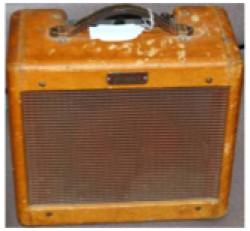
This morning, I was taking stock of gear that I hadn’t played in a awhile, and saw my little ’58 Fender Champ sitting on my workbench. I hadn’t played it for several months. So I hooked it up, and started playing. Now mind you, I’ve had some serious work done on it. I had to have the leaky caps replaced, and I had the amp set up with an A/B switch so I could bypass the stock, internal speaker and use a different speaker cabinet if I wanted. Plus, my good buddy, Jeff Aragaki lent me a custom tweed cabinet that he built that houses a Weber 10″ Alnico speaker.

After getting it all hooked up (I ran the amp into a 1 X 12 with a Jensen Jet Falcon speaker), one thing struck me right away after playing my Strat through it. To me, this is THE classic Tweed sound. But it is also the perfect platform to record completely raw signal, then tweak, which has been done in lots of studios over the years, as a Champ was used to record all sorts of rock and roll.

Take, for instance the following recording:

This was recorded straight into my computer with no EQ, no nothin’ attached. It’s a clean, dry signal that simply captures the tone of my Strat. But apply some reverb and delay effects, some compression, EQ, and that plain signal becomes something else entirely. Here’s the same track, but this time, I’ve textured it with reverb, delay, compression and EQ.

Had the compression make-up gain a little high, so there’s a tiny bit of clipping, but what I was able to get was a super-rich and full sound.

Even dirtied up, the Champ is simply a great platform. Here’s a raw clip of the Champ completely cranked up:

Again, this is simply a fantastic platform from which to shape the guitar sound. So, in this next clip (which again is the same track, but tweaked) I added some compression, reverb, a tiny bit of stereo delay and beefed up the lows with some Fat EQ:

It’s no surprise to me why so many studios have these Champs in their amp lineups.

As for gigging this bad boy, I always run it through speakers that have a good bottom-end response. What results is a nice, scooped tone – VERY American tone-wise.

Anyway, if you can find one of these, get it. Or you can get the ’57 Champ re-issue, which lots of players love. Me, I got mine for $700 (that’s the actual picture of the amp above), and spent roughly $200 on getting the caps replaced and putting in some NOS tubes. Still comes out under the price of the ’57 reissue.

…We know it’s good for us, but we don’t enjoy the taste.

That’s a corollary on a saying my cousin shared on Facebook: Truth is a bully we all pretend to like. It got me thinking about some feedback I gave to a young singer/songwriter this weekend on her playing, which was not very good. I first didn’t say it directly and simply said, “That’s a great song you’ve written. If you have a chart, I could accompany you, so you could focus on your singing and not have to think about the accompaniment.”

“I play just fine,” she said.

I replied, “Well… truth be told, some customers last week did mention that while they liked the song, they felt the piano playing was a bit choppy.” (That’s actually the truth; as a few asked me why I didn’t accompany her).

“To you, maybe,” she shortly replied, “I’m not here to be the brilliant musician.”

I said, “Look, you’re reading me completely wrong. I want to make you and your song look absolutely the best, and frankly, your playing is choppy, and you’d have a much better appeal if you had backup that’ll make you shine.”

She wasn’t having any of it. There was a bit more in the exchange that I’d rather not dive into, but I was really taken aback by the arrogance and total lack of humility. I do know one thing, having been performing for over 40 years, she’s in for some serious smack-down. I’ve encountered many performers like that over the years that operate off their own hubris. They get their bubble popped and it’s like their world comes crashing down around them.

Hell! I even operated like that years ago, thinking my own music was something special; only to get feedback from a pro that lyrically, it was cliche, and a lot of my musical phrasing was something that had been done hundreds of time over – in other words, it wasn’t very original. Yikes! I was crushed.

But as Sylvester Stallone said in the movie, Rocky Balboa, “It ain’t about how hard you hit, but about how hard you can get hit and keep moving forward…” And that’s kind of the crux of this entry, dear readers.

We all tout wanting to be honest and receive honesty in return. But honesty is like taking cold medicine. Rarely do we enjoy the taste. But in the end, we actually do feel better. After having experienced that crushing review of my music, I just happened to watch Rocky Balboa and that saying shook me to the core, and I realized that a little humility goes a long, long way. It’s good to believe in ourselves and our abilities, but don’t let that belief turn into hubris. Besides, with humility, we give ourselves room to grow and get better.

After I got that feedback, it actually took me awhile to do some soul-searching – a couple of years, in fact. But I jumped on the horse again, so to say, and started writing again. This time ’round, I went at it with no particular goal in mind; just let the music and lyrics flow. Don’t have expectations of where I think my music should be. It it goes nowhere, that’s okay. But most importantly, really listen to the feedback. So as opposed to parading my music in front of friends and family first, none of my newest songs go out without a professional review from producers in the music industry who critique the songs on their structure, lyrics, and melody. As a result, I think I’ve become a much better writer.

It’s not that I’m following a formula that they prescribe. The reviewer I use the most stresses originality, and absolutely nails me on being cliche. But they are keen on flow and making sure my lyrics make sense. All in all, it has been a great growing experience.

Who knows where my music will go? I’ll be heading into the studio in the next couple of months to start recording and then I’ll get my album out. We’ll see where it goes from there…

I have finally moved into the tablet world and recently received an iPad as a job referral gift. Since it is the lowest level iPad, I haven’t been going crazy and loading up on apps – though to appease my kids I did get “Angry Birds.”

As fate would have it, soon after I got my iPad, app developers started contacting me about th eir wares. One of these developers created a nifty little drum beat backing track software with which guitarists can practice. It’s called Back Beats.

Check out the demo video:

Personally, I hate practicing or even recording to a metronome because it is fairly lifeless. But when I record or practice to an actual drum track, I can “feel” the ebbs and flows of the rhythm pattern, and that is reflected in my performance.

Anyway, the app is a measly 99-cents. For more information, check out the Back Beats website