Feeds:
Posts
Comments

I’m not one to buy into hype; especially all the hype that you hear in the forums. There’s A LOT of hype associated with Paul Cochrane’s Tim and Timmy pedals. But after reading tons of posts over the last couple of years on how much people love these, and also after hearing one live in action, I decided to get on the waiting list.

As Paul puts it, the pedal was designed for a Strat played through a Plexi or Vox; in other words, amps with lots of midrange. He says his pedals don’t sound so good with “Black Face” amps. But since I don’t have any amps like that, well, it’s all good.

As for the waiting list, my position doesn’t come up until February. But that’s cool. I’m willing to wait. From what I’ve heard, this is a pedal that should fit right into my style of playing!

BTW, if you’ve got one, I’d love to hear about your experience with it!

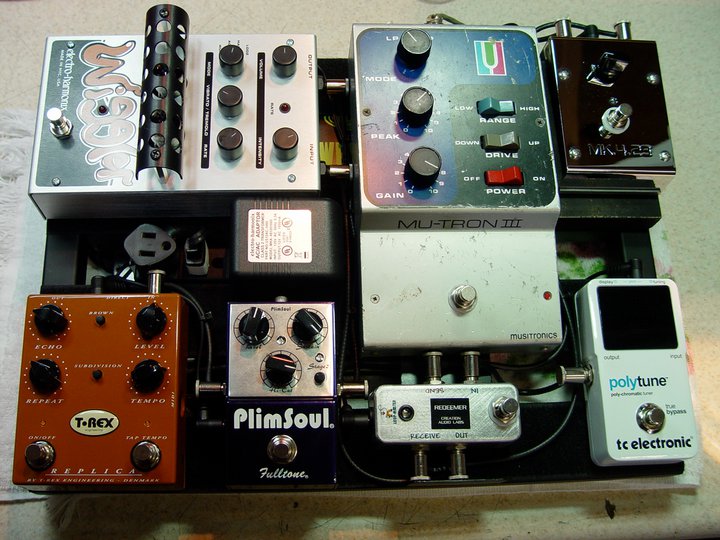
Peter Frampton's BoardI was perusing The Gear Page this morning, and came across a post about Peter Frampton’s pedal board. Cool stuff on the board! But the pedal that really caught my eye was the pedal in the top-right corner: A Creation Audio Labs Mk.4.23 Clean Boost. Ever since I got one, it has never left my board. In fact, it’s one of the only pedals I have besides my trusty Boss TU-2 that hasn’t been rotated. Here’s my original review of the pedal.

Circling back, of course, this is probably not his touring board. Further in the post he is quoted as saying that this is a board that he could “grab and go jam at your house.” Wouldn’t that be cool to have a buddy like Peter Frampton call up and say, “Hey mate, wanna jam? I’ll come over.”

Like any gear freak, I’ve got tons of gear. Just check out the “My Rig” page, andΒ  you’ll see what I mean. I use it all. Now while I rotate my usage of guitars, I use all my amps in the studio. But when playing out, I almost invariably go with a specific type of setup: A humbucker guitar through a vintage-Marshall-style amp; and lately and more specifically, a Les Paul through a Marshall-style amp. That tone simply speaks to me. Clean or dirty, it’s what I almost always go to in a live situation.

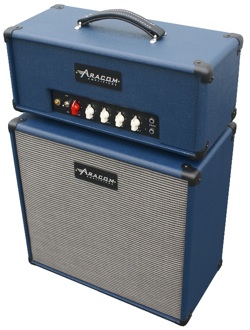
At my church gig yesterday, I brought along one of my favorite amps: My Aracom PLX18-BB Trem, which is a “Bluesbreaker” style 18 Watt Plexi clone with two channels and no master volume. With that amp, I usually play in the Bright channel, which is a clone of the Plexi circuitry. This is a simple channel with just one volume and one tone knob. I love this channel! I usually have the volume dimed, with the tone at about 3pm, then control the amount of breakup with my guitar’s volume knob and/or pick attack. That amp just oozes Plexi goodness, and is so incredibly dynamic. The EZ81 rectifier provides just the right amount of sag, where even with the amp dimed to the hilt, it never turns soupy or mushy due to sag. I also loaded it with NOS ’59 GE 12AX7’s in V1 and V2, then have a 60’s JAN Philips 12AT7 in V3. To compensate for the overall brightness of the amp, I loaded a kick-ass Fane Medusa 150 to bring out the bottom end. The net result is that this amp sounds A LOT bigger than its 18 Watts may imply.

Then take all that Plexi goodness and combine it with a Les Paul, and to me, that’s a recipe for rock-and-roll! πŸ™‚

It took me several years to get my “Go-To” tone, which accounts for the gear that I’ve got from my explorations; not that I’d get rid of much of it because in the studio, having lots of gear to get different sounds is important, but for me, when I’m playing out, it’s the Les Paul/Plexi combo all the way. To my ears, there’s simply nothing like the tone that that combination produces!

So what produces your “Go-To” tone?


V-Picks Bb Pick
Summary: Nice and thick at 4.10 mm, but this pick glides over the strings!Pros: As with all V-Picks, “smooth” is the key, but with this bevel, you get great note articulation and control! As thick as a Snake, but slightly smaller in diameter, I’m finding I like this pick even better than the Snake!

Cons: None.

Features:

  • Laser Cut
  • 4.10 mm thick
  • About the size of a quarter

Price: $10

Tone Bone Score: 5.0 ~ I’ve been a Snake user for quite some time, and it has served as my “go-to” pick. But the game has changed with the Bb.

Yet another new favorite pick?

I do need to clarify that as I’ve reviewed other picks, they haven’t necessarily become my favorites. For instance, I dig Wegen picks. They play great and they really glide over the strings, and for acoustic they’re a dream to play. But for electric, they just don’t feel entirely comfortable. With my Red Bear Tortis picks, I absolutely love them for their tone on both electric and acoustic, but they wear pretty easily and they’re also kind of expensive.

The Bb isn’t cheap at $10, but it’s half the price of both the Wegens and the Red Bears, and more importantly, I it’s a durable pick that I can use with both acoustic and electric. One thing that I didn’t mention about the other picks is that I have used them with both electric and acoustic, but I’ve found that I’ve had to adjust my attack slightly when moving from acoustic to electric and vice-versa. It wasn’t too much of a problem, but with the Bb, I attack the strings the same way, whether I’m playing acoustic or electric.

More comfortable (to me) than a Snake

The one thing that struck me, the first time I held the Bb was that it was immediately comfortable – more comfortable than the Snake that I had in my pocket (please don’t read anything into that). πŸ™‚ When I first looked at it in the bag at the shop, I was a bit dubious of its smaller size. But all I had to do was hold it, and I was immediately hooked! The shape is perfect to me: Imagine a quarter with three protruding, rounded points, and that is the Bb. You can see what I mean in the picture to the right. Out of all the thick picks I’ve played – even the Snake – this is the absolutely most comfortable pick I’ve ever played.

Another thing that I love about the size of the Bb is that I can easily get pinch harmonics with it. I could achieve them with the Snake, but its overall diameter actually made it quite difficult. Plus, there were a couple of times during gigs where I’d get to a place where I’d like to do a pinch harmonic, and because I had to shift the position of the pick, I’d actually drop it! Not so with the Bb. With its smaller size, I can simply bend my forefinger and thumb a bit more, get to the harmonic, and voila! Pinch harmonic!

Tone

Like the Snake, Vinnie Smith describes the Bb’s tone as producing lots of midrange. But my experience is a bit different. To me, with either pick, the tone you get depends heavily on your attack. With a light attack, the bevel produces a ringing, chimey, tone. Bearing down, the thickness of the pick comes into play, and you can get a super fat tone that has a bright finish due to the bevel. I guess that’s where Vinnie gets the “midrange” from, as the fatness from the thick body and the ring from the bevel balance out. But no matter how you want to describe it, the tone this pick produces is fantastic.

A New Convert

Interestingly enough, the guy who recommended the Bb to me was a guy named Jordan who runs the guitar department at Gelb Music in Redwood City, CA who was a total non-believer. I showed him V-Picks ages ago, and he was pretty skeptical at the time. But Vinnie being such a great salesman got a V-Picks case into the shop, and Jordan then had a chance to play them. He is now a convert.

I was in the shop yesterday to get a One-Spot, and I realized that I was short of picks. Since they were having a big sale, they didn’t have the V-Picks case out because they couldn’t police the picks area. But all I had to do was mention V-Picks, and Jordan said, “By the way, I’m diggin’ the Bb. It just glides over the strings, and the bevel is perfect!”

I just laughed and said, “This coming from the biggest skeptic of all time! Welcome to the thick pick club!”

“Yeah,” Jordan replied, “Once you go to a thick pick, you’ll never go back.”

Like many, I participate in various forums on the ‘Net, and I came across a plug for a fascinating article written in 1998 talking about devices that employ tubes – specifically amps and hi-end audio – and does a very good job of explaining why people gravitate towards tubed devices. Here’s the link to the article. It’s long, but worth it!

http://spectrum.ieee.org/consumer-electronics/audiovideo/the-cool-sound-of-tubes/0

Aracom Amps VRX22 - First in the series

The Aracom VRX22 has been my primary amp for quite some time now – almost 2 years – and I’m still discovering the beauty of this wonder 22 Watt amp. It’s no small wonder that it has been my “Go-To” amp since I’ve gotten it. It sounds so killer both clean and dirty, and tonight, I realized just how great it is with pedals!

Since I’ve had the VRX22, I haven’t been using my overdrive pedals as much. I know, I used to be a real nut about overdrive pedals, and I have several. But this afternoon, I reconfigured my board, and placed my favorite drive pedals on it with the intention of using them. This included my Doodad Guitars Overdrive/Booster, Tone Freak Abunai 2, and my KASHA overdrive.

For my gig, I set the amp up in the clean channel, with the volume at a level where I’d have to dig in a bit with my Les Paul to get some grind. This would leave me with lots of headroom to work with, and not break into overdrive so early that all I get is more overdrive, and not volume.

Then I tweaked the overdrive pedals so I’d get different characters of overdrive, depending upon what I was after. I set the Doodad up for Tube Screamer like overdrive, at just over unity gain, but with the drive knocked up a bit so I’d get lots of sustain. I set the Kasha on “Classic” at just above unity gain for a more biting, trebly tone. Then I set up the Abunai 2 for a more thick, compressed overdrive.

The one thing I love about overdrive pedals is that as opposed to providing all the distortion as with a distortion pedal, they are meant to interact with the amp so what you get is a combination of distortion characteristics from both the pedal and the amp. This combination doesn’t always work so well. I’ve played many amps and some just want to overdrive by themselves. Using an overdrive pedal with those amps just muddies the tone. It’s not pretty.

Not so with the VRX22. I’ve thrown all sorts of pedals at it, and it handles them all without a hitch. It’s especially good with overdrive pedals, and in my gig, I just kept smiling because it sounded so damn great with them! And with second channel on the VRX22 that has another gain stage that acts as a built-in overdrive, I had yet another overdrive voicing to use, and I used all four either individually, or in many cases, I’d stack two or more together. And that’s a key thing with the VRX22. It can deal very well with stacked overdrives, retaining its touch sensitivity and note separation. Other amps I’ve used when stacking just can’t deal with the stacked overdrives very well.

In any case, this kick-ass amp is something you should consider. At $895, it’s simply tough to beat for a true hand-wired, boutique amp. And for those of you who already have Jeff’s PRX150-Pro or -DAG attenuator, you already know the build quality that goes into Aracom gear. It’s simply killer!

For more information on this wonderful amp, check out the VRX22 product page at Aracom’s web site!

VHT Special 6 Combo
Summary: This is a hand-wired, solidly built tone machine that packs great features for an unbelievable price. The value proposition alone is enough to turn heads, but add superb tone to the equation and you have a winner!

Cons: None.

Features (as tested):

  • 6 Watts
  • One 6V6 Output Tube
  • One 12AX7 Preamp Tube
  • Volume and Tone Controls
  • Footswitchable Boost Mode
  • High/Low Power Switch (Pentode/Triode)
  • 10” VHT High-Sensitivity Speaker
  • 4, 8, and 16 Ohm Speaker Jacks
  • Mod-Friendly Eyelet-Type Board
  • Hand-wired In China

Price: $199 Street / $179 Street for Head

Tone Bone Score: 5.0 ~ Clean or dirty, this amp delivers the goods! The tone sweep is absolutely excellent giving you gorgeous, warm jazz cleans, to classic rock bite! Add the Hi/Lo power switch, and Push-Pull volume knob boost (also includes a footswitch), and you’ve got an amp that can live in a variety of musical genres.

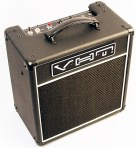
About a week ago, I extolled virtues of the Marshall Class 5, and raved about how great it sounds. It’s a fantastic little amp, and I haven’t changed my opinion of it. But along came the VHT Special 6 and the game has completely changed. VHT raised the bar with Chinese-manufactured, low-cost, low-wattage amps by offering a hand-wired, super-well-built amp with fantastic features that can easily change the amp’s character for under $200 for a 1 X 10 combo.

I think the arrangements many gear manufacturers have made with overseas assemblers is great. Egnater is another example of a manufacturer doing it with great success. Design the gear here in the US, then partner with an overseas manufacturer to take advantage of their cheaper parts and labor, ensure that they meet a high standard of quality, then give the savings back to the customer. The top-of-the-line stuff can be saved for domestic production, but the stuff you want to get out to the masses can certainly be made elsewhere, and in much higher volumes and production rates. It’s a good model that many manufacturers have been following for years. I realize that I’m going to piss off some of the ultra-patriotic that will only buy stuff made in the USA; I myself prefer to buy US-made stuff, but it’s tough to argue with getting great tone for a great price, and that is EXACTLY what the VHT Special 6 and lots of other gear assembled overseas provide.

But enough toeing the political line. Let’s get into discussing the Special 6, shall we?

Fit and Finish and Features

The first thing I noticed when I first looked at the amp is how solid it looked. Picking it up revealed an amp that is no lightweight. I don’t know the exact weight, but the Special 6 is not lacking in heft. The cabinet is made of birch ply, and from what I could tell, fairly large transformers were used with the amp and those are heavy. Note that I’ve actually heard some conflicting information about the cabinet wood. Some say MDF, others say Baltic birch ply. Actually, it just doesn’t matter. The cabinet’s solid, and it works well as a resonance chamber for the speaker.

As far as cosmetics are concerned, the amp is covered in tolex with white piping around the front grille. The rear panel sports a partially open back that, like the Marshall Class 5, has a thin metal screen covering the opening. That’s a nice touch.

The control panel is super simple. You’ve got two chickenhead knobs for tone and volume, on/off switch, a three-way Hi/Lo Power / Standby switch (I dig that), and two input jacks for Lo and Hi input. The volume knob is a push-pull knob that when out, adds boost (sorry, not sure about the amount of boost). You can surmise just by these features that you can do a lot of tone shaping with this little beast. πŸ™‚ The back panel has jacks for 4, 8, and 16 ohm speaker outs, plus a jack for switching between normal and boost.

Sound and Dynamics

Even with a 10″ speaker, the amp is capable of producing a variety of tones, from lush, Fender cleans, to ringing, AC15-like overdrive to gorgeous, smooth Plexi overdrive. I’m not kidding about this! Depending upon the pickup you’re using and where you set the tone knob, and other amp settings such as hi/lo input, pentode/triode mode, you can cover a wide range of tones! This is what is so SICK about this amp! It’s so damn versatile!

I played around with it in my studio this afternoon, getting ready to record some clips (which I’ll have in an upcoming article), and just for kicks, I unplugged the stock speaker and ran the amp out to my 2 X 12. Granted, there is a HUGE difference between a 2 X 12 and a little 10″ speaker, but in my experience, many low wattage amps still sound a little on the thin side even when going into a bigger cab; not so with the Special 6. It sounded big and ballsy; much more “big-amp-ish” than it’s diminutive power. That really came as a surprise, much like my surprise when I plugged the Reason Bambino into a big cab. It’s clear that just like the Reason guys, VHT didn’t want to just build a low-wattage amp. They wanted to build a great amp, period.

I also gigged with the amp in my weekly church gig yesterday afternoon, and it worked absolutely stellar! I kept the amp in high power mode, plugged into the high power input, set the tone and volume at 3pm each, then pulled the boost knob to activate the normal/boost footswitch. I didn’t use any effects at all as I just wanted the raw amp tones. I even tuned with my Peterson StroboClip so my signal from my guitar to the amp was completely direct. Note that even with a 10″ speaker, I still had to use an attenuator, and my trusty Aracom PRX150-Pro worked stellar with the amp.

During the gig, I mostly used the volume knob on my guitar to vary gain, whether in normal or boost mode. The amp responded so well to volume knob and pick attack. Even if I didn’t reduce the volume, and picked very lightly, I could clean up the sound. So sweet!

The only time I made any adjustments to the amp was when we did a song that I needed absolutely clean tones. I simply reduced the volume to around 11 am, then bypassed the attenuator. And the cleans were simply fantastic!

Made to Mod

Despite the fact that VHT says this amp is highly modifiable, I doubt that most people will do no more than swap tubes. I’ve seen some forum posts where people have made a couple of changes, but I’d say the majority of folks just won’t see a need to do that. But curious, for shits and giggles, I swapped out the stock 6V6 with a couple of different 50’s-era 6V6’s (GE and RCA). They each sounded beautiful as I expected, but quite frankly, they were just too smooth. The Chinese tube seems to be “hotter” and produces lots of harmonics; something my NOS tubes didn’t do. In my opinion, the Special 6 is meant to be a mini-rock machine. It won’t do really heavy stuff, but for 70’s and 80’s classic rock, it sits right in the sweet spot.

Overall Impression

I am thoroughly impressed with the VHT Special 6. Hand-wired, immensely versatile, plus fantastic tone for under $200? That’s tough to beat! And unlike other small, low-wattage amps that have only a volume and tone knob, the combination of inputs, low/hi power modes and boost make this an amp that can be used in a variety of ways. Big thumbs up, and 5 Tone Bones!

I’ll have clips in an upcoming article. Stay tuned!

Update: January 2, 2013

It has been awhile since I wrote the original article, and amazingly enough, I’m still using the Special 6. I did finally swap out tubes to 50’s era NOS for both pre-amp and power tubes, and I also swapped out the stock speaker and put in a Jensen Jet Electric Lightning. I use this amp frequently at my church gig where I don’t need a lot of volume since mic the amp and use the PA, and it is perfectly suited for that venue.

Even after all this time, I do have to say that I’m still thoroughly impressed with the tone of this little amp. When it’s cranked, and especially with the Electric Lightning speaker, the amp sounds SO much bigger than what its diminutive 6 watts would suggest. A lot of that has to do with how the speaker projects, but when cranked, that amp absolutely sings with tones of sustain and really sweet overtones. I love playing this amp with a Les Paul. The clean tones are gorgeous as well, and when I don’t hook it up to an attenuator, I just use pedals to get my distortion. From that perspective, the amp takes to pedals real well.

Finally, even with a simple, single EQ knob, the EQ works fantastically well with the amp. It’s kind of bright out of the box, so I normally just set the tone control to about 10 am. On some amps I’ve played, that muddies the tone a bit; but not with the Special 6. It simply makes the lower range stand out a bit more.

I’ve even been using the amp in the studio, over my DV Mark Little 4o and Aracom VRX’s (except where I need a heavier sound). It’s perfect for the studio.

It has been a long time coming, but I finally got an actual Gibson Les Paul. I’ve mentioned that I’ve been wanting to get one for quite awhile, and when the opportunity presented itself, I went for it. It took me about two years to get just the right deal, but it was definitely worth the wait!

When I first considered getting one, I didn’t know too much about Les Pauls and just how many different ones there are! But then meeting Jeff Aragaki of Aracom Amps helped me educate myself on the type of Les Paul to get. Jeff has an encyclopedic knowledge of Les Pauls; especially vintage ones as he has a fine collection of them himself. So it was fortuitous to meet and befriend him; otherwise, I wouldn’t have a clue as to what to get.

I looked at and played countless Les Pauls in shops, and several months ago, almost pulled the trigger on a ’58 VOS at Gelb Music. But then I discovered the Gibson Nighthawk, and I got distracted. Luckily I did that because the Nighthawk is very Les Paul-like, though with the super hot pickups, it has a much fatter sound. Then I got a ’59 replica, and that was a real game changer for me. But still, I wanted a real Gibson. So I waited some more, and that gave me more time to narrow down exactly what I wanted.

I finally narrowed it down to the Standard Reissues, from ’58 to ’60. So I started monitoring auctions on EBay. I must’ve looked at hundreds of guitars, and I did a lot of sifting. It was a bit mind-numbing, but I wanted to make sure I’d get exactly what I wanted. Here were my parameters:

  • Didn’t want to spend over $2200
  • The Standard had to have all the case candy in addition to the Certificate of Authenticity (there were a lot that only had the COA and were missing some or all of the case candy).
  • It had to be a Standard Reissue
  • The guitar had to be in great shape: No worming down to the finish and minimal dings.
  • Finally, the EBay seller had to have lots of positive ratings, 99% positive and above.

That was a fairly tall order, but then Jeff had mentioned he’d seen a few in his own searches that were going for a good price and had all the right stuff. So I waited. And waited. And waited, until I finally found what appeared to be a fantastic deal, and now I have the guitar.

So without further ado, let me introduce you to “Amber.”

This slideshow requires JavaScript.

Here are some clips I recorded this evening. The first two and the fourth and fifth clips are of Amber recorded raw. With the fourth, I added a touch of reverb to both tracks, and the sixth is an excerpt from a song I wrote.

Neck, Clean

Neck, Dirty

Middle, Clean (Rhythm) Neck, Clean (Lead)

Middle, Dirty

Bridge, Dirty Lead

Bridge, Dirty Lead Again as part of a song

3D Sound

It’s hard to capture in a recording, but Amber projects a real 3D sound; especially when she’s cranked up. Her tone is so complex, and has all these subtle overtones and harmonics. It’s the type of tone that just makes you close your eyes and smile while you’re playing to soak up all that tonal goodness.

Playability

Being that this was a purchase of a guitar I had never even played, I was a little concerned about how fat the neck might be, as I have short fingers, and fat necks and short fingers don’t go well together. But when I took Amber out of her case for the first time, and started playing, yeah, her neck is hefty, but not like a baseball bat. In fact, the size of her neck was absolutely perfect, and I found that I could move up and down her neck with utter ease!

The setup is absolutely perfect. The original owner really took good care of her! Even though it’s a 2005, before Gibson started to plek its Les Pauls, there is no setup necessary. The intonation is perfect, and the fretboard – oh that wonderful fretboard – just plays like butter!

I Finally Understand

After getting my ’59 replica, I really started getting the vibe about vintage and historic Les Pauls. I used to dismiss those who extolled the Les Paul – especially the historics – as people spouting semi-religious drivel. But now that I have one, I understand why it’s hard to put one the guitar down. I’m hooked!!!

Marshall Class 5 AmplifierSummary: Class A, Plexi goodness in a low wattage amp that packs a punch despite its smaller size.Pros: Great, ballsy tone that’ll just make you smile

Cons: None.

Features (as tested):

  • Power: 5 watts
  • Preamp tubes: 2 x ECC83
  • Power tubes: 1 x EL84
  • Controls: Volume, Treble, Middle, Bass
  • Speaker: 1 x 10″ 16ohm Celestion G10F-15
  • Headphone output
  • Extension speaker output
  • Dimensions: 19.48″ x 16.34″ x 9.05″
  • Weight: 26.46 lbs

Price: < $400 Street

Tone Bone Score: 5.0 ~ Even though I didn’t get to spend as much time as I’d like to play around with the amp, I was simply impressed by the tone that it delivers, and at a price point that makes it very difficult to ignore. While many low wattage amps can sound thin and tinny, the Class 5 with its generously-sized cabinet has a fantastic, rich tone.

On Low Wattage Amps

I love low wattage amps – those that are 10 Watts or less. I have a few. For years, people eschewed these super low wattage amps, and passed them off as mere practice tools. But I suspect they really didn’t understand what a super low wattage amp brings to the party. Low wattage amps such as the 5 Watt Fender Champ helped define the sound of rock and roll. Listen to classic rock tunes, and more likely than not, the venerable Fender Champ would be the amp providing the sound.

Today, more and more people are turning to low wattage amps – especially home recording enthusiasts, and even pros like Jeff Beck – to save their ears and to get crunch and grind at low volume levels. As a result of the increased demand, many manufacturers, boutique and mainstream alike, have responded and come up with a slew of low wattage amps. It’s a good thing and a bad thing. On the one hand, you have tons of selections, on the other hand; well, you have tons of selections. There are a lot of them out there and it’s tough to decide which way to go.

The shear amount of low wattage amps on the market is perhaps a big reason why Marshall waited so long to come out with its super own low wattage amp. Perhaps they were studying what the market responded to and what they could do to address what people might have fed back as improvements that could be made.

Enter the Marshall Class 5 amp. This amp was released in the UK near the middle of last year, and arrived here on our fair shores around November of last year. Amazingly enough, news about this amp has been relatively quiet. There hasn’t been all that much advertising that I’ve seen about this amp. The Marshall Haze amps have gotten lots of “rag” time, and the response to those amps has been generally positive. But I haven’t heard much about this amp other than user reviews. That’s too bad because after playing it, I have to say that I really dig it!

Classic, Killer Tone!

Is Marshall embarrassed about advertising such a low wattage amp? I certainly hope not, because I got a chance to play this amp today, and I just have two words to describe it: KICK ASS! Built upon the “Bluesbreaker”/Plexi pedigree, the Class 5 has all of that Plexi goodness in a low wattage combo. Make no mistake: The Class 5 packs a serious punch; maybe not maximum volume-wise (for a gig, this amp would need to be miked, but will provide plenty of stage volume), but if you’re looking for those classic Plexi tones in a low wattage solution, look no further!

Because I was in a shop, I only tested it with a single guitar: An Epiphone Les Paul Ultra. But the Class 5 delivered that cranked Les Paul through a cranked Marshall Plexi true to form. It was everything I expected to hear from a cranked Plexi, just at a lower volume. That really blew me away!

There’s really something special about that tone. My Aracom PLX18BB is a super-close replica of the Plexi 18, plus my good buddy has several Marshalls including an original JTM45 and Plexi 50, so I’m very familiar with that classic tone. While the Class 5 is just a tad grittier in its overdrive than its more powerful siblings (perhaps due to the new speaker), the rich harmonics and smooth overdrive delivered with “balls” with a gorgeous sustain is all there.

While it might seem from my description that this amp isn’t very loud, it’s plenty loud. You can even gig with it easily, even with the stock 10″ speaker which, by the way, has tons of volume and provides rich tone. I was actually expecting the amp to sound a bit thin due to the smaller speaker, but there was nothing thin-sounding about the amp.

Another reviewer mentioned turning the bass all the way down, because he thought it was flabby. I really didn’t detect a flabbiness to the bass, but I like a bright amp anyway so I had the bass EQ dialed down to about 8pm which is almost off.

All this tonal goodness is delivered by a 10″ speaker specially developed for the Class 5 by Celestion, the G10F-15. As expected, the 10″ really has an emphasis on the mid- to high-frequencies, but Marshall compensated for the lows by providing a spacious cabinet to act as a nice resonance chamber for the speaker. The result is a very balanced and smooth tone, if a little on the bright side. But bright is what Plexi’s are all about, and the Class 5 delivers on that swimmingly!

As far as my customary test clips go, sorry, this was a shop eval, so I didn’t record any. But if and when I get the amp, I’ll post some for sure!

Yikes! It’s Too Loud!

Hello… 5 Watts is loud. In fact the speaker’s SPL is rated at 97dB at 1 meter with a power rating of 15 Watts. People have complained that they can’t crank it up in the bedroom past 3 or 4. Yeah… welcome to the Non-Master-Volume club. But that’s the beauty of the Plexi in the first place! You need to saturate the power tubes as well as the preamp tubes to get that Plexi vibe. If you need to run this amp at bedroom levels, the best solution is to get an attenuator such as the Aracom PRX150-Pro.

I sincerely hope that Marshall doesn’t cave in to those complaining it’s too loud and add a master volume to the amp. To me, it doesn’t need and would take away from its vibe.

Made in the UK

This amp is constructed in the UK, amazingly enough. And what’s even more amazing is that it sells for less than $400! The shop I tested it at had it a retail price of $389! One would expect those kinds of prices to come from gear manufactured in Asia. But not this beauty. So to have a UK-made amp at this price point is truly remarkable! Then to get tone this good? OMG! Truly amazing!!!

Fit and Finish

This amp is extremely well made. The cabinet feels real solid, and nothing was loose. Apparently, earlier versions suffered from a buzz, but the unit I tested didn’t have that at all. In any case, I inspected the amp thoroughly – front and back-Β  and didn’t detect any finish flaws. The tolex was nicely molded down to the surface of the underlying wood, and there were no loose pieces of material. From what I could tell, 1/2″ ply was used for the cabinet, and that is good because I’ve found, at least from a purely qualitative perspective, that cabs built with 1/2″ thickness tend to resonate quite well. This obviously helps bolster the bottom end, and it does it nicely.

The rear of the cab is interesting in that it is partially closed with about a 4″ opening, covered by a metal grill. I suppose that this is so you don’t throw in the cable and accidentally puncture the speaker cone, but it may be purely aesthetic in nature. The rear grill is rather cool.

Overall Impression

I totally DIG this amp! It was fun cranking it up in the store this afternoon! Admittedly, the amp doesn’t really hit its sweet spot until the volume knob is about midway. But completely cranked up, it produces the tone I expect out of a Plexi! And even cranked up, it responds well to volume knob levels, so you can clean up the amp quite easily.

Compared to other super low wattage amps I’ve played, even my venerable ’58 Champ, this amp has tons of balls in stock configuration. With my Champ, I had to have an amp tech add a 1/4″ jack so I could run it into an external cab because the 8″ speaker really can be quite thin-sounding. But the Class 5 has enough balls and volume stock to not need any of that (though it’ll be fun to run this into an external cab anyway, which I plan to do).

Note that unlike other reviews, I really didn’t make mention of the amp being “Class A.” That’s a big deal with lots of folks, but to me, even though I understand the classification, it really doesn’t matter. What does matter to me is how the amp sounds, and it simply sounds killer. In my book, I couldn’t care less about an amp’s classification so long as I can get great tones out of it; and the Class 5 will certainly deliver on that!

As you might surmise, I’ll probably end up getting this amp. As if I need another! But it’s a great amp at a great price. That’s just plain tough to ignore! And note that this amp sounds so good stock to me that I really don’t see a need to swap out tubes unless they burn out (which they probably will considering I’ll be running the amp all out all the time πŸ™‚ ).

Here are some cool video clips of the Class 5 in action:

New Gear: The Rock Lock

You’ve heard of it happening to other guitarists, and how could it possibly happen to you? That’s right, your guitar gets stolen at a gig. Over the years, I’ve heard of countless stories of players having their axes taken right off the stage during a break; especially at small clubs where the stage can get obscured by the crowd. Bands have devised numerous ways to protect their gear from taking their guitars with them during breaks, to always leaving at least one band member in the stage area to keep watch over gear to even cordoning off parts of the stage area.

Myself, in my solo acoustic gigs where I play outside at a busy outdoor mall, I cordon off the open, rear area – I play in a “patio” at the end of a busy walkway – to prevent people from walking through my “stage.” But I also do this as a mild deterrent from possible theft. In other gigs, the stage is either raised or in an area that’s secure enough so as to offer more reasonable protection from theft. But still, that’s not complete insurance, so when I take a break, I either do it within line-of-sight of my rig, or have the servers and bussers keep watch over the stage when I can’t be within eye-shot. But if in the rare chance that any of them get busy and can’t keep watch, it’s possible for a cunning thief to come along at take my guitar.

Just a couple of weeks ago, this kid wandered over to my stage area and started checking out my rig while I was on a break. He was even audacious enough to twiddle with my pedals – he even lifted my Deep Blue Delay to inspect it! And while I was trying to get through the crowd back to the stage, he picked up my guitar! I finally got out there and asked him what the hell he was doing, and told him to put my guitar down. It turned out that he was just a young, high-school kid who turned out to not have any filters for manners. Some of the stuff he blurted out during our conversation made me open my eyes wide (had to say a brief prayer that I make sure my kids have filters πŸ™‚ ). In any case, he just assumed that since he played he could just go up and mess with another player’s gear. I was friendly enough so as not to make him too uncomfortable, but I was quite firm when he asked me if he could play my guitar while I was on break that no, he couldn’t, and it was just not cool to just pick stuff up.

So what are we gigging musicians to do?

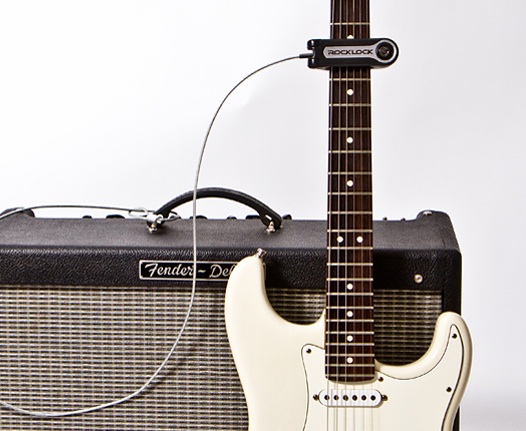
Enter the new Rock Lock from The Rock Lock Company. This is one of those inventions where you say, “Damn! Why didn’t I think of that?” The Rock Lock is much akin to a laptop tether with a loop at one end to attach to a fixed, stationary object (like a guitar handle as shown in the picture to the right), and a locking mechanism that wraps around the neck of your guitar.

Folks, this is the answer to guitar security! Talk about a theft deterrent! I’m totally excited to get one of these as it will certainly set my mind at ease when I go on breaks!

Here’s some information about the Rock Lock from the site:

  • MADE IN USA!!!
  • PATENT PENDING
  • Core Constructed from Cutting Edge Metal Replacement Technology
  • Nitro-Cellulose Safe Over-Mold
  • Heavy-Duty Braided Steel Cable
  • 1 Year Full Warranty with Registration
  • 2 Keys Included, with optional Key Registration
  • Fits almost all standard 6 string Guitars.
    This excludes: 12 String Instuments, Flamenco/Spanish Guitars, and Bass Guitars.

Pricing and Ordering

The Rock Lock will retail at $49.99, and if you’re one of the fortunate first to pre-order, you’ll get free shipping.

Note that the Rock Lock is not widely available just yet, but you can submit your name and email address to be notified when the next shipment is available (apparently, the first short, test-run sold out immediately). I exchanged info with the manufacturer, and he indicated that the first large production batch will be available on December 1, 2010, so get your name in ASAP!

You owe it to yourself to be comfortable to leave your stage knowing that your axe(s) are safe!