Feeds:
Posts
Comments

Builder Profile: Neal Moser

The other day, I was surfing around the web to find some pricing on Solid Cables, and stumbled upon Moser Custom Shop, a dealer for Solid Cables. Of course, as the name implies, cables aren’t their primary business. So, curious, I poked around the site to see Neal’s wares, then I gave him a call to talk to him about his guitars and his build process.

Such a BICH
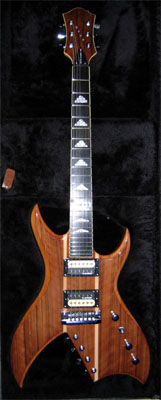
If you’re at all familiar with BC Rich guitars, then you may know that Neal Moser is the designer of BC Rich’s Rich Bich guitar; an eclectic 10-string that looks like a Vulcan lute from Star Trek – or at least something Spock might play. I’m not really into pointy guitars myself, but I actually dig the look of that guitar. There’s something about it that – at least to me – oozes a cool mojo.

And based upon the Bich, you have an idea of the style of guitars Neal designs. Most are pointy, very aggressive-looking guitars. Even his more traditionally-styled guitars have a decidedly edgy look to them. But that’s not a bad thing at all. In fact, Neal’s guitars have a very pleasing vibe about them. I look at Neal’s guitars, and the first thing I think of is that these guitars are meant to be played through a fully cranked amp. You’d be doing a disservice to the guitar if you didn’t let it breathe fire. 🙂
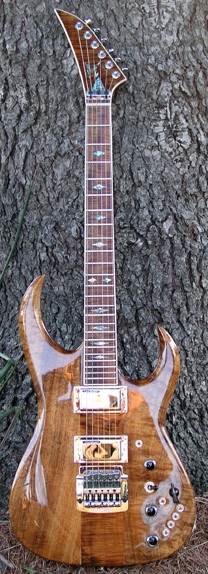
As the name implies, Moser Custom Shop specializes in custom-made guitars, and one thing I dig about his process is that everything is done by hand. Neal uses custom jigs and templates, and hand-shapes everything. No wonder I like these guitars. Just like Saint Guitars, which are made in the same fashion, each custom guitar Neal builds has its own character. There’s nothing production line about these guitars!

Here’s an interesting factoid: BC Rich and Moser Custom Shop have an agreement that allows him to  to continue to build Bich’s, though he has to call them his 10/6 model. Unlike the production line stuff from BC Rich, if you want a custom Bich, you can specify everything on a 10/6! How cool is that?!!!

Moser Custom Shop also has a line of Korean imports, much along the same vein as PRS, contracting out the manufacturing to a Korean builder. I think that’s totally cool because if a buyer really wants a Moser design but can’t afford the cost of a fully custom guitar, the imports cost a fraction of the price. For instance, the Korean MMI-T, which is based upon the MCS Scimitar model, costs $649 and comes with a case. That’s a steal! You don’t get all the electronic bells and whistles of the Scimitar, but you get a nice design and a capable guitar at a great price!

A little about Neal

Neal has been around quite awhile. He started working with guitars in 1964, first as a guitar repairman, and over the course of his career, has worked on guitars of some very famous cats, including Jimi Hendrix, Stephen Stills, and David Crosby. He formed Moser Custom Shop after a long stint with GMW Guitar Works, coming out of retirement to start the company with his wife Earlleen.

Neal is one of those personable guys that you just love to talk to. In fact, he’s one of the nicest people I’ve met in a long time. He’s got a very friendly and inviting demeanor, and he speaks his mind. Even after almost 50 years working with guitars, you can tell he has a passion for what he does, and that comes through in how he talks about how he makes them. Passion is what it’s all about to last this long in ANY industry, and Neal’s got tons of it!

For more information about Moser Custom Shop, visit their site! While there, give Neal a call.

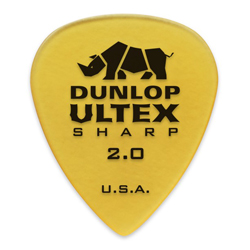
Dunlop Ultex Sharp 2.0 mm

Summary: It’s sharp alright; nice and pointy, and it feels great in your hand!

Pros: Like any sharp pick, this pick is accurate. It’s super lightweight, and made of a material takes a lot of pressure to even slightly bend. The pointy end makes pick harmonics a breeze!

Cons: It’s a small nit, but I wish the butt-end were just a bit wider.

Features (from the web site):

Based off of a coveted vintage tortoiseshell pick in our collection, the Ultex Sharp delivers a pick with a rigid body tapering into a thinner and sculpted tip for intense control and speed. The seamless contoured edge surrounds the pick for more playing surfaces and tones. Engineered of Ultex—the Ultex Sharp is virtually indestructible and delivers a crisp tone and quick release attack. Available in .73, .90, 1.0, 1.14, 1.40, and 2.0mm gauges.Price: 50 cents street

Tone Bone Score: 4.75 – Real nice-sounding and nice-playing pick. If you want to step up to a thicker, more rigid pick, but don’t want to shell out for high-end picks, this is a winner!

Okay, I’ll admit it: I’m a bit of pick snob. Ever since I started playing with V-Picks and Red Bear picks, I’ve mildly eschewed mainstream picks in favor of the insanely awesome picks those two companies produce. But I have to tell you that I was taken by complete surprise by the Dunlop Ultex Sharp pick! I wasn’t really looking to explore new picks, but a buddy of mine was looking for some Ultex picks at a local store, and offered to buy me a couple. Hell! They were only 50 cents apiece! I carried them around for a couple of days before I actually got to try them; not because I was dubious of them, I just couldn’t find time until this evening to sit down with an axe. Life happens, you know?

Anyway, I slung “Blondie” my trusty Squier Classic Vibe Tele, dug an Ultex out of my pocket, and started to play. Admittedly, I had a bit of trouble playing with the pick at first. Even though it’s slightly thicker than the thinnest pick I play – a Red Bear Tuff-Tone – it’s decidedly narrower in shape; something to which I’m no longer accustomed. But being the hard-headed type, and because I wanted to give the pick a fair shake, as it were, I kept at it, playing scales and riffs to get used to it.

I have to say that I’m really impressed by this pick! First of all, the material feels great in your hand, and like any real good pick, you forget about it. I love the rigidity of the material as well. Contrary to what you might think, a rigid pick actually makes you relax your hand. I know, it’s counterinuitive, but any player that plays a rigid pick will attest to this.

I spent quite a bit of time playing with this pick, and it’s a fast pick, though what I really missed was how my high-end picks really glide over the strings, like they’re lubricated. The Ultex material is pretty smooth, but there is a difference. Mind you, I’m not saying it’s bad in the slightest; it just has a different feel on the strings.

Most importantly though, the Ultex Sharp produces a nice, bright tone. That’s what I really dig about this pick! Part of it is due to it being rigid, but the other part is because of the pointy end. It really makes the strings snap in a very nice way!

Will the Ultex supplant my V-Picks and Red Bear picks? Probably not, but I will be using it for sure. It’s not even a small wonder why these picks are so popular among guitarists. They’re great playing and sounding picks at an insanely cheap price. I’m sold! Buy a few, and you’ll see for yourself!

I was perusing Solid Cables site this morning, and couldn’t find any pricing, so I surfed their dealer list to see how much I could get a 10′-12′ cord for. I found this site that had one of their Dynamic Arc Ultra cables listed for $135.95! OMG! I think the most I’ve ever paid for a cable was $80, and I still have that cable – it’s great; well-made with solid construction. People have raved about real high-end cables in the past, and I’m wondering how big of a difference they make. In any case, I put together a poll to see what people would pay for a cable. Here it is:

Gig Report: Reason Bambino

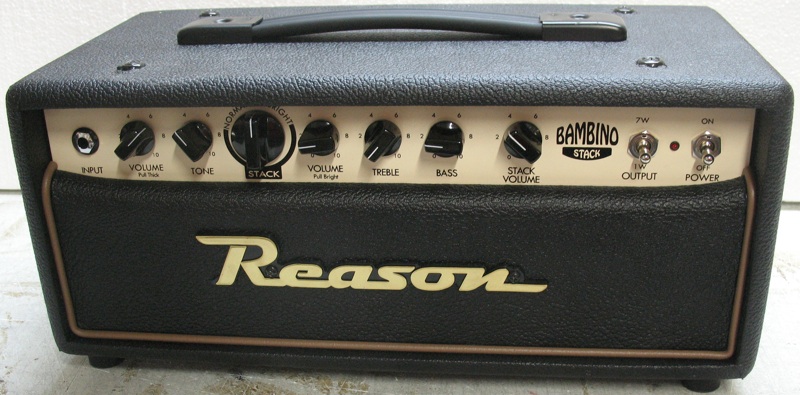
I’ve been extolling the virtues of the Reason Amps Bambino for several months, and how great it sounds. Among the things that I’ve mentioned is that for a little amp, it has a BIG sound. That was a design objective with Obeid Kahn, Reason’s amp designer, when he was designing the amp. He didn’t want to just build yet another affordable, low-powered amp. He wanted to build a great amp. Period.

Despite the sound though, what has really turned me on about this amp is its versatility. For instance, last Friday I did my regular, weekly solo gig at a local restaurant. I haven’t been very happy about my Stratacoustic’s tone into my DigiTech Vocalist Live box, so I decided to bring the Bambino to provide some pre-amplification and use its balanced line out to go directly into the restaurant’s board. What I was greeted with was simply put, a spectacular sound, and this from a line out directly from the amp! I’ve mentioned using this in the past, but this time, I had no speaker. I went direct into the board, and the only monitoring I had was from the PA. A couple of days later, I used it for my weekly church gig, with my 1 X 12 speaker cab, and also using the line out to plug into my church’s board.

For a church gig, minimal stage volume is important because voices are reinforced through the house audio, not from the band area. So to have this kind of amp where all I have to get is my stage volume, then use the house to get my sound out, it’s simply a boon.

The only other amps I’ve ever used that have this kind of versatility are acoustic amps. I realize that there are probably other tube amps that may have this capability, but getting all the great sound and versatility AND boutique quality in a $699 package is just unheard of! If you’re looking for a great amp that’ll work in variety of places, look no further!

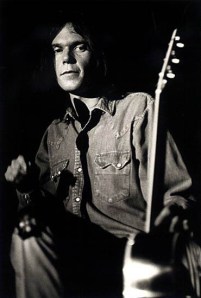
I got inspired to write this entry from none other than Neil Young yet again. Back in July, I wrote another post about how much I love Neil Young’s playing. It’s raw, it’s untrained, and it’s absolutely in your face. It’s not very good playing at that, but for some reason, it’s incredibly appealing to me – and I’m not the only one who thinks this! That article was inspired by an interview he gave and the commentary he made about his playing. Then, lo and behold, I read an old interview recently that really got me thinking about expression versus technique. Here’s an excerpt of what he said (courtesy of Guitar Player mag):

“First of all, it doesn’t matter if you can play a scale. It doesn’t matter if your technique is good. If you have feelings you want to get out through music, that’s what matters. If you have the ability to express yourself, and you feel good when you do it, then that’s why you do it. The technical side of it is a complete boring drag, as far as I’m concerned. I mean, I can’t play fast. I don’t even know scales… …I appreciate these guys who play great. I’m impressed by metal bands with their scale guys. I mean, Joe Satriani and Eddie Van Halen are genius guitar players. They’re unbelievable musicians of the highest caliber. But I can’t relate to it. One note is enough…”

While I don’t entirely agree with Mr. Young about technique, I do get the gist of what he’s saying: It’s YOUR musical expression and feeling good about it that’s important; no matter what speed that is or the technique(s) you use to express yourself.

Personally, I believe in being serious about learning new techniques and honing what limited skills I have only for the sake of opening up different ways to express myself. But that’s kind of the rub. How far do I take technique? Sooner or later I have to apply it; hence, the title of this article. Make no mistake, technique is important, but the music you make from that technique is even more so.

As eternal students of the guitar, it is so easy to fall into a rut with “how” to play as we discover our instrument – hell, I’ve been exploring for many years, and I feel I’ve only scratched the surface of possibilities – but as musicians, I will submit that once you’re playing, “how” is irrelevant, and that “what” you’re playing is far more important.

For instance, I recently saw a video of the guy who broke the Guinness world record for guitar speed by playing “Flight of the Bumblebee” at 320 beats per second. The student in me appreciated the work and focus that went into being able to play that fast; I could never play that fast, that clean. But the musician in me said, “So what? It ain’t music at that speed.” You can watch the video here. Granted, the technique that went into being able to play that piece that fast is absolutely incredible! But at that speed, the guitar sounds like a Formula 1 race car revving its engine as the player ascended and descended the neck of his guitar! From a musical standpoint, it made no sense whatsoever.

That’s why what Neil Young said resonates with me as a musician. I personally don’t think technique is a complete boring drag, but when I’m playing, what I’m playing is far more important than how I’m playing it.

I’ve been working on a new instrumental for over a month now, called “Strutter.” I think I’ve probably made 50+ recordings of the song, and even though I dig the melody I’ve come up with, I’ve always thought it needed something… more… Couldn’t put my finger on it, but none of my recordings of the song were working for me completely. After I finished recording this final cut which I’ll share below, I believe a lot of my “frustration” had to do with me wanting to only use a single guitar and amp for the recording since I play this song live with only a single guitar.

But it’s different in the studio. I have a lot of options open to me, so I decided to break down and instead of recording the song in its entirety with a single take with a single guitar and amp, I recorded the two different parts of the song with two guitars and two amps. The result knocked my socks off! So the lesson learned is in the studio, you can be truly creative, and for me, I’ll use the tools I need in favor of what I’d like to have. Anyway, here’s the song:

Gear:

Rhythm: Fender MIM Strat / Aracom VRX22 (6V6) Clean Channel
Lead 1 : Squier Classic Vibe Telecaster 50’s (bridge) / Aracom VRX18 (EL84) Channel 2 (Master cranked / Volume 3pm)
Lead 2 : Saint Guitars Messenger (bridge) / Aracom VRX22 Channel 2 (Master 4pm / Volume 3pm)

All guitars were recorded at bedroom level using the Aracom PRX150-Pro attenuator, with no effects. Estimated output of any of the amps was less than 1 watt! That unit is absolutely amazing!!!

Small room reverb was added during production to give a more spatious effect to the lead tracks, and absolutely no EQ was applied to the guitars.

Description:

This song was originally inspired by an image of a supa-mac-daddy-pimp dude struttin’ his stuff down the avenue. 🙂 At least that was the kind of vibe I wanted to capture: 70’s-style guitar-plugged-straight into the amp. It’s a raw kind of tone.

From a structure/feel point of view, what I was after with this song was a contrast in textures. The Rhythm track uses the VRX22 clean channel for that snappy clean attack. For the Lead 1, I wanted use the creamy smoothness of the VRX18 combined with a single coil, and take advantage of the awesome decay of the tube rectifier. For Lead 2, there’s nothing like the pure balls-out sound of the VRX22 drive channel played with a bridge humbucker. The distortion though is ultra smooth, but very complex.

I should be the Aracom Amps poster boy!

I just realized that this song could be an Aracom Amps VRX amp line demo! I make no secret that these are my amps of choice (I have three of them). Jeff Aragaki’s amp designs are absolutely killer – that’s why I buy his equipment.

Moving Up in the World…

I’ve been an avid GarageBand user for quite some time, having shied away from moving to a more sophisticated recording solution because of how easy GarageBand makes it to record the demo songs and sound clips I produce. Geez! How easy could it get? To create a sound clip, it’s as easy as opening the app, setting the song’s tempo, choosing a drum loop to play to, creating a new track to capture my guitar, and recording.

Of course, GarageBand comes with its own shortcoming, not the least of which is the ability to change tempo mid-song, editing the timing and tempo of an audio region, and doing more sophisticated fader automation. For years, these shortcomings were okay for me. I was able to produce an entire album with GarageBand – even with its shortcomings. But admittedly, a lot of my best songs didn’t make it to the album because GarageBand couldn’t do things I needed for those songs; especially varying the tempo mid-song, which I’ve written into several of my pieces for dramatic effect.

My wife has been bugging me for a long time to record some of her favorite pieces that I’ve written for church service. One in particular is based upon the second movement in Beethoven’s Moonlight Sonata. While that song is not structurally complex, it requires three different tempo changes. Moving from 52 bps for the intro (the original tempo), to 58 bps for the verses, then 62 bps for the refrain, back down to 58 bps, then back down to 52 for the outro. I tried recording the song in GarageBand several times, but just couldn’t get it down.

Enter Logic Express 9. With its tempo and wave editing features, I can now record my songs the way they were meant to be recorded. I can’t even begin to tell you how incredible that is to me! I’ve the application less than 24 hours – and only used it for a couple of hours – but I can already tell that it’s going to be a HUGE boon to my music production. I’m really excited. I’ve already played around with the tempo changing features, but there is just so much to this application that I have yet to discover; not the least of which is the mix-down capability and throwing tracks onto different busses to apply different effects.

No, it’s not a full-blown recording solution like ProTools or it’s bigger sibling Logic Pro. But for the home studio recording enthusiast like myself, it has everything I need to create great recordings. At $199, it’s a real bargain. Besides that, if I ever need to upgrade to the Pro version, it’s a $99 upgrade. Not bad. Not bad at all.

If you’re currently using GarageBand, and want to expand your recording capabilities, I highly recommend Logic Express! I will say this: it’s not a simple slam-dunk to move from GarageBand to Logic Express. Yes, there are similarities, but the mix-down and mastering stuff that GarageBand does for you by default you now have to do yourself. However, one thing I tried was creating a project in GarageBand, applying mastering, then importing the song into Logic Express. Lo and behold, the Master got imported with all the buss settings – which you then can edit. Nice.

For more information on the feature set, please visit the Logic Express site!

I'm running a poll to find out how much gear GuitarGear.org visitors have.
I'll keep this post up for awhile so we can get some stats.

Take a Sweet Break!

A friend of mine – actually by association through my wife who grew up in the same court – writes an awesome blog about the culture and history of candy in America, called the CandyProfessor.com. She told me about it today while she was visiting with us, and being a bit of a sweet freak as well as a gear freak, I was really intrigued by what she calls “her little project.” I spent a couple of hours reading through her posts, and I have to say, Wow! What a perspective!

Given the time of the year, it’s natural to think of sweets, and what better way to think about sweets but reading about them in a blog! Ha! But mind you, the author, Samira Kawash, is no amateur. She is a real professor (hence the site’s name) who just recently left her tenured job with a university to write full time, and CandyProfessor.com is part of her writing process! Love it! Check it out! It’s really refreshing reading!

Like many gear sluts, I’ve got several guitars and each guitar, no matter how much I’ve spent on it, has its own little quirk or quirks. One might not have much natural sustain, another might have tiny frets, yet another may have wide neck profile. But no matter the quirk, in the end, if I can work through a guitar’s particular quirk or quirks, it’s the sound that comes out of my amp that counts. But the cool thing that I’ve found is that these very quirks have also served to help me become a better guitar player. Mind you, these aren’t flaws in the gear. They’re simply, well, quirks that make either consciously or sub-consciously make me compensate for a particular quirk in some way.

For instance, my Squier Classic Vibe Tele has pretty little frets, making vibrato a challenge; especially the violin type of rolling vibrato. But what it has taught me is to get much better at bending vibrato to coax sustaining tones out of that guitar. The net result is if I take the time to make a note sing, I’m rewarded with this beautiful bloom as the string vibrations resonate through its pine body. The reward of that is priceless, and what I’ve found while playing that guitar is that I actually try to play slower and express whatever idea I’ve got in as few notes as possible. That has affected my entire playing style.

Building on that, the other night I played guitar in the band at my kids’ school’s Christmas pageant. This is a cool production in that unlike most pageants, it’s presented as a theatrical production, replete with story line. The various classes then sing a song as part of a scene of the play. For the first time, the show was done with a simple rock combo in addition to the standard keyboard to fill up the music. And even cooler was the fact that this particular production had very rock and roll flavor. I originally rehearsed the play with my Tele, but I wasn’t satisfied with the overall drive sound, so I switched to my LP copy, a Prestige Guitars Heritage Elite.

Remember I mentioned my Tele forcing me to get better at bending vibrato, well, from repeatedly practicing that on my Tele, once I picked up my Heritage Elite, it was game over! I really felt my expressiveness go through the roof! Now that guitar just sustains forever, but add some technique, and I couldn’t believe how good that guitar sounded! It was as if I was playing a completely different guitar.

The same kind of thing goes for Goldie. Now she has jumbo frets that are both wide and tall, so that it takes a minimal amount of pressure to articulate a note. What that guitar has taught me is to relax my left hand. The net result is that I’m much quicker over the strings. But that lightness of touch has extended to my other guitars as well.

So the net of all this is that quirks in your gear aren’t necessarily bad, and oftentimes can help you improve your playing.