Feeds:
Posts
Comments

I normally don’t write about instructional sites, mainly because they’re a dime a dozen, and most follow the same model of discussing theory, and providing scale diagrams that accompany the theory. Not that these aren’t helpful, but I tend to be the type of player that learns more effectively by actual example. So it was fortuitous that I happened upon a discussion on a forum about guitar lessons. Someone asked a question about guitar lessons online, and to a person, the respondents all replied that the original poster should go to: Mark Wein Guitar Lessons (http://www.markweinguitarlessons.com).

Intrigued, I went there, and was totally blown away by what Mark Wein offers: Free instructional videos that not only cover theory, but provide instruction on practical applications of the theory. Take, for instance, the following video on the minor blues progression and some variations:

While Mark mentions some theory in the video, it’s mostly about interesting ways to “liven up” the minor blues chord progression. Now that’s useful!

After I viewed several of the videos, I decided to give Mark a call and just chat with him about his vision for the site. Here’s a transcript of the interview:

GuitarGear: So Mark, tell me about the site… Why would you just give away great lessons like these?

Mark: I wanted to differentiate my site from other instructional sites that simply offer text-based discussions of theory and give you a few diagrams of scales. Frankly, the videos draw in a lot of business for us. But as far as the videos are concerned, I didn’t want to just show the information, I wanted to provide the “why” behind the instruction. It’s all about communicating these ideas; teaching them in an easy way for students to understand and adopt in their playing.

GuitarGear: So what would say your overall philosophy is with respect to teaching?

Mark: There’s a real concentration on really teaching the guitar and more importantly, making music. I found that it students progress a lot faster when they have a context. Sure, I can teach mechanics, but to me, it’s more important to teach students to play music.

GuitarGear: Mark, I have to tell you that it’s refreshing to hear that. I work with a lot of young people who join my Church band, and some of these kids are incredibly talented, being able to cop their favorite guitarists’ licks like there’s no tomorrow. But ask them to strum some simple, funky blues progression, and they flail hopelessly.

Mark: Right. That’s my point exactly. Lots of people know technique, but are they really playing music? Probably not.

GuitarGear: Let’s move on… Can you tell me a bit about your history? How did you start with guitar?

Mark: It’s actually kind of a funny story. Like a lot of kids I got together with a few guys to start a band. I had been around music all my life, so it was only natural that I’d do the band thing. Anyway, I wanted to play drums, but one of the guys already played. So I couldn’t do that. I did bass for awhile, but another guy did that. You really don’t want me singing, so I basically got stuck with guitar. When I got older, I went to a local community college to study music theory and performance, then I got accepted to USC – unfortunately, I wasn’t able to attend, so I started working in a couple of bands, produced some stuff, and did teaching as well. Anyway, I decided to put a real focus on teaching, which I loved anyway.

GuitarGear: So you’ve had this business for awhile…

Mark: Actually, we’re celebrating our fifth anniversary this year. But it was my wife who was really behind me opening up a school, and since we’ve opened, we’re up to ten teachers, teaching all sorts of styles. Plus we have a performance program so bands and musicians can learn performance.

GuitarGear: Very cool…

Mark: We also offer online lessons…

GuitarGear: Really? Now you’re talking. That’s exactly what I’m looking for! And since we share similar philosophies about guitar playing, I’m going to set up some lessons in the near future…

At that point, the interview kind of ended, because we got into a discussion about what I was after, and how I could take lessons and stuff, then of course, we got into the obligatory discussion about gear. Here’s a brief synopsis of what Mark plays:

Guitars

Suhr Classic
Suhr Classic T
Les Paul Standard (cream-colored – nice)

Amps

’66 Bassman
Silvertone 1484
Peavey Pentone

Tons of pedals…

It was great talking gear with Mark. He’s a true believer in using lower-wattage amps so you can take advantage of the power tube grind. He shared a story with me that had me chuckling where he played a gig on this HUGE Van Halen-size stage and only had a 22 Watt amp. People laughed, but the sound guys loved him. And that’s a great story because unlike the bad old days when sound reinforcement wasn’t nearly as good as it is now, you had to have multiple stacks to get your sound out. But nowadays, you have great PA gear, so it’s just a matter of getting a stage volume that you can hear, and let the PA handle the rest. That makes a lot of sense, and Mark’s sensible approach to guitar is what has given him success so far.

Rock on, Mark!

For more information, go to http://www.markweinguitarlessons.com

5 Tone Bones - Gear has stellar performance, value, and quality. This is definitely top of the class, best of breed, and it's a no-brainer to add this to your gear lineup!

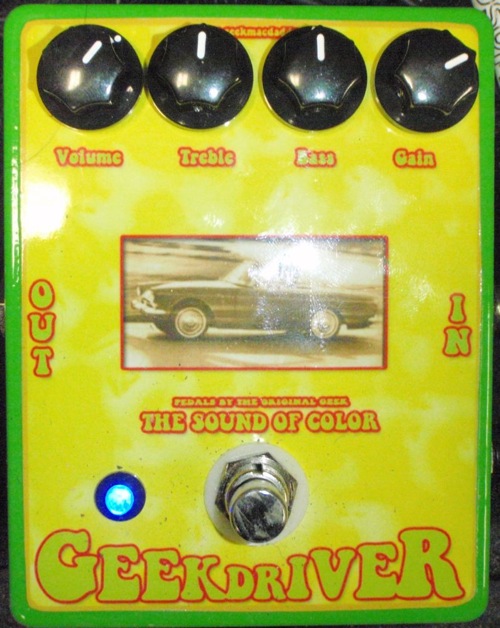
GeekDriver by the Original Geek

The GeekDriver by the Original Geek

Summary: Is it a booster? Is it an overdrive? No! It’s the GeekDriver.

Pros: From gorgeous, slightly fat boost to searing, face peeling overdrive with tons of overtones and harmonics, this pedal does it!

Cons: None.

Features:

  • Hand-wired and soldered in the US
  • Volume, Treble, Bass and Gain Controls
  • Neutrik and Switchcraft jacks
  • True Bypass

Price: $205 direct

Tone Bone Score: 5.0. I’m absolutely blown away by this pedal! I can’t say for sure, but this is a pedal that I’d almost always have on.

I don’t give 5 Tone Bones away lightly. I have to be so totally blown away by some gear that I have to give it my highest rating. When I first heard the GeekDriver on Geek’s Premier Guitar Video, I immediately became intrigued. Then when I finally met the Geek himself at the shop he shares with Tonic Amps, and he demonstrated the GeekDriver in person, I knew I had to have one, so I told him I wanted one, and tonight I picked it up.

What exactly is the GeekDriver?

As the Geek will tell you, the GeekDriver is based upon the ColorSound Overdriver that was popularized by Jeff Beck. At its core, it’s a clean booster, but the Gain knob changes the game significantly, giving you anywhere from mild breakup to ugly, snarling dog overdrive, replete with tons of overtones and harmonics. At high gain levels, it’s like the ugly dog that’s so ugly you can’t help but love it, if you catch my drift.

One thing’s for sure, it’s not transparent, nor is it meant to be. When active it adds a slight compressive fat boost at all volume levels. The effect is incredibly subtle, almost visceral, in that  you “feel” that coloration more than you hear it. This aspect alone made me give this pedal the 5 Tone Bones. The effect is so sensual and appealing. I know I’m using a lot of flowery adjectives here, but it’s because it’s so hard to articulate the emotional effect that compressive boost has on me. When I get that feeling, I know I’m onto something good.

Then you turn the gain up, and in addition to that colored boost, you get layers of overdrive which become this ugly fuzz as you increase the gain that’s total ear candy. But despite the cacophony of distorted signals, the tone is still incredibly defined and articulate. Unlike a pedal like the OCD which can get pretty muddy when you crank the gain, the GeekDriver just oozes thick fuzz, but never gets muddy. Nice.

How it sounds…

In a word, it sounds awesome. It is very hard to describe what it actually sounds like. It’s like a colored overdrive with fuzz attached. In any case here are a couple of clips (BTW, both clips were recorded at bedroom level using my Aracom PRX150-Pro attenuator. That thing ROCKS, retaining all my tone and dynamics):

In this first clip, I was just noodling, switching back and forth a couple times between the clean tone of my amp and the GeekDriver. Note that I set the Gain pretty high on the GeekDriver on the first section to show how ugly it can get – I love that sound!

In this next clip, I start the solo out only with the GeekDriver, with a very light pick attack. In the second part of the solo, I add my Abunai 2 to the chain to demonstrate how delicious the GeekDriver sounds when another overdrive pedal is stacked on top of it.

I believe the GeekDriver was meant to be stacked. I placed it first on my board, then ran my Tone Freak Effects Abunai 2, and my Creation Audio Labs Holy Fire after it. With both pedals, the GeekDriver just FREAKIN’ ROCKED THE HOUSE!!! Oh, it’s sounds f-in’ awesome by itself, but used as a “base” pedal in front of another OD or distortion pedal, and the mix is like nothing you’ve experienced!

Overall Impressions

As you can tell, I freakin’ love this pedal! I’m not surprise why Jeff Beck dug the original ColorSound Overdriver. This is definitely Geek’s unique take on that classic pedal, and what a unique take that is! It may not be for everyone, especially if you’re looking for a transparent boost. But if you’re looking for something totally different from your typical boost or drive pedal, the GeekDriver has a voice all its own. Like I said, it freakin’ rocks the house!

About the Original Geek

Meeting Geek was pure serendipity. I originally was going to Tonic Amps to meet Darin Elingson about his cabs and Fane speakers. I didn’t know the Original Geek shared a shop space with him. That’s serendipity for you.

For those who are familiar with Jeff and his creations, he is known as “GeekMacDaddy,” and for years, his pedals have been by GeekMacDaddy. But his company has gone through a recent name change, and is now known as the “The Original Geek.” But who cares about the name? I certainly don’t. I just know his pedals kick f-in’ ass!

For more information, and to order one, go to http://www.geekmacdaddy.com.

5 Tone Bones - Gear has stellar performance, value, and quality. This is definitely top of the class, best of breed, and it's a no-brainer to add this to your gear lineup!
Aracom Amps PRX150-Pro Attenuator
Aracom Power Rox PRX150-Pro Attenuator

Summary: This is hands-down the best attenuator on the market! I’ve played a lot of attenuators, and no other has been able to retain tone and dynamics at high attenuation levels as the Power Rox!

Pros: The Power Rox isn’t just an attenuator. It packs extra features that’ll just blow you away, making a it versatile part of your stage or studio rig!

Cons: None.

Features:

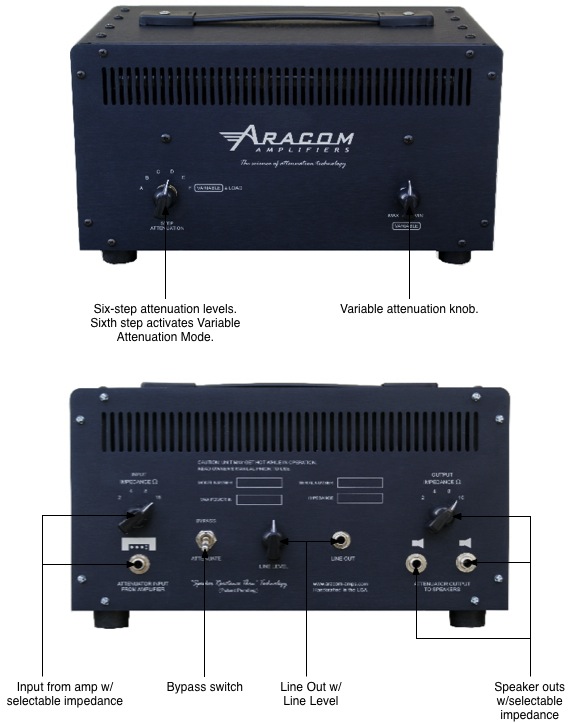
  • Rotary Switch provides (6) Step Attenuation Levels, plus
    the Variable Mode allows continuous variable control of “bedroom” level adjustment
  • 33dB attenuation range
    * Attenuates 100 watts down to well under 1 watt (0.05 watt).
  • 150 watt (continuous average) power rating
  • Independent Input Impedance Switch: 2, 4, 8, 16 ohm
  • Independent Output Impedance Switch: 2, 4, 8, 16 ohm
    * Uniquely allows mismatched amplifier and speaker impedances to be used.
  • Attenuator Bypass Switch
  • Load Mode
  • Line Out with Level Control
  • 2 Speaker Jacks (wired in parallel)
  • Passive design, does not require AC power
  • Rugged, black anodized aluminum housing
  • Heavy duty, steel reinforced handle
  • Handwired and Handcrafted in the USA.

Price: $649 direct

Tone Bone Score: 5.0. Jeff Aragaki of Aracom Amps never ceases to amaze me with the stuff he comes up with! This time, it’s an attenuator invention that blows away the competition in safety and tone and dynamics with its patent-pending Speaker Reactance Thru (SRT) technology, plus extra features that make it unmatched in versatility and usability.

I’ll admit it: As much of gear nut that I am, I’m also a huge techno-geek. I dig new technologies and the engineering behind them; and when someone comes up with some new approach to something, with completely awesome engineering, it’s hard to control my GAS. I just have to have it.

I recently took delivery of a brand new attenuator invented by Jeff Aragaki of Aracom Amps, called the Power Rox PRX150-Pro. This, by far, is the best attenuator I have ever used, and will be a fixture in my rig for years to come. That’s right. This will always be in my chain. But not just because of its ability to transparently attenuate an amp signal. This attenuator has features that no other attenuator has such as two speaker outs, and a Line Out that you can use to go direct into a DAW, or even another amp! Talk about versatility. Not only that, because you can match impedance in both the input AND the output, combined with Jeff’s patent-pending Speaker Reactance Thru (SRT) technology, you can squelch down the power of your amp and not worry about ever blowing our your tubes and ruining your amp. The SRT technology just kicks ass!

Talking the Talk AND Walking the Walk: Speaker Reactance Thru Technology

Jeff is a very humble man, so he’d never say anything like this, but I’m not nearly as humble, so I will say it: There’s not a better attenuator than the PRX150-Pro. Even if Jeff didn’t include all the extra features you get with the Power Rox, this attenuator simply kicks the shit out of all the attenuators I’ve ever tried – and I’ve tested several, including the Ultimate Attenuator that seems to be the most popular attenuator; and with respect to safety, tone and dynamics, all others simply pale by comparison.

Where other manufacturers make bold claims (read: brag) about their attenuators’ transparency, not only can Jeff Aragaki make the claim (in his quiet and humble way), he backs it up with detailed discussions of his SRT technology and the engineering behind it and what makes it so transparent. Jeff’s SRT technology is absolutely incredible. At any level of attenuation, the Power Rox retains your tone and dynamics. This is because instead of just dealing with amp power reduction through a series of resistors or a dummy load, which also have the added effect of flattening out the impedance curve and changing tone, the SRT technology ensures that reactance between the amp is maintained throughout the entire spectrum of attenuation; hence, the name “Speaker Reactance Thru.” This means that the impedance curve is kept intact so that the continuity of reactance between the speaker and the amp are maintained. Jeff discusses this in a detailed article about the advantages of the PRX150-Pro.

Let’s talk a bit about safety…

As I mentioned, the PRX150-Pro will not burn out your amp. You can crank your amp up all the way, getting that wonderful power tube drive, and not worry about your amp blowing a tube, or worse yet, frying some circuits from flyback voltage. We’ve all heard the horror stories about people using attenuators, cranking their amps, and blowing power tubes. A lot of this has to do with impedance mismatching. Some manufacturers have added options to match impedance from one direction, but the Power Rox has impedance matching in both the input and output jacks! But the point of this is that with impedance matching on both sides, you don’t have to deal with any type of mismatch. That is very comforting to know.

I’ve actually been playing with the Power Rox for the last couple of months regularly before it hit the shelves, and to date, I haven’t had any power tube problems. And we’re talking running my amps down to less than a watt for a few hours straight. I could never do that even with my Dr. Z, which is one of the more safe products out there. I’ve burned out power tubes using my Dr. Z by cranking power too much. It’s not pretty, and I’ve been lucky so far that only my tubes got burned out. It could’ve been a lot worse.

This ain’t yer Daddy’s Buick…

When Jeff first spoke to me about the Power Rox, I thought, “Okay, it’s another attenuator. I’m sure it’ll be great considering what a whiz Jeff is…” But when he delivered the unit, I couldn’t believe what he had added! I was already impressed that it had both input and output impedance matching. That was simply awesome. But he added some awesome features that I was not at all prepared for:

  • Bypass Switch – This is a mechanical bypass that completely bypasses the attenuation circuit.
  • Line Out – This one thing is just so cool! I used it to go both direct into my DAW, and also used it to re-amp into my Hot Rod Deluxe! Talk about versatility! For a test, I ran a cable to my 1 X 12 cab, then ran another cable to my Hot Rod. I could’ve easily just run direct into my Hot Rod without going out to another speaker as well, but you can see how useful this is. I could get my amp’s tone and combine it with the Hot Rod’s tone. So cool!
  • Two Speaker Outs – This is yet another cool thing. You have multiple cabs that you want to drive with a single amp? This makes it easy.
  • Input AND Output Impedance Matching – No other attenuator matches impedance in both input and output, but the Power Rox has it. It’s all part of the package to ensure continuous reactance between the amp and the speaker.

So as you can see, the added features make this oh so much more than just an attenuator, and it’s a testament to Jeff’s creativity!

The proof is in the pudding…

Unfortunately, doing sound clips of an attenuator’s effect is fruitless, because it is difficult to hear the changes, and moreover, it is difficult to describe the change in dynamics on a recording. However, the Power Rox was tested side-by-side to a number of popular attenuators, and even at low levels of attenuation, compared to Power Rox, all the other attenuators had an effect on tone and dynamics. To date, several people have performed head-to-head comparisons between different attenuators and the Power Rox, and they all come to the same conclusion: The Power Rox is truly transparent; not just the most transparent of the lot, but truly transparent. To me, this box sets the standard by which all others must be measured now.

I used my own transparency test procedure to compare attenuators, but Jeff has also provided a very detailed, and in-depth transparency test that you can view on his site.

I know, I must sound like a twitterpated schoolgirl with how I’m raving about this product, but for the very first time, I’ve been able to record my amps fully cranked without pissing off my family and neighbors, and more importantly, without having to worry that I’m going to blow a tube. Even with my Dr. Z, I’ve had to settle with less drive on my recordings for fear of burning out my amps. But with the Power Rox, I can crank my amps and get that wonderful power tube drive! And even better yet: I can trust that my tone and dynamics will not change, no matter the volume!

For more information on the Power Rox PRX150-Pro attenuator, go the Power Rox Product Page!

PRX-front-543You ever have an itch you can’t scratch? Well, it has been like that keeping my mouth shut about the Power Rox PRX150-Pro. Ever since I played with the early prototypes, I’ve been completely blown away by this attenuator! This is a totally new take on attenuator technology, folks, and I’m hoping it takes the industry by storm. Why? Simply because what we’re talking about with the Power Rox is true transparency in tone when this is in your signal chain; not “almost” transparent, but truly transparent.

Check out the Power Rox PRX150-Pro page at Aracom Amps!

Most comparisons between attenuators revolve around what’s the “most transparent” attenuator, indicating that really none of them are transparent, so people pick the best of the lot. And frankly, I’ve tested out several attenuators and ended up with the Dr. Z Airbrake, as I felt it was the most transparent out of the ones I tested. But nothing could have prepared me for the transparency of the Power Rox.

I could go on and on, but I won’t. In fact, I had already written a significant amount of text, but decided to just point you in the right direction. Go to the product page. Read through the product description, but more importantly, read the supplementary documentation behind the links at the bottom of the page. Jeff Aragaki has graciously provided some very in-depth articles on how attenuators work, and also provides a high-level explanation of the technology behind the PRX150-Pro.

Other manufacturers may brag about the safety and transparency of their attenuators, but none is willing to back up their claims with the engineering behind their attenuators (and if you knew what some were doing, believe me, if you care about your tone and the safety of your amp, you’d get worried). If you’re interested in or even use an attenuator, you owe it to yourself – and your tone – to check this unit out!

I don’t have any details, but I just read that Ted Weber passed away yesterday. So sad.

Ted suffered from a lung disease that brought his lung capacity way down. He was on oxygen 24/7 and was awaiting a lung transplant. I guess his body couldn’t wait any longer.

I, for one, will send out a prayer for his family.

27_Les-PaulEarly this morning, I got a text message from my friend Jeff saying that Les Paul had passed away. While part of me is sad from this inevitability, a very large part of me is thankful to him for what he brought to the guitar and recording world. The man was a living legend while alive, having invented the humbucker, the reverb effect, and multi-track recording. His contributions, not only to the guitar world, but to the music world in general have literally shaped the course of musical history, let alone history, as artists the world over have made music – I believe the ultimate leveler in the world – with his inventions.
So while he will be missed, instead of mourning the loss, I for one will celebrate the fact that I had the privilege to live in a time when a legend walked.

Here’s a news story: http://www.cnn.com/2009/SHOWBIZ/Music/08/13/obit.les.paul/index.html?imw=Y&iref=mpstoryemail

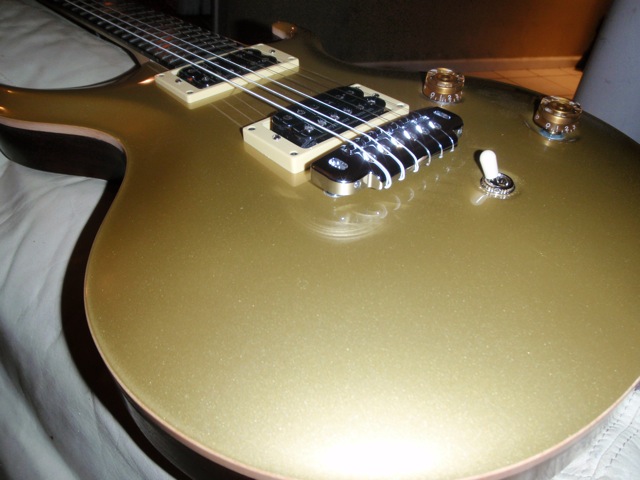
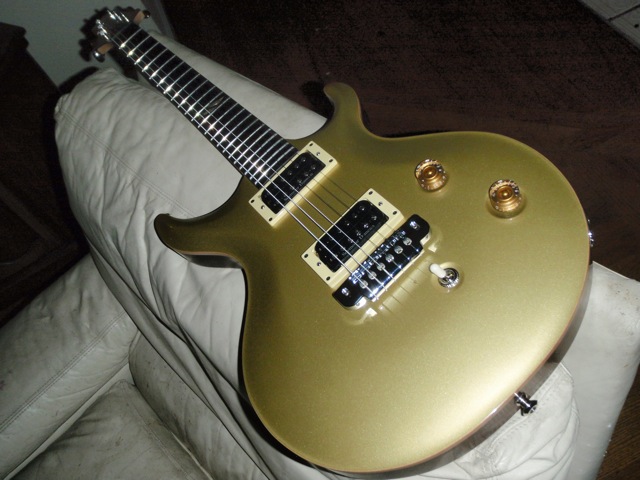
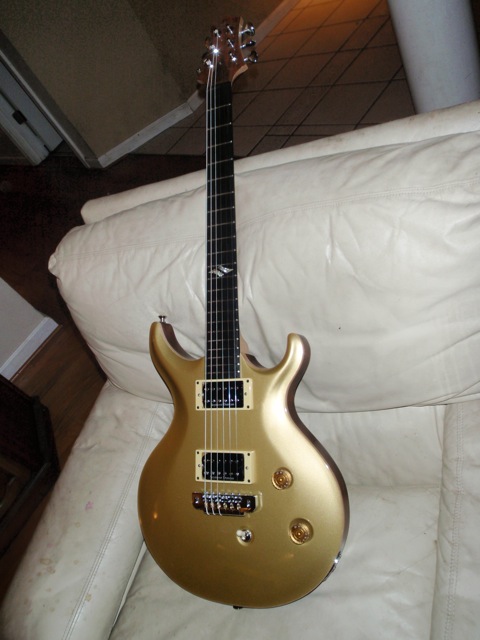
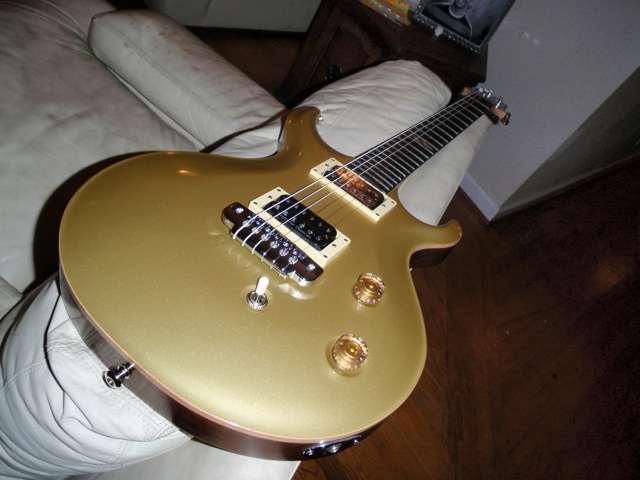
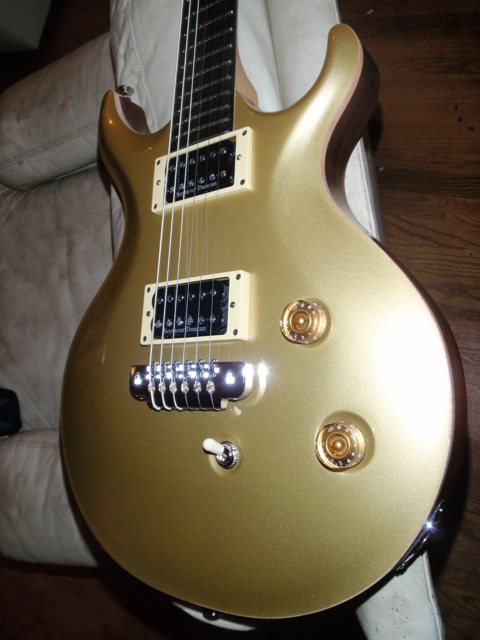
It is so hard to believe, but I finally have “Goldie.” I met Adam Hernandez this evening to pick up the guitar, and she is absolutely gorgeous in both looks and sound! I’m still kind of pinching myself because I can’t believe I finally have her. There is absolutely NOTHING like having a guitar that is custom made to your specifications.

Below are just a few pictures that I wanted to share for now. I will take more pictures of her in the morning. I need to play her a bit more before going to bed. 🙂

To see the full pictorial, check out my page dedicated to Goldie!

Sound Clip

I quickly recorded a sound clip of how Goldie sounds clean. In the “rhythm” part, I have both humbuckers going. It has a sweet, chimey, and big tone. The first part of the solo features the bridge pickup in single-coil mode. The second part to the end features the bridge pick in full humbucker configuration. The tones I’m able to produce with this guitar are just amazing!

This guitar has exceeded ALL my expectations, and her sound is so unique. With the coil-tapped humbuckers, I can get a gorgeous, chimey, Strat-like tone to incredibly beefy breakup! The neck is absolutely perfect. It is a perfect “C” at the nut, then tapers out to a flatter “C” at the joint. In fact, with Goldie, Adam discovered a new way to taper the neck that he will be using in future builds!

Goldie was an experiment with wood combinations. What I wanted to achieve with her was a bright toned guitar that had the ability to grow some big, hairy balls, yet at high gain, would retain its clarity. With its solid walnut back, maple top, rock maple neck, and ebony fretboard, Adam achieved exactly the tone I was after. And with Adam’s proprietary and unique neck joint, this guitar sustains for days! I’m absolutely in love with this guitar!!!

For more information about Saint Guitars, visit the Saint Guitar Company web site!

Wow! I’m so amazed that Goldie is finally ready. It has been a long process, as Adam has worked in his precious spare time to build this guitar for me, but the wait has been worth it. If you’ve missed the build series, check it out here: https://guitargear.org/makinggoldie.

minutiae

I asked myself this question this morning while having my morning cup. I was ruminating on various ways to make my signal chain a cleaner. It’s pretty clean as it is, and I pride myself on having little to no electronic noise when my rig is at rest. But I still want it dead quiet. I don’t know if it’s entirely possible, but I knew there were things that I could do. So I started coming up with a punch list of things including getting high-quality cables with good shielding; replacing any non-true-bypass pedals on my board that often cause noise; things like that.

Then I stopped and asked myself, “Where am I at with my tone? Am I reasonably satisfied with it? Is there any specific thing that really needs addressing?” And the answer to those questions was no. I looked at my list and decided they were nice-to-have’s but not really addressing and particular problem or “hole” in my tone. Truth be told, as of late, I’ve been using pedals A LOT less as of late. While I may kick in an overdrive pedal occasionally, and usually have my reverb on, I’ve been doing without pedals. In fact, for the past couple of gigs I’ve played, I haven’t used pedals at all, except for a tuner!

I guess this is the dark side of being a gear slut; it’s really a borderline addiction; an urge akin to an itch you can’t scratch, a unicorn that can’t be caught. Like the cursed pirates in the Pirates of the Carribean, the desire for gear is a lust that is never slaked, or at least easily slaked. At times it gets to the point of not even having a reason for getting the gear – I just have to have it! 🙂

I was actually surprised by my moment of lucidity, and actually relieved that I pulled myself back from the brink of investing yet another few hundred dollars into gear. I also realized that as far as my rig is concerned, I’ve sort of reached a point where the law of diminishing returns is starting to kick in. Yeah, it would be nice to have high-end, expensive cables (I still may do that just for my pedal board), but at this point, it doesn’t really buy me much – even my pedal cables. And while I believe I would get an improvement in my tone, I think the improvement would be more subtle than anything else.

So here’s some food for thought: The next time you want to buy some gear, ask yourself if you’re already satisfied with your tone. Be honest. You may be surprised to find that you are.

Courtesy of zentao.com

Courtesy of zentao.com

This will be a pretty short entry, but it is something that it seems I’ve spoken about with various young guitarists I work with on a constant basis, so I thought I write my thoughts about it here. BTW, this is not necessarily going to be an instructional article. For that, do a search on “guitar right hand technique” and you’ll be rewarded with lots of sites that provide instruction on right hand technique.

But that brings to light a problem I’ve seen with a lot of guitarists I’ve worked with over the years, young and mature alike. Many playes focus so much on the left hand and playing “lead” guitar that they completely forget about the right hand! The left hand my make the notes, but the right hand makes the sound and just as importantly, keeps the tempo. Music is a function of making notes and playing those notes in a rhythm.

Don’t forget about the right hand!