Feeds:
Posts
Comments

Posts Tagged ‘amps’

4.75 Tone Bones - Almost perfect but not quite. Still way above average!

Aracom Amps RoxBox 18 Watt Combo Amp

Aracom Amps RoxBox 18 Watt Combo Amp

Aracom Amps RoxBox 18 Watt Combo

Summary: The RoxBox is an ideal small to medium size venue amp. Don’t let it’s diminutive size fool you. This amp is LOUD, and packs a real punch. Oodles of clean headroom in Channel 1 and capable of super-sinister drive in Channel 2 due to the “hidden” extra gain stage. Very pedal friendly.

Pros: Crystal-clear clean tone in either channel, though the second will break up earlier. Switchable from 18 Watts down to 9 Watts, so you can use this on stage and in the bedroom. Master volume kicks ass, and acts very similar to an effects loop attenuator. At 18 Watts, it’s loud enough to blow your ears off! Very pedal friendly.

Cons: Only a nit, but I wish this thing had a spring reverb. Also, overdrive can be a bit harsh at lower volumes, especially with single coils, though it’s gorgeous at louder volumes and moderate volumes using hubuckers.

Price: $895 direct

Specs:

– (2) EL84 Power Tubes
– (2) 12AX7 & (1) 12AT7 Preamp Tubes
– S.S. Rectifier with “sag” circuit
– Hi/Low B+ voltage switch (18/9 watts)
– On/Off Switch
– Indicator Lamp
– Custom Heavy Duty Aluminum Chassis
– Custom Wound Transformers
– 4, 8, 16 ohm Speaker Jacks
– Custom Handcrafted
Turret Board
– Handwired
– Weight: ~35 lbs

Combo Cabinets
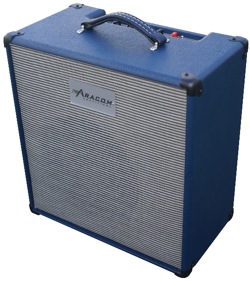
Standard Tolex: Navy Blue Levant (as tested)
– Dimensions
1×10 Combo: 18″w x 19h x 10″d
1×12 Combo: 18″w x 19h x 10″d
– Weight
1×10 Combo: 36 lbs
1×12 Combo: 39 lbs

Tone Bone Score: 4.75 On value alone, this would get a 5, but the mildly harsh breakup at lower volumes gives it just a slight mark off. Still, it’s a great amp!

Jeff Aragaki, the owner and designer/builder of Aracom Amps is on a mission to transition from his telecommunications business entirely into his amp building business. I’d say that based upon playing just this one amp (both the head and combo versions), and having a look at a couple of other amps in his line (which I will probably review in time), he’s well on his way to successfully completing that mission. And Jeff’s not alone in this quest. A few folks I know here in the Silicon Valley have preceded Jeff, moving from their high-tech careers into the music equipment business; and while they may not have become super-wealthy off these new endeavors, they’re certainly living their dreams.

It’s like that in the Silicon Valley which, for decades has been a hotbed of innovation and dream-chasing. And while its star has faded somewhat as the global technology leader and the market has opened up allowing more players to the tech scene (China and India, for instance), the spirit of innovation and going after your dreams upon which “The Valley” was built remains alive and well, as evidenced by guys like Jeff. And true to Silicon Valley form, what these guys produce is quality stuff, and Aracom amps definitely follows suit!

When Jeff and I first hooked up, I was really excited about his 18 Watt RoxBox. First of all, I just dig the EL-84 tone, and secondly, I was amazed that he could offer this amp for less than a grand, and it’s a hand-wired amp, for goodness sake! I knew I had to check it out. And lucky for me, the city where Jeff lives is a half-hour away (if the traffic’s good), so two days after I first spoke with him, he personally delivered a head and a combo. I’ve been playing with both since (though I was so excited, I let my buddy borrow the head for a couple of days to see how he likes it). I’ve tested both amps in the studio as well as at gigs, but I’m writing this review about the combo. If you want to hear how the head sounds, check out this clip:

My Tests

For my tests, I used my Strat, my PRS SE Soapbar II with P-90’s, and a Saint Baritone Messenger that I’m also testing. The amp performed excellently with all three guitars, but was especially responsive to the baritone which has active humbuckers in Channel 2. But before I get ahead of myself, let first me go over the amp’s features apart from its technical specs.

Controls and Equipment

The RoxBox features two independently voiced channels, each equipped with a volume and tone knob. The Tone control functions similarly to a high-freq sweep. It also has a Master volume which is available to both channels. The Master volume is very cool as it functions as an attenuator between the pre-amps and the power tubes, so you can slam the front of the amp with tons of input gain to get that sweet, mid-rangy pre-amp distortion while keeping the output volume at bedroom levels. Great for edgy blues and classic rock tones. The combo I tested also sports an Eminence Red Fang Red Coat 12″ speaker. Operating at 30W, this sucker has a lot of balls! As expected, the sound was a little harsh when I first tried it out, but after several hours of playing, it’s starting to break in and the tone is starting to become a lot more smooth. Now with that out of the way, let’s get into some details.

Channels

Channel 1 would be considered a normal channel, while Channel 2 is a drive channel that will break up a lot earlier. But with Channel 1, the name of the game is “clean.” With my Strat plugged in, this channel has so much clean headroom that I had to really dig into the strings to produce even a slight amount of grind. My PRS with P-90’s and the Saint Messenger could only produce moderate amounts of grind when the volume was dimed. That’s pretty impressive, and definitely not what I expected. With so much clean headroom, Channel 1 is VERY pedal friendly.

Channel 2 on the other hand definitely breaks up early and is voiced just a tad brighter than Channel 1. But it also has a lot of clean headroom as well. With my Strat, I had to turn the volume knob past 7 to get some decent grind, and had to peg my guitar volume. Believe me, that’s not a bad thing either. On the other hand, My PRS SE Soapbar II and the Saint Messenger had no problems producing grind. I could get breakup at around 4 with the Messenger, and around 5 with the PRS.

To get earlier breakup, Channel 2 actually has a third “hidden” pre-amp gain stage in series behind the pre-amp you plug into with fixed settings. It’s voiced a bit hot, and as Jeff puts it, it’s like having a built in tube overdrive. The end result is you get breakup a lot earlier. I have to say that while I like Channel 1’s tone, for pure versatility, Channel 2 really does it for me, as it is lively and responsive to changes in attack and guitar volume. And putting a booster in front of this Channel really brings on the growl that this channel is capable of producing.

How It Sounds

Tonally, this is definitely an EL-84 amp. It’s bright and chimey, and with the Red Fang, it also has lots of balls. For sweet, clean tones, Channel 1 produces a lush clean tone, and my Strat in the Neck/Middle position sounds gorgeous through this channel. As I mentioned, it’s a bit brighter than Channel 1, which made me tweak my guitar tone knobs a bit, but not so much so that it’s unusable. And where this amp really shines in the tone department is when it’s moving lots of air. Plugged into Channel 2 with the volume turned up around 12-2 o’clock, and the Master past three, the amp simply sings its heart out, though at those volume levels in an enclosed space like a home studio, the assault on your eardrums can get a bit uncomfortable.

And while I don’t want to say anything negative because I truly dig this amp, I have to say that at lower to moderate volumes with a Strat, a driven Channel 2 (Volume around 8, Master around 2) seems a little flat sounding. At this level, the pre-amps are distorting with little contribution from the power tubes. Don’t get me wrong: It’s not bad sounding, it’s just a bit uninspiring. But turn the master up so that the second gain stage starts clipping and the power tubes start getting hit, and the world is made right again. I did, however, find a couple of workarounds to this. The first was easy: Just engage my Tube Screamer to add to the grind produced by the pre-amps at lower volumes; instant sweetness. Also, slamming the front-end with input gain from my booster worked wonders as well. The best solution I found that will also engage the power tubes was to use my Dr. Z Air Brake Attenuator. The world definitely became right with that in the signal path.

Versatility

The RoxBox is very versatile and is comfortable on both the stage n in the studio. I really dig the master volume on this because that’s really what makes this amp so versatile. And one feature that is mentioned in the specs but something I’ve found incredibly useful is that the amp is switchable from 18 Watts to 9 Watts with the flick of a toggle switch underneath the amp chassis. For home studio use, this is a godsend as the lower wattage allows the tubes to saturate earlier, which means you can get grind at lower volume levels. Some people think this means lower volume – it doesn’t – for any variable wattage amp. All it means is that the amp breaks up earlier. But having this capability means that you can gig with it at 18 Watts, then bring it into your home studio and get some great tube distortion without keeping the neighbors up late at night while you’re wailing on your guitar.

Also, as opposed to having a single output jack for external speakers, the RoxBox sports three, for 4, 8, and 16 ohm extension cabs.

Overall Comments

This is an amp that I’ll definitely be considering to add to my arsenal because of its tonal similarity to the classic Vox AC15, plus its gorgeous and plentiful clean headroom in Channel 1, but also for its value. At $995 for the combo the tonal versatility you get for the price is well worth the expense. If I had a nit, it would be the same nit I have with the Reason SM25, and that is the absence of a nice spring reverb. But that is just a nit because both amps sound great without it – it would just be icing on the cake.

Read Full Post »

Aracom Amps RoxBox 18 Watt Amp

Aracom Amps RoxBox 18 Watt Amp

I love writing this blog. Not only do I get to share my passion for guitar and guitar gear, in the couple of years since I started this blog, I’ve met and encountered some really great folks who also share the same passion. After all, it’s why you visit, and I thank you for all the support you’ve given me! When I started GuitarGear.org, I didn’t have any idea of where I’d go with it. I just started writing; not very often at first, but then it just kind of took on a life of its own as I found other great gear blog sites, and started interacting with the general blogging community, and the people I’d meet on other sites would visit my site. That’s what has kept me going, and it’s just an amazing thing!

Of course, it’s really cool to review gear, whether I own it or test it, then share my findings with folks. And speaking of reviewing gear, in this article, I’m introducing what looks to be a real promising, new amp company, called Aracom Amps! They have a whole line of reasonably affordable, hand-wired amps modeled mostly after classic Marshal amps. From what I could tell from the sound samples, these are very nice sounding amps, and the few reviews I’ve been able to find have all been exceedingly favorable. So like I said, there’s a lot of promise in this relative newcomer to the custom, hand-wired amp space.

Jeff from Aracom contacted me the other day to see if he could buy some ad space on my site. I replied that I had never even considered doing that because I didn’t want to commercialize the site. The most commercial thing I’ve done to this point is to put “click-throughs” to Musicians Friend on some of my review pages so people could buy gear directly, but I never actually expected to make any serious money from the site. However, I did tell him that at the very least, I’d review some gear for him, and if I really loved it, like I do with Reason Amps and Saint Guitars (by the way, I just got a new baritone yesterday to test, and IT ROCKS!!!), I’d make a banner for him and put it on my site.

So I am now awaiting delivery of what I think is a very, very cool EL-84 based 18 Watt amp called the RoxBox. It’s completely hand-wired on turret board, and it comes in a head version (which is what I’ll be initially reviewing), and in two different combos: A 1 X10 and a 1 X 12. Nice. It has two individually voiced channels with independent volume and tone control, and is also switchable down to 9 Watts. So this promises to be a very versatile little amp. To say I’m extremely excited about receiving this amp is putting it mildly. The reason why I’m so excited is because the most you’ll pay for one of these is $995.00!!! Imagine that! A hand-wired amp for less than a grand! It’s unheard of! And all Jeff’s amps are very reasonably priced.

Let’s look at some features:

General Specifications:
– (2) EL84 Power Tubes
– (2) 12AX7 & (1) 12AT7 Preamp Tubes
– S.S. Rectifier with “sag” circuit
– Hi/Low B+ voltage switch (18/9 watts)
– On/Off Switch
– Indicator Lamp
– Custom Heavy Duty Aluminum Chassis
– Custom Wound Transformers
– 4, 8, 16 ohm Speaker Jacks
– Custom Handcrafted Turret Board
– Handwired

Head Cabinet
Standard Tolex: Black Levant. See options below for other colors.
– Dimensions: 19″w x 8h x 8.25″d
– Weight: 23 lbs

Combo Cabinets
Standard Tolex: Black Levant. See options below for other colors.
– Dimensions
1×10 Combo: 18″w x 19h x 10″d
1×12 Combo: 18″w x 19h x 10″d
– Weight
1×10 Combo: 36 lbs
1×12 Combo: 39 lbs

Introductory pricing:
Rox Box Head $895
Rox Box Combo with 10″ Jensen ALNICO Speaker $995
Rox Box Combo with 12″ Jensen Ceramic Speaker $995

Pretty impressive!

I had a great conversation with Jeff this morning about his amps’ price points, and he said that considering today’s economy, he wanted people to be able to buy his amps, and since he does all the work himself, and has done a tremendous job with planning his manufacturing (for example, all his amps use the exact same chassis template), he can keep the price down. With the RoxBox, he was able to keep the price point down further by using a solid-state rectifier that simulates a rectifier tube’s voltage sag rather than using a tube rectifier. Now before you dismiss this, remember that the venerable Fender company has been using solid state rectifiers in their amps for decades, and no one complains about their gorgeous sound! But besides that single piece of solid state componentry, everything else is hand-wired and tube-based.

Check out the RoxBox and other Aracom Amps at the company web site!

Read Full Post »

Reason Amps SM25 25 Watt Combo Amp

Reason Amps SM25 25 Watt Combo Amp

Reason SM25 25 Watt Combo Amp

Summary: Incredibly expressive and versatile amp that can deliver a wide range of tones from glassy, sparkly cleans, to lewd, rude, and crude distortion, all in a single cabinet!

Pros: Killer tones in all channels. Amp is voiced bright by design, which makes it great to use in the studio. StackModeTM is the best thing since sliced bread, and is THE secret sauce that makes Reason Amps stand out from the rest.

Cons: No effects loop, which would be handy for placing reverb and other modulation effects after the amplified signal. Just a nit.

Price: $2395

Specs:
• Output: 25 watts RMS @ 5% THD
• 1 X 12 Eminence Red Coat Driver
• (2) 6V6 output tubes, in Class AB Fixed Biased configuration
• (4) 12ax7 preamp tubes
• GZ34 Rectifier tube
• 3 way Stack switch – Normal, Stack, Bright
• Normal channel – Volume, Treble, Middle, Bass
• Bright channel – Volume, Tone
• StackMode™ – Bright & Normal channel controls are active, Stack Volume & Hi-Cut
• Oversized extra capacity power supply
• Power Switch
• Standby Switch
• Independent output jacks for 4,8, 16-Ohm operation
• Footswitch access to all three channels/modes

When I discovered the Reason Amplifier company a few weeks ago, I was so intrigued by what they had to offer that I immediately contacted them. I had the fortune of getting in touch with Anthony Bonadio, one of the founders of Reason to talk to him about his exciting new company and his new line of amps. That conversation led to him sending me an SM25 25 Watt combo to review; and since I’ve had it, I haven’t gotten much sleep from playing with it late into the night. Now you might say that I’m just excited about playing a new amp. Yes, that certainly has a lot to do with it. But what Reason has come up with in their amplifiers is so incredibly brilliant and unique that I’ve been spending all my free time trying to discover the subtle intricacies of this tone machine. There’s a lot to talk about, so let’s get started!

“Dahr-ling, you look mahvelous!”

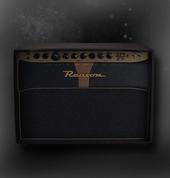
The Reason founders, Anthony Bonadio and Obeid Kahn, are both vintage gear freak-o-maniacs, and the retro styling of the entire Reason amp line is a testament to that passion. The SM25 sports a black tolex cabinet with light brown trim around the grille cloth, and a thick leather handle with what appears to be brass accoutrements. Between the control surface and grill cloth is a prominent tolex-covered cross board sporting the Reason logo which, by the way, is very cool, very retro as well. The control board looks like burnished brass with black, bold lettering for labels. And to add to that retro vibe, chicken head knobs are used for all the controls. This amp, and all Reason amps for that matter, just ooze vintage mojo. Just looking at the amp, I can’t help but grin that grin you get when you see something so far-out COOL!

It’a hard to discern the actual size of the amp from just a picture. So make no mistake about its size: This is not a diminutive 25 Watt amp. In fact, it’s about as big as a Fender Twin, though not as deep. The shipping weight said 32 pounds, but from feel and comparison to my Fender Hot Rod, it weighs almost as much. But that’s not a bad thing. A beefy cabinet creates a lot of resonance if done correctly, and believe me, it’s done correctly with this amp.

How It Sounds

All Reason amps, including the SM25 are voiced bright. You don’t get beefy lows out of this, and that’s by design. Now before you dismiss that, on stage and in the studio, that bright voicing will ensure your guitar cuts through the mix. I recently played it at one of my regular gigs, and where my amp oftentimes gets lost in the mix, forcing me to pump up my volume, I had no problem cutting through, and mind you, I barely had to push my volume. The bright voicing let my guitar tone sit in the mids and highs. My sound guy even commented on how well he could hear my guitar without me pushing the volume like I usually do during a solo break; though admittedly, like any lead guitarist, I usually don’t mind being louder than everyone else. 🙂

In the studio, using the amp for recording is like being in heaven. The bright voicing combined with the rich tones the amp produces is simply candy for the ears. From a practical perspective, brightly voiced amps also record much better. For home recording I’ve had to stop using my big amp because it’s just too boomy, no matter how I set the EQ. I’ve had to use smaller, brighter amps because they cut through a mix much better. But since I’ve had the SM25, I’ve recorded two songs with it, and like I said, I’m in heaven. I now have a bright voice to cut through the mix, but rich tones as well. It’s the best of both worlds!

The SM25 is also incredibly touch-sensitive and responsive to the subtlest manipulations I made on my guitar. In fact, when I first started playing with it, I was a bit embarrassed by how I sounded. For my all my tests, I played along to some jam tracks I’ve produced for practicing different styles, and recorded what I played through the amp. When I played back what I had recorded, I was appalled at how crappy I sounded! All my mistakes came through! I couldn’t hide whatever bad habits or bad technique I had behind effects, like I normally would. In short, this amp has forced me to play better because it’s so unforgiving when you make a mistake. But hey! It’s never a bad thing to be shown your weaknesses. That’s how you grow and improve!

Multiple channels, lots of tone shaping possibilities…

The SM25 comes with two channels: Normal and Bright. But it also sports a third “channel” called StackModeTM that’s essentially the Normal and Bright channels run in a series with an extra gain stage, while retaining volume and tonal control over the Normal and Bright channels. To me, StackMode is Reason’s secret sauce, but I’ll get into that in a bit. I’ll first describe the independent channels.

The Normal channel sports a volume knob and a three-band EQ. The volume knob is also a push-pull knob, and pulling it out adds some extra high-freq boost to bring out the super high frequencies. The effect is that once you set up your EQ, pulling out the knob adds some extra high-freq shimmer and sparkle. It’s subtle, but absolutely delicious. Comparatively speaking, the Normal channel sounds like your classic, jangly American clean tone, but with the high-freq boost, you get a bit of the sharpness of the British clean – nice.

The Bright channel is well, bright. It too has a push-pull volume knob for extra high-freq boost, and it has a single tone knob to back off some of the brightness. The Bright channel is also the more “ballsy” of the two, and really kicks in some pretty high gain. It’s quite lovely, in my opinion, and it’s perfect for doing the traditional solo break that will cut right through a mix with ease.

Channels? We don’t need no stickin’ channels!

But for me, the real attraction of this amp, and actually any amp from Reason for that matter, is StackModeTM. In all my years of playing, I’ve never come across anything quite like it. On the surface, you might think this is just another channel on a multichannel amp. It is in a way, because of its independent gain stage. But that’s about as close a comparison that you can make to other multichannel amps. Unlike other multichannel amps where all the channels are independent, StackModeTM input doesn’t come directly from the guitar. The guitar’s signal is routed through the Normal and Bright channels first, then fed into the StackMode channel. And the volume and EQ settings on the Normal and Bright channels are still active!

Because volume and EQ are retained in the Normal and Bright channels in StackModeTM, the tone shaping possiblities are incredible. What you adjust in Normal or Bright affects the final output. You can crank up the volumes on the first two channels and achieve uber gain, with thick, rich distortion. Or you can dial it back a bit and take a more balanced approach. The point is that you can do a lot of tone shaping to your needs while in StackModeTM. And here’s the kicker: The amp still retains its touch and guitar volume sensitivity in StackModeTM.

What does this mean? Well, I soon discovered that StackModeTM was the only channel I’d probably ever use, unless I had to go super clean, whereas I’d just switch to the Normal channel. The amp in StackModeTM is so responsive to picking attack and volume knob levels that I found I just didn’t need to do any channel switching at all once I dialed in my settings for the Normal and Bright channels. It’s that good!

One other thing, the volume knob on the StackModeTM channel is a very good Master volume. When I’m playing late at night, I can turn the volume down on the StackModeTM channel, and still retain the characteristics of the settings I made in the first two channels. It’s just softer. How cool is that? So that’s why entitled this section, “Channels? We don’t need no stinkin’ channels.” Once you have your settings dialed into StackModeTM, you’ll never want to get out of it! So for me, the SM25 is effectively a single channel amp with adjustable stages.

My Tests

In any case, for my tests, I used four different guitars: A Strat, a PRS SE Soapbar II with P-90’s, an Epiphone Korina Explorer and a Saint Guitars Benchmark, both with humbuckers. I’ll talk about how each guitar sounds separately below.

Fender Strat

Obeid Kahn is known in the industry as a “Strat man,” and this amp really sounds great with a Strat. I’ve got the vintage re-issue Tex Mex pickups in mine, and slathering on reverb, you can get some awesome Dick Dale-like tones. But it doesn’t necessarily sound like a Fender amp. In fact, the clean tone is like a cross between a Fender and a Marshall. It’s creamy smooth, but bright and sparkly at the same time. The big cabinet adds to the resonance, and the ever so slight voltage sag that you get from the rectifier adds to the sustain and resonance. This is boon when you’re playing with a Strat because they do not sustain well at all. I could get country twang to hard-driving distortion with uber sustain with my Strat.

PRS SE Soapbar II

P-90’s are hot pickups by nature, and it doesn’t take much to push any amp into overdrive, and when it does this, it’s a preamp overdrive lover’s wet dream! With the SM25, the 12AX7’s just sing with sweet, smooth overdrive goodness. There’s nothing harsh about the sound this produces in the SM25, but one thing I did notice with the tone was that unlike other amps I’ve played with my SE Soapbar II, even though the amp is bright, the sound the amp produces with it is big and bold, without being boomy. It’s crystal clear, and doesn’t wash out the higher notes in a barre chord, which often happens with more boomy amps. All in all, I just dug that halfway between single coils and humbucker sound my P-90’s produced with the SM25.

Epiphone Korina Explorer

This is a real rock guitar, with a warm ballsy tone. Plugged into the SM25, I was amazed at how the amp responded to this guitar, and I was able to spew out some thick distortion and singing sustain with the volume knobs on the amp dimed to the hilt. I’m not a metal player, and technically, with the bright voicing of the Reason amps one wouldn’t think they’d be suitable for metal, but the lewd, rude, and crude drive I could produce with the Explorer plugged into the SM25 was scary! But in a good way. And when I scooped the EQ, yikes!

Saint Guitars Benchmark

Of all the guitars I used for testing the SM25, the amp seemed to love the Benchmark the most. This guitar was spec’d with Blues and Classic Rock in mind, and through the SM25, I’ve never heard it sing like this. I could go from deep, dreamy clean to rabid dog distortion, and the whole time, the SM25 maintained a tonal clarity and character; never muddying or washing out. It was other-worldly, to say the least.

Made for the Road and the Studio

Anthony Bonadio cautioned me during a previous conversation that he didn’t want to alienate people from buying the amps when he said, “Our amps are really intended for the gigging and session musician.” In other words, Reason amps aren’t really meant for the bedroom musician. These amps want to move air, and that’s no exception with the SM25. In fact, when cranked, it’s a hell of a lot louder than my 40 Watt Fender Hot Rod Deluxe, and that’s a loud amp! It just wants to project its voice. Premier Guitar even gave its bigger brother, the SM50, its “Loud as Hell” award. But in my opinion, the real test of an amp is how good it sounds throughout its entire range of volume. That’s a mark of versatility, and in spite of what Anthony claims is the focus of Reason’s line of amps, you actually can play these amps at bedroom levels and still produce kick-ass tone!

A lot of amps don’t sound good unless they’re cranked, but at lower volumes they just peter out and lose their character. But at least with my experience with the SM25, it sounds great at ANY volume. Considering that all Reason amps are built around the exact same circuitry, I can safely say that this probably applies to the entire line. So don’t be fooled by the “loud as hell” moniker. These amps are incredibly versatile amps that are comfortable be played in lots of different venues under a variety of conditions.

My Overall Take

I think you can guess that I just love the SM25. For a musician like me who plays small to medium venues, and whose studio is located in a carpeted garage, this amp is a dream come true. It’s expressive with all my guitars, and it’s so versatile that I can use it wherever I play.

As I shared with Anthony recently, StackModeTM is it for me. It’s the secret sauce that sets Reason amplifiers apart from the competition! For more information, go to the Reason Amps web site. And if your local dealer has some in stock, I encourage you to go there and play around with one. You will not be disappointed; in fact, you’ll be blown away!

Read Full Post »

Reason Amplifiers

This is a continuation and expansion of the original new gear article I wrote previously

Riddle me this…

So what do you get when you cross a veteran cabinet maker with an electrical engineering guru? Right. A new amp manufacturer. But the two guys I’m talking about, Anthony Bonadio and Obeid Kahn, didn’t just want to create another boutique amp outfit; they had to have a “reason” to create yet another amp manufacturing company; and after putting their heads together they did come up with a “reason.” It’s called Reason amps!

I recently had the privilege to speak with Anthony Bonadio at length about his new company, and I’m incredibly impressed with the vision behind Reason amps. As Anthony put it, their new amp had to be different: Not just a re-expression of existing designs, but something truly different; otherwise there wouldn’t be a reason to build one (get it?). And at first blush, it certainly appears that they’ve realized their desire to be different. But in order to be different, you have to know what you can do against the existing paradigms, and both Anthony’s and Obeid’s pedigrees as amp cab manufacturer and electrical engineer respectively have given them a certain industry perspective that have allowed them to produce an amp that does indeed push beyond the current paradigms.

So what’s so different about Reason amps? You might look at the amp and say, “This is just another flavor of a vintage-voiced two channel amp.” And if all you used were the Normal and Bright channels independently, you’d be mostly correct. In fact, both Obeid and Anthony are vintage gear freaks, and wanted to produce a vintage-voiced amp – but take it elsewhere… And it’s the third mode of operation that makes this amp really stand out. It’s something Obeid coined “StackMode.” Make no mistake, StackMode isn’t just adding a gain stage to an amp. It’s actually running the two amp channels in series.

“So what,” you might say, “That sounds like a bunch of marketing mumbo-jumbo. There are lots of multi-channel amps on the market.” Not like this. In almost all multi-channel amps, the signal handling for each channel is performed independently. Channel switching is pretty much an internal A/B box. Some amps will have independent EQ on each channel, though most have a “Master” EQ that controls the EQ for all the channels.

StackMode is different – and more importantly, it hasn’t been done before (at least not that I know of).

With StackMode engaged, the fully amplified signal from the first channel flows into the next channel in a series, so what you do to the input gain, EQ and output from the first channel directly affects the signal of the second stage; hence the term, “StackMode.” So in reality, this is not just a different take on an existing pattern. It’s taking an existing pattern and creating a completely new application out of it.

In light of this, I asked myself, why hasn’t this been done before? It seems so simple in concept. But in reality, it’s not easy at all because of the power management issues that arise from essentially re-amping a previously amplified signal that has already gone through a gain stage. With the Reason amps, it’s all about the engineering behind managing the voltage and current, and that’s where Obeid Kahn’s engineering genius has come into play.

So to re-answer the original question that I started the article with: What do you get when you cross a veteran cabinet maker with an electrical engineering guru? You get a new amp that completely breaks the mold of existing amp designs. To say I’m excited about this doesn’t even begin to scratch the surface of what I’m feeling.

The Amps

Reason amps come in two tonal flavors depending upon the power tubes you choose, either EL34- or EL84-based. From the EL34 side Reason offers the SM50 head, SM25 head, SM25 combo for 50 and 25 Watt ouput respectively. On the EL84 side, there are the SM40 head and SM20 combo, with 40 and 20 Watts of output respectively. And of course, they 4X12, 2X12, and 1X12 speaker cabs for the heads as well. No matter what amp you choose, all come with StackMode, so all you have to decide upon is your tonal and power requirements!

Amazingly enough, prices are “Reason-able” considering the engineering that has gone into the amps and compared to other boutique amp manufacturers. Here’s a quick list:

EL34

SM50 Head – $2295
SM25 Head – $2195
SM25 Combo – $2395

EL84

SM40 Head – $2195
SM20 Combo – $2295

Cabs

412 Cab – $995
212 Cab – $595
112 Cab – $395

So why are the prices for the different amps so close together? Simply because the circuitry is the same for each amp. The only significant difference between the amps is in the power handling for each amp, and according to Anthony, that doesn’t impact the production cost in any significant way.

Hybrid Construction

A lot of purists scoff at the idea that any PCB board is used in the construction of a vintage-style amp. But Reason actually uses a combination of turret boards and PCB boards to handle specific tasks for optimal performance. For instance, all signal handling (read: the tone producing stuff) is done with point-to-point wiring on turret boards, while all the switching is done on PCB boards to ensure fast response and reliability. All boards employed are high-grade, 1/8” thick, so even the PCB boards have ample traces to ensure great current flow. So the idea is to use the best and most appropriate components for a particular job. That’s just plain intelligent engineering.

Made by players for players

A lot of companies claim this, but with Obeid’s and Anthony’s collective experience as performing musicians, they really had the gigging and session guitarist in mind when building their amps. For instance, the amps are voiced bright by design, as brighter amps will be able to cut through a mix a lot easier. They also record a lot better. Case in point, even though I love my Fender Hot Rod Deluxe, I have to admit that it doesn’t record very well because of its naturally expansive output that makes it sound a bit muddy in a mix. It works great on stage, especially in the low volume venues I play. But in the studio, I tend to use smaller amps that have a real mid- to high-freq voicing because the guitars just sound so much better through them. But with a brightly voiced amp like a Reason, I wouldn’t have to rely so much on tiny, less “ballsy” amps.

One thing I do have to mention is that the volume knob on all Reason amps is a push-pull knob. When you pull it out, you get a high-freq EQ boost, to get more high-end freqs that’ll add extra sparkle and shimmer to your output. This is great for recording!

All that said, Anthony did stress that he didn’t want to alienate any players who didn’t happen to be gigging or session musicians; it’s just that those kinds of guitarists would definitely find an immediate advantage of using a Reason amp because of how it’s voiced.

My Take Overall

Yeah, yeah, I’m excited about yet another thing – if you read this blog with any regularity, when am I not? But really, it’s not too often that new gear totally blows me away. To me, the concept behind StackMode is a staggering achievement. As an engineer myself (though in software), I have a genuine appreciation for new and innovative solutions to different problems, and StackMode is something that really tickles the geek in me. Granted, I’ve only heard sound bites, but I’m soon going to be demoing the SM25 in the near future, and I just know I won’t be disappointed!

Check out the whole story at the Reason Amps web site. It’s awesome.

Read Full Post »

Reason SM25 Combo Amp

Reason SM25 Combo Amp

Need a tube amp? Now you have a Reason. Sorry, couldn’t resist the pun. All right, I know what you’re thinking, “Another amp manufacturer?” That’s what I thought at first until I saw some video clips (I’ll get to those in a sec). But on the flip side of that mild complaint, thank the universe that people have the creativity to come up with different approaches to existing paradigms.

I found out about Reason amps from none other than Mr. Phil Vickman of Fat Tone Guitars just outside of Chicago, Illinois. Being a fellow blog freak, I found Phil’s Fat Tone Blog awhile ago, and signed up for his newsletter. Much to my surprise, his latest newsletter featured an upcoming in-store demo from the guys at Reason Amps on November 12 at 5-7pm. Go to Fat Tone Guitars for address information, or give ’em a call at: 866/512-8663.

So, being curious, I checked out the Reason Amps web site, checked out their sound bites, and much to my surprise, they didn’t have a dealer list, and they didn’t even list MSRP’s for their amps! So, I gave Phil a call, and we had a nice chat. Apparently, Reason Amps is NEW. So new, that not too many people have heard of them. But I have a feeling that their amps are soon going to get some traction.

So what makes Reason amplifiers so special?

Whether you go low wattage or up to their 50W amps, they all come with three modes: Normal, Bright, and Stack. It’s actually two channels, with the third mode being a blend of the two channels that Reason calls “Stackmode.” Stackmode uses a “cascade series connection that sets up the circuit architecture to blend the independent gain stages” of the two channels.

The net result? Yikes! Tones that you wouldn’t expect to find from an amp that is essentially a vintage-style amp. But don’t take my word for it. Check out the YouTube demo:

You can also view all their videos here by clicking here.

Granted, YouTube audio is not the most desirable audio to be heard, but if the amps sound that good over YouTube, you gotta believe they’re going to sound outstanding live. So check out the Reason web site!

A Little Plug for Fat Tone Guitars

Phil Vickman has a nice little business going with Fat Tone Guitars. I go to the Fat Tone site to get on my drool factor for the wonderful gear he sells. Amazingly enough, there’s not a Fender guitar listed on his site, though he does carry Gibson. But make no mistake, Fat Tone sells high-end gear from several boutique guitar makers like Baker, St. Blues, and Ram. From my recent conversation with Phil, he likes unique approaches to guitars. For instance, Ram guitars make Tele-style guitars made from pine! Wow! We spoke at length about Saint Guitars and how Adam Hernandez likes using different kinds of woods like walnut or bloodwood. That’s cool and unique. Adam told me he spoke to Phil, and will be sending him a couple of demo guitars. That’s so awesome! Way to go Adam, and way to go Phil! You won’t be disappointed!

Read Full Post »

Peavey Windsor Studio

Peavey Windsor Studio

At-A-Glance: 15-20 Watt Class A tube amp, 12″ speaker, balanced XLR out with mic simulator.

Price: $399.00 (street)

Features:

  • Class A Power Amp can use various octal power tubes including EL34 (stock), 6L6GC, 6550, 6CA7, KT88, KT66, or any variation on these types
  • Two 12AX7/ECC83 Preamp tubes
  • 15-20W (rms) into 4, 8, or 16 Ohms with “Power Sponge” output power attenuator
  • No negative feedback in Power Amp
  • High & Low Gain Inputs
  • Preamp Volume
  • Low, Mid, and High EQ
  • Footswitchable Boost function
  • Footswitchable Effects Loop
  • Spring Reverb
  • Transformer balanced XLR Recording Output w/passive mic simulator
  • XLR Ground Lift switch
  • Dual Speaker Outputs
  • Impedance Selector
  • 1/4″ TRS footswitch jack for Boost and Loop defeat
  • 12″ Blue Marvel Speaker

I’ve never been much of a Peavey fan, but there’s something VERY cool about this little amp. For starters, I dig the fact that you can use different pentodes with it – and you can switch them with out re-biasing! Imagine getting that glassy sound with a 6L6GC (standard in Fender deluxes), then switching over to a KT88 for a more compressed overdrive sound. That feature alone makes it really attractive. But on top of that it also has a built-in attenuator!

This ain’t a giggin’ amp – least not for anything more than a small venue. As the name implies, it’s made for the studio, and with its included features, it’s clear that that is what it’s made for. For home recording stiffs like me, this amp seems like an ideal amp to have in my home studio. I used to be really dubious about low-power amps, but for low volume applications, you just can’t go wrong with a low power amp. Why? Simply because you can get low wattage amps into breakup at a much lower volume than with higher output amp. And with the right mic placement, in many cases you can’t tell just how little that low wattage amp really is. 🙂

But here’s the real kicker for me: It costs $399 retail. You can find it on EBay for even less! That alone is worth a look. Now I know that you might be thinking that this is just a cheap amp. Maybe it is, but based upon the demo below, I think this amp may deliver WAY more value than for what it’s selling. Check it out:

I’m going to have hit a Guitar Center or another local shop that carries one to try it out. If you’ve got or played one, I’d love to hear your insights!

Read Full Post »

Roland Cube 60 Amplifier

Roland Cube 60 Amplifier

Roland Cube 60 Amplifier
Summary: Built like a tank, great-sounding and versatile, the Roland Cube 60 is at home on the road and in the studio.

Pros: Built-in Roland COSM modeling technology to mimic 9 British, Vintage and Modern amps, plus an added Acoustic mode. The Cube 60 also sports Recording Out, Line Out and Speaker Outs, plus a Tuner Out that can feed a Tuner independent from Volume control. Very loud for a small amp!

Cons: Reverb sounds hollow and a muddy at higher settings, with a definite loss of clarity.

Price: New $300-$359 Street ($250-$275 used)

When I bought my Cube 60 a three years ago, I wasn’t even looking for an amp. At the time, I was using a Line 6 Flextone III that served my purposes beautifully. But when you’re a gear freak and you just happen to have a bit of coin to spend well, some things just can’t be passed up.

Such was the case when I was perusing my favorite local gear store. I sauntered into the cramped guitar area, and saw this tiny black cube amp sitting against the wall. Intrigued, I picked it up by its handle and marveled at not only its diminutive size, but also its light weight (it weighs only 25 lbs.). Then Jordan, the guitar guy walked up and said, “I just got me one of these. It sounds awesome, and you can use it anywhere.” Normally, when I hear stuff like this coming from a salesperson’s mouth, I just nod, smile and say, “Cool.” But I’ve known Jordan for awhile, and I’ve learned to trust him. After all, he’s a gigging guitarist who knows his gear. When I hear him even slightly rave about something, I know it has got to be something cool (not that I can always afford the stuff he says is cool, but that’s another story).

So instead of my usual reaction, I silently pulled a Strat down from one of the hangers while Jordan went to fetch a cord. Big mistake! 🙂 It took me no longer than 10 minutes to know that I had to have this amp. Plus it was on sale for the Christmas season, so I got it for $50 less than normal retail!

I won’t go into the technical details of this amp because you can google for them. Let me just say this: This amp kicks ass! While I use my Fender Hot Rod for my electrics on stage, I use this with my acoustic, and it’s a dream. There’s something about the Acoustic channel on this amp that makes my Ovation sound like a Martin dreadnought! It’s that sweet

But in the studio, I use this amp a lot for recording backing rhythm parts. Even though it’s a modeling amp, which I normally don’t really get too wild about, this amp produces really nice tones in all of its amp modeling settings. And with its recording out jack, which shuts off the speaker, I can safely record deep into the wee hours of the morn without worrying about waking the neighbors. Surprisingly enough, it sounds great going direct into my DAW. In fact, I recorded this song using nothing but my Roland Cube 60. Of course, there’s nothing like the sound that a cranked tube amp produces, but late in the night, when you’ve got the inspiration, having the convenience of an amp that sounds great going direct is very nice!

Finally, did I say this amp is LOUD? You’d never expect the kind of volume that this amp is able to produce. At home, I rarely take the amp above 9am on both the Gain and Volume knobs. Any louder, and I’d start getting calls from the neighbors and complaints from my wife! 🙂 One of my close friends uses this amp for gigging, and he loves its versatility. Mind you, this is a guy who has tons of gear. His amps include a Marshall JCM half stack, and a gorgeous ’71 Fender Twin. But he likes to gig with the Cube because it’s so versatile AND it’s incredibly light! Weight matters when you’re hauling gear.

This amp is definitely worth a look.

Rock on!

Read Full Post »

« Newer Posts