Feeds:
Posts
Comments

Posts Tagged ‘aracom’

One of the guitarists in my church band recently got a Carr Mercury, which is a great little amp. In addition to sporting vintage styling, it has some great power scaling from 8 Watts down to 1/10 Watt, a three-position boost to vary the drive to the single EL34 power tube, and a very nice and liquid reverb. All in all, it sounds pretty killer. Add my bandmate’s Barron Wesley custom guitar, and it’s a great tone combo!

But as he plays next to my rig, which consists of a Les Paul going into an Aracom PLX18BB Trem (“PLX”) which is a clone of the very simple Marshall 18 Watt Plexi, I felt the Carr’s tone paled in comparison to the tone my rig produces. Mind  you, the Carr sounds  killer. But in comparison to the PLX, its attack is much faster, and there’s noticeably less sag from rectifier than the PLX, so my perception is that there’s not much sustain with the amp..

Granted, I realize this is purely subjective, but there is something very special about the PLX. Perhaps it’s due to that classic “Bluebreaker” tone – hence the BB designation of the amp – that Clapton made so popular while with John Mayall and the Bluesbreakers. The Les Paul/Plexi combination is absolutely magical. Perhaps it’s also due in part to the absolute simplicity of the 18 Watt Plexi’s circuitry. Or perhaps it’s due to how the amp sags that gives it this almost reverb-like tone. Whatever it is, it’s a tone with which I completely identify.

I realize that I probably mention the PLX in this blog more than any amp that I have or have tested. But it has become my “go-to” amp. As the title of this article says, some rig combinations just never get old.

In front of the PLX, I have just a few pedals because I like to keep things simple. Here’s the complete chain:

Les Paul R8 -> Timmy Overdrive -> TC Electronic Corona Chorus -> Mad Professor Deep Blue Delay (handwired) -> DigiTech RV-7 Reverb -> Aracom PLX18 BB Trem -> Aracom PRX150 Attenuator -> Fane Medusa 150 12″ speaker.

I typically only use the  delay and reverb when playing clean, which is actually quite a bit.  But when I’m  playing driven, either with the Timmy or with the amp cranked, I just let the amp speak for itself. 🙂

I mentioned the sag of the PLX. It’s not so saggy that you get a lot of crosstones. But Jeff Aragaki (amp builder) did find a sweet spot in setting up the rectifier that balanced the classic responsiveness of the original Plexi with enough sag in the rectifier to make the amp absolutely expressive.

I made some modifications of my own in the way of tubes. I have gorgeous 1959 RCA grey glass pre-amp tubes in it to drive the pre-amp. I actually kept the original JJ EL84 power tubes in the amp because they compress quite nicely when driven without over-compressing into mush. Then to add fatness, I dropped in the gorgeous, super-sensitive (103 dB) Fane Medusa 150 12″ speaker. Combine that with a large 1 X 12 combo cabinet, and you’ve got a nice resonating chamber for the speaker which adds further depth to the tone.

Upon writing the above, I think a huge reason why I love the tone of this amp so much as compared to the Carr probably has a lot to do with the size of the cabinet, which can also easily house 2 10″ speakers.  That extra room for the sound to bounce around creates a lot of complexity.


In any case, that particular combination of gear never gets old to me. Even though I have lott of other guitars and amps, when I gig, I go to that setup. Now if only Jeff will build me my FlexPlex 50… 🙂

 

Read Full Post »

I have a LOTS of pedals, but sometimes I forgo the use of them in order to just keep things simple. For instance, while I was in my studio this evening working on a new song, I got a little sidetracked and started jamming to a little chord progression that I quickly came up with to warm my fingers up. So much for the songwriting tonight as I ended up looping the chord progression and playing over it – for about two hours. I finally decided to record a clip.

In the clip you’re about to hear, I’m using Amber, my trusty Les Paul R8, plugged into my Aracom Amps PLX-18 BB Trem, which is a 18 Watt Marshall Plexi clone. I’ve been gigging with this amp a lot as of late, as its tone is just to die for! In any case, I recorded the rhythm part with the guitar plugged straight into the amp. Then for the lead, I cheated a little and added a boost pedal to slam the front-end of the amp with gain so I could make sure the power tubes compressed a bit. The amp was in the drive channel cranked all the way up. Also, the rhythm part was done with the guitar in the middle position, while the lead was on the bridge pickup.

I did master the clip a little bit, and added some EQ texturing on the master track, but I left the guitars alone EQ-wise, and only added a touch of reverb to each track. At least to me, the end result is just pure, cranked Les Paul/Vintage Marshall tone. No distortion or overdrive pedals, just getting my distortion from gain. The is just letting my fingers do the talking. 🙂

I remember when I was weaning myself off of drive pedals, it was really hard because all the drive pedals I have add a bit of sustain. But with no pedals, you just have the natural sustain of your guitar and the sustain that comes from overdriving the amp. But once I got used to it, and learned to wiggle my strings effectively, I found I preferred playing like this most of the time. But that said, I will always have drive pedals on my board as they produce distortion sounds that my amps can’t produce by themselves, and they do come in handy for lead breaks when I’m performing live.

Read Full Post »

In my previous article, I cited the Marshall Shoppers Guide as the definitive resource to help you make a decision in purchasing a Marshall amp, both vintage and modern. In that article, I mentioned that my very good friend, Jeff Aragaki of Aracom Amps was especially helpful in guiding me towards the type of Marshall amp sound that appealed to me. Jeff specializes in building vintage Marshall-style amps, and in order for him to be able to build those types of amps, he had to acquire quite a bit of knowledge about the vintage Marshalls. On top of that, he’s also a collector, and has an original JTM 45. Niiiiice!

Jeff’s such a great guy in sharing information, and he has written an EXCELLENT article that covers the vintage Marshall amps from 1962 to 1973. It is entitled: “History of Early Marshall Amplifiers.” In the article, he talks about the various Marshall amps and their configurations. It’s lots of information that is really geared towards the collector.

So now there’s another definitive resource on vintage Marshall amps!!!

Read Full Post »

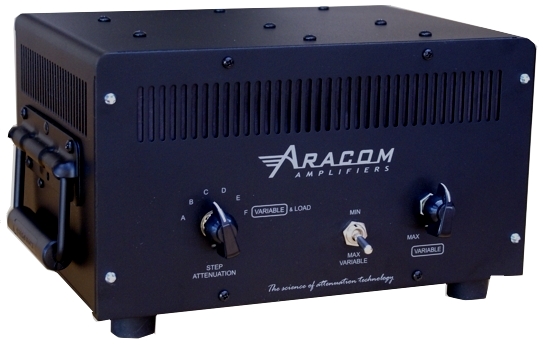
For a long time I was – and pretty much still to this day – an overdrive pedal lover. I have several, and am waiting for my new Paul Cochrane Timmy to be completed and delivered in the next few weeks. I’ve been wanting one of these for awhile now, and finally bit the bullet and got on the waiting list. So excited! But using an attenuator  – specifically the Aracom PRX150-Pro – changed the way I use overdrive pedals.

In the “old days” before I used an attenuator, I used an overdrive pedal to get grind through a clean amp. Early on, I was using my Fender Hot Rod Deluxe that was all about loud, clean headroom, and I couldn’t get the volume above 2 or 3 before it would be just too damn loud; not to mention, the tubes weren’t working that much at all at that level. Yeah, I could crank the volume then set the Master to about 1/2 to get some dirt, but the pre-amp only distortion of that amp never really appealed to me. So I used overdrive pedals to get that soft-clipping on the front-end, and especially looked to pedals that provided a bit of color.

But once I got an attenuator, the entire game changed. I was able to crank my amps to get both the preamp and power amp sections saturated. For a long while, I actually stopped using overdrive pedals altogether because I was getting all the drive I wanted. I still sometimes just go to my gigs with only a tuner pedal and just plug directly into whatever amp I’m using, though I’m now starting to introduce overdrives to add gain stages to my chain.

But that brings me to the crux of this post… I used overdrives because I couldn’t get sufficient grind at reasonable volumes. But once I got a real transparent attenuator like the PRX150-Pro (I had an AirBrake and tested several), I could finally hear what my amps sounded like fully cranked. But here are some things I discovered once I was able to crank up my amps that I’d like to share:

  • I have 8 amps, and with the exception of two, once I cranked them up, I did not like their fully cranked up tone.
  • A common thing that I found among all the amps where I didn’t like their cranked up tone was a certain harshness or in some cases “fizz” that was not at all pleasing to me.
  • As opposed to getting rid of the amps, I swapped tubes and speakers until I was able to balance out their tone. For instance, with my Aracom PLX BB 18 combo, which is a replica of a Marshall 18 Watt Blues Breaker, the cranked tone was horrendously fizzy to me. So I replaced two preamp tubes with NOS Mullard and GE tubes, and to tame the natural brightness of the amp, replaced the stock Eminence Red Fang with a Fane Medusa 150 which really emphasizes the low-end. It’s now gorgeous, and I use that amp regularly!

The point to all the items that I shared was that once I was able to crank up my amps, most of them just didn’t sound all that good. Lots of folks who are new to attenuators complain about different artifacts being introduced by the attenuator, but based upon my experience, I think a lot of those “artifacts” have a lot to do with them never having cranked their amps all the way up. To me, it’s definitely a case of “you may not like what you hear…”

So if you ever do get a hold of an attenuator, and you crank your amp up, if you don’t like the tone, don’t immediately assume that it’s the attenuator. Especially with the latest generation of attenuators that are much more transparent than the traditional ones, the likelihood that they’re introducing artifacts is pretty low. Look to your amp first, and see what you can do to adjust it to deal with its cranked tone. Personally, I’d start with tubes first; especially replacing new production tubes with NOS pre-amps. I know, they’re getting more and more scarce, but I’ve gotten the best results in smoothing out my tone with NOS pre-amp tubes.

Read Full Post »

I swear by my Aracom attenuator as do many others, and it’s great to see people demonstrating it. This demo comes from a guy in Italy who can cop Angus Young like no other. This dude rocks the house and has several vintage amps and guitars. He’s not just a collector, he’s a bonafide player!

Read Full Post »

My good buddy Jeff Aragaki of Aracom Amps (http://www.aracom-amps.com) is in a bit of a quandry. His attenuators have been incredibly successful and very well-received by both amateur and pro guitarists. He actually built the attenuator in the hopes that it would raise awareness of his wonderful amps, of which I own three with a fourth on the way. Unfortunately, it sort of backfired because his attenuators are so great that they’ve completely overshadowed his amps. That’s too bad, because they’re great amps, and they’re all I gig and record with.

So to try to raise more awareness of his products, Jeff compiled a few videos that feature moi, Clint Morrison – who’s a pro player out of Austin, TX – and Doug Doppler. Check ’em out. Clint’s and my videos feature both the PRX-150 Pro or DAG, and Aracom amps.

Yours Truly:

Clint Morrison:

Doug Doppler:

For more information on Aracom Amps products, go to the Aracom website!

Read Full Post »

Yeah, I mention it a lot, but I thought I talk about it once again, because it truly has had a HUGE impact on how I approach amps. To me, there’s simply no attenuator on the market that can touch the quality of its sound; well, it doesn’t produce sound of course, but it lets all your tone come through, but more importantly, no matter where you set it, you will always have your dynamics. In any case, I recorded a couple of videos this afternoon, talking about this wonderful device by Aracom Amplifiers.

Part I: Discussion

Part II: Demo

BTW, recorded these clips with an Alesis VideoTrack. Nice little unit. Not sure how long I’ll actually use it because I actually do want a better picture. But for now, it’s great to have an all-in-one solution to get some video out!

For more information on this great attenuator, go to the Aracom PRX150 product page!

Read Full Post »

I did a “What is it about…” regarding the tone of a 100-Watt amplifier recently, and while I’m now hooked on higher-wattage amps, and will probably sell off a few of my low wattage amps, I’ve got some other lower-wattage amps – namely, my Aracom amps – that I will never part with because of their insanely fantastic tone and dynamics. While not nearly as beefy-sounding or -feeling as a 100 Watt amp, they just ooze great tone, and when cranked to the hilt, just sustain for days!

For instance, this morning I played a church service at my kids’ school and had two of my fellow church band members to play a power trio. Since we didn’t have a lot of room (the 5th grade class shares our normal band space), I just brought my Aracom PLX18 BB Trem combo with me so I wouldn’t have to hook up a cab. This amp is based upon the popular Marshall 18-Watt Plexi circuit, which is absolutely simple, as all vintage Plexi circuits were. It has a single gain stage that feeds into an EQ (and on the PLX, it’s a single tone knob to bleed off highs), then straight into the power amp. I believe it’s this simplicity that gives the amp and its Marshall ancestors such pure tone.

With their single gain stage, obviously amps of this ilk will not do over-the-top overdrive, and have to be cranked (as in dimed) to deliver any overdrive. But when they do deliver it, it’s smooth as silk and incredibly dynamic and articulate. This has always been my experience with Plexi-style amps, be they 100 Watts or 18 Watts. For my own PLX, as I said, it may not have the beefy tone that a 100 Watt version may offer, but that smooth overdrive and dynamicism is all present.

Anyway, I set up my rig this morning and I warmed up the amp. Then I plugged in my Gibson 2009 Limited Run Nighthawk, and started playing some warm-up scales. I hadn’t played my PLX for awhile, and running through my warm-up, I was reminded about how damn good that amp sounds! As Jeff Aragaki (Aracom’s owner) puts it, “It doesn’t matter what wattage the amp is. You just know a great amp when you play and hear it. And Marshall got that circuit right.” At least to me, Jeff couldn’t be more right. The PLX is pretty much an exact copy of the classic 18 Watt Plexi circuit (with some slight mods that Jeff has made), and that amp was made to be hit hard. When you do that, you’re rewarded with a tone that, at least to me, is other-worldly! If you’re looking a great Plexi-style amp, this is an amp you have to check out!

Here’s a little treat. Gene Baker of B3 Guitars recorded a great clip that demonstrates the PLX18’s wonderful crunch tone. Check it out:

Over the years, I’ve tried and tested a lot of different amps, and several that cop Marshall designs. No doubt, there are some great amps out there, but Jeff at Aracom really “gets it” with respect to vintage Marshall-esque amps. The cool thing is that instead of making an exact replica of the circuits as many amp builders do, Jeff sees where he feels the designs may be weak, makes corrections or improvements, or creates new amps altogether from the base. For instance, my VRX22 started out as a Plexi 18, but Jeff wanted to add more gain with the second channel, so he added another gain stage that acts as a tube overdrive that’s always on, went from EL84’s to 6V6’s, and what he came up with is an absolutely superb amp that has vintage-style Marshall dynamics, but a sound all its own.

For more information, please visit the Aracom Amps site!

Read Full Post »

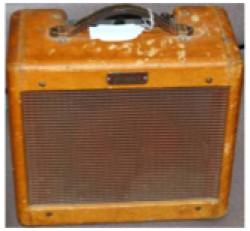
I was so excited to finally get one of these several months ago! I played it A LOT until the original caps finally wore out and started to leak both fluid and the amp started leaking electricity (i.e. I could feel current when I touched the amp – not good!

So I had my good friend and amp genius, Jeff Aragaki of Aracom Amps overhaul the amp. I just got it back a few days ago, and it totally kicks ass! Among Jeff’s mods were:

  1. Replace the original two-prong cord with a grounded three-prong cord. For this, he had to make some adjustments to the heater.
  2. Replace the original caps with new Sprague paper caps.
  3. Replaced the original speaker with a new Weber 8″ speaker.
  4. Provide a way for me to use either the internal speaker or an external cabinet. This was done by connecting the output wire to a jack and running that into a custom switch box that he constructed.

But Jeff actually did one better, and that was to put the amp chassis in a larger tweed cabinet that had a 10″ speaker. What a difference in volume and tone!

That amp is VERY special, and it’s not a small wonder why Jeff Beck is now using Champs. He can get great tones at lower volumes! For instance, here’s a new praise song I recorded using just the Champ for the guitar tracks. The rhythm track was recorded using the 10″ speaker with the mic at the rim of the speaker cone pointed along the angle of the paper so I could capture more of the low frequencies. The “lead,” overdriven guitar used a closed-back external 1 X 12 cabinet with a Jensen Jet Falcon. It sounds like it’s coming from a much bigger amp!

For guitars, I used my trusty Squier CV Tele for the clean rhythm, and used my Gibson R8 Les Paul for the “lead.”

The thing that struck me about playing the amp was how it really responded and felt like an amp 10X its size. The touch-sensitivity and dynamics, especially when cranked, are spectacular with lots of overtones and harmonics. Being naturally brightly voiced, this amp never gets muddy. It’s actually rather unsettling to play this amp at times because it sounds much bigger than it actually is. That’s VERY cool!

Read Full Post »

Like any gear freak, I’ve got tons of gear. Just check out the “My Rig” page, and  you’ll see what I mean. I use it all. Now while I rotate my usage of guitars, I use all my amps in the studio. But when playing out, I almost invariably go with a specific type of setup: A humbucker guitar through a vintage-Marshall-style amp; and lately and more specifically, a Les Paul through a Marshall-style amp. That tone simply speaks to me. Clean or dirty, it’s what I almost always go to in a live situation.

At my church gig yesterday, I brought along one of my favorite amps: My Aracom PLX18-BB Trem, which is a “Bluesbreaker” style 18 Watt Plexi clone with two channels and no master volume. With that amp, I usually play in the Bright channel, which is a clone of the Plexi circuitry. This is a simple channel with just one volume and one tone knob. I love this channel! I usually have the volume dimed, with the tone at about 3pm, then control the amount of breakup with my guitar’s volume knob and/or pick attack. That amp just oozes Plexi goodness, and is so incredibly dynamic. The EZ81 rectifier provides just the right amount of sag, where even with the amp dimed to the hilt, it never turns soupy or mushy due to sag. I also loaded it with NOS ’59 GE 12AX7’s in V1 and V2, then have a 60’s JAN Philips 12AT7 in V3. To compensate for the overall brightness of the amp, I loaded a kick-ass Fane Medusa 150 to bring out the bottom end. The net result is that this amp sounds A LOT bigger than its 18 Watts may imply.

Then take all that Plexi goodness and combine it with a Les Paul, and to me, that’s a recipe for rock-and-roll! 🙂

It took me several years to get my “Go-To” tone, which accounts for the gear that I’ve got from my explorations; not that I’d get rid of much of it because in the studio, having lots of gear to get different sounds is important, but for me, when I’m playing out, it’s the Les Paul/Plexi combo all the way. To my ears, there’s simply nothing like the tone that that combination produces!

So what produces your “Go-To” tone?

Read Full Post »

« Newer Posts - Older Posts »