Feeds:
Posts
Comments

Posts Tagged ‘aracom’

I was feeling like crap today, but still accompanied my friend, Jeff Aragaki, to go to the offices of Guitar Player Magazine, which just so happens to be local to us in the Silicon Valley. Nested in an office building near the heart of San Bruno, CA, the office itself is rather unassuming, though there are tons of pictures hanging on the wall of great musicians from over the years. Very cool.

Like I said, it looked like your typical office, replete with cubicles… Then you see all the guitar cases in the cubes, and the amps stacked along walls, and effects in various states of disassembly on desks for evaluators to examine. Moving to the back of the office, is an area filled with boxes of gear waiting to be reviewed. Had I died and gone to heaven? 🙂

Jeff invited me along to help him show some of his equipment to the GP folks. We were supposed to meet with one of the editors, but unfortunately, because of the SF Bay Bridge closing, he couldn’t make it to the meeting. Instead, we were greeted by Reggie Singh, who is the marketing and ad sales guy for the mag. Very cool dude. He gave us a tour of the office, and let us get some back and upcoming issues of the mag, plus some very cool swag (I got this GREAT coffee table book on Gibson guitars). But the highlight of the day was going into the GP test studio where I got to demo the PRX150-Pro for Reggie.

For the demo, I played a ’59 Les Paul Reissue with the fat 50’s neck and light, mahogany body. OMG! Reggie said that guitar was the one everyone uses to test gear. The way he said it was so non-chalant, as if that was a beater guitar (mind you, it was great shape)! You gotta love being able to work at a guitar magazine! Anyway, we demonstrated the features of the PRX150-Pro through a Dr. Z Remedy. That’s a 40 Watt, quad 6V6 tone beast that was absolutely incredible! Very simple control layout – just single bank of a few knobs, and it had such a sweet tone! I think I’m going to have to review this one… 🙂

Going to that magazine office was an eye-opener… There’s A LOT of gear out there! You don’t fully realize it until you go to a place like this where people’s jobs are to evaluate it. It’s not like a store where things are on display. In fact, several times, Reggie told us, “Hey, if you want to plug something in, please feel free.” Damn! I could spend a whole day there and not make a dent in all the gear that’s in that office.

That was truly an adventure of magnificent proportions!

Read Full Post »

Just put in a re-labeled 1960’s-era Mullard ECC83 into my Aracom VRX22 this afternoon. I had a JJ 12AX7 in there, and make no bones about it; that’s a great pre-amp tube. But the difference in tone between the two is immense. Where my JJ had a great tone, one thing that I noticed was that the highs tended to be rather harsh when the tube was overdrive, and I found myself turning my Tone knob left of center – a lot – to bleed off some of the highs.

But after I installed the Mullard, I was absolutely blown away! The overdrive seemed so much more focused, with zero high-end harshness. It was some of the smoothest overdrive I’ve heard, and definitely the smoothest the VRX22 has sounded since I got it. That’s saying quite a bit because I love the tone of this amp immensely, even without the NOS Mullard. Which brings me to the crux of this entry…

As a tube amp aficionado, I’ve gone through lots of pre-amp tubes, and almost invariably, I’ve gravitated towards NOS tubes to get the tone I like. Some people I’ve spoken to say it’s all hype but, at least to me, it’s not. I suppose for some types of tubes, there’s not much of a difference. For instance, I almost invariably use JJ’s for power tubes because they just sound great to me. They’re well-made, and run pretty hot, and they break up nicely.

But with respect to pre-amp tubes, I’ve found a marked difference between NOS and new tubes. I love Mullard and JAN Phillips tubes for pre-amp tubes. They’re just so smooth sounding, smoother than all the new make tubes I’ve played. Plus, they were made during a time when most electronic devices were run with tubes, so the build expertise, equipment and materials for making tubes was abundant. According to my friend Jeff Aragaki of Aracom Amps, the alloys used in NOS tubes are not as readily available nowadays, and that could account for the difference in tone. Not sure if this is true, but it certainly makes sense. The only drawback is the price. That Mullard sells for $129 retail, and that is by no means inexpensive.

But I look at buying NOS tubes very much like buying a great pair of shoes. For instance, I spend almost $200 a pair for my everyday shoes. These are absolutely comfortable, and not only that they last a long time because they’re constructed so well. In fact, it takes me about 4-5 years to really wear them out. This in contrast to lower priced shoes that I’ve worn out within a few months. After a long period of time, I’ll spend more on the cheap shoes. A better case is my father. His shoes cost at least $500. But they last almost 20 years! He just gets them resoled every few years until the shoe repair guy says that it’s not worth it.

NOS tubes are similar. I’ve had the same NOS tubes in my Hot Rod Deluxe for almost five years, and they still sound great! I play that amp a lot. On the other hand, the new Tung-Sol tubes I put in another amp lasted all of two months before they started to lose their character, with one becoming microphonic. Granted, they’re fairly inexpensive tubes and they sound great, but if I have to shell out $25 every couple of months, that starts to add up. NOS tubes, especially the mil-spec tubes that I prefer were made for military usage, which means they had to be well-built and durable. That’s a huge advantage NOS tubes have over newer tubes.

Jeff also shared a story with me today about a friend of his who used to be stationed on an aircraft carrier. He was telling Jeff that when the ship replaced electronic components, they’d dump boxes of tubes – good ones, mind you – over the side of the ship. So the ocean has NOS tubes littering its bottom.

In any case, please do not just take me at my word! 🙂 This is simply my perception based upon my experience. In the end, as I am often apt to mention, you’re judge of what sounds pleasing to you. So only buy what makes sense to you!

Read Full Post »

For a long time, I’ve had this thing for getting a big guitar sound in my recordings. I’ve done a bunch of different things like doubling, overdubbing, signal splitting between two amps, and the like. But recently, I got a couple of pieces of gear that is allowing me to explore yet another way to get a big guitar sound: Re-amping. Re-amping is essentially taking an already amplified guitar signal, and running it through another amplifier. This is not like adding a gain stage because that usually involves multiple pre-amp sections. With re-amping, you’re building on a fully amplified signal that has passed through the power tubes. The result is VERY different in tonal character from just moving the signal through another gain stage.

There are lots of ways to re-amp, so I won’t go into a lot of detail. But I will share how I do it. Ever since I got my Aracom PRX15-Pro, I’ve been contemplating this very thing because of its line out which could be used in a variety of ways; such as running the signal into a PA (since it’s unbalanced, you need a DI box), or taking that line level, and running it into another amp to re-amplify the signal yet again. The cool thing about the PRX150-Pro is that I can simultaneously run an output to a speaker, then the amp that’s doing the re-amping can also have it’s own audio output.

Now here’s something even more cool! I have a Reason Bambino, which also has a line out. It’s a balanced line out, so it can go directly into a board, and doesn’t need to be hooked up to an external cab. The tone coming from the line out of the Bambino is very nice. I suppose that I could’ve miked the Bambino from another cabinet, but I did want to test the line out.

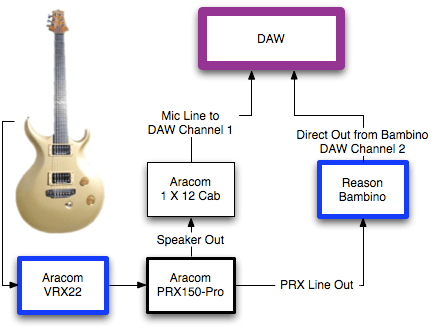
In any case, here’s a diagram of how I had everything hooked up:

VRX22-ReAmp

In a nutshell, I plugged my guitar directly into my Aracom VRX22, which ran into the PRX150-Pro. I hooked up an external cab to the attenuator, placed a mic in front of the cabinet that ran into Channel 1 of my audio interface. Then, I ran the line out of the attenuator to the input of the Reason Bambino. From there, I went directly from the Bambino into Channel 2 of my audio interface.

I set up a clip from a song I wrote and added two tracks that took input from the two channels. I also panned Channel 1 full left and Channel 2 full right. Once I had the levels worked out, I recorded a solo over the existing music. Once the recording was finished, I took the Bambino’s signal slightly out of phase with Channel 1, to make it sound like two guitars are playing simultaneously. The effect is totally cool, and it creates a very in-your-face, big guitar sound! Here’s the clip:

Note that this is a kind of a different way to employ re-amping, which basically runs two amps in a series then out a single output. The way I employed it, the re-amped signal is a component of the overall package.

Read Full Post »

Aracom Amps VRX18 18 Watt Head

Aracom Amps VRX18 18 Watt Head

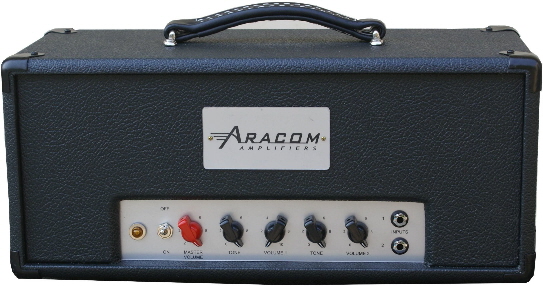
I’m falling in love again with my Aracom VRX18. This was the amp that first got me introduced to Aracom and my good friend Jeff Aragaki. My amp is actually a tweaked version of the stock VRX18 as it sports an EZ81 tube rectifier, plus a tweaked circuit that adds a bit more sag and sustain. The result is just a gorgeous overdriven tone that really brings out the best of the EL84 power tubes.

One thing about EL84 amps is that if they’re done right, they have a distinctive overdrive tone that creates a subtle top-end fizz when they’re overdriven. I’ve played others that drive the power tubes too much, and they sound very harsh and incredibly compressed. Jeff did this amp right, and while the power tubes do indeed compress a bit, the overdrive tone retains its open character, while adding that nice top-end fizziness that EL84 amp lovers have come to appreciate.

The clip below is an excerpt from a slow blues song I wrote. It features my beloved Goldie plugged straight into the Aracom VRX18, and it also features the insane Aracom PRX150-Pro attenuator! Believe it or not, the amp was recorded at just above loud conversation levels! We’re talking less than 1/10 of a Watt, and the amp still retains its tone and dynamics! Anyway, here’s the clip:

Read Full Post »

I’ve often extolled the virtues of a cranked amp here at GuitarGear.org and elsewhere. My belief is that when you’ve got both your pre-amp and power tubes working, you get the real character out of your amp. There’s something that happens to your tone once you get juice into your power tubes that adds a certain dynamicism and complexity that you just can’t get with just your pre-amp tubes. Unfortunately, most mere mortals, like myself, don’t normally play venues that that will allow us to crank our amps to the point where the power tubes of our amp come into play.

Take, for instance, my good buddy Phil. He’s the lead singer of a bar band called Phil ‘N The Blanks. Up until recently he was playing through a Marshall DSL100 JCM2000 100 Watt head into a Marshall 1936 2 X 12 cab. Talk about too much amp for his gigs! I ran sound for him at a gig a couple of months ago, and could only turn his volume and gain controls to about 3 each before he stepped on the band entirely; not to mention peeling faces off! Since he’d owned the DSL100, he’d never played above 5 because it was way too loud.

Recently, I lent him my Aracom PRX150-Pro attenuator so he could squelched down the volume but crank up his amp. He couldn’t believe his ears! He was finally able to get the gain up in his amp where his power tubes would break up. It was like a completely different amp once he heard the cranked up tone. I had been telling him for months that there’s really nothing quite like a cranked up amp, and for the first time since he owned the amp he was able to hear for himself what I had been talking about. Before that, he was on tonal training wheels! 🙂

Ultimately, he decided against going with an attenuator, but he did a very smart thing: He purchased a low-wattage amp, the Marshall Haze MHZ15 15 Watt amp. It hasn’t arrived yet, but I’m excited for him because he’ll be able to crank that amp at a reasonable volume level, as the lower wattage amp will break up a lot earlier, and he’ll be able to reap the benefits of the response of his cranked amp!

1 Watt is LOUD!

But here’s the funny thing: 15 Watts can still be freakin’ loud when cranked! The following chart shows SPL at 1 meter vs. Wattage (I got this from the Aracom site where Jeff discusses understanding attenuation).

POWER VS. LOUDNESS CHART

Watts

SPL (db)

Loudness

0.0078

79

Passenger car at 10 (60-80dB)

0.0156

82

0.0312

85

Vacuum cleaner

0.0625

88

Major Road Noise (80-90dB)

0.125

91

Noisy factory

0.25

94

0.5

97

1

100

Jack hammer at 1m

2

103

4

106

8

109

Accelerating motorcycle at 5m

16

112

32

115

Hearing Damage (short term exposure)

64

118

Rock concert

128

121

256

124

512

127

Jet at 100 meters (110-140 dB)

1024

130

Threshold of pain

What’s amazing from the table is how loud 1 Watt is at 1 meter! It’s as loud as a jack hammer! And 0.0312 Watt is as loud a vacuum cleaner! Jeff got this information from a well-known study done in 1933 by Harvey Fletcher and W A Munson about human hearing response. For those people who say, “P-shah” to low wattage amps, just reference this chart.

Granted, there is a certain mojo about a 100 Watt amp cranked up – even a 50 Watt amp. But most people other than those playing large venues can crank their amps to experience that mojo. But in spite of that, there’s been a movement in the industry these past few years towards lower wattage amps. I think a big part of the reason for this is the improvement in PA gear over the years. Want to get your sound out there? Mic your amp. After all, all you need is stage volume so you can hear yourself. Let the sound guys project your sound out.

My buddy Vinni Smith of V-Picks does exactly that. As amazing as he is with a guitar, he gigs with a Roland Cube 30! He just gets his stage volume, then has his amp miked to get his guitar out to the audience. This dude gigs alot, and he’s living proof that you don’t need a lot of power to get perform. As long as you can get your tone, you’re golden!

Circling back to the title of this article, there really isn’t anything like the sound and feeling of a cranked amp. Especially with tube amps, when the power tubes have juice, they add all sorts of things to your tone such as compression, a different kind of breakup and even more touch sensitivity. You can get that in a couple of ways:

  1. Get an attenuator. There are several on the market, including the increasingly popular Faustine Phantom, but my bet is on the Aracom PRX150-Pro, as it takes a completely different approach to attenuation than all others. I’ve never played an attenuator as transparent is this.
  2. Get a lower wattage amp. I’m not even going to list what amps to buy as there are tons of fantastic amps – both boutique and mainstream – on the market. Just make sure you give them a listen.

Read Full Post »

Ladies and Gentlemen! Welcome to the bout of the century! A truly momentous occasion in the vein of David versus Goliath! In the red corner we have a Goliath, the reigning King of Attenuators, the Ultimate Attenuator; self-proclaimed King of Transparency – Guaranteed! In the blue corner is the Aracom Power Rox PRX150-Pro, a virtual David, armed with only a transparency sling ! And here’s the opening bell!

The Ultimate Attenuator strikes first, tongue lolling, with bombastic claims of pure transparency. The agile Power Rox ducks, and moves away, its sling of true transparency whirring rapidly. Wait! It launches! It strikes the Ultimate Attenuator square in the head. It’s going down! Oh the humanity! Oh the humanity! The match was over before it was even begun!

I had the great opportunity this evening of testing the Aracom Power Rox and the Ultimate Attenuator in a head-to-head shootout to determine which was the most transparent attenuator. As you can tell from the somewhat facetious and fictitious pseudo-boxing match, you know who won: The Aracom Power Rox PRX150-Pro. Folks, it wasn’t even a contest. Even at the lowest attenuation levels, the Power Rox swept the floor with the Ultimate Attenuator!

My Test Procedures

Equipment: My test was conducted using a Replica JTM45 equipped with original Mustard Caps and a pair of  KT-66’s, into a 4 X 12 cabinet equipped with (2) Original 55Hz Greenbacks and (2) Custom Weber (75Hz) Greenbacks, with a ‘Gibson 57 Les Paul Historic Goldtop as my test guitar.

Clean Test

First, I started with the amp totally clean. I strummed a simple chord progression to get my base tone. Setting the Ultimate Attenuator at about half “volume,” I activated it. I immediately noticed a distinct loss in both highs and lows, as even at minimal attenuation, the bandwidth of my tone was severely narrowed. The full bottom-end and sparkly top-end of my clean tone were significantly reduced. The tone wasn’t that bad, mind you, but it certainly lacked the richness of my base tone – it sounded flat.

One thing that really bugged me was activating the UA, which required a strumming the guitar, then switching on the UA, as if the UA needed a signal to pass through it to even start working. What a pain! It’s amazing that users would even tolerate this.

I repeated the same test with the Power Rox, setting it at half attenuation on the 6-way switch. The result was a reduced volume, but no loss of bottom- or top-end at all.

Clean Test – Bedroom Mode

Same test as above with both attenuators. With the Ultimate Attenuator, can you say “tone sucker?” The tone was not at all pleasing! Even more narrow bandwidth, and non-existent dynamics. There was nothing even remotely good to like at this level with the UA. How the UA website can claim to be “the most transparent and safest tube amplifier attenuator on the market in the world. Guaranteed” is beyond me. Even my old Dr. Z Airbrake sounded better than the UA. So again, at this level, the Power Rox just kicked ass. Lower volume, but full retention of bandwidth and dynamics.

Dirty Tests

In my dirty tests, I ran the amp in its drive channel cranked up fully. 40 Watts through a 4 X 12 is LOUD!!! Especially when you’re standing right in front of the cab! Actually there’s nothing like feeling the SPL’s with an amp full-out! I ran the same tests as I did with the clean channel with both attenuators, and as expected got the same results: The Ultimate Attenuator really sucked my tone, while the PRX150-Pro retained tone and dynamics at all levels. The Plexi switch just made the tone even worse, acting like a treble booster, which made an already horrid tone even worse by just upping the highs. The tone was akin to an old transistor radio played at the volume of a loud TV. Not pleasing at all, and actually, it was a bit annoying, like cats screeching! YUCK!

The Power Rox, on the other hand, again just reduced the volume. The tone remained rich and full, and all the overtones and harmonics came through. It’s amazing what those subtleties do for your tone. You really miss them when they’re not there, as they provide depth.

It’s evident that the Power Rox’s Speaker Reactance Thru technology is far superior at any application. For me, the Ultimate Attenuator company can make all the claims it wants about transparency, but that’s all they are: claims. And while it doesn’t sound all that bad at low attenuation levels, the marked difference in tone between the UA and Power Rox at any attenuation level relegates the UA – at least to me – to the junk heap. You couldn’t get me to put this in my rig if you paid me.

I realize that the UA was the best game in town for quite awhile, and I am sure that at the time it came out, it outperformed the THD HotPlate, which I have also tested, and didn’t like. I also realize that I’m being fairly harsh – much more harsh than I’ve ever been with a product – but all the claims of the UA being truly transparent are mere exaggerations, and not backed up by any discussion of its technology. In fact, all the hyperbole surrounding the UA is quite irritating!

If you knew what went into a UA, you’d have serious concerns, not the least of which is the 32 ohm fixed resistor, which essentially flattens out your impedance, and creates a mismatch so high that you could fry your amp! Adding insult to injury, the solid-state amplifier is what is really running your speaker. Transparent? Hell no! Not electronically, and definitely not audibly.

And mind you, I’m not the only person who feels this way. One new PRX150-Pro user, who is also a former UA user was so impressed with the Power Rox and disgusted by the UA’s tone compared to the Power Rox, that he bought two Power Rox’s! That says quite a bit.

For more information about the Aracom Power Rox PRX150-Pro, visit the Aracom Amps PRX150-Pro product page!

Read Full Post »
5 Tone Bones - Gear has stellar performance, value, and quality. This is definitely top of the class, best of breed, and it's a no-brainer to add this to your gear lineup!
Aracom Amps PRX150-Pro Attenuator
Aracom Power Rox PRX150-Pro Attenuator

Summary: This is hands-down the best attenuator on the market! I’ve played a lot of attenuators, and no other has been able to retain tone and dynamics at high attenuation levels as the Power Rox!

Pros: The Power Rox isn’t just an attenuator. It packs extra features that’ll just blow you away, making a it versatile part of your stage or studio rig!

Cons: None.

Features:

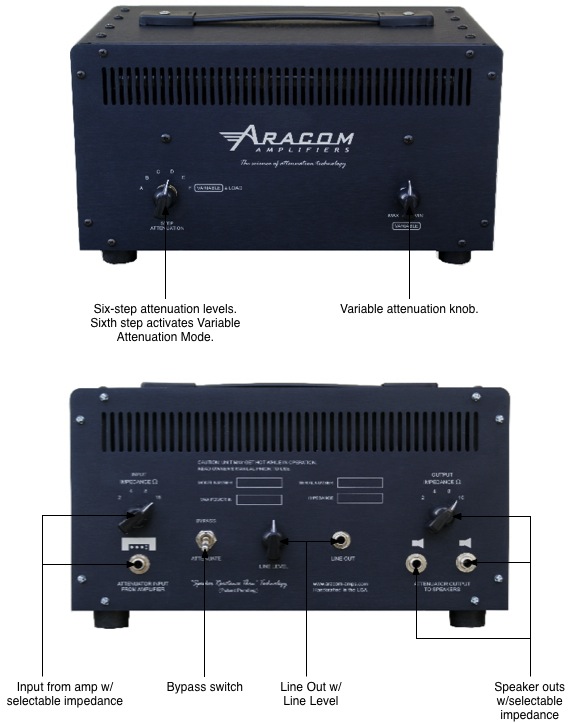
  • Rotary Switch provides (6) Step Attenuation Levels, plus
    the Variable Mode allows continuous variable control of “bedroom” level adjustment
  • 33dB attenuation range
    * Attenuates 100 watts down to well under 1 watt (0.05 watt).
  • 150 watt (continuous average) power rating
  • Independent Input Impedance Switch: 2, 4, 8, 16 ohm
  • Independent Output Impedance Switch: 2, 4, 8, 16 ohm
    * Uniquely allows mismatched amplifier and speaker impedances to be used.
  • Attenuator Bypass Switch
  • Load Mode
  • Line Out with Level Control
  • 2 Speaker Jacks (wired in parallel)
  • Passive design, does not require AC power
  • Rugged, black anodized aluminum housing
  • Heavy duty, steel reinforced handle
  • Handwired and Handcrafted in the USA.

Price: $649 direct

Tone Bone Score: 5.0. Jeff Aragaki of Aracom Amps never ceases to amaze me with the stuff he comes up with! This time, it’s an attenuator invention that blows away the competition in safety and tone and dynamics with its patent-pending Speaker Reactance Thru (SRT) technology, plus extra features that make it unmatched in versatility and usability.

I’ll admit it: As much of gear nut that I am, I’m also a huge techno-geek. I dig new technologies and the engineering behind them; and when someone comes up with some new approach to something, with completely awesome engineering, it’s hard to control my GAS. I just have to have it.

I recently took delivery of a brand new attenuator invented by Jeff Aragaki of Aracom Amps, called the Power Rox PRX150-Pro. This, by far, is the best attenuator I have ever used, and will be a fixture in my rig for years to come. That’s right. This will always be in my chain. But not just because of its ability to transparently attenuate an amp signal. This attenuator has features that no other attenuator has such as two speaker outs, and a Line Out that you can use to go direct into a DAW, or even another amp! Talk about versatility. Not only that, because you can match impedance in both the input AND the output, combined with Jeff’s patent-pending Speaker Reactance Thru (SRT) technology, you can squelch down the power of your amp and not worry about ever blowing our your tubes and ruining your amp. The SRT technology just kicks ass!

Talking the Talk AND Walking the Walk: Speaker Reactance Thru Technology

Jeff is a very humble man, so he’d never say anything like this, but I’m not nearly as humble, so I will say it: There’s not a better attenuator than the PRX150-Pro. Even if Jeff didn’t include all the extra features you get with the Power Rox, this attenuator simply kicks the shit out of all the attenuators I’ve ever tried – and I’ve tested several, including the Ultimate Attenuator that seems to be the most popular attenuator; and with respect to safety, tone and dynamics, all others simply pale by comparison.

Where other manufacturers make bold claims (read: brag) about their attenuators’ transparency, not only can Jeff Aragaki make the claim (in his quiet and humble way), he backs it up with detailed discussions of his SRT technology and the engineering behind it and what makes it so transparent. Jeff’s SRT technology is absolutely incredible. At any level of attenuation, the Power Rox retains your tone and dynamics. This is because instead of just dealing with amp power reduction through a series of resistors or a dummy load, which also have the added effect of flattening out the impedance curve and changing tone, the SRT technology ensures that reactance between the amp is maintained throughout the entire spectrum of attenuation; hence, the name “Speaker Reactance Thru.” This means that the impedance curve is kept intact so that the continuity of reactance between the speaker and the amp are maintained. Jeff discusses this in a detailed article about the advantages of the PRX150-Pro.

Let’s talk a bit about safety…

As I mentioned, the PRX150-Pro will not burn out your amp. You can crank your amp up all the way, getting that wonderful power tube drive, and not worry about your amp blowing a tube, or worse yet, frying some circuits from flyback voltage. We’ve all heard the horror stories about people using attenuators, cranking their amps, and blowing power tubes. A lot of this has to do with impedance mismatching. Some manufacturers have added options to match impedance from one direction, but the Power Rox has impedance matching in both the input and output jacks! But the point of this is that with impedance matching on both sides, you don’t have to deal with any type of mismatch. That is very comforting to know.

I’ve actually been playing with the Power Rox for the last couple of months regularly before it hit the shelves, and to date, I haven’t had any power tube problems. And we’re talking running my amps down to less than a watt for a few hours straight. I could never do that even with my Dr. Z, which is one of the more safe products out there. I’ve burned out power tubes using my Dr. Z by cranking power too much. It’s not pretty, and I’ve been lucky so far that only my tubes got burned out. It could’ve been a lot worse.

This ain’t yer Daddy’s Buick…

When Jeff first spoke to me about the Power Rox, I thought, “Okay, it’s another attenuator. I’m sure it’ll be great considering what a whiz Jeff is…” But when he delivered the unit, I couldn’t believe what he had added! I was already impressed that it had both input and output impedance matching. That was simply awesome. But he added some awesome features that I was not at all prepared for:

  • Bypass Switch – This is a mechanical bypass that completely bypasses the attenuation circuit.
  • Line Out – This one thing is just so cool! I used it to go both direct into my DAW, and also used it to re-amp into my Hot Rod Deluxe! Talk about versatility! For a test, I ran a cable to my 1 X 12 cab, then ran another cable to my Hot Rod. I could’ve easily just run direct into my Hot Rod without going out to another speaker as well, but you can see how useful this is. I could get my amp’s tone and combine it with the Hot Rod’s tone. So cool!
  • Two Speaker Outs – This is yet another cool thing. You have multiple cabs that you want to drive with a single amp? This makes it easy.
  • Input AND Output Impedance Matching – No other attenuator matches impedance in both input and output, but the Power Rox has it. It’s all part of the package to ensure continuous reactance between the amp and the speaker.

So as you can see, the added features make this oh so much more than just an attenuator, and it’s a testament to Jeff’s creativity!

The proof is in the pudding…

Unfortunately, doing sound clips of an attenuator’s effect is fruitless, because it is difficult to hear the changes, and moreover, it is difficult to describe the change in dynamics on a recording. However, the Power Rox was tested side-by-side to a number of popular attenuators, and even at low levels of attenuation, compared to Power Rox, all the other attenuators had an effect on tone and dynamics. To date, several people have performed head-to-head comparisons between different attenuators and the Power Rox, and they all come to the same conclusion: The Power Rox is truly transparent; not just the most transparent of the lot, but truly transparent. To me, this box sets the standard by which all others must be measured now.

I used my own transparency test procedure to compare attenuators, but Jeff has also provided a very detailed, and in-depth transparency test that you can view on his site.

I know, I must sound like a twitterpated schoolgirl with how I’m raving about this product, but for the very first time, I’ve been able to record my amps fully cranked without pissing off my family and neighbors, and more importantly, without having to worry that I’m going to blow a tube. Even with my Dr. Z, I’ve had to settle with less drive on my recordings for fear of burning out my amps. But with the Power Rox, I can crank my amps and get that wonderful power tube drive! And even better yet: I can trust that my tone and dynamics will not change, no matter the volume!

For more information on the Power Rox PRX150-Pro attenuator, go the Power Rox Product Page!

Read Full Post »

PRX-front-543You ever have an itch you can’t scratch? Well, it has been like that keeping my mouth shut about the Power Rox PRX150-Pro. Ever since I played with the early prototypes, I’ve been completely blown away by this attenuator! This is a totally new take on attenuator technology, folks, and I’m hoping it takes the industry by storm. Why? Simply because what we’re talking about with the Power Rox is true transparency in tone when this is in your signal chain; not “almost” transparent, but truly transparent.
Check out the Power Rox PRX150-Pro page at Aracom Amps!

Most comparisons between attenuators revolve around what’s the “most transparent” attenuator, indicating that really none of them are transparent, so people pick the best of the lot. And frankly, I’ve tested out several attenuators and ended up with the Dr. Z Airbrake, as I felt it was the most transparent out of the ones I tested. But nothing could have prepared me for the transparency of the Power Rox.

I could go on and on, but I won’t. In fact, I had already written a significant amount of text, but decided to just point you in the right direction. Go to the product page. Read through the product description, but more importantly, read the supplementary documentation behind the links at the bottom of the page. Jeff Aragaki has graciously provided some very in-depth articles on how attenuators work, and also provides a high-level explanation of the technology behind the PRX150-Pro.

Other manufacturers may brag about the safety and transparency of their attenuators, but none is willing to back up their claims with the engineering behind their attenuators (and if you knew what some were doing, believe me, if you care about your tone and the safety of your amp, you’d get worried). If you’re interested in or even use an attenuator, you owe it to yourself – and your tone – to check this unit out!

Read Full Post »

I was noodling around the other day, and came up with a riff. The riff turned into a jam track, then the jam track turned into a full song. I’m still working on the song, but thought I’d post it for folks to give it a listen. Here it is:

Here’s what I used:

  • Rhythm Part: Clean Strat in Neck/Middle position. My Aracom VRX22 in the Clean channel, with the Master cranked and volume at halfway. Used a Red Bear Trading Tuff-Tone pick to get that percussive sound out of the chords.
  • Part 1 Solo: Strat in Neck Position into my MicroVibe and the same amp settings. Also, used the Tuff-Tone pick to get a more percussive attack to the notes.
  • Part 2 Solo: Strat in Bridge Position into MicroVibe. Amp was set on Channel 2 with the Master dimed and volume at 6 for some nice, but not over-the-top breakup. I love that 6V6 breakup! Here I used my V-Picks Psycho to smoothen out the attack and give the bright bridge pickup a bit of extra oomph.
  • Part 3 Solo: Strat in Neck position, nixed the Vibe, into the clean channel with Master and Volume fully dimed. Used the Psycho here as well, but used a percussive attack.

In order to get those kind of high power settings from the amp, I used a soon-to-be-released Aracom attenuator that’s like NOTHING I’ve played through before! This thing is completely transparent because it maintains reactance between the amp and speaker; something that a lot of attenuators have a problem with (please don’t get me started on the UA, which I think is the biggest bunch of hype I’ve ever run across as far as attenuators go).

Another word about the VRX22. When the Master is fully open, and the power tubes are getting lots of juice, this amp just oozes all sorts of tone. And as the rectifier circuit kicks in, this amp feels as if it has built in reverb! As you can tell, I love this amp! Check it out at: http://www.aracom-amps.com.

I know that you might think I’m a bit nutso for using different picks; obviously in a live situation I’d probably only use one. But the in the studio where I can do pretty much anything I want, using different picks to affect my tone is totally cool. Check out Tuff-Tone picks at http://www.redbeartrading.com and the Psycho pick at http://www.v-picks.com. I swear by these two brands, and while I don’t work for either of these companies, like the Aracom Amps, they’ll always be part of my “rig.”

Read Full Post »

Fender-'57-Champ-Reissue

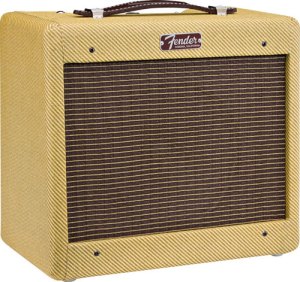
I’ve had a love/hate relationship with Fender over the years. When I’ve loved Fender, I’ve really loved them, and when I’ve hated them, I’ve really hated them. Right now, I’m really hating them. I’m just aghast at the prices they’re charging for their new gear! This Champ ’57 Reissue from the Fender Custom Shop lists at $1295 with a street price of $999! This for a 5 Watt amp with a diminutive 8″ speaker.

Make no mistake: The parts for this cost less than $400! This pricing is absolutely outrageous. Yeah, I’m familiar with its history, blah, blah, blah. And even though I’m no electronics dude, and couldn’t possibly construct an amp myself, I know a few manufacturers who build hand-wired amps with more power and GREAT sound for even less!

Take for instance, the Aracom VRX22. This is a hand-wired, 22 Watt amp that simply kicks freakin’ ass, and the head sells for $895! Then, there’s the upcoming release of the Reason Bambino. This is an 8 Watt amp that will sport that distinctive Reason sound. This head costs $699! It’s my next amp.

I’m sorry folks, this is the same issue that I had with the Fender Roadworn series of guitars. I’m not really in to reliced guitars, but there’s no way I could justify paying $999 for a freakin’ MIM guitar, especially when I paid less than $400 a couple of years back for my MIM Strat.

MAYBE Fender’s production costs are much higher than the smaller run manufacturers (not likely), which is how they justify the price-point for this amp. But this amp is nothing special from my point of view, and as I mentioned above, the parts for this cost less than $400. Lots of people have built 5F1-based amps. Look at the Valve Train Amps Concord. This is a 6 Watt point-to-point, hand-wired combo with a 10″ speaker. It sells for less than $500.

Go ahead, you can argue all you want about the classic sound and history of the Fender ’57 Champ reissue. But to me, Fender’s just again trying to trade on nostalgia. If that’s what floats your boat, more power to you – and mind you – I’m not questioning the quality or the tone of this classic. It has done much to contribute to the sounds of rock and roll. I just want to make it very clear that there are clear alternatives out there that may not have the name but undoubtedly have great tone, and watt-for-watt, and dollar-for-dollar have A LOT more value.

Note that I have the Champ 600 and it is one of my all-time favorite amps. But it has limited usability outside of my home studio. And that’s another thing that bugs me about the ’57 re-issue. It’s a hefty price to pay for an amp that would see limited if any use outside of my studio.

Like I said, if this floats your boat, and the price of this classic reissue, more power to you. For me, I demand a lot more value for the money I pay.

Recent Update

I’m still not sold on this amp, even though I have indeed played it, and it has some real vintage mojo. The sounds it produces are fantastic, but I still can’t justify buying it for the price Fender wants for it. Besides, I’ve seen some late-50’s originals that sell for the same price on EBay! I would buy one of those before I’d buy the re-issue.

Read Full Post »

« Newer Posts - Older Posts »