Feeds:
Posts
Comments

Posts Tagged ‘aracom’

5 Tone Bones - Gear has stellar performance, value, and quality. This is definitely top of the class, best of breed, and it's a no-brainer to add this to your gear lineup!

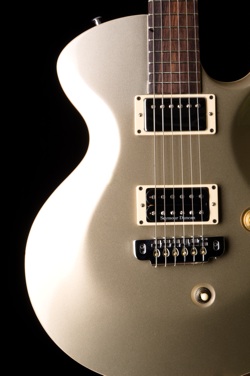
Saint Guitar Company Goldtop Benchmark

Saint Guitar Company Goldtop Benchmark

Saint Guitars Goldtop Benchmark

Summary: I never ceased to be amazed at the guitars Adam Hernandez builds. Here is yet another incredible tone machine but with classic looks and even better sounds.

Pros: This guitar oozes both visual and tonal bliss. The rosewood neck, mahogany body, and maple top combine to create thick but bright resonance that just stirs the inspiration juices.

Cons: None. None at all.

Price: $5000

Specs:

  • Mahogany Body
  • Maple Top
  • Brazilian Rosewood Neck
  • Rosewood Fretboard
  • Seymour Duncan SH-TB-PG1b Pearly Gates Humbucker (Neck)
  • Seymour Duncan SH-14 Custom 5 Humbucker (Bridge)
  • 25-1/4″ Scale
  • Wide, C-shape neck
  • Dual-action truss rod
  • Wide/Pyramid fret wire
  • Blind Dovetail neck joint
  • Gotoh bridge and tuners
  • Volume and Tone Control
  • Cleverly placed pickup switch

Tone Bone Rating: 5.0 – There is literally nothing not to like on this guitar. It truly rocks the house!

Like a lot of folks, I love vintage and vintage-style gear. There’s a certain, je ne sais quoi, perhaps mojo (I know, it’s an overused term) about vintage gear that seems to harken back to the “good ol’ days” when things were handmade and sturdy. But when that style is expressed in a modern way, at least for me, something stirs in my soul, and I’m totally inspired. It has been this way with every Saint guitar I’ve had the priviledge to play, and that continues with the Goldtop Benchmark.
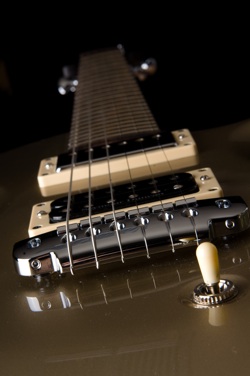
The Goldtop's Bridge

The Goldtop's Bridge

When I did my first Saint Guitars review of the Faded Blue Jeans model, I couldn’t believe how perfect the guitar was. The walnut body and neck, combined with the quilted maple top produced a bright and resonant tone that just begged to be explored to eek out all the possible tonal variations. With the Goldtop, the experience is still the same, but with that absolutely gorgeous finish, I’m experiencing a bliss that’s coming from both visual and aural sources.

Fit and Finish
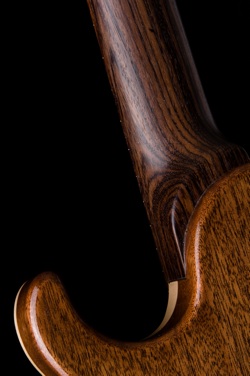
The Goldtop's Body and Neck

The Goldtop's Body and Neck

I’ve come to realize that there are some things in life that you can’t avoid describing with the heavy use of grandiose phrases, and the Goldtop definitely falls within this category with respect to how it looks. It’s perfect in every way. The creamy gold finish that almost looks white under light is a wonder to behold, but that’s just part of the equation. The gloss-finished mahogany body and open-pore rosewood neck add a certain sensuousness to the look of the guitar. I love that Adam had the foresight to keep the rosewood in as natural and organic state as possible. It feels absolutely wonderful when you grip the neck.

If I were to come up with a metaphor for how this guitar looks, it’s like admiring a beautiful woman that’s nicely dressed, but doesn’t need any makeup or other adornments to enhance her beauty. She’s self-aware and confident in how she looks, but doesn’t come across as aloof or unapproachable. In other words, this is a woman that has a purely natural and organic magnetism, and someone to whom I’d want to be close. That’s the response I have to this guitar.

Playability

I love the feel of natural grain, which is probably why I love my Strat so much with its maple neck. Again, for me there’s a certain sensousness in feeling the wood’s grain in my hand, and the Goldtop doesn’t disappoint in this department. When I first held the guitar, I was surprised and a little worried about the neck profile, which is wide by design, but add to that the C-shape, and I didn’t know if my relatively short fingers could reach all the frets, especially in the upper registers to hit the 6th string. But to my very pleasant surprise, I could get to those notes with ease.

As with all Saint’s that I’ve played, the Goldtop has a fast neck. The frets are just how I like them: Not too deep, but really lending themselves to a nice vibrato when you dig in a bit. And moving up and down the fretboard is a pure joy. The fret spacing is just right. As a guitar player himself, Adam really took great pains to get this part of the guitar right. For me, as I’ve said in the past, I’m not a really great improv guy, but I do play chords up and down the fretboard, and being able to move and nail the chords is very important. It’s as if precision was built into this guitar!

Adding to the playability is the arrangement of the neck and body. It’s very Les Paul-like, and that’s a good thing, which means that the higher frets are very easy to reach when the guitar hangs naturally from the straps. With my Strat, to get to the high frets, I have to physically shift the guitar to the left a couple of inches. Of course, part of that has to do with my gut 🙂 and it’s not really a problem, but I don’t have to shift the Goldtop at all.

How It Sounds

This is one of the best pickup combinations I’ve ever heard. The Pearly Gates in the neck has a nice, sweet, and smooth vintage tone. I liken it to a sip of a 25 year old Scotch. It’s warm and sweet and totally comforting. The Custom 5 is bright, but with a nice, taut low-end. When you turn up the gain on this pickup, you get the expected bright bridge tone, but because of the solid bottom-end, there is absolutely no “tinniness.” It’s just brighter sounding. This is a trait I’ve become accostomed to with all Saint Guitars. They’re the only guitars I’ve ever played that at least to me, have a usable bridge pickup. Combine the two in the middle switch position, and it’s pure heavenly tone. I could keep the guitar in this setting for practically everything I play, unless I wanted to get a super-smooth tone (neck), or need a bright tone to cut through the mix for a lead (bridge).

To me, the mark of a truly great guitar is balance in the dynamic response; more pointedly, that when you play high notes, the guitars volume doesn’t suddenly dive down. I don’t know how many guitars I’ve played that when I get above the 12th fret, the first three strings’ volumes literally sink, forcing you to really dig in with your pick to make them sound louder. That makes for a much more difficult playing approach, and is one thing that bugs me about my PRS SE II Soapbar. With that guitar, the first three strings are quite a bit lower in volume than string four through six. I’ve learned to compensate with my volume knob which thankfully is in a good position for on-the-fly tweaking. But with the Goldtop, and all the Saint’s I’ve played, this is not a problem. The dynamic response is balanced through all strings. It’s a testament to the resonance of the guitar. It picks up all the frequencies!

One thing I’ve learned about testing guitars is that the really important tonal properties are exposed when you play the guitar clean. I’ve played a lot of guitars that sound great when they distort, but just sound weak and hollow when you play them clean. Remember the beautiful woman I described above? This is her speaking voice: It’s rich and sensuous, and something you can listen to and never tire of it. Here’s a clip to prove the point:

I used an Aracom Amps Custom 45R that was re-tubed with 6L6’s from the stock KT-66 tubes, and Jeff kindly installed a Jensen Alnico speaker, replacing the Governor that I was testing with it. Both served to really open up the tone quite a bit with much more midrange – it started out very low-end focused.

What was amazing about this clip was that I wrote it earlier in the day, then recorded it 15 minutes before I had to leave to take my son to his lacrosse game, and just saved the audio file. When I finally sat down to listen to it, I couldn’t believe what I was hearing. Mind you, the clip is not EQ’d or mastered in any way. That’s the natural sound of the guitar out of the Custom 45R. I added just a touch of reverb on the amp, but other than that, it’s just the guitar, and the tone is – at least to me – amazing! It almost gives off a chorus effect. I thought it was due to the reverb at first, but when I came home, I played the song without any effects, and that chorusy tone was still there! I was blown away!

Overall Impressions

I didn’t think you could improve upon perfection, but the Goldtop is now my standard of perfection. As I wrote in a previous article, I’ve been in a bit of rut with writing music as of late, but with the Goldtop, I’m getting inspired again. It’s a marvelous guitar!

Read Full Post »

I just dig it when I find a great guitar and amp combo! Featured in this Jam Track are the Saint Guitar Company Messenger Baritone and the Aracom Amps Custom 45R, both of which I’ve reviewed previously. (Messenger Review | Custom 45R Review). The Custom 45 has a really beefy low-end and a slight scooped tone, and the Messenger, while a baritone, has this incredibly bright-sounding voice. The two complement each other particularly well! Here’s the Jam Track:

You have just over 6 minutes to play around with this one. For the rhythm part, I used a fairly basic rock beat, but I also added some Latin drums underneath to take the edge off the heavy downbeat. And by the way, there’s no bass in this track at all. All of that is provided by the Messenger!

Read Full Post »

4.75 Tone Bones - Almost perfect but not quite

Aracom Amps Custom 45R

Aracom Amps Custom 45R

Aracom Amps Custom 45R

Summary: A great take on the classic Marshall JTM45, with some extra goodies like tube-driven spring reverb, a fantastic master volume (post phase inverter), half power switch (40 to 20 Watts), and bright and bite switches to add hi and hi-mid EQ bumps for more tonal contouring.

Pros: Very versatile amp with a tonal palette that can serve up gorgeous clean tones to thick, super-compressed power tube distortion.

Cons: Heavy – weighs in at 60lbs.

Price: $2195 street (as tested with 1 X 12 Combo)

Specs:

  • Pre-amp tubes: (3) 12AX7, (1) 6BM8
  • Power Amp Tubes: (2) 6L6GC or KT66 (as tested)
  • Rectifier: (1) GZ34 (5AR4)
  • Reverb Tank: Accutronics Long TankHi/Low B+ voltage switch (40/20 watts)
  • On/Off Switch
  • Standby Switch
  • Indicator Lamp
  • Custom Heavy Duty Aluminum Chassis
  • Custom Wound Transformers
  • Impedance Switch:  4, 8, 16 ohm
  • (2) Speaker Jacks
  • Custom Handcrafted Turret Board
  • Handwired

Tone Bone Rating: 4.75 – Sweet amp with lots of tonal variety, but very heavy at 60 lbs. in a 1 X 12 combo! I would definitely get casters for this amp.

One thing I’ve learned about reviewing gear is to never have preconceptions about what something might sound like, especially with guitars and amps, regardless of what the manufacturer might say. When Jeff Aragaki of Aracom Amps dropped his latest amp off at my house, then explained that it was modeled off a Marshall JTM45, but with a few enhancements, despite my normal resistance to those suggestions, I still made a few assumptions about what the amp would sound like. Mistake. I was expecting a Marshall tone; it’s there, but it’s also different. But let’s get into some detail, shall we?

Fit and Finish

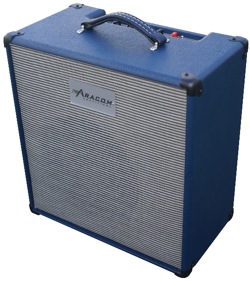
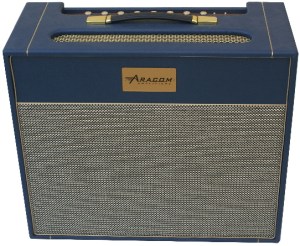
All Aracom amps are very well built and constructed. The amp I tested uses the cabinet shown above, but is covered in green tolex, and the same acoutrements as the cabinet above. The cabinet itself is very sturdy and very resonant. The metal grille at the top of the amp is a nice touch, as you can see into the chassis and see the tubes all lit up. I dig that kind of stuff. Jeff uses all high-quality material from the chassis to the knobs, and everything is well laid out.

How It Sounds

This is one awesome-sounding amp! I was actually expecting a real scooped tone, but was very surprised that the amp is actually voiced quite evenly through the EQ range, with just a tad bit of lower-mid range. This gives the tone a darker, almost fatter feel. But still, the cleans are rich and crisp, not chimey like an EL-84 would sound. The huge KT-66’s this amp packs probably account for that.

The reverb is subtle – very subtle – but I really like the effect it has. It definitely won’t do surf. It was as if Jeff wanted to add the reverb as a nice decoration for the amp’s tone. If you’re looking for a deep ‘verb, this won’t do it, but the reverb it does give you, for lack of a better word, just “fits.” Here’s a sound sample that I recorded with my Strat playing the amp clean in the Normal channel with all the EQ’s set to their midpoints:

By the way, the clip is the raw recording, with no EQ or mastering or level adjustments (which accounts for a bit of the distortion as I didn’t apply a limiter). As you can tell, the clean tone is sweet and well, clean. And it has TONS of clean headroom in the Normal channel.

As far as distortion is concerned, before this, I had never played with a KT-66-based amp, so I didn’t quite know what to expect, but this amp can produce some serious distortion. When saturated, the KT-66’s really compress the tone, and the compression comes on with even just a bit of breakup. It’s a great sound, but it’s difficult to cut through a mix with that amount of compression. But hitting the bite switch adds a bit of high-mid-frequency gain, so that compensates for the compression by sort of shifting the EQ up a bit.

The bite switch works with both channels, but the bright switch only works on the Normal Channel. This switch boosts the upper-mids and highs. Don’t expect a ringy sound out of this – it’s more like an instance presence control, though the amp sports a sweepable presence knob as well.

I wish I had a sound sample for my test with a Saint Guitars Baritone Messenger. Even though it’s a baritone, the walnut gives it a fairly bright tone, and that is really complimented by the Custom 45R. I was enjoying myself so much with the baritone, I totally forgot to record a clip! Maybe later… In any case, this amp just LOVED the Baritone! The Messenger also sports two Duncan active ‘buckers, and the drive they produce really made the amp growl with a real savage tone. It was very heavy, and I was just diggin’ it! Yowza!

Overall Impressions

While I really like the tone of this amp, and am having a lot of fun playing with it, admittedly I still lean towards that chimey EL-84 tone or that “Fender” tone that 6L6’s produce. The Marshall-esque tone never has been for me, but if I were to be on the lookout for an amp with that type of tone, I’d definitely give this amp some serious consideration.

Read Full Post »

4.75 Tone Bones - Almost perfect but not quite. Still way above average!

Aracom Amps RoxBox 18 Watt Combo Amp

Aracom Amps RoxBox 18 Watt Combo Amp

Aracom Amps RoxBox 18 Watt Combo

Summary: The RoxBox is an ideal small to medium size venue amp. Don’t let it’s diminutive size fool you. This amp is LOUD, and packs a real punch. Oodles of clean headroom in Channel 1 and capable of super-sinister drive in Channel 2 due to the “hidden” extra gain stage. Very pedal friendly.

Pros: Crystal-clear clean tone in either channel, though the second will break up earlier. Switchable from 18 Watts down to 9 Watts, so you can use this on stage and in the bedroom. Master volume kicks ass, and acts very similar to an effects loop attenuator. At 18 Watts, it’s loud enough to blow your ears off! Very pedal friendly.

Cons: Only a nit, but I wish this thing had a spring reverb. Also, overdrive can be a bit harsh at lower volumes, especially with single coils, though it’s gorgeous at louder volumes and moderate volumes using hubuckers.

Price: $895 direct

Specs:

– (2) EL84 Power Tubes
– (2) 12AX7 & (1) 12AT7 Preamp Tubes
– S.S. Rectifier with “sag” circuit
– Hi/Low B+ voltage switch (18/9 watts)
– On/Off Switch
– Indicator Lamp
– Custom Heavy Duty Aluminum Chassis
– Custom Wound Transformers
– 4, 8, 16 ohm Speaker Jacks
– Custom Handcrafted
Turret Board
– Handwired
– Weight: ~35 lbs

Combo Cabinets
Standard Tolex: Navy Blue Levant (as tested)
– Dimensions
1×10 Combo: 18″w x 19h x 10″d
1×12 Combo: 18″w x 19h x 10″d
– Weight
1×10 Combo: 36 lbs
1×12 Combo: 39 lbs

Tone Bone Score: 4.75 On value alone, this would get a 5, but the mildly harsh breakup at lower volumes gives it just a slight mark off. Still, it’s a great amp!

Jeff Aragaki, the owner and designer/builder of Aracom Amps is on a mission to transition from his telecommunications business entirely into his amp building business. I’d say that based upon playing just this one amp (both the head and combo versions), and having a look at a couple of other amps in his line (which I will probably review in time), he’s well on his way to successfully completing that mission. And Jeff’s not alone in this quest. A few folks I know here in the Silicon Valley have preceded Jeff, moving from their high-tech careers into the music equipment business; and while they may not have become super-wealthy off these new endeavors, they’re certainly living their dreams.

It’s like that in the Silicon Valley which, for decades has been a hotbed of innovation and dream-chasing. And while its star has faded somewhat as the global technology leader and the market has opened up allowing more players to the tech scene (China and India, for instance), the spirit of innovation and going after your dreams upon which “The Valley” was built remains alive and well, as evidenced by guys like Jeff. And true to Silicon Valley form, what these guys produce is quality stuff, and Aracom amps definitely follows suit!

When Jeff and I first hooked up, I was really excited about his 18 Watt RoxBox. First of all, I just dig the EL-84 tone, and secondly, I was amazed that he could offer this amp for less than a grand, and it’s a hand-wired amp, for goodness sake! I knew I had to check it out. And lucky for me, the city where Jeff lives is a half-hour away (if the traffic’s good), so two days after I first spoke with him, he personally delivered a head and a combo. I’ve been playing with both since (though I was so excited, I let my buddy borrow the head for a couple of days to see how he likes it). I’ve tested both amps in the studio as well as at gigs, but I’m writing this review about the combo. If you want to hear how the head sounds, check out this clip:

My Tests

For my tests, I used my Strat, my PRS SE Soapbar II with P-90’s, and a Saint Baritone Messenger that I’m also testing. The amp performed excellently with all three guitars, but was especially responsive to the baritone which has active humbuckers in Channel 2. But before I get ahead of myself, let first me go over the amp’s features apart from its technical specs.

Controls and Equipment

The RoxBox features two independently voiced channels, each equipped with a volume and tone knob. The Tone control functions similarly to a high-freq sweep. It also has a Master volume which is available to both channels. The Master volume is very cool as it functions as an attenuator between the pre-amps and the power tubes, so you can slam the front of the amp with tons of input gain to get that sweet, mid-rangy pre-amp distortion while keeping the output volume at bedroom levels. Great for edgy blues and classic rock tones. The combo I tested also sports an Eminence Red Fang Red Coat 12″ speaker. Operating at 30W, this sucker has a lot of balls! As expected, the sound was a little harsh when I first tried it out, but after several hours of playing, it’s starting to break in and the tone is starting to become a lot more smooth. Now with that out of the way, let’s get into some details.

Channels

Channel 1 would be considered a normal channel, while Channel 2 is a drive channel that will break up a lot earlier. But with Channel 1, the name of the game is “clean.” With my Strat plugged in, this channel has so much clean headroom that I had to really dig into the strings to produce even a slight amount of grind. My PRS with P-90’s and the Saint Messenger could only produce moderate amounts of grind when the volume was dimed. That’s pretty impressive, and definitely not what I expected. With so much clean headroom, Channel 1 is VERY pedal friendly.

Channel 2 on the other hand definitely breaks up early and is voiced just a tad brighter than Channel 1. But it also has a lot of clean headroom as well. With my Strat, I had to turn the volume knob past 7 to get some decent grind, and had to peg my guitar volume. Believe me, that’s not a bad thing either. On the other hand, My PRS SE Soapbar II and the Saint Messenger had no problems producing grind. I could get breakup at around 4 with the Messenger, and around 5 with the PRS.

To get earlier breakup, Channel 2 actually has a third “hidden” pre-amp gain stage in series behind the pre-amp you plug into with fixed settings. It’s voiced a bit hot, and as Jeff puts it, it’s like having a built in tube overdrive. The end result is you get breakup a lot earlier. I have to say that while I like Channel 1’s tone, for pure versatility, Channel 2 really does it for me, as it is lively and responsive to changes in attack and guitar volume. And putting a booster in front of this Channel really brings on the growl that this channel is capable of producing.

How It Sounds

Tonally, this is definitely an EL-84 amp. It’s bright and chimey, and with the Red Fang, it also has lots of balls. For sweet, clean tones, Channel 1 produces a lush clean tone, and my Strat in the Neck/Middle position sounds gorgeous through this channel. As I mentioned, it’s a bit brighter than Channel 1, which made me tweak my guitar tone knobs a bit, but not so much so that it’s unusable. And where this amp really shines in the tone department is when it’s moving lots of air. Plugged into Channel 2 with the volume turned up around 12-2 o’clock, and the Master past three, the amp simply sings its heart out, though at those volume levels in an enclosed space like a home studio, the assault on your eardrums can get a bit uncomfortable.

And while I don’t want to say anything negative because I truly dig this amp, I have to say that at lower to moderate volumes with a Strat, a driven Channel 2 (Volume around 8, Master around 2) seems a little flat sounding. At this level, the pre-amps are distorting with little contribution from the power tubes. Don’t get me wrong: It’s not bad sounding, it’s just a bit uninspiring. But turn the master up so that the second gain stage starts clipping and the power tubes start getting hit, and the world is made right again. I did, however, find a couple of workarounds to this. The first was easy: Just engage my Tube Screamer to add to the grind produced by the pre-amps at lower volumes; instant sweetness. Also, slamming the front-end with input gain from my booster worked wonders as well. The best solution I found that will also engage the power tubes was to use my Dr. Z Air Brake Attenuator. The world definitely became right with that in the signal path.

Versatility

The RoxBox is very versatile and is comfortable on both the stage n in the studio. I really dig the master volume on this because that’s really what makes this amp so versatile. And one feature that is mentioned in the specs but something I’ve found incredibly useful is that the amp is switchable from 18 Watts to 9 Watts with the flick of a toggle switch underneath the amp chassis. For home studio use, this is a godsend as the lower wattage allows the tubes to saturate earlier, which means you can get grind at lower volume levels. Some people think this means lower volume – it doesn’t – for any variable wattage amp. All it means is that the amp breaks up earlier. But having this capability means that you can gig with it at 18 Watts, then bring it into your home studio and get some great tube distortion without keeping the neighbors up late at night while you’re wailing on your guitar.

Also, as opposed to having a single output jack for external speakers, the RoxBox sports three, for 4, 8, and 16 ohm extension cabs.

Overall Comments

This is an amp that I’ll definitely be considering to add to my arsenal because of its tonal similarity to the classic Vox AC15, plus its gorgeous and plentiful clean headroom in Channel 1, but also for its value. At $995 for the combo the tonal versatility you get for the price is well worth the expense. If I had a nit, it would be the same nit I have with the Reason SM25, and that is the absence of a nice spring reverb. But that is just a nit because both amps sound great without it – it would just be icing on the cake.

Read Full Post »

Saint Guitars Messenger Baritone

Saint Guitars Messenger Bariton

Saint Guitars Messenger Bariton

Just wanted to share some initial sound bites that I created with a couple of new pieces of gear. The first is a Saint Guitars Messenger Baritone. Before now, I had never played a baritone, and really didn’t know what to expect. But after playing around with it for a few days, I have to say that I just love how this thing sounds. Baritones have been getting more and more popular as of late due to their very low, natural tone, and several metal players have started using them because of this. But I truly believe that a good test of a guitar or an amp is how it sounds clean. Played clean, you can’t hide mistakes. So here’s a clip that I created this morning to demonstrate the beautiful, clear tone the Messenger Baritone creates.

The guitar was played through the Normal channel of a Reason SM25 amp. As you can hear, the tone is deep, but surprisingly chimey due to the bright-sounding walnut body and neck, Adam Hernandez’ tone wood of choice. It took awhile to get used to playing the wider frets, but once I got a handle on it, I just started loving how this guitar plays and sounds!

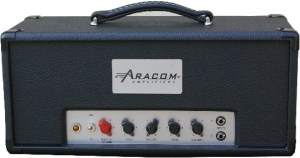
Aracom Amps RoxBox 18 Watt Head

Aracom Amps RoxBox 18 Watt Head

Aracom Amps RoxBox 18 Watt Head


You know me, in addition to just digging on overdrive pedals, I love low-power amps! When Jeff at Aracom initially contacted me, I had never even heard of Aracom amps! And I pride myself on knowing about these things! Yikes! So when I perused his site, I was immediately taken by the RoxBox. And after just a day of using it, I have to say that I LOVE THIS LITTLE AMP!!! First, because it’s a low-wattage amp, which makes it very versatile, and secondly because it comes equipped with EL-84 power tubes! There’s a brightness in the EL-84 tubes that just makes my soul reverberate, and I just dig the sounds that this amp can produce. But just as with the Messenger above, the big test for me is how the amp sounds clean. And baby, it sounds great clean! The sound bite I have here uses the same clip above, but layers on a lead part using just my Strat played through Channel 1 of the RoxBox. Channel 1 has TONS of clean headroom, and even ‘buckers have a hard time making this channel grind. This will definitely score well with the pedal freaks like myself. Anyway give it a listen:

This little amp is nothing short of impressive, and priced at $895 for the head, it’s also an incredible value!!! Kudos to Jeff at Aracom for creating an attainable hand-wired amp! Looks like I’m going to be shelling out bucks for both the Reason SM25 AND the Aracom RoxBox.

Read Full Post »

Aracom Amps RoxBox 18 Watt Amp

Aracom Amps RoxBox 18 Watt Amp

I love writing this blog. Not only do I get to share my passion for guitar and guitar gear, in the couple of years since I started this blog, I’ve met and encountered some really great folks who also share the same passion. After all, it’s why you visit, and I thank you for all the support you’ve given me! When I started GuitarGear.org, I didn’t have any idea of where I’d go with it. I just started writing; not very often at first, but then it just kind of took on a life of its own as I found other great gear blog sites, and started interacting with the general blogging community, and the people I’d meet on other sites would visit my site. That’s what has kept me going, and it’s just an amazing thing!

Of course, it’s really cool to review gear, whether I own it or test it, then share my findings with folks. And speaking of reviewing gear, in this article, I’m introducing what looks to be a real promising, new amp company, called Aracom Amps! They have a whole line of reasonably affordable, hand-wired amps modeled mostly after classic Marshal amps. From what I could tell from the sound samples, these are very nice sounding amps, and the few reviews I’ve been able to find have all been exceedingly favorable. So like I said, there’s a lot of promise in this relative newcomer to the custom, hand-wired amp space.

Jeff from Aracom contacted me the other day to see if he could buy some ad space on my site. I replied that I had never even considered doing that because I didn’t want to commercialize the site. The most commercial thing I’ve done to this point is to put “click-throughs” to Musicians Friend on some of my review pages so people could buy gear directly, but I never actually expected to make any serious money from the site. However, I did tell him that at the very least, I’d review some gear for him, and if I really loved it, like I do with Reason Amps and Saint Guitars (by the way, I just got a new baritone yesterday to test, and IT ROCKS!!!), I’d make a banner for him and put it on my site.

So I am now awaiting delivery of what I think is a very, very cool EL-84 based 18 Watt amp called the RoxBox. It’s completely hand-wired on turret board, and it comes in a head version (which is what I’ll be initially reviewing), and in two different combos: A 1 X10 and a 1 X 12. Nice. It has two individually voiced channels with independent volume and tone control, and is also switchable down to 9 Watts. So this promises to be a very versatile little amp. To say I’m extremely excited about receiving this amp is putting it mildly. The reason why I’m so excited is because the most you’ll pay for one of these is $995.00!!! Imagine that! A hand-wired amp for less than a grand! It’s unheard of! And all Jeff’s amps are very reasonably priced.

Let’s look at some features:

General Specifications:
– (2) EL84 Power Tubes
– (2) 12AX7 & (1) 12AT7 Preamp Tubes
– S.S. Rectifier with “sag” circuit
– Hi/Low B+ voltage switch (18/9 watts)
– On/Off Switch
– Indicator Lamp
– Custom Heavy Duty Aluminum Chassis
– Custom Wound Transformers
– 4, 8, 16 ohm Speaker Jacks
– Custom Handcrafted Turret Board
– Handwired

Head Cabinet
Standard Tolex: Black Levant. See options below for other colors.
– Dimensions: 19″w x 8h x 8.25″d
– Weight: 23 lbs

Combo Cabinets
Standard Tolex: Black Levant. See options below for other colors.
– Dimensions
1×10 Combo: 18″w x 19h x 10″d
1×12 Combo: 18″w x 19h x 10″d
– Weight
1×10 Combo: 36 lbs
1×12 Combo: 39 lbs

Introductory pricing:
Rox Box Head $895
Rox Box Combo with 10″ Jensen ALNICO Speaker $995
Rox Box Combo with 12″ Jensen Ceramic Speaker $995

Pretty impressive!

I had a great conversation with Jeff this morning about his amps’ price points, and he said that considering today’s economy, he wanted people to be able to buy his amps, and since he does all the work himself, and has done a tremendous job with planning his manufacturing (for example, all his amps use the exact same chassis template), he can keep the price down. With the RoxBox, he was able to keep the price point down further by using a solid-state rectifier that simulates a rectifier tube’s voltage sag rather than using a tube rectifier. Now before you dismiss this, remember that the venerable Fender company has been using solid state rectifiers in their amps for decades, and no one complains about their gorgeous sound! But besides that single piece of solid state componentry, everything else is hand-wired and tube-based.

Check out the RoxBox and other Aracom Amps at the company web site!

Read Full Post »

« Newer Posts