Feeds:
Posts
Comments

Posts Tagged ‘effect pedals’

Imagine a TC Electronic pedal for under $200! That’s right! It’s the Nova Repeater Delay. It has the same great quality you expect from TC Electronic, but at a great price. As TC Electronic puts it, the Nova Repeater is a “no-frills-with-a-sound-that-kills” type of pedal. In other words, it doesn’t have a lot of bells and whistles. You dial in your settings and play. The most useful feature I dig is the tap tempo you can do strumming your guitar! You hold down the tap tempo button, strum your guitar, and the pedal picks up the tempo you strum! Very cool! When you hold down the tap tempo to set your tempo via your guitar, the pedal shuts off the signal to your amp, so you can set your tempo practically noiselessly. The TC Electronic dudes are awesome! Here’s a video:

I’ve been wanting to get a simple delay pedal for awhile now, and this one looks very promising. However, TC Electronic announced this pedal on March 27, 2009, and it hasn’t hit the stores yet! Damn! I was going to lay down the $149 for this sight-unseen! Oh well, guess I’ll have to wait, or get the Catalinbread Dirty Little Secret first… 🙂

Read Full Post »

Catalinbread Dirty Little SecretI always love being able to get great tone at a bargain. It’s not that I’m cheap. I’ll pay top-dollar for great gear, but when potentially great gear comes at an incredibly affordable price, the Dawg’s ears perk up, and his nose starts sniffing around to see where he can play some gear.

Such was the case when I first came across this little pedal company located in Portland, Oregon called Catalinbread. I had run across the name on a couple of gear forums, but didn’t get a chance to check out their site until today when I read their press release in Harmony Central Effects News. After I read the press release, I had to check out Catalinbread’s site, and much to my pleasure, Catalinbread offers several, very cool pedals.

One thing that makes them stand apart is their diminutive size. As noted in ProGuitarShop’s Catalinbread company page, “One of the defining features of Catalinbread effects pedals is the size. Catalinbread pedals are half the size of your standard MXR. That’s right, take a Phase 90 and cut it in half vertically and you’ve got the basic size of Catalinbread’s pint-sized pedals.” But, as they say, size isn’t everything. Apparently Catalinbread’s pedals pack a lot of sonic punch.

The other thing that makes Catalinbread pedals stand apart is their price. Their most expensive pedal that I found was US$179.95. Several of their pedals are under US$120.00! Mind you, these are handmade pedals! That’s so awesome! Catalinbread is definitely taking the stand of selling gear at lower prices to get it into players’ hands. Creation Audio Labs does this with their awesome pedals, and Aracom Amps does it with their VRX line. This ain’t trivial stuff, either. This is great, handmade gear at a great price!

Can you keep a secret?

The Dirty Little Secret could be construed as another “amp in a box” pedal. But from what I’ve heard from sound clips, it’s far from that. Catalinbread claims to have built into the box amp-like touch sensitivity that accurately respond to your playing dynamics and volume input; so much so that you feel like you’re playing in front of an amp, and not through a pedal. But there are several videos on the DLS product page that bears this out. Check out that page here.

Of course, only a live test will reveal if that is true, but I’m intrigued enough to go try one out if I can. The only problem with that is there are none to be found. This pedal’s so scarce that you can’t even order one on the Catalinbread’s web site! I have a feeling they’re being sucked up as fast as the company can produce them. Even retailers who were hawking the pedals awhile ago have either removed their sale pages or replaced their “buy now” link with ‘Email us about ordering.”

Well… my brother lives up in Portland. Maybe I’ll have him look these guys up!

Read Full Post »

Ahh… yet another distortion box! Hehe. You know I just dig ’em. This one is from the same guys that bring us the J. Backlund Designs guitars; specifically, Bruce Bennet, of Bennett Music Labs, the actual maker of the J. Backlund Designs guitars.

I discovered this pedal while perusing the web for videos of the JBD-100 that I announced yesterday. It turned out that there was a video of how Bruce built the Brown Sound pedal (it’s below). That really got me interested in the pedal, so I did a bit more searching. I went to the J Backlund Site, and they had a link to view and list to sample of their pedals on a MySpace page.

That turned out to be a bit of dead-end because I couldn’t find where to buy them. I finally found a place that sells the pedals, call OohLaLa Manufacturing. Apparently, they’re a distributor and production house for a bunch of boutique pedals. They either take designs from pedal designers, then manufacture them or, as I found out from Bruce Bennett today, they just distribute the finished pedals. Defintely check out their site! Too bad they don’t have sound samples.

The Brown Sound

The original “Brown Sound” was popularized by the likes of Jimi Hendrix and Clapton with the “Woman Tone.” In its simplest sense, the Brown Sound was produced by using a bit of fuzz combined with TONS of power tube distortion. The end result was a way huge sound! Fast-forward a bit, and the Brown Sound then became associated with Eddie Van Halen. But to produce his tone requires a bit more work.

What about the Brown Sound pedal? Well, it’s not an EVH tone simulator. Apparently, it’s more of a Hendrix tone simulator as the guys at Analogman describe here. Interesting to note that this pedal is not meant to add gain. The volume knob is more of a volume cut, and the drive adjusts the amount of “Brown” you get. That’s actually kind of cool because I’m assume you don’t have to mess around with the volume much to find unity gain. Just leave the volume knob wide open, and let the pedal do its thing.

I’m gonna have to contact the guys over at OohLaLa to get more information about this pedal. I love that tone, and to get it in a box would be awesome!

I forgot to mention: The pedal is all hand-wired, and it’s only $159! Pretty cool! Anyway, check out the video of how it’s made.

Read Full Post »

I’ve personally had a mostly tepid response to BOSS’s multi-effects units. A buddy of mine has an ME-50, and he rarely uses it – though he has other interests besides guitar. But from what I’ve heard from it, it just never inspired me. But the ME-70 seems a bit more promising; the operative word here being “promising.” This new version packs 40 effects of what BOSS claims to be it’s “hottest” pedals. It doesn’t make me all hot and bothered, but it does pique my interest enough to go down to my local Guitar Center and try it out. It’s not a bad price of at $299, and for the solo gigs I play, having a nice, compact effects rig with some built-in amp models is definitely something to consider. But that said, the only REALLY promising multi-effects unit I’ve come across is the TC Electronic Nova System. But it’s also twice the price. Only a test will prove it out. In the meantime, check out the video from BOSS:

Read Full Post »

Gear-aholic. Tone Freak. Gear Maniac. At least that is what I have been called. I like to think of myself as a “Tone Crusader.”

I comb the ethers in search of implements to try to catch the unicorn called “Tone.” And since tone has so many faces, I need different kinds tools to help me catch the unicorn.  Thus, I have an arsenal of axes, both custom and commonly available; a bank of sound amplification devices to announce my presence with special foot pedals to alter my sound to affect a different response.

I spend hours upon hours developing and honing my skills, and learning how to most effectively use my tools. I am a warrior who must constantly be at the ready to perform.

And like the Crusaders of old, my quest for the tone unicorn is a life-long pursuit that has been fraught with both times of extreme joy and with days of dark dispair. But despite its ups and downs, I cannot even begin to imagine abandoning this pursuit! I’ve seen the unicorn! I have even come close to touching it! And until I do touch it, I will never give up. Never!!!

I fully realize that I may go to my grave without ever catching the unicorn. But it is not the goal that matters to me in any case; it is the journey that matters.

Read Full Post »

I recently started a friendship with Vinni Smith at V-Picks – what a cool dude! Not only does he make great picks, but that man can make an axe sing! Anyway, I was e-mailing him this evening about how his “The Snake” pickup has changed my life, and it got me to thinking about specific pieces of gear that have had a drastic effect on how I approach the guitar. I’ll share them here in kind of a loose chronology:

1. The Kyser Capo

Yeah, lots of people call ’em “cheaters,” but screw ’em. I couldn’t play lots of songs without one. But the Kyser capo in particular really changed my approach, especially after I saw James Taylor playing with one. For years, I used a standard nylon strap type of capo that just basically stayed in place. But then I saw JT playing with a Kyser. I always wondered how he did his mid-song key changes. I used to think he just changed his hand position and played barre chords. But I’ll be damned if he didn’t just slide the capo up, then just played open chords in another key. That was it! I was sold.

2. Ovation Celebrity Deluxe

After my beloved “Betsy” (a Yamaha FG-335 acoustic) broke in a terrible fall, I immediately went in search of a new guitar. I played all sorts in this used gear store and came across this gorgeous sunset burst Ovation. I wasn’t much of an Ovation fan – thought they were really tinny sounding. But when I played this one, it had a much deeper sound than the Ovations I’d played up to that point, and it was a shallow body, no less. When I plugged it into an amp, it sounded even better! That guitar got me into amplified sound. So of course, in addition to buying the guitar, I also got a small Roland 25 Watt practice amp. What a life changer that was.

3. Fender Hot Rod Deluxe

This was my very first tube amp, and an amp that I still use because of how good it sounds… er… I’ve had some modifications done to it, but nevertheless, being my first tube amp, it exposed me to a whole new world of tonal possibilities. Up to that point, I’d played only solid state amps from a Roland JC-12o to a Line 6 Flextone III to a Roland Cube 60 (which I still have – it’s an awesome amp). The Hot Rod showed me the wonders and beauty of tube amp distortion which is nothing like what you get with solid state amps.

4. Ibanez Tube Screamer

There are overdrive boxes, and there are overdrive boxes. But the Tube Screamer is THE classic overdrive box, and the oldest pedal on my board. I’ve of course fallen in love with other OD’s like the Creation Audio Labs Holy Fire, but the Tube Screamer had a real huge effect on how I looked at tone and established what pleases me the most with respect to breakup. It’s a great pedal (though I’m really psyched about testing the Tone Freak Effects Abunai 2).

5. Blizzard Pearl Fender 60th Diamond Anniversary Stratocaster

I love that classic, vintage sound, and this guitar delivered it from the moment I played it. Yeah, it’s made in Mexico, it cost me less than $400 new, but I chose it over Strats five times its price. Why? Because it kicked the shit out of the other guitars. It was THE guitar that convinced me that it’s not the price you pay but the tone you produce that matters. Since I’ve gotten her, I play “Pearl” every day. She’s the first guitar I go to when working on a new song. What a wonderful instrument.

6. Saint Guitar Company “Baby Blue” Benchmark

This isn’t my guitar, and I no longer have it in my studio, but this was the very first guitar that was made to my personal specifications. There is nothing like playing a guitar that’s made to order. The experience is surreal, and started me down this path of playing a custom guitar. Adam’s going to be building me one in the next few months – I’m keeping that one. 🙂

7. Reason Amps SM25 Combo

Even though I love my Hot Rod, the SM25 marks a time when I’ve gotten super-serious about my tone. I’d played a bunch of amps, but this amp showed me that sometimes you do have to pay to get stellar tone – and it’s worth every penny. Lots of manufacturers have created amps that run their channels in series, but I haven’t come across one amp yet that does it as well as Obeid Kahn and Anthony Bonadio. They’ve come up with an amp, cab, and speaker combo that’s like nothing I’ve played before – and I’ve played some awesome amps.

8. Creation Audio Labs Mk.4.23 Clean Boost

I used to think clean boosts were just to help punch a solo through the mix. I didn’t know that they could be used to slam the pre-amps of a tube amp to produce super-overdrive in an amp that no distortion or overdrive pedal can give you. But this one’s very special in that it adds no tonal artifacts of its own – it’s uncanny. What it does is boost the natural sound of your guitar, and when slamming the front-end of amp, gives you the true overdriven tone of your amp. This is a piece of gear that I cannot do without any longer, and it now has a permanent place on my board.

9. Red Bear Picks

I never thought I’d buy a handmade pick, nor pay $20 for one no less. But Red Bear Trading TortisTM picks truly changed my life. I now use Red Bears exclusively for playing acoustic guitar. They sound great with electric as well – I’ll get to that below when I talk about V-Picks – but no pick I’ve ever played has made my Ovation sound so good. These picks look and feel like natural tortoise shell, but they’re made from a polymer of milk protein. No matter, they’re awesome picks!

10. Aracom Amps RoxBox 22 Watt (soon to be released)

This diminutive amp oozes 6V6 goodness. It’s still kind of in the prototype phase so I can’t really write too much about it, but I think my friend Jeff Aragaki has hit a real sweet spot with this amp. Get this: It’s hand-wired, though it uses a solid state rectifier, and it costs less than $1000! The profound thing about this is you can indeed get boutique caliber gear at a great price. But for me personally, this amp is the very first boutique amp I’m buying. Oh, I’ll eventually get the Reason SM25 to run in parallel with this one, 🙂 but this amp is special because it’s the first boutique amp I will ever have owned.

11. V-Picks “The Snake”

As I mentioned above, I’ve befriended Vinni Smith, and I just dig the dude! He knows so much about guitar, and we’ve shared a lot of the same experiences, and love the same kind of music (his favorite guitar solo is the lead break in the middel of Frampton’s Do You Feel Like We Do – my favorite as well). When we first met, Vinni sent me a large sample of his picks, which I compared head-to-head with my Red Bear picks. Of course, I love my Red Bear Classic B-style Heavy, but when I played the comparable V-Picks Standard on my electric guitars, I just couldn’t believe this sound and action I was getting! So I decided to use my Red Bears for acoustic – as I said, nothing sounds better than a Red Bear on acoustic. But for electric, it was going to be V-Picks all the way. Then during a conversation we were having a couple of weeks ago, Vinni told me he’d send me his Snake picks. These are a whopping 4.1 mm thick, with a different bevel than his others. Since I’ve gotten them, I’m never going to use anything on electric guitar than the Snake! I use the rounded for a smoother, fatter tone, and use the pointy for bright attack tones – especially when I’m doing stuff on the bridge pickup! These two picks have totally changed my approach to playing electric. Thick picks in general did that, but these are the thickest I’ve played, and they absolutely ROCK THE HOUSE!

12. May 30, 2010 – I know, a bit late on the uptake here with this one, but life-changing nonetheless, and that is my Aracom Power Rox PRX150-Pro attenuator. This is the first attenuator that I’ve used that truly stays transparent down to bedroom levels. It is the only attenuator that accurately gives me my cranked up tone at low volume levels, and it is absolutely wonderful! I know there are others out there, but knowing that they’re modeled after existing attenuator designs that I know don’t sound very good at low volume levels, it was a no-brainer for me to choose this one. As Doug Doppler said to me in a recent visit to his home, “This thing has saved my ears!” Even Joe Satriani uses one of these units and loves it! That’s how good it is!

Okay, that’s it for me… Anyone care to share what gear has changed their lives?

Read Full Post »

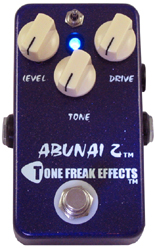
Tone Freak Effects Abunai 2

Tone Freak Effects Abunai 2

When I stumbled upon Tone Freak Effects as I described in a recent article, I didn’t let on that with the Abunai 2, there might be a Tube Screamer killer in my midst. As you may know if you’re a regular reader here at GuitarGear.org, I love my Tube Screamer. It is the one overdrive pedal that has stayed on my board for years. That creamy-smooth distortion with the mid-range bump just stirs me to the core. I use it all the time, even though I’ve been playing GREAT amps that break up beautifully.

So it is with incredible excitement and anticipation that Dereck over at Tone Freak Effects is sending me an Abunai 2 to evaluate. I’m always a bit dubious about overdrive pedals, and always make the comparison to my beloved Tube Screamer when I run across new ones. But the more I listen to the sound clips, and read reviews on the web about the Abunai 2, the more I’m thinking that if this pedal performs as well as the clips suggest, my Tube Screamer may have some serious competition.

Here are a couple of clips, both through a Suhr Badger:
Clean

Pushed

Impressive, huh?

The thing that REALLY turns me on about this pedal is that it has three switchable clipping configurations in addition to the gain, drive and tone knobs. That kind of versatility is extremely intriguing to me. We shall soon find out in the next couple of weeks.

Read Full Post »

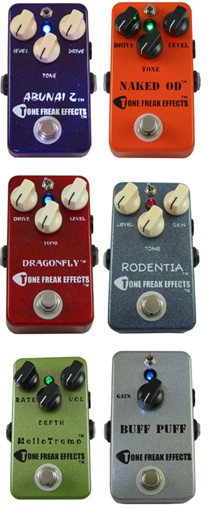
Tone Freak EffectsI love serendipitous moments, when I stumble upon something new when I’m doing something else entirely. Such was the case of me stumbling upon Tone Freak pedals. I was seeing if the domain name “tonefreak.com” was taken, and at the top of the search results was Tone Freak Effects. You know me and overdrive and distortion pedals. I LOVE ‘EM! And Tone Freak Effects specializes in two kinds of overdrive, two kinds of distortion pedals, plus a buffer/booster and a really nice trem pedal.

The OD and distortion pedal clips I listened to demonstrate a very diverse set of pedals that have a classic character, but also sound fairly unique as well. For instance the Abunai 2 clips sounded a lot like a classic Tube Screamer – nice and open – but with a bit more low-end while maintaining that openness. In fact, all the pedal clips I listened to portrayed familiar OD and distortion sounds, but were also wonderfully different in very good ways. This could likely be because almost all the pedals are the result of collaborations with various guitarists.

No matter, these pedals sound awesome!

I’m particularly interested in the Buff Puff, a signal buffer, plus a clean boost. The buffer is on all the time, and helps restore the signal loss that can occur in a long effects chain. When you switch the pedal on, you get some clean boost. Not sure how many dB, but that is something that I find totally cool. In addition to my love for OD pedals, I’ve really started getting into clean boost – not just to up my volume, but to also slam the front-end of an amp. It’s wonderful!

Anyway, check Tone Freak Effects out at: http://www.tonefreak.com!

Read Full Post »

LavaCable CPS

LavaCable CPS

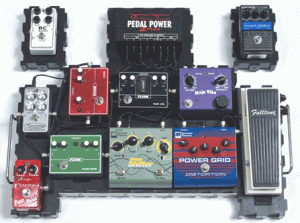
Introduced at Winter NAMM, the Lava Cable CPS (Configurable Pedal Board System) is what Lava Cable claims is the first fully configurable pedalboard system ever. They may be right, and are certainly on to something. The CPS consists of individual, notched pedal “blocks” that fit flush together. You then screw the pieces together in whatever fashion you wish. Imagine growing or shrinking your board at will! For pedal junkies like me, this system could be a bit dangerous. The limited size of my current board makes getting more pedals prohibitive, and that’s a good thing. A system like this would allow me to expand it ad infinitum!

In all seriousness though, being able to flexibly lay out your board is a totally cool concept to me. You’re not reliant on the shape of the board nor, if you’re into doing it yourself, must you cut out your own templates. For more info, go to: http://www.lavacable.com/lavacps.html

There is also an interesting discussion on The Gear Page with some pictures people have taken of their setups. http://www.thegearpage.net/board/showthread.php?t=487904

Read Full Post »

5 Tone Bones - Gear has stellar performance, value, and quality. This is definitely top of the class, best of breed, and it's a no-brainer to add this to your gear lineup!

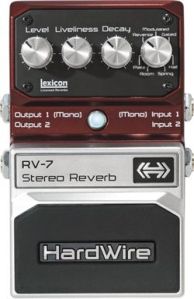
Hardwire RV-7 Stereo Reverb

Hardwire RV-7 Stereo Reverb

Summary: With seven (7) licensed Lexicon reverb models, this is one bad-ass reverb pedal, and a great value proposition given the relatively inexpensive price of $149.99 for a true bypass pedal. With the Hardwire series, Digitech has really hit a home run!

Pros: Just about the best-sounding spring and plate reverbs I’ve ever heard in a digital reverb. Capable of subtle reverb, to thick, rich and wet surf.

Cons: None. I dig this pedal!

Price: $149.99 street

Features (from Digitech):

  • Reverb Types
    • Room – Fast decaying reverb; great for a touch of ambience
    • Plate – Renowned studio reverb heard on classic recordings
    • Reverse – Reverb in reverse; gradually crescendos to full volume
    • Modulated – Lush, modulating, reverb ideal for chords
    • Gated – Unique reverb with abrupt decay; good for percussive playing
    • Hall – Large, encompassing reverb with warm decay
    • Spring – Classic “surf” reverb; great for Rockabilly too!
  • Tails On/Off Switch – When on, reverb tails are not cut off in bypass
  • True Bypass circuitry preserves your tone in bypass
  • Constant high-voltage operation for tonal quality and noise reduction
  • HardWire Pedals include the following stage accessories
    • Stomplock™ knob guards lock your tone in place and prevent tampering or accidental knob adjustments onstage
    • Green gaffer tape helps you locate the pedal in adverse stage lighting
    • Custom-cut Velcro® pads attach and lock your pedals to your pedalboard

Tone Bone Rating: 5.0 – I did a review of this awhile back, but I finally bought one, and I am oh so pleased with how it sounds!

Yeah, yeah, say what you will about Digitech being known for “consumer” grade pedals, and I’m as much of a boutique pedal snob as the next guy, but there’s no denying the quality workmanship that has gone into the Digitech Hardwire series of pedals. And yes, I know, I reviewed this pedal before, but that review was based upon a test at my local Guitar Center, while competing against the flailing of a wanker sitting next to me, trying to look cool and and trying to play metal licks and failing horribly. Okay, enough of the ranting… Y’all know how I feel about wankers… (search GG for “wankers”).

And say what you will about a digital effect box, but the fact the RV-7 has seven licensed Lexicon reverb voices inside give this pedal LOTS of credibility in my book. As I mentioned in my previous review, I’ve used a Lexicon rackmount for vocals at my Church, and have absolutely loved the reverb effects it contains. Though digital, Lexicon has figured it out, so it’s no surprise that they’re pretty much the standard for digital reverb.

In any case, despite the conditions I had to play within during my initial test, the RV-7 blew me away. Honestly, at the time, I didn’t think Digitech was capable of making a truly great-sounding pedal. Make no mistake, I’ve had Digitech pedals in the past, and they’re all quite functional, but I would never give them a “best in class” rating. They tend to offer great value for the money you pay – which isn’t much for their standard stuff; at least until I discovered the Hardwire series – especially the RV-7!

Since I reviewed the RV-7, I’ve tried several, and even came close to buying an EH Holy Grail. It too is a great sounding reverb, but there was something about its room reverb model which just didn’t do it for me. It’s a great pedal though, but I still liked the RV-7 better.

Recently, I had the chance to go to the local music shop near my work (B Street Music in San Mateo, CA) to perform an A/B test between the Holy Grail and the RV-7. Head-to-head the pedals were pretty close in performance, but the RV-7 beat the Holy Grail with the types of reverb voices it offered, plus the room reverb model on the RV-7 was superb! While the Holy Grail just edged out the RV-7 with the spring reverb, I found I could dial in a great sounding spring reverb with the RV-7 just the same, so that, combined with the awesome room reverb was what sold me. But let’s get into some specifics…

Fit and Finish

All the Hardwire pedals are solidly built with a cool, flat metallic finish. These pedals are very well-built, and surprisingly heavy – definitely gig-worthy. The RV-7 has a purplish, flat metallic finish on the body with a flat silver switch plate that has a nice rubber pad with the Hardwire logo. The pedal featurs a cool, light-blue LED indicator light. The RV-7 has four control knobs: Level, Liveliness, Delay, and a Voice selector knob. The first three knobs are not smooth sweep knobs. They have – for lack of a better term – micro-notches that really add to the whole industrial vibe that the Hardwire pedals have going on. When you look at the pedal, what’s not to like? 🙂 Of course, how it sounds is where it’s at, isn’t it?

Controls

Level – Controls the Wet/Dry amount. Fully clockwise is 100% wet.
Liveliness – This is actually hi-cut filter to add or reduce the amount of high-end freqs that come through
Delay – Controls how long the reverb effect decays after striking a note or chord
Voice Selector – pretty self-explanatory

How It Sounds

In a word, AWESOME! I used it in my weekly acoustic gig this evening, and was thanking the heavens for such a great pedal. My guitar maintained its clarity, no matter how much I upped the level knob. It must have a slight pre-delay built in; whatever, the fact that I could clearly hear the notes and chords I was playing and not having them washed out by the effect was truly an inspiring experience. Add to the fact that it is true bypass, so when it’s off, it’s really off, is yet another reason to love this pedal; no hum, no buzz.

To be fair, I have no idea what to do with the reverse reverb other than to add some interesting effect with single notes in a song. But other than that, I’m really digging this pedal!

Sound Samples

Here are some sound samples I quickly created… Please excuse the recording quality. I just recorded in an open room with no filtering. BTW, I used a Strat with a prototype Aracom RoxBox 18 Watt Amp with a Jensen 1 X10 speaker. In almost every case, all the dials were at 12 o’clock, except for the Hall and Spring, where I set Level and Decay to about 2pm. I prefer a more subtle reverb effect, but as you’ll hear, the RV-7 is crystal clear, and produces a very nice reverb effect.

Room

Plate

Reverse

Modulated

Gated

Hall

Spring

Read Full Post »

« Newer Posts - Older Posts »