Feeds:
Posts
Comments

Posts Tagged ‘Effects’

Yup, you guessed it… yet another overdrive pedal. I came across this pedal while perusing the forums over at Mark Wein Guitar Lessons. Mark occasionally posts “Pedal of the Day” entries, and this was his latest. I know, lots of people complain about “yet another OD pedal.” But if you stop to think about it, there’s probably a great reason why there are so many OD’s on the market. What comes to mind for me is that no one overdrive can cover everything. Let’s face it, a Tube Screamer or TS-like OD can only take you so far tonally.

Don’t get me wrong: Not all OD’s are created equally. Admittedly, there’s lots of crap out there, which is a fallout of the boutique gear movement. I’ve suspected several boutique gear “manufacturers” of simply building gear based on kits, putting a nice paint job on them, then selling the pedal for hundreds of dollars; which is why I’ve always stressed to folks – try before you buy!

The LovePedal Kalamazoo is no exception to this rule. While it has some very cool features (I’ll list them below), you really never know how a pedal will work with your rig until you put it in your chain. But despite that, I’m really intrigued by LovePedal’s twist on the overdrive with the Kalamazoo.

So what’s to like? As you can see, there are two little knobs called Tone and Glass under the common Level and Drive knobs. I believe this is where the magic of the pedal lies. Tone is a treble content roll-off, while glass is a treble booster that doesn’t affect the lows. These are wired in series, so they interact with each other. From what I could gather from the demo from ProGuitarShops I’ve seen, these two knobs offer up a world of tonal possibilities.

Another thing that appeals to me is that I prefer a more “open” kind of overdrive to let my power tubes do the compression. To me, it sounds more natural that way. The Kalamazoo was designed to create an “open” type overdrive tone. With it, you can slam the front-end of your amp, and make that gain push the power tubes into compression.

And from what I could gather, the Kalamazoo is VERY responsive to input gain, which is demonstrated in the ProGuitarShops video.

Here are the pedal’s features (from the Love Pedal site):

9VDC Input
True Bypass LED Status
Compact Die cast Aluminum Case 4.37″ X 2.37″ X 1.07″

Controls:
DRIVE – Sets the amount of overdrive
LEVEL – Master volume control
TONE – Softens the treble content
GLASS – Increases treble without cutting bass response
STOMPSWITCH – Turns effect ON or OFF

Cost: $199

To top it off, the pedal has a mirror finish! I really dig that! My Creation Audio Labs Mk.4.23 booster has a mirror finish as well. Sweet! And at $199, this is a pedal that will not break the bank!

Here’s LovePedal’s Intro Video:

And here’s ProGuitarShop’s Demo:

For more information, visit the LovePedal site!

Read Full Post »

In my First Impressions article on the VOX Big Bad Wah, a reader commented that “I think this looks like the one Vox Satch pedal that they got right.” After playing with it for the last couple of days, I heartily agree. With both the voice, UK/US inductor and wah mode switches, the Big Bad Wah opens up a ton of possibilities with respect wah tone. So far, I’ve been happy as a clam with the Wah I mode and the US-style inductor (Voice and Drive don’t become active until you activate Wah II). I’ve been playing with Wah II a bit, and it really kicks butt. I dig the Drive knob that adds up to a 10dB clean boost, so you can get a nice gain boost for solos. I still have more experimentation to do, but so far so GREAT!

Having a really great wah pedal makes all the difference in the world to me. I used my Original Cry Baby only sparingly because it was so quirky, and because it was a bit noisy – even when disengaged – I sort of refused to use it on recordings. Well, with the Big Bad Wah, that’s going to change. The sweep on this pedal is perfect. It’s nice and even, which makes it incredibly controllable. It is really a joy to play.

In any case, here’s a clip that I made this morning. It’s a little minor jazz-blues tune. With this clip I wanted to feature Wah II with the darker, more “vowelly” voicing. No boost in this because I didn’t want the amp to break more. Signal chain is: Squier CV Tele –> Big Bad Wah –> Boss CE-2 Chorus –> VOX Time Machine Delay (for a little slap-back). BTW, the Big Bad Wah really plays nice with other pedals. I’ll have some other clips when I do my full review of it. But for now, here’s the current clip:

Read Full Post »

VOX Big Bad WahThe one thing about pedals is that eventually, they wear out; especially pedals that have moving parts like a wah. It may take years, but they do wear out. It’s a fact of life.

My Dunlop Cry Baby has been on the fritz on and off for the past few months. Not wanting to take the time to replace it, and considering that it is easy to clean and adjust, I’ve occasioned to just do a DIY job on it and get it working again. No problem. But I finally just got tired of doing that, and decided to look at a new one.

About a year and a half ago, I evaluated several wah pedals but finally just went with a used Original Cry Baby, figuring it would tide me over for my wah needs. It certainly served me well, and I got a lot of mileage out of it. At the time of my original search though, the VOX Big Bad Wah hadn’t come out, so I really couldn’t consider it. But time went on, and I completely forgot about it until I saw the announcement for the new VOX Ice 9 overdrive pedal. Then suddenly, a light went off in my head, and I just nodded to myself, “That’s right. Joe helped design a wah pedal.”

So I did a bit more research, and saw an excellent video on YouTube with Joe discussing the idea behind the Big Bad Wah, and I knew I had to try it. So I immediately hopped into the car and went down to my local Guitar Center to try it out. I spent about an hour in the GC isolation room playing around with the different settings, and I have to say that Satch and VOX really did well putting their heads together on this wah pedal.

One thing that struck me before I played it was a comment that Joe had made in the video and how he described how Jimi Hendrix used a wah-wah pedal as an “extension of the music,” and the notes that were being played, and not something that was merely a rhythmic effect within an ensemble. That really spoke to me because even though I couldn’t hope to have their chops, I’ve always looked at the wah pedal in that light. So it was with great hope that when I did play it, I could use it in that way.

To make a long story short, the Big Bad Wah (“BBW”) lived up to my expectations and even more! I was thoroughly impressed! The sweep is perfect on this pedal, and unlike other wah pedals I’ve tested, doesn’t have a “breaking point” where the wah effect comes on suddenly. It’s nice and gradual. The total physical sweep of the pedal was also well-though out. It’s wide enough so you can add subtle portions of the effect in, but not so wide that you have to travel a lot to create a dramatic wah effect.

The one thing that used to irk me with my Cry Baby was how it would sound REALLY thin when I got to its full extent. Not so with the BBW. It gets trebly at the top, yes, but not so much that it’ll shatter glass, which means that in the middle of a lead, you can peg the pedal and get some great trebly voicing! On the other end of the spectrum, the lowest setting didn’t put a complete muzzle on my tone. It’s more of a compression effect, with a bleeding off of the highs. That means that your notes still stay fairly clear. Very cool!

Another thing that got me diggin’ the pedal was the different voicings. It has two: Vintage and Modern. The Vintage is a classic VOX wah tone, while the Modern includes the Vintage voice and adds a 10 db boost which is controllable via a Drive knob. Not only that, the Big Bad Wah also has an inductor switch that allows you to choose between a classic UK type of inductor, or a more modern USA type of inductor. The tone shaping possibilities with the BBW are immense!

Needless to say, I walked out of the store with the pedal. 🙂 Once I got a chance, I got a backing track going from one of my songs called, “In the Vibe,” and recorded a quick clip. I realize that I could probably have been a bit more dramatic with the wah effect in certain places, but I’m still getting used to the sweep. I’ll have better clips once I do a full review. In any case, give it a listen.

Also here’s the video I was talking about earlier:

Read Full Post »

Debuted at Musikmesse 2010, the Ice 9 is the newest member of the VOX Joe Satriani line of pedals, named after a song with the same title on Joe’s “Surfin’ with the Alien” album. While it uses the same box and layout as the Satchurator, this is a completely different animal. The Satchurator is a distortion box, while the Ice 9 is an overdrive. Okay… so it’s yet another overdrive pedal entry into the already – excuse the pun – saturated overdrive pedal market. But the Ice 9 has some interesting features that are worth noting.

First of all, it has a Vintage/Modern switch. This switch provides different overdrive voicings. According to VOX, the Vintage circuitry models the classic Tube Screamer tones, while the Modern circuitry adds a bit more top-end bit and a bit of compression. In addition to the Vintage/Modern switch, the Ice 9 features a Bass knob for dialing in more bass response; perfect for getting really scooped, modern drive tones. Finally, like the Satchurator, the Ice 9 has the JS line’s signature “More” toggle, which adds a 10dB clean boost when engaged.

Pretty cool features, IMO. The Ice 9 is slated to be shipped in June. I don’t have any pricing information on it yet, but I don’t doubt that it’ll be reasonably priced if the rest of the JS line is any indication. Here are a some videos:

VOX Ice 9 Introduction Video

VOX Musikmess Demo

Musikmesse Demo from PremierGuitar

Read Full Post »

Click on the picture to see an enlarged view.

Wicked Woody “Original” Pedal Board

Summary: Handmade with carpentry-grade wood, this is one gorgeous pedal board. Nothing like making something so utilitarian a virtual work of art!

Pros: Completely handmade with high-grade wood that doesn’t only look great, it’s lightweight as well! Platform is reversible so you can configure the board to have your volume or wah pedal on either right or left sides. Lots of space under the platform to fit a power brick and stow your plug, and the routing on the top makes it easy to run your cables.

Cons: Could use some rubber or silicon feet to protect the bottom from scratching and elevate it above possible spills (think bar gig).

Features:

  • Elevated pedal platform. With an elevated platform, it is both easier to see, and easier to reach all of your pedals.
  • Handmade, of the highest quality certified hardwood plywood. Durable finish that will protect your woody for life.
  • Easy cable management, with the cable chanels routed into the platform it is a cinch to place your pedals in any configuration you desire, and wire them however you would like.
  • Alternative storage, under the platform for your power supply or other storage needs.
  • Measurement: 24″ X 15″

Price: $80 direct

Tone Bone Score: 4.75 ~ I’ve never seen a pedal board that looked so nice. Despite its looks though, I really would’ve liked to see some “feet” on the bottom for some extra protection. Something that looks this good should be really protected. That said, it’s easy to get some hardware that’ll do the job with minimal effort. But if it had that right off the bat, I’d give this puppy a 5.0!

For Goodness’ Sake! It’s Just a Pedal Board!

I would venture to guess that most players don’t really put to much thought into the “look” of their pedal board other than if the cables are nicely arranged and out of the way. But lots of players obsess over the look of everything in their rig; even down to their pedals’ paint jobs. So why not put them on a platform that really shows them off, as well as being useful? Aesthetics are a good thing. Myself, I tend to be far more practical to even consider something like this, but hey! Cool is cool in my book, and although I may not normally consider having a board like this, that doesn’t take away from the fact that this is one gorgeous piece of functional hardware!

From my point of view the Wicked Woody pedal board is like a nicely shined pair of shoes. Most people wouldn’t normally notice them, but they do notice that there’s something “nicer” when you wear them. Such is the case with the Wicked Woody. It’s not a showy and sparkly, but it just looks well, nice. Besides, there’s nothing sweeter-looking to me than nicely grained wood, and all Wicked Woody pedal boards are made of high-grade woods, with a nice, smooth finish. In other words, the provide a sweet presentation platform for your pedals!

Setting Up the Board

When I received my evaluation board today, I was amazed by how lightweight it was, but it was absolutely solid. The plywood used would not bend or give at all! But in addition, it looked fantastic! I know, it’s kind of hard to be excited by something so utilitarian, but this board looks so good – it kicks ass!

Luckily, my evaluation board also included some velcro strips, so it was a simple matter of attaching them to the board. I got a fairly long length, so I just cut it in two and laid the strips straight across the board. If I were to actually keep the board, I’d be a lot more meticulous and place strips so the they don’t show at all. But for my evaluation, I just wanted to be able to easily arrange my pedals.

I have to say that I’ve never seen my pedals look so good. 🙂 Here’s a picture:
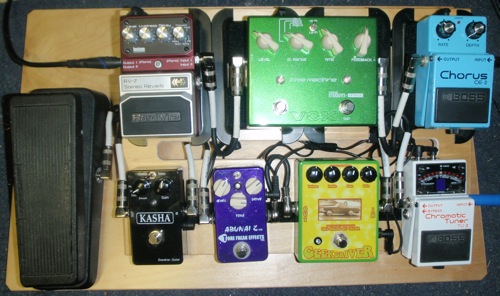
A very cool thing that I liked immediately was that the platform fits my back line of pedal risers perfectly! Four pedal risers fit exactly flush to the edges of the platform. The folks at Wicked Woody say you might not need pedal risers, and based upon the space between the front and back lines and the nice angle of the platform, I’d tend to agree with that. But with my clumsy, double-E feet, I need every advantage I can get, so it’s very convenient that the platform fits the pedal risers so perfectly.

You can clearly see the route in the center. There are actually two routes, but the upper one is obscured by my pedal risers. But both are very conveniently placed. The platform has a round hole on each side to run cables through as well. That is very convenient as I was able to run the power and connector cables underneath the wah. Then to connect the wah to my next pedal, I ran the connector through one side hole, then out the other side hole to connect to my CE-2. When all was said and done, I was impressed by the arrangement. Plus, the big base board really creates a nice spacious effect.

Now I know there’s a lot of debate with the placement of a wah pedal. Should it be before or after the drive pedals? I happen to prefer mine to be placed after my drive pedals, so the default arrangement, with the wah pedal on the left was perfect for me. However, for those who prefer it to be on the other side, the platform is reversible. You just have to unscrew the platform from the bottom of the board, turn it around, and you can place your wah (or volume or expression pedal) on the right side.

I didn’t take a picture of the back of the platform, but there’s plenty of room underneath. I placed a fuzzy strip underneath the platform, and put my Dunlop DC Brick there then ran the power connectors to the pedals through the routes. Having those routes is a real nice feature because it keeps your power cable runs nice and neat – and hidden from view. There’s also plenty of room underneath to place a spare pedal or two (as long as they have a low profile), and of course, you can stow your plug underneath during transport.

The eval board didn’t come with a case, so I’m not sure if there is one available. Hopefully there is one available because I’d definitely want one to transport the board to and from gigs if I owned one of these beauties.

So… overall impression? I dig this board. It looks fantastic, but it has some very nice features that make setting up your pedals a breeze. It literally took me less than 10 minutes to get everything hooked up. Granted, if I owned one of these, I’d take a bit more time to make everything perfect, but one could do a lot worse.

Update: April 1, 2010

Just got a message from the folks at Wicked Woody. They don’t have a case for their boards yet, but should have one as an option within the next couple of weeks. This is great news!

For more information, go to the Wicked Woody site!

Read Full Post »


Click on the picture to see an enlarged view.

BOSS RV-5 Digital Reverb

Summary: No, it isn’t the be-all end-all in reverb pedals, but for what it offers as a nice, subtle reverb to add some spaciousness to your sound, then the RV-5 really excels.

Pros: Plate reverb is excellent on this pedal – especially with an acoustic guitar. Amazingly enough, the RV-5 is transparent to my ears and doesn’t suck tone. The RV-5 is also super-quiet, and makes no line noise at all; pleasantly surprising qualities.

Cons: The Spring reverb is a little funky on this pedal. At higher Decay settings, there’s a bit of an intended artifact in the tail of the signal. Not too pleasing to my ears.

Features (from the BOSS web site):

  • Stereo input/output for compatibility with other stereo pedals
  • 6 high-quality reverb modes on par with rackmount processors
  • First-of-its-kind Modulate mode detunes the reverb sound for added spaciousness
  • New spring reverb emulation offers realistic spring reverb sounds
  • New gate reverb taken from high-end Roland studio gear

Price: $149 street

Tone Bone Score: 4.5 ~ As I mentioned above, for what this pedal offers, it’s great! To me, its strong suit is to use it as a subtle effect to add some spaciousness to your sound. As long as you don’t overdo it, this pedal will work great. The Plate reverb is particularly fantastic with acoustic.

With all the great boutique pedals out there, BOSS tends to be a bit too run-of-the-mill for many tone connoisseurs. Even I’ve thought of BOSS as somewhat of an afterthought considering some of the great boutique pedals I have, and from my participation in various online forums. Like, “Oh yeah… BOSS has “xxx” pedal. But it’s BOSS, and that means cheap, production line stuff.” But after I purchased the BOSS RV-5, one of my first thoughts was: “Have I become such a boutique gear snob that I can so easily dismiss production line pedals like BOSS because they’re not hand-made, boutique, and cost far less than boutique stuff that’s SUPPOSED to be better. ‘Cause here I am walking out the store with a BOSS pedal!”

Admittedly, it was a sobering thought. It wasn’t that I was experiencing buyer’s remorse. I truly like this pedal. But I founded this blog to share gear I’ve either purchased or come across, and most importantly, with the premise that it’s tone that matters and not the price or who made it; that is, if it sounds good, who the hell cares who made it or how much it costs? The BOSS RV-5 is a perfect example of this. Yeah, it’s made by a company that is generally equated with “cheap” pedals. But who the hell cares? I like how it sounds. If it wasn’t for the Spring Reverb, which I don’t particularly like on this pedal, it would’ve gotten a higher rating.

My intent with getting yet another reverb pedal was to get a journeyman pedal that would just do the job for my solo acoustic gigs. I wasn’t looking for a reverb where I’d layer on tons of the effect; just something subtle. After all, I was plugging into a PA board, and just wanted a touch of spaciousness, not have the reverb be the primary tone. In my experience, at low levels, even “cheap” stuff works pretty well, so I took the RV-5 for a spin, and was rewarded with a very nice-sounding reverb. As with any digital reverb that I’ve used, using them judiciously and in moderation is the key, and that was how I did my evaluation in the shop.

The net result is that I purchased the pedal. It does the job of providing a subtle, background reverb VERY well. Someone commented in my Gig Report that they’d take the RV-3 over this. I think this was motivated by the fact that the RV-3 is great for ambient stuff, as it is both reverb AND delay. But the RV-5 is really a different animal. Heavy, ambient reverb is not its strong suit. But for adding a slight spacious texture to your tone, it clearly excels in my opinion.

How It Sounds

For what it provides for me, I think this reverb sounds great. It’s not the be-all, end-all in reverbs, and it’s definitely not something I’d use for ambient stuff, but frankly, I never use a reverb pedal for that anyway, which is why I have a delay pedal. I put together samples of the same chord progression to give you an idea of what it sounds like in its various modes. The pedal is set with Level and Tone at noon, and Decay at 2pm. All clips were played with my Gibson Nighthawk, and running into the reverb pedal and into my Aracom VRX22.

Modulate

This mode adds an ever-so-slight slight chorus modulation to the tone. It’s nice.

Gate

Gate is interesting. Both pre-delay and decay are very short. This is actually kind of cool when you want a reverb tone that doesn’t tail.

Room

This setting really started growing on me when I was doing my tests. This is really a small-room type of reverb.

Hall

Nice, expansive tone with this mode.

Plate

Probably the most subtle of the modes, it really shines with acoustic guitar, but is very useful with electric.

Spring

BOSS claims to have added real spring reverb effects to this mode. Well, it didn’t succeed. The little motes of slightly buzzing spring are absolutely annoying to me, and I would never use this mode. You can hear it a little in the clip. I wasn’t expecting it at all, so it’s out as far as I’m concerned.

Overall Impressions

Sans the Spring mode, I like the reverb this produces. Plate and Room are definitely my favorite modes on this pedal, and Modulate comes in a close third. All in all, if you’re looking for journeyman reverb where you just want to lay on some spacious texture, this is a great pedal to consider!

Read Full Post »

What? No formal review? Well, being that the pedal is less than 24 hours old, and I gigged with it before doing a full review, I thought that I’d share how it performed first before giving it a rating.

First the back story…

I do a solo acoustic gig at  local restaurant every Friday. Rig-wise, my rig has been very simple: An acoustic/electric and a DigiTech Vocalist Live 4. I’ve brought amps in the past, but usually err on the side of convenience to keep things as simple as possible. The Vocalist Live has worked fine for several years, and it’s easy to hook up to the PA and go. Unfortunately, it’s showing its age and wear and tear from using it so much (I do at least two gigs a week where I use it). Lately, the guitar input has been crackling a little, so I’ve had to use the “Thru” jack to go out to the PA. That’s not a problem, but typically a raw signal into a PA can be a bit muddy and harshly so.

So yesterday, knowing that I would have to go direct to the PA, I went down to my local music store and got a great passive DI box from Radial Engineering called the “ProDI.” I’ll have a review of that in a bit. But since the PA at the restaurant doesn’t have any effect inserts or a loop, I decided to get a reverb pedal specifically for this gig. Enter the RV-5

BOSS may be considered a bit too mainstream for most people’s tastes, but I have to hand it to them. They’ve created some wonderful pedals in the past that have served to define certain tonal genres; for instance, the CE-2 Chorus. Now, I’m not saying the RV-5 is a standard by any stretch of the imagination. But considering how long BOSS (Roland) has been around, they do know how to get some great sounds. And the fact that almost everything they make is pretty affordable, that’s not a bad thing at all!

Add to the fact that BOSS pedals seem to last forever, and that is a testament to their build quality. My thought is that BOSS has always been able to produce “giggable” tones at a great price that may not be absolutely perfect or the ideal I may be after with a particular tone, but they’re well-built, reliable, and I can get my tones “close enough” so that most folks would never notice. Hell! I had my all-digital CE-5 on my board for years, and no one was the wiser (though, of course, it’s no match to the liquid, smooth tones of the CE-2).

I wasn’t expecting much out of the RV-5. After all, despite BOSS’s longevity in the marketplace, most of their new stuff is simply okay. But when I auditioned the pedal at the shop, going through a PA system, I was really impressed with its tone – especially with the “Plate” setting, which provides a nice, warm and snappy reverb that’s ideal for acoustic guitar. I didn’t play too much with the other reverb settings at the time, but I was really pleased with the Plate just the same. On that voicing alone, I knew I had a winner for my gig yesterday.

The other thing that REALLY stuck out for me was that the RV-5 is dead quiet. No errant hiss or artifacts at all, and that is a real delight, not having to deal with line noise.

So last night, I ran my guitar into the Vocalist Live, went out the “Thru” jack, into the RV-5, into the Radial ProDI, then straight into the board. I was crossing my fingers that it would work, and it work it did! I was pleasantly surprised about how transparent the pedal was! My Stratacoustic Deluxe has this quirky, but pleasing jangle from the Tele lipstick pickup in the neck that I absolutely love, and I was actually concerned that I’d lose that with the RV-5. But my concerns were all waylaid as that jangle was retained.

What I discovered through tweaking the pedal last night was that I actually like the “Hall” setting quite a bit, and switched back and forth between “Plate” and “Hall” all night. I really didn’t get into the “Spring” setting that much, and frankly, I’ve never really liked digitally modeled spring reverbs – even the Lexicon spring that’s on my Hardwire RV-7. But that’s just a nit. It’s not bad, but it’s not really my cup of tea. I tend to like a more spacious-sounding reverb.

So all in all, I really dig the Boss RV-5. I’ll do a full review in the next couple of days!

Read Full Post »

If you’ve read this blog with any regularity, you’d know that I’ve lamented trading away my original BOSS CE-2 Chorus for a Multi-function DigiTech pedal. Hey! I didn’t know better at the time. The CE-2 was cheap when I got it new back in the early 80’s, and so I figured, what would be the harm in trading a cheap pedal for another cheap pedal, especially if the new cheap pedal was all-digital! Oh well, I’ve redeemed myself. I finally got a CE-2, and for a GREAT deal on EBay!

To me, THIS chorus sound is the chorus sound that defines the entire gamut of chorus pedals. Say what you want about the others. While they’re all good – and I’ve heard and played many – the CE-2 chorus is the sound I grew up with as a young guitarist. To me, nothing matches its warmth and the liquidity of its tones. This is pure analog Chorus goodness.

I did some really quick demos about fifteen minutes ago. All clips were played clean with my Squier CV Tele 50’s running into my pedal board and into my Aracom VRX22. Excuse the 60Hz hum from my Tele and the ambient background noise of my fridge. 🙂 Each clip starts with a dry version then the CE-2 is engaged.

First up is a little clean blues groove. The chorus, when engaged is set to 3pm on both Rate and Depth to get a sort of vibey effect:

Next up is a simple chord progression done finger style. The CE-2 has both Rate and Depth set to noon:

Finally, the last clip demonstrates how well the CE-2 plays with other modulation effects. It first starts out with my VOX Time Machine and Hardwire RV-7 Reverb. When I play it over with the CE-2, the CE-2 is set to my favorite setting, with Rate at noon, and depth at 2pm (some things are just etched in your memory):

Of course I realize that appreciation of tone is an entirely subjective matter. But even after all these years, I just can’t get over how much I love this chorus sound and thick and liquid it can get, but still be crystal clear and articulate. My CE-5 did a great job for real subtle chorus, but cranked up, it was unusable. But with the CE-2, there are usable tones, no matter where you set it!

I have to admit that I am absolutely emotional right now. I’ve got all these memories flooding through my head from almost 30 years ago when I first bought it: Memories of watching a young Michael Hedges work his magic on his acoustic; trying to cop Andy Summer’s tone; late nights in my parents’ house plucking away at my guitar; lots of memories, both good and bad. Wow!

This pedal will NEVER leave my board again!

Read Full Post »

No, I’m not talking about a resonator guitar. This is an effect. It essentially adds tons of sustain and feedback kind of like one of those Moog guitars, but in a pedal connected to a gooseneck stand that appears to have an optical scanning device attached to the end that “reads” your strings, then processes the vibrations. It’s interesting to say the least, and Uli Jon Roth apparently uses it.

That said, I like the idea of having something like this to get super-sustain and feedback, and totally get that you don’t have to spend an arm and a leg to get at least part of what the Moog guitar does, but it’s another piece of equipment to lug around. Don’t know how I feel about that.

Don’t know how practical it is, but I’ve seen worse things.

Check out the Vibesware site for more information!

Read Full Post »

Man, I love it when gear manufacturers build stuff for a cause! Wampler has just re-released their limited run Underdog Overdrive (only 100 were originally made) to help out a friend who has breast cancer, as she can’t pay her doctor bills and apparently can’t get any insurance. All the profits from this re-release are going to help this woman out. It’s great to see this type of generosity!

Here’s a transcript of the press release:


Wampler Pedals has recently re-released their popular “Underdog Overdrive” pedal. Only 100 of the pedals were built originally.

According to Brian Wampler, owner of Wampler Pedals, “A close friend of mine has breast cancer and has no insurance, no family, and the government will not pay any medical costs for her to get the treatment she needs. Now, I’m not rich by any means, but I had to do something to help her. My wife and I came up with the idea of creating a pink pedal that is rich, dynamic, and very tweakable, and donate ALL the profits to her. Out of that limited run, famed country artist Brad Paisley bought one and loved it. A number of guitarists saw the pedal on Brad’s pedalboard and asked me to build one more for them, so I decided to start building more to keep up with demand. We are still donating all the profits to my friend, Ivy East, who is struggling to pay the doctor bills to combat this terrible disease.”

And here’s a video demo of the pedal. Apparently this is one of Brad Paisley’s favorite overdrive pedals:

For more information, visit the Wampler Pedals site!

Read Full Post »

« Newer Posts - Older Posts »