Feeds:
Posts
Comments

Posts Tagged ‘GAS’

4.75 Tone Bones - Almost perfect but not quite

Blackheart BH5-112 Little Giant 5 Watt Combo

Blackheart BH5-112 Little Giant 5 Watt Combo

Blackheart BH5-112 Little Giant 5Watt Combo

Summary: Nice, simple, and versatile studio/practice/small venue amp with sporting happening EL-84 tones.

Pros: Sweet and chimey EL-84 tones with Class A circuitry; simple and straightforward to use. Switchable between 5Watts and 3Watts, ensuring usability in just about any smaller venue. 3W mode kicks ass for getting power tube saturation at a reasonable volume.

Cons: I wish it had a Master Volume, but that’s just a nit.

Price: $349 street (used to be $249 when it first came out! Damn! Shoulda gotten one then.)

Specs:

• Single-ended Class A circuit
• All tube signal path
• One 12AX7/ECC83 dual-triode preamp tube and one EL84/6BQ5 pentode output tube
• Pentode (5W rms) Triode (3W rms) switch
• Solid-state rectifier
• DC filament power supply for all tubes
• 3-band EQ
• 16-gauge (1.5 mm) thick, folded and spot welded steel chassis
• Double-sided custom color PCB with 2 oz. copper
• 15-ply, 18 mm thick, void-free birch plywood construction
• Custom-designed 12″ Eminence Blackheart speaker
• 16 ohm, 8 ohm, and 4 ohm speaker outputs

Tone Bone Rating: 4.75 – Very musical and expressive amp. Nice cleans, with a decent amount of headroom.

I first heard about Blackheart amps back in 2007. They were so new that very few people knew about them. And while a local shop was listed as a dealer, only the owner knew about the amps, and they didn’t carry them in stock! Blackheart Engineering is sort of an overseas spinoff from Crate which produces cool, yet affordable tube amps. As a home studio enthusiast, I keep my ear to the ground about low-cost, low-wattage combo amps. When I first heard about the BH5-112, I was excited. I thought it was a bold move for Crate, and a smart one, considering Crate is a huge manufacturer with huge lineup of gear; adding even something cool like the Blackheart line would just get lost in the mix. But Blackheart was pretty low-key. No ads, spotty coverage on the Internet.

So it was a very pleasant surprise to see a few Blackhearts at a local shop yesterday, and among them, the Little Giant. I was actually there to play that G & L Tribute Comanche I wrote about last week; the last time I was at the shop, they didn’t have any Blackhearts, so I wasn’t expecting to see them at all. But with them there, I naturally had to try one out, and luckily they had the Little Giant.

Fit and Finish

This little amp has a real cool vibe going on. I really like the cabinet that Blackheart uses. It’s a closed back cab, and for an amp made overseas, it’s appears to be very well constructed. There were no apparent flaws in the tolex layering, and Blackheart logo on the front is killer. I dig the white vinyl trim used on the front around the grille cloth. Real boutique styling at a pretty affordable price!

The control layout is simple: An input jack on the left, volume and three-band eq knobs, an indicator light and an on/off switch, making it simple to plug in, dial in your tone, and start rockin’.

How It Sounds

I’ve really come to love the EL-84 tones, especially when they’re saturated, and the Little Giant doesn’t disappoint when delivering its sound. With the EQ knobs at 12 o’clock, the natural tone of the amp leans toward a slightly scooped tone with a bright voicing. Even with the specially-made Eminence 1 X 12, it’s bright, but it does retain a taut low-end that really smooths out the tone. Quite pleasing. I only tested the amp with that Tribute Comanche, but it didn’t matter. When I test an amp, I play it clean for a lot of my tests to see if it will deliver the natural tonal character of the guitar, and the Blackheart Little Giant fulfills its mission.

The amp is very responsive to volume knob and pick attack. With the volume set at about halfway, and cranking the guitar volume, I was able to get that AC30-like response: Clean and shimmery, with just the slightest bit of breakup when you dig in. Very pleasing to the ears.

Amazingly enough, even though its power rating is a minuscule 5 Watts, with the 12″ speaker, this amp can put out some volume! Hence its name “Little Giant.” It probably couldn’t keep up with a drum set and a band going all out, but it can pack a good enough punch to work well in a small venue where lower volume is critical, and it definitely could be put to great use in a studio!

Overall Impressions

What can I say? I dig this amp, much like I dig the Fender Champ 600. But unlike its Fender cousin, the 12″ speaker really lets the amp breath. And speaking of volume, I was quite impressed with the volume control. Unlike many amps that practically max out by 6, the sweep covered by the Little Giant’s volume knob is nice, even and more importantly, wide. Two thumbs up!s

Here’s a video (excuse the dude’s misinformation about Class A amps – damn! That’s even worse than my faux pas about modes 🙂

Read Full Post »

4.5 Tone Bones - Very solid performer, and has almost everything but just missing a couple of things

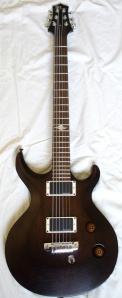
Saint Guitar Company Baritone Messenger

Saint Guitar Company Baritone Messenger

Saint Guitars Baritone Messenger

Summary: An aggressive guitar that wants to growl! This baritone is well-suited to de-tuned, low-freq, hard-driving metal, yet can be tamed to produce sweet, ringing cleans.

Pros: Very playable guitar, with a fast neck despite the wider frets. The hot, high-gain, active pickups practically eliminate the need for distortion pedals. Will hit the front-end of amp with tons of oomph! Bright tone will cut right through any mix.

Cons: Not really suited for a cleaner style of playing.

Price: $2300

Specs:

  • Solid walnut body and neck
  • Rosewood fretboard
  • Seymour Duncan Blackouts in Neck and Bridge
  • Master Volume and Tone
  • Gorgeous, dark-brown open-pore finish

Tone Bone Rating: 4.5 – Metalheads will love this guitar! I dug its playability, but would probably swap out the active pickups for a pair of ’59’s or Alnico Pro II’s to give the tone a fuller sound. But as with any Saint Guitars instrument, it’s really playable!

I’m very blessed. I have great friends who share my passion for guitar, and several of them make equipment. And I feel extremely grateful that I get to play the stuff they create. Such is the case with Adam Hernandez, whiz-kid owner and luthier of Saint Guitar Company. Adam and I struck up a friendship in the middle of last year, and I get to test (and sometimes spec) guitars he’s adding to his inventory. He doesn’t carry many in inventory as his business is fairly dedicated to creating custom works of functional art. But it’s cool that he lets me play with them. On the flip side, I’m more than willing to do writeups of his excellent guitars.

And while the guitars Adam creates are nothing short of amazing, what really turns me on about the guitars is Adam’s fearless approach to guitar making. For instance, Adam’s tone wood of choice is walnut. Walnut is usually considered bright and dead. But Adam has somehow found a way to shape and construct guitars made from walnut that are incredibly resonant and rich in tone. A guitar player himself, his designs reflect a sensitivity to the working guitarist, with easy-to-reach controls, and beautifully shaped bodies and necks that are more than just pleasing to the eye, they’re meant to be played!

When Adam contacted me and told me he wanted to swap the Faded Blue Jean Benchmark that I had been testing, I have to admit that I experienced a bit of trepidation in making the trade. For one thing, I kind of got attached to the “Baby Blue” as I came to call it, and more importantly, I had never played a baritone guitar, and didn’t know what to expect. But far be it from me to let those things get in the way. It’s not every day that you get to play custom, hand-made guitars. So a couple of weeks after he called me, we met at my local coffee hangout. That was before Christmas, so I’ve had quite a bit of time to play with the guitar.

Fit and Finish

What can I say that I haven’t said before? Saint Guitars are flawless in look and build. With this Baritone, I really dig the open-pore finish! It really brings out the natural grain of the walnut. As usual, the frets are perfectly shaped, and you’ll never find any rough edges or production burrs on the fret wire. And being that it is a solid stain, it’s just beautiful in its simplicity.

Playability

As I mentioned briefly in the summary, this is a very playable guitar. The action is PERFECT, and the jumbo frets make it easy to achieve vibrato just by wiggling your finger ever so slightly. In fact, since I like to really dig in with my left hand, it took me awhile to adjust to the light touch that’s required to voice a note or chord. But that’s a good thing. I’ve said it before: A good instrument will force you to be a better player because it won’t hide your mistakes or the idiosyncracies in your playing.

Adam is partial to wide, but shallow “D” shape necks. The “D” shape on the baritone is less pronounced on the Messenger than it was on the previous guitar I tested. I myself am partial to narrow “C” shape necks, but irrespective, the neck shape certain didn’t preclude me from playing. It did take a little while to get used to, but once I found a good height and angle, the guitar became a dream to play!

How It Sounds

I’ll let you decide for yourself. Here’s a clip:

And here’s the same clip with my Strat layered on top. I did this to see how well it played tonally with a standard scale guitar.

Okay, I did add a touch of reverb to the guitar in the tracks above, but the natural resonance and sustain even without reverb is astonishing! You can dig into a note, wiggle your finger, and the guitar will happily carry that note into the ethers forever. It’s very pleasant.

Now here’s the rub… and the reason I gave it 4.5 Tone Bones. For my style of playing, which leans towards the blues and classic rock, the Seymour Duncan Blackouts were way too aggressive for my tastes. I could clean them up just fine, but the guitar in this configuration was simply way too aggressive for the styles of music I play. For instance, when I recorded the rhythm track above, the guitar’s volume was set at around 3, the amp’s volume was at 2, and I used the Master to get clean headroom. Any higher on the guitar, and the gain the Blackouts produce would just slam the amp’s front end (BTW, I used an Aracom RoxBox 18 Watt head and a 1 X 12 cabinet with an Eminence Red Coat “The Governer” speaker). It sounds great clean, and if I were to purhase this guitar, I’d have Adam swap out the Blackouts and go with a pair of ’59 humbuckers or Alnico Pro II’s. They’re very vintage sounding, and a lot more full-bodied.

With respect to the natural aggressiveness from the pickups, while I played with the guitar a lot in the past month, I just couldn’t get inspired to write anything that took advantage of the high gain of the pickups. It just wasn’t in me this round, which is a shame because it is such a fine instrument in every other way. What I’d like to do is play the guitar with different pickups.

So what about with high gain? Damn! This guitar simply screams! With the volume knob dimed, it slams the front-end of an amp and causes immediate saturation! I usually have to bolster my Strat with a clean boost or an overdrive pedal to achieve the kind of high-gain this little monster can produce by itself! It’s very cool to hear!

Overall Impression

I think this guitar would be metalhead’s wet dream come true in stock form. In fact, Adam constructed and equipped the guitar with thrash metal in mind, and tried to see if he could get James Hetfield of Metallica to play it. Alas, he couldn’t find a way last time they were in town. But I can attest to what this guitar can do to an amp! But with different pickups, I’m sure I’d give it a perfect score.

Read Full Post »

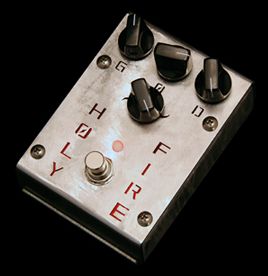
Creation Audio Labs Holy Fire Overdrive/Distortion Pedal

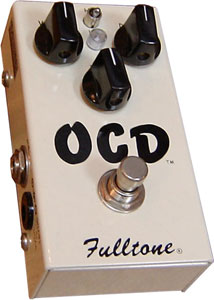
Fulltone OCD Drive Pedal

What do you do when you have two kick-ass overdrive/distortion pedals and don’t know which one to choose because both pedals bring so much to the table? The obvious answer is to use both. But my problem in choosing is exacerbated by limited pedal real estate, so I have to make a choice.

Actually, the choice wasn’t too hard to make once I started playing with the Creation Audio Labs Holy Fire. While I love the OCD, the Holy Fire wins hands-down for its versatility and total transparency. While the OCD is somewhat transparent, it can get kind of muddy and a little choppy at high drive settings, whereas the Holy Fire’s distortion section reacts a lot like a power tube at high gain settings producing a compressed effect that just rocks the house!

I still love the sound that the OCD produces. It really brings out harmonics and overtones, and set in a “sweet spot” produces a nice sparkly distortion that really sounds great. But as of late I’ve been gravitating towards retaining the natural sound of my guitar and amp, so the added artifacts that the OCD adds aren’t really what I want right now.

On the other hand, the overdrive on the Holy Fire is totally unique, and nothing like I’ve ever witnessed in all my tests of overdrive pedals (and believe me, I’ve tested a lot). The overdrive has what Creation Audio Labs calls a “wave shaping” circuit that evenly distorts the entire bandwidth of the incoming signal as opposed to creating a mid-range hump, or scooping the EQ. It really is completely even. You don’t lose any lows or highs, which is common in overdrive pedals. And the circuit reacts to both volume and pick attack, providing more wave shaping as you hit the front-end of the pedal harder. Simply put, you retain all the natural tone of your guitar! It’s insane! And it’s so special, Creation Audio Labs is trying to patent it!

I gigged with the Holy Fire for the first time this evening at my weekly Church gig. Make no mistake, this may be a church service, but we regularly hit above 100db in our sets, so there is plenty of room to let our amps breath, and take advantage of the higher gain settings on our equipment. Tonight, I made sure to pick music that would allow me to use the Holy Fire throughout my set. Talk about being inspired! I used it with my Strat and a Reason SM25 amp. What a combo! I set the gain to just above unity with the clean channel (about 10am), the overdrive at about 2pm, and distortion at about 3pm (so the distortion section would compress – it does this at around 2pm). The breakup was so smooth and delicious, I wanted to keep it on all the time! Unfortunately, I couldn’t do that with some songs, but where I had the entire band playing all out, the Holy Fire just made my heart sing!

The Holy Fire also plays well with other pedals. My mainstay overdrive pedal is my trusty green machine, an Ibanez TS-808 Tube Screamer. That’s one pedal that will NEVER leave my board! But here’s the cool thing: Running the Tube Screamer in front of the Holy First was like nothing I’ve heard before. I did this with my OCD as well, essentially getting a combined tonal effect that the TS and OCD produce. But the Holy Fire maintained the tone the Tube Screamer produces! On the other hand, it smoothed out and thickened the distortion. The result was the expected mid-range hump from the Tube Screamer, but with super-creamy distortion, plus the TS tone, that was like candy to my ears. No extra coloration that I came to expect by running my TS into the OCD. It was like playing a fatter Tube Screamer!

Believe me, despite playing in a worship service, the way I was feeling with both those pedals running together made it seem I like I was flying with the angels! I’m not exaggerating! There is absolutely nothing compared to the feeling you get when you’re playing with wonderful tone. It inspires and emboldens you, and you take your playing to places you didn’t think possible.

That was the feeling I got when I first started playing with the OCD, and frankly, I didn’t think it could get much better. But the Holy Fire has changed everything.

On top of that, I was using another Creation Audio Labs pedal, the Mk.4.23 clean boost, yet another amazing product from those electronics wizards. I used the booster to give me just a slight gain boost for when I was doing solos, or was in the refrain section of a song when I needed just a bit more volume. It too is a totally transparent boost, adding ZERO artifacts to your signal, so all the time I spent dialing in my settings wouldn’t be lost when the Mk.4.23 was engaged.

I swear, I must sound like a twitterpated, googly-eyed schoolgirl! 🙂 But it’s been a long time that I’ve felt truly inspired, like everything was totally right with my world of tone. I’ve finally (at least for now), found total balance in my tone. The circle is complete…

At least until I get a bad case of GAS!!!

Read Full Post »

5 Tone Bones - Gear has stellar performance, value, and quality. This is definitely top of the class, best of breed, and it's a no-brainer to add this to your gear lineup!

Reason SM40 Head

Reason SM40 Head

Reason Amps SM40 HeadSummary: Deep, lush cleans, with bright, ballsy and aggressive overdrive. The SM40 is a classic rocker’s wet dream come true.Pros: Touch-sensitive and expressive. The voltage sag in the 5U4 is just enough to create almost a reverb quality as the signal fades. Truly lovely sound!

Cons: None.

Price: $2195

Specs:

• Output: 40 watts RMS @ 10% THD
• (4) EL84 output tubes, in Class A Cathode Biased configuration
• (2) 12ax7 preamp tubes
• 5U4 Rectifier tube
• 3 way Stack switch – Normal, Stack, Bright
• Normal channel – Volume, Tone
• Bright channel – Volume, Tone
• StackMode™ – Bright & Normal channel controls are active, Stack Volume & Hi-Cut
• Oversized extra capacity power supply
• Harmonics Switch – works in the final output stage to change the harmonic structure of the
overdrive.
• Power Switch
• Standby Switch
• Half-power switch
• Independent output jacks for 4,8, 16-Ohm operation
• Footswitch access to all three channels/modes

Tone Bone Rating: 5 – This is a blues and classic rock machine!!!

This review is a long time in coming as I evaluated the SM40 over a month ago, but as they say, better late than never. As many may know, I’ve had a love affair with the SM25 that the Reason guys sent me to review, and that amp will be in my rig (see my review here). In my view, very few amps can match it in versatility. It is an extremely expressive amp that is capable of producing lush, ringing cleans, to searing overdrive. And according to both Anthony Bonadio and Obeid Kahn, the founders of Reason Amps, the SM25 Combo was built specifically with versatility in mind. It is very pedal-friendly, and StackModeTM is the greatest thing since sliced bread!

But sometimes, you just don’t want or need that kind of versatility because with versatility comes compromises. For instance, the SM25’s Normal or clean channel breaks up a little earlier than you’d expect though I actually rarely if ever play at the volume so it’s a none-issue for me. Since I play a variety of styles, versatility is a key factor in my decision on an amp. But that versatility is lost on those who just don’t need it. And mind you, that’s not a bad thing. It’s merely a matter of choice, which is why you have a number of amp options to choose from with Reason Amps. Premier Guitar already covered the SM50, which gives a fair picture of the SM50’s capabilities – though I do have to take issue with Premier Guitar giving it the “Loud As Hell” award. It’s not just a noise-maker. It’s just that you’d swear the SM50 is 100 Watts as opposed to 50 Watts. It’s an extremely powerful and expressive amp with classic EL-34 goodness.

The SM40, on the other hand is a very interesting take based upon EL-84 output tubes. Where the SM25 and SM50 are based on EL-34’s in Class AB fixed-bias configuration, the SM-40 is built around two EL-84’s operating in Class A Cathode Bias configuration. Like the other Reason Amps, the SM40 has two independent channels with the trademark StackModeTM “channel,” that combines the fully amplified signals from both Normal and Bright Channels in a series with an extra gain stage, while retaining both the volume and EQ control that each channel contributes to the combination.

The Story Behind the SM40

I called the Reason guys up to shoot the breeze a bit yesterday, but to also pick their brains about the SM40, Obeid Kahn (Reason’s amp designer) and I had a great conversation about the story behind the SM40. For all intents, and purposes, the SM40 was Reason’s first production amp. Obeid had gone through several prototypes before he finally produced the SM40 which included StackMode. Previous versions had completely independent channels with separate inputs, then evolved into switching between the two, then finally evolved into connecting the two channels in a series. So the SM40 could be considered the eldest sibling in the Reason amp line and the first successful incarnation of StackMode.

How It Sounds

The SM40 is targeted at blues and classic rock players, and it definitely shows that in the way it’s voiced. Moreover, there’s something really special about the clean tone of an EL-84-based amp. It’s naturally chimey and glassy, and guitars that have that natural quality bring that tone out even more. On the Normal channel, the kind of voicing is beautiful; chimey with lots of mid-range, but not overdone. And there’s TONS of clean headroom in this channel, which makes it ideal for use with pedals. Put a booster in front of this channel, and you get that AC-30-like breakup, which is subtle and smooth. Very nice.

The Bright channel, on the other hand, is actually not that much brighter than the Normal channel. In fact, the tonal differences between Normal and Bright are so subtle that you’d think there’s no difference at all. But that’s by design. Unlike the SM25 which was built around versatility, the SM40 is a much more focused machine, which is why you only get volume and tone on any channel or mode, as opposed to the SM25 which includes a 3-band EQ on the Normal channel. The idea behind that makes sense: Players who buy this amp will mostly play a certain style of music and don’t want to be bothered tweaking knobs to dial in their sound. Not that the amp can’t be used in a variety of genres, but players who play this won’t want to stray from the general tone the SM40 produces.

Similarities between the channels aside, the real kicker for me is the StackMode “channel,” which combines Normal and Bright channels in a series, while retaining both volume and tone shaping in both channels. This really opens up a whole new pallette of tones you can produce. It’s super-expressive, and because you’re essentially working with three gain stages in a series, this mode makes the amp incredibly responsive to volume knob and attack. Dime the volume on your guitar, and you can get tons of overdrive. Back it down and pick lighter, and the tone cleans right up. In my tests of both Reason amps, StackMode was pretty much all I used, unless I was playing something where I needed a pure, glassy clean tone for which the Normal channel excels.

An interesting switch labeled Odd/Even resides on the control panel. This is a harmonics switch that works with the phase splitter in the final gain stage. The idea behind it is that at super-high gain, you start getting a “notch” type of distortion. Flipping the switch smooths that out. I actually didn’t notice that much of a difference with the switch in either Odd or Even positions, but maybe that was because I was only 3 feet from the amp, and it was cranked! 🙂 For the most part though, the switch won’t have too much of an effect until you get into really thick overdrive.

Playing It

The SM40 was tested with a Strat copy and a Saint Guitars Benchmark with humbuckers. With the Strat copy, you’re immediately taken to the roots of blues. The chimey vibe really comes out with single coils, and I found myself closing my eyes to take in the sweetness. With the Benchmark, the SM40 grew big balls of steel. Not that you’d do metal with this amp, but humbuckers make the SM40 want to growl. It’s really nice.

Overall Impressions

The SM40 is a sweet amp, and like its sibling, the SM50, it’s really made for the stage. It’s expressive and ballsy, and is meant to be played hard. As both Anthony and Obeid have both told me, this amp is made for active musicians. And while I wouldn’t want to keep people from buying it because it sounds so good, by the same token, I wouldn’t recommend it for bedroom use. You wouldn’t be able to take advantage of its full range of tones.

Read Full Post »

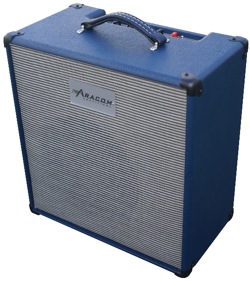
Aracom Amps RoxBox 18 Watt Amp

Aracom Amps RoxBox 18 Watt Amp

I love writing this blog. Not only do I get to share my passion for guitar and guitar gear, in the couple of years since I started this blog, I’ve met and encountered some really great folks who also share the same passion. After all, it’s why you visit, and I thank you for all the support you’ve given me! When I started GuitarGear.org, I didn’t have any idea of where I’d go with it. I just started writing; not very often at first, but then it just kind of took on a life of its own as I found other great gear blog sites, and started interacting with the general blogging community, and the people I’d meet on other sites would visit my site. That’s what has kept me going, and it’s just an amazing thing!

Of course, it’s really cool to review gear, whether I own it or test it, then share my findings with folks. And speaking of reviewing gear, in this article, I’m introducing what looks to be a real promising, new amp company, called Aracom Amps! They have a whole line of reasonably affordable, hand-wired amps modeled mostly after classic Marshal amps. From what I could tell from the sound samples, these are very nice sounding amps, and the few reviews I’ve been able to find have all been exceedingly favorable. So like I said, there’s a lot of promise in this relative newcomer to the custom, hand-wired amp space.

Jeff from Aracom contacted me the other day to see if he could buy some ad space on my site. I replied that I had never even considered doing that because I didn’t want to commercialize the site. The most commercial thing I’ve done to this point is to put “click-throughs” to Musicians Friend on some of my review pages so people could buy gear directly, but I never actually expected to make any serious money from the site. However, I did tell him that at the very least, I’d review some gear for him, and if I really loved it, like I do with Reason Amps and Saint Guitars (by the way, I just got a new baritone yesterday to test, and IT ROCKS!!!), I’d make a banner for him and put it on my site.

So I am now awaiting delivery of what I think is a very, very cool EL-84 based 18 Watt amp called the RoxBox. It’s completely hand-wired on turret board, and it comes in a head version (which is what I’ll be initially reviewing), and in two different combos: A 1 X10 and a 1 X 12. Nice. It has two individually voiced channels with independent volume and tone control, and is also switchable down to 9 Watts. So this promises to be a very versatile little amp. To say I’m extremely excited about receiving this amp is putting it mildly. The reason why I’m so excited is because the most you’ll pay for one of these is $995.00!!! Imagine that! A hand-wired amp for less than a grand! It’s unheard of! And all Jeff’s amps are very reasonably priced.

Let’s look at some features:

General Specifications:
– (2) EL84 Power Tubes
– (2) 12AX7 & (1) 12AT7 Preamp Tubes
– S.S. Rectifier with “sag” circuit
– Hi/Low B+ voltage switch (18/9 watts)
– On/Off Switch
– Indicator Lamp
– Custom Heavy Duty Aluminum Chassis
– Custom Wound Transformers
– 4, 8, 16 ohm Speaker Jacks
– Custom Handcrafted Turret Board
– Handwired

Head Cabinet
Standard Tolex: Black Levant. See options below for other colors.
– Dimensions: 19″w x 8h x 8.25″d
– Weight: 23 lbs

Combo Cabinets
Standard Tolex: Black Levant. See options below for other colors.
– Dimensions
1×10 Combo: 18″w x 19h x 10″d
1×12 Combo: 18″w x 19h x 10″d
– Weight
1×10 Combo: 36 lbs
1×12 Combo: 39 lbs

Introductory pricing:
Rox Box Head $895
Rox Box Combo with 10″ Jensen ALNICO Speaker $995
Rox Box Combo with 12″ Jensen Ceramic Speaker $995

Pretty impressive!

I had a great conversation with Jeff this morning about his amps’ price points, and he said that considering today’s economy, he wanted people to be able to buy his amps, and since he does all the work himself, and has done a tremendous job with planning his manufacturing (for example, all his amps use the exact same chassis template), he can keep the price down. With the RoxBox, he was able to keep the price point down further by using a solid-state rectifier that simulates a rectifier tube’s voltage sag rather than using a tube rectifier. Now before you dismiss this, remember that the venerable Fender company has been using solid state rectifiers in their amps for decades, and no one complains about their gorgeous sound! But besides that single piece of solid state componentry, everything else is hand-wired and tube-based.

Check out the RoxBox and other Aracom Amps at the company web site!

Read Full Post »

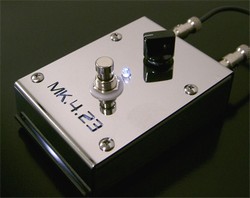
Creation Audio Labs Mk.4.23 Boost

Creation Audio Labs Mk.4.23 Boost

Creation Audio Labs Mk 4.23 Clean Boost

Summary: Truly flat EQ response, zero coloration, clean boost pedal that takes your tone and gives you more, much more of it. Can be used as a simple clean booster, or can slam the front of your amp with up to 24dB of gain.

Pros: Does only one thing: It boosts your signal, giving you more cleans, or slamming your preamp tubes into sweet, singing, sustaining distortion. No bells and whistles, just a single volume knob. Super cool stainless steel finish, with backlit lettering.

Cons: None.

Price: $149 direct

Specs:

  • From zero to +24 dB of transparent boost
  • No tone coloration
  • No signal distortion
  • No phase reversal
  • True bypass with quiet switching
  • Ultra quiet 9v power supply included

Want a pure boost pedal? One that just does what it’s supposed to do? Simple to use? Doesn’t add its own “character” and just gives you more of your own tone? Look no further. I don’t say these words lightly either. All those things are true!

When Anthony Bonadio of Reason Amps first told me about the Creation Audio Labs Mk 4.23, I was really taken by the emotion in his voice when he described the pedal, and his claim that it was the best boost pedal he’d ever used. That’s saying a lot coming from a man who rarely uses pedals. And when he offered to send his to me to try with the Reason SM25 amp I recently reviewed, I just couldn’t wait until it arrived. It arrived today, and now I understand why he feels the way he does about the Mk 4.23.

Playing it through the Normal (clean) channel of the SM25, it does what it’s supposed to do: It boosts your clean channel. It was what I expected, so it was a bit boring, though I was impressed by the fact that there was no snap, crackle, pop when I kicked it in, and it just simply gave me more of my clean tone. But where this pedal really shined was when I kicked in the Bright and StackMode channels of the amp.

Talk about a visceral response! I can’t even describe the feelings I experienced as the pedal slammed the preamp tubes, and made the amp produce sweet, singing sustain that lasted for days! I always knew that the amp could produce incredible distorted tones, but with the boost engaged, I could hear additional harmonics and overtones issuing from the amp that up until that point I had never heard! On top of that, I never lost a bit of tonal clarity, even when I had the volume knob dimed and was creating that scooped, snarling dog buzz. That’s certainly a testament to the quality of the amplifier and complex and sophisticated sounds it can produce, but it’s also a huge testament to Mk 4.23 that can push the amp into that organic, high-gain overdrive. OH MY FREAKIN’ GOD!!!

I tested the pedal with humbuckers and single coils, and it was interesting to hear the difference in how the pedal performs with both. With humbuckers, the volume boost is less dramatic, as humbuckers send a lot of gain by default. But the effect was by no means displeasing. Where I didn’t get a significant volume boost, I got a lot more gain, driving the preamp tubes even harder. The sound was absolutely delicious! In fact, it drove the amp into feeding back, even a lower volumes! How cool is that?!! The guitar I used has tons and tons of sustain, but with the amp slammed, the sustain went on and on and on. And with that much gain, the compression from the power tubes just gave the signal balls of steel. But wait! There’s more!

With my Strat, the volume boost effect was dramatic; perfect for pushing your volume into great lead levels to get over the top of a mix. I didn’t get as much drive into the preamp tubes, but I wasn’t expecting that in any case. And yet again, the booster just took my tone, and simply gave me more of it.

So as you can tell, I REALLY like this pedal. I love what it does in a big way. But here’s another thing to love about this pedal: Its price. Creation Audio Labs got tired of using middle men and retailers that would price the pedals out of many players’ budgets, so they decided to only go direct. So what used to be a $260 pedal is now only $149. Buy it direct from Creation Audio labs!

In closing, after I return this pedal to Anthony, I’m going to buy this pedal. After just using it for just a short time, I’m confident in saying that this is a pedal that will always be on my board.

Read Full Post »

Valve Train Spring Thing

Valve Train Spring Thing

In my search for a new reverb unit, I ran across this interesting unit by Valve Train. I know, it looks like an amp, but it’s a tube-driven reverb unit with a dedicated reverb tank – very cool. There’s really nothing like a good spring reverb unit, especially ones done the old school way. I’d love to try one of these. However, one issue I might raise is where to put it in my chain. Ideally, I’d run it through an effects loop, so I reverb the amplified signal. But what about using with an amp that doesn’t have an effects loop? I’ve had mixed results with reverb unit in the past that I’ve run before my amp. Maybe because they were digital units – who knows? But that’s definitely a concern, though I suppose I could run it from the amp output, into the unit, then into the speaker, though that might be bad idea considering what kind of impedance the unit can handle.

This just in:

Rick from Valve Train Amps sent me a message. Here’s his answer to my question:

Brendan,

my favorite place to put the ST is actually in a effects loop if the amp has one…

otherwise, put it anywhere in the effects chain that you like the sound… (some folks like it before overdrive pedal, some after)
because it is an active tube circuit, placing in front of a high gain amp may cause some unwanted hiss, etc…
I have a lot customers that use it in between the guitar and a tweed style amp with no other toys in the chain…

hope that helps…

Rick Gessner

Sure does! Thanks, Rick! I probably could’ve answered my own question – You have to experiment! 🙂

In any case, check out this video I found on YouTube about this unit.

Read Full Post »

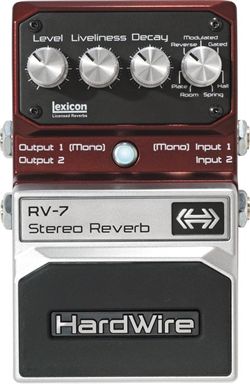
Hardwire RV-7 Stereo Reverb

Hardwire RV-7 Stereo Reverb

Back in September of this year, DigiTech released a line of high-end pedals under the “Hardwire” brand. These are high-quality, true-bypass pedals, and I have to say that I’m very impressed. Traditionally, DigiTech hasn’t been known for really high-end pedals. They’re typically priced at the mid- to low-end, and have always had reasonable quality. Nothing to complain about, but definitely nothing to write home about either.

But with the new Hardwire line, they’ve completely stepped beyond the norm, and have created pedals that have the potential to compete with other high-end pedals. In addition to being true-bypass, the pedals operate with a higher operating voltage which gives them a lot of headroom, making them a lot less susceptible to clipping. The power conditioning within each unit also ensures a constant voltage; a boon when a battery is being used, so you don’t get performance loss as battery power runs down (though I wonder how that affects battery life…).

I’ve been so focused on off-name brands of pedals for awhile that I’ve essentially ignored what the big production houses have been creating. So I apologize for being a bit behind the curve with the timing of this review. But be that as it may, I’m glad I stumbled upon this particular pedal while I was testing the EH #1 Echo at my local Guitar Center.

After I was done testing the #1 Echo, which I really liked, by the way, I asked the helpful, and amazingly knowledgeable sales guy if he had any good reverbs in stock. GC doesn’t really carry much in the way of boutique pedals, so I wasn’t expecting much. But very much to my surprise, he pointed me to the new line of Hardwire pedals, with special emphasis on the RV-7 Stereo Reverb, explaining that Hardwire was a new brand from DigiTech. I raised my eyebrows at that…

Sensing that I wasn’t some schmuck, he didn’t try to do a selling job on me, and just simply said, “Dude, I think you’ll really like this pedal. I wasn’t expecting it to be THIS good. You gotta try it out.” So I did, and the first words that came out of my mouth were “Damn! That’s sweet!” The sales guys just grinned and said, “I told you. Surprising to come from DigiTech, huh?” That was putting it mildly, to say the least.

So what makes this pedal special? DigiTech licensed 7 reverb effects from Lexicon. I’ve worked with Lexicon reverbs for years, and they are top-notch. At my Church gig, we use a Lexicon rack for vocals, and I just DIG that unit. To have them in a pedal for my guitar is even better! Granted, it’s digital modeling, but this pedal really KICKS ASS! In all the voicings, the sound is consistent, and you can dial in as much attack and decay as you need. Attack is controlled via the Liveliness knob which is similar to a pre-delay. For those of you who aren’t familiar with pre-delay, it’s essentially a certain amount of time (usu. in milliseconds) that a reverb unit waits before it kicks in the reverb. It’s very useful to have this kind of control, because those units without it often suffer from being really wet and soupy. Pre-delay allows a certain amount of dry signal to go out first, then tail out with reverb. The net result is that you get much better note articulation.

My favorite setting was the Spring Reverb, though they all sounded dynamite! And with the fine-tuning you can dial in with the Liveliness and Decay knobs, you can get just the right reverb effect for your purposes. I had so much fun playing with this little box! I spent more time with it than the #1 Echo.

Let’s look at the RV-7 features (from the DigiTech web site):

  • Reverb Types
    • Room – Fast decaying reverb; great for a touch of ambience
    • Plate – Renowned studio reverb heard on classic recordings
    • Reverse – Reverb in reverse; gradually crescendos to full volume
    • Modulated – Lush, modulating, reverb ideal for chords
    • Gated – Unique reverb with abrupt decay; good for percussive playing
    • Hall – Large, encompassing reverb with warm decay
    • Spring – Classic “surf” reverb; great for Rockabilly too!
  • Tails On/Off Switch – When on, reverb tails are not cut off in bypass
  • True Bypass circuitry preserves your tone in bypass
  • Constant high-voltage operation for tonal quality and noise reduction
  • HardWire Pedals include the following stage accessories
    • Stomplock™ knob guards lock your tone in place and prevent tampering or accidental knob adjustments onstage
    • Green gaffer tape helps you locate the pedal in adverse stage lighting
    • Custom-cut Velcro® pads attach and lock your pedals to your pedalboard
The features in this pedal, plus the standard features included in all the Hardwire pedals are definitely worth a look. And you’ll actually be blown away by the price: $149.00. While higher than their $100 pedals, that’s not a lot more to ask for that much more quality and features!  And just for shits and giggles, here’s a video review by ProGuitarShops.com:
Finally, I realize that this review isn’t in the format of my regular reviews, and for that, I’m sorry. I just wanted to get this out. In any case, the DigiTech Hardwire RV-7 Stereo Reverb gets:
5 Tone Bones - Gear has stellar performance, value, and quality. This is definitely top of the class, best of breed, and it's a no-brainer to add this to your gear lineup!

Read Full Post »

Creation Audio Labs Mk.4.23 Boost

Creation Audio Labs Mk.4.23 Boost

As many know who read this blog regularly, I’m a bit of an overdrive/distortion pedal nut. Just love the things. Silicon, germanium, doesn’t matter. I’ve always dug the tones boxes like the Fulltone OCD and Ibanez TS-808 produce. But then again, I never had good enough tube amps whose natural distortion didn’t require some bolstering.

Then I discovered Reason Amps, and did a review of the Reason SM25, which the guys at Reason graciously sent me to evaluate and to show to some local dealers. For the first time in my playing career, I’ve been playing an amp that has a knock-your-socks-off natural distortion. It’s so pleasing that I just don’t need overdrive or distortion pedals to get that saturated sound. It’s in the amp!

But the one thing that I found that I missed when playing with the amp at a couple of recent gigs was the volume boost I’d set up in my drive pedals to play a lead. It wasn’t that big a deal; I just set up the base volume of the amp a little louder than normal, then use the volume knob on my guitar. And for most situations that has worked out well. But when the band gets really loud, I need some extra oomph, and that’s when I started thinking that a booster pedal would really help.

And wouldn’t you know it, by pure coincidence, Anthony Bonadio at Reason called me last week and asked me if I had tried out the Creation Audio Labs Mk.4.23 Boost pedal. He claimed that it was best boost pedal he’d every played through, and that it was completely transparent. It takes your guitar’s signal and just makes more of it; totally transparent. Then told me he’d send his own out to try with the SM25. Then I got really interested. Check out the video demonstration below:

Flat EQ response, and a single volume knob? What could be easier?

I know there are lots of booster pedals out there. But from my research, it seems that most add some coloration of their own, or have an extra “drive” knob to add overdrive. From my perspective, a booster should just well, boost; that is, take what you have and just give you more of it. And from what Anthony has said, and from the reviews I’ve read, this seems like it does just that.

If this is enough for you to take a bit, you can only get the pedal at Creation Audio Labs directly. But don’t dispair! This pedal is only $149.00!!! Can you believe it?!!! Creation Audio Labs want to reach as many people as possible, so they eliminated the middle man and sell their pedals direct. So what used to be $250+ pedal is over a hundred bucks cheaper!

I think those pedals are definitely worth a look for price alone! Creation Audio Labs has been known as a great boutique pedal maker, and to have them get into the range of more affordable pedals is absolutely awesome! Check ’em out!

Read Full Post »

Reason Amps SM25 25 Watt Combo Amp

Reason Amps SM25 25 Watt Combo Amp

Reason SM25 25 Watt Combo Amp

Summary: Incredibly expressive and versatile amp that can deliver a wide range of tones from glassy, sparkly cleans, to lewd, rude, and crude distortion, all in a single cabinet!

Pros: Killer tones in all channels. Amp is voiced bright by design, which makes it great to use in the studio. StackModeTM is the best thing since sliced bread, and is THE secret sauce that makes Reason Amps stand out from the rest.

Cons: No effects loop, which would be handy for placing reverb and other modulation effects after the amplified signal. Just a nit.

Price: $2395

Specs:
• Output: 25 watts RMS @ 5% THD
• 1 X 12 Eminence Red Coat Driver
• (2) 6V6 output tubes, in Class AB Fixed Biased configuration
• (4) 12ax7 preamp tubes
• GZ34 Rectifier tube
• 3 way Stack switch – Normal, Stack, Bright
• Normal channel – Volume, Treble, Middle, Bass
• Bright channel – Volume, Tone
• StackMode™ – Bright & Normal channel controls are active, Stack Volume & Hi-Cut
• Oversized extra capacity power supply
• Power Switch
• Standby Switch
• Independent output jacks for 4,8, 16-Ohm operation
• Footswitch access to all three channels/modes

When I discovered the Reason Amplifier company a few weeks ago, I was so intrigued by what they had to offer that I immediately contacted them. I had the fortune of getting in touch with Anthony Bonadio, one of the founders of Reason to talk to him about his exciting new company and his new line of amps. That conversation led to him sending me an SM25 25 Watt combo to review; and since I’ve had it, I haven’t gotten much sleep from playing with it late into the night. Now you might say that I’m just excited about playing a new amp. Yes, that certainly has a lot to do with it. But what Reason has come up with in their amplifiers is so incredibly brilliant and unique that I’ve been spending all my free time trying to discover the subtle intricacies of this tone machine. There’s a lot to talk about, so let’s get started!

“Dahr-ling, you look mahvelous!”

The Reason founders, Anthony Bonadio and Obeid Kahn, are both vintage gear freak-o-maniacs, and the retro styling of the entire Reason amp line is a testament to that passion. The SM25 sports a black tolex cabinet with light brown trim around the grille cloth, and a thick leather handle with what appears to be brass accoutrements. Between the control surface and grill cloth is a prominent tolex-covered cross board sporting the Reason logo which, by the way, is very cool, very retro as well. The control board looks like burnished brass with black, bold lettering for labels. And to add to that retro vibe, chicken head knobs are used for all the controls. This amp, and all Reason amps for that matter, just ooze vintage mojo. Just looking at the amp, I can’t help but grin that grin you get when you see something so far-out COOL!

It’a hard to discern the actual size of the amp from just a picture. So make no mistake about its size: This is not a diminutive 25 Watt amp. In fact, it’s about as big as a Fender Twin, though not as deep. The shipping weight said 32 pounds, but from feel and comparison to my Fender Hot Rod, it weighs almost as much. But that’s not a bad thing. A beefy cabinet creates a lot of resonance if done correctly, and believe me, it’s done correctly with this amp.

How It Sounds

All Reason amps, including the SM25 are voiced bright. You don’t get beefy lows out of this, and that’s by design. Now before you dismiss that, on stage and in the studio, that bright voicing will ensure your guitar cuts through the mix. I recently played it at one of my regular gigs, and where my amp oftentimes gets lost in the mix, forcing me to pump up my volume, I had no problem cutting through, and mind you, I barely had to push my volume. The bright voicing let my guitar tone sit in the mids and highs. My sound guy even commented on how well he could hear my guitar without me pushing the volume like I usually do during a solo break; though admittedly, like any lead guitarist, I usually don’t mind being louder than everyone else. 🙂

In the studio, using the amp for recording is like being in heaven. The bright voicing combined with the rich tones the amp produces is simply candy for the ears. From a practical perspective, brightly voiced amps also record much better. For home recording I’ve had to stop using my big amp because it’s just too boomy, no matter how I set the EQ. I’ve had to use smaller, brighter amps because they cut through a mix much better. But since I’ve had the SM25, I’ve recorded two songs with it, and like I said, I’m in heaven. I now have a bright voice to cut through the mix, but rich tones as well. It’s the best of both worlds!

The SM25 is also incredibly touch-sensitive and responsive to the subtlest manipulations I made on my guitar. In fact, when I first started playing with it, I was a bit embarrassed by how I sounded. For my all my tests, I played along to some jam tracks I’ve produced for practicing different styles, and recorded what I played through the amp. When I played back what I had recorded, I was appalled at how crappy I sounded! All my mistakes came through! I couldn’t hide whatever bad habits or bad technique I had behind effects, like I normally would. In short, this amp has forced me to play better because it’s so unforgiving when you make a mistake. But hey! It’s never a bad thing to be shown your weaknesses. That’s how you grow and improve!

Multiple channels, lots of tone shaping possibilities…

The SM25 comes with two channels: Normal and Bright. But it also sports a third “channel” called StackModeTM that’s essentially the Normal and Bright channels run in a series with an extra gain stage, while retaining volume and tonal control over the Normal and Bright channels. To me, StackMode is Reason’s secret sauce, but I’ll get into that in a bit. I’ll first describe the independent channels.

The Normal channel sports a volume knob and a three-band EQ. The volume knob is also a push-pull knob, and pulling it out adds some extra high-freq boost to bring out the super high frequencies. The effect is that once you set up your EQ, pulling out the knob adds some extra high-freq shimmer and sparkle. It’s subtle, but absolutely delicious. Comparatively speaking, the Normal channel sounds like your classic, jangly American clean tone, but with the high-freq boost, you get a bit of the sharpness of the British clean – nice.

The Bright channel is well, bright. It too has a push-pull volume knob for extra high-freq boost, and it has a single tone knob to back off some of the brightness. The Bright channel is also the more “ballsy” of the two, and really kicks in some pretty high gain. It’s quite lovely, in my opinion, and it’s perfect for doing the traditional solo break that will cut right through a mix with ease.

Channels? We don’t need no stickin’ channels!

But for me, the real attraction of this amp, and actually any amp from Reason for that matter, is StackModeTM. In all my years of playing, I’ve never come across anything quite like it. On the surface, you might think this is just another channel on a multichannel amp. It is in a way, because of its independent gain stage. But that’s about as close a comparison that you can make to other multichannel amps. Unlike other multichannel amps where all the channels are independent, StackModeTM input doesn’t come directly from the guitar. The guitar’s signal is routed through the Normal and Bright channels first, then fed into the StackMode channel. And the volume and EQ settings on the Normal and Bright channels are still active!

Because volume and EQ are retained in the Normal and Bright channels in StackModeTM, the tone shaping possiblities are incredible. What you adjust in Normal or Bright affects the final output. You can crank up the volumes on the first two channels and achieve uber gain, with thick, rich distortion. Or you can dial it back a bit and take a more balanced approach. The point is that you can do a lot of tone shaping to your needs while in StackModeTM. And here’s the kicker: The amp still retains its touch and guitar volume sensitivity in StackModeTM.

What does this mean? Well, I soon discovered that StackModeTM was the only channel I’d probably ever use, unless I had to go super clean, whereas I’d just switch to the Normal channel. The amp in StackModeTM is so responsive to picking attack and volume knob levels that I found I just didn’t need to do any channel switching at all once I dialed in my settings for the Normal and Bright channels. It’s that good!

One other thing, the volume knob on the StackModeTM channel is a very good Master volume. When I’m playing late at night, I can turn the volume down on the StackModeTM channel, and still retain the characteristics of the settings I made in the first two channels. It’s just softer. How cool is that? So that’s why entitled this section, “Channels? We don’t need no stinkin’ channels.” Once you have your settings dialed into StackModeTM, you’ll never want to get out of it! So for me, the SM25 is effectively a single channel amp with adjustable stages.

My Tests

In any case, for my tests, I used four different guitars: A Strat, a PRS SE Soapbar II with P-90’s, an Epiphone Korina Explorer and a Saint Guitars Benchmark, both with humbuckers. I’ll talk about how each guitar sounds separately below.

Fender Strat

Obeid Kahn is known in the industry as a “Strat man,” and this amp really sounds great with a Strat. I’ve got the vintage re-issue Tex Mex pickups in mine, and slathering on reverb, you can get some awesome Dick Dale-like tones. But it doesn’t necessarily sound like a Fender amp. In fact, the clean tone is like a cross between a Fender and a Marshall. It’s creamy smooth, but bright and sparkly at the same time. The big cabinet adds to the resonance, and the ever so slight voltage sag that you get from the rectifier adds to the sustain and resonance. This is boon when you’re playing with a Strat because they do not sustain well at all. I could get country twang to hard-driving distortion with uber sustain with my Strat.

PRS SE Soapbar II

P-90’s are hot pickups by nature, and it doesn’t take much to push any amp into overdrive, and when it does this, it’s a preamp overdrive lover’s wet dream! With the SM25, the 12AX7’s just sing with sweet, smooth overdrive goodness. There’s nothing harsh about the sound this produces in the SM25, but one thing I did notice with the tone was that unlike other amps I’ve played with my SE Soapbar II, even though the amp is bright, the sound the amp produces with it is big and bold, without being boomy. It’s crystal clear, and doesn’t wash out the higher notes in a barre chord, which often happens with more boomy amps. All in all, I just dug that halfway between single coils and humbucker sound my P-90’s produced with the SM25.

Epiphone Korina Explorer

This is a real rock guitar, with a warm ballsy tone. Plugged into the SM25, I was amazed at how the amp responded to this guitar, and I was able to spew out some thick distortion and singing sustain with the volume knobs on the amp dimed to the hilt. I’m not a metal player, and technically, with the bright voicing of the Reason amps one wouldn’t think they’d be suitable for metal, but the lewd, rude, and crude drive I could produce with the Explorer plugged into the SM25 was scary! But in a good way. And when I scooped the EQ, yikes!

Saint Guitars Benchmark

Of all the guitars I used for testing the SM25, the amp seemed to love the Benchmark the most. This guitar was spec’d with Blues and Classic Rock in mind, and through the SM25, I’ve never heard it sing like this. I could go from deep, dreamy clean to rabid dog distortion, and the whole time, the SM25 maintained a tonal clarity and character; never muddying or washing out. It was other-worldly, to say the least.

Made for the Road and the Studio

Anthony Bonadio cautioned me during a previous conversation that he didn’t want to alienate people from buying the amps when he said, “Our amps are really intended for the gigging and session musician.” In other words, Reason amps aren’t really meant for the bedroom musician. These amps want to move air, and that’s no exception with the SM25. In fact, when cranked, it’s a hell of a lot louder than my 40 Watt Fender Hot Rod Deluxe, and that’s a loud amp! It just wants to project its voice. Premier Guitar even gave its bigger brother, the SM50, its “Loud as Hell” award. But in my opinion, the real test of an amp is how good it sounds throughout its entire range of volume. That’s a mark of versatility, and in spite of what Anthony claims is the focus of Reason’s line of amps, you actually can play these amps at bedroom levels and still produce kick-ass tone!

A lot of amps don’t sound good unless they’re cranked, but at lower volumes they just peter out and lose their character. But at least with my experience with the SM25, it sounds great at ANY volume. Considering that all Reason amps are built around the exact same circuitry, I can safely say that this probably applies to the entire line. So don’t be fooled by the “loud as hell” moniker. These amps are incredibly versatile amps that are comfortable be played in lots of different venues under a variety of conditions.

My Overall Take

I think you can guess that I just love the SM25. For a musician like me who plays small to medium venues, and whose studio is located in a carpeted garage, this amp is a dream come true. It’s expressive with all my guitars, and it’s so versatile that I can use it wherever I play.

As I shared with Anthony recently, StackModeTM is it for me. It’s the secret sauce that sets Reason amplifiers apart from the competition! For more information, go to the Reason Amps web site. And if your local dealer has some in stock, I encourage you to go there and play around with one. You will not be disappointed; in fact, you’ll be blown away!

Read Full Post »

« Newer Posts - Older Posts »