Feeds:
Posts
Comments

Posts Tagged ‘GAS’

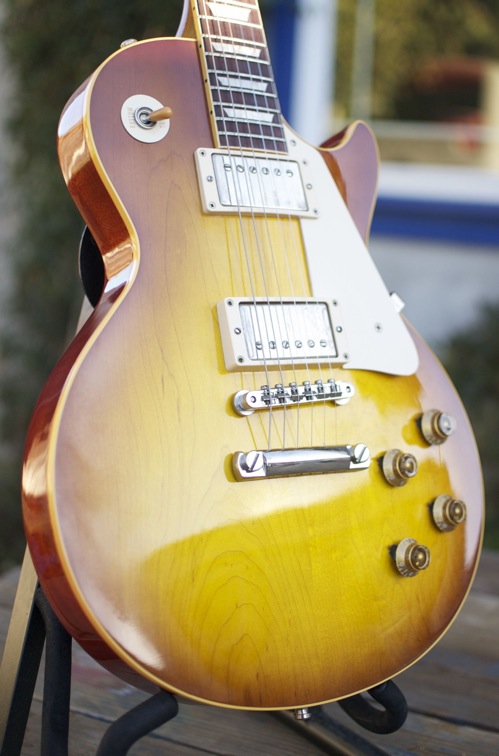
For my Les Pauls, I just dig the plain tops, and though I’m not averse to flame tops, they’re not my first choice – at least for Les Pauls. My ’59 replica has a very subtle flame that is only apparent when you look at the guitar from the side. But head-on, it looks like a very cool plain top, and that’s what really appealed to me about that guitar. Having said that, I dig flame tops on other guitars. For instance, my Gibson Nighthawk has this really cool flame that combined with the translucent amber finish, give it an incredible 3D effect. If it was a plain top or just opaque lacquer,  think it would lose its charm.

What are  your preferences?

Read Full Post »

…high-end Yamaha acoustic/electric guitars haven’t taken off in the US? It’s not as if Yamaha instruments aren’t known in the States. But what you most commonly find in US shops are the sub-$1000 guitars.

I’m a little embarrassed to say this, but I didn’t know Yamaha had a whole lineup of high-end acoustics until I started doing research for a new acoustic-electric last year, and I happened to go their site to see Yamaha’s handmade line of acoustic and acoustic-electric guitars. These appeared to be on par with any American high-end acoustic with respect to materials and design, and they’ve been building these for years!

When I finally made my decision on a new acoustic-electric and comparing many different brands I ended up buying a Yamaha APX900, which is just about the best stage acoustic I’ve ever played! But a couple of months after I got that wonderful guitar, I saw a press release that Yamaha picked up Steve Lukather and he was playing their LJX26CP model. Curious, I looked through the Yamaha site and saw this beautiful lineup of various handmade guitars.

The LJX26CP is a handmade, medium-jumbo guitar with a natural finish. Here are some specs:

Top Solid Engelmann Spruce A.R.E.
Back&Side Solid Rosewood
Neck 5ply (Mahogany + Padauk)
Finger Board/Bridge Ebony
Body Depth 100 -125mm (3 15/16″-4 15/16″)
Nut Width 44mm (1 3/4″)
String Lengh 650mm (25 9/16″)
Tuning Machine Open Gear
Color Natural
Finish Gloss
Preamp System62
Standard Accessory Hard CaseX

The very cool thing about  this guitar (and others in the new lineup) is the new SRT pickup system, which is an improvement over the incredible ART system, which is what I have in my APX900. I chose the APX900 over all comers because of this pickup system. It is by far the best pickup system I’ve ever used in any acoustic, hands-down. But SRT goes even further than this by adding microphone modeling and other tone-shaping features to further enhance the natural sound of a guitar while plugged in. I wish I had that in my APX!!! OMG!

What got me thinking about Yamaha guitars was recording this song:

With this, I mic’d my APX900. It sounds pretty good, but I really had to do a lot of EQ and other adjustments to get a richer sound. As you can tell, the tone is pretty bright, which works pretty good, but I really don’t like applying EQ to guitar tracks as I want to capture the natural sound of the guitar, whether it’s an acoustic or electric. Anyway, I was thinking to myself that it would be great to have a guitar that has a killer tone both plugged in and unplugged. That’s when I thought of the LJX26CP.

What I wanted was to have my cake and eat it too. While my APX900 sounds absolutely fantastic on stage, from what I’ve been able to gather on the LJX26CP is that it also sounds killer unplugged!

So circling back to my original query, it’s amazing that these amazing guitars with amazing electronics haven’t caught on more here in the states or why Yamaha hasn’t invested more in marketing their top line in the States. Maybe they think the market’s too saturated. Who knows? It’s not as if the guitars are completely inaccessible. You can special order them, and if you’re in Europe or Asia, you can get them online. But as someone once told me, “There’s room in this world for people who are good.” That totally applies to gear. And if Yamaha brought these guitars to shops, I have no doubt that they’d do well here. It just takes getting the word out and coming up with messaging that differentiates it from the competition.

Without a doubt, the big differentiator for Yamaha’s guitars is the SRT system. As if ART wasn’t impressive enough in previous models, SRT looks like it will blow ART away! I definitely want an LJX26CP! Luckily for me, the local shop where I get a lot of my gear is a Yamaha dealer, and they can order one for me. I sure wish I could play it before I order it; hopefully, they’ll have a return policy, or allow me to not buy it if I don’t like it. Chances are that I will indeed like it.

In any case, from personal experience with Yamaha guitars over the years – my first acoustic was a cheapo Yamaha FG335 that my dad gave me for my 18th birthday. Those inexpensive, it had a fantastic voice that was comparable to high end acoustics. I performed and recorded with it for years! To me, Yamaha totally gets it with acoustic guitars, and even its budget models sound and play great, plus they’re very well-built.

For more information on the Yamaha guitars that have the SRT pickup system, visit the SRT site! You’ll notice that the site’s in Japan. It took me A LOT of digging to find that site. There are clips and interviews on the site that will provide you with tons of information on the line.

Read Full Post »

Okay, I’m a Les Paul/Gibson guy, but I hate Gibson just the same. Why? Well, lemme tell ya:

  1. Just looking at Les Pauls gives me serious GAS!
  2. My Les Paul GAS makes me spend my money.
  3. I lose countless hours playing my Les Pauls because they sound so damn good, I lose track of time.
  4. Because of my Les Pauls, I’ve had an itch to get appropriate amplifiers to showcase their incredible tone (call it “ancillary GAS”).
  5. That ancillary GAS further drains my wallet.
  6. They keep on coming out with kick-ass new Les Pauls that I want. For instance, this one. Then I get even more GAS.
  7. I’ve become obsessed with Les Pauls, dammit! And I’m not an obsessive person – or am I? 🙂
  8. But besides Les Pauls, they make the ES-335. I want yet another – dammit again!

Dammit! Dammit! Dammit! I hate you Gibson! You ROCK and I hate you so much that I’m giving you my hard-earned cash! 🙂

Yeah, yeah, I know all you anti-Gibson naysayers out there. I’ve heard your arguments, and I’m not getting into a debate. Gibson guitars just do it for me just as PRS, Fender, Taylor, etc. do it for others. Give me a Les Paul, or Nighthawk (2009), or ES-335, and I’m a happy man!

But I still hate Gibson for triggering my frequent GAS attacks.

Read Full Post »

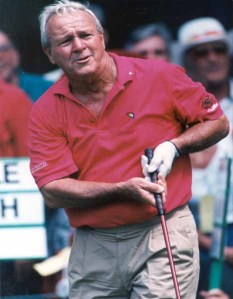
I’m an avid golfer, and one of my all-time favorite golfers is Arnold Palmer. During his heyday back in the 1960’s, he was known as a hard-charger who seemed to take a lot of risks. But he was rewarded with several wins and an appreciative fan base who could dig what he was about.

So it was a real pleasure to come across an article he wrote in the latest issue of GolfDigest magazine. Each month, GolfDigest has a “10 Rules” column, and this month, the 10 Rules were entitled, “On Being a Savvy Risk-Taker.” After reading it, I got inspired by a couple of the rules and especially how they relate to guitar gear. Here’s the list of rules from the article:

  1. Measure risk against reward
  2. Think twice before reaching deep
  3. Bold putting isn’t risky
  4. Don’t compound mistakes
  5. A low ball means lower risk
  6. Don’t try things you haven’t practiced
  7. Be true to yourself
  8. Reduce risk from the rough
  9. Know the difference between risks and gambles
  10. Don’t let a partner tempt you

The two rules that got my attention in particular were rules #2, #4 and #7.

Rule #2, “Think twice before reaching deep” is related to something that I frequently say in this blog: You’re the one responsible for your own buying decisions. In the GolfDigest article, Arnie described how when Jack Niklaus arrived on the scene, he could crush the ball, and it was difficult to not try to keep up with him. The only problem was that “reaching deep” to get that extra distance usually resulted in a total loss of accuracy.

How that translates to buying gear is that while other people’s input can indeed be helpful, in the end, it’s your decision and only you can determine if some gear will work for you. And it’s also fine to want to get gear like your favorite artists, but no matter what gear you play, you’re going to sound like you. Overshadowing all this is that you shouldn’t feel pressured to “keep up” with other people’s rigs.

Rule #4, “Don’t compound mistakes” may on the surface seem to not have anything to do with gear, but from a certain, very real perspective it has a lot to do with gear, and it’s something I’ve had to learn the hard way. Most gearheads have LOTS of gear; I mean LOTS. I’m no exception. In my  quest for the Unicorn we call tone, I’ve spent a lot of time going down various paths of gear acquisition, only to find that that path is not the “right” path, and as a result have left lots of unused gear in my wake. Sound familar? To me, that’s the result of compounding mistakes.

Picture this: I get in my mind that I want a certain effect or flavor in my tone. I do some research, and finally decide on a piece of gear. I take it into my studio and gig with it, only to find that it’s missing some quality. A reasonable person would just return the gear – maybe even take a bit of a loss and take a “learning tax.” But noooooo, the stubborn gear freak in me thinks that everything can be “tweaked,” so I buy let’s say a pedal to compensate. But that doesn’t get me there. Then I buy NOS tubes. Still that doesn’t get me there. Then I swap out speakers. Almost there. And so on and so forth.

That happened with my Fender Hot Rod. To be completely honest – and hindsight is 20/20 – the Hot Rod is all about clean headroom. In stock form, its clean tones with just a tad spring reverb are simply gorgeous. But its dirty tones leave much to be desired. So I swapped tubes and swapped speakers. And I did that quite a bit. It took me about three or four rounds of changes to finally get a good dirty tone, only to find that I really didn’t want to use the amp as a dirty amp. Talk about compounding mistakes! 🙂

Rule #7 “Be true to yourself” is pretty self-explanatory, but of all the rules that impressed me the most, it was this one. The reason for this is because if it’s one thing that I’ve learned in all my gear purchases, it is to look at acquiring gear from the perspective of what it will do for the music I play; that is, is it relevant? I’ve come across and played some REALLY cool gear, and in my less wary days, if it was cool, I’d buy it. But now, I’m realistic about my gear purchases. If it doesn’t help what I play or perhaps plan to play, then chance are, I won’t buy it.

Take, for instance, the Dumble amp. Having listened to one and briefly played one, I was thoroughly impressed! But that’s also way beyond my spending limit, and musically, I don’t think it’ll get me much more than what I can get with my current rig.

Finally, here’s a funny thought. A friend of mine told me of something he read: I get the best gear that I can get because if I suck, then I know it’s not the gear. 🙂 Love it! Rock on!

Read Full Post »

In my previous article, I cited the Marshall Shoppers Guide as the definitive resource to help you make a decision in purchasing a Marshall amp, both vintage and modern. In that article, I mentioned that my very good friend, Jeff Aragaki of Aracom Amps was especially helpful in guiding me towards the type of Marshall amp sound that appealed to me. Jeff specializes in building vintage Marshall-style amps, and in order for him to be able to build those types of amps, he had to acquire quite a bit of knowledge about the vintage Marshalls. On top of that, he’s also a collector, and has an original JTM 45. Niiiiice!

Jeff’s such a great guy in sharing information, and he has written an EXCELLENT article that covers the vintage Marshall amps from 1962 to 1973. It is entitled: “History of Early Marshall Amplifiers.” In the article, he talks about the various Marshall amps and their configurations. It’s lots of information that is really geared towards the collector.

So now there’s another definitive resource on vintage Marshall amps!!!

Read Full Post »

Before I got my Les Paul R8, I spent over two years searching; not just for the right deal, but sifting through all the different models. That meant reading lots of articles, joining several forums, and participating in lots of discussions. I’m glad I took the time, but looking back, it would’ve been great to have a single, definitive source for information on the different Les Paul models. It probably would’ve cut my search time by a significant factor!

As if searching for a Les Paul was bad enough, I was also at the same time looking for an amp. Having cut my teeth on the Fender sound, once I started writing and playing more heavy stuff, I started gravitating towards the Marshall camp. Now luckily for me, I met Jeff Aragaki of Aracom Amps who not only builds vintage-style Marshall-esque amps, he owns several Marshall amps from, including a 60’s JTM 45 that is an absolute tone monster! What a machine! Anyway, he has been my source for Marshall amp information; without him to guide me to the type of sound I was after, I probably would’ve had to resort to my method for finding a Les Paul (Jeff was also instrumental in that camp as he is a Les Paul collector). In the end, the tone I dig from Marshall amps comes from the JTM and Plexi camp. By the way, he’s coming out with a new 50 Watt amp called the “FlexPlex” that includes circuitry for both JTM and Plexi amps, and even has some Dumble-esque features. That’s my next amp!

Circling back to searching for a Marshall amp, I recently came across two articles that include pretty much everything you need to know about the different flavors of Marshall amps, collectively called the “Marshall Shopper’s Guide.” The articles are very detailed, and more importantly, they’re unbiased. Here they are:

Part I: Marshall’s Plexi Era

Part II: Vintage “metal panel” through JCM 2000 Series

To say I was thoroughly impressed by these articles is an understatement. The author, David Szabados, really did a great job with them, and my hat’s definitely off to him for providing such rich information. So if you’re looking for a Marshall Amp, at least in my opinion, there is no better source for getting information on Marshall amps.

Read Full Post »

Just came across this today, and it is the most comprehensive OD shootout I’ve seen/heard – EVER! This isn’t a simple A/B. This is 36 OD pedals. Very good!

NOTE: If the video keeps stopping, watch the video on the YouTube site directly: http://www.youtube.com/watch?v=WuTt8YFblcE

Read Full Post »

For years I was on an Overdrive kick. I still kind of am. I love dirt pedals despite the fact that I don’t use them nearly as much as I used to, and am patiently waiting for my Timmy to arrive. 🙂 But ever since I went on my quest to get an original BOSS CE-2 chorus, I’ve kind of gotten on a chorus kick as well; not as bad as my overdrive kick, but every time I see a new chorus, I have to at least listen to it. And if I REALLY  like it, I might just buy it. That’s how it was with my Homebrew THC. It just came along at the right place at the right time.

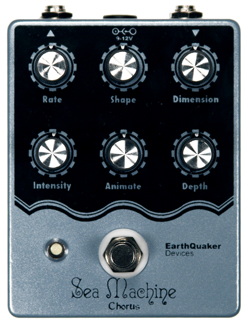
Truth be told though, while I’m not currently in the market for another chorus pedal, the Sea Machine Chorus from Earthquaker devices does give me pause. One thing that always turns me on with respect to gear is versatility, and the Sea Machine certainly cannot be blamed for lack of it. In addition to the tradition, Rate, Depth, and Intensity knobs, the Sea Machine also boasts three other knobs:

  • Animate – adjusts the width of the chorus pitch shift
  • Shape – adjusts the shape of the LFO
  • Dimension – which adds reverb/delay-like ambience to the tone.

This is impressive because from demos I’ve seen, this pedal is capable of producing TONS of different tones from your traditional chorus to leslie to vibe to all-out tweaked!

The pedal retails for $215 online. Here are some demos for your viewing/listening pleasure:

I totally dig Andy at ProGuitarShop.com’s demo as he demonstrates AND explains what the pedal can do, which is a lot. The Dimension feature is absolutely awesome!

If I had to do it over again, and I hadn’t purchased the Homebrew THC, I probably would’ve picked up the Sea Machine. Great chorus!

Read Full Post »

A few years ago, I was perusing a popular guitar-related forum when I came across a post about a particular pedal, and how people were waiting up to three years to get one. I remember at the time that I’d never do that, and I kept to my word; at least until I got on the list to get a Timmy Overdrive. That wait will only be about 6 months, and since I wasn’t in a rush, AND I didn’t have to give Paul Cochrane a down payment, it was a no-brainer putting my name on the list; especially after poring over reviews and sound clips and speaking with Paul directly. There’s other equipment out there that has a long waiting list as well. Analogman’s King of Tone is over a year long. The Faustine Phantom waiting list has been over a year for people who got on the earlier lists (though apparently Tim now has a new production partner and his production times are supposedly going down).

What prompted me to put out this question was that I was thinking about my Timmy on order. Then I thought: What was the impetus for getting on a waiting list? To be completely honest, I’m not sure. But probably a big reason was that I didn’t have to take any financial risk by giving Paul a down payment. Plus, the pedal’s only $129 shipped so it’s kind of hard to go wrong. I _might_ do the same with the King of Tone, but I’m really not sure I’d wait a year or more for a pedal. I guess for me, there has to be a good balance between wait time and financial risk.

Read Full Post »

Usually during winter or summer NAMM, I keep close watch on the press releases and trade rags to make announcements about new gear. I’ve received plenty of press releases for this current Winter NAMM 2011, but there really haven’t been any  new sounds lately to get me excited. Maybe it’s because I have the flu, and I’m a bit grumpy, but nothing I’ve seen thus far has really wowed me. The trade rags still tend to play to the major manufacturers, so all you normally get is the expected set of gear from the expected set of manufacturers, though I do have to say that at least Premier Guitar makes an effort to showcase non-mainstream, boutique gear, as they seem to cater a lot to “The Gear Page Forum” crowd.

So the fact that I hadn’t seen anything new and exciting led me to the question: Do we have all the tones we can get? And by that I mean new classes of tones outside the standard amplitude, frequency, and time modulation classes; and let’s not forget envelope filters and the like. Frankly, all that territory has been well-explored. But some genius may come up with some other thing that will add yet another dimension to guitar tone in the future – it’s just not now.

So where does that leave us?

Well luckily we’re no longer in the days when only a few manufacturers existed and the selection of gear was fairly narrow. With all the boutique manufacturers out there now, there’re all sorts of choices at our disposal. We may not have any new classes of tones being developed, but we do have fairly limitless possibilities to combine gear within the existing classes. That’s a great thing!

For me, there’s still undiscovered country in what’s currently out there. I think my next avenue of exploration will be envelope filters. A lot of my latest music has had a real funk feel to it, and an envelope filter or an auto-wah may just add that little funky zest to my rhythm lines.

I did see this one very interesting – maybe weird – “guitar” called the Kitara by Misa Digital Instruments that’s completely digital. No strings. Each “fret” has a button. The right hand (it also can be flipped to be a lefty) uses a touchpad to generate sound. The Kitara is connected to a synth or software. Interesting concept, but I’m not sure if this will be the future of guitar. It does provide some very interesting possibilities, though. Here’s a demo:

Read Full Post »

« Newer Posts - Older Posts »