I’ve always associated Orange Amps with metal until I actually played a Tiny Terror. What a great amp! It’s got nice, bright EL-84 tone, and for $550 new, it’s a great little amp! Hmmm…. looks like I should do a review of it… 🙂
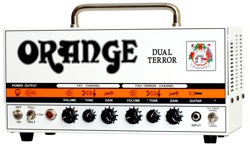
But Orange is taking the amp a step further and has just announced the Dual Terror, which is a 30 Watt, dual channel amp that is switchable down to 15 and 7 Watts! Oooo… From the announcement I read, it looks like this will be a real versatile amp! Can’t wait to test one out. FYI, here’s a copy of the press release I just got from Orange….
Orange Amplification launches ‘Dual Terror’
British amplifier manufacturer, Orange Amps launched the Tiny Terror amp in 2006 and has already sold over 30,000 units, making it one of the most in-demand amps in the world. The concept of the Tiny Terror was simple: squeeze every drop of Orange’s unique signature tone into a lunch-box sized amp to create 15 watts of unmistakable Orange Class A Tone weighing only a few kilos – and at a price every guitarist can afford.
Orange can now announce the next generation of the Tiny Terror concept – the ‘Dual Terror’: a twin channel, 30-watt head, switchable from 30 to 15 or 7 watts giving more choice and options shrunk into a size that belies its power!
The 30 watt Class A dual channel amp incorporates the unique Tiny Terror channel and a new ‘Fat Channel’ bringing a new ‘fatter’ chunkier sound, whilst keeping the classic Tiny Terror sound.
The power options make this a truly versatile amp, capable of dominating at bigger venues and subtle enough to be perfect for recording, studio work and home playing. Switchable between 30, 15 and 7 watts and switchable between 4 and 2 output valves, the combinations of options provide for unmatched levels of performance and flexibility.
The Dual Terror OS-DT30-H is built to the usual Orange high quality standards, using top quality components and its roadworthy rugged construction (supplied with padded gig bag ) is everything you’d expect from an Orange amp. The proven ‘Orange Terror’ concept of combining portability, versatility and delivering most importantly a great sound, is all here.
The original Tiny Terror has legions of fans, with users including Gary Moore, Mark Knopfler, Steve Jones, Eddie Van Halen, Andy Dunlop, Kaiser Chiefs and Eddie Kramer. The new Dual Terror will have even wider appeal to professional users and enthusiasts alike.
For further information contact:
USA info@orangeusa.com or outside USA info@omec.com
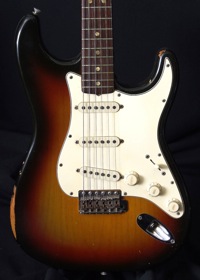
Ever since Fender announced the new Roadworn Series of guitars, I’ve been lurking the gear forums and googling for information about them and trying to get a feel for what people think about them. It’s still early in the game, but not surprisingly, opinions are fairly evenly split. Lots of people like them, lots of people don’t. I’m part of the latter crowd.
From my point of view, if I was going to play a beat-up-looking, “roadworn” guitar that’s broken in, I’d rather have done the breaking in myself, or have had it done by someone else – like my first electric guitar that my little brother gave me. It was an Ibanez Strat copy and it looked like a piece of shit! The paint was cracked and flaking in areas, the electronics were completely screwed up due to the jury-rigged wiring jobs my brother did on it. But when I had it working, that little bad boy could sing! Even my brother inherited from one his band mates. In other words, this guitar has a history, and it plays and feels like it has a history.
My problem with the Fender Roadworn series is that these are brand new guitars that are made to look like they have a history, but they’re fresh off a friggin’ production line! They have no history! Oh yeah, I can hear a Fender rep saying, “We ‘wore out’ some of the most common areas where guitars get worn, and added some other cosmetic blemishes to produce a guitar that looks and feels like its been played for 20 years.’” What a crock of shit! Sorry, not buying the rationale, nor the guitars. Besides, to me, it’s how the guitar sounds and plays whether it’s new or used that counts.
I suppose if you have to have a replica of a famous guitarists axe, hey! More power to you! But in the end, you’re the one playing it, and you ain’t gonna sound like the guitarist whom which the guitar was modeled.
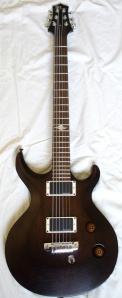
Imagine, if you will, that guitar to the left, in a glossy, goldtop finish. That will be the guitar that Adam Hernandez of Saint Guitars will be building for me. It was by no means an easy decision to make. As a tester for Saint Guitars, and ostensibly a rep for Saint Guitars (I’ve been careful about keeping that separate from this site – though news about it will be out within the next few weeks), I love every single guitar I’ve gotten my hands on. I dig Adam’s approach to guitar-building, and of course, I simply love his designs.
But despite the relationship, I was a little wary of actually purchasing one. Why? There are lots of factors, which I’m going to share here. But first, the juicy back story…
As some of you may know, I’m a huge fan of G & L Guitars, especially the Comanche line. Yngwie Malmsteen calls the Strat a perfect guitar, but I believe the Comanche improves on it even further, especially with its Z-coil pickups that still offer that gorgeous single-coil feel, but with much more output.
For the last few months, I had been saving my pennies to purchase a Comanche from my local G & L dealer. I’ve been skrimping and scraping every extra buck I could because I just had to have one. It’s an incredible guitar that just speaks to my soul. And about a month ago, I had enough to get my beloved guitar. Then Adam contacted me via e-mail a few days before I was all set to buy the guitar and said he wanted to construct a guitar for me based upon this “dream” goldtop I had described to him a month before that when he asked me what I think would be my dream guitar.
Now you might think I just up and dropped all my plans to get a Comanche. I didn’t. I’ve been very drawn to the Comanche for a long time, but as I’ve shared, I also love Saint guitars. In fact, though I received the e-mail early in the morning, I sat on it for the whole day, and didn’t reply until late that night. In short, I was seriously conflicted, and for several good reasons, which is why I’m sharing this experience. And perhaps by sharing this experience, I can shed some light on helping you make your own choice in whether or not to go with a custom-made boutique guitar.
Most people who come to GuitarGear.org have a serious and virtually incurable case of GAS. Several have custom guitars – a few even have a few Saint guitars to their name. So there is no doubt that what you ultimately get is high-quality, and tailored to your specific tonal requirements. But the conflict in my mind was something entirely different than cost, quality, build, tone, etc.. I know what Saint Guitars sound like, and they’re some of the most gorgeous-sound guitars I’ve ever played; cost would be an issue, but if I made the decision, I’d make it happen; rather, it was dealing with the “known” versus the “unknown.”
So, to boutique or not to boutique? That is the question I posed as the title of this article. If it wasn’t cost or quality or tone that was the issue, what do I mean by the “known” versus the “unknown.” I’m going to bullet-point the known issues first:
First off, the Comanche was a known quantity to me. I have played several over the last couple of years, and while each is slightly different – after all you’re dealing with wood which is by no means uniform from instrument to instrument – they’ve all generally fallen within the same range of playability and tone.
And because I’ve spent a lot of time playing that model of guitar, I knew how I’d fit it into my stable and what it could do for my tone, and how I’d use it in my compositions and performances.
The Z-coil pickup is what I believe to be Leo Fender’s finest achievement. Even though Leo was known for creating the Strat, what a lot of people don’t know is that he didn’t play guitar – at all. He didn’t even tune them until late in life! He was all about the pickup, and he built the Strat around his pickup invention. So there’s a bit of history behind the Comanche.
So what about the “unknowns?”
Being that a custom-made is a unique creation, I don’t have a precedent from which to follow. There aren’t any previous guitars made with the EXACT specs my guitar would have. In other words, I don’t have any similar models from which to reference.
I suppose there are reasonable facsimiles, and since I’ve had the fortune to test Saint guitars, I know how well they’re made, but the guitar I have in mind isn’t made of walnut, which is Adam’s choice of wood. It’s a solid mahogany body with a maple neck – similar to a Charvelle I played a few days ago – very nice playing guitar.
Also, with a custom guitar, what I found was that I really had to think and on top of that do research on tone woods and pickups and hardware. That’s something that I wouldn’t have to do with a Comanche. I’ve just had to play a bunch to find the one that I like. That kind of leads back to the first point that there are no previous guitars with my exact specs from which to reference.
But despite all that, I’m still going to have Adam build me my guitar. The uniqueness certainly plays into it, but I’ve been playing long enough now that I have a good idea of how a guitar sounds with a particular type of tone wood, so tone is not quite as unknown as I might have originally thought. But I think the thing that probably was the scariest thing for me was having to specify the different pieces. In other words, all the effort I’d have to put into getting the guitar created. And even though it’s a bit of a moving target, here are the specs I so far:
Finish: Glossy Goldtop
Body: Double-cut Mahogany
Neck: Maple
Fretboard: Ebony
Headstock: Maple
Summary: Nice, simple, and versatile studio/practice/small venue amp with sporting happening EL-84 tones.
Pros: Sweet and chimey EL-84 tones with Class A circuitry; simple and straightforward to use. Switchable between 5Watts and 3Watts, ensuring usability in just about any smaller venue. 3W mode kicks ass for getting power tube saturation at a reasonable volume.
Cons: I wish it had a Master Volume, but that’s just a nit.
Price: $349 street (used to be $249 when it first came out! Damn! Shoulda gotten one then.)
Specs:
• Single-ended Class A circuit
• All tube signal path
• One 12AX7/ECC83 dual-triode preamp tube and one EL84/6BQ5 pentode output tube
• Pentode (5W rms) Triode (3W rms) switch
• Solid-state rectifier
• DC filament power supply for all tubes
• 3-band EQ
• 16-gauge (1.5 mm) thick, folded and spot welded steel chassis
• Double-sided custom color PCB with 2 oz. copper
• 15-ply, 18 mm thick, void-free birch plywood construction
• Custom-designed 12″ Eminence Blackheart speaker
• 16 ohm, 8 ohm, and 4 ohm speaker outputs
Tone Bone Rating: 4.75 – Very musical and expressive amp. Nice cleans, with a decent amount of headroom.
I first heard about Blackheart amps back in 2007. They were so new that very few people knew about them. And while a local shop was listed as a dealer, only the owner knew about the amps, and they didn’t carry them in stock! Blackheart Engineering is sort of an overseas spinoff from Crate which produces cool, yet affordable tube amps. As a home studio enthusiast, I keep my ear to the ground about low-cost, low-wattage combo amps. When I first heard about the BH5-112, I was excited. I thought it was a bold move for Crate, and a smart one, considering Crate is a huge manufacturer with huge lineup of gear; adding even something cool like the Blackheart line would just get lost in the mix. But Blackheart was pretty low-key. No ads, spotty coverage on the Internet.
So it was a very pleasant surprise to see a few Blackhearts at a local shop yesterday, and among them, the Little Giant. I was actually there to play that G & L Tribute Comanche I wrote about last week; the last time I was at the shop, they didn’t have any Blackhearts, so I wasn’t expecting to see them at all. But with them there, I naturally had to try one out, and luckily they had the Little Giant.
Fit and Finish
This little amp has a real cool vibe going on. I really like the cabinet that Blackheart uses. It’s a closed back cab, and for an amp made overseas, it’s appears to be very well constructed. There were no apparent flaws in the tolex layering, and Blackheart logo on the front is killer. I dig the white vinyl trim used on the front around the grille cloth. Real boutique styling at a pretty affordable price!
The control layout is simple: An input jack on the left, volume and three-band eq knobs, an indicator light and an on/off switch, making it simple to plug in, dial in your tone, and start rockin’.
How It Sounds
I’ve really come to love the EL-84 tones, especially when they’re saturated, and the Little Giant doesn’t disappoint when delivering its sound. With the EQ knobs at 12 o’clock, the natural tone of the amp leans toward a slightly scooped tone with a bright voicing. Even with the specially-made Eminence 1 X 12, it’s bright, but it does retain a taut low-end that really smooths out the tone. Quite pleasing. I only tested the amp with that Tribute Comanche, but it didn’t matter. When I test an amp, I play it clean for a lot of my tests to see if it will deliver the natural tonal character of the guitar, and the Blackheart Little Giant fulfills its mission.
The amp is very responsive to volume knob and pick attack. With the volume set at about halfway, and cranking the guitar volume, I was able to get that AC30-like response: Clean and shimmery, with just the slightest bit of breakup when you dig in. Very pleasing to the ears.
Amazingly enough, even though its power rating is a minuscule 5 Watts, with the 12″ speaker, this amp can put out some volume! Hence its name “Little Giant.” It probably couldn’t keep up with a drum set and a band going all out, but it can pack a good enough punch to work well in a small venue where lower volume is critical, and it definitely could be put to great use in a studio!
Overall Impressions
What can I say? I dig this amp, much like I dig the Fender Champ 600. But unlike its Fender cousin, the 12″ speaker really lets the amp breath. And speaking of volume, I was quite impressed with the volume control. Unlike many amps that practically max out by 6, the sweep covered by the Little Giant’s volume knob is nice, even and more importantly, wide. Two thumbs up!s
Here’s a video (excuse the dude’s misinformation about Class A amps – damn! That’s even worse than my faux pas about modes 🙂
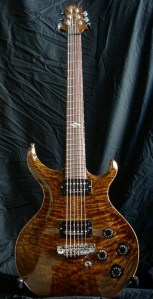
Summary: An aggressive guitar that wants to growl! This baritone is well-suited to de-tuned, low-freq, hard-driving metal, yet can be tamed to produce sweet, ringing cleans.
Pros: Very playable guitar, with a fast neck despite the wider frets. The hot, high-gain, active pickups practically eliminate the need for distortion pedals. Will hit the front-end of amp with tons of oomph! Bright tone will cut right through any mix.
Cons: Not really suited for a cleaner style of playing.
Price: $2300
Specs:
Solid walnut body and neck
Rosewood fretboard
Seymour Duncan Blackouts in Neck and Bridge
Master Volume and Tone
Gorgeous, dark-brown open-pore finish
Tone Bone Rating: 4.5 – Metalheads will love this guitar! I dug its playability, but would probably swap out the active pickups for a pair of ’59’s or Alnico Pro II’s to give the tone a fuller sound. But as with any Saint Guitars instrument, it’s really playable!
I’m very blessed. I have great friends who share my passion for guitar, and several of them make equipment. And I feel extremely grateful that I get to play the stuff they create. Such is the case with Adam Hernandez, whiz-kid owner and luthier of Saint Guitar Company. Adam and I struck up a friendship in the middle of last year, and I get to test (and sometimes spec) guitars he’s adding to his inventory. He doesn’t carry many in inventory as his business is fairly dedicated to creating custom works of functional art. But it’s cool that he lets me play with them. On the flip side, I’m more than willing to do writeups of his excellent guitars.
And while the guitars Adam creates are nothing short of amazing, what really turns me on about the guitars is Adam’s fearless approach to guitar making. For instance, Adam’s tone wood of choice is walnut. Walnut is usually considered bright and dead. But Adam has somehow found a way to shape and construct guitars made from walnut that are incredibly resonant and rich in tone. A guitar player himself, his designs reflect a sensitivity to the working guitarist, with easy-to-reach controls, and beautifully shaped bodies and necks that are more than just pleasing to the eye, they’re meant to be played!
When Adam contacted me and told me he wanted to swap the Faded Blue Jean Benchmark that I had been testing, I have to admit that I experienced a bit of trepidation in making the trade. For one thing, I kind of got attached to the “Baby Blue” as I came to call it, and more importantly, I had never played a baritone guitar, and didn’t know what to expect. But far be it from me to let those things get in the way. It’s not every day that you get to play custom, hand-made guitars. So a couple of weeks after he called me, we met at my local coffee hangout. That was before Christmas, so I’ve had quite a bit of time to play with the guitar.
Fit and Finish
What can I say that I haven’t said before? Saint Guitars are flawless in look and build. With this Baritone, I really dig the open-pore finish! It really brings out the natural grain of the walnut. As usual, the frets are perfectly shaped, and you’ll never find any rough edges or production burrs on the fret wire. And being that it is a solid stain, it’s just beautiful in its simplicity.
Playability
As I mentioned briefly in the summary, this is a very playable guitar. The action is PERFECT, and the jumbo frets make it easy to achieve vibrato just by wiggling your finger ever so slightly. In fact, since I like to really dig in with my left hand, it took me awhile to adjust to the light touch that’s required to voice a note or chord. But that’s a good thing. I’ve said it before: A good instrument will force you to be a better player because it won’t hide your mistakes or the idiosyncracies in your playing.
Adam is partial to wide, but shallow “D” shape necks. The “D” shape on the baritone is less pronounced on the Messenger than it was on the previous guitar I tested. I myself am partial to narrow “C” shape necks, but irrespective, the neck shape certain didn’t preclude me from playing. It did take a little while to get used to, but once I found a good height and angle, the guitar became a dream to play!
How It Sounds
I’ll let you decide for yourself. Here’s a clip:
And here’s the same clip with my Strat layered on top. I did this to see how well it played tonally with a standard scale guitar.
Okay, I did add a touch of reverb to the guitar in the tracks above, but the natural resonance and sustain even without reverb is astonishing! You can dig into a note, wiggle your finger, and the guitar will happily carry that note into the ethers forever. It’s very pleasant.
Now here’s the rub… and the reason I gave it 4.5 Tone Bones. For my style of playing, which leans towards the blues and classic rock, the Seymour Duncan Blackouts were way too aggressive for my tastes. I could clean them up just fine, but the guitar in this configuration was simply way too aggressive for the styles of music I play. For instance, when I recorded the rhythm track above, the guitar’s volume was set at around 3, the amp’s volume was at 2, and I used the Master to get clean headroom. Any higher on the guitar, and the gain the Blackouts produce would just slam the amp’s front end (BTW, I used an Aracom RoxBox 18 Watt head and a 1 X 12 cabinet with an Eminence Red Coat “The Governer” speaker). It sounds great clean, and if I were to purhase this guitar, I’d have Adam swap out the Blackouts and go with a pair of ’59 humbuckers or Alnico Pro II’s. They’re very vintage sounding, and a lot more full-bodied.
With respect to the natural aggressiveness from the pickups, while I played with the guitar a lot in the past month, I just couldn’t get inspired to write anything that took advantage of the high gain of the pickups. It just wasn’t in me this round, which is a shame because it is such a fine instrument in every other way. What I’d like to do is play the guitar with different pickups.
So what about with high gain? Damn! This guitar simply screams! With the volume knob dimed, it slams the front-end of an amp and causes immediate saturation! I usually have to bolster my Strat with a clean boost or an overdrive pedal to achieve the kind of high-gain this little monster can produce by itself! It’s very cool to hear!
Overall Impression
I think this guitar would be metalhead’s wet dream come true in stock form. In fact, Adam constructed and equipped the guitar with thrash metal in mind, and tried to see if he could get James Hetfield of Metallica to play it. Alas, he couldn’t find a way last time they were in town. But I can attest to what this guitar can do to an amp! But with different pickups, I’m sure I’d give it a perfect score.
Back in the early 1990’s, Jeorge Tripp started Way Huge and created a line of pedals starting with the “Fuzz Box” that for all intents and purposes started the whole boutique pedal movement. Later in the decade, he decided to go on to other stuff (I believe he went to Line 6). I didn’t play much electric guitar back then, but I do remember a couple of guys I knew who used to rave about Way Huge pedals. I had never heard of them, and as a primarily acoustic guitar player, didn’t really pay too much attention because distortion was not part of my tonal palette. That all changed when I started focusing on electric guitar a few years ago. I’d visit forums and lurk discussions about how people were paying hundreds (never saw any go for thousands, but apparently some did) for these rare pedals. I was amazed. These pedals must’ve been something special if they were in such high demand.
Then a few weeks ago, I had heard that Jeorge Tripp struck a deal with the Jim Dunlop company to resurrect Way Huge. I did a google search to see if I could find any info, and came up pretty empty-handed. Even the Way Huge site had no information – until I did another search about ten minutes ago, and saw that a search on “way huge” produced the result “Jim Dunlop – Way Huge” as a search result. Naturally, I had to click the link, despite the seemingly sexual undertones the link title might have implied.
To my everlasting surprise, the Way Huge site was completely transformed from the comic book-like line drawing theme into a real site, replete with Flash graphics! But to be clear, the fact that it’s Flash did not get me excited. It was the fact that it was a real site. You have to check it out!
Featured on the site are the three pedals Way Huge is offering right now: The Swollen Pickle Mk II, The Fat Sandwich, and the Pork Loin. The Swollen Pickle is a pure Fuzz machine, while the Fat Sandwich and Pork Loin are soft-clipping overdrive pedals. Each has a very unique voice. The sound samples really display the capabilities of each pedal, so I encourage you to check ’em out.
Personally, I’ve never been much of a fuzz guy, but I do love soft clipping pedals. So naturally, I gravitated toward the Fat Sandwich and Pork Loin pedals. Very nice sounds indeed!
This piece of gear is so new, it’s not even in production yet, but I just had to share the news!
A few months ago, I was watching a video on YouTube about the Faustine Amps VT-58 amp, which is based on the 5E8A “Low Power Twin” circuit. Very nice, compact amp. But that’s not the story. Faustine is just about to debut a standalone version of their built-in attenuator.
One thing to note about Faustine amps is that all models have a built-in attenuator that gives you from -3dB down to -18dB attenuation. I played at VT-57 at Tone Merchants, which is a 35Watt, 3 X 10 amp – classic, sweet Tweed tone. But it was the built-in attenuator that really sold me on the amp, and actually one of the things that started me thinking about using an attenuator in the first place. As you know, I ended up going with a Dr. Z AirBrake, which has totally served me well, and will continue to do so in the future, but I remember the attenuator working so well on the Faustine, that I was wishing that Faustine had a standalone attenuator.
My wish has been granted.
If you watched the video (and I will present it in its full glory at the end of this entry), the reviewer mentions it being released in early 2009. That prompted me to contact Tim Gregoire, Faustine Amps designer and owner to see if and when it will be released. According to Tim, full production models will be available by the end of this quarter or early next quarter. He’s currently building a set of pre-production models for select clients in the SoCal area, and once he’s done with those, he’ll begin production of generally available models.
So what’s so special with this attenuator? From my personal experience with the built-in one, the attenuator circuit Tim has created is totally transparent – at any level. While I love my Dr. Z, at high attenuation levels, it starts sucking tone, and that’s not good. But with the Faustine, I didn’t detect any tone loss, even when I cranked up the attenuation to its highest setting!
According to Tim, the standalone model will have a wider attenuation range than the built-in attenuator. He shared that it will attenuate within the range of -2dB all the way down to -26dB – that’s conversation-level! Freakin’ awesome! No price yet, it probably won’t be cheap. But sometimes you have to pay for transparency. Once out, the unit will be sold exclusively for a time through Tone Merchants. Stay tuned, as I will hopefully be able to get a unit to review!
Here’s the video of the VT-58. This is a great little low-power amp, with wonderful, vintage Tweed goodness!
What do you do when you have two kick-ass overdrive/distortion pedals and don’t know which one to choose because both pedals bring so much to the table? The obvious answer is to use both. But my problem in choosing is exacerbated by limited pedal real estate, so I have to make a choice.
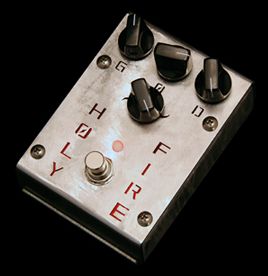
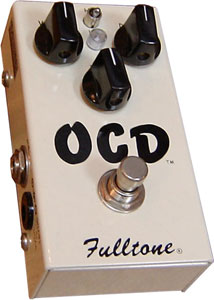
Actually, the choice wasn’t too hard to make once I started playing with the Creation Audio Labs Holy Fire. While I love the OCD, the Holy Fire wins hands-down for its versatility and total transparency. While the OCD is somewhat transparent, it can get kind of muddy and a little choppy at high drive settings, whereas the Holy Fire’s distortion section reacts a lot like a power tube at high gain settings producing a compressed effect that just rocks the house!
I still love the sound that the OCD produces. It really brings out harmonics and overtones, and set in a “sweet spot” produces a nice sparkly distortion that really sounds great. But as of late I’ve been gravitating towards retaining the natural sound of my guitar and amp, so the added artifacts that the OCD adds aren’t really what I want right now.
On the other hand, the overdrive on the Holy Fire is totally unique, and nothing like I’ve ever witnessed in all my tests of overdrive pedals (and believe me, I’ve tested a lot). The overdrive has what Creation Audio Labs calls a “wave shaping” circuit that evenly distorts the entire bandwidth of the incoming signal as opposed to creating a mid-range hump, or scooping the EQ. It really is completely even. You don’t lose any lows or highs, which is common in overdrive pedals. And the circuit reacts to both volume and pick attack, providing more wave shaping as you hit the front-end of the pedal harder. Simply put, you retain all the natural tone of your guitar! It’s insane! And it’s so special, Creation Audio Labs is trying to patent it!
I gigged with the Holy Fire for the first time this evening at my weekly Church gig. Make no mistake, this may be a church service, but we regularly hit above 100db in our sets, so there is plenty of room to let our amps breath, and take advantage of the higher gain settings on our equipment. Tonight, I made sure to pick music that would allow me to use the Holy Fire throughout my set. Talk about being inspired! I used it with my Strat and a Reason SM25 amp. What a combo! I set the gain to just above unity with the clean channel (about 10am), the overdrive at about 2pm, and distortion at about 3pm (so the distortion section would compress – it does this at around 2pm). The breakup was so smooth and delicious, I wanted to keep it on all the time! Unfortunately, I couldn’t do that with some songs, but where I had the entire band playing all out, the Holy Fire just made my heart sing!
The Holy Fire also plays well with other pedals. My mainstay overdrive pedal is my trusty green machine, an Ibanez TS-808 Tube Screamer. That’s one pedal that will NEVER leave my board! But here’s the cool thing: Running the Tube Screamer in front of the Holy First was like nothing I’ve heard before. I did this with my OCD as well, essentially getting a combined tonal effect that the TS and OCD produce. But the Holy Fire maintained the tone the Tube Screamer produces! On the other hand, it smoothed out and thickened the distortion. The result was the expected mid-range hump from the Tube Screamer, but with super-creamy distortion, plus the TS tone, that was like candy to my ears. No extra coloration that I came to expect by running my TS into the OCD. It was like playing a fatter Tube Screamer!
Believe me, despite playing in a worship service, the way I was feeling with both those pedals running together made it seem I like I was flying with the angels! I’m not exaggerating! There is absolutely nothing compared to the feeling you get when you’re playing with wonderful tone. It inspires and emboldens you, and you take your playing to places you didn’t think possible.
That was the feeling I got when I first started playing with the OCD, and frankly, I didn’t think it could get much better. But the Holy Fire has changed everything.
On top of that, I was using another Creation Audio Labs pedal, the Mk.4.23 clean boost, yet another amazing product from those electronics wizards. I used the booster to give me just a slight gain boost for when I was doing solos, or was in the refrain section of a song when I needed just a bit more volume. It too is a totally transparent boost, adding ZERO artifacts to your signal, so all the time I spent dialing in my settings wouldn’t be lost when the Mk.4.23 was engaged.
I swear, I must sound like a twitterpated, googly-eyed schoolgirl! 🙂 But it’s been a long time that I’ve felt truly inspired, like everything was totally right with my world of tone. I’ve finally (at least for now), found total balance in my tone. The circle is complete…
I dig interesting pedals. in my search for a decent reverb, I came across the Plush Verberator that is a tube-driven effects loop and a 24-bit reverb in one pedal. I’m not too sure about the effects loop bit, but the reverb sounds really awesome. Here’s the product description from the Plush site:
The Verbrator® is a new multipurpose pedal which combines an all-tube effects loop with a studio grade reverb featuring a 32-Khz clock speed for full 16-K audio bandwidth. The Verbrator® is our most innovative pedal offering to date. It’s an effects loop, it’s a reverb, it’s both!
Unlike other “tube pedals,” the Verbrator® power supply features a unique regulated switching technology that takes the incoming 9 volts and converts it up to the optimal high voltage a tube really needs to operate best. In addition, a 6-volt DC regulator provides consistent clean DC power for the tube filament assuring lowest noise and consistent performance despite any changes to incoming line voltage.
The Verbrator® can be used as a pedal on a pedal board as a reverb pedal. It features a level control and decay control allowing you to have a short medium or long decay reverb algorithm. It can also be used as a tube buffer to convert an incoming high impedance signal to a low impedance for long cable runs or driving a pedal board. The recovery (gain) stage can be used to boost the level of a guitar or pedal board with a true tube audio stage. It provides a warm sweet utility gain stage with a multitude of uses.
The effects loop portion of the pedal features a unity gain cathode follower to work with any amp that has passive preamp output – power amp input patch jacks, and not a true active effects loop like Ceriatone, Dumble, Bludotone, Brown Note, some Marshall models and others. It has a send level control and high headroom. The return portion of the loop features a high impedance input (250-K) and a low output impedance with its own level control as well. The loop can be run in series or parallel modes, and features a level adjust switch for rack or pedal style effects.
9-volt DC adaptor provided, the Verbrator® features a unique “window” showing the tube. Like all Fuchs pedals, the Verbrator® features solid cast aluminum powder coated enclosure with heat cured silk screening, dual sided heavy circuit boards, premium switches and controls, and premium electronic parts throughout.
Like I said, I’m not too sure about the effects loop part of it, but the reverb really sounds good. Check out the video below:
My good friend Phil of Phil ‘N The Blanks has been bugging me to write about speakers for the last couple of weeks. I’d talk about this speaker or that in some amp or cab, and he’d say, “There’s your next article, dude. You gotta write about speakers.” Admittedly, I’ve been a bit reticent about the subject because of all guitar parts, what makes a speaker sound good is purely a subjective thing; that is, someone’s assessment of a speaker’s tonal quality is entirely personal.
Oh yeah, you can argue the case of alnico vs. ceramic. You can argue vintage vs. modern voicing. You can argue about the materials used in a particular speaker. But in the end, none of that matters unless it sounds good to… well… you.
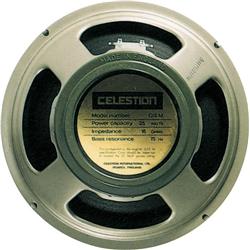
Phil has been trying to get me to write about certain speakers, but that’s something I just won’t do because again, it’s personal preference. For instance, Jeff Aragaki of Aracom Amps came over to my house today and we talked at length about his RoxBox 18 Watt Combo. I love the amp, but really wasn’t moved by the Eminence Red Coat Red Fang, which uses an alnico driver. On the other hand, I love the RoxBox head plugged into the Reason SM25 speaker cabinet that sports a Red Coat “The Governor,” which uses a ceramic driver. To me, it has a deeper sound. I kind of lean towards the “woman tone,” and “The Governor” is voiced a lot like a Celestion Greenback, which is known for its rich tones. Combined with my Strat I can get that tone. It just wasn’t happening for me with the Red Fang, though for really heavy rock stuff, the Red Fang really shines when it’s pumped up, as it compresses very nicely at high gain output. But that’s not the style I play, so it was hard for me to truly appreciate its virtues.
That said, Jeff mentioned another guitarist who just loves that setup. He’s more of a pure rock player, and loves the warmth and brightness that the Red Fang produces. See what I mean? To talk about this speaker or that is akin to starting a holy war. And you can’t tell anyone a particular speaker is bad or good because that’s just an opinion.
So here’s my advice if you want to switch to a different speaker: Go to a place where you can try speakers out and pick the one YOU like. Use reviews and sound bites as guides only. They’ll generally get you into the ballpark of the tone you want to achieve. And don’t be surprised if you get a speaker for cheap. Remember, as far as gear is concerned, something that costs more a lot of times just costs more – it may not sound any better to you. A good comparison to make is with the speakers I mentioned above. The Red Fang costs about $129, while The Governor costs $89. But I like the sound The Governor produces. If the prices were switched, I’d still go with The Governor.
So don’t be fooled by any marketing mumbo-jumbo. Go out and test for yourself! 🙂



 My good friend Phil of
  Guitar Gear