Feeds:
Posts
Comments

Posts Tagged ‘guitar’

Last night I had the privilege and pleasure to see Elton John and Billy Joel in concert. That in and of itself was absolutely phenomenal, and seeing these two in concert together – two of my favorite musicians – was a once-in-a-lifetime event for me! But what had me going even more was the fact that Elton had two of his original bandmates playing with him: Nigel Olsson on drums (my favorite drummer of all time for his heavy beats), and one of my all-time favorite guitarists and guitar influences, Davey Johnstone.

As Elton John’s musical director, Davey Johnstone enjoys a prominence in a big-name act that most of us would die for! Yet despite his longevity with the band (he has been playing with EJ for over 37 years), and his reknown in the music industry in general, he is seldom mentioned in the guitar community, which has always puzzled me. He has a wholly distinctive sound, and his instincts as a guitarist are quite simply hard to match.

In any case, when the show started, I didn’t know if Davey would be playing – or any of the original band for that matter – but I whooped out loud when the lights came up and there he was standing coolly composed in front of his amp as he always has since the first time I saw Elton in concert (I’ve seen EJ in concert 3 times since 1980). In his hands he held the custom “Captain Fantastic” Les Paul that he had commissioned by the Gibson custom shop. It’s pictured in the photo I provided at the top. Don’t know the specs, but that is one freakin’ cool guitar!

As the concert wore on, I took note of the axes he slung. Sorry, didn’t capture the songs he played with them. I was too busy singing along. 🙂 Here’s what he played:

  • Custom Captain Fantastic Les Paul
  • Double Neck Ibanez
  • Takamine Acoustic with a single cutaway
  • Black Les Paul with three pickups
  • Ovation Elite
  • Dark Burst Strat
  • Double Neck Gibson EDS-1275
  • Cool red guitar (couldn’t get the make from where I sat, and the jumbotron shots never showed the headstock. (click on the pic for a larger view)
  • Red Gibson Explorer
  • Honey Burst Les Paul
  • What looked like a R9 Les Paul

As far as his amplification, I could only see one amp onstage, and it had the size and shape of a California Blonde acoustic amp (though it was definitely not that). He ran two tilt-back 4 X12 cabs – probably in stereo – on either side of the amp. From the diminutive size of the amp, it was clear that this wasn’t a high-powered amp. I suppose he was just getting stage volume, and relying on the PA to project to the audience which, by the way, was absolutely incredible. He’s yet another musician who realizes the power of using a lower wattage amp. It saves your ears, and it really allows you to get great pushed tones!

As far as Davey playing, he’s the ultimate sideman. He has got licks and tricks up his sleeve that don’t necessarily stand out – because his guitar takes a back seat to Elton’s piano – but weave in and out of the songs and fit perfectly. Even when he was playing rhythm in Billy Joel’s tunes last night, I was watching what he was doing. He was all over the neck, playing little single or double-string embellishments that you could actually make out in the mix, but blended so well, that if you didn’t know what to listen for, you’d never hear it! That just blew me away! To me, that just demonstrates incredible instinct as to what to play when and where, but also an incredible humility and awareness that he doesn’t have to be a “star,” but mixed with a confidence that he has nothing to prove.

Make no bones about it. Elton John’s hits are nothing without Davey Johnstone’s guitar. He has had artist credit on every hit Elton has had. With the exception of the addition of the great Caleb Quaye doubling on guitar on “Blue Moves,” Davey has been THE Elton John guitarist. Last year, he celebrated his 2000th show with Elton. 2000!!! How’s that for a defining career?!!!

If you’re an Elton fan, you probably know of Davey Johnstone. But I would highly suggest in any case, to give some of Elton’s hits a listen, and you’ll see the absolute mastery of Davey Johnstone’s guitar playing!

Read Full Post »

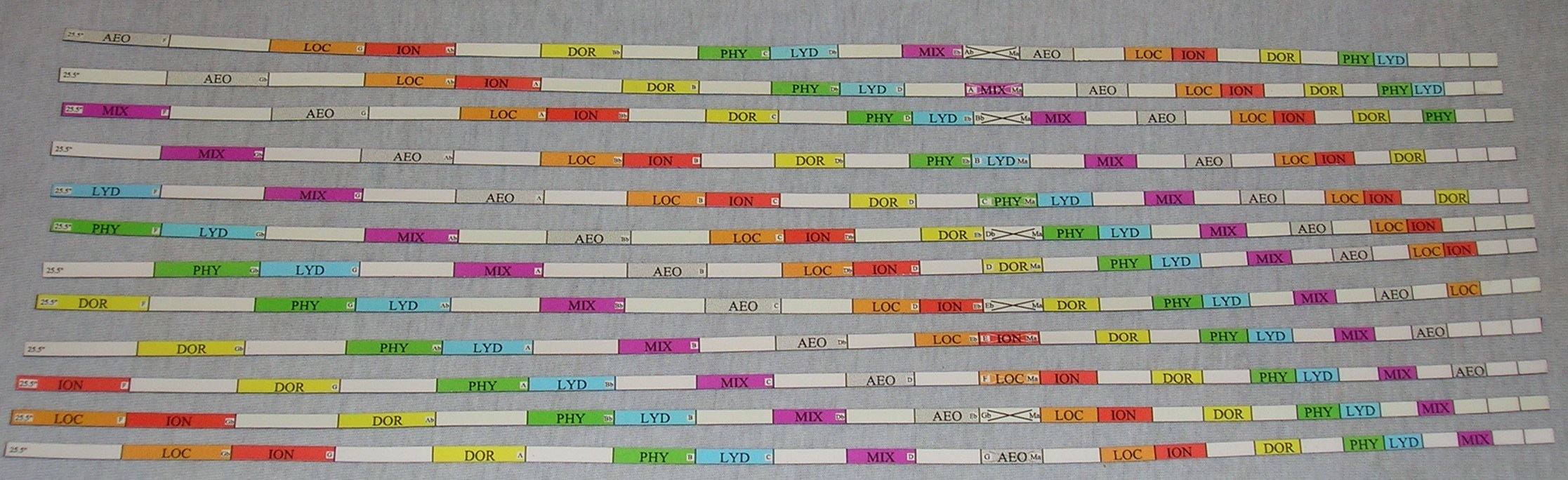
Click on the picture to see the magnets.

Guitar Scale Magnets – Major Scale Strips
Summary: Great “cheat sheet” for learning where the various major scale modes start on the fretboard. Very convenient, and very easy to install!

Pros: Magnetic base strip attaches easily to the side of your fretboard. The strips provide a superb way to visualize the starting point of the major scale boxes.

Cons: Just a nit, but only available for 25.5″ scale guitars. Not a really big deal as that’s pretty much a standard. Of course, I have different scale lengths, but they fit my Tele perfectly!

Features:

  • Base strip has a very weak adhesive that sticks to the side of the neck, but will not peel varnish.
  • Magnetic strips are made of the same material as those “refrigerator stickers.” They’re pliable and very easy to use.
  • Major scale strips include all keys from C to B.
  • Includes scale charts for all modes. Very handy.
  • Comes with a convenient storage tube for storing the strips when you’re not using them.
  • Great way to visualize the modal starting points in any key.

Price: ~$19.99 plus $5.00 S&H

Tone Bone Score: 5.0 ~ I’m a very visual learner, and having visual cues helps me learn much more effectively.

I’m not much of a guitar theoretician, not because of not wanting to be, but simply because with my busy lifestyle, having the time for academic pursuits is limited. So for my learning, I rely on tools and videos that will help me learn concepts quickly as opposed to traditional step-by-step methods that dissect the concepts into chunks. It may not be the best method of learning, but it’s all I have. But besides that, I’m also a very visual learner, and definitely a learn-by-doing type of guy. So if I can get my hands on something that will give me visual cues, my learning experience is much more valuable to me.

Enter Guitar Scale Magnets. One of the things I’ve been wanting to learn for awhile is modal theory. It has always interested me, but I’ve never seemed to have the time to really sit down to learn it – nor did I have the funds to take lessons (I spend it all on gear). So when I found out about Guitar Scale Magnets, I was immediately intrigued, and asked Jason Ellestad, the inventor of the guitar scale magnets to send me a set of major scale magnets to review.

In a word, these things are awesome! Made of the same magnetic material as those flexible “fridge” magnets – but not at thick – the magnets provide a very convenient way to learn the major scale modes by giving you visual cues of the starting points. Of course, you still have to learn the patterns, but you get the patterns on a couple of 8.5 X 11 sheets that you can tape to your wall for reference. Not bad for $19.99.

To attach magnets to the side of your fretboard, Jason provides step-by-step instructions. But you don’t even need the instructions. The base strip, of course, has no markings on it, so it’s easy figure out that it’s the base. It also has a weak adhesive that’s tacky enough to stick to your fretboard, and stay in place as you play, but not strong enough that it’ll peel your varnish. Once you have it in place, it’s just a simple matter of finding the key you want to practice, and laying it on top of the base strip. Each key is color-coded to show you the starting points for each mode. Click on the picture above to see an enlarged version of what they look like.

I won’t belabor how useful I’ve found these to be. I’m just going to recommend that you try them out. Jason has three types of strips available: Major Scale, Pentatonic Scale, and Learn the Fretboard/Tab strips. So if you need some visual cues for learning your scales, Magnetic Scale Strips are a great tool! For you teachers out there, I think these would be invaluable to give to your students to help them learn and practice in conjunction with your curricula.

For more information, go to the Guitar Scale Magnets site!

Read Full Post »

I know, I know… I talk about this pedal A LOT, and I’ve already reviewed it a few times… (here’s the original) But I keep on discovering so many great things about this pedal that makes me want to talk about it. Just when I think I’ve got it dialed in, I find yet another thing that it does that just completely turns me on!

Tonight, I was screwing around with my song Strutter yet again. I’m done writing it, but I wanted to practice, and that song is really fun to practice to; I just mute the lead tracks and have at it. Mind you, all I wanted to do was practice and play “Blondie,” my Squier CV Tele – I didn’t have anything else in mind.

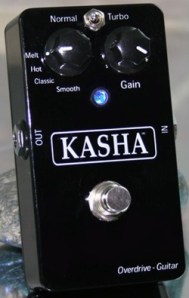
So I hooked up my Aracom PLX18 BB and started playing over the rhythm track. Folks, this amp just oozes classic Marshall “Bluesbreaker” tone as is, but just for shits and giggles, I decided to switch on my KASHA Overdrive to add a little flavor to my tone because I was working on a new song recently where I loved what this pedal did – especially with the PLX18 BB! For that song (which I’m still writing) I didn’t want to add too much gain. All I wanted to do was add some texture. So I thought it might just sound good while I practiced over Strutter. Man, was that a good call!

Here’s an A/B clip of sorts of the first two verses of the song. In verse 1, I’m playing the PLX18BB with nothing added – just a touch of room reverb as an insert in the mix. In the second verse, I switch on the KASHA overdrive (still with some reverb in the mix). The pedal is in the “Hot” channel, and I set the gain knob at 12 o’clock, which just provides a bit of a gain boost (it’s capable of adding up to 15dB of boost in this channel), but this channel also sustains for days, adding a touch of high-end sparkle. Here’s the clip:

Please excuse the little playing mistakes I made… 🙂 It’s nothing really egregious. In any case, when you compare the two verses, the difference in tone is actually subtle, at least to my ears. But from a playing standpoint, the amount of touch-sensitivity and sustain that was added made the second verse so much more musical and so much more inspiring to play. And speaking of subtlety, I think that is yet another mark of a great overdrive pedal. To me, overdrives should be transparent, they should never alter your tone – that’s what fuzz and distortion are for. At the most, they should simply add EQ emphasis, and that’s it. And that’s why I love the overdrives I play through: Tone Freak Abunai 2, GeekMacDaddy Geek Driver, Creation Audio Labs Holy Fire, the KASHA overdrive, TubeScreamer, and believe it or not, a Bad Monkey. They all bring to the table their own little voicings, but none of these alter your basic tone.

Great gear evokes a sense of inspiration – at least in me – that makes me want to keep playing and playing and playing. I just can’t say enough about this pedal. At around $200, it is worth every penny I paid for it. Thanks, John Kasha for coming up with such a fantastic pedal! Now back to playing!

Read Full Post »

What is it about guitar makes it immediately associated with hot chicks? Hey! Not that I’m complaining. Take a look at this smaller version of the free poster from The Tone Box (click on the picture to download the full picture – it’s 18mb – so it may take a bit):

It was this picture that made me ask the question above. I suppose manufacturers figure if they get us to sport wood for their female representatives, that image will make us sport wood for their products. Interesting. Interesting indeed! While I have an incredible appreciation for the female form, as a buyer of guitar gear, nice tits and a great ass will only serve to distract me. And if your gal is extra slutty (which does nothing for me at all), I won’t even bother looking at a manufacturer’s gear. It’s not that I’m a prude, but I’m really not swayed by that because even though I’m a red-blooded, American horn dog who loves the female form, I’m also a tone FREAK-I-ZOID, and in the end, I don’t want the distraction. Just f%&kin’ demonstrate how the mutha-f%^ka sounds!

I can just imagine a rather funny situation. Let’s say this kind of advertising actually works, and every guy who views the sexy ads has the same reaction to the gear. You could go down to Guitar Center or some other place and be able to tell whose seen the ads. They’d be the guys that are slightly bent over, faking that they’re doing the pee-pee dance, or unabashedly flaunting the bulge in their pants (or they could do the cucumber bit like the bassist in Spinal Tap).

But maybe some manufacturers have learned the lesson that no matter how many hot chicks you put on your ads, it’s how your gear sounds that matters, and heaven forbid! The sound and how it pleases people so much that they spread the word that is what actually sells your product. Off the top of my head, Goodsell Amps was notorious for using hot chicks in all their visuals, but perhaps even they learned the lesson. I remember the first time I went to their site after seeing a recommendation on The Gear Page. I happened to be at work when I clicked on the link, and had to close the page immediately because of the scantily clad chick sitting on a Goodsell amp.

When I got home, I opened up the page, but my first thought was, “What the F$&K does this have to do with the amps?” Like I said, I’m not a prude, but I couldn’t be the first one who asked the very same question. I actually found it kind of obnoxious. It reminded me of the old Comdex show in Las Vegas back in the 80’s when electronics manufacturers would hire scantily clad models (read: topless) to attract geeks to their booths. I went to the show a few times, and I can tell you from personal experience, I was a hell of a lot more interested in the round orbs of fleshy goodness than that actual goods. Such was my response when I first went to that site. However, if you go to the Goodsell amp site nowadays, you’ll see that it is just a plain old amp site now – no hot chicks on the home page. Maybe Goodsell figured that the expense of hot models didn’t bring in more sales. You think? 🙂

I’ve got some ideas on what actually works nowadays, but that’s a bit beyond the scope of this entry. I’ll maybe talk about my ideas in a future post.

Read Full Post »

A couple of months ago, I asked the question, “Where have all the overdrives gone?” in response to a trend that I was noticing that there seemed to be fewer new overdrives being released after a long period where new overdrives from different pedal manufacturers were coming out every week. I guess they were waiting for NAMM to come because “They’re BAAAAACK!”

The latest to arrive on the scene is actually a re-issue from Wampler pedals: The Limited Edition Pinnacle(2) reissue. Wampler is an effects company I’ve known about for a long time, but have never actually played or owned one – even though I’ve always been impressed with their tone. In any case here’s Wampler’s explanation for coming out with the re-issue:

The original Pinnacle(2) evolved into the pinnacle over the span of a couple of years. During that time, we’ve had a ton of customers ask us about coming back out with the original version which had a stomp-switchable gain boost. While the current pinnacle and the original pinnacle 2 were 95% the same circuit-wise, some felt that there was a certain ‘magic’ to it. Since we’ve had so many requests for it, we decided to come out with a limited version of it complete with the gain boost stomp switch. We are only building a small number of these so unfortunately when it’s gone – it’s gone. At this time, it is only available on this website.

So how does it sound? Well, it can do quite a bit, actually. But it is really known for its ability to cop a great “brown sound” tone. Here’s a great video that demonstrates this (this dude can cop EVH pretty good):

I find it amazing that the amp he used was a software amp. AmpliTube has really come a LONG way!

As Wampler mentions, there are only going to be a limited run of these pedals. But here’s the real winner for me: This pedal is only $179.00! I need to tie down my hand so it doesn’t reach for my wallet!!! 🙂 It’s definitely worth a look!

I really don’t know why I love overdrive sounds so much. I guess that there’s something really primitive inside me that loves that growling tone. Who knows? Who cares? I love ’em!!!

For more information, go the Wampler Pedals site!

Read Full Post »

Oo-la-la! T-Rex will soon be releasing a new distortion pedal called the Tonebug Distortion. Not much info on it yet, but it is supposed to lay on tons of gain. I was fortunate enough to see a video from the folks at GearWire that quickly demonstrates what this pedal can do.

Admittedly, I’ve preferred overdrives over distortion boxes, but I’m really liking the tone from this puppy! Don’t know if I’d shell out $399 for it, though. But T-Rex pedals are premium pedals, so that’s not a surprising price.

For more information, check out the T-Rex site!

Read Full Post »

or… Doc Brown in Back to the Future saying, “I finally invented something that works!” Speaking in reference to the Flux Capacitor. Nah, it’s nothing of the sort, but it is by no means less cool. The Flux Density Modulation Speakers are a new approach to attenuation where the attenuation happens right at the speaker! Giving you up to -9 dB attenuation, while keeping your tone, that is what I call cool, and something I must check out! You know me, I’m an attenuator fan, and something like this has me absolutely GAS-ing! From what I could tell from the videos below, the tone is really preserved. Now, mind you that -9 dB of attenuation won’t get you down to conversation levels, but it’ll sure provide enough attenuation to take the bite off the volume. If you need to go lower, hell! Get an Aracom attenuator, and get it down REAL LOW! Check out the NAMM vids!

and from GuitarWorld…

Read Full Post »

I was persuing YouTube today to check out some cool stuff from NAMM, so I got a few vids that I thought were worth sharing.

The first if from Fender (yeah, I know, it’s mainstream, but Fender has been doing some interesting stuff). This is Acoustasonic Tele, which is a half acoustic / half Tele. As you know, I have the Acoustasonic Strat, but this looks like it’s even better! Check it out:

Here’s a really cool thing for acoustic guitars – no more string pegs!

Ever wanted a Tube Screamer in an amp? Well Ibanez has come out with a 15 Watt amp they appropriately call “The Tube Screamer.” It features an authentic Tube Screamer circuit in the front end, and has a half-power switch (pentode-triode) switching. It will only cost $299. Probably mostly solid state, but it has 2 X 12AX7’s in the pre-amp stage and a pair of 6V6’s to power it up. Interesting. Here’s a demo… At least the amp sounds decent (read: I don’t necessarily like how it’s being played): 🙂

And here’s a new overdrive… the HAO OD-16, handmade in Japan. The NAMM vid I found on this was private, so I did a search for another. Apparently it has a street price of $300… yikes! I’ll do a bit more research on this one. Sounds very nice!

That’s it for now. If I find more stuff, I’ll post it here. There are lots of videos to wade through….

Read Full Post »

I’ve been using the Aracom PLX18 BB Trem in my studio for the past couple of months, and it is simply a great amp. As I’ve written in the past about this amp, I’ve made some modifications to it such as replacing all the stock pre-amps with NOS (the JJ EL84’s are killer in this amp, so no need to even look for NOS for these), and replacing the stock speaker with a Fane Medusa 150.

As most GuitarGear readers know, my go-to gigging amp is my beloved, customized Aracom VRX22. But every now and then, I like to take my other amps out for a spin. For this evening’s church gig, I took the PLX18. Based upon tonight’s experience, it looks like I’m going to gig with this amp a lot more.

One thing that I’ve come to love about Jeff Aragaki’s amp designs, is that he has got the vintage Marshall mojo down. Mind you, he doesn’t make clones. He takes the original circuit designs and innovates on top of them. The PLX18 BB started out as a classic “Bluesbreaker” design, but with improvements to the circuit to make it much more efficient. The result is a real smooth-sounding amp that – like the amp it is modeled after – has tons of clean headroom, and needs to be absolutely cranked to get grind. But when it grinds, it’s so rich and smooth and dynamic, you just close your eyes and let your fingers do the talking!

Such was the case tonight. About a year ago, I re-arranged a classic Catholic hymn and gave it a bluesy, folk-punk vibe (think a cross between Death Cab and Clapton). I know, it sounds like a weird mix, but amazingly enough, it works. People know the song really well, but this arrangement gets them nodding their head in time – it’s cool to see! In any case, I also arranged it so that there was plenty of room in between verses for little solos. It’s a somewhat slow song, so you can’t go overboard, but the phrasing really lends itself to a lead played with an amp just at the edge of breakup, with lots of bends and vibrato.

And it helps to have an amp that has a lot of natural sustain. The PLX is just so damn good at that! I played the amp in the “clean” channel that I had almost cranked up all the way, since that’s where a vintage Marshall sounds great, and of course, it was plugged into my attenuator so I could crank it and still have a manageable volume level. The PLX is so responsive to attack and volume knob adjustments that it makes playing just a dream. Throughout the song, I just closed my eyes and got into pure expression mode. It was one of those occasional experiences where the tone just takes you right into the Zone! When you’re in the Zone, you just can’t do wrong. Hearing the PLX sing with my Squier CV Tele – I just floated away in absolute bliss.

For our closing song, I actually didn’t play, and gave “Blondie” over to my guitar cohort Dave so I could thump out on bass. For that song, I activated the wonderful Kasha overdrive pedal, in the Hot channel to really slam the amp with gain. The great thing about the Kasha overdrive is that it’s a really transparent overdrive pedal, and allows you amp to do it’s magic. With the OD engaged, the PLX took on this incredible character. It’s a bright amp by nature, but the tone became really jangly and ringy, with just a touch of compression coming from the EL84’s. It helps that I replaced the original JJ pre-amps with the NOS ones. In any case, talk about creamy smooth but articulate overdrive! Listening to that just got me thumpin’ out on the bass! We had a lot of fun with that song. Kind of felt like the White Stripes as we only had two instrumentalists (though it was two guitars, or a bass and guitar – no drums). It was raw and edgy, but oh so cool! You gotta just dig moments like this!

As I’ve mentioned, the PLX18 BB Trem is Jeff’s oldest amp design and unfortunately, his least-known amp. It’s tough to compete in the market when there are so many boutique, vintage Marshall-style amps on the market. I’ve played many, but the PLX18 BB is special. Others who own one of these will attest to just how special this amp sounds. Even though it’s not quite as versatile as the VRX22 that can get me over-the-top gain, for what it does, I can’t think of a better amp. Mind you, this ain’t just a one-trick pony. For blues, classic rock, and country, it’s simply killer. So if you’re looking for that classic “Bluesbreaker” tone at a price that won’t break you at the same time (the head is $1345, and the combo – which I have is $1750), I encourage you to check this amp out! And if you do get it, you won’t regret it in the slightest!

As far as equipping it, pay the extra for NOS pre-amps (the JJ EL84’s are just fine – I actually prefer them), and even though Jeff recommends an Eminence Red Fang Alnico to be paired with the PLX18 BB, for my personal tastes, I prefer something with a bit tighter bottom end; hence, the Fane Medusa that I swapped in. If you still want bright tone, then an Eminence Governor works insanely well, and will give you nice mids and high-mids, and I hear the Celestion Gold sounds killer in the the combo! YMMV…

For more information on this wonderful amp, check out the Aracom Amps site!

Read Full Post »

13 years old and can play like Paul Gilbert! This kid rocks the house! He’s the real thing fo-sho! Not just your mechanical prodigy, this kid has feel. Check it out!

Read Full Post »

« Newer Posts - Older Posts »