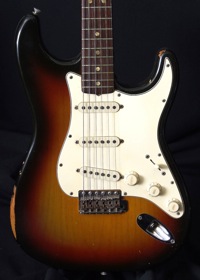
Ever since Fender announced the new Roadworn Series of guitars, I’ve been lurking the gear forums and googling for information about them and trying to get a feel for what people think about them. It’s still early in the game, but not surprisingly, opinions are fairly evenly split. Lots of people like them, lots of people don’t. I’m part of the latter crowd.
From my point of view, if I was going to play a beat-up-looking, “roadworn” guitar that’s broken in, I’d rather have done the breaking in myself, or have had it done by someone else – like my first electric guitar that my little brother gave me. It was an Ibanez Strat copy and it looked like a piece of shit! The paint was cracked and flaking in areas, the electronics were completely screwed up due to the jury-rigged wiring jobs my brother did on it. But when I had it working, that little bad boy could sing! Even my brother inherited from one his band mates. In other words, this guitar has a history, and it plays and feels like it has a history.
My problem with the Fender Roadworn series is that these are brand new guitars that are made to look like they have a history, but they’re fresh off a friggin’ production line! They have no history! Oh yeah, I can hear a Fender rep saying, “We ‘wore out’ some of the most common areas where guitars get worn, and added some other cosmetic blemishes to produce a guitar that looks and feels like its been played for 20 years.’” What a crock of shit! Sorry, not buying the rationale, nor the guitars. Besides, to me, it’s how the guitar sounds and plays whether it’s new or used that counts.
I suppose if you have to have a replica of a famous guitarists axe, hey! More power to you! But in the end, you’re the one playing it, and you ain’t gonna sound like the guitarist whom which the guitar was modeled.
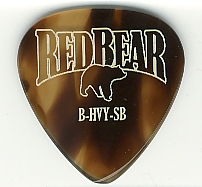
Summary: Thick, meaty hand-made pick from Red Bear Trading. You might think a pick doesn’t really matter until you play one of these picks. They’re totally awesome!
Pros: Thick and tactile, this heavy pick gives you instance response as soon as you strike a string. Chords seem to ring out better. Don’t be fooled by the thickness – the beveling makes this pick glide across the strings!
Cons: None
Price: $20
Okay, I admit it, I am now a true believer in hand-made picks! I wrote a review about Red Bear picks a few weeks ago. In the article I asked, “Does a pick really make that much of a difference?” After nearly a month playing with a Style B Medium, and now a Style B Heavy, I can undeniably say that it makes all the difference in the world! In this short span of time, I’ve become a better player, and while I attribute that to quite a bit of practice, I have to attribute a lot of my recent improvements in both tone and attack to the pick I’ve been using. I don’t say this lightly: These picks have totally changed my life with respect to my guitar playing!
When you first hold one of these picks, your first reaction is: Damn! This thing is thick! And while its smooth texture kind of sticks to your skin, it absolutely glides over your strings. And because of its thickness, it produces sound much faster than conventional nylon picks that need to be before they make a sound. The sound the picks produce is also much more crisp.
For instance, playing my Ovation acoustic/electric, I’ve never heard it ring the way it rings – and it’s because of the pick. I’ve had that guitar for over 15 years now, and it quite frankly has never sounded this good! It always sounded awesome to me because of its thick tone. But when I strum it with one of these picks, it now has a gorgeous chime! F-in’ A!
At first blush, you might think that paying $20 for a pick is just way too much. But how much would you pay for good tone? We guitarists spend literally thousands on guitars and amps and racks and pedals and other accessories every year! But most of us tend to play them with inferior plectrums, never knowing what we’re missing by making a relatively small investment compared to the vast sums we spend on other gear. Sure, our standard picks are cheap, and it’s okay to lose them, but there is absolutely NOTHING that compares to the tone you can produce with a hand-made pick. And once you play with a great pick, you’ll never go back to the cheapo picks again.
To be honest and fair, Red Bear is not the only one who makes handmade picks. But Dave is the only plectrum maker who uses TortisTM, a polymer made from animal protein that looks and feels EXACTLY like tortoise shell. Dave has mastered cutting and shaping of the material, something no one else who has tried to work with it has been able to do.
What’s so special about this material? If you speak with people who have played with tortoise shell picks, they’ll tell you about how good it feels to play with one. But by the same token, to play with tortoise shell means that a sea turtle had to be sacrificed to create the pick. On the other hand, Tortis feels like real tortoise shell. In fact, when Dave first sent out his first prototypes, people told him he was full of shit when he said the picks weren’t tortoise shell! That’s how natural these feel!
As I mentioned in the previous article, Dweezil Zappa swears by these! And for good reason. The sound they produce, and how they make your playing much more precise is an absolute inspiration! For more info, and to order them, go to Red Bear Trading!
If you live in the SF Bay Area, and especially near Palo Alto, you can also get them at Gryphon Stringed Instruments.
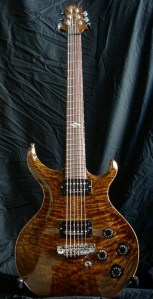
Imagine, if you will, that guitar to the left, in a glossy, goldtop finish. That will be the guitar that Adam Hernandez of Saint Guitars will be building for me. It was by no means an easy decision to make. As a tester for Saint Guitars, and ostensibly a rep for Saint Guitars (I’ve been careful about keeping that separate from this site – though news about it will be out within the next few weeks), I love every single guitar I’ve gotten my hands on. I dig Adam’s approach to guitar-building, and of course, I simply love his designs.
But despite the relationship, I was a little wary of actually purchasing one. Why? There are lots of factors, which I’m going to share here. But first, the juicy back story…
As some of you may know, I’m a huge fan of G & L Guitars, especially the Comanche line. Yngwie Malmsteen calls the Strat a perfect guitar, but I believe the Comanche improves on it even further, especially with its Z-coil pickups that still offer that gorgeous single-coil feel, but with much more output.
For the last few months, I had been saving my pennies to purchase a Comanche from my local G & L dealer. I’ve been skrimping and scraping every extra buck I could because I just had to have one. It’s an incredible guitar that just speaks to my soul. And about a month ago, I had enough to get my beloved guitar. Then Adam contacted me via e-mail a few days before I was all set to buy the guitar and said he wanted to construct a guitar for me based upon this “dream” goldtop I had described to him a month before that when he asked me what I think would be my dream guitar.
Now you might think I just up and dropped all my plans to get a Comanche. I didn’t. I’ve been very drawn to the Comanche for a long time, but as I’ve shared, I also love Saint guitars. In fact, though I received the e-mail early in the morning, I sat on it for the whole day, and didn’t reply until late that night. In short, I was seriously conflicted, and for several good reasons, which is why I’m sharing this experience. And perhaps by sharing this experience, I can shed some light on helping you make your own choice in whether or not to go with a custom-made boutique guitar.
Most people who come to GuitarGear.org have a serious and virtually incurable case of GAS. Several have custom guitars – a few even have a few Saint guitars to their name. So there is no doubt that what you ultimately get is high-quality, and tailored to your specific tonal requirements. But the conflict in my mind was something entirely different than cost, quality, build, tone, etc.. I know what Saint Guitars sound like, and they’re some of the most gorgeous-sound guitars I’ve ever played; cost would be an issue, but if I made the decision, I’d make it happen; rather, it was dealing with the “known” versus the “unknown.”
So, to boutique or not to boutique? That is the question I posed as the title of this article. If it wasn’t cost or quality or tone that was the issue, what do I mean by the “known” versus the “unknown.” I’m going to bullet-point the known issues first:
First off, the Comanche was a known quantity to me. I have played several over the last couple of years, and while each is slightly different – after all you’re dealing with wood which is by no means uniform from instrument to instrument – they’ve all generally fallen within the same range of playability and tone.
And because I’ve spent a lot of time playing that model of guitar, I knew how I’d fit it into my stable and what it could do for my tone, and how I’d use it in my compositions and performances.
The Z-coil pickup is what I believe to be Leo Fender’s finest achievement. Even though Leo was known for creating the Strat, what a lot of people don’t know is that he didn’t play guitar – at all. He didn’t even tune them until late in life! He was all about the pickup, and he built the Strat around his pickup invention. So there’s a bit of history behind the Comanche.
So what about the “unknowns?”
Being that a custom-made is a unique creation, I don’t have a precedent from which to follow. There aren’t any previous guitars made with the EXACT specs my guitar would have. In other words, I don’t have any similar models from which to reference.
I suppose there are reasonable facsimiles, and since I’ve had the fortune to test Saint guitars, I know how well they’re made, but the guitar I have in mind isn’t made of walnut, which is Adam’s choice of wood. It’s a solid mahogany body with a maple neck – similar to a Charvelle I played a few days ago – very nice playing guitar.
Also, with a custom guitar, what I found was that I really had to think and on top of that do research on tone woods and pickups and hardware. That’s something that I wouldn’t have to do with a Comanche. I’ve just had to play a bunch to find the one that I like. That kind of leads back to the first point that there are no previous guitars with my exact specs from which to reference.
But despite all that, I’m still going to have Adam build me my guitar. The uniqueness certainly plays into it, but I’ve been playing long enough now that I have a good idea of how a guitar sounds with a particular type of tone wood, so tone is not quite as unknown as I might have originally thought. But I think the thing that probably was the scariest thing for me was having to specify the different pieces. In other words, all the effort I’d have to put into getting the guitar created. And even though it’s a bit of a moving target, here are the specs I so far:
Finish: Glossy Goldtop
Body: Double-cut Mahogany
Neck: Maple
Fretboard: Ebony
Headstock: Maple
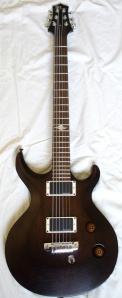
Summary: An aggressive guitar that wants to growl! This baritone is well-suited to de-tuned, low-freq, hard-driving metal, yet can be tamed to produce sweet, ringing cleans.
Pros: Very playable guitar, with a fast neck despite the wider frets. The hot, high-gain, active pickups practically eliminate the need for distortion pedals. Will hit the front-end of amp with tons of oomph! Bright tone will cut right through any mix.
Cons: Not really suited for a cleaner style of playing.
Price: $2300
Specs:
Solid walnut body and neck
Rosewood fretboard
Seymour Duncan Blackouts in Neck and Bridge
Master Volume and Tone
Gorgeous, dark-brown open-pore finish
Tone Bone Rating: 4.5 – Metalheads will love this guitar! I dug its playability, but would probably swap out the active pickups for a pair of ’59’s or Alnico Pro II’s to give the tone a fuller sound. But as with any Saint Guitars instrument, it’s really playable!
I’m very blessed. I have great friends who share my passion for guitar, and several of them make equipment. And I feel extremely grateful that I get to play the stuff they create. Such is the case with Adam Hernandez, whiz-kid owner and luthier of Saint Guitar Company. Adam and I struck up a friendship in the middle of last year, and I get to test (and sometimes spec) guitars he’s adding to his inventory. He doesn’t carry many in inventory as his business is fairly dedicated to creating custom works of functional art. But it’s cool that he lets me play with them. On the flip side, I’m more than willing to do writeups of his excellent guitars.
And while the guitars Adam creates are nothing short of amazing, what really turns me on about the guitars is Adam’s fearless approach to guitar making. For instance, Adam’s tone wood of choice is walnut. Walnut is usually considered bright and dead. But Adam has somehow found a way to shape and construct guitars made from walnut that are incredibly resonant and rich in tone. A guitar player himself, his designs reflect a sensitivity to the working guitarist, with easy-to-reach controls, and beautifully shaped bodies and necks that are more than just pleasing to the eye, they’re meant to be played!
When Adam contacted me and told me he wanted to swap the Faded Blue Jean Benchmark that I had been testing, I have to admit that I experienced a bit of trepidation in making the trade. For one thing, I kind of got attached to the “Baby Blue” as I came to call it, and more importantly, I had never played a baritone guitar, and didn’t know what to expect. But far be it from me to let those things get in the way. It’s not every day that you get to play custom, hand-made guitars. So a couple of weeks after he called me, we met at my local coffee hangout. That was before Christmas, so I’ve had quite a bit of time to play with the guitar.
Fit and Finish
What can I say that I haven’t said before? Saint Guitars are flawless in look and build. With this Baritone, I really dig the open-pore finish! It really brings out the natural grain of the walnut. As usual, the frets are perfectly shaped, and you’ll never find any rough edges or production burrs on the fret wire. And being that it is a solid stain, it’s just beautiful in its simplicity.
Playability
As I mentioned briefly in the summary, this is a very playable guitar. The action is PERFECT, and the jumbo frets make it easy to achieve vibrato just by wiggling your finger ever so slightly. In fact, since I like to really dig in with my left hand, it took me awhile to adjust to the light touch that’s required to voice a note or chord. But that’s a good thing. I’ve said it before: A good instrument will force you to be a better player because it won’t hide your mistakes or the idiosyncracies in your playing.
Adam is partial to wide, but shallow “D” shape necks. The “D” shape on the baritone is less pronounced on the Messenger than it was on the previous guitar I tested. I myself am partial to narrow “C” shape necks, but irrespective, the neck shape certain didn’t preclude me from playing. It did take a little while to get used to, but once I found a good height and angle, the guitar became a dream to play!
How It Sounds
I’ll let you decide for yourself. Here’s a clip:
And here’s the same clip with my Strat layered on top. I did this to see how well it played tonally with a standard scale guitar.
Okay, I did add a touch of reverb to the guitar in the tracks above, but the natural resonance and sustain even without reverb is astonishing! You can dig into a note, wiggle your finger, and the guitar will happily carry that note into the ethers forever. It’s very pleasant.
Now here’s the rub… and the reason I gave it 4.5 Tone Bones. For my style of playing, which leans towards the blues and classic rock, the Seymour Duncan Blackouts were way too aggressive for my tastes. I could clean them up just fine, but the guitar in this configuration was simply way too aggressive for the styles of music I play. For instance, when I recorded the rhythm track above, the guitar’s volume was set at around 3, the amp’s volume was at 2, and I used the Master to get clean headroom. Any higher on the guitar, and the gain the Blackouts produce would just slam the amp’s front end (BTW, I used an Aracom RoxBox 18 Watt head and a 1 X 12 cabinet with an Eminence Red Coat “The Governer” speaker). It sounds great clean, and if I were to purhase this guitar, I’d have Adam swap out the Blackouts and go with a pair of ’59 humbuckers or Alnico Pro II’s. They’re very vintage sounding, and a lot more full-bodied.
With respect to the natural aggressiveness from the pickups, while I played with the guitar a lot in the past month, I just couldn’t get inspired to write anything that took advantage of the high gain of the pickups. It just wasn’t in me this round, which is a shame because it is such a fine instrument in every other way. What I’d like to do is play the guitar with different pickups.
So what about with high gain? Damn! This guitar simply screams! With the volume knob dimed, it slams the front-end of an amp and causes immediate saturation! I usually have to bolster my Strat with a clean boost or an overdrive pedal to achieve the kind of high-gain this little monster can produce by itself! It’s very cool to hear!
Overall Impression
I think this guitar would be metalhead’s wet dream come true in stock form. In fact, Adam constructed and equipped the guitar with thrash metal in mind, and tried to see if he could get James Hetfield of Metallica to play it. Alas, he couldn’t find a way last time they were in town. But I can attest to what this guitar can do to an amp! But with different pickups, I’m sure I’d give it a perfect score.
Back in the early 1990’s, Jeorge Tripp started Way Huge and created a line of pedals starting with the “Fuzz Box” that for all intents and purposes started the whole boutique pedal movement. Later in the decade, he decided to go on to other stuff (I believe he went to Line 6). I didn’t play much electric guitar back then, but I do remember a couple of guys I knew who used to rave about Way Huge pedals. I had never heard of them, and as a primarily acoustic guitar player, didn’t really pay too much attention because distortion was not part of my tonal palette. That all changed when I started focusing on electric guitar a few years ago. I’d visit forums and lurk discussions about how people were paying hundreds (never saw any go for thousands, but apparently some did) for these rare pedals. I was amazed. These pedals must’ve been something special if they were in such high demand.
Then a few weeks ago, I had heard that Jeorge Tripp struck a deal with the Jim Dunlop company to resurrect Way Huge. I did a google search to see if I could find any info, and came up pretty empty-handed. Even the Way Huge site had no information – until I did another search about ten minutes ago, and saw that a search on “way huge” produced the result “Jim Dunlop – Way Huge” as a search result. Naturally, I had to click the link, despite the seemingly sexual undertones the link title might have implied.
To my everlasting surprise, the Way Huge site was completely transformed from the comic book-like line drawing theme into a real site, replete with Flash graphics! But to be clear, the fact that it’s Flash did not get me excited. It was the fact that it was a real site. You have to check it out!
Featured on the site are the three pedals Way Huge is offering right now: The Swollen Pickle Mk II, The Fat Sandwich, and the Pork Loin. The Swollen Pickle is a pure Fuzz machine, while the Fat Sandwich and Pork Loin are soft-clipping overdrive pedals. Each has a very unique voice. The sound samples really display the capabilities of each pedal, so I encourage you to check ’em out.
Personally, I’ve never been much of a fuzz guy, but I do love soft clipping pedals. So naturally, I gravitated toward the Fat Sandwich and Pork Loin pedals. Very nice sounds indeed!
This piece of gear is so new, it’s not even in production yet, but I just had to share the news!
A few months ago, I was watching a video on YouTube about the Faustine Amps VT-58 amp, which is based on the 5E8A “Low Power Twin” circuit. Very nice, compact amp. But that’s not the story. Faustine is just about to debut a standalone version of their built-in attenuator.
One thing to note about Faustine amps is that all models have a built-in attenuator that gives you from -3dB down to -18dB attenuation. I played at VT-57 at Tone Merchants, which is a 35Watt, 3 X 10 amp – classic, sweet Tweed tone. But it was the built-in attenuator that really sold me on the amp, and actually one of the things that started me thinking about using an attenuator in the first place. As you know, I ended up going with a Dr. Z AirBrake, which has totally served me well, and will continue to do so in the future, but I remember the attenuator working so well on the Faustine, that I was wishing that Faustine had a standalone attenuator.
My wish has been granted.
If you watched the video (and I will present it in its full glory at the end of this entry), the reviewer mentions it being released in early 2009. That prompted me to contact Tim Gregoire, Faustine Amps designer and owner to see if and when it will be released. According to Tim, full production models will be available by the end of this quarter or early next quarter. He’s currently building a set of pre-production models for select clients in the SoCal area, and once he’s done with those, he’ll begin production of generally available models.
So what’s so special with this attenuator? From my personal experience with the built-in one, the attenuator circuit Tim has created is totally transparent – at any level. While I love my Dr. Z, at high attenuation levels, it starts sucking tone, and that’s not good. But with the Faustine, I didn’t detect any tone loss, even when I cranked up the attenuation to its highest setting!
According to Tim, the standalone model will have a wider attenuation range than the built-in attenuator. He shared that it will attenuate within the range of -2dB all the way down to -26dB – that’s conversation-level! Freakin’ awesome! No price yet, it probably won’t be cheap. But sometimes you have to pay for transparency. Once out, the unit will be sold exclusively for a time through Tone Merchants. Stay tuned, as I will hopefully be able to get a unit to review!
Here’s the video of the VT-58. This is a great little low-power amp, with wonderful, vintage Tweed goodness!
As GuitarGear.org has grown, so has its readership, but trying to keep a constant feed of fresh content isn’t as easy you might think, considering that it has only been me doing it for the past couple of years, with a couple of contributions from folks like Tweed Demon in the past. One of the areas that I wanted to expand to was providing more education pieces; partly because I’ve started teaching beginning to intermediate guitar players, but also because music theory is something that really interests me. But far be it from me to share any formal knowledge – I’m self-taught. I can only describe theory in terms of how I’ve experienced it, not in any real academic ways.
So it comes as a real pleasure to introduce to you GuitarGear’s newest author, “wesman.” Wesman started commenting on the site a couple of months ago, and his feedback has been both honest and insightful. So after he “corrected” me in a recent post about music theory, I felt compelled to contact him and ask him to contribute his knowledge to the site. He gracefully accepted. Here’s a transcript of a quick interview I gave to him:
How did you discover GuitarGear.org?
It was suggested to me in google reader
What’s your musical background? Did you study formally or organically?
I started playing guitar around the age of 10. I took fairly standard guitar lessons in that they were lax on theory. I never learned notation and only minimal (practical) theory. In high school some friends and I were able to persuade the school to do a theory class for the 6 of us as an elective and that was my first exposure to “real” theory. My the time I graduated I was competent on guitar, bass and drums. I took a few classes in theory, history and composition in college while majoring in computer science and worked on my playing in various bands. I picked up the harmonica and also started experimenting with a cassette 4-track which started my love of recording. Since college I’ve become proficient on piano and organ, honed my guitar skills and focused on composition and live performance. I’m working on picking up the sax now!
What styles of music do you play or write?
I play primarily rock music – typically fast, loud stuff – punk, not metal or anything too evil sounding – I have done a lot of intimate quiet recordings as well, but I usually prefer uptempo music when playing in a band – I’ve got some demos on my myspace: myspace.com/angoraluvu <http://myspace.com/angoraluvu> .
What’s in your rig?
oh man – I love talking about this stuff – my main amplifier for live use is the mesa/boogie mk iv which I think is nearly perfect. at home I have a mid-70s Fender Vibro-Champ. For guitars, I primarily play a les paul classic and my backup is a double cutaway les paul special. I also have a 70’s RI strat and some foreign-built epiphone casino (the label came off – I think it’s indonesian or something, but it is nice for playing at home). live, I typically use just a fulltone clyde deluxe wah pedal though lately I’ve been bringing a line6 FM4 which I use for uni-vibe, flanger, tremolo and ring modulator effects. For acoustics, I have a beautiful 1970’s gibson j-200 artist and a seagull m12 12-string. I play bass in a band as well – I use a 1982 gibson ripper and a recent rickenbacker 4001 through an ampeg v4b that, I think, is from the 90s
What do you do when you have two kick-ass overdrive/distortion pedals and don’t know which one to choose because both pedals bring so much to the table? The obvious answer is to use both. But my problem in choosing is exacerbated by limited pedal real estate, so I have to make a choice.
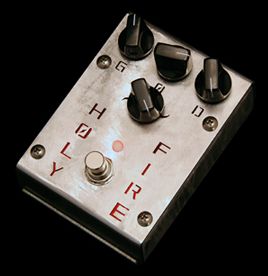
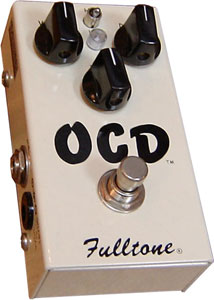
Actually, the choice wasn’t too hard to make once I started playing with the Creation Audio Labs Holy Fire. While I love the OCD, the Holy Fire wins hands-down for its versatility and total transparency. While the OCD is somewhat transparent, it can get kind of muddy and a little choppy at high drive settings, whereas the Holy Fire’s distortion section reacts a lot like a power tube at high gain settings producing a compressed effect that just rocks the house!
I still love the sound that the OCD produces. It really brings out harmonics and overtones, and set in a “sweet spot” produces a nice sparkly distortion that really sounds great. But as of late I’ve been gravitating towards retaining the natural sound of my guitar and amp, so the added artifacts that the OCD adds aren’t really what I want right now.
On the other hand, the overdrive on the Holy Fire is totally unique, and nothing like I’ve ever witnessed in all my tests of overdrive pedals (and believe me, I’ve tested a lot). The overdrive has what Creation Audio Labs calls a “wave shaping” circuit that evenly distorts the entire bandwidth of the incoming signal as opposed to creating a mid-range hump, or scooping the EQ. It really is completely even. You don’t lose any lows or highs, which is common in overdrive pedals. And the circuit reacts to both volume and pick attack, providing more wave shaping as you hit the front-end of the pedal harder. Simply put, you retain all the natural tone of your guitar! It’s insane! And it’s so special, Creation Audio Labs is trying to patent it!
I gigged with the Holy Fire for the first time this evening at my weekly Church gig. Make no mistake, this may be a church service, but we regularly hit above 100db in our sets, so there is plenty of room to let our amps breath, and take advantage of the higher gain settings on our equipment. Tonight, I made sure to pick music that would allow me to use the Holy Fire throughout my set. Talk about being inspired! I used it with my Strat and a Reason SM25 amp. What a combo! I set the gain to just above unity with the clean channel (about 10am), the overdrive at about 2pm, and distortion at about 3pm (so the distortion section would compress – it does this at around 2pm). The breakup was so smooth and delicious, I wanted to keep it on all the time! Unfortunately, I couldn’t do that with some songs, but where I had the entire band playing all out, the Holy Fire just made my heart sing!
The Holy Fire also plays well with other pedals. My mainstay overdrive pedal is my trusty green machine, an Ibanez TS-808 Tube Screamer. That’s one pedal that will NEVER leave my board! But here’s the cool thing: Running the Tube Screamer in front of the Holy First was like nothing I’ve heard before. I did this with my OCD as well, essentially getting a combined tonal effect that the TS and OCD produce. But the Holy Fire maintained the tone the Tube Screamer produces! On the other hand, it smoothed out and thickened the distortion. The result was the expected mid-range hump from the Tube Screamer, but with super-creamy distortion, plus the TS tone, that was like candy to my ears. No extra coloration that I came to expect by running my TS into the OCD. It was like playing a fatter Tube Screamer!
Believe me, despite playing in a worship service, the way I was feeling with both those pedals running together made it seem I like I was flying with the angels! I’m not exaggerating! There is absolutely nothing compared to the feeling you get when you’re playing with wonderful tone. It inspires and emboldens you, and you take your playing to places you didn’t think possible.
That was the feeling I got when I first started playing with the OCD, and frankly, I didn’t think it could get much better. But the Holy Fire has changed everything.
On top of that, I was using another Creation Audio Labs pedal, the Mk.4.23 clean boost, yet another amazing product from those electronics wizards. I used the booster to give me just a slight gain boost for when I was doing solos, or was in the refrain section of a song when I needed just a bit more volume. It too is a totally transparent boost, adding ZERO artifacts to your signal, so all the time I spent dialing in my settings wouldn’t be lost when the Mk.4.23 was engaged.
I swear, I must sound like a twitterpated, googly-eyed schoolgirl! 🙂 But it’s been a long time that I’ve felt truly inspired, like everything was totally right with my world of tone. I’ve finally (at least for now), found total balance in my tone. The circle is complete…
I dig interesting pedals. in my search for a decent reverb, I came across the Plush Verberator that is a tube-driven effects loop and a 24-bit reverb in one pedal. I’m not too sure about the effects loop bit, but the reverb sounds really awesome. Here’s the product description from the Plush site:
The Verbrator® is a new multipurpose pedal which combines an all-tube effects loop with a studio grade reverb featuring a 32-Khz clock speed for full 16-K audio bandwidth. The Verbrator® is our most innovative pedal offering to date. It’s an effects loop, it’s a reverb, it’s both!
Unlike other “tube pedals,” the Verbrator® power supply features a unique regulated switching technology that takes the incoming 9 volts and converts it up to the optimal high voltage a tube really needs to operate best. In addition, a 6-volt DC regulator provides consistent clean DC power for the tube filament assuring lowest noise and consistent performance despite any changes to incoming line voltage.
The Verbrator® can be used as a pedal on a pedal board as a reverb pedal. It features a level control and decay control allowing you to have a short medium or long decay reverb algorithm. It can also be used as a tube buffer to convert an incoming high impedance signal to a low impedance for long cable runs or driving a pedal board. The recovery (gain) stage can be used to boost the level of a guitar or pedal board with a true tube audio stage. It provides a warm sweet utility gain stage with a multitude of uses.
The effects loop portion of the pedal features a unity gain cathode follower to work with any amp that has passive preamp output – power amp input patch jacks, and not a true active effects loop like Ceriatone, Dumble, Bludotone, Brown Note, some Marshall models and others. It has a send level control and high headroom. The return portion of the loop features a high impedance input (250-K) and a low output impedance with its own level control as well. The loop can be run in series or parallel modes, and features a level adjust switch for rack or pedal style effects.
9-volt DC adaptor provided, the Verbrator® features a unique “window” showing the tube. Like all Fuchs pedals, the Verbrator® features solid cast aluminum powder coated enclosure with heat cured silk screening, dual sided heavy circuit boards, premium switches and controls, and premium electronic parts throughout.
Like I said, I’m not too sure about the effects loop part of it, but the reverb really sounds good. Check out the video below:


 Guitar Gear