Feeds:
Posts
Comments

Posts Tagged ‘Guitars’

When you’ve got a guy like Lance Keltner singing the praises of your equipment and calling you a genius to boot, you must be doing something right. Jeff Aragaki of Aracom Amps is someone I’ve been praising for quite awhile, and I’m glad he’s finally getting the recognition he deserves.

As far as the DAG unit is concerned, that’s available exclusively through Destroy All Guitars. I’ve played through one of those units myself, and the high-cut filter works great, and definitely takes the edge off, without throwing a blanket over your tone and dynamics like many attenuators do that include one. If you have an amp that outputs lots of highs when cranked – or somehow hear high-frequency transients –  then the DAG unit is the way to go.

Coming up…

While Jeff has gained lots of popularity with his attenuators, often overlooked are his wonderful amplifiers of which I have three. In the next couple of days, I will be getting a 50 Watt Evolver to test out in my studio. I’m so excited! I’ve played through an Evolver at Jeff’s workshop and that amp has tons of balls! It’s definitely Marshall-esque, but with Jeff’s particular twists. I’m excited to be getting this unit for a full test!

Read Full Post »

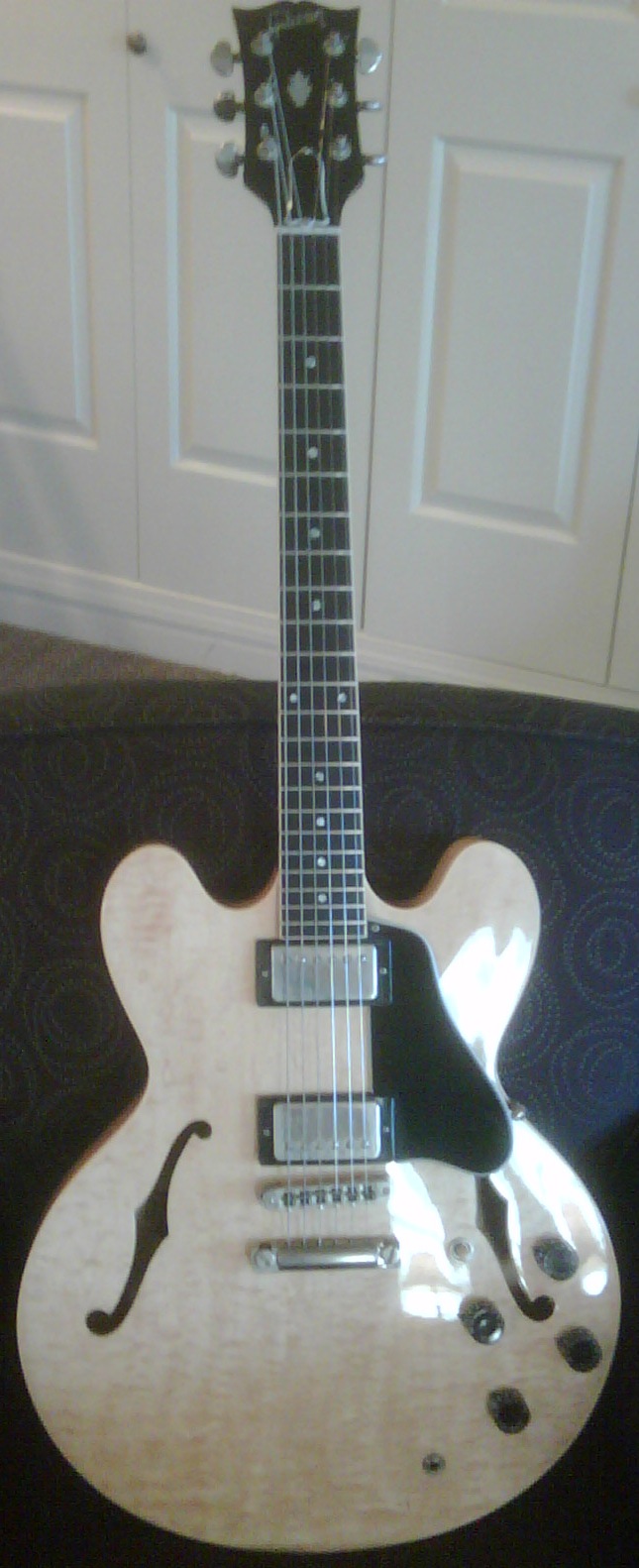
Click to enlarge. Sorry, phone pic


1987 Gibson ES-335 Custom St (St = Standard? Studio?) Summary: A rare beauty with a natural blonde finish with classic ES-335 tone!Pros: Absolutely tip-top shape for a guitar of this age. No major dings, but has been well-played. Sounds amazing!Cons: None.Features:

  • Mahogany neck
  • Bound carved flame maple top and maple sides and back
  • Bound ebony fretboard
  • Medium jumbo frets
  • Bone nut
  • Original chrome hardware (look like Tone Pros)
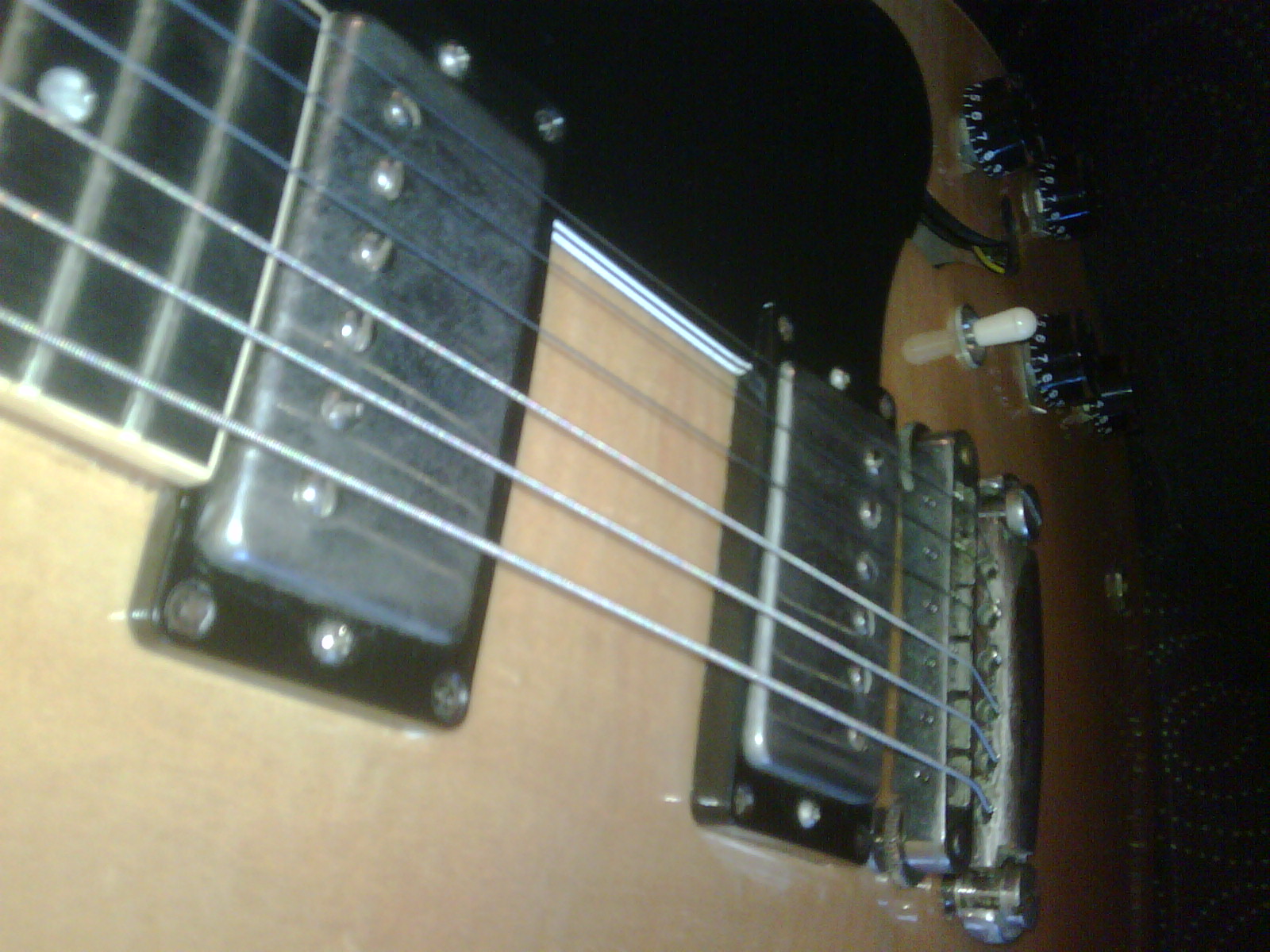
  • Original chrome pickup covers
  • 60’s-style lower profile neck
  • 50’s-style pickup wiring (either volume knob acts as a master, but the tone controls have a different cap value that doesn’t throw a blanket over your tone when you turn it down – this is crucial for playing in the bridge pickup).

Tone Bone Score: 5.0 ~ This guitar sounds and plays like a dream! While the action is a just a tad higher than I like it, the guitar still plays ultra-smooth.

I already talked about how I happened to get this guitar, so I won’t bother rehashing the details. Suffice it to say that I got this guitar for an absolute steal. In a way, this guitar is sort of redemption for me having sold my original ES-335 a couple of years ago when times were tough. So getting this guitar is a real milestone for me.

Fit and Finish

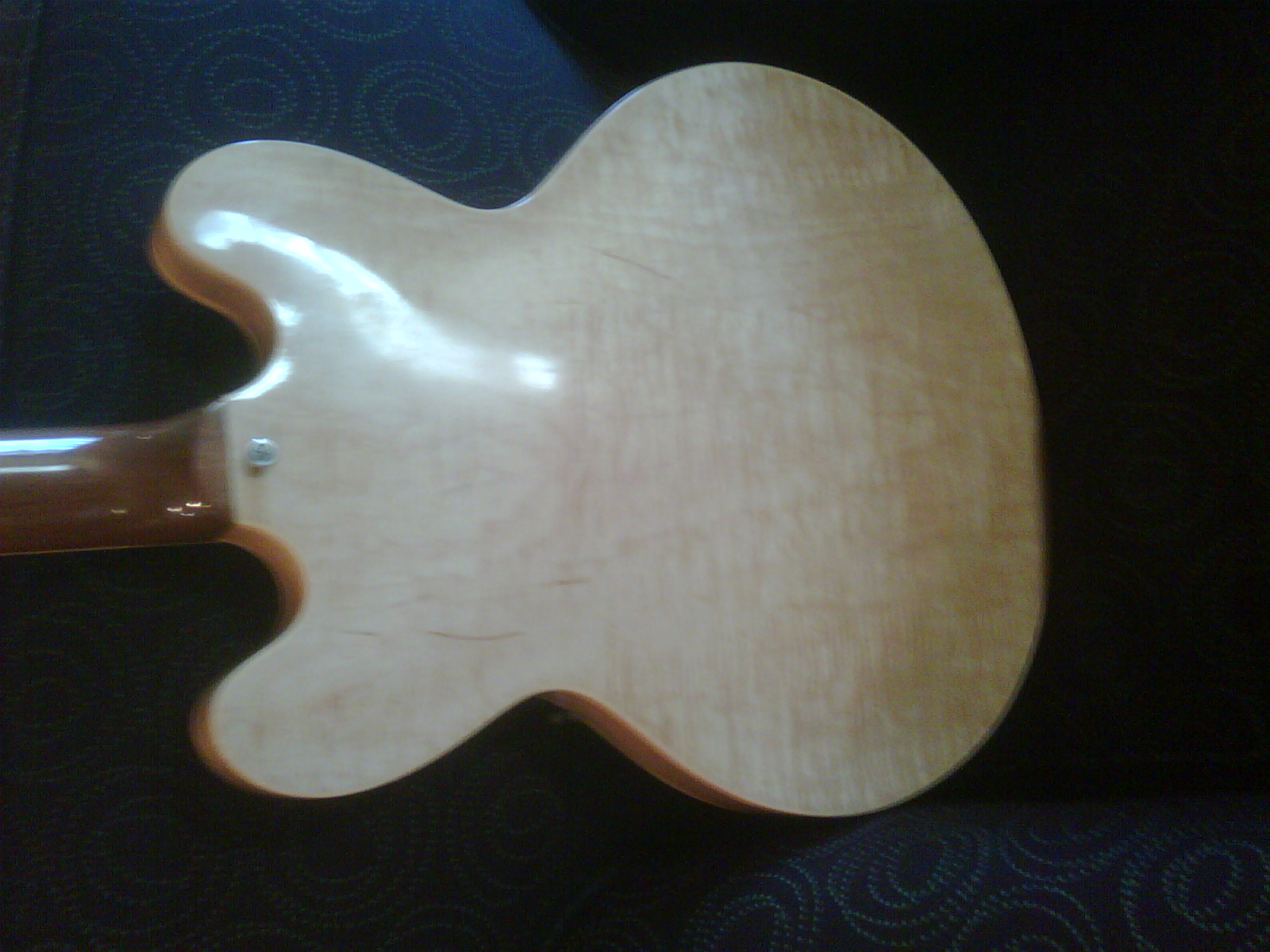
For a 23 year old guitar, it is in absolutely amazing shape. The body has some very minuscule dings in it that fortunately don’t penetrate the finish. I didn’t notice any checking in the gloss either, though that may occur after a few more years if the finish Gibson used was a nitro lacquer. The hardware is aged as to be expected, though there’s a little oxidation in the brass stop tailpiece that can easily be removed. The pick guard has pick marks on it, but no scratches and all the joints are perfect. There’s some fret wear, but nothing major where the frets would have to be replaced. As for the fretboard itself, it’s gorgeous. I love ebony fretboards as they’re so smooth to the touch, and it makes bending a breeze. The back of the guitar has a few nicks that don’t penetrate the finish – and no buckle rash. All in all, for as much as this guitar has been played, I’m just amazed at its overall condition.

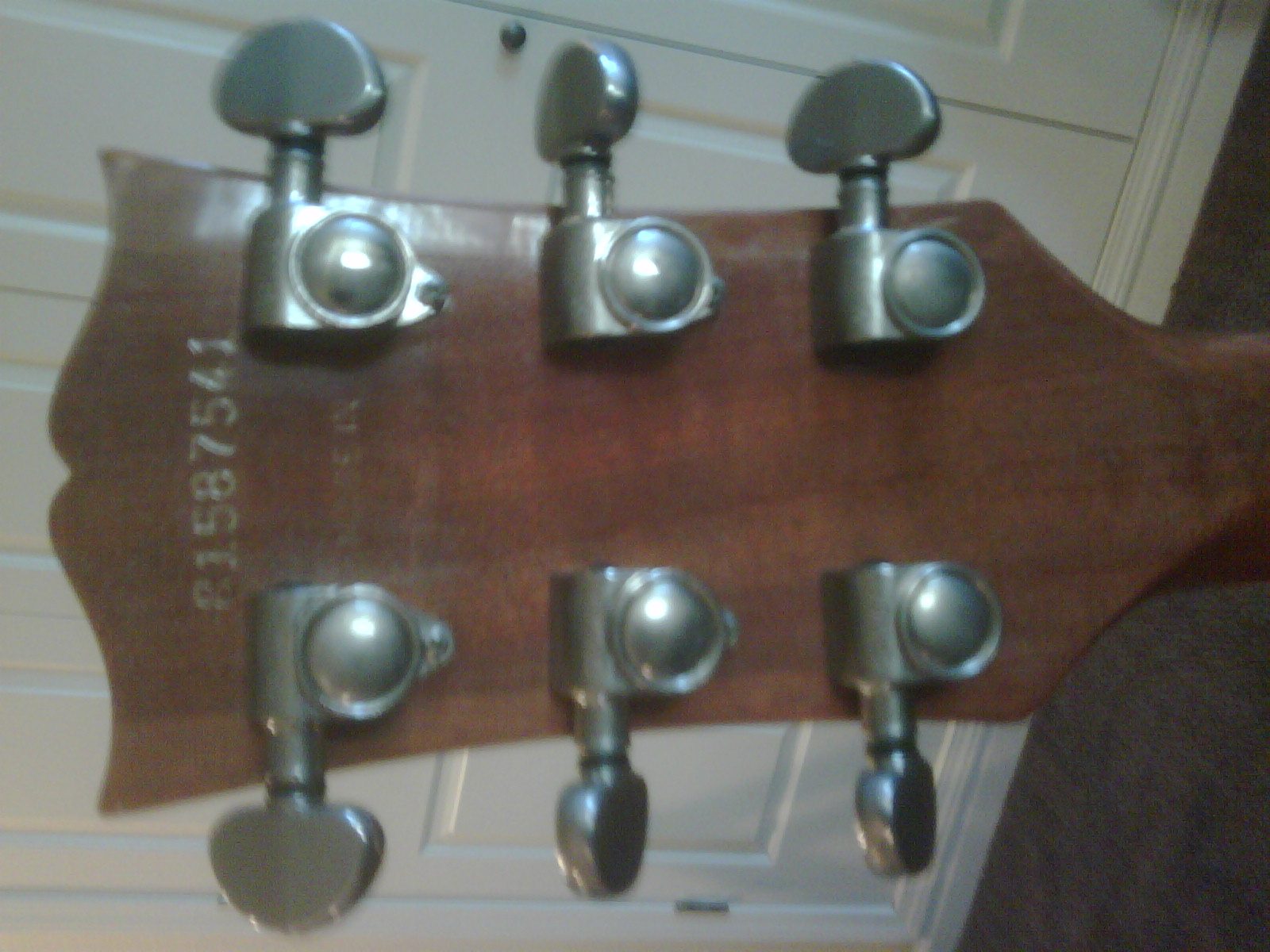
Here are some pictures I took with my cell phone. Sorry if the quality is low. I’ll have better ones later…

How It Sounds

This guitar has all the tone I was expecting out of an ES-335, but as it has been broken in and the wood aged, the tone is A LOT richer than what I remember with my original ‘335. As far as pickup positions go, there are three as usual, though I understand that some models did have coil-tapped humbuckers; not this model, though.

I’ve always loved the gorgeous, deep tones of the neck pickup on an ES-335 and this guitar doesn’t disappoint in that department. This is where the ES-335 gets very close to the deep, rich tones of an archtop, but it’s well, different…

Kicking in the bridge pickup in the middle position gives the ES-335 its distinctive “hollow” tone. It’s really hard to describe, but that I’m a firm believer that that middle pickup selector position is what draws people to this guitar. It certainly is one of the main things tonally that originally drew me to the ES-335 in the first place! With the bridge dimed and adding more or less neck pickup, you can get tons of great tones!

The bridge pickup is bright as to be expected – perhaps a bit too bright – but the wonderful tone knob nicely takes the edge off the brightness. I did notice that the bridge pickup is not significantly louder than the neck pickup, which leads me to believe that the original owner lowered the height of that pickup. When I get home from vacation, I’m going to raise it a bit because I prefer to have that dramatic change in volume.

In any case, here are some clips:

Neck pickup, clean

I love the haunting character of the neck pickup on and ES-335. The wonderful thing about this pickup is that it produces a very deep tone, without sounding like an acoustic. Adding a little reverb “grease” only accentuates the haunting effect.

Middle position, with some grind for rhythm; bridge pickup for lead.

In this, I have the bridge dimed, and the neck about halfway for the rhythm part. The lead is just the wide-open bridge pickup. Notice that it’s bright and almost twangy.

Middle position, clean; both rhythm and lead

I had to do a bit of a tribute to the great Andy Summers with this last clip… 🙂 I added a touch of reverb and chorus to get that “Every Breath You Take” vibe.

For all the clips, since I’m on vacation, I don’t have an amp, but I always carry around an IK Multimedia StealthPlug to facilitate my songwriting or, in this case, create clips. I used AmpliTube Fender. For the clean clips, I used a ’65 Twin Reverb model, and for the crunchy clip, I used a ’59 Bassman.

Cool Funk Lead

There are two parts to this next clip. In the first part, I play in the neck position, then switch over to the bridge in the second part plus attack a lot more. Unlike a Les Paul, the 335 doesn’t sustain as much, but that’s not a bad thing. The net result is that overdrive tones tend to be much more tight and focused. BTW, the amp used here was an Aracom PLX18BB in its drive channel.

Overall Impression

This guitar really moves me. She plays so sweet and sounds so good that I truly am inspired. Of course, the price I happened to pay for it didn’t hurt at all, but irrespective of my price, I’d still give this guitar 5 Tone Bones. It’s really an incredible guitar! I can’t wait to get it home and to a luthier for a professional setup. The shop owner did a pretty good job of setting the guitar up, but he strung it with 11-53’s which, while certainly playable, aren’t really my cup of tea. I’ll have the shop put on a set of pure nickel 10’s.

Read Full Post »

Or… you never know what you’re going to find on vacation…
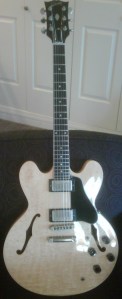
Click to enlarge. Sorry, phone pic

I’ve been up at Clear Lake, CA since this past Saturday, and wouldn’t you know it, on Sunday morning when the family and I stopped off at a Safeway in Lakeport to get some provisions, the shopping center just happened to have a musical instrument store called Bandbox Music. Of course, gear freak that I am, I couldn’t pass up looking into the window to see what the shop was like. As Lakeport is a small town, I wasn’t expecting to see much, but what the heck! You never know what you may find!

As I walked up to the window, I noticed a gorgeous, natural-finish Gibson ES-335 in the shop’s front case. I could tell that it was used, but it was in practically pristine condition, save for the pickup covers and stop tailpiece which were tarnished; otherwise the guitar looked great. I could tell that it had been played a lot, but the original owner had taken care of the finish for the most part as from the distance of about 6 feet that I was standing from the case, the only wear I could see where pick marks on the pick guard. Unfortunately, the shop wasn’t open on Sundays, so I made it a point to return to the shop the next day to check it out.

Couldn’t make it Monday, but we were going to Lakeport on Tuesday so the family could check out the town. So on the way to downtown, I had them drop me off at the shop. I walked in and was greeted by a bunch of elderly gentlemen sitting around, shootin’ the breeze. I didn’t want to interrupt their conversation, so I waited patiently until the shop owner asked me if I needed help. I pointed to the ES-335 and said that I’d like to give it a whirl. He graciously responded and removed the guitar from the case, and instructed me to grab a cord.

Ron, the shop owner, proceeded to tell me about the guitar in that it was a 1987 ES-335 Custom Studio. He got it from the son of the original owner (more on that sad story later). He showed me the case, which was the original case it came in, along with the Gibson warranty papers, and the original Guitar Center invoice. While he spoke, I did a visual inspection of the guitar. There were a few miniscule dings on the back, and a couple on the front, but nothing that penetrated the finish. I remarked to Ron that the guitar was in remarkable shape, and he said it was owned by a player, and that guy took care of the guitar.

It probably sat for quite awhile in a closet somewhere, as the metal was tarnished – the original owner probably played it so much that he never bothered to clean it. Ron said he spent a lot of time cleaning the guitar when he got it, but was really surprised at the shape the body was in – so was I! Anyway, I plugged her in, tuned her up, tweaked the amp, to a nice clean with a little reverb “grease” and was immediately greeted with that distinctive rich, full tone that only an ES-335 can make. I was in tonal heaven!

The ES-335 and I have a history. When financial times were rough for my family, I had to sell my original 2003 ES-335 for some cash. When I did that, I swore that I’d never sell one of my guitars again. Hearing that guitar and how it sang reminded me of “Rusty.” Rusty was my first high-end guitar. I was so proud to have him, but putting food on the table was more important at the time, so I had to let him go. This ’87 would be redemption if I got her.

After playing her for well over an hour, I finally asked Ron how much the guitar was. He said $1200, but he knew it was worth far more than that as he had seen the exact same model in similar condition going for almost triple the price on EBay. I was taken aback by the price! I keep tabs on many guitars, and I knew he was in the ballpark with how much it was worth. He said he didn’t get it for much (I didn’t ask his buying price out of politeness), so he was willing to move it for far less than its market value.

I didn’t do the impulse buy right then and there, and told him I needed a couple of days to think about it, and I’d roll the dice and let it go back into the case. Over the next couple of days I did some research on the guitar. The first place I looked was on EBay, and sure enough, the same make, model, and year ES-335 has an asking price of $3500! I looked at several ES-335’s from the surrounding years, and they’re also going for similar prices!

So I made my decision, and called up Ron this morning and asked him to put the guitar aside, as I’d go to the shop later today. Ron repeated the price of $1200 and I said, “That’s the price you quoted Tuesday.” So I got it for $1200 OUT THE DOOR – no tax! OMG!!! I can’t tell you how jazzed I am about this absolute steal, but I think the best thing about it is that I didn’t have to make a lowball offer. Everyone won in this transaction, and that really pleased me as well!

Wow! Sorry, I got a little carried away… But I do want to tell a little history of this particular guitar…

Don’t know the name of the original owner, but he was a apparently a smalltime pro player. He passed away last year, and left his son his two guitars, a Les Paul (which Ron sold), and the ES-335, which is apparently what he played the most. According to Ron, the son came in to sell the Les Paul first, then a couple of weeks later returned to sell the ES-335. Ron doesn’t know exactly what the son was going to do with the money, but as there’s a real crystal meth problem in the area, he could make a fairly educated guess. That’s sad to me, and it’s this lesson that I want to pass onto my kids: Don’t sacrifice your family’s heritage to satisfy a personal craving. You’ll just end up regretting it.

By the way, I’ll have pictures and sound clips in my next post. 🙂

Read Full Post »



Peavey Classic 30 Amp

Summary: Great looks, great sound, and at a GREAT price!

Pros: Beautiful cleans with a sweet, airy reverb, and smooth overdrive tones

Cons: This is a nit, but I was a bit annoyed at the labeling of Pre- and Post- volume controls on the Lead channel. Why not just follow convention? It’s obvious that “Pre” is volume, and “Post” is master. But when I first saw it, I wasn’t quite sure what to make of them until I turned the amp on.

Features (from the Peavey site):

  • 30 watts (rms) into 16 or 8 ohms
  • Four EL84s and three 12AX7s
  • 12 inch Blue Marvel® speaker
  • 2-channel preamp
  • Pre- and post-gain controls on lead channel
  • Normal volume control on clean channel
  • 3-band passive EQ (bass, middle, treble)
  • Boost switch
  • Reverb level control
  • Effects loop
  • Footswitch selectable channel switching and reverb
  • External speaker capability
  • Chrome-plated chassis
  • Classic tweed covering
  • Footswitch optional (not included)
  • Weight Unpacked: 39.50 lb(17.917 kg)
  • Weight Packed: 46.00 lb(20.865 kg)
  • Width Packed: 13″(33.02 cm)
  • Depth Packed: 21.5″(54.61 cm)
  • Height Packed: 19.25″(48.895 cm)

Price: $599 street

Tone Bone Score: 5.0 ~ Even my little nit couldn’t keep this amp from getting my top score. It’s simply a great-sounding amp!

I’ve been a big proponent of: If it sounds good to you, then brand and price don’t matter. This goes back to my very first guitar, a Yamaha FG-335 Acoustic that my dad bought me for my 18th birthday. I still have that guitar. But I remember a jam about 25 years ago I was having with my brother at a party. We were sitting in our living room, and we pulled out our guitars to have a jam and singalong. When I got my guitar out of its case, my brother remarked facetiously upon seeing its worn condition, “Dude, you should turn that into a beach guitar.” I just looked at him blankly and replied, “Nope. It may not look like much, but it has a great sound. Why the f&%k would I want to trash it? I’ll never get rid of this guitar!” Ahh… brotherly competition. 🙂 But I digress…

The point of me mentioning that is that nowadays with boutique gear being all the rage with “tube” this, “mustard cap” that, “hand-wired” this, etc., it’s so easy to dismiss some excellent gear that sounds absolutely KILLER! If you can get said killer-sounding gear at a fantastic price, then that’s even better. Now I admit that I have some expensive gear, but not once have I purchased gear because of a name or because someone told me to buy something because they love it. I suppose with this blog you might accuse me of doing just that, but I always suggest people try things out for themselves before making any buying decisions. Damn! Again I digress! Let’s get on the with the review, shall we?

Fit and Finish

Talk about vintage mojo! The first time I saw this amp in a local shop, I was stunned by its looks. With its vintage-style front panel and dark brown cloth grille, and tweed covering with chrome-plated corner protectors; what’s not to like? Weight-wise, at 40 lbs, it’s not light, but it’s also not a behemoth that you can’t lug easily into a gig. And don’t let the small size of its cabinet fool you: It’s quite resonant, but more importantly, its size doesn’t make it unweildy in the slightest. Simply put, the Classic 30 just plain looks great!

How It Sounds

In my test, I used a Squier Classic Vibe Tele 50’s, a Custom Shop Strat, and a Les Paul Standard. I always start out all my tests with the amp clean, and playing finger-style. No matter what guitar I used, the cleans were absolutely spectacular. I love EL84 cleans. They’re sparkly and chimey, and the Classic 30 simply delivered that EL84 clean goodness! The single coils sounded chimey as expected, but I totally dug the cleans with the LP! Adding a bit of grease with the reverb brought out the  lush, deep tones of the Les Paul nicely. I believe the reverb is a digital reverb, but who the hell cares? It sounds incredible! I guess that’s the point I was trying to make above. If something works well, it doesn’t matter what it’s made of.

As far as overdrive is concerned, as its name implies, the Classic 30 isn’t going to get you modern high-gain overdrive tones, but there’s tons of overdrive on tap. Once I dialed in the Pre and Post volume control balances, I was able to get nice overdrive tones that weren’t at all harsh, no matter how hard I pushed the amp. Since I was in a shop, I didn’t get a chance to record clips, but here are some clips from Peavey:

Clean

Clean, Reverb

Channel 2 Flat

Channel 2 Preamp

Channel 2 Boost

As you heard, great tones out of this little beastie. Even completely dimed, you don’t get over the top overdrive, but for classic rock and blues, this is a GREAT amp. That Blue Marvel 12″ speaker works great in this cab!

Overall Impressions

At $599, this amp looks and sounds as good as many boutique amps I’ve played. I love this amp, and it’s definitely going to be added to my amp collection. 🙂 I didn’t get to try out the effects loop, but I love the fact that it has one. It just adds to its versatility. If you’re looking for a vintage-style amp for a great price, this is definitely an amp to consider!

Read Full Post »

…to get me inspired.

I’m on vacation right now up at Clear Lake, CA. It’s one of those family vacations where we do pretty much nothing but chill out. Our resort is on the lake, and it’s absolutely gorgeous! We don’t have any plans, no itinerary; there are places to go, but we have 10 days of just clearing out our minds.

This afternoon after attending morning Mass, we headed back to our resort. The rest of the family went to the pool, while my oldest son and I hung out in our room. He was “PhotoShop-ing” some pictures, and I was just tooling around on my acoustic. I was just messing around when I came upon a chord progression that kind of stuck. So I pulled out my IK Multimedia StealthPlug (it goes everywhere with me), opened up GarageBand, laid down the chord progression, then laid down a melody with a counter-melody.

This was total stream-of-consciousness. I LOVE THAT! I told myself when I started my vacation that my aim was to chill. Not think about work, not think about stuff to do around the house, and not think about music to write. Clearing out my mind made room for some creative juices to flow. So here’s a rough cut of the song I came up with; it’s called “Down Highway 29:”

Read Full Post »

…if I’m playing acoustic or electric guitar. I love to gig! Mind you, it’s not an ego thing. I just love performing; always have. I’ve been doing the same weekly gig at a local restaurant going on seven years, and I never get tired of it! I love it because it’s such an intimate venue; especially when I can play outdoors. As the patio is in one of the busiest areas of a fairly popular outdoor shopping mall, I get to entertain more than just the restaurant-goers. And the cool thing is if people weren’t planning to stop and have a drink or a meal, many sit and don’t leave for a couple of hours. A lot of that probably has to do with song choice, but I think a lot of that also has to do with passion.

My thought about performing is that I just do what I do, and as I love music, I put everything into it. I don’t want to give this false persona just to make people listen to me. It’s a risky proposition because there’s always this “what if people don’t like it” thought that looms in the back of my mind. But I truly believe that putting your entire soul into your performance makes a huge difference. It’s easy to tell when people are just going through the motions – their performance and how they interact with the audience seems contrived. And putting your entire self out there also helps you connect with your audience.

I suppose that what it’s all about for me: Connection. I thrive on that connection. I thrive on taking people on an emotional journey with me when I perform. When I do my solo gig, I flip through my song book, not looking for charts, but to see what’s appeals to me emotionally. Last night, I was in kind of a romantic mood, so I did a bunch of love songs. Here’s a cover of one of them:

That song, no matter how many times I’ve played it over the years, always moves me, and when I perform it, I do my best to convey how I’m moved by it and the images I get of my lovely wife when I sing it.

If you’re a performer of any kind, here’s a suggestion next time you gig: Put your entire soul into your performance. It’s easy to say, but not easy to do. And for some, it’s terrifying. But it takes shedding your conscious vision of yourself and how you should comport yourself, and letting your true self shine through in your performance. You might be surprised at the depths of passion you can tap into…

If you ever get a chance to see Steve Miller live or a recording of a concert of his, watch both him and especially his sideman. Miller’s sideman is the epitome of passion when he plays. He doesn’t move around much at all – he leaves that up to Steve – but when he gets a lead break, that dude puts everything into it. I was actually more blown away by him that I was Steve Miller when I saw a recorded concert last year!

By the way, I may be on a short hiatus with GuitarGear.org for a week or so. I’m going on a much-needed family vacation!

Read Full Post »

Still haven’t thought of a name for this guitar yet. Might call her “Smokey” as she bears a tobacco sunburst finish. I’ll think of something. In any case, awhile ago, I wrote a song called “Strutter” that featured a couple of guitars and amps: My CV Tele and Gibson Nighthawk Re-issue; and my Aracom PLX18 BB and Aracom VRX22 amps. Out of curiosity, I wanted to see how the song would sound with just the ’59 replica and a single amp, my PLX18 BB.

So I made a copy of the original Logic project, and proceeded to record both guitar parts as a test. Well, as these things go, I ended up re-recording the entire song using just the ’59 – it sounded so freakin’ fantastic. Here’s the song:

The verses are played in the neck position of the ’59, while the refrains are played in the bridge. The contrast between the two pickups is incredible. I had the amp absolutely cranked, but because the pups are not really high gain, they drive the amp nicely, but maintain a real smooth texture. What a combo!

Read Full Post »

That is the slogan of the Navy Seals, but it certainly can apply to life in general. It’s not necessarily about struggle, but facing life head-on. It’s making the choice to do the harder thing instead of taking the easy way out.

I had the privilege to listen to a great speaker this week, Admiral Ray Smith (ret.), who is a leadership and peak performance speaker. The Admiral led the Navy SEALs, and was its longest termed commander in the history of that elite fighting force. He covered a lot of things in his talk but one thing he said really struck home, and that was when he was talking about the extreme mental and physical challenges each SEAL prospect has to go through just in order to get into the SEALs in the first place.

“Normalize the abnormal,” was the phrase. And he described that trainees go through serious mentally and physically challenging situations to remain calm, no matter what may come their way, and always go back on their training. For instance, they have a pool activity where they have to dive down then tie a rope a certain way. Not a problem. Then they have to do the same thing blindfolded. Then they have to try to tie the rope while blindfolded and an instructor tangles up their SCUBA hose, and then turns them around a few times to disorient them. The idea is to increase the levels of stress to see if they can remain relaxed. If you tense up, then you can get into serious trouble.

When I heard that, it immediately reminded me of performing last week. While not nearly as stressful as the test above, I had a similar situation while at a gig last week. Here I was, just happily strumming along, and a gust of wind came up and blew all sorts of dust up which unfortunately, landed in my eyes. I couldn’t see damn thing, and I was in the middle of a song! I panicked a bit at first, but kept on playing, then just squinted my eyes closed and relied on my memory of the song.

Like I said, not nearly as stressful as that SEAL training, but if I let that little bit of stress get to me, I would’ve completely blown the song, and that wouldn’t have been acceptable to me. So I gritted my teeth, finished the song, then immediately flushed my eyes out. Besides, it was a good time for a break… 🙂

Following on the title of this article though, that’s a really profound statement. In my book, you can only REALLY appreciate things you acquire whether they’re skills or material things if you earned them. It’s a value I always share with my kids: There’s nothing more satisfying than something you’ve earned. That takes putting energy into what  you’re doing to acquire the thing you want.

Mind you, I don’t look at that saying within the context that everything has to be a struggle, but if you really want something or you want to be successful at anything, you have to work for it. It shouldn’t be easy. I look at my many years of playing guitar. Yes, I’d like to someday be at the level of some of my guitar heroes, and over the years, I’ve acquired the skills as some of them, but it hasn’t been without work or even struggle at times. And  my learning process hasn’t become easier, it has become harder. Ten years ago, I used to practice MAYBE 15 minutes a day. But now, I practice at least an hour, and most times up to two hours. And as things have gotten more complicated, my rate of skill acquisition has slowed. But that’s how it should be.

The SEAL slogan really hits home with me. The only easy day really is yesterday…

Read Full Post »

My buddy, Jeff Aragaki, forwarded me a cool video showing “Mean Gene” Baker in his original shop building a guitar from wood billets to shaping to putting to finishing. I’ve seen still pictures, and have a set from the guitar I had custom built, but not an actual video that shows the builder in action. VERY COOL!

Read Full Post »

Funny how my studio tests and practice jams seem to turn into songs. This song, entitled, “The Long Way Home” is about that deep longing and melancholy when you’ve been away from home for a long time. I wrote the chord progression several weeks ago and saved it, then when I returned to it last night to record a studio test of the 1959 Les Paul Replica, I started thinking of being 40 or 50 years back in time at train station, looking down the tracks, and getting that longing feeling for home while I was constructing the melody lines. The painting above by Jeff Burgess captures that melancholy perfectly.

Tonight, after listening to the original test, I scrapped everything, both guitar parts and bass and re-recorded them. This time, I recorded my 2 X 12 with a pair of mics so I could get both speakers’ tones. That was actually pretty tough, as I spent about two hours getting the right mic positions. My cab has a Celestion Gold and Blue in it. I placed the Gold’s mic right at the seam of the cone and center “button” and placed the Blue’s mic head-on at the edge of the speaker cone to get more low end. Oh well… that’s just one of the challenges of capturing decent tone.

What amazed me about the recording wasn’t the lead, but the rhythm part. The neck pickup of the ’59 played clean sounds like an acoustic. It’s absolutely lush and gorgeous without being at all boomy.

Here’s the finished product:

Amp: VRX22

Guitar: 1959 Les Paul Replica

Read Full Post »

« Newer Posts - Older Posts »