So you want to get a tube amp, but there are literally hundreds of manufacturers, not to mention, amps on the market. That can make for a rather harrowing experience in making a choice; especially if you’re new to tube amps. Plus, there are so many amp features to contend with as well. But have no fear. It’s not as hard as it may seem on the surface as long as you take some things into account.
1. Tone is king!
The most important thing to keep in mind in your search for a tube amp is that YOUR opinion of the tone of an amp is the most important opinion of all. By all means, listen to the input of others to help guide you, but in the end, you need to make your decision based upon how good an amp sounds to YOU. To formulate an opinion, you have to play several. And for goodness sake, don’t buy anything unless you’ve heard it in person.
2. Sound clips don’t tell the whole story…
Bear in mind that sound clips are great as an initial reference, but that’s all they should be. And make sure to listen to clips that have been recorded with the raw sound of the amp; that is, the plugged straight into the amp, and no EQ on the recording medium. Be especially wary of clips of fully arranged songs where a particular amp was used because more likely than not, even if the amp was recorded straight with no pedals in the chain, the other instruments and the EQ of the song can interfere with potentially negative aspects. Nothing beats listening to an amp live or raw.
3. Higher cost doesn’t mean better
Sometimes higher cost is well, just higher cost, and it doesn’t necessarily buy you much. I’ve played some pretty expensive amps that to me sound like crap, so don’t be lured into buying an amp by its price. Also, bear in mind that some amps simply have a higher price because a well-known guitarist actually uses one.
4. Don’t jump onto the boutique wagon right away!
In your search, you’ll come across people who’ll recommend all sorts of boutique amps. Don’t jump there immediately. I recommend this mainly because a boutique amp will fix you into a certain tone or range of tones. That’s NOT a bad thing at all. It just means that they serve up a certain flavor of tone and they’re good at that; not wanting be so versatile. For instance, my Aracom PLX18-BB Trem is a great example of a fairly focused tone with its abundance of mid-range, and smooth and creamy breakup. This amp was built based upon the classic 18-Watt Marshall Plexi, which has distinctive tone and dynamics. It’s not muscular at all, and was never meant to be. Contrast that to my Aracom VRX22 which, while based upon a Marshall Plexi design is A LOT more “ballsy” with a fatter bottom end, and slightly compressed overdrive. As a foot-switchable 2-channel amp, it is much more versatile and is my “go-to” amp for gigging.
In addition to the focused tonal characteristics, boutique amps in general cost significantly more than their mainstream counterparts; let’s face it: They’re investments. But like any investment, you should choose wisely, and go more generic starting out to get an idea of what tone you’re after. A good place to start is a low-cost tube amp, and there are several mainstream tube amps on the market that cost under $500. Some of them, like the Peavey Windsor Studio or Egnater Tweaker will allow you to change power tubes to change tone and dynamics. For instance, a 6L6-based amp will sound quite different than an EL34-based amp or even a high-gain 6V6. Amps like this let you play a bit. Here’s an example list.
VOX Night Train $499
Blackstar HT-5H $399
333 Amp JCA20H $333
Epiphone Valve Jr. $129
Egnater Tweaker $399
Blackheart Little Giant $199
Fender Blues Jr. $499
Fender Champion 600 $149
Peavey Windsor Studio $399
I started out with a Fender Hot Rod Deluxe myself. I got it before Fender did their price hike last year, so I got it for a great price. It’s a great starter tube amp, and really an unsung hero among amps. But with the right tubes and a replacement speaker, that amp can keep up with many of the boutique amps out there. It’s more pricey than what I listed here, but you can find used ones for around $500. It’s also loud as hell, which makes it viable for doing lots of different venues.
5. Don’t rush… Try learning how a tube amp operates…
The worse thing you can do in making your first tube amp purchase is rushing into it. As I mentioned above, try out several before making your decision. The best advice I ever got was from Noel over at Tone Merchants in Orange, CA. I told him I wanted to get a tube amp, but he insisted that I take my time, and in the meantime get a Fender Hot Rod Deluxe because it was tweakable. That turned out to be the absolutely best advice I had gotten from anyone, and it saved me thousands of dollars. Buying that amp gave me time to learn about how tube amps operate and form an opinion on what I’d like different.
6. Use the buddy system to evaluate an amp
By all means, play through the amps that you are evaluating, but something I’ve found very useful in evaluating amp settings is to have someone else play while I tweak. When I did the Dumble amp video series, I had the fortune of the great Doug Doppler playing so I could REALLY get how it sounded. That’s sort of rare, but even when I’m in a Guitar Center, I’ll sometimes walk up to some dude playing an amp I’d like to evaluate, and ask him if I could tweak while he plays. It’s a great way of quickly evaluating an amp’s capabilities.
So… Not rocket science by any stretch of the imagination, but useful, practical advice that you can hopefully use to your advantage.
Read Full Post »
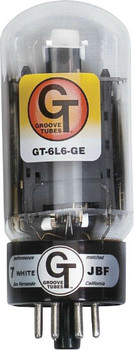 If you read this blog with regularity, you know that I love NOS tubes. Who knows? Maybe I’m being a cork-sniffer, but the significant impact NOS tubes have had on my amps has led me to preferring them over new production tubes. Unfortunately, NOS tubes are getting scarcer and scarcer, so I suppose that eventually I’ll have to get new production tubes.


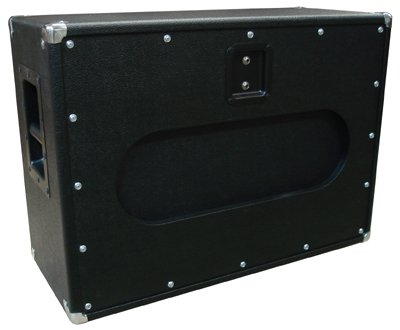

 I’ve always had an appreciation for vintage gear, though the most “vintage” that I’ve ever gone is purchasing several sets of NOS tubes over the years. And quite frankly, though I’ve appreciated vintage gear in general, I’ve never been compelled to be a vintage gear collector as I’m an active musician who uses his stuff all the time.
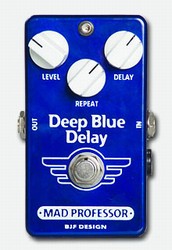 This is a “mini-review” only because I wanted to provide feedback on it after using it, and because I only used it in a limited way. The Mad Professor Deep Blue Delay is a digital/analog delay pedal meaning it is a digital delay with an analog direct signal path – or as Mad Professor puts it, the direct signal path is made of analog amplifiers with no filtering. In other words, it’s supposed to be transparent with no tone coloration.
 Guitar Gear