I’ve been extolling the virtues of the Reason Amps Bambino for several months, and how great it sounds. Among the things that I’ve mentioned is that for a little amp, it has a BIG sound. That was a design objective with Obeid Kahn, Reason’s amp designer, when he was designing the amp. He didn’t want to just build yet another affordable, low-powered amp. He wanted to build a great amp. Period.
Despite the sound though, what has really turned me on about this amp is its versatility. For instance, last Friday I did my regular, weekly solo gig at a local restaurant. I haven’t been very happy about my Stratacoustic’s tone into my DigiTech Vocalist Live box, so I decided to bring the Bambino to provide some pre-amplification and use its balanced line out to go directly into the restaurant’s board. What I was greeted with was simply put, a spectacular sound, and this from a line out directly from the amp! I’ve mentioned using this in the past, but this time, I had no speaker. I went direct into the board, and the only monitoring I had was from the PA. A couple of days later, I used it for my weekly church gig, with my 1 X 12 speaker cab, and also using the line out to plug into my church’s board.
For a church gig, minimal stage volume is important because voices are reinforced through the house audio, not from the band area. So to have this kind of amp where all I have to get is my stage volume, then use the house to get my sound out, it’s simply a boon.
The only other amps I’ve ever used that have this kind of versatility are acoustic amps. I realize that there are probably other tube amps that may have this capability, but getting all the great sound and versatility AND boutique quality in a $699 package is just unheard of! If you’re looking for a great amp that’ll work in variety of places, look no further!
I got inspired to write this entry from none other than Neil Young yet again. Back in July, I wrote another post about how much I love Neil Young’s playing. It’s raw, it’s untrained, and it’s absolutely in your face. It’s not very good playing at that, but for some reason, it’s incredibly appealing to me – and I’m not the only one who thinks this! That article was inspired by an interview he gave and the commentary he made about his playing. Then, lo and behold, I read an old interview recently that really got me thinking about expression versus technique. Here’s an excerpt of what he said (courtesy of Guitar Player mag):
“First of all, it doesn’t matter if you can play a scale. It doesn’t matter if your technique is good. If you have feelings you want to get out through music, that’s what matters. If you have the ability to express yourself, and you feel good when you do it, then that’s why you do it. The technical side of it is a complete boring drag, as far as I’m concerned. I mean, I can’t play fast. I don’t even know scales… …I appreciate these guys who play great. I’m impressed by metal bands with their scale guys. I mean, Joe Satriani and Eddie Van Halen are genius guitar players. They’re unbelievable musicians of the highest caliber. But I can’t relate to it. One note is enough…”
While I don’t entirely agree with Mr. Young about technique, I do get the gist of what he’s saying: It’s YOUR musical expression and feeling good about it that’s important; no matter what speed that is or the technique(s) you use to express yourself.
Personally, I believe in being serious about learning new techniques and honing what limited skills I have only for the sake of opening up different ways to express myself. But that’s kind of the rub. How far do I take technique? Sooner or later I have to apply it; hence, the title of this article. Make no mistake, technique is important, but the music you make from that technique is even more so.
As eternal students of the guitar, it is so easy to fall into a rut with “how” to play as we discover our instrument – hell, I’ve been exploring for many years, and I feel I’ve only scratched the surface of possibilities – but as musicians, I will submit that once you’re playing, “how” is irrelevant, and that “what” you’re playing is far more important.
For instance, I recently saw a video of the guy who broke the Guinness world record for guitar speed by playing “Flight of the Bumblebee” at 320 beats per second. The student in me appreciated the work and focus that went into being able to play that fast; I could never play that fast, that clean. But the musician in me said, “So what? It ain’t music at that speed.” You can watch the video here. Granted, the technique that went into being able to play that piece that fast is absolutely incredible! But at that speed, the guitar sounds like a Formula 1 race car revving its engine as the player ascended and descended the neck of his guitar! From a musical standpoint, it made no sense whatsoever.
That’s why what Neil Young said resonates with me as a musician. I personally don’t think technique is a complete boring drag, but when I’m playing, what I’m playing is far more important than how I’m playing it.
I’ve been working on a new instrumental for over a month now, called “Strutter.” I think I’ve probably made 50+ recordings of the song, and even though I dig the melody I’ve come up with, I’ve always thought it needed something… more… Couldn’t put my finger on it, but none of my recordings of the song were working for me completely. After I finished recording this final cut which I’ll share below, I believe a lot of my “frustration” had to do with me wanting to only use a single guitar and amp for the recording since I play this song live with only a single guitar.
But it’s different in the studio. I have a lot of options open to me, so I decided to break down and instead of recording the song in its entirety with a single take with a single guitar and amp, I recorded the two different parts of the song with two guitars and two amps. The result knocked my socks off! So the lesson learned is in the studio, you can be truly creative, and for me, I’ll use the tools I need in favor of what I’d like to have. Anyway, here’s the song:
All guitars were recorded at bedroom level using the Aracom PRX150-Pro attenuator, with no effects. Estimated output of any of the amps was less than 1 watt! That unit is absolutely amazing!!!
Small room reverb was added during production to give a more spatious effect to the lead tracks, and absolutely no EQ was applied to the guitars.
Description:
This song was originally inspired by an image of a supa-mac-daddy-pimp dude struttin’ his stuff down the avenue. 🙂 At least that was the kind of vibe I wanted to capture: 70’s-style guitar-plugged-straight into the amp. It’s a raw kind of tone.
From a structure/feel point of view, what I was after with this song was a contrast in textures. The Rhythm track uses the VRX22 clean channel for that snappy clean attack. For the Lead 1, I wanted use the creamy smoothness of the VRX18 combined with a single coil, and take advantage of the awesome decay of the tube rectifier. For Lead 2, there’s nothing like the pure balls-out sound of the VRX22 drive channel played with a bridge humbucker. The distortion though is ultra smooth, but very complex.
I should be the Aracom Amps poster boy!
I just realized that this song could be an Aracom Amps VRX amp line demo! I make no secret that these are my amps of choice (I have three of them). Jeff Aragaki’s amp designs are absolutely killer – that’s why I buy his equipment.
I’ve been an avid GarageBand user for quite some time, having shied away from moving to a more sophisticated recording solution because of how easy GarageBand makes it to record the demo songs and sound clips I produce. Geez! How easy could it get? To create a sound clip, it’s as easy as opening the app, setting the song’s tempo, choosing a drum loop to play to, creating a new track to capture my guitar, and recording.
Of course, GarageBand comes with its own shortcoming, not the least of which is the ability to change tempo mid-song, editing the timing and tempo of an audio region, and doing more sophisticated fader automation. For years, these shortcomings were okay for me. I was able to produce an entire album with GarageBand – even with its shortcomings. But admittedly, a lot of my best songs didn’t make it to the album because GarageBand couldn’t do things I needed for those songs; especially varying the tempo mid-song, which I’ve written into several of my pieces for dramatic effect.
My wife has been bugging me for a long time to record some of her favorite pieces that I’ve written for church service. One in particular is based upon the second movement in Beethoven’s Moonlight Sonata. While that song is not structurally complex, it requires three different tempo changes. Moving from 52 bps for the intro (the original tempo), to 58 bps for the verses, then 62 bps for the refrain, back down to 58 bps, then back down to 52 for the outro. I tried recording the song in GarageBand several times, but just couldn’t get it down.
Enter Logic Express 9. With its tempo and wave editing features, I can now record my songs the way they were meant to be recorded. I can’t even begin to tell you how incredible that is to me! I’ve the application less than 24 hours – and only used it for a couple of hours – but I can already tell that it’s going to be a HUGE boon to my music production. I’m really excited. I’ve already played around with the tempo changing features, but there is just so much to this application that I have yet to discover; not the least of which is the mix-down capability and throwing tracks onto different busses to apply different effects.
No, it’s not a full-blown recording solution like ProTools or it’s bigger sibling Logic Pro. But for the home studio recording enthusiast like myself, it has everything I need to create great recordings. At $199, it’s a real bargain. Besides that, if I ever need to upgrade to the Pro version, it’s a $99 upgrade. Not bad. Not bad at all.
If you’re currently using GarageBand, and want to expand your recording capabilities, I highly recommend Logic Express! I will say this: it’s not a simple slam-dunk to move from GarageBand to Logic Express. Yes, there are similarities, but the mix-down and mastering stuff that GarageBand does for you by default you now have to do yourself. However, one thing I tried was creating a project in GarageBand, applying mastering, then importing the song into Logic Express. Lo and behold, the Master got imported with all the buss settings – which you then can edit. Nice.
Like many gear sluts, I’ve got several guitars and each guitar, no matter how much I’ve spent on it, has its own little quirk or quirks. One might not have much natural sustain, another might have tiny frets, yet another may have wide neck profile. But no matter the quirk, in the end, if I can work through a guitar’s particular quirk or quirks, it’s the sound that comes out of my amp that counts. But the cool thing that I’ve found is that these very quirks have also served to help me become a better guitar player. Mind you, these aren’t flaws in the gear. They’re simply, well, quirks that make either consciously or sub-consciously make me compensate for a particular quirk in some way.
For instance, my Squier Classic Vibe Tele has pretty little frets, making vibrato a challenge; especially the violin type of rolling vibrato. But what it has taught me is to get much better at bending vibrato to coax sustaining tones out of that guitar. The net result is if I take the time to make a note sing, I’m rewarded with this beautiful bloom as the string vibrations resonate through its pine body. The reward of that is priceless, and what I’ve found while playing that guitar is that I actually try to play slower and express whatever idea I’ve got in as few notes as possible. That has affected my entire playing style.
Building on that, the other night I played guitar in the band at my kids’ school’s Christmas pageant. This is a cool production in that unlike most pageants, it’s presented as a theatrical production, replete with story line. The various classes then sing a song as part of a scene of the play. For the first time, the show was done with a simple rock combo in addition to the standard keyboard to fill up the music. And even cooler was the fact that this particular production had very rock and roll flavor. I originally rehearsed the play with my Tele, but I wasn’t satisfied with the overall drive sound, so I switched to my LP copy, a Prestige Guitars Heritage Elite.
Remember I mentioned my Tele forcing me to get better at bending vibrato, well, from repeatedly practicing that on my Tele, once I picked up my Heritage Elite, it was game over! I really felt my expressiveness go through the roof! Now that guitar just sustains forever, but add some technique, and I couldn’t believe how good that guitar sounded! It was as if I was playing a completely different guitar.
The same kind of thing goes for Goldie. Now she has jumbo frets that are both wide and tall, so that it takes a minimal amount of pressure to articulate a note. What that guitar has taught me is to relax my left hand. The net result is that I’m much quicker over the strings. But that lightness of touch has extended to my other guitars as well.
So the net of all this is that quirks in your gear aren’t necessarily bad, and oftentimes can help you improve your playing.
There’s an unspoken battle raging on The Gear Page forum about which is the best “popular” attenuator on the market. Yeah, everyone claims theirs is the most transparent, and frankly, that’s true for very low levels of attenuation. But for really cranking down on the volume, my money, of course, is on the Aracom PRX150-Pro. To me, not only is it the most transparent attenuator based upon head-to-head comparisons of some of the popular attenuators done by me and others, and also being the safest with its input AND output impedance matching, it is also the most cost-effective attenuator out there. Don’t believe it? Well, the numbers don’t lie. When you consider the versatility of input/output impedance selections vs. cost of the unit that the PRX150-Pro offers, it’s simply no contest.
Let’s have a look at the numbers shall we?
Cost Per Impedance Selection Combination
Attenuator
Price
# Impedance Combos.
Cost/Imp. Combo
THD HotPlate
$329.00
1
$329.00
Alex’s Attenuator
$350.00
1
$350.00
Faustine Phantom
$799.00
3
$266.33
Aracom PRX150-Pro
$650.00
16
$40.56
Clearly, based upon the number of impedance matching selections, the PRX150-Pro is the clear winner in terms of value. Even if the Aracom unit only had three impedance matching selections, it still will have 9 different available input/output impedance selection combinations, and each combination would only cost $72.11; still far below the competition!
Furthermore, let’s say the PRX150-Pro didn’t have output impedance matching, reducing its impedance matching combinations to 4. It still outperforms the competition in terms of value at $162.25 per selection!
Let’s compare the PRX150-Pro with the Alex’s attenuator for example. People love the Alex’s attenuator, and I understand it works great. But you have to get 4 of those units to match the impedance matching capabilities of the PRX150-Pro. In absolute cost terms, yes, the PRX150-Pro costs more. But with respect to value, well, you can’t hide from the numbers. The same thing applies to the THD HotPlate (though I have other reasons not to like this product). As for the Faustine Phantom, it has more versatility than the Alex’s by far, but it’s also very expensive, and it is unclear whether or not you’ll get one in a timely fashion. Some people have been waiting for theirs for several months.
Sometimes you have to spend more to get much more, and in the case of the Aracom PRX150-Pro, you’re getting A LOT more!
Disclaimer: I will say this again that I am not an employee of Aracom – I’m a faithful customer because of the superior product Jeff produces.
There are two things you should consider doing before you decide to get rid of it. I’ve done this on two amps, and have ended up keeping them both.
1. Change your speaker(s)
Let’s state the obvious: An amp’s speaker produces the sound, but it is amazing how many people I’ve come across who don’t look at replacing this vital component first when they’re not happy with their tone. I know, evaluating speakers is tough, and a lot of the time, you can only rely on people’s words and frequency response charts. I actually find frequency response charts useful in making a decision on a new speaker. If I want more mid-range and presence, I’ll look at speakers whose frequency response charts are big in the mids and high-mids, with a much more smooth bass response curve, like the Jensen P12N. If I’m looking for more bottom end, and a slightly scooped tone, I’ll look for a speaker that has those kinds of characteristics, such as the Fane Medusa 150. Of course, you have to hear the speakers in the end to decide if they work for you, but the frequency response chart is a good place to start.
2. Change your pre-amp tubes
I’m a NOS tube fanatic. To me, there’s nothing like the build and tonal quality of a good NOS tube. The ones I’ve chosen tend to have a bit less gain than newer tubes, and they break up so much more smoothly. But that’s just me. I want a smoother overdrive tone, whereas someone else may want a harsher tone. To each their own on this. However, changing tubes – especially pre-amp tubes – can have a profound effect on your tone. Like speakers, you have to try several before you find ones that fit your tastes, but it’s worth it once you do. And note, with respect to tubes, you get the most bang for your buck by replacing the pre-amp tubes as opposed to the power tubes. I use JJ power tubes for practically all my amps, and you know what? I’ve never replaced any of them because I just haven’t seen that much tone improvement by replacing them.
Where I have seen LOTS of improvements is in replacing the pre-amp tubes, as you’ll see below…
As I stated above, I saved two of my amps from the chopping block. Yeah, I had to spend a bit of money to save them, but save them I did. My most recent “save” experience was with my Aracom PLX18 BB. This amp is based upon the classic Marshall 18 Watt Plexi “Bluesbreaker.” When I first got it, I loved it, but one thing that I didn’t quite bond with was the fizz that the amp naturally produced. I really dug the mild distorted tone of the amp, but there was just something that wasn’t quite “right” when I’d crank the amp all the way.
So the first thing I did to bleed off some of the highs was to replace the stock speaker. The Red Coat Red Fang is a nice, bright speaker, but brand new, it’s pretty harsh, and I didn’t want spend a lot of time breaking it in. But even still, the amp was naturally bright, and with a bright speaker, I just didn’t feel it was a good fit. As luck would have it, I had another speaker on hand, a Fane Medusa 150. The thing about this speaker is that it has a real strong, tight bass response. Once I had it installed, I couldn’t believe my ears! It really balanced out the brightness of the amp, and curbed a lot of the fizz.
But there was still some fizz left. Knowing that there were JJ’s in the pre-amps, which have a lot of gain, my thought was that they were throwing a lot of gain at the EL84 power tubes, which can get fizzy when driven hard. So I swapped them out for a set of NOS circa 1959 GE and RCA long plate 12AX7’s, which are oh-so-smooth and a have a bit less gain than the JJ’s. The result was simply magnificent!
That clip was recorded with the Aracom PLX18 BB, and using my LP copy Prestige Heritage Elite. Sorry, I don’t have a “before” clip, but before I did those two simple modifications, the amp produced a ton of fizz that I just couldn’t connect with, even though I loved the dynamics when it was fully cranked. Now, I can crank that puppy up, and get those rich tones with no fizz.
Just how important is the technical design of an amp or a guitar?
If you read incredibly captivating (read: time eater) threads like this: http://www.thegearpage.net/board/showthread.php?p=7264585 on The Gear Page you might think the science and technology that goes into a product is all-important, as the original poster laments about the lost art of amp design, and how amps today just aren’t made like they used to be made because people don’t understand the science. In a project with his son, he claims to have rediscovered the science and is now using that amp as a prototype to perhaps launch a new line of Trainwreck clones. That’s a new one. Wow!
As for me, with respect to the techno stuff, I’m kind of on the fence about it.
After all, how many times have we consumers chosen a product not based upon technology, but for completely different reasons? Can you say BetaMax vs. VHS? Back in the 70’s Sony’s BetaMax video technology was clearly better than VHS. But BetaMax players were more expensive and media producers were slow to adopt the format. Needless to say, it died a quiet death. Just an aside: Some say the porn industry had a lot to do with it as well as they adopted the cheaper VHS to get their tapes out to market more cost-effectively.
Anyway, with respect to guitar gear, let’s look at the Aracom PRX150-Pro attenuator. I’ve had several in-depth discussions with Jeff about the technology behind this attenuator, and how it differs from the traditional L-Pad and resistor networks that also throw a load across the speaker. Jeff’s doesn’t. I’m no expert in electronics, but I am an engineer by trade, and the scientific and engineering principles that Jeff employed to arrive at his solution make it significantly different in approach than the traditional-style attenuators. But this isn’t an article on attenuators.
The point to my bringing up the PRX150-Pro is that despite the technology it’s built upon, that’s not what compels people to buy it. The primary reason they buy it is because it is the most transparent attenuator on the market today (not to mention that it’s less expensive and you can get one in a lot less time than its nearest competitor – and you don’t have to put a down-payment on it). Yes, it is its technology that enables that transparency. But I would venture most people don’t really care or only have a nominal interest in the technology. As for me, my gearhead nature loves the tech stuff, but I’m frankly more interested in the end product.
So what’s the point? No matter what kind of product, manufacturers can talk all they want about their technology and claim how their product is better than the rest. But in the end, a consumer’s choice will be based upon how that product moves them. Tech may play a role, but it’s minor compared to performance.
So to the original poster of that thread: Brother, you may have some great technology on your hands, but I gotta like how it sounds.
I walked into my garage/studio this morning and looked over to my gear – there’s a lot (though probably not as much as I’ve seen from other gear sluts’ pictures). Peering over my collection, the thought struck me: What if I could only have one of each type of gear… What would I choose? What would be the basis for my decision?
After ruminating on this subject over breakfast and coffee, I decided that I’d choose the gear that gives me the most versatility with respect to tone and usability given the various types of music I play. So based upon that here are my choices:
Squier Classic Vibe Tele 50’s
Aracom VRX22 with 1 X 12 Cab
BOSS TU-2 Tuner
Aracom PRX150-Pro Attenuator
Those four things will get me through any gig or recording session. Not to say that they’re my favorite pieces of gear, but that combination will give me the most versatility with respect to versatility and usability.
What? No Goldie? Man, I love that guitar, don’t get me wrong. But that guitar is so heavy, I don’t gig with it unless I’m at a place where I have to sit down. The Tele, on the other hand, is super-light, and with its pine body, it’s very resonant, so I can get thick, almost humbucker-type sounds to nice trebly tones. Goldie offers that up and more, but she loses on usability in a variety of venues due to her weight.
The Aracom VRX22 happens to be my favorite amp in any case, but it’s my favorite because of its versatility. Once I had Jeff do the footswitch mod so I could switch between channels, and remove the clean channel from the master volume, there’s nary a tone – except for super heavy, high gain – that I can’t produce with that amp.
With respect to my TU-2 tuner, yeah, I know, there are much better ones out there, but it’s what I’ve got. But despite that, I’d rather be in tune than to have a cool effect, so that pedal would stay.
Finally, the Aracom PRX150-Pro attenuator will always be a part of any rig I put together because it allows me to set limits to my max volume in any venue. Since I play mostly small to medium venues, this box is essential for dialing in just the right amount of volume for the house. And even if I have to play at super low volumes where the Fletcher-Munson effect comes into play, I can rest assured that when my amp is miked, I’ll get my true tone.
I was actually surprised by my own choice of guitar primarily because Goldie is such a tone machine. But for as much as I move around when performing, lugging a heavy guitar is definitely not my cup of tea; especially if it makes me throw out my back, which I did a couple of weeks back. But it also says loads about that Squier Tele. I’ve got some great guitars, but that little $329 wonder creates such awesome tones and it plays so great, that it’s a clear winner. I might’ve gotten lucky with my particular guitar because I’ve read some user reviews that their tone is inconsistent. I’ll play a few more to see how that holds up.
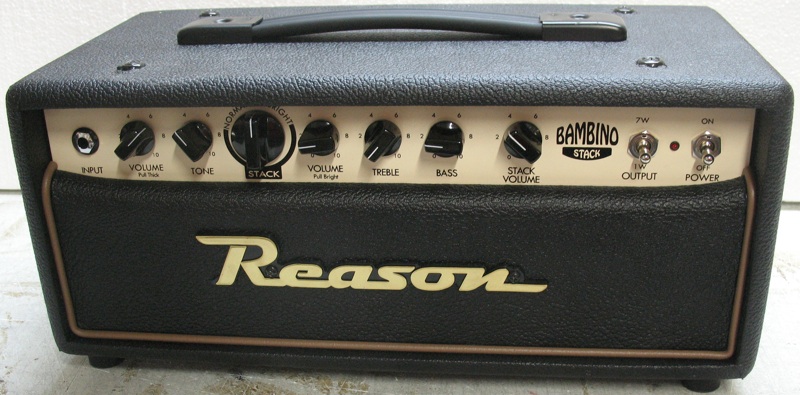 I’ve been extolling the virtues of the Reason Amps Bambino for several months, and how great it sounds. Among the things that I’ve mentioned is that for a little amp, it has a BIG sound. That was a design objective with Obeid Kahn, Reason’s amp designer, when he was designing the amp. He didn’t want to just build yet another affordable, low-powered amp. He wanted to build a great amp. Period.
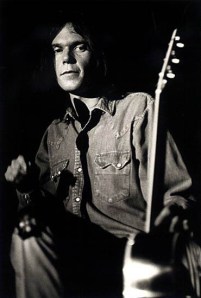 I got inspired to write this entry from none other than Neil Young yet again. Back in July,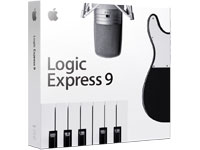
 Like many gear sluts, I’ve got several guitars and each guitar, no matter how much I’ve spent on it, has its own little quirk or quirks. One might not have much natural sustain, another might have tiny frets, yet another may have wide neck profile. But no matter the quirk, in the end, if I can work through a guitar’s particular quirk or quirks, it’s the sound that comes out of my amp that counts. But the cool thing that I’ve found is that these very quirks have also served to help me become a better guitar player. Mind you, these aren’t flaws in the gear. They’re simply, well, quirks that make either consciously or sub-consciously make me compensate for a particular quirk in some way.
 Guitar Gear