Feeds:
Posts
Comments

Posts Tagged ‘Music’

Ibanez Jemini Distortion Pedal

Ibanez Jemini Distortion Pedal

Does the guitar playing world need yet another distortion pedal? That’s almost like asking if your town needs another Starbucks. Hmmm… maybe that’s a bad analogy because while we could probably do without yet another coffee commodity, I for one don’t ever mind seeing another distortion pedal hit the market.

And just when I thought I’d heard all the variations of distortion around, and that not much else could be done, along comes Ibanez with yet another mind-blowing distortion box, designed by none other than one of my guitar heroes, Steve Vai. I gotta admit it: I’m really impressed with this latest offering from Ibanez – at least as much as I was impressed with the Vox Satchurator. Don’t get me wrong; it’s not because of Steve Vai, or because I’m a Vai wannabe. It’s because there’s something about a great distortion sound that evokes a visceral response inside of me. It’s hard to explain. So I’m more than pleasantly surprised about the Jemini because it produces a GREAT distortion sound; at least from what I could tell from this video starring Steve Vai and Steve Vai – you’ll get the joke once you watch it:

Leave it to Steve Vai to not only demonstrate his mastery over the guitar, but the eternal showman manages to make the video a joy to watch. I was laughing my ass off at his antics! He’s so likeable!

Okay… now for a reality check… I really would like to get this pedal, but at $199, it’s a bit out of my price range right now. But being two distortion pedals in one for that price, it’s a hundred bucks a pedal. That’s actually not bad at all. But I have to admit, I have my sights set on a Satchurator right now. I kind of go for the more mid-rangy type of distortion. But I’m not going to let that keep me from taking one out for a spin.

On a final note, what’s been really great as of late is that big-name gear manufacturers are finally producing what could be considered boutique-type pedals. Having played with the Satchurator, that thing is built like a tank, and it just kicks ass. The Jemini appears to follow suit of well-made, gig-worthy quality. That’s very pleasing to me, because I’m a big proponent of getting great sound without breaking the bank.

Read Full Post »

I don’t plug other web sites often, mainly because there are so many out there, it’s difficult to keep up. But a new site, called TonePedia is so interesting in its concept, I just had to share it! The basis of the site is for members to share the tone of their rigs through sound bites they share with the community. Want to know what an LP sounds like through a Crate amp? It’s there on the site.

What a cool idea! Check it out! I’m going to post a few samples myself! Er… Once I find some time… 🙂

Read Full Post »

The mags and rags of the guitar playing world seem to have forgotten about the absolutely amazing virtuosity of Greg Howe who, in my maybe not so humble opinion ranks among the best guitarists in the world, hands down. He’s as fast as Yngwie or Paul Gilbert, but in my opinion covers a lot broader musical territory. But the guy’s not only a speed demon, his solos are incredibly expressive, employing a lot of phrases that you’d expect to hear in jazz.

I’ve been amazed by Greg Howe’s mastery over the guitar for years, and I actually feel bad that I hadn’t acknowledged him here. Maybe it’s because he’s considered to be more of a fusion artist more than a rock and roll dude… Who knows? Actually, who cares? Greg Howe KICKS ASS!

Here’s a video that displays just some of that musicality and other-worldly technique. Please view it to the end. When he starts out, you’ll think it’s nothing special… Wait until he hits his stride! Aiyeeeeeee!

Click here to see more on YouTube!

Read Full Post »

I was reading several interesting threads about technique and improv the other day. I have to admit that I was quietly embarassed by the fact that I don’t have a large library of techniques that I can tap into while I read the posts and articles. There are so many things to learn with respect to technique out there that it’s daunting!

But after reading those articles, I realized that a lot of the technique I have developed – especially over the past couple of years – has come from stumbling upon how to play a certain phrase through experimentation. I’ll be the first to admit that I’m not a disciplined improv dude that can instantly tap into a library of patterns and apply them. I’ve never taken guitar to that intellectual level. My approach to soloing tends to be fairly experimental; primarily because I don’t have a lot of techniques on which to fall back. But that doesn’t mean the process of experimentation isn’t cool in an of itself.

In fact, that process, at least for me, has been absolutely rewarding, and after I’m done with an “experimentation” session and play back the different takes, I often say to myself, “Did I actually play that?” It’s mildly amusing, but it’s also a bit scary because I’ll eventually have to play that or at least something similar to that when I play the song live. But that gets me to practice the technique until I have it down.

For instance, early on when I started my experimentation, I stumbled upon the minor pentatonic scale just by playing what fit. At the time, I didn’t know that it was the minor pentatonic scale. I just know that what I played fit with the song. I’ve since learned the other patterns of the minor pentatonic, and it’s something I tap into regularly. In another instance a few years ago, I was playing a solo, and one of the other musicians in my band asked, “Hey man, did you just do that in Mixolydian mode?” I replied, “Mixo-what? I don’t know, I just thought that it would be cool to start the lead a fifth above the root and play within that relative area.” Mind you, I still don’t know all the modes by heart – I think I stick to Dorian and Mixolydian a lot, or often start playing a minor pentatonic in the relative minor of the root chord (if it’s a major chord).

The point is that I don’t go out to specifically learn and practice a technique or mode or scale. Admittedly, that has probably slowed my technical advancement to a large degree, and I’ll have to admit that for the more organized and discplined among us, that approach is probably unacceptable, but it works for me, and I’ve learned a lot of things that I was later able to identify as formal techniques.

I know that there thousands of guitar players who are a whole lot better than me, but here’s a glimpse into my experimentation process:

  • GarageBand or some other package where you can easily set up loops and record rhythm parts is kind of essential. Having this is akin to having a basic chemistry set to mix chemicals.
  • Once you come up with a loop, play it continuously and jam to it to see what falls out of your experimentation. Never mind trying to be intellectual – just let it flow.

I’ve literally spent hours at a time practicing using this method, and a lot of these progressions have turned into songs.

To get you started, here’s a Jam Track that you can use. It’s a simple, 3 minute track in the key of A. I laid it down because I wanted to practice chord soloing… er… actually to see if I could do it. 🙂 In any case, have a go!

Read Full Post »

As part of my five-year-plan to be on the road touring, I entered three of my songs into the Song Door International Songwriters Competition. This is a big step for me as I’m crossing into completely new territory. It’s one thing to get acclaim from your friends, it’s an entirely different matter to have your music put under the microscope. I’m both excited and nervous at the same time! Anyway, here are the numbers I chose:

The Animal Side of Attraction

You’re Stuck With Me

I Come To You

I don’t know how they’ll match up against the competition, but I have high hopes!

Read Full Post »


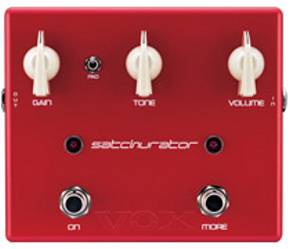
A few months back, I had heard some buzz about Joe Satriani teaming with Vox to come up with some new pedals, and just recently caught wind of the first pedal from this partnership called the “Satchurator.” When I first read about it, I was thinking to myself, “Now this is cool…” I’ve known about Satch being a pedal freak for awhile, so I figured that having his input into a new pedal would be worth a look; and based on my few hours of research, and listening to samples and watching videos (I’ll insert a couple below), this pedal is worth more than just a look. It looks like I’m gonna get it!

Okay, just what I need… yet another drive/distortion pedal. But there’s something very very cool about the sound that this pedal produces, and from my perspective, it has nothing to do with trying to sound like Satch (even though people say that this is Joe’s tone in a box). For instance, I’d rarely, if ever crank the gain full. My stuff is more on the bluesy side of things, and the distortion this pedal produces can be really thick at higher gain levels from what I’ve heard. Nah, this is a different brand of distortion altogether. It’s not as mid-rangy as a Tube Screamer, but it’s also a little thicker than an OCD – it’s kind of hard to describe.

Of course, I’ll have to do a test drive before I actually buy it, but it sure looks like a winner to me. Let’s look at the features (from Vox):

  • Analog distortion pedal designed under the complete supervision of Joe Satriani
    Controls for Gain, Tone and Volume
  • ‘More’ gain boost switch enables two footswitchable distortion sounds in one pedal. This gain boost is dramatic when gain knob is set low, and is a subtle solo boost when gain knob is set to maximum.
  • ‘Pad’ switch pads down input to allow for high gain pedals (such as modern wahs) placed before Satchurator. Up is pad ‘ON’. Down is pad ‘OFF’ for full Satchurator effect.
  • High gain, low noise design provides vintage to modern distortion sounds
  • Dynamic circuit is highly responsive to rolling off the guitar’s volume and preserves the guitar’s high end when the volume is rolled off. (NOTE: This means it cleans up nicely when you lower your guitar’s volume – SLICK)
  • Cream chicken-head knobs for precise positioning and high visibility on dark stages

Now get this: THIS BOX IS STREET PRICED AT $129.00!!! Holy Simolians, Batman! That’s incredibly affordable! I am totally blown away by the price of this pedal! I’d kind of come to expect paying a steep price for something from Vox (can you say “Virage?”), but this just blows me away. Anyway, here a couple of videos I found while surfing:

Guitar World Review

Vox Demo

And from Joe himself…

Read Full Post »

Peavey Windsor Studio

Peavey Windsor Studio

At-A-Glance: 15-20 Watt Class A tube amp, 12″ speaker, balanced XLR out with mic simulator.

Price: $399.00 (street)

Features:

  • Class A Power Amp can use various octal power tubes including EL34 (stock), 6L6GC, 6550, 6CA7, KT88, KT66, or any variation on these types
  • Two 12AX7/ECC83 Preamp tubes
  • 15-20W (rms) into 4, 8, or 16 Ohms with “Power Sponge” output power attenuator
  • No negative feedback in Power Amp
  • High & Low Gain Inputs
  • Preamp Volume
  • Low, Mid, and High EQ
  • Footswitchable Boost function
  • Footswitchable Effects Loop
  • Spring Reverb
  • Transformer balanced XLR Recording Output w/passive mic simulator
  • XLR Ground Lift switch
  • Dual Speaker Outputs
  • Impedance Selector
  • 1/4″ TRS footswitch jack for Boost and Loop defeat
  • 12″ Blue Marvel Speaker

I’ve never been much of a Peavey fan, but there’s something VERY cool about this little amp. For starters, I dig the fact that you can use different pentodes with it – and you can switch them with out re-biasing! Imagine getting that glassy sound with a 6L6GC (standard in Fender deluxes), then switching over to a KT88 for a more compressed overdrive sound. That feature alone makes it really attractive. But on top of that it also has a built-in attenuator!

This ain’t a giggin’ amp – least not for anything more than a small venue. As the name implies, it’s made for the studio, and with its included features, it’s clear that that is what it’s made for. For home recording stiffs like me, this amp seems like an ideal amp to have in my home studio. I used to be really dubious about low-power amps, but for low volume applications, you just can’t go wrong with a low power amp. Why? Simply because you can get low wattage amps into breakup at a much lower volume than with higher output amp. And with the right mic placement, in many cases you can’t tell just how little that low wattage amp really is. 🙂

But here’s the real kicker for me: It costs $399 retail. You can find it on EBay for even less! That alone is worth a look. Now I know that you might be thinking that this is just a cheap amp. Maybe it is, but based upon the demo below, I think this amp may deliver WAY more value than for what it’s selling. Check it out:

I’m going to have hit a Guitar Center or another local shop that carries one to try it out. If you’ve got or played one, I’d love to hear your insights!

Read Full Post »

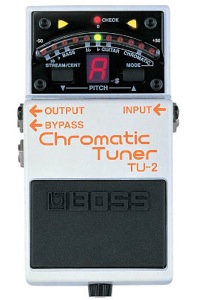
BOSS TU-2 Chromatic Tuner

BOSS TU-2 Chromatic Tuner

BOSS TU-2 Chromatic Tuner
Summary: Basic, no-frills chromatic tuner in a convenient stomp box that can also double as a power source.

Pros: Super-convenient stomp box makes on-stage tuning a breeze. Tuning mode automatically cuts off signal to the rest of your board for relatively “silent” tuning.

Cons: Only has 11 total LED’s, so fine adjustments aren’t possible.

Price: New $99 Street

Features (fr. BOSS site):

  • BOSS world-renowned TU-Series tuner accuracy in a convenient stompbox design
  • Mute/Bypass select for silent tuning with a single stomp
  • 11-point LED indicators and new “stream” meter display tuning discrepancy via speed and direction of LEDs (speed of LED movement gets slower as pitch becomes more accurate)
  • 7-segment LED displays string and note names, easily visible on dark stages
  • Seven easy tuning modes include Chromatic, Guitar Regular, Guitar Flat, Guitar Double Flat, Bass Regular, Bass Flat, Bass Double Flat
  • Tuning mode setting and display style choice stored in memory
  • Adjustable reference pitch from 438 to 445Hz
  • 8-octave tuning range–the widest in its class
  • Footswitchable Tuner Off mode preserves battery life by disabling LEDs

Let’s face it: Tuning is a fact of life when you play any musical instrument. And if you’re like most gigging musicians, you don’t have a guitar tech at your gigs to tune your guitars in between songs. For that, you need a tuner. For years, I used a cheap, hand-held analog tuner with a sweep meter for tuning. It was very accurate and did the job well, but as I started to gig more and more, having to turn the volume down on my amp to tune soon became irritating.

So I decided to get a stomp box tuner, and went down to Guitar Center and bought the TU-2. Now I will be the first to admit that I didn’t do much research before buying the TU-2. I’d recently read an interview with Joe Satriani and he had a TU-2. I figured if something’s good enough for Satch then it’s definitely good enough for me. It was a safe bet then, and it’s a safe bet now. The TU-2 is solid performer that’s fairly accurate, though no LED-based tuner could even possibly suss the accuracy of a strobe or analog tuner. But for what it does, I’m pretty satisfied with it.

Another nice feature about the TU-2 is that it can also act as a power source for up to either other pedals. I power up my board with a Dunlop DC Brick, but once I used up the 6 available 9V ports, I couldn’t add more
pedals without having to get another brick. For one or two pedals, that’s just not a good justification when you’re spending 100-bucks. The TU-2 comes with both a DC-in and a DC-out port. You can use a standard 9V cable to hook up another pedal, but it probably makes more sense to spend  the $12.99 and buy the BOSS PCS-20A power cord, which will route power up to eight pedals. Caveat: The cable runs between connectors are short. BOSS assumes you’ll be using nothing but BOSS pedals, but with tone freaks, that’s rarely the case. But it is a cheap, convenient solution nonetheless.

So what’s my verdict? I wouldn’t have it if I didn’t think it was useful. It’s not in any way, shape, or form something to do cartwheels over, but it’s a solid pedal that gets the job done. At Harmony Central, when you write a review, they ask you what you’d do if it the gear you’re reviewing gets broken or lost. Were I to review this pedal there and answer that question, I’d probably take a serious look at the Korg stomp box tuner that sports more LED’s and is a bit more accurate than the TU-2. The only thing that would probably keep me from switching is the ability of the TU-2 to provide power to other pedals.

Rock on!!!

Read Full Post »

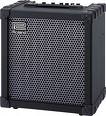
Roland Cube 60 Amplifier

Roland Cube 60 Amplifier

Roland Cube 60 Amplifier
Summary: Built like a tank, great-sounding and versatile, the Roland Cube 60 is at home on the road and in the studio.

Pros: Built-in Roland COSM modeling technology to mimic 9 British, Vintage and Modern amps, plus an added Acoustic mode. The Cube 60 also sports Recording Out, Line Out and Speaker Outs, plus a Tuner Out that can feed a Tuner independent from Volume control. Very loud for a small amp!

Cons: Reverb sounds hollow and a muddy at higher settings, with a definite loss of clarity.

Price: New $300-$359 Street ($250-$275 used)

When I bought my Cube 60 a three years ago, I wasn’t even looking for an amp. At the time, I was using a Line 6 Flextone III that served my purposes beautifully. But when you’re a gear freak and you just happen to have a bit of coin to spend well, some things just can’t be passed up.

Such was the case when I was perusing my favorite local gear store. I sauntered into the cramped guitar area, and saw this tiny black cube amp sitting against the wall. Intrigued, I picked it up by its handle and marveled at not only its diminutive size, but also its light weight (it weighs only 25 lbs.). Then Jordan, the guitar guy walked up and said, “I just got me one of these. It sounds awesome, and you can use it anywhere.” Normally, when I hear stuff like this coming from a salesperson’s mouth, I just nod, smile and say, “Cool.” But I’ve known Jordan for awhile, and I’ve learned to trust him. After all, he’s a gigging guitarist who knows his gear. When I hear him even slightly rave about something, I know it has got to be something cool (not that I can always afford the stuff he says is cool, but that’s another story).

So instead of my usual reaction, I silently pulled a Strat down from one of the hangers while Jordan went to fetch a cord. Big mistake! 🙂 It took me no longer than 10 minutes to know that I had to have this amp. Plus it was on sale for the Christmas season, so I got it for $50 less than normal retail!

I won’t go into the technical details of this amp because you can google for them. Let me just say this: This amp kicks ass! While I use my Fender Hot Rod for my electrics on stage, I use this with my acoustic, and it’s a dream. There’s something about the Acoustic channel on this amp that makes my Ovation sound like a Martin dreadnought! It’s that sweet

But in the studio, I use this amp a lot for recording backing rhythm parts. Even though it’s a modeling amp, which I normally don’t really get too wild about, this amp produces really nice tones in all of its amp modeling settings. And with its recording out jack, which shuts off the speaker, I can safely record deep into the wee hours of the morn without worrying about waking the neighbors. Surprisingly enough, it sounds great going direct into my DAW. In fact, I recorded this song using nothing but my Roland Cube 60. Of course, there’s nothing like the sound that a cranked tube amp produces, but late in the night, when you’ve got the inspiration, having the convenience of an amp that sounds great going direct is very nice!

Finally, did I say this amp is LOUD? You’d never expect the kind of volume that this amp is able to produce. At home, I rarely take the amp above 9am on both the Gain and Volume knobs. Any louder, and I’d start getting calls from the neighbors and complaints from my wife! 🙂 One of my close friends uses this amp for gigging, and he loves its versatility. Mind you, this is a guy who has tons of gear. His amps include a Marshall JCM half stack, and a gorgeous ’71 Fender Twin. But he likes to gig with the Cube because it’s so versatile AND it’s incredibly light! Weight matters when you’re hauling gear.

This amp is definitely worth a look.

Rock on!

Read Full Post »

Be Healthy; Play Guitar

A few months ago, I wrote an entry about how I was developing intermittent numbness in my hands, and imagining what it would be like to not be able to play guitar (I was already starting to have trouble). For those of you who happened to read the post, I will admit this: I WAS SCARED SHITLESS!!! But it scared me enough to turn my life around, so I thought I’d give an update about the changes I’ve made in my life:

  1. I cut down on the portions I eat at each meal. In fact, I started eating breakfast, so I wouldn’t have a voracious appetite at lunch; speaking of which, I’m still too lazy to bring lunch every day, so I eat out a lot at lunch, but I order far less now, and order things that have either a salad or are vegetarian. No fried foods, and very little red meat (that was a real tough one). In other words, I’m really eating healthy now.
  2. Went to see my cardiologist who just flat out said, “Your heart is fine, and the numbness you feel and your shortness of breath are because you’re out of shape and overweight. But you don’t have heart disease, so it’s your hands to correct your situation.” So I got back on my heart med (I have a genetic defect – minor problem), and cholesterol med. I’ve also been taking daily doses of fish oil pills.
  3. I’m now working out! I am the proud owner a gym-quality exercise bike that a friend gave to me, and I ride it least once a day 6 days a week, and twice a day 3 times a week. I’m also playing soccer once a week with my mates at work.

The net is that I’m feeling better than I have in 10 years. I’m not dozing off in the middle of the day due to inactivity, and I now have this constant overall feeling of well-being.

What does this have to do with my guitar playing? Well, I seem to have found my creative spark again, and am writing music. The numbness episodes are A LOT less frequent, and when I get them, it’s a signal for me to get on the bike or take a walk and be active to get my blood flowing.

I have to tell you that I’m totally jazzed! I feel as if I have a new lease on life, and maybe it’s me, but there seems to be a difference in how I’m approaching my music now. It took a scare to kick me in the ass, but I get it now.

Okay… time to hit the exercise bike and do my situps!

Read Full Post »

« Newer Posts - Older Posts »