I got my first introduction to VOX Tonelab boards when I saw a dude playing one direct into his PA at a casino a couple of years back. I was amazed at how awesome it sounded, and completely changed my opinion of using models in a live situation. Since then, I’ve played with some of the Tonelab series boards and Valvetronix amps, and have generally been pleased with them. But with the Tonelab SE, I think I’m going to take a really good look at this new offering from Vox.
First off, it’s nice and compact. It’s their smallest footprint yet!
50 Presets and 50 User programs.
33 amps and a 11 cabinets – more than you’ll ever need to customize your sound.
I’ve always dug the fact that it has an on-board expression pedal to adjust a bunch of different parameters – but most of all, to use as a wah (the wah is actually pretty sweet on these units).
Finally, at $199 (street), there’s tons of value in this little unit!
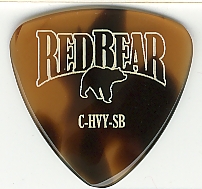
Imagine a pick shaped like the one to the left, but at 4 mm thick! That’s the Super Thick Gypsy Jazz Pick!
A couple of weeks ago, I was having a conversation with Dave Skowron, maker of Red Bear Trading picks, and said, “You know Dave, I just dig this Gypsy Jazz thick pick that I just bought. But as you know, for electrics, I play with a V-Picks Snake because I love the 4.1 mm thickness.” As background, I had just purchased a standard GJ thickness to replace the Heavy that I gave to a friend so she could try it out. I continued, “Do you have anything that is even close to that thickness? I would love to have that kind of thickness for playing acoustic.”
Dave replied, “Yeah, I have a sheet of the Tortis material that is pretty close to that thickness at about 4 mm. I did something even thicker for a guy once.”
“No, no any thicker, Dave, and I think it would be too much. But if you have a 4 mm thick pick, I’m all over it!”
“Okay, I’ll make up a prototype and send it to you to evaluate.”
All I can say after playing with “the prototype” for a couple of days is I hope that pick goes out of prototype because it is an incredible pick! You know how I love the feel and sound of Tortis, especially on acoustic guitar. In fact, I love the sound of Tortis with acoustic guitar that I won’t play any other type of pick on my acoustic. On electric, I dig my V-Picks Snake for its speed, tone, and thickness. Put all that together in one pick, and what you’ve got is a “Super Pick!”
The thicker you go with picks, the deeper and richer the sound. It’s not that you lose the highs; you don’t. It’s just that the thicker picks also bring out the lows, so what you get in a nice, even tonal presentation. That’s why I dig thick picks! On top of that, there is something magical with the way a Tortis pick interacts with an acoustic guitar’s strings. With me at least, playing a Tortis pick on acoustic evokes a certain visceral feeling that makes me want to close my eyes and just soak up all the tonal goodness. Not only that, Tortis, being made of a natural material, just feels natural. It’s the perfect complement for playing acoustic guitar!
So what about this super-thick Gyspy Jazz gauge? OMG!!! I am in guitar-playing heaven with this pick! It has the thickness of my beloved V-Picks snake, but all the feel and tone that I’ve come to love with my Tortis picks! To just call it “awesome” would be a complete understatement.
I first played the “Super Thick” last Friday at a gig that was primarily acoustic guitar. It started with playing some dinner entertainment music before a re-enactment of Christ’s passion. I was playing my Ovation Celebrity directly into a Genz-Benz 100 Watt upright. When I struck the first chord of the opening song. I actually had to pause and let the chord just ring and hang in the air. It was quiet enough in the room where I was playing that I could hear my guitar, as the amp was there for simple sound reinforcement. I thought my original GJ as awesome at 2.3 mm. What this pick did to the natural tone of my guitar was otherwordly!
I spent most of the day yesterday playing guitar, much to the chagrin of my wife! It feels so incredible!
In any case, if you’re interested in getting one of these, contact Dave Skowron at Red Bear Trading. I’m sure he’ll make one for you. Mind you, this thickness of pick won’t be cheap, but it’ll be well worth the investment!
If I could go higher, I would with this rating. But this pick gets my highest rating!
I always love being able to get great tone at a bargain. It’s not that I’m cheap. I’ll pay top-dollar for great gear, but when potentially great gear comes at an incredibly affordable price, the Dawg’s ears perk up, and his nose starts sniffing around to see where he can play some gear.
Such was the case when I first came across this little pedal company located in Portland, Oregon called Catalinbread. I had run across the name on a couple of gear forums, but didn’t get a chance to check out their site until today when I read their press release in Harmony Central Effects News. After I read the press release, I had to check out Catalinbread’s site, and much to my pleasure, Catalinbread offers several, very cool pedals.
One thing that makes them stand apart is their diminutive size. As noted in ProGuitarShop’s Catalinbread company page, “One of the defining features of Catalinbread effects pedals is the size.Catalinbread pedals are half the size of your standard MXR.That’s right, take a Phase 90 and cut it in half vertically and you’ve got the basic size of Catalinbread’s pint-sized pedals.” But, as they say, size isn’t everything. Apparently Catalinbread’s pedals pack a lot of sonic punch.
The other thing that makes Catalinbread pedals stand apart is their price. Their most expensive pedal that I found was US$179.95. Several of their pedals are under US$120.00! Mind you, these are handmade pedals! That’s so awesome! Catalinbread is definitely taking the stand of selling gear at lower prices to get it into players’ hands. Creation Audio Labs does this with their awesome pedals, and Aracom Amps does it with their VRX line. This ain’t trivial stuff, either. This is great, handmade gear at a great price!
Can you keep a secret?
The Dirty Little Secret could be construed as another “amp in a box” pedal. But from what I’ve heard from sound clips, it’s far from that. Catalinbread claims to have built into the box amp-like touch sensitivity that accurately respond to your playing dynamics and volume input; so much so that you feel like you’re playing in front of an amp, and not through a pedal. But there are several videos on the DLS product page that bears this out. Check out that page here.
Of course, only a live test will reveal if that is true, but I’m intrigued enough to go try one out if I can. The only problem with that is there are none to be found. This pedal’s so scarce that you can’t even order one on the Catalinbread’s web site! I have a feeling they’re being sucked up as fast as the company can produce them. Even retailers who were hawking the pedals awhile ago have either removed their sale pages or replaced their “buy now” link with ‘Email us about ordering.”
Well… my brother lives up in Portland. Maybe I’ll have him look these guys up!
A couple of weeks ago, the Dawg was sniffing around for some new and interesting gear, and came across a little company in Raleigh, NC called Acoustic Image, that specializes in acoustic and bass amps. While I love my Roland Cube 60 for its acoustic channel, I was really impressed by the sound of the Acoustic Image Corus. Now, I could only go off the sound of the YouTube video below, but this puppy has some serious, natural tone. Amazingly enough, it’s a diminutive amp with a 10″ downward firing woofer, a 5″ midrange driver, and 1″ tweeter. It produces 450W at 8 ohms and 800W at 4 ohms. That’s a boatload of power! But we’re talking solid state here, so it’s tough to compare to tube amps. But power isn’t everything – it’s the sound that counts, and from what I can tell, this amp sounds fantastic! I need to get to a store that carries these to try it out with my acoustic/electric. Check out the video!
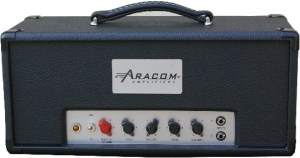
I’ve never had a #1 of anything in my life – or at least nothing of consequence – but this weekend, I’m taking delivery of the very first production amp in the Aracom VRX 22 line! That’s it to the left! OMG!!! I’m excited! This is a real special time for me. I’ve played all sorts of fantastic gear, but I’ve never played something so impactful on my music where I got the first unit! It’ll probably never happen again, but who cares? It’s happened once, and that’s all that matters.
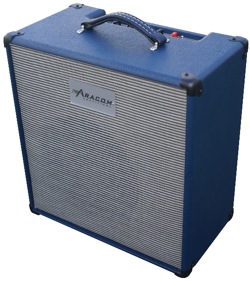
I decided to go with the separate head and cab for more versatility (plus I could use the cab with other amps – like my Fender Champ, and as an extra speaker for my Hot Rod). This amp is just perfect, driven by a couple of 6V6 power tubes. Read the review I gave it previously! In a nutshell, when I had the pre-production unit, I just couldn’t stop playing it! I’d totally lose track of time! That’s the mark of a special piece of gear!
The cool thing about the cab is that it has removable slats so I can go from fully closed to get extra bass response to wide open. Jeff made this suggestion when we were talking about what I was looking for in an extension cabinet. A musician himself, he’s constantly thinking of how he’d use his amps in a live situation, and he made this suggestion to add tonal versatility to the cabinet because we were talking about closed back versus open back designs. So why not the best of both worlds?
Also, the speaker is a Jensen P12N Alnico. I tried this speaker out in a different amp that I was testing for Jeff, and just fell in love with it! It is a very dynamic speaker capable of handling a wide range of tones.
So how did I end up with the very first amp in the line? Easy. I tested the original prototype, and the final pre-production unit. When Jeff picked it up, he was going to bring over other amps for me to try out, but I told him that the VRX 22 was the one I wanted, and verbally placed my order.
This is a real special amp, and it is so versatile. It is capable of going from super chimey cleans to all-out snarling overdrive. Here are some sound samples from the Aracom site (sorry, no cleans in this set – I’ll record some and post them later):
Slight Grind (this one says it’s the combo, but it’s the head into a prototype cabinet – I know because I recorded the clip 🙂 )
The following clips were recorded with the head plugged into a 4 X 12 cabinet.
Slight grind with a slide:
Grinding Blues:
More grinding Blues:
Fully cranked in Channel 2! Volume and Master on 10!
While the clips all sound great, this amp live is absolutely gorgeous-sounding!
Oh, and by the way, the amp head only costs $895. But don’t be fooled by the price: The VRX (as well as all Aracom Amps) is completely handwired and uses a solid-state rectifier and voltage sag simulator, which accounts for the lower price. But who cares? It sounds freakin’ awesome. I gigged with both the prototype and the pre-production units, and I can attest to how great it sounds. And great sound at a price like this is simply amazing!
Summary: This brand-new 22 watter is the newest in the Aracom low-wattage amp series now called the Vintage Rox or VRX series, which includes the original RoxBox 18 (now called the VRX18). Loaded with a pair of 6V6 power tubes, this amp oozes vintage American clean and dirty tone ala Stevie Ray Vaughn.
Pros: More clean headroom in Channel 1 as compared to its EL84-based 18 Watt sibling. And despite its lower wattage rating, this amp is capable of getting LOUD! Plus the VRX series sports what I think are the best power switching and master volume in the business!
Cons: None.
Price: $895 Head / $995-$1095 for Combo (dep. on speaker)
Specs:
– (2) 6V6 Power Tubes
– (3) 12AX7 Preamp Tubes
– S.S. Rectifier with “sag” circuit
– Hi/Low B+ voltage switch (22/10 watts)
– On/Off Switch
– Indicator Lamp
– Custom Heavy Duty Aluminum Chassis
– Custom Wound Transformers
– 4, 8, 16 ohm Speaker Jacks
– Custom Handcrafted
Turret Board
– HandwiredTone Bone Rating: 5.0 – Jeff Aragaki has hit the ball out of the park with this amp! I loved the original RoxBox 18, and gave it a 4.75, but with this amp, Jeff “fixed” the harshness of the breakup at lower volumes. To me, it’s the perfect amp!
Let’s roll back the clock a couple of months. I get a call from Jeff Aragaki. The conversation went something like this…
“Hey Brendan! How’s it going?” asks Jeff.
“Not bad. Howzit with you?” I ask.
“It’s going good. Listen, I’m experimenting with a new tube compliment for the RoxBox and put a pair of 6V6’s in it to see how it sounds,” says Jeff.”
“Oh REALLY? Kinda tryin’ to get an American voicing, are ya…”
“Yeah, plus the output rating should be bit higher at around 22-25 Watts,” Jeff states.
“Okay,” I say, “Now you’ve got my attention. When can I try it out?” I ask.
<chuckle> “Well, I called to see if could bring it over to you for you try out and give me some feedback,” replies Jeff.
“Brand new amp? Experiment? Need you ask to see if I’d like to try it out? I’m free Saturday morning!” I exclaimed.
Fast-forward to the following Saturday, and Jeff lets me try the amp for a couple of days before he has to take it back, and I immediately start taking it through its paces. I even gig with it. I’d instantly fallen in love with it! I call Jeff and tell him that I think he’s onto something with this amp. He’s glad for the feedback, then a couple of days later, he picks it up to finish it out.
A few days later, he calls and tells me that he had to tweak the circuits a bit to handle the increased power. Uh-oh. So I asked, “Did it change the tone?”
“Hahaha… not at all. In fact it was actually running at way below 22 Watts. Since I reworked the circuitry, it has tons of power now, and it sounds even better. I even adjusted Channel 1 so you get even more clean headroom, and Channel 2 breaks up real nicely now. In any case, I’m going on a business trip to Indonesia and you can play with the amp for a couple of weeks while I’m gone.”
And play I did! That was one of the most exhausting two weeks of my life because I was up till late (like 2-3 am) playing that amp. I just couldn’t get enough of it, especially playing “Goldie” (a Saint Guitar Goldtop I recently reviewed) through the amp. And in all that time, I wanted to write a review of it, but I had agreed with Jeff to not talk about it (though I hinted a lot) until he got back from Indonesia and turned it into a production amp.
Once he returned from Indonesia a couple of weeks ago, he came over to pick the amp up. He asks me the usual questions about how I liked it, and I just said, “Jeff, this is a PERFECT amp! I can’t say anything bad about at all. Channel 1 is gorgeous and works great with pedals. Channel 2 just rocks the house! It’s the channel I used the most, and it’s also real pedal-friendly. And for once in my life, I’m at a total loss for words; that’s how much this amp affects me to the core.”
Jeff just laughed, and said, “Well, I’ve got a couple of other amps for you to try out…”
I cut him off, and told him that it’s fine if he wanted me to review them, but as far as what amp I’d choose to go with for my personal amp, the VRX22 was it. Search over. He laughed again, and said he’d get started on it….
Okay… fast forward to yesterday…
Jeff called me up to give me a status on my amp, and that he talked to someone this past week who is also getting one, choosing the VRX22 over a well-known boutique manufacturer. So it was definitely going into production, and he was almost done with the web page and announcement. Of course, I couldn’t keep my mouth shut and immediately wrote an announcement, despite his recommendation to wait until today). 🙂 I just promised I wouldn’t say too much, which I didn’t because I wanted to write a review.
What’s in a name…
To create alignment in the series, Jeff has renamed the “RoxBox” line to the “Vintage Rox” or VRX series. If you recall, the original RoxBox 18 sported a pair of EL84 power tubes and is now called the VRX18; and the only difference between the two amps is that the VRX22 employs 6V6’s and circuits that can deal with the increased power. In essence, with the VRX series, Jeff is providing both British (VRX 18) and an American (VRX 22) voicing options. The EL84-based VRX18 breaks up very similarly to a VOX AC15, with a lot of high-freq shimmer. The VRX22, on the other hand, breaks up like a classic Tweed. Frankly, once I have the bucks, playing both together will sound absolutely awesome!!! And priced at $895 each for the head models, that’s A LOT cheaper than a single hand-wired amp from most boutique manufacturers.
Hand-wired goodness at an affordable price
I can’t stress this enough: The thing that originally blew me away with Aracom Amps was the price of the RoxBox. I couldn’t believe Jeff could sell a hand-wired amp for less than a grand – even with a solid-state rectifier! As I’ve gotten to know Jeff, and I’ve come to understand one thing about him: He’s an incredibly shrewd businessman. As he shared with me this morning, “It’s a matter of philosophy. Some guys make boutique gear, give their stuff a nice paint job, then charge a bunch of money for their gear. Then there are other guys who just want to make a few bucks off their gear, but sell it at a lower price so more people will play it.”
The net result is that we consumers reap the rewards of that philosophy, and probably one of the reasons why Jeff’s amps are starting to gain a lot of traction in the industry. And artists have started to find out about Jeff’s amps. Gene Baker of B3 Guitars fame plays an early-model Evolver, and just recorded his new album using the Evolver in all the songs. Obviously, a guy like this who gigs all the time is a believer. I’m nowhere near Gene’s abilities, but I totally dig his amps – I think you can tell. 🙂
How It Sounds
I’m not going to rehash features here, since the features are the same as the original RoxBox 18 that I reviewed a few months ago. Again, the fundamental difference is the use of 6V6’s.
If you’re looking for a classic American tone, this amp is it. Yeah, you COULD go with a classic Tweed from Fender or other boutique manufacturers. But you’d pay way more for the sound. But I also need to qualify that. The tone is “American-like.” It has a voicing that whether Jeff stumbled onto it or not, is a voicing that is at once familiar, but all its own at the same time. To me, I don’t give a rat’s ass about the power rating of this amp. All I know is that it sounds like nothing I’ve played before. That’s the feeling I get with the Reason SM25, which is another 6V6 beauty, but has a sound all it own.
Channel 1 is bright and gorgeous. It’s chimey as you’d expect from a classic Tweed sound, but it’s amazingly very lush as well – which is where this amp is really distinct. The words that come to mind with this clean channel are “subltely sensuous.” It’s not like a hot chick dressed in a tight mini skirt. It’s more akin to a gorgeous woman dressed in a simple cotton summer dress who doesn’t need any makeup to enhance her looks, and she has nothing to prove. She just looks to be all-woman. The net result is that you’re just drawn into aura without really knowing why – nor caring. The clean channel of the VRX22 has a similar effect on me. It’s just a gorgeous tone with any guitar (though I especially loved play “Pearl,” my Strat through it. The raw tone just draws you in, and when you add effects, it just handles them beautifully.
Channel 2 is also bright and ballsy, but its breakup is incredibly smooth. This is the channel where I think Jeff has really hit the ball out of the park. One of the things that has bugged me about the power tube distortion in a lot of Tweed-types of amps is the harsh grind from the power tubes that you oftentimes have to tame with some filter cap and capacitor changes – it’s a bit too open. Not so with this amp. The “hidden” gain stage that acts as a tube overdrive pedal that’s always on helps smooth out the distortion by making it a bit tighter, but not so much that you lose that openness that you expect from a Tweed-type amp. I loved slamming the front-end of the amp with tons of input gain, and pushing both pre-amp and power tubes at the same time. Talk about compression and sustain!
Here’s a clip I used for my review of “Goldie.” The amp is in Channel 2 for the lead, and I added just a tad of Tube Screamer to get a more punchy midrange response. The TS overdrive was maybe at 10 am – not much at all. Plus I layered on some reverb with my Hardwire RV-7 Reverb. The bulk of the breakup came from the amp. The rhythm track was recorded with Pearl on Channel 1.
Man! I just listened to that track again, and can’t get over how great the amp sounds. Normally I record at bedroom levels, but I wanted the amp to move a bit more air this time, and I recorded it at gig levels (for me, that’s around 90-100db, so it’s fairly loud but not over the top), and I used a ribbon mic to pick up the ambient a bit better. The mic was placed at a 45 degree angle along the speaker cone about a foot and a half away from the amp.
Overall Impression
I just can’t rave about this amp more! To me, it’s the perfect balance of tone and power for practically all my needs! I’m getting the head with a 1X 12 cab, both wrapped in that awesome blue tolex that you see in the picture above!
Admittedly, the purist in me originally scoffed at the idea of a solid-state rectifier in the original RoxBox series. But as I told Jeff this morning, what people are typically after is the voltage sag you get with a tube rectifier. Jeff has built a custom “sag simulator” circuit that does the job so well that frankly, I can’t tell the difference. Besides, it’s what the amp sounds like that counts, not necessarily its components. Look at the classic Roland JC-120. That has to be one of my all-time favorite amps – even Satch played with one for years. It’s completely solid-state and it sounds freakin’ awesome!
But circling back to the VRX22. You can’t go wrong with this amp. Yes, it’s priced for value, but the tone that you get for that far surpasses anything that I’ve played at these lower wattages.
Summary: Is it possible to build a better Les Paul. Prestige Guitars thinks so, and I think they’re on to something with the Heritage Elite. With its stunning looks and gorgeous voice, this is a great, all-around versatile guitar that will fit any style of music.
Pros: Very full and rich sound, and all the accoutrements make this guitar a real looker. Very nice treble pickup with higher gain settings.
Cons: This is just a little one. I’m not fond of the abalone outlining on the the neck as to me it takes away from the gorgeous vine inlay. But that’s just me. Also the intonation was off on the 6th string – again, it wasn’t a big deal – I just fixed it and went off to the races.
Tone Bone Rating: 4.75 – 6th string was slightly off in intonation, and I had to adjust it. Weird, because all the other strings were perfectly intoned. If it hadn’t been for that, the guitar would get a 5.0 rating.
Didn’t I just write a First Impressions? Well, I haven’t put this guitar down all day because I was having so much fun with it, so I decided to just go ahead and write the review. I’ll do a gig report once I’ve played it in a gig setting – which will be tomorrow. 🙂
Fit and Finish
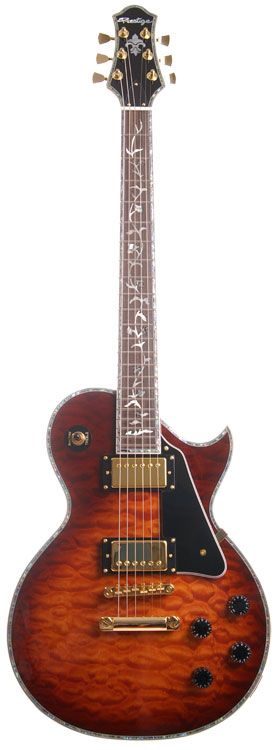
What can I say? This guitar is gorgeous, and except for my little nit, everything is perfect on this guitar. I love the stain burst finish that really accentuates the quilted maple top. There’s no glue marks or finish mistakes to be found on this beauty, and the abalone binding around the body and ebonized head stock is to die for! The neck joint is perfect as well, and is nicely set with no extra bulk, so reaching notes in the upper registers is an absolute breeze!
Prestige really thought out the design of this guitar really well. The gold hardware is a nice touch, and the Grover tuners are the bomb. Even though they’re not locking, the guitar stays in tune. I’ve only had to hit the tuner twice all day due to temperature changes in my garage/studio. The vine inlay on the neck is oh-so-stunning, and reminiscent of high-end guitars I’ve seen and played that cost a helluva lot more than this beauty queen. How Prestige was able to build a great-looking guitar with so much boutique bling at a fairly reasonable price is beyond me, but hey! Who’s complaining? Definitely not me.
Normally, I can’t stand pick guards, but somehow, the pick guard on the Heritage Elite is really unobtrusive. This guitar just “works.” I dig it.
Playability
I have to admit that after playing “Goldie,” a Saint Guitar Company Benchmark that has a wide profile neck, it was tough to get used to the comparatively narrower neck profile of this guitar. But once I got my hands dialed in, I gotta say that this guitar is very easy to play. The C-shape neck is a joy to play, and the rosewood fretboard is nice and smooth, yet with enough texture to give great tactile feedback.
The thin body makes positioning very easy – especially for a big guy like myself that has a middle-aged gut, so how it hangs from the strap is important. I didn’t have to make any positional adjustments with this guitar, which is something I have to do with a lot of guitars.
The shorter scale was something I also had to get used to, but that’s not even a nit. Again, once I got my hands dialed in to play this guitar, it was so very easy to play. The action was perfect out of the box – nice and low, which is how I like it. They strung it with D’Addario 10’s to boot, which is my preferred gauge and a brand I’ve used for years (though I’ve lately been using almost exclusively DR strings), so the strings were instantly familiar-feeling. As I mentioned, the only ding that the guitar got was the intonation on the 6th string. I understand that this could be due to shipping, but it was off enough where I had to get my micro allen wrench and adjust it. That always makes me nervous with these demo guitars because I don’t want scratch them out of respect for the manufacturer’s hard work. But all went smoothly, so no harm, no foul.
How It Sounds
In a word, “gorgeous.” It has that classic Les Paul fatness, but it’s also brightly voiced, like a Saint Guitar. It’s not as EQ balanced in its brightness like a Saint is, but for what it offers, this guitar really kicks ass tonally. The Heritage Elite packs tons of nice harmonics and overtones that add complexity to its tonal presentation. And another thing that I really dig about this guitar is that it has tons of sustain, which really comes out in the treble pickup, especially at high gain settings! I’ve played tons and tons of guitars, and most have ear shattering treble pickups. The Saint Guitars and this Heritage Elite have the most usable treble pickups I’ve played. I think this is due to the guitars’ inherent, natural sustain. In any case, check out some sound samples I made:
Clean – Both Pickups
Clean – Neck Pickup
Clean – Bridge Pickup
Dirty – Both Pickups
Dirty – Neck Pickup
Dirty – Bridge Pickup
Clean clips were played in the Clean channel of my Fender Hot Rod Deluxe, while the dirty clips were played in the Drive channel. For the dirty treble pickup clip, I slammed the front-end of the amp with a wide-open Creation Audio Labs Mk.4.23 clean boost, the best clean boost on the planet. That brought on tons of overtones and rich harmonics! Sweet.
Overall Impressions
I really like this guitar. It looks great, it sounds great and it plays great! By the way, this is their top of the line model, and at $1800 Canadian, it’s an incredible value proposition. Believe me when I tell you that you’re getting a boutique-quality guitar for a great price with the Prestige Heritage Elite!
Saint Guitar Company just released its first set of inventory guitars to the public today on its site (http://www.stguitars.com)! OMG! These guitars are gorgeous! As I test guitars for Adam, I’ve had the privilege to play both Messengers (double-cut): the Vintage Metallic Green Messenger, and the Solid Walnut Baritone Messenger. Both of these guitars are just super sweet to play. The two Benchmark (single-cut) and the Green Messenger guitars actually hung on a rack at the Mesa Boogie store in Hollywood for a few months, but Adam decided to take them back for inventory to sell them directly from his site.
This is a huge step for Adam. For the last ten years, he’s been selling his guitars to individuals purely by word-of-mouth. With the new site, he’s opening up a whole new way to get these excellent pieces of playable art! I’m so excited for him.
In the next few days, Vinni Smith of V-Picks will be releasing a video review of one of Adam’s guitars. I’ll keep you posted!
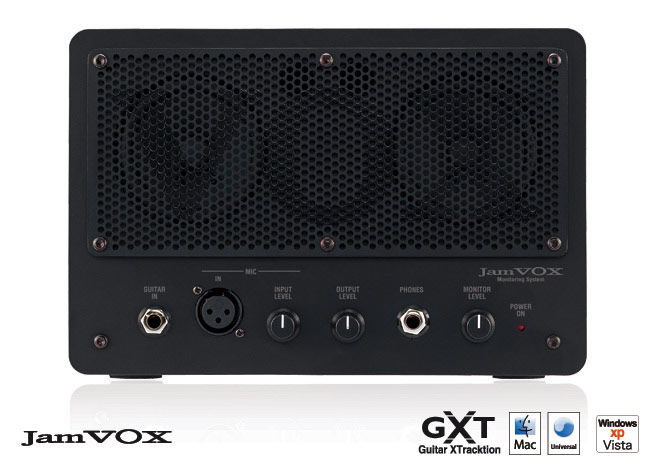
Even though I have some patterns and scales that I practice, I usually end up jamming to jam tracks that I either write myself or download. But I also like to jam to music from popular bands. The only problem with this is that the guitar parts are already printed, and it’s tough to jam over recorded stuff.
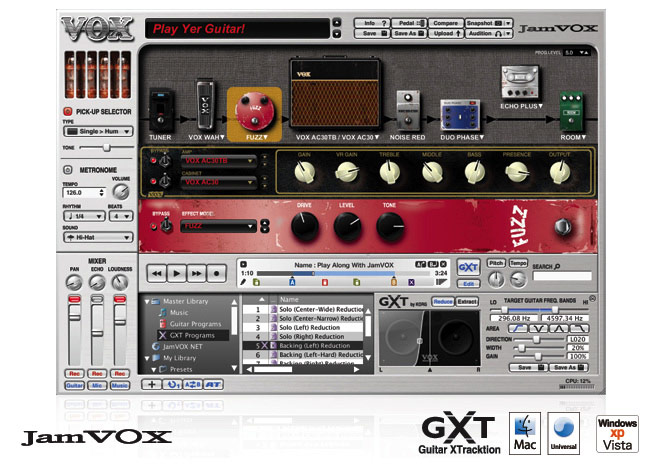
But VOX has just come out with the JamVOX, a jam and practice tool consisting of softare and a mini practice amp to play along with any MP3. The software apparently extracts the guitar part from any MP3, and you can rip away! I don’t think this is the first of its kind, but compared to the solutions I’ve seen in the past, this looks like it is the most well-integrated software/hardware solution to date. I’m definitely going to check it out as soon as I can! Here are the features from the VOX site!
Revolutionary new GXT (Guitar XTracktion) function lets you cancel or extract the guitar part of an existing song.
19 famous guitar amps and 54 effect units ranging from vintage to modern are provided as software.
Easy-to-use “drag and drop” interface enables guitarists to create their “dream guitar rig” without any advanced knowledge of amps or effects. Sound famous fast!
A music player feature with convenient functions for jam sessions or practice.
Import music files to jam along with from your favorite CDs, music library or MP3 player.
A dedicated USB monitor speaker is included, and there’s no need for complex wiring or specialized knowledge of computer music.
Two guitar play-along CDs containing 28 famous rock classics.
Check out a few videos:
After watching the videos, I’m REALLY stoked about JamVOX!!! And at $249.00, it’s a great deal!!! Can’t wait to give it a whirl!
Introduced at Winter NAMM, the Lava Cable CPS (Configurable Pedal Board System) is what Lava Cable claims is the first fully configurable pedalboard system ever. They may be right, and are certainly on to something. The CPS consists of individual, notched pedal “blocks” that fit flush together. You then screw the pieces together in whatever fashion you wish. Imagine growing or shrinking your board at will! For pedal junkies like me, this system could be a bit dangerous. The limited size of my current board makes getting more pedals prohibitive, and that’s a good thing. A system like this would allow me to expand it ad infinitum!
In all seriousness though, being able to flexibly lay out your board is a totally cool concept to me. You’re not reliant on the shape of the board nor, if you’re into doing it yourself, must you cut out your own templates. For more info, go to: http://www.lavacable.com/lavacps.html

 If I could go higher, I would with this rating. But this pick gets my highest rating!



 Guitar Gear