You ever pick up a guitar and just can’t seem to put it down? For the past few years, that has been “Pearl” my Blizzard Pearl Strat. I just love the way she sings, and she sings oh so sweetly. But ever since I got “Goldie,” a Saint Guitars Goldtop Benchmark to test out, I just can’t seem to put her down. It’s tough because ever since she arrived, I’ve been splitting my time between the two… Wish I had the problem with women when I was single. 🙂 <sigh> Oh well…
“Goldie” is a very special guitar, with a mahogany body, maple top, and solid rosewood neck. I know, I’ve already reviewed her, but she’s absolutely the perfect guitar – at least to me. The tone from the woods are so balanced and warm that when you play her, you have to just close your eyes and let her take you for a ride. And her neck… ah, her neck! What a thing of grace and beauty. The open-pore finish of the rosewood is so wonderful to the touch, you just want to run your hands up and down the fretboard and feel the sensuousness of her gentle curves. I know, I’m sounding kind of weird, but it’s the best I can come up with to draw a metaphor of how it feels to play this guitar!
Tonight, after I returned home from a quiet date for a cup of tea with the love of my life for Valentine’s Day, I retired to my studio to play around with Goldie. I was just noodling when I played a phrase that just begged to be laid down. So I figured out the chord progression that would go with the phrase, and here’s what I came up with:
Goldie has a bright, big voice, and true to all Saint guitars that I’ve had the priviledge to play, she has an even, dynamic range in all strings, up and down the fretboard. Unlike other guitars where you pluck the top two strings, and you get a loss in volume, forcing you to dig in when you play those strings, especially about the 12th fret, not so with any Saint guitar – it’s uncanny, and a mark of the care Adam Hernandez has put into his designs to ensure his guitars are resonant in any frequency!
Having a great amp to bring out the best in a guitar doesn’t hurt either. The amp I used is a soon-to-be-released prototype Aracom Amp, based upon the RoxBox 18 Watt, but with different tubes, and slightly different power handling. Sorry, I can’t be more descriptive at Jeff Aragaki’s request. You can be assured that once Jeff gives me the go-ahead, I’ll be writing a review of it, and it will be good. 🙂 This amp in particular is very pedal friendly, and I used a Tube Screamer to give me some grit on the lead, plus my new Hardwire Reverb.
In any case, I just wanted to share my excitement about this guitar. It simpy kicks ass, and paired with a dynamite amp, I’ve got a winning combination on my hands!!!
Summary: I never ceased to be amazed at the guitars Adam Hernandez builds. Here is yet another incredible tone machine but with classic looks and even better sounds.
Pros: This guitar oozes both visual and tonal bliss. The rosewood neck, mahogany body, and maple top combine to create thick but bright resonance that just stirs the inspiration juices.
Tone Bone Rating: 5.0 – There is literally nothing not to like on this guitar. It truly rocks the house!
Like a lot of folks, I love vintage and vintage-style gear. There’s a certain, je ne sais quoi, perhaps mojo (I know, it’s an overused term) about vintage gear that seems to harken back to the “good ol’ days” when things were handmade and sturdy. But when that style is expressed in a modern way, at least for me, something stirs in my soul, and I’m totally inspired. It has been this way with every Saint guitar I’ve had the priviledge to play, and that continues with the Goldtop Benchmark.
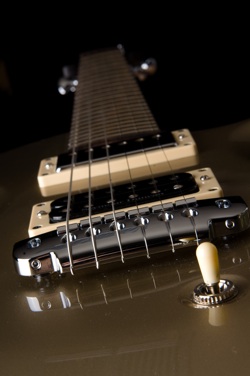
The Goldtop's Bridge
When I did my first Saint Guitars review of the Faded Blue Jeans model, I couldn’t believe how perfect the guitar was. The walnut body and neck, combined with the quilted maple top produced a bright and resonant tone that just begged to be explored to eek out all the possible tonal variations. With the Goldtop, the experience is still the same, but with that absolutely gorgeous finish, I’m experiencing a bliss that’s coming from both visual and aural sources.
Fit and Finish
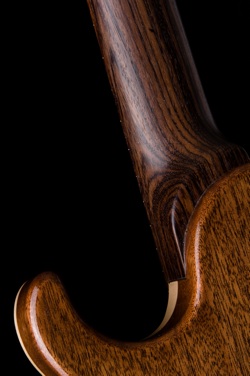
The Goldtop's Body and Neck
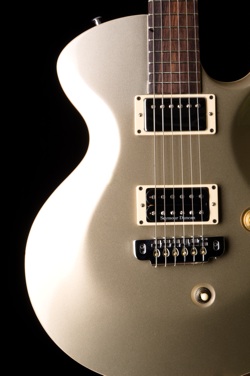
I’ve come to realize that there are some things in life that you can’t avoid describing with the heavy use of grandiose phrases, and the Goldtop definitely falls within this category with respect to how it looks. It’s perfect in every way. The creamy gold finish that almost looks white under light is a wonder to behold, but that’s just part of the equation. The gloss-finished mahogany body and open-pore rosewood neck add a certain sensuousness to the look of the guitar. I love that Adam had the foresight to keep the rosewood in as natural and organic state as possible. It feels absolutely wonderful when you grip the neck.
If I were to come up with a metaphor for how this guitar looks, it’s like admiring a beautiful woman that’s nicely dressed, but doesn’t need any makeup or other adornments to enhance her beauty. She’s self-aware and confident in how she looks, but doesn’t come across as aloof or unapproachable. In other words, this is a woman that has a purely natural and organic magnetism, and someone to whom I’d want to be close. That’s the response I have to this guitar.
Playability
I love the feel of natural grain, which is probably why I love my Strat so much with its maple neck. Again, for me there’s a certain sensousness in feeling the wood’s grain in my hand, and the Goldtop doesn’t disappoint in this department. When I first held the guitar, I was surprised and a little worried about the neck profile, which is wide by design, but add to that the C-shape, and I didn’t know if my relatively short fingers could reach all the frets, especially in the upper registers to hit the 6th string. But to my very pleasant surprise, I could get to those notes with ease.
As with all Saint’s that I’ve played, the Goldtop has a fast neck. The frets are just how I like them: Not too deep, but really lending themselves to a nice vibrato when you dig in a bit. And moving up and down the fretboard is a pure joy. The fret spacing is just right. As a guitar player himself, Adam really took great pains to get this part of the guitar right. For me, as I’ve said in the past, I’m not a really great improv guy, but I do play chords up and down the fretboard, and being able to move and nail the chords is very important. It’s as if precision was built into this guitar!
Adding to the playability is the arrangement of the neck and body. It’s very Les Paul-like, and that’s a good thing, which means that the higher frets are very easy to reach when the guitar hangs naturally from the straps. With my Strat, to get to the high frets, I have to physically shift the guitar to the left a couple of inches. Of course, part of that has to do with my gut 🙂 and it’s not really a problem, but I don’t have to shift the Goldtop at all.
How It Sounds
This is one of the best pickup combinations I’ve ever heard. The Pearly Gates in the neck has a nice, sweet, and smooth vintage tone. I liken it to a sip of a 25 year old Scotch. It’s warm and sweet and totally comforting. The Custom 5 is bright, but with a nice, taut low-end. When you turn up the gain on this pickup, you get the expected bright bridge tone, but because of the solid bottom-end, there is absolutely no “tinniness.” It’s just brighter sounding. This is a trait I’ve become accostomed to with all Saint Guitars. They’re the only guitars I’ve ever played that at least to me, have a usable bridge pickup. Combine the two in the middle switch position, and it’s pure heavenly tone. I could keep the guitar in this setting for practically everything I play, unless I wanted to get a super-smooth tone (neck), or need a bright tone to cut through the mix for a lead (bridge).
To me, the mark of a truly great guitar is balance in the dynamic response; more pointedly, that when you play high notes, the guitars volume doesn’t suddenly dive down. I don’t know how many guitars I’ve played that when I get above the 12th fret, the first three strings’ volumes literally sink, forcing you to really dig in with your pick to make them sound louder. That makes for a much more difficult playing approach, and is one thing that bugs me about my PRS SE II Soapbar. With that guitar, the first three strings are quite a bit lower in volume than string four through six. I’ve learned to compensate with my volume knob which thankfully is in a good position for on-the-fly tweaking. But with the Goldtop, and all the Saint’s I’ve played, this is not a problem. The dynamic response is balanced through all strings. It’s a testament to the resonance of the guitar. It picks up all the frequencies!
One thing I’ve learned about testing guitars is that the really important tonal properties are exposed when you play the guitar clean. I’ve played a lot of guitars that sound great when they distort, but just sound weak and hollow when you play them clean. Remember the beautiful woman I described above? This is her speaking voice: It’s rich and sensuous, and something you can listen to and never tire of it. Here’s a clip to prove the point:
I used an Aracom Amps Custom 45R that was re-tubed with 6L6’s from the stock KT-66 tubes, and Jeff kindly installed a Jensen Alnico speaker, replacing the Governor that I was testing with it. Both served to really open up the tone quite a bit with much more midrange – it started out very low-end focused.
What was amazing about this clip was that I wrote it earlier in the day, then recorded it 15 minutes before I had to leave to take my son to his lacrosse game, and just saved the audio file. When I finally sat down to listen to it, I couldn’t believe what I was hearing. Mind you, the clip is not EQ’d or mastered in any way. That’s the natural sound of the guitar out of the Custom 45R. I added just a touch of reverb on the amp, but other than that, it’s just the guitar, and the tone is – at least to me – amazing! It almost gives off a chorus effect. I thought it was due to the reverb at first, but when I came home, I played the song without any effects, and that chorusy tone was still there! I was blown away!
Overall Impressions
I didn’t think you could improve upon perfection, but the Goldtop is now my standard of perfection. As I wrote in a previous article, I’ve been in a bit of rut with writing music as of late, but with the Goldtop, I’m getting inspired again. It’s a marvelous guitar!
Ran across these demos on YouTube, and thought I’d share them here. This first one is from VOX at the NAMM show, and sound quality stinks, but the dude’s explanation of the differences between the two different voices (British or American):
This next clip comes from someone apparently in Japan, where the pedal was recently released. The sound quality is much better, and he inserted little conversation bubbles to show his settings. Picture quality isn’t that great but the quality of the sound makes up for it. Plus, it’s kind of amazing that this dude has such clever and articulate feet that he can make all the adjustments with his toes! HA! He’s not bad at guitar either! Check it out!
Especially after viewing the second clip (despite Mr. Clever Toes), this is definitely my next pedal – at least until after I try it out for myself. 🙂
This piece of gear is so new, it’s not even in production yet, but I just had to share the news!
A few months ago, I was watching a video on YouTube about the Faustine Amps VT-58 amp, which is based on the 5E8A “Low Power Twin” circuit. Very nice, compact amp. But that’s not the story. Faustine is just about to debut a standalone version of their built-in attenuator.
One thing to note about Faustine amps is that all models have a built-in attenuator that gives you from -3dB down to -18dB attenuation. I played at VT-57 at Tone Merchants, which is a 35Watt, 3 X 10 amp – classic, sweet Tweed tone. But it was the built-in attenuator that really sold me on the amp, and actually one of the things that started me thinking about using an attenuator in the first place. As you know, I ended up going with a Dr. Z AirBrake, which has totally served me well, and will continue to do so in the future, but I remember the attenuator working so well on the Faustine, that I was wishing that Faustine had a standalone attenuator.
My wish has been granted.
If you watched the video (and I will present it in its full glory at the end of this entry), the reviewer mentions it being released in early 2009. That prompted me to contact Tim Gregoire, Faustine Amps designer and owner to see if and when it will be released. According to Tim, full production models will be available by the end of this quarter or early next quarter. He’s currently building a set of pre-production models for select clients in the SoCal area, and once he’s done with those, he’ll begin production of generally available models.
So what’s so special with this attenuator? From my personal experience with the built-in one, the attenuator circuit Tim has created is totally transparent – at any level. While I love my Dr. Z, at high attenuation levels, it starts sucking tone, and that’s not good. But with the Faustine, I didn’t detect any tone loss, even when I cranked up the attenuation to its highest setting!
According to Tim, the standalone model will have a wider attenuation range than the built-in attenuator. He shared that it will attenuate within the range of -2dB all the way down to -26dB – that’s conversation-level! Freakin’ awesome! No price yet, it probably won’t be cheap. But sometimes you have to pay for transparency. Once out, the unit will be sold exclusively for a time through Tone Merchants. Stay tuned, as I will hopefully be able to get a unit to review!
Here’s the video of the VT-58. This is a great little low-power amp, with wonderful, vintage Tweed goodness!
I don’t know why I love overdrive pedals so much, despite my recent discovery of the beauty of using a clean boost. I just do. I can’t help myself. So when I hear about new drive pedals appearing on the market, I’m keen to check ’em out and better yet, see if I can play ’em; but that’s besides the point of this entry… 🙂
Anyway, I just found out about a brand-spankin’-new company called Fairfield Circuitry, who’s just come out with a new overdrive pedal called “The Barbershop.” In their own words,
“Have you ever sat in a barber’s chair wishing your tone was as slick as your freshly shaved upper lip? With the Barbershop Overdrive on your pedalboard, you could keep your moustache and sound good doing it.”
That’s pretty amusing! But the sound of this pedal, at least from the samples provided on the product page, is absolutely serious. According to the Fairfield Circuitry spec sheet, this is an original design and completely handmade from JFET’s. It has three controls: Drive for driving the gain, Sag (which I find very cool) to control voltage into the internal amplifiers, and Volume to control output volume without changing the effect. The Volume control is a very cool feature – it’s like a Master Volume on an amp. I dig it!
The Barbershop is the first of three pedals to be produced by Fairfield Circuitry. Two more will be coming out in the near future, but there’s very little information on these right now. In any case, check out the site for yourself!
And by the way, this pedal, though handmade is actually quite affordable: $175 CAN. That converts to $141.68 US! Not bad at all!
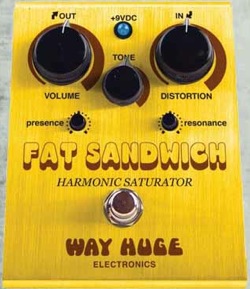
Okay, okay already. Another overdrive pedal. Just when you think you’ve seen ’em all, another pops up. But harken back to the early 90’s, and you’ll find Way Huge pedals gracing the boards of many guitar gods. Way Huge closed their doors in 1999, but a recent partnership with Dunlop has revived Way Huge, and the Fat Sandwich is one of the products of the partnership.
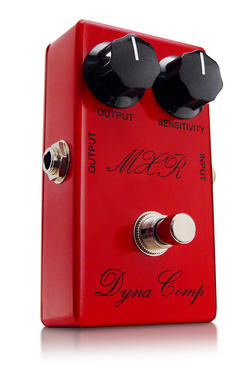
Over a year ago when I was looking for a compression pedal, one of the pedals I reviewed was the MXR Dyna Comp, along with the Boss CS-3. I didn’t like either of them. The CS-3 was way too squishy and I thought it significantly altered my tone. The MXR wasn’t quite as bad, but I still thought it did enough tone alteration to pass on it.
As many might know, I ended up going with the Maxon CP9 Pro+, which I felt didn’t alter my tone, no matter how far I squeezed the signal. I love the pedal, and when I play my Strat, it’s almost always on.
But in my search for a compressor back then, I ran across several discussions on the classic Dyna Comp from the 70’s. People raved about its transparency, and how it was a highly sought-after pedal. In fact, a search on eBay revealed that I couldn’t get a vintage one for under $250. Yikes! For a pedal that brand new goes for under $80, the vintage Dyna Comp must’ve been really special.
Well, the folks at the MXR Custom Shop have produced a limited run of the classic Dyna Comp replete with the script lettering, and more importantly, the EXACT same circuitry as the original. According to the article I read, the IC’s used in the original pedal haven’t been produced since the 80’s. But the Custom Shop folks seemed to have found some – at least enough to produce a limited run.
I looked on the Dunlop site for any information about the new pedal, and there was none to be found. No prices either. Count on this baby to hit collectable status real quick. Also count on it being priced a hell of a lot more than its newer sibling, which you can get at Musician’s Friend for $69.99. Now given that I already have a kickass compression pedal, I’m probably won’t be in the market for one, but I sure would love to get my hands on one just to review it.
For those of you who are a bit dubious of using a compression/sustainer, please don’t scoff. I will admit that for high-volume, high-gain situations, a compression sustainer is not really needed. You’ll get a lot of compression from your saturated power tubes. But for those of us who mostly play in low-volume applications, a compression/sustainer is a total life saver.
The restaurants and church that I play at have high ceilings, and of course, there’s the ambient crowd noise to deal with – especially at the restaurants. To help cut through the crowd noise, and to deal with the expansive acoustic environment without turning up too loud, I couldn’t do without a compression pedal. This is especially true when I kick in distortion, which tends to “spread” out your sound a bit. With a compression pedal, you fatten up your tone and produce a more even volume, albeit a tad less dynamic.
You might think that the loss volume dynamics is a bad thing, but before I got my CP-9, I had to fight my volume all the time – it was frustrating.
Apparently, the newer M-102 version with serial numbers starting with ABxxx are true bypass, and sound really nice. Maybe the one I tried at the time was not one of ’em. Oh well… In any case, if you’re interested, you can check it out at Musician’s Friend:


 Guitar Gear