Feeds:
Posts
Comments

Posts Tagged ‘new gear’

Click for larger image

Sennheiser ew 172 G3 Wireless System

Summary: If you’re looking for a great instrument wireless system that is both easy-to-use and a snap to set up, look no further!

Pros: 1680 available frequencies make this ideal for busy RF venues. Super easy to set up sensitivity levels. Transmitter sports a metal housing, so durability shouldn’t be an issue. Integrated guitar tuner in transmitter – works great! 25Hz low-end response – great for bass!

Cons: None.

Features:

  • Sturdy metal housing (transmitter and receiver)
  • 42 MHz bandwidth: 1680 tunable UHF frequencies for interference-free reception
  • Enhanced frequency bank system with up to 12 compatible frequencies
  • High-quality true diversity reception
  • Pilot tone squelch for eliminating RF interference when transmitter is turned off
  • Automatic frequency scan feature searches for available frequencies
  • Enhanced AF frequency range
  • Increased range for audio sensitivity
  • Wireless synchronization of transmitters via infrared interface
  • User-friendly menu operation with more control options
  • Illuminated graphic display (transmitter and receiver)
  • Auto-Lock function avoids accidental changing of settings
  • HDX compander for crystal-clear sound
  • Transmitter feature battery indicatation in 4 steps, also shown on receiver display
  • Programmable Mute function
  • Integrated Equalizer, Soundcheck mode and guitar tuner
  • Contacts for recharging BA 2015 accupack directly in the transmitter
  • Wide range of accessories adapts the system to any requirement

Price: $499 street

Tone Bone Score: 5.0 ~ I waited a LONG TIME to pull the trigger on a wireless system, and while I could’ve gotten a cheaper one that would work well, but it was hard to argue with the frequency coverage of this unit. The added features of a guitar tuner and EQ are great, but the ease of use factor really hit home with me as well.

As I mentioned above, I’ve been holding out a long time to get an instrument wireless system. When I finally pulled the trigger, I decided upon the Sennheiser G3 Wireless system; first and foremost because of the number of frequencies it has on tap, but honestly, also because it’s a name I trust as my performance mics are Sennheiser. I’m not being a cork-sniffer here. I swear by the brand because of the years of great performance I’ve gotten out of other Sennheiser equipment, so it stands to reason to trust it for something completely new.

As it turns out, true to my past experience with Sennheiser gear, there was absolutely nothing to be disappointed about with the wireless system. I took it to my church gig yesterday and it well, just worked, with no tweaking on my part; save for adjusting the sensitivity levels which I didn’t even think to do when I first opened up the box. In fact, I didn’t even read the manual when I took it out to try in my studio. I just attached the antennas to the receiver and plugged in the instrument wire into the transmitter, popped in the batteries, and let ‘er rip. It literally took less than a couple of minutes to get up and running. Insofar as my church gig is concerned, it was a great venue to put the unit through its paces, as there are potentially several wireless units in operation at one time, including my own wireless headset mic. I’ll talk more about the system’s operation below.

In any case, since this isn’t something that actually makes music, my review areas are going to be a bit different from my normal reviews.

Ease-of-use

As I indicated above, the unit’s pretty plug and play. But of course, you should check the sensitivity of the transmitter and receiver to make sure you’re not overdriving the unit. The LCD’s on both the transmitter and receiver makes setting sensitivity of either unit a snap. Both have an active meter and navigating to the sensitivity menu is just a couple of button presses. Sennheiser did a great job with the menus to make them only two levels deep, so you won’t have a problem getting to the parameter you need to set.

Durability

Both transmitter and receiver have very sturdy metal housings, so you needn’t worry about the units cracking. The transmitter has a real solid feel, and that instills confidence that you don’t have baby the unit, though of course, it’s always good to take care of gear.

Performance

Despite having 1680 UHF frequencies to scan, the receiver locks on to a usable frequency almost instantaneously once you turn it on. That is such a boon to using the unit. You switch it on, and you can use the unit.

One of the tests that my sound guy and I did was for me to walk a distance away from the receiver to see if it lost connection. I honestly don’t know what the maximum range is, but no matter how far I got away – I got about 100 feet away – the transmitter and receiver didn’t lose their connection to each other.

To save battery life, when I’m not playing I always switch off the transmitter on my headset mic. I did the same with the G3 in between songs. Every time I switched it back on, making a connection to the receiver only took a couple of seconds.

Final Verdict

I haven’t even begun to explore all the different features that this system has; one of which is a cable emulation mode that simulates a cable’s capacitance to ensure consistent operation of your effects and amp settings whether you’re plugged in or wireless. This a great feature. Admittedly, I didn’t use this, but my rig sounded pretty much the same with the same dynamics once I dialed in the sensitivity of both transmitter and receiver. Or it could be that the only thing I obsess about with my tone is if it sounds good and I’ve got dynamics. Minute changes due to changes in my chain don’t really bother me too much. So if I got a slight change in tone, since my sound with the G3 system was good with no loss in dynamics, it didn’t trigger anything displeasing with me.

But other than performance and sound and all the other stuff I discussed, going wireless is simply fantastic. I like to move around a lot when I perform, and not being tied to a spot by a cable is so freeing! It really boosted my ability to lead musical worship, and that is so COOL!

Read Full Post »

When you’ve got a guy like Lance Keltner singing the praises of your equipment and calling you a genius to boot, you must be doing something right. Jeff Aragaki of Aracom Amps is someone I’ve been praising for quite awhile, and I’m glad he’s finally getting the recognition he deserves.

As far as the DAG unit is concerned, that’s available exclusively through Destroy All Guitars. I’ve played through one of those units myself, and the high-cut filter works great, and definitely takes the edge off, without throwing a blanket over your tone and dynamics like many attenuators do that include one. If you have an amp that outputs lots of highs when cranked – or somehow hear high-frequency transients –  then the DAG unit is the way to go.

Coming up…

While Jeff has gained lots of popularity with his attenuators, often overlooked are his wonderful amplifiers of which I have three. In the next couple of days, I will be getting a 50 Watt Evolver to test out in my studio. I’m so excited! I’ve played through an Evolver at Jeff’s workshop and that amp has tons of balls! It’s definitely Marshall-esque, but with Jeff’s particular twists. I’m excited to be getting this unit for a full test!

Read Full Post »

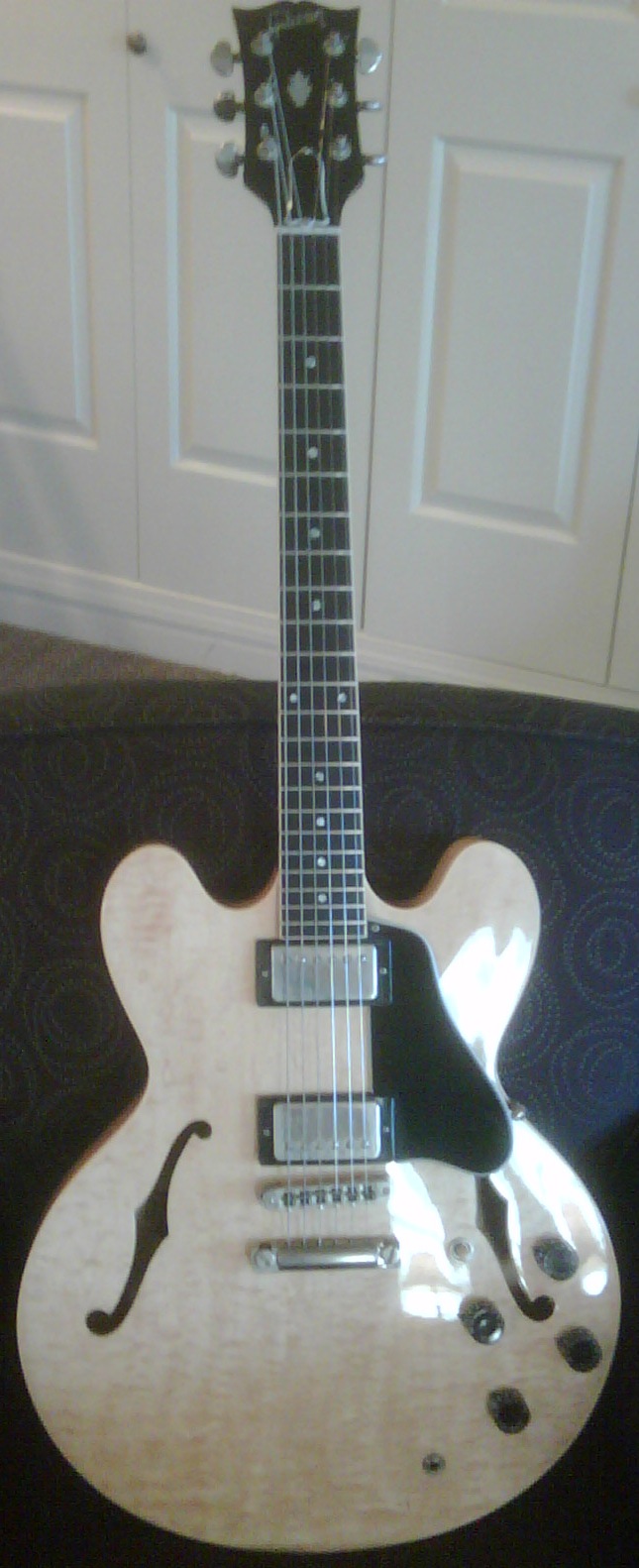
Click to enlarge. Sorry, phone pic


1987 Gibson ES-335 Custom St (St = Standard? Studio?) Summary: A rare beauty with a natural blonde finish with classic ES-335 tone!Pros: Absolutely tip-top shape for a guitar of this age. No major dings, but has been well-played. Sounds amazing!Cons: None.Features:

  • Mahogany neck
  • Bound carved flame maple top and maple sides and back
  • Bound ebony fretboard
  • Medium jumbo frets
  • Bone nut
  • Original chrome hardware (look like Tone Pros)
  • Original chrome pickup covers
  • 60’s-style lower profile neck
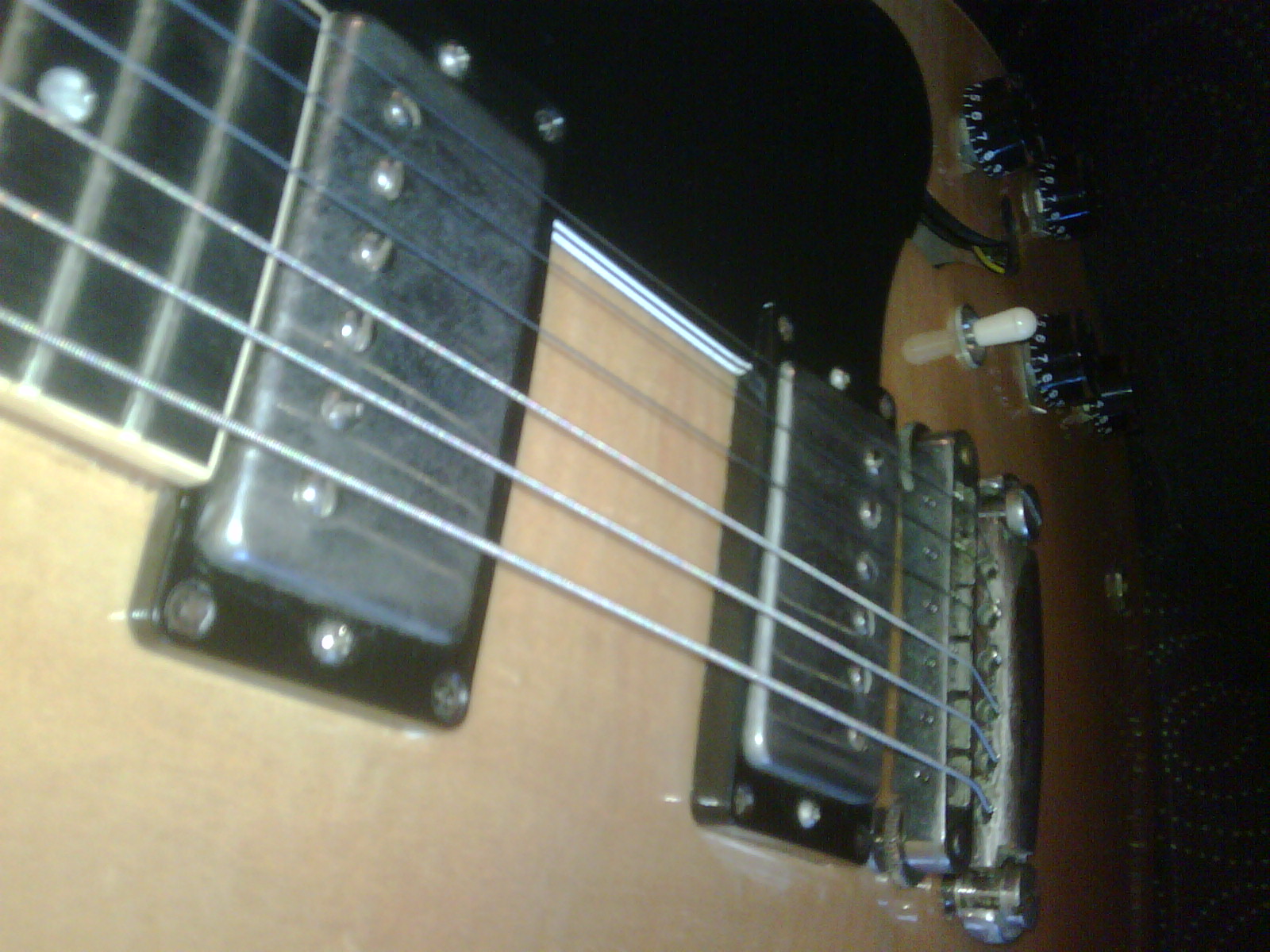
  • 50’s-style pickup wiring (either volume knob acts as a master, but the tone controls have a different cap value that doesn’t throw a blanket over your tone when you turn it down – this is crucial for playing in the bridge pickup).

Tone Bone Score: 5.0 ~ This guitar sounds and plays like a dream! While the action is a just a tad higher than I like it, the guitar still plays ultra-smooth.

I already talked about how I happened to get this guitar, so I won’t bother rehashing the details. Suffice it to say that I got this guitar for an absolute steal. In a way, this guitar is sort of redemption for me having sold my original ES-335 a couple of years ago when times were tough. So getting this guitar is a real milestone for me.

Fit and Finish

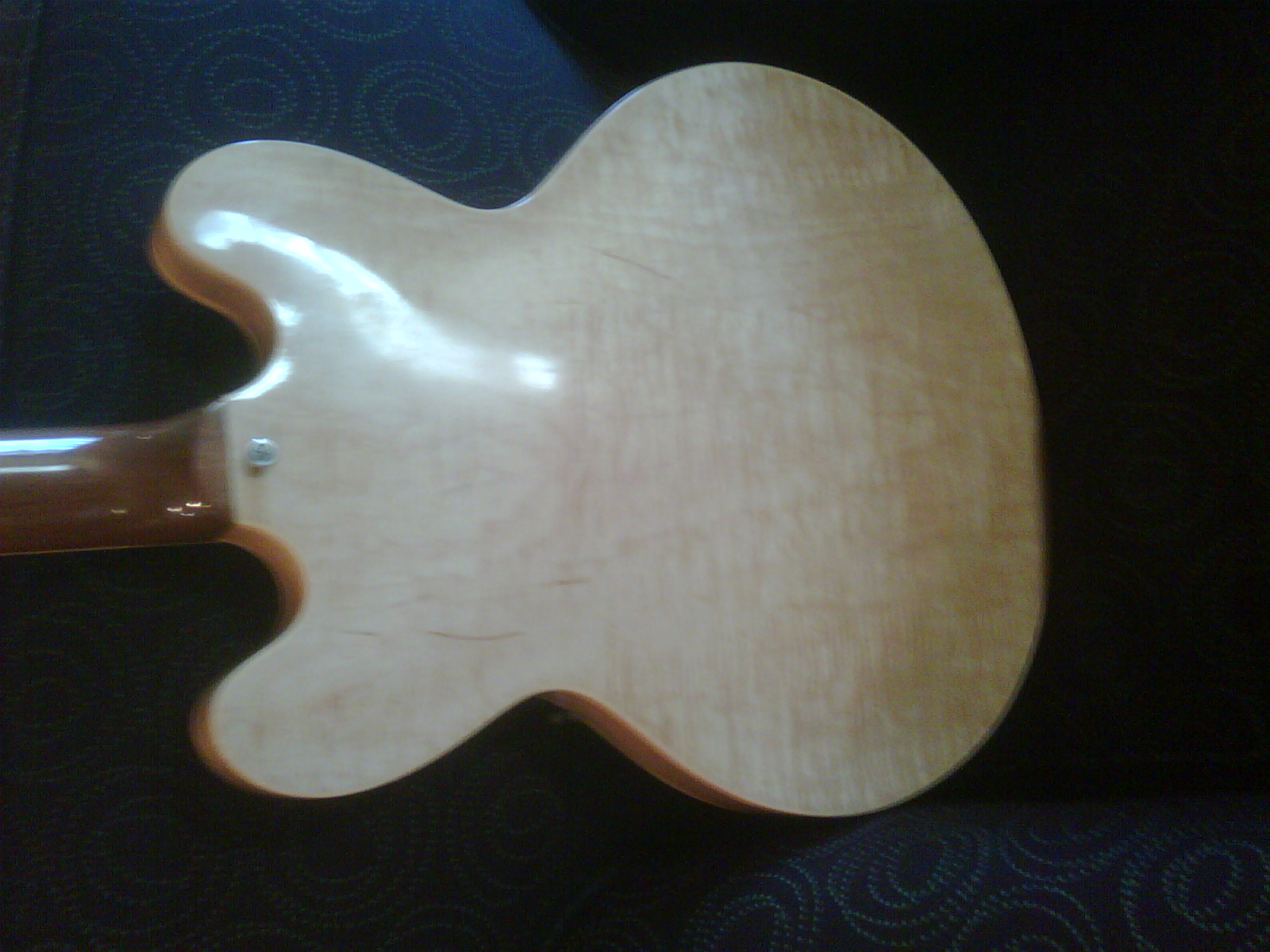
For a 23 year old guitar, it is in absolutely amazing shape. The body has some very minuscule dings in it that fortunately don’t penetrate the finish. I didn’t notice any checking in the gloss either, though that may occur after a few more years if the finish Gibson used was a nitro lacquer. The hardware is aged as to be expected, though there’s a little oxidation in the brass stop tailpiece that can easily be removed. The pick guard has pick marks on it, but no scratches and all the joints are perfect. There’s some fret wear, but nothing major where the frets would have to be replaced. As for the fretboard itself, it’s gorgeous. I love ebony fretboards as they’re so smooth to the touch, and it makes bending a breeze. The back of the guitar has a few nicks that don’t penetrate the finish – and no buckle rash. All in all, for as much as this guitar has been played, I’m just amazed at its overall condition.

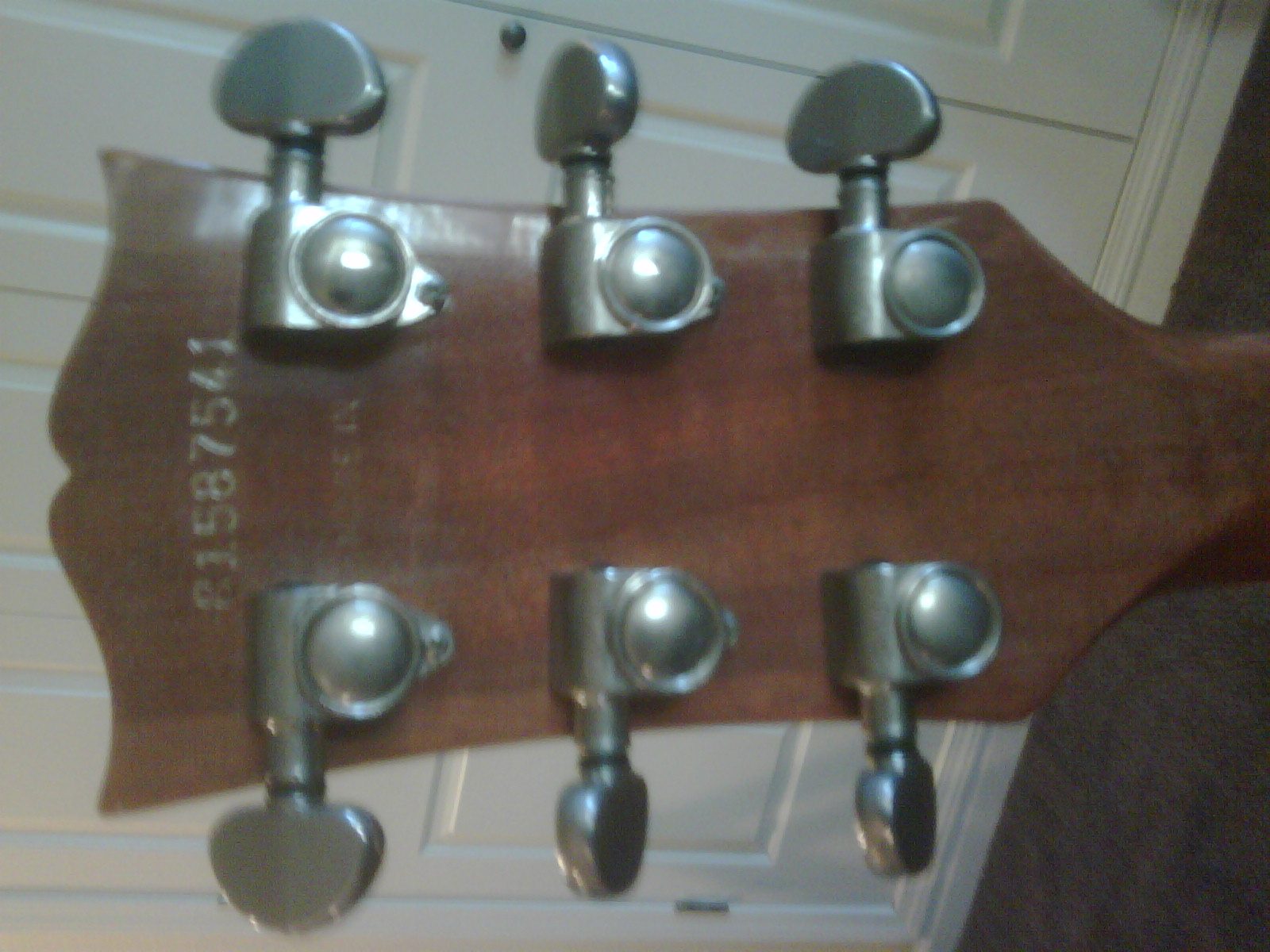
Here are some pictures I took with my cell phone. Sorry if the quality is low. I’ll have better ones later…

How It Sounds

This guitar has all the tone I was expecting out of an ES-335, but as it has been broken in and the wood aged, the tone is A LOT richer than what I remember with my original ‘335. As far as pickup positions go, there are three as usual, though I understand that some models did have coil-tapped humbuckers; not this model, though.

I’ve always loved the gorgeous, deep tones of the neck pickup on an ES-335 and this guitar doesn’t disappoint in that department. This is where the ES-335 gets very close to the deep, rich tones of an archtop, but it’s well, different…

Kicking in the bridge pickup in the middle position gives the ES-335 its distinctive “hollow” tone. It’s really hard to describe, but that I’m a firm believer that that middle pickup selector position is what draws people to this guitar. It certainly is one of the main things tonally that originally drew me to the ES-335 in the first place! With the bridge dimed and adding more or less neck pickup, you can get tons of great tones!

The bridge pickup is bright as to be expected – perhaps a bit too bright – but the wonderful tone knob nicely takes the edge off the brightness. I did notice that the bridge pickup is not significantly louder than the neck pickup, which leads me to believe that the original owner lowered the height of that pickup. When I get home from vacation, I’m going to raise it a bit because I prefer to have that dramatic change in volume.

In any case, here are some clips:

Neck pickup, clean

I love the haunting character of the neck pickup on and ES-335. The wonderful thing about this pickup is that it produces a very deep tone, without sounding like an acoustic. Adding a little reverb “grease” only accentuates the haunting effect.

Middle position, with some grind for rhythm; bridge pickup for lead.

In this, I have the bridge dimed, and the neck about halfway for the rhythm part. The lead is just the wide-open bridge pickup. Notice that it’s bright and almost twangy.

Middle position, clean; both rhythm and lead

I had to do a bit of a tribute to the great Andy Summers with this last clip… 🙂 I added a touch of reverb and chorus to get that “Every Breath You Take” vibe.

For all the clips, since I’m on vacation, I don’t have an amp, but I always carry around an IK Multimedia StealthPlug to facilitate my songwriting or, in this case, create clips. I used AmpliTube Fender. For the clean clips, I used a ’65 Twin Reverb model, and for the crunchy clip, I used a ’59 Bassman.

Cool Funk Lead

There are two parts to this next clip. In the first part, I play in the neck position, then switch over to the bridge in the second part plus attack a lot more. Unlike a Les Paul, the 335 doesn’t sustain as much, but that’s not a bad thing. The net result is that overdrive tones tend to be much more tight and focused. BTW, the amp used here was an Aracom PLX18BB in its drive channel.

Overall Impression

This guitar really moves me. She plays so sweet and sounds so good that I truly am inspired. Of course, the price I happened to pay for it didn’t hurt at all, but irrespective of my price, I’d still give this guitar 5 Tone Bones. It’s really an incredible guitar! I can’t wait to get it home and to a luthier for a professional setup. The shop owner did a pretty good job of setting the guitar up, but he strung it with 11-53’s which, while certainly playable, aren’t really my cup of tea. I’ll have the shop put on a set of pure nickel 10’s.

Read Full Post »

Or… you never know what you’re going to find on vacation…

Click to enlarge. Sorry, phone pic

I’ve been up at Clear Lake, CA since this past Saturday, and wouldn’t you know it, on Sunday morning when the family and I stopped off at a Safeway in Lakeport to get some provisions, the shopping center just happened to have a musical instrument store called Bandbox Music. Of course, gear freak that I am, I couldn’t pass up looking into the window to see what the shop was like. As Lakeport is a small town, I wasn’t expecting to see much, but what the heck! You never know what you may find!

As I walked up to the window, I noticed a gorgeous, natural-finish Gibson ES-335 in the shop’s front case. I could tell that it was used, but it was in practically pristine condition, save for the pickup covers and stop tailpiece which were tarnished; otherwise the guitar looked great. I could tell that it had been played a lot, but the original owner had taken care of the finish for the most part as from the distance of about 6 feet that I was standing from the case, the only wear I could see where pick marks on the pick guard. Unfortunately, the shop wasn’t open on Sundays, so I made it a point to return to the shop the next day to check it out.

Couldn’t make it Monday, but we were going to Lakeport on Tuesday so the family could check out the town. So on the way to downtown, I had them drop me off at the shop. I walked in and was greeted by a bunch of elderly gentlemen sitting around, shootin’ the breeze. I didn’t want to interrupt their conversation, so I waited patiently until the shop owner asked me if I needed help. I pointed to the ES-335 and said that I’d like to give it a whirl. He graciously responded and removed the guitar from the case, and instructed me to grab a cord.

Ron, the shop owner, proceeded to tell me about the guitar in that it was a 1987 ES-335 Custom Studio. He got it from the son of the original owner (more on that sad story later). He showed me the case, which was the original case it came in, along with the Gibson warranty papers, and the original Guitar Center invoice. While he spoke, I did a visual inspection of the guitar. There were a few miniscule dings on the back, and a couple on the front, but nothing that penetrated the finish. I remarked to Ron that the guitar was in remarkable shape, and he said it was owned by a player, and that guy took care of the guitar.

It probably sat for quite awhile in a closet somewhere, as the metal was tarnished – the original owner probably played it so much that he never bothered to clean it. Ron said he spent a lot of time cleaning the guitar when he got it, but was really surprised at the shape the body was in – so was I! Anyway, I plugged her in, tuned her up, tweaked the amp, to a nice clean with a little reverb “grease” and was immediately greeted with that distinctive rich, full tone that only an ES-335 can make. I was in tonal heaven!

The ES-335 and I have a history. When financial times were rough for my family, I had to sell my original 2003 ES-335 for some cash. When I did that, I swore that I’d never sell one of my guitars again. Hearing that guitar and how it sang reminded me of “Rusty.” Rusty was my first high-end guitar. I was so proud to have him, but putting food on the table was more important at the time, so I had to let him go. This ’87 would be redemption if I got her.

After playing her for well over an hour, I finally asked Ron how much the guitar was. He said $1200, but he knew it was worth far more than that as he had seen the exact same model in similar condition going for almost triple the price on EBay. I was taken aback by the price! I keep tabs on many guitars, and I knew he was in the ballpark with how much it was worth. He said he didn’t get it for much (I didn’t ask his buying price out of politeness), so he was willing to move it for far less than its market value.

I didn’t do the impulse buy right then and there, and told him I needed a couple of days to think about it, and I’d roll the dice and let it go back into the case. Over the next couple of days I did some research on the guitar. The first place I looked was on EBay, and sure enough, the same make, model, and year ES-335 has an asking price of $3500! I looked at several ES-335’s from the surrounding years, and they’re also going for similar prices!

So I made my decision, and called up Ron this morning and asked him to put the guitar aside, as I’d go to the shop later today. Ron repeated the price of $1200 and I said, “That’s the price you quoted Tuesday.” So I got it for $1200 OUT THE DOOR – no tax! OMG!!! I can’t tell you how jazzed I am about this absolute steal, but I think the best thing about it is that I didn’t have to make a lowball offer. Everyone won in this transaction, and that really pleased me as well!

Wow! Sorry, I got a little carried away… But I do want to tell a little history of this particular guitar…

Don’t know the name of the original owner, but he was a apparently a smalltime pro player. He passed away last year, and left his son his two guitars, a Les Paul (which Ron sold), and the ES-335, which is apparently what he played the most. According to Ron, the son came in to sell the Les Paul first, then a couple of weeks later returned to sell the ES-335. Ron doesn’t know exactly what the son was going to do with the money, but as there’s a real crystal meth problem in the area, he could make a fairly educated guess. That’s sad to me, and it’s this lesson that I want to pass onto my kids: Don’t sacrifice your family’s heritage to satisfy a personal craving. You’ll just end up regretting it.

By the way, I’ll have pictures and sound clips in my next post. 🙂

Read Full Post »


Click to enlarge

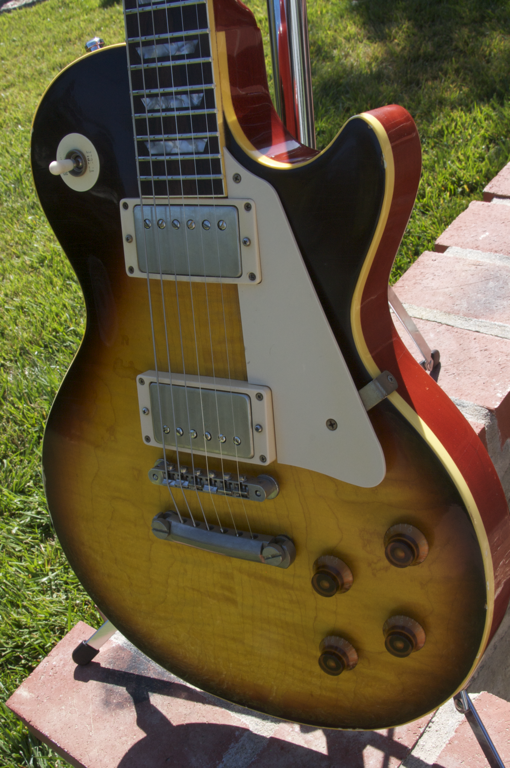
1959 Les Paul Replica

Summary: About as close as you can get to the real deal without paying hundreds of thousands of dollars.

Pros: Bright and super smooth tone, and sustain that’s absolutely to die for! This guitar is everything I imagined a ’59 Les Paul to sound and play like. Sounds and plays better than any Gibson re-issue I’ve ever played.

Cons: None

Features:

  • One piece Honduran (Old Growth) Mahogany body and neck (long tenon), 1959 neck profile
  • Brazilian rosewood fretboard with trap inlays
  • Lightly figured (realistic) maple top
  • Holly headstock veneer
  • RS Guitarworks (Winchester, KY) Nitro Lacquer finish with light aging in a Perryburst (Joe Perry burst colors), includes RS Guitarworks Certificate of Authenticity
  • PLEK and nut work
  • RS aluminum tailpiece
  • Tonepros AVRII bridge (Locking) ABR-1 Bridge with Maple Flame Mod (extra long stainless steel bridge studs)
  • Pots and Tone Capacitors from RS Guitarworks
  • Bone Nut
  • Wolfetone Dr. Vintage pickups with aged Nickel covers
  • Single line Kluson tuners
  • Weighs 9.68 lbs and is a rock machine
  • Year Built:  2008

Price: Vary from $4000 to  $20,000 depending upon who builds it (more on that below)

Tone Bone Score: 5.0 ~ This guitar is a dream come true! I recently wrote on my Facebook status: “There are guitars and then there are Les Pauls. There is no substitute.”

The first thing you’ll notice in the review is that I didn’t name the luthier of this guitar. That’s because I didn’t want to “out” the luthier, lest Gibson finds out and sues them for copyright infringement; that’s how close these replicas get to the original. But despite the risk of litigation, there’s an incredibly active underground market for these replicas, and having played around with this one for a few days, I don’t think that market will ever die. BTW, if you want to know who the luthier is, just send me an e-mail (goofydawg “|” guitargear.org), or if you’re on TGP, send me a PM.

Besides, replicas like this put Gibson back on the relevance map. Can you say Slash and GnR’s “Appetite for Destruction?” Whether or not Gibson likes it, the replica that Slash played made the Les Paul popular among guitarists again.

Forget how close it may come to the sound, feel, and dynamics of the original. Playing this guitar is like a religious experience! With this particular model, the original owner had the neck slightly tapered near the heal to relieve some of that “baseball bat” girth. It worked marvelously! Combined with the PLEK treatment, this guitar is absolutely easy to play. I usually have to take a few days to get to know the feel of a new neck. I even had to do this with my beloved Gibson Nighthawk. But with this guitar, I felt right at home!

Weight-wise, it has some heft at 9.6 lbs., but it’s so comfortable, and once I started playing, I completely forgot about the weight.

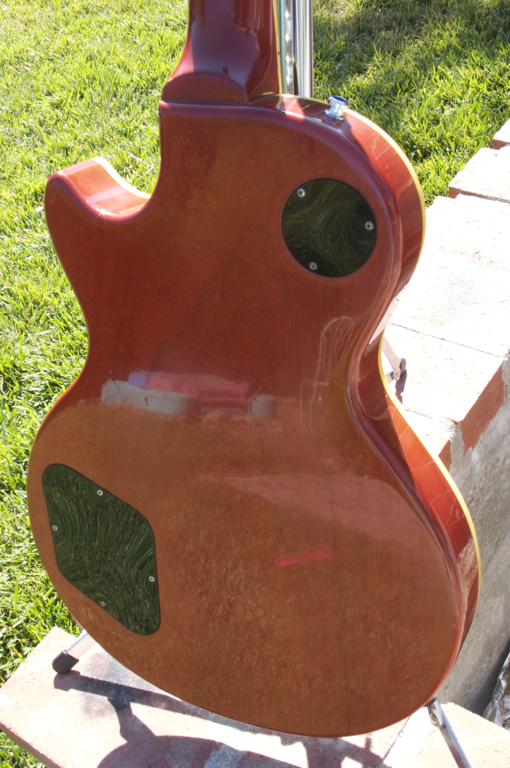
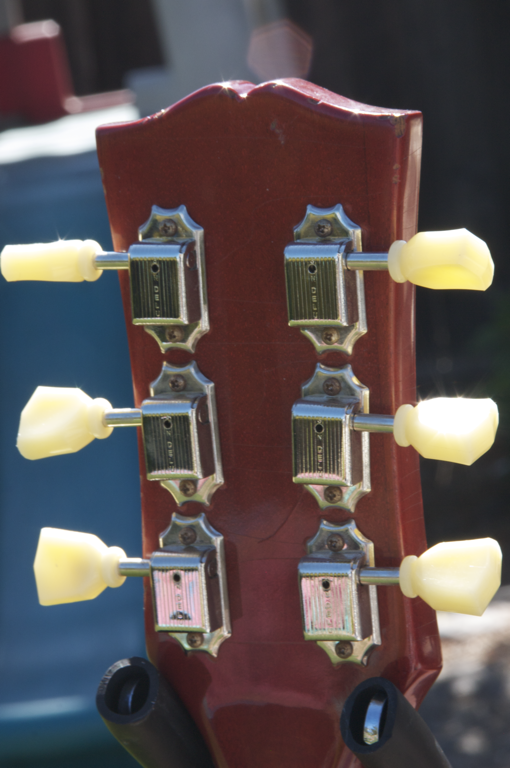
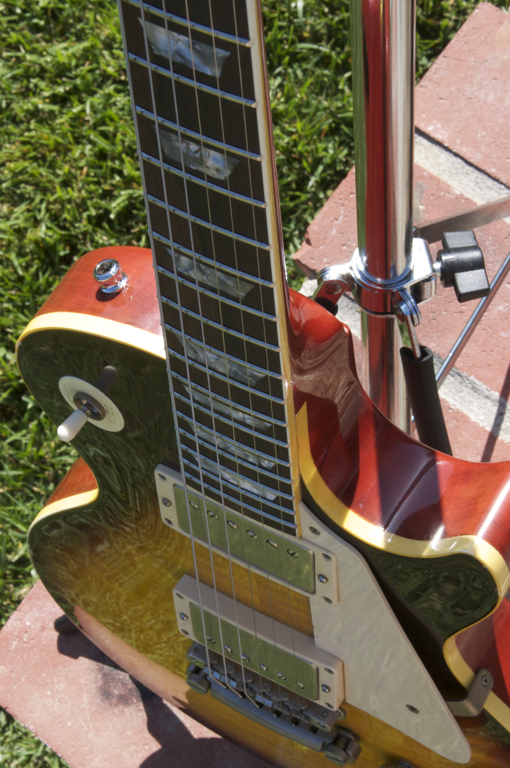
Here are some pictures:

Pictures courtesy of Bennie Delumpa (my son).

Fit and Finish

As you can see from the pictures, the guitar has been lightly relicked. I’m not normally a fan of aging a perfectly good guitar, but the purpose behind the aging was to produce a guitar that looked like a well-taken-care-of guitar from 1959. It has a couple of nicks on the binding of the body, and the lacquer has been very, very lightly checked. But other than that, it’s gorgeous.

How It Sounds

Unfortunately, my studio is still in a bit of disarray after the construction I had done on my house, so I don’t have my usual sound clips. But all I can say about the tone of this guitar is that it is nothing short of spectacular. The tone is on the brighter side of midrange, but the guitar produces all sorts of overtones and harmonics. The pickups used in the guitar are not hot at all, but that just makes it real smooth. Another thing is that the cap values used for the tone knobs make them quite usable. You can really knock the tone down, and the tone will not muddy up. I love that, as it gives me that much more tone shaping capabilities that I can do right at the guitar, as opposed to doing it at the amp.

The guitar also sports the classic Les Paul “bloom” as the body resonates, and boy does it resonate! Pluck a string, and you get your note, and then the body starts resonating, and you can hear AND feel the swell of the string vibrations as they course through the tone woods. I just close my eyes and go off to Never-never land.

There’s a lot to be said about old growth wood that has been drying for 50 years. Jeff Aragaki, who is quite knowledgeable about Les Pauls (he has many) is convinced that the combination of materials (old growth woods, hide glue, nitro-cellulose lacquer, correct hardware, etc.) that were used on this guitar make its sound that special. I really have never played a guitar that sounds and responds to like this!

I was just thinking that once I do manage to get a recording of this guitar, it just won’t do justice to the feel and dynamics of this spectacular specimen. I’ll hopefully be able to capture at least some of what I’m talking about.

Overall Impression

As I said above, forget about how close it may come to the original. I’ve never played a guitar that felt and sounded as good as this. I’ve never played a real ’59, but this guitar just oozes Les Paul goodness, and it’s everything I believe a Les Paul should be!

Read Full Post »

Even though I got this news via a press release, it doesn’t surprise me at all that DBZ won the Best In Show award this year. I’ve been quietly following DBZ since they hit the scene, and I’ve appreciated what Dean Zelinsky  (founder of DBZ and famous for Dean Guitars) has been trying to accomplish with his guitars from the start; that is, build great looking, great sounding, and great playing guitars at a GREAT price. Yeah, that’s a common formula, and lots of people try to do that, but Dean has accomplished that.

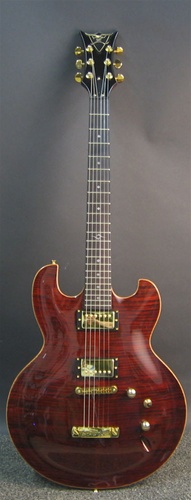
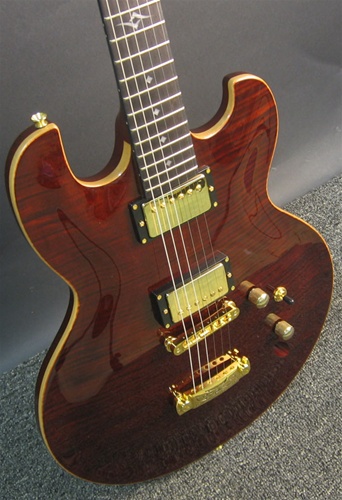
Take, for instance, the Imperial Premier model to the left. I had the chance to hold and play around with one of these exact models in Transparent Wine a couple of weeks ago (didn’t get to plug it in, though hopefully the DBZ rep will let me borrow one for a review). The Imperial has some classic styling – it’s shaped very similarly to a Gibson SG, but that’s where the similarities end. If you look at the picture to the right, you’ll see how incredibly thin the body is. That makes for a super, super, super light weight. All I could say when I first picked it up was, “Wow!”

Now you might think that that would never fly, but I have to tell you, that guitar felt absolutely wonderful, and I could feel the string vibrations resonating through the body as I played. The soft v-shape of the neck stands for Very comfortable. The fretboard is nice and smooth. DBZ calls it “ebonized” rosewood – not sure what that means, but it’s as smooth as ebony, and I just love the feel of ebony fretboards.

Unfortunately, I didn’t get a chance to plug it in because I was busy picking up my Fishman Solo Amp. But just based upon my initial inspection, and just holding it it in my hands, if I wasn’t getting the Fishman, I wouldn’t have let the rep leave the shop with the guitar. Yup, I was THAT impressed! Even the store manager was completely blown away by the guitar. He’s a jazz player, and while he said he prefers archtops, he loved that guitar.

Here are some specs:

  • Construction/Scale: Set Neck 24.75″
  • Body: Mahogany/Maple Top
  • Flamed Maple Top
  • Natural Scrape Binding
  • Fingerboard: Ebonized Rosewood
  • Neck: Mahogany Soft V Neck
  • Frets: 22
  • Inlays: Premier Series
  • Pickups: DBZB/DBZ5
  • Electronics: Vol/Tone/3-way
  • Tuners: Grover
  • Hardware: Gold
  • Bridge: DBZ Custom Stop Tail

Pretty nice features. You can see more pictures and other information on the DBZ site.

Here’s the real kicker: You can get this guitar for $649 online!!! Fat Tone Guitars outside of Chicago has these in stock. So how is the price so low? Simply put, it’s due to technology. Dean Zelinsky isn’t shy nor embarrassed by this blatant use of tech to build guitars. And why not? With computerized routers, you can ensure build consistency. Plus, I believe all the heavy work is done overseas, so that keeps the prices down. Even though I try to stick to US-made gear where I can, in the end, geographic location is far less important to me than how the gear plays and sounds.

DBZ is still trying to build its dealer base, but I encourage you to check one out if there’s a shop near you.

Read Full Post »

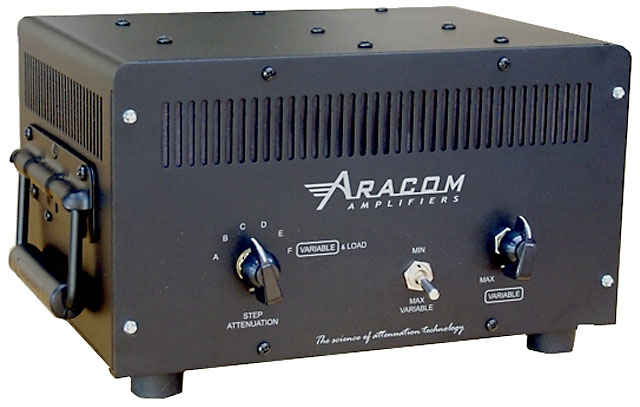
The venerable “Destroy All Guitars” shop has teamed up with Aracom Amplifiers to come up with a new version of the fantastic Aracom PRX150-Pro. Sporting a smaller cabinet (sorry, not reduced weight), and a couple of very cool new features, the $785 PRX150-DAG is the answer to anyone who wants to go to the extreme in transparent power attenuation.

Here are the features:

* Proprietary SRT Power Attenuation Technology
* Six levels of step attenuation, plus a continuously variable attenuation control (bedroom mode)
* 40dB of attenuation–attenuates 150 watts down to .015 watt
* 150 watt power rating
* Independent input and output impedance selector switches:
– from the amplifier and into the attenuator, select from: 2, 4, 8, 16 ohm
– from the attenuator and to the speaker cabinet(s), select from: 2, 4, 8, 16 ohm
– uniquely allows 16 possible Input and Output impedance combinations
* Hi Frequency Cut Filter with a True Bypass Switch
* Features a Load setting and is equipped with a Line Out Jack and Line Out Level Control
* Rack Mount Option
* Handwired in the USA

The two notable features are the Hi-Cut Filter, and the increased attenuation down to -40dB attenuation. With respect to the high-cut filter, some people had mentioned that they heard a high-frequency artifact coming through when they hooked up the original PRX150-Pro. I myself have never heard it, though I suppose anything’s possible. In Jeff Aragaki’s (of Aracom Amps) words:

The PRX150-DAG is equipped with a High Frequency Cut switch, that rolls off the highs above 6KHz, that some users might find useful with amplifiers that have a pronounced high end frequency response. Some guitarists go to great lengths to control the high end response of their amplifier, by carefully selecting speakers, tubes, and other components to roll off the highs. Now with the PRX150-DAG, a guitarist might not need to rely on changing these components; the high cut filter switch allows the flexibility of rolling off the high end or not. The true bypass switch allows the filter to be completely bypassed, providing the full frequency response of the attenuated amplifier to pass through to the speakers.

The other great feature is the Min/Max variable attenuation modes Jeff has introduced. Minimum attenuation mode is the traditional -16dB down to about -30dB variable attenuation, whereas the Maximum variable attenuation mode goes from -27dB to -40dB. With a 100 Watt amp, that’s taking down the output power to .015 Watt!!! Wanna have full dynamic response at bedroom levels with your 100 Watt amp? Look no further!

The Aracom-DAG PRX150-DAG is available exclusively through Destroy All Guitars. Check it out!

Read Full Post »

Click to enlarge

“Guitar Player” mag took a recent poll asking: If you could only have a single pedal in  your rig, what would it be? Overwhelmingly, and actually not too surprising to me, most pollsters chose an overdrive pedal. I personally didn’t take the poll, but I would definitely fall into the majority. You know me, I just can’t enough of overdrive pedals!

So much to my great pleasure, Maxon has released the new ST-9 Pro+ Super Tube Screamer Overdrive. Based upon Maxon’s classic “808” circuit, and building upon the original Ibanez ST-9 and its ability to control the amount of “midrange hump,” this “reissue” adds features that have the potential of making this a truly great Tube Screamer-class pedal.

  • First of all, the ST-9 Pro+ sports 9V or 18V operation. 18V mode adds more headroom and warmth. This is controlled by a slider switch in the battery compartment.
  • In addition to the Drive, Level, and Tone Knobs, the ST-9 Pro+ also has a “Mid-Enhance” knob which controls where the mids are boosted. Clockwise moves the boost towards the high mids, while counter-clockwise moves the boost to the lower mids. To me, this is probably the most useful feature, as you can dial in the mid boost to adapt the pedal to different amps.
  • The ST-9 Pro+ also has a switch that selects either “Classic” or “Low Boost.” Low Boost gives a 12dB boost at 100Hz and a 4dB boost a 500Hz. This can be quite useful for fattening up single coil guitars!
  • Finally, the ST-9 Pro+ has true-bypass switching.

OMG!!! I love the features on this pedal! Were I to consider getting another pedal in the Tube Screamer lineage, this pedal would be at the top of my list! However, with a street price of around $206, it’s not a cheap proposition. But with it’s features, it certainly warrants a close look; and based upon my experience with Maxon pedals, their build and sound quality is undeniable. While I don’t use it much any longer, my CP-9 Pro+ compressor is a testament to that quality (I paid $250 used for that pedal), and it’s a pedal I’ll always have. As for the ST-9 Pro+, I’ll see if I can find a place where I can audition it.

Finally, here’s a great demo video that shows off the ST-9 Pro+ quite nicely:

For more information, check out the Maxon ST-9 Pro+ page!

Read Full Post »

Being “GoofyDawg,” it’s always cool to find gear with the “dawg” moniker. 🙂 So when I came across Li’l Dawg Amps on one of the forums, I had to check out their web site. All I can say is, “Wow!!!” The reason for that is because I was completely blown away by the prices of these handmade amps! For instance, a 5F1 Champster (based on the 5F1 circuit) in a metal lunchbox enclosure is only $399! After seeing the prices of his amps, I had to get the low-down on the low prices, so I called Jim Nickelson up.

The story of how Li’l Dawg started is actually really cool, and Jim tells the story well in his Story page. What started out as a labor of love turned into a full-on amp business. What a way to retire! This was “supposed” to be a hobby. 🙂 Well personally, I’m glad he took up the hobby because many people have benefited from it.

Jim’s approach to Li’l Dawg is no-nonsense. He can keep the price down because he does all the work himself. He doesn’t advertise, which is another cost saver, and he’s worked out a product system where he turn around an order within 2-3 weeks! That’s amazing as most single man shops typically take months to complete an order.

But what about the amps? Well, I haven’t played one – yet. But Jim specializes in classic Tweed circuit amps, like the Champ and Deluxe. The model that I’m particularly interested in is a hybrid amp that has a 5E3 preamp (replete with jumperable inputs – nice) and a 5F1 power section, called “The Mutt.”

Now, Jim could probably just stop there and produce reproductions, but he has some nice added touches with his amps, such as Mercury Magnetics or Heyboer trannys, Sprague caps, and choices of steel or aluminum chassis.

As Jim shares, he wants to create a “candy store” experience when people choose an amp, and provide a basic foundation from which options can be added. So very nice, indeed! Then when you see the prices well, how could you not consider one of these amps?!!!

In any case, here are a few clips of the Mutt to whet your whistle:

Bright Rock Style

Clean, Chords

Jumpered

I don’t know about you, but that has TONS of classic rock mojo going on! Can’t wait to try one out! Or maybe I shouldn’t – I just may leave with an amp. 🙂 Well, that’s NEVER a bad thing. 🙂

Read Full Post »

Why? Because every time I satisfy my GAS, they come out with new stuff that gets me GAS-ing all over again, dammit! 🙂 Here I was innocently reading my e-mail this morning when I got Prestige’s latest newsletter that said they were about to release a line of acoustic guitars! Knowing the fantastic stuff they produce, and given that they didn’t release anything more than announcement that they were releasing a new line, I had to give them a call to get more information. I shouldn’t’ve done that. I’m now GAS-ing so damn bad that it’s killing me!

But I got the scoop on these guitars, and before you start thinking, “Yeah, here we go, another import guitar… How good could it be?” Well, let me just say that a major publication already reviewed it and gave their top-of-the-line model a very – excuse the pun – prestigious award. And after I heard the details of these guitars, it’s not a surprise that even before their official release, they already won an award. So here’s at least some preliminary information that I found out…

They will have three guitars in various price ranges. I didn’t get model names, but I did get the makes of each model:

  • The top-of-the-line model has a koa body and koa top
  • The intermediate features a rosewood body and Adirondack spruce top
  • The lowest tier (and only by materials) features a mahogany body and Adirondack spruce top

Though not set, the guitars will range in price from about $1000 to $2100 street, so even the lowest-tier model isn’t anything to shake a stick at; and before you balk at the price, there’s a good reason for the pricing. Prestige didn’t skimp on the features that all three models share:

  • Adirondack spruce X-bracing designed in partnership with Balaz Prohaszka, a well-known European luthier
  • 12″ radius
  • 25.35″ scale length
  • 1 3/4″ nut width
  • D-shape neck
  • Split Bridge Saddles
  • Bone nut, Bone Saddles
  • Ebony Fingerboard, Ebony Bridge, Ebony Bridge Pins, Ebony Strap Pin.
  • Ebony Headstock face
  • Satin Mahogany Neck, Laser Etched Logo and Serial Number behind the headstock.
  • Beveled Cutaway with Paduck inlay, Mother of Pearl Logo, Mother of
  • Pearl Eclipse Fingerboard Inlay, Abalone Rosette
  • Gotoh 501 21:1 Tuners with Ebony Buttons.
  • Paduck/Abalone Body Binding, Paduck/Maple fingerboard binding.

An option for each guitar is the Fishman Ellipse Matrix Blend pickup system. This is a very non-invasive soundhole pickup system that combines an undersaddle pickup with a gooseneck condenser mic. I’ve heard one of these installed in a Taylor acoustic, and it sounds marvelous!

So the pricing is really a reflection in the difference in tone woods used; otherwise, they’re all the same. That is incredibly COOL!

I’d be remiss if I didn’t have pictures, so here are a couple of the Koa/Koa model. These aren’t the pro pics as you can see the reflections of background objects – that’s how glossy the bodies are! Freakin’ awesome!!!

This slideshow requires JavaScript.

These are serious guitars, folks. Can’t you just DIG that beveled cutaway? Damn! I dig little things like that, and the outer bracing is absolutely superb! And another nice touch is the satin finish on the neck. I always prefer that because it allows me to polish it with my own body oils after time. For me, the ebony fretboard is a HUGE selling item! There is absolutely nothing like the feel of ebony; it’s smooth as silk and feels so nice to the touch!

I can’t wait to get a demo into my studio to give it a whirl! I TOTALLY DIG the Koa/Koa! Now do you see why I hate Prestige Guitars?!!! 🙂

For more information, please go to the Prestige Guitar web site!

Read Full Post »

« Newer Posts - Older Posts »