Feeds:
Posts
Comments

Posts Tagged ‘new gear’


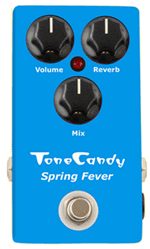
ToneCandy Spring Fever Reverb

Summary: Just about the sweetest spring reverb pedal I’ve ever heard, plus the pedal sports a nice, transparent clean booster that you can even use on its own!

Pros: I’ve heard simulated spring reverbs before, and they’ve been nice, but not THIS nice! Supposedly modeled after the original BOSS spring reverb sound, but takes it way ahead!

Cons: Very very pricey for a just a reverb with boost. Also, doesn’t run on batteries

Features:

  • Volume knob acts as a transparent clean boost
  • Reverb knob acts as a “dwell.”
  • Mix knob controls the amount of wet/dry signal (this is a very nice feature)
  • True bypass
  • All analog except for the simulation chip
  • Can do the full range of spring reverb from adding a tinge of grease to heavy surf.

Price: $275 Street

Tone Bone Score: 4.5 ~ I was completely blown away by the sound of this pedal, but the price completely scared me away. If cost isn’t an in issue for you, you’ll find none better than this!

Being friends with guys at a music shop can be incredibly useful, since they’ll show off their new stock; plus, knowing that I may buy it if they show it to me, they don’t hesitate to show it off. 🙂 Luckily, I usually have enough self-control to not buy most of the stuff they demonstrate.

I have to admit, though, that I was VERY tempted to get this pedal because I haven’t heard one like it – ever! It can slather on the ‘verb quite nicely and note clarity is retained at any setting along the reverb knob sweep. Obviously ToneCandy figured out some great values for pre-delay and trail. I just couldn’t get over how great it sounded with chord progressions and single note picking!

In fact, A/B’ing it with a Fender Deluxe Reverb Reissue just blew me away! It sounded even better than an actual spring reverb! Fender spring reverb, at least to me, is the gold standard in spring reverb, and for a pedal to sound even better than that, well, needless to say, that made a compelling case to get this reverb pedal. Add to that a completely transparent boost, and you’ve got a great pedal that you can put at the end of your signal chain and get all sorts of usage out of it! I could feel the GAS really starting to build up.

Then I asked the price, and my eyes bulged! At $275 for the pedal, that made my GAS go away pretty quickly. If price wasn’t an issue for me, I’d totally go for this pedal, but unfortunately, at that price, I started thinking, “I could get a couple of decent pedals, or even a nice Squier for close to that price.”

Needless to say, I didn’t get the pedal, though I do have to applaud ToneCandy for coming up with a fantastic spring reverb tone. Maybe if I can find one used in the future for a lower price I’ll get it. But for now, I’ll just gaze at it in the glass case when I go to the shop…

Here’s a sound sample:

Read Full Post »

Yamaha APX900 Thinline Acoustic/Electric Guitar

Click to enlarge

As I mentioned in my review of the Yamaha APX900, I’ve had this thing for Yamaha acoustics for many years. Maybe it’s nostalgia or sentimentalism, as my first guitar was a Yamaha, but I’ve always liked their tone. In any case, I’ve full circle with the Yamaha APX900, and I just couldn’t be happier. This is one killer guitar! With its Mocha Black finish, mother-of-pearl “bookend” inlays, and gorgeous binding, it has stunning looks!

But of course, looks don’t tell the whole story. It plain sounds fantastic! Whether plugged in or unplugged, the APX900 has a magical, creamy tone that I’d easily put up against guitars three or four times its price which, at a mere $699 street, makes this an incredible value!

Unplugged, the tone is smooth and well-defined, and even as a thinline guitar, it’s not so thin that sustain is sacrificed. The body resonates and provides lots of sustain. In fact, it’s smaller size belies the big voice that the APX900 possesses. Here’s a clip:

There’s nothing subdued about that tone. For that recording, I used a Senheiser e609 pointed at the front edge of the sound hole about 4″ away from the guitar. The APX900 has an phenomenally even EQ response. When I played back the recording, I had to do a double-take! Make no mistake, that is the raw recording with no EQ or filtering! It’s amazing!

Plugged in, the APX900 shows even more magic. The first thing I noticed when I first played it – direct into a PA – was that it sounded natural; that is, it didn’t sound like an acoustic plugged into a board, where the tone is completely flattened out, and what you end up with is high, mid-rangy, and lifeless. It’s due to the APX900’s ART or Acoustic Resonance Transducer pickup system, which is a system of three pickups; strategically-placed to emphasize or de-emphasize certain EQ ranges. This lets you dial in all sorts of tones! I’m still discovering the possibilities!

Here’s the same progression I recorded unplugged, but with a solo played on top of it. For the “rhythm” part, I have the Low, Mid, and High faders, plus the under-the-saddle pickup’s EQ set to dead-center. With the solo, I added a touch of the mid, plus more highs to cut through. The result is spectacular!

Again, with this clip, I didn’t adjust any EQ on either track, though I did add some reverb for some ambience and to simulate what I’d do on a PA board anyway. The tone is different from the unplugged sound, but with a little playing around with the faders, I can get very close. But no matter, the tone is still killer, and most importantly, the dynamics are fully retained, and on stage, that’s absolutely critical!

So yeah, I really do dig this guitar. I’m looking forward to gigging with it!

Read Full Post »

Click to enlarge

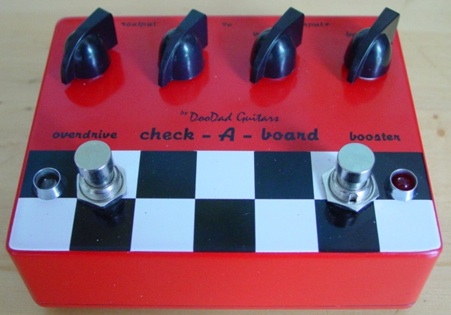
You know me… I LOVE overdrive pedals! I have several, and amazingly use them all, depending upon the voicing that I want, as I don’t think I’ve ever come across any two that sound exactly alike. But since I’ve been playing through really nice tube amps, I’ve come to really appreciate a great booster pedal as well. So it was very pleasant surprise to discover Doodad Guitars’ Check-A-Board RED overdrive-booster pedal that combines both OD and boost in a single pedal.

You might be thinking, “So what?” I certainly did, until I found out that you could operate either one separately or both in tandem to not only add some clipping before your amp, but to also slam the front end with more gain. That really piqued my interest!

I discovered this pedal through Mal Stich over at The Alternative Guitar and Amplifier Company (“Alternative” for this discussion) as I was searching for more information about Marble Amps, a Dutch company that makes vintage Fender clones. “Alternative” is their US dealer. I called up Mal to get info about the amps, and we had a great conversation. He shared that the amps were fantastic, but it was tough to sell them here in the states because shipping and duties are so high for such heavy gear that it makes it hard for Marble to compete in the boutique amp marketplace in the States. Then he mentioned that he was working with another Dutch company that had just released a brand-new overdrive-booster combo pedal. That got my ears up! So he graciously offered to send one to me for review.

So as a first impression, what do I think? This is a killer pedal, folks! I love both sides of the RED pedal. While the overdrive is supposedly based upon the classic TS-808 circuit, it doesn’t sound at all like a Tube Screamer (remember, I have one), but that’s a good thing, as it has it’s own voice. It can go from slightly gritty to super saturated and sustaining. But the coolest thing I dig about it is that it doesn’t compress your signal much with the drive set high. But like the Tube Screamer, at high drive settings, it sustains for days!

With respect to the booster, I dig it. It doesn’t give me as much boost as my Creation Audio Labs Mk.4.23, but very importantly, it doesn’t add any artifacts either; in other words, it boosts as expected, and does it transparently. And it comes in handy when I need a slight volume jump for a lead. I guess you might compare it to the VOX Satchurator’s “More” toggle, but with this booster, the gain is adjustable. Nice! While I really love the overdrive side of the pedal, I’ve found myself using the booster a lot more because my amps just loved to be slammed with gain on the front-end! 🙂 The booster really brings out the best in these low-wattage amps!

For controls, the RED pedal has four knobs: Three (Drive, Tone, and Volume) control the overdrive section, while the four controls the amount of boost the pedal produces when the boost is engaged. The Tone control is more of a high-cut filter than a true EQ, but that’s okay. I prefer that with overdrive pedals as I usually want all my tone, so I normally have it all the way up, or if I’m playing a naturally bright amp, like my 18-Watt Plexi clone, I just dial out a tiny bit of the highs. One thing that I noticed immediately with the overdrive besides its sustain, is the incredible note separation, even at higher drive settings. That makes it a no-brainer to use when I want singing lead tones! As I mentioned, the signal doesn’t compress that much, so having that note separation is killer!

In my short time using the pedal, I’ve actually preferred to use the overdrive and booster separately. My little low-wattage amps provide enough dirt that slamming them with overdrive AND boost is just overkill. If I had higher-wattage, high-gain amps, it probably would make more sense to use both. In any case, I have some clips of the pedal. I’m using my Squier CV Tele plugged straight into the RED pedal then into my Aracom PLX18BB Plexi-clone.

PLX18BB By Itself

Overdrive Engaged

Booster Engaged

I have some more playing to do with it before I do my full review, but I will be giving this pedal a pretty high rating!

For more information, go to The Alternative Guitar and Amplifier Company site!

Read Full Post »

Never really been into fuzz that much, but some of my latest stuff could really use some fuzz, so I was pleasantly surprised this morning to receive Fat Tone Guitars’ newsletter this morning that featured an announcement that they’re the exclusive sellers for Earthquake Devices’ new Zap Machine Fuzz. This is a brand-new pedal, released just this past Monday, and from what I can tell, it sounds VERY COOL! Here’s a video:

As I mentioned, it’s only available through Fat Tone Guitars, and this is a limited edition pedal, so get ’em while they’re hot! 🙂

Read Full Post »

Debuted at Musikmesse 2010, the Ice 9 is the newest member of the VOX Joe Satriani line of pedals, named after a song with the same title on Joe’s “Surfin’ with the Alien” album. While it uses the same box and layout as the Satchurator, this is a completely different animal. The Satchurator is a distortion box, while the Ice 9 is an overdrive. Okay… so it’s yet another overdrive pedal entry into the already – excuse the pun – saturated overdrive pedal market. But the Ice 9 has some interesting features that are worth noting.

First of all, it has a Vintage/Modern switch. This switch provides different overdrive voicings. According to VOX, the Vintage circuitry models the classic Tube Screamer tones, while the Modern circuitry adds a bit more top-end bit and a bit of compression. In addition to the Vintage/Modern switch, the Ice 9 features a Bass knob for dialing in more bass response; perfect for getting really scooped, modern drive tones. Finally, like the Satchurator, the Ice 9 has the JS line’s signature “More” toggle, which adds a 10dB clean boost when engaged.

Pretty cool features, IMO. The Ice 9 is slated to be shipped in June. I don’t have any pricing information on it yet, but I don’t doubt that it’ll be reasonably priced if the rest of the JS line is any indication. Here are a some videos:

VOX Ice 9 Introduction Video

VOX Musikmess Demo

Musikmesse Demo from PremierGuitar

Read Full Post »

Click on the picture to see an enlarged view.

Wicked Woody “Original” Pedal Board

Summary: Handmade with carpentry-grade wood, this is one gorgeous pedal board. Nothing like making something so utilitarian a virtual work of art!

Pros: Completely handmade with high-grade wood that doesn’t only look great, it’s lightweight as well! Platform is reversible so you can configure the board to have your volume or wah pedal on either right or left sides. Lots of space under the platform to fit a power brick and stow your plug, and the routing on the top makes it easy to run your cables.

Cons: Could use some rubber or silicon feet to protect the bottom from scratching and elevate it above possible spills (think bar gig).

Features:

  • Elevated pedal platform. With an elevated platform, it is both easier to see, and easier to reach all of your pedals.
  • Handmade, of the highest quality certified hardwood plywood. Durable finish that will protect your woody for life.
  • Easy cable management, with the cable chanels routed into the platform it is a cinch to place your pedals in any configuration you desire, and wire them however you would like.
  • Alternative storage, under the platform for your power supply or other storage needs.
  • Measurement: 24″ X 15″

Price: $80 direct

Tone Bone Score: 4.75 ~ I’ve never seen a pedal board that looked so nice. Despite its looks though, I really would’ve liked to see some “feet” on the bottom for some extra protection. Something that looks this good should be really protected. That said, it’s easy to get some hardware that’ll do the job with minimal effort. But if it had that right off the bat, I’d give this puppy a 5.0!

For Goodness’ Sake! It’s Just a Pedal Board!

I would venture to guess that most players don’t really put to much thought into the “look” of their pedal board other than if the cables are nicely arranged and out of the way. But lots of players obsess over the look of everything in their rig; even down to their pedals’ paint jobs. So why not put them on a platform that really shows them off, as well as being useful? Aesthetics are a good thing. Myself, I tend to be far more practical to even consider something like this, but hey! Cool is cool in my book, and although I may not normally consider having a board like this, that doesn’t take away from the fact that this is one gorgeous piece of functional hardware!

From my point of view the Wicked Woody pedal board is like a nicely shined pair of shoes. Most people wouldn’t normally notice them, but they do notice that there’s something “nicer” when you wear them. Such is the case with the Wicked Woody. It’s not a showy and sparkly, but it just looks well, nice. Besides, there’s nothing sweeter-looking to me than nicely grained wood, and all Wicked Woody pedal boards are made of high-grade woods, with a nice, smooth finish. In other words, the provide a sweet presentation platform for your pedals!

Setting Up the Board

When I received my evaluation board today, I was amazed by how lightweight it was, but it was absolutely solid. The plywood used would not bend or give at all! But in addition, it looked fantastic! I know, it’s kind of hard to be excited by something so utilitarian, but this board looks so good – it kicks ass!

Luckily, my evaluation board also included some velcro strips, so it was a simple matter of attaching them to the board. I got a fairly long length, so I just cut it in two and laid the strips straight across the board. If I were to actually keep the board, I’d be a lot more meticulous and place strips so the they don’t show at all. But for my evaluation, I just wanted to be able to easily arrange my pedals.

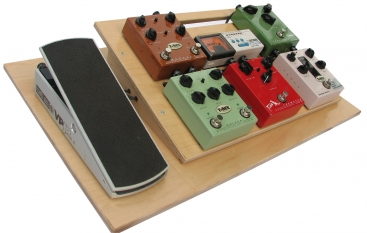
I have to say that I’ve never seen my pedals look so good. 🙂 Here’s a picture:
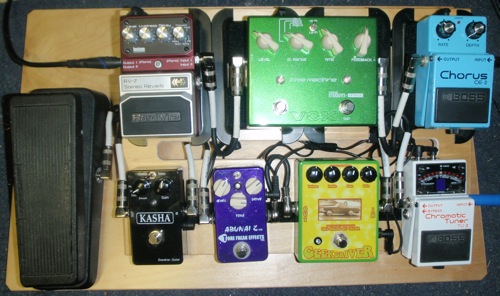
A very cool thing that I liked immediately was that the platform fits my back line of pedal risers perfectly! Four pedal risers fit exactly flush to the edges of the platform. The folks at Wicked Woody say you might not need pedal risers, and based upon the space between the front and back lines and the nice angle of the platform, I’d tend to agree with that. But with my clumsy, double-E feet, I need every advantage I can get, so it’s very convenient that the platform fits the pedal risers so perfectly.

You can clearly see the route in the center. There are actually two routes, but the upper one is obscured by my pedal risers. But both are very conveniently placed. The platform has a round hole on each side to run cables through as well. That is very convenient as I was able to run the power and connector cables underneath the wah. Then to connect the wah to my next pedal, I ran the connector through one side hole, then out the other side hole to connect to my CE-2. When all was said and done, I was impressed by the arrangement. Plus, the big base board really creates a nice spacious effect.

Now I know there’s a lot of debate with the placement of a wah pedal. Should it be before or after the drive pedals? I happen to prefer mine to be placed after my drive pedals, so the default arrangement, with the wah pedal on the left was perfect for me. However, for those who prefer it to be on the other side, the platform is reversible. You just have to unscrew the platform from the bottom of the board, turn it around, and you can place your wah (or volume or expression pedal) on the right side.

I didn’t take a picture of the back of the platform, but there’s plenty of room underneath. I placed a fuzzy strip underneath the platform, and put my Dunlop DC Brick there then ran the power connectors to the pedals through the routes. Having those routes is a real nice feature because it keeps your power cable runs nice and neat – and hidden from view. There’s also plenty of room underneath to place a spare pedal or two (as long as they have a low profile), and of course, you can stow your plug underneath during transport.

The eval board didn’t come with a case, so I’m not sure if there is one available. Hopefully there is one available because I’d definitely want one to transport the board to and from gigs if I owned one of these beauties.

So… overall impression? I dig this board. It looks fantastic, but it has some very nice features that make setting up your pedals a breeze. It literally took me less than 10 minutes to get everything hooked up. Granted, if I owned one of these, I’d take a bit more time to make everything perfect, but one could do a lot worse.

Update: April 1, 2010

Just got a message from the folks at Wicked Woody. They don’t have a case for their boards yet, but should have one as an option within the next couple of weeks. This is great news!

For more information, go to the Wicked Woody site!

Read Full Post »

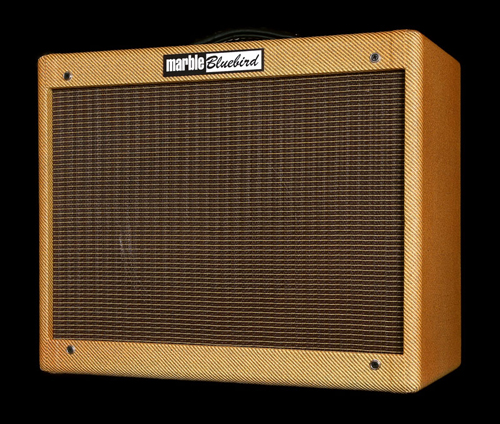
I was perusing The Gear Page today, and while in a thread, happened upon a post where a guy mentioned he had recently purchased an amp made by a company called Marble Amps. He said they specialized in Fender-style reproductions with tweed covering, all hand-wired for a reasonable price. He wasn’t kidding. He got a used head for $800! Oh well… we all can’t be that lucky.

However, I did a little digging and found their web site. Talk about oozing classic Fender mojo! They apparently have a US distributor, the Alternative Guitar and Amp Company in Southern California, but they don’t have any information on them (although I left them a message).

Very cool stuff!

Read Full Post »


Click on the picture to see an enlarged view.

Yamaha APX900 Thinline Acoustic-Electric Guitar

Summary: Yamaha got it right with its Acoustic Resonance Technology (ART) pickup system. Plugged in, the tone shaping possibilities are amazing. If you’re looking for a mid-range performance guitar, this is a guitar you have to consider.

Pros: ART pickup system rocks the house! Incredibly playable guitar with a great-feeling neck. Action out of the box was just right.

Cons: A little bright and thin-sounding unplugged, but this is a thinline, so that’s expected. But despite that, it has a nice, rich tone.

Features (from the Yamaha web site):

Top Solid Spruce
Back & Sides Flamed Maple
Neck Nato
Fingerboard Rosewood
Bridge Rosewood
Tuners Die-cast Gold
Body Style Thinline with Cutaway
String Scale 25 9/16″
Body Depth 3 1/8″ – 3 9/16″
Nut Width 1 11/16″
Colors Natural, Mocha Black, Ultramarine, Crimson Red Burst
Finish Hi-Gloss
Preamp System57 (3-way A.R.T.)

Price: $699 street

Tone Bone Score: 5.0 ~ This guitar offers the best of both worlds: Fantastic plugged in tone, and rich (though bright) unplugged tone.

My very first brand-new guitar was an old Yamaha FG335 that my dad gave me for my birthday. Up to that point,  I had been playing hand-me-downs from my cousins. Not complaining about those old guitars, but getting a brand-new guitar is always special. That FG served me well for 15 years before it had a bit of an accident, and I had to retire her (I had named her “Betsy”).Since owning “Betsy,” I’ve always been partial to Yamaha acoustics, though the FG was the only one I’ve ever owned. They make great-sounding and -playing guitars at an affordable price. What’s to complain about that? 🙂

As you may know, I just purchased a BOSS RV-5 Digital Reverb that I recently reviewed. At the shop where I did my evaluation, I just happened to do the evaluation with an APX900; hence, this review that you’re reading. But before I continue with the review, this is my next acoustic guitar! For what you get for the retail price, you just can’t beat it!

Fit and Finish

Even with the “cheap” product lines, I’ve always been impressed with Yamaha’s build quality. No errant coating, nice and straight joints, and well-dressed frets. The APX900 was no exception in this department. The frets ends were rounded off nicely, the action was perfect – not too low, not too high. I dig the “bookend” triangular mother-of-pearl inlays on the neck. It’s a real nice touch; and the binding about the sound hole and body add nice definition to the look of the guitar.

Playability

With a nice “C” shape neck, the APX is a very comfortable guitar to play. Cutouts are must for me to play high up on the neck and the action is such that high notes are easy to fret. I detected no buzz at all anywhere on the neck, and the intonation was perfect – at least from what I could tell. The neck is a bit on a narrow side, much like an electric guitar, but that’s the way I personally like it, so whether playing chords or picking individual notes, the key word with the APX900’s playability is “comfort.”

How It Sounds

As I mentioned above, as a thinline guitar, its natural, unplugged tone is a bit thin. But that doesn’t mean it’s tinny. It just happens to sit a bit higher up in the mids, which could actually be very useful when playing with larger acoustics. And despite its thinner body, the solid spruce top really helps to project the sound out, so it produces more natural volume than you’d expect.

Plugged in is a completely different matter, and this is where the ART pickup system comes into play. As I understand it, the ART system isn’t your traditional EQ. It is a system of three individual pickups placed at specific points in the body that produce or emphasize different EQ frequencies. Unlike traditional tone controls that act as frequency cut or boost, each slider for low, mid and high is a volume control, and your output signal is a mix of the three pickups.

How does it work? In a word, AWESOME! I took several minutes to play around with the controls, and just fell in love with the system! Where traditional EQ controls may muffle or muzzle the tone if you turn down, this doesn’t happen with the ART system. Clarity is retained, no matter what you do because after all, all you’re doing is adjusting a volume control. I have to admit that it was a little unsettling at first because I was expecting the tone to muffle, especially as I bled off some highs. But that didn’t happen at all. For instance, when I first started playing, I thought the tone had a bit too much high-end. So I adjusted it down. The cool thing was that the high-end was still there, it just wasn’t as prominent as it was before I made the adjustment. I found that to be incredibly cool! I also set up the ART so I could play an arrangement of Sting’s “It’s Probably Me” where I play sort of a bass line on the 5th and 6th strings. With that, I brought down the mid and high, and turned up the bass. I was rewarded with a rich, bassy tone that was not boomy at all.

Overall Impressions

The ART system makes this guitar a winner in my opinion. If it worked this well with the APX line, I can only imagine how well it works with the top-of-the-line LX series. I’m duly impressed!

Read Full Post »

Man, I love it when gear manufacturers build stuff for a cause! Wampler has just re-released their limited run Underdog Overdrive (only 100 were originally made) to help out a friend who has breast cancer, as she can’t pay her doctor bills and apparently can’t get any insurance. All the profits from this re-release are going to help this woman out. It’s great to see this type of generosity!

Here’s a transcript of the press release:


Wampler Pedals has recently re-released their popular “Underdog Overdrive” pedal. Only 100 of the pedals were built originally.

According to Brian Wampler, owner of Wampler Pedals, “A close friend of mine has breast cancer and has no insurance, no family, and the government will not pay any medical costs for her to get the treatment she needs. Now, I’m not rich by any means, but I had to do something to help her. My wife and I came up with the idea of creating a pink pedal that is rich, dynamic, and very tweakable, and donate ALL the profits to her. Out of that limited run, famed country artist Brad Paisley bought one and loved it. A number of guitarists saw the pedal on Brad’s pedalboard and asked me to build one more for them, so I decided to start building more to keep up with demand. We are still donating all the profits to my friend, Ivy East, who is struggling to pay the doctor bills to combat this terrible disease.”

And here’s a video demo of the pedal. Apparently this is one of Brad Paisley’s favorite overdrive pedals:

For more information, visit the Wampler Pedals site!

Read Full Post »

The HAO OD-16, that is…. 🙂

Godlyke Distribution, which represents several boutique pedal manufactures has just released the HAO OD-16 overdrive pedal. Oh yeah… yet another overdrive pedal. But who cares? As the dean of my college once told me, “There’s room in this world for people who are good,” and as far as guitar gear is concerned, there’s certainly room in this world for good gear, and the HAO OD-16 (pr. “how”), promises to be a pedal that will make gear freaks make room for this pedal on their boards.

Designed and built by HAO in Japan, the OD-16 is a very cool take on the traditional overdrive. It’s ostensibly a Tube Screamer type of overdrive, which might ellicit a “so what” kind of reaction. However, with it’s internal voltage doubling circuit that takes a standard 9V and boosts it internally to 16V (hence the numeric designation), what the engineers were after was more headroom, and much more drive. And baby, this thing delivers all sorts of drive! Check out this demo video:

I dig the fact that you can bypass the internal tone pot to get more “bite” out of the pedal, and of course, true bypass is always appreciated. 🙂 Don’t know about you, but that video is causing me some SERIOUS GAS!!! Oy-Vay!!! Great tones – even out of low-res audio from the vid! I think I need to install a lock on my back pocket.

For more information, check out the Godlyke web site!

Read Full Post »

« Newer Posts - Older Posts »