Feeds:
Posts
Comments

Posts Tagged ‘pedals’


Click on the picture to see an enlarged view.

BOSS RV-5 Digital Reverb

Summary: No, it isn’t the be-all end-all in reverb pedals, but for what it offers as a nice, subtle reverb to add some spaciousness to your sound, then the RV-5 really excels.

Pros: Plate reverb is excellent on this pedal – especially with an acoustic guitar. Amazingly enough, the RV-5 is transparent to my ears and doesn’t suck tone. The RV-5 is also super-quiet, and makes no line noise at all; pleasantly surprising qualities.

Cons: The Spring reverb is a little funky on this pedal. At higher Decay settings, there’s a bit of an intended artifact in the tail of the signal. Not too pleasing to my ears.

Features (from the BOSS web site):

  • Stereo input/output for compatibility with other stereo pedals
  • 6 high-quality reverb modes on par with rackmount processors
  • First-of-its-kind Modulate mode detunes the reverb sound for added spaciousness
  • New spring reverb emulation offers realistic spring reverb sounds
  • New gate reverb taken from high-end Roland studio gear

Price: $149 street

Tone Bone Score: 4.5 ~ As I mentioned above, for what this pedal offers, it’s great! To me, its strong suit is to use it as a subtle effect to add some spaciousness to your sound. As long as you don’t overdo it, this pedal will work great. The Plate reverb is particularly fantastic with acoustic.

With all the great boutique pedals out there, BOSS tends to be a bit too run-of-the-mill for many tone connoisseurs. Even I’ve thought of BOSS as somewhat of an afterthought considering some of the great boutique pedals I have, and from my participation in various online forums. Like, “Oh yeah… BOSS has “xxx” pedal. But it’s BOSS, and that means cheap, production line stuff.” But after I purchased the BOSS RV-5, one of my first thoughts was: “Have I become such a boutique gear snob that I can so easily dismiss production line pedals like BOSS because they’re not hand-made, boutique, and cost far less than boutique stuff that’s SUPPOSED to be better. ‘Cause here I am walking out the store with a BOSS pedal!”

Admittedly, it was a sobering thought. It wasn’t that I was experiencing buyer’s remorse. I truly like this pedal. But I founded this blog to share gear I’ve either purchased or come across, and most importantly, with the premise that it’s tone that matters and not the price or who made it; that is, if it sounds good, who the hell cares who made it or how much it costs? The BOSS RV-5 is a perfect example of this. Yeah, it’s made by a company that is generally equated with “cheap” pedals. But who the hell cares? I like how it sounds. If it wasn’t for the Spring Reverb, which I don’t particularly like on this pedal, it would’ve gotten a higher rating.

My intent with getting yet another reverb pedal was to get a journeyman pedal that would just do the job for my solo acoustic gigs. I wasn’t looking for a reverb where I’d layer on tons of the effect; just something subtle. After all, I was plugging into a PA board, and just wanted a touch of spaciousness, not have the reverb be the primary tone. In my experience, at low levels, even “cheap” stuff works pretty well, so I took the RV-5 for a spin, and was rewarded with a very nice-sounding reverb. As with any digital reverb that I’ve used, using them judiciously and in moderation is the key, and that was how I did my evaluation in the shop.

The net result is that I purchased the pedal. It does the job of providing a subtle, background reverb VERY well. Someone commented in my Gig Report that they’d take the RV-3 over this. I think this was motivated by the fact that the RV-3 is great for ambient stuff, as it is both reverb AND delay. But the RV-5 is really a different animal. Heavy, ambient reverb is not its strong suit. But for adding a slight spacious texture to your tone, it clearly excels in my opinion.

How It Sounds

For what it provides for me, I think this reverb sounds great. It’s not the be-all, end-all in reverbs, and it’s definitely not something I’d use for ambient stuff, but frankly, I never use a reverb pedal for that anyway, which is why I have a delay pedal. I put together samples of the same chord progression to give you an idea of what it sounds like in its various modes. The pedal is set with Level and Tone at noon, and Decay at 2pm. All clips were played with my Gibson Nighthawk, and running into the reverb pedal and into my Aracom VRX22.

Modulate

This mode adds an ever-so-slight slight chorus modulation to the tone. It’s nice.

Gate

Gate is interesting. Both pre-delay and decay are very short. This is actually kind of cool when you want a reverb tone that doesn’t tail.

Room

This setting really started growing on me when I was doing my tests. This is really a small-room type of reverb.

Hall

Nice, expansive tone with this mode.

Plate

Probably the most subtle of the modes, it really shines with acoustic guitar, but is very useful with electric.

Spring

BOSS claims to have added real spring reverb effects to this mode. Well, it didn’t succeed. The little motes of slightly buzzing spring are absolutely annoying to me, and I would never use this mode. You can hear it a little in the clip. I wasn’t expecting it at all, so it’s out as far as I’m concerned.

Overall Impressions

Sans the Spring mode, I like the reverb this produces. Plate and Room are definitely my favorite modes on this pedal, and Modulate comes in a close third. All in all, if you’re looking for journeyman reverb where you just want to lay on some spacious texture, this is a great pedal to consider!


Read Full Post »

Got a little ambitious tonight and recorded some clips of the VOX Time Machine this evening. All clips were recorded with my trusty Aracom VRX22 amp.

The first is a short song featuring my CV Tele in the rhythm and my Gibson Nighthawk 2009 doing the lead. This was close-miked to a 1 X 12.

With the next four clips, I wanted to a chorus kind of vibe going by hooking up two 1 X 12’s to my Aracom PRX150-Pro’s speaker outs. I didn’t record in stereo. I just used my Sennheiser e609 placed about a foot away from both speakers that were about 75 degrees turned toward each other. Sorry for the background noise that’s the ambient noise in my garage – I had to turn up the input gain a lot to get a decent recording signal.

The first clip is just a simple chord progression done finger style. The pedal is set to about 11am level and 2pm feedback. I tapped in about a 72 bpm tempo.

The next clip has the both level and feedback at about 2pm with a 60 bpm tempo. This is sort of a “space echo” type of thing ala Steve Miller.

With this next clip I wanted sort of a heavy slap-back type of vibe doing a rhythm part on the 5th and 6th strings. At the end I play an Em chord very lightly to demonstrate how the pedal reacts to pick attack. The Time Machine is set to about noon on the level and 11 am on the feedback. I’ve got about a 90 bpm tempo.

Finally, I did another short song to demonstrate how the Time Machine works well to get a gorgeous, spacious tone for clean leads. Here I set the level at 10am and feedback at 2pm, and also engaged the vintage mode, which produces a bit thicker of a tone. The rhythm was just recorded with a reverb.

This is a fairly good representation of how the pedal sounds with a clean tone. Again, sorry for the background ambient noise. Maybe if I had a “proper” studio… 🙂

Read Full Post »

As many might know, one of the first places I test out new gear is at my weekly church gig. Church services are especially great for testing gear that you normally use clean or with just a little grit, and it proved to be a great venue for testing out the Time Machine.

All I can say about the Time Machine is, “Wow!” It really was made for being run in front of an amp! I know that some people don’t like it because it can’t be used in an effects loop, but in front of an amp, it works great! Don’t know how VOX did it, but it doesn’t seem vary the output gain – at least as far as I could tell – so it didn’t give me pulsing grind when I set my amp at just the edge of breakup. That really blew me away because I was concerned about that happening as I always set my amp on the edge of breakup, so increases in gain, whether due to volume knob or attack will give me some light dirt. Amazingly enough, the Time Machine didn’t push my amp over the edge at all.

That gave me tons of confidence to really experiment with the pedal. As with most church services with contemporary christian music, the flavors of songs change throughout the service. This provides ample opportunity to test gear. Whether used in smooth ballads or rockin’ with some slapback, the Time Machine delivered on all fronts. I was particularly impressed with using the Time Machine on slow songs where I could dial in a real long delay (it can get a delay time of up to 5800 seconds). Setting the feedback to about noon and the level to around 11am, I was able to get this great ambient, ethereal tone with an approximate metronome setting around 58-62 bpm by using the tap tempo toggle.

I dig the tap tempo on the Time Machine. It’s always on, so making midstream tempo adjustments is simply a breeze. In one of our songs this evening, the group sped up for some reason, and it really threw off my delay tone. But a quick tempo adjustment – while I was still playing, mind you – got my delay back in sync. That was so incredible!

As I mentioned in my review of the Time Machine, I’ve been waiting for a couple of years to get a new delay after I gave my old DD-5 away. I’m glad I took the time to wait. The Time Machine is the bomb!

Read Full Post »

I’ve known about Handwired-Effects for a few weeks now, but didn’t really talk about it too much because their site didn’t have much on it, and they only had a single pedal. But now that they’ve got a few, I felt it was time to talk about them. Handwired-Effects has pretty much come out of nowhere with their pedals. Their initial offering is pretty straight-forward: a chorus, an overdrive, and a limited run “preamp overdrive” custom made for Dario Lorina.

I know… New pedal companies are started all the time so what has piqued my interest in Handwire-Effects? It’s actually not their products but their location that made me raise my eyebrows. Most new pedals seem to come primarily out of the US and Japan. Handwired-Effects is based in Switzerland. In all my years of buying gear, I’ve never used a guitar product made in Switzerland. No, I’m not thinking that these pedals may be better because of the “Swiss watch” thing. 🙂 But it sure is interesting that it’s located there…

Unfortunately, they don’t have any clips of their products, save a poor-quality video of Dario Lorina playing the Dario Lorina custom box at NAMM. We’ll just have to wait and see…

Read Full Post »

Oo-la-la! T-Rex will soon be releasing a new distortion pedal called the Tonebug Distortion. Not much info on it yet, but it is supposed to lay on tons of gain. I was fortunate enough to see a video from the folks at GearWire that quickly demonstrates what this pedal can do.

Admittedly, I’ve preferred overdrives over distortion boxes, but I’m really liking the tone from this puppy! Don’t know if I’d shell out $399 for it, though. But T-Rex pedals are premium pedals, so that’s not a surprising price.

For more information, check out the T-Rex site!

Read Full Post »

O thou with such dirty little minds! I’m not talking about some Red Hot Chili Peppers-style playing with a tube sock around my member. I’m talking about playing with zero effects! So there!

For the past few weeks, I’ve recorded and gigged several times with no effects at all, and the only pedal I use is my trusty BOSS TU-2. The first time I did it, I was being lazy and didn’t want to break down my rig from my studio – especially since I was in the middle of laying down some tracks and didn’t want to lose my settings. But that first time turned into a second, then a third, and so on.

I’ve found it to be refreshing on a number of fronts; not the least of which is the much lighter load I have to lug around. But more importantly, I think it has really helped my playing as I can’t rely on pedals to fill in the gaps. For instance, I’m a lot more aware of how I’m sustaining notes, and trying to hold them as long as possible before I have to move on.

I know of lots of players who don’t use pedals at all, and for quite awhile, I couldn’t imagine life without pedals. But “playing naked” has really helped me to not rely on them. I used to always use overdrive pedals as my main source of drive, but I now use them as accents. I used to slather on the reverb but now, I rarely use it, except in the studio and even there, I use it sparingly.

Don’t get me wrong, I’m not going to put my board away. There are times when I need a pedal for a particular song, but for the most part, I can do without them, or just use them to provide tonal accents. In a way, I feel liberated…

Read Full Post »

stagetrix-pedalfastener

Click for full size view

I wrote about StageTrix Pedal Risers awhile ago, and how they elevate the back row of your board to make your pedals more accessible. I’ve been using them since, and they really are a godsend! I did mention that they already came with the fastener already installed, so all you have to do is place the riser.

I really like the fastener they’re using. For one, the material is thinner than most kinds you buy at a store, which means it shapes well to contours. Another thing – and more importantly, in fact – is that the glue StageTrix uses on the fastener can withstand up to 200 degrees Fahrenheit. That’s the best thing. We’ve all had the experience of getting velcro glue on our fingers. It’s a gooey mess! Well, that’s solved with the Pedal Fasteners.

For $9.95, you get a pack of three (click on the picture to get a full size view). You can install a fastener with the middle, or you can remove the middle part, and only use the fastener on the edge of  your pedal. Very cool stuff!

For more information, check out the StageTrix Products site!

Read Full Post »

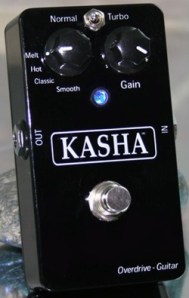
KASHA KA-ODP-A
I finally got some time to record a couple of clips of the absolutely wonderful KASHA Overdrive tonight, and I am just so blown away by how it sounds! This little box is like having 4 differently voiced amps in a little box! I’m not going to spend too much time praising it because I’ve already done that a couple of time here, so let’s get into the clips, shall we?

The first clip is slow, slow blues clip in Am. The chord progression is actually adapted from one of Chuck D’Aloia’s “Blues With Brains” video lessons. If you’re looking to get more into the blues, I highly recommend this set of lessons. It’s the best $40 bucks you’ll ever spend! In any case, I used the chord progression to test out the KASHA Overdrive, and to practice some of the concepts I learned tonight.

Anyway, there are two parts to the clip. The rhythm part was recorded with the KASHA Overdrive in Smooth with the gain set at 12 o’clock. This acts just like a clean boost, and at 12 o’clock it’s at unity gain. The first part features the Classic “channel,” and the second part features the Hot channel. Give it a listen:

The second clip has no backing track, and features the Melt channel with a simple chord riff. Excuse the sloppy playing, but instead, focus on the articulation of the notes. I had the Gain pushed up to about 3pm, which is almost all the way up. But even at a really high gain setting, you can still hear the individual notes. THIS IS AMAZING! And man, the touch sensitivity in this channel is to die for!

By the way, both clips were played through the clean channel of my Aracom VRX22, and recorded at conversation levels using the incredible Aracom PRX150-Pro attenuator. To me, this is the absolute king of attenuators. Oh! Almost forgot that I used my beloved Goldie to record the clips.

Read Full Post »

tonebox

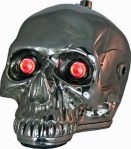
When I wrote my original announcement of the Skull Crusher, it was absolutely brand new, and not surprising at all, it was met with a mixed response. But as I mentioned in my announcement, get beyond the looks, and this pedal is a KASHA overdrive with an EQ knob, and I LOVE how that sounds. Apparently, so do the guys from Ratt, as shown in this video taken over the weekend at the Jack FM 2009 concert in southern California this past weekend:

And here’s a video of the VERY talented PhilX playing the Skull Crusher live and doing a demo in the studio:

Lots of guys panned the look of the pedal, but I think it looks incredible! And knowing that it has the absolutely wonderful KASHA overdrive guts makes this pedal a winner in my book.

Read Full Post »

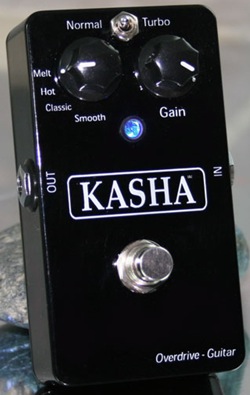
KASHA KA-ODP-A

OMG!!! Just gigged with my brand-new KASHA Overdrive last night, and I was in tonal heaven! Even though I’d done a pretty good test on it in my original review, there’s nothing like using gear in a live situation. So here are my observations:

  • Incredible Dynamics – The one thing that is readily apparent is how this pedal responds to pick attack and volume knob changes. It is so amp-like, it’s uncanny! I set the pedal up in unity gain with just normal strums on my guitar. But if I dug in a bit more, the pedal responded just like an amp with a bit more punch and volume. Frankly, the volume swell surprised the hell out of me. It’s not huge, mind you, but the response is so amp-like, it really does take you by surprise. I totally dug that while gigging last night!
  • Plays Well With Other Overdrive Pedals – I love stacking overdrives, and the KASHA OD performs beautifully in this role. I set it up as a based OD pedal, then stack it with my Tone Freak Effects Abunai 2. Those two together are an awesome combination!
  • Lots of Tonal Variety – While my favorite channel on this is the Classic channel that adds a chimey mote to your tone, I also played in the Hot channel as well, and the grit and grind was super-sweet. But add to that the dynamic response of the pedal, and what you’ve got is a pedal that has a lot of inherent tonal variety. Last night, I ran it mostly through the clean channel of my amp. But later, I screwed around with it a bit more in my studio, with my amp set at the very edge of breakup. This is where the pedal just warms my heart! With its touch sensitivity, when my amp is set up at the edge of breakup, I can take my tone from gritty and grimy to sweet and chimey with just a touch of dirt simply by modifying my attack or adjusting my volume knob.
  • Open Distortion Characteristics – No matter what channel you use with the KASHA Overdrive, the overdrive never gets compressed. It just gets dirtier. The cool thing about that is that any kind of compression will then come from your power tubes. I’ve rarely liked that compression in pedals, save for my Abunai 2, which compresses in a very pleasing way, but for most overdrive pedals, I don’t want that at all, and thankfully, the KASHA Overdrive remains very open, no matter how hot you go on the channels.
  • Simple Design – Probably one of the best features of this pedal that I appreciate is its straight-forward design. Notice that it doesn’t have an EQ control. It doesn’t need it. It takes your signal, adds a voice to it, and that’s it! Set your EQ on your guitar and/or amp to where you want it, then set the gain knob on the pedal, and just play. What could be more simple?

All in all, I’m pretty much done with my search for an overdrive pedal. I knew it from the first time I played this; and combined with my other OD’s, I can pretty much say – at least for quite awhile – I’m set in the overdrive department!

I’m an overdrive pedal freak, and I can safely say that this is the best overdrive pedal that I have ever played! It’s hard to believe that this little black monster does what it does. I’m totally blown away by it, and I’ve only gigged with it once! I can’t wait to really start using it in all its modes!

For more information, go to the KASHA web site!

Read Full Post »

« Newer Posts - Older Posts »