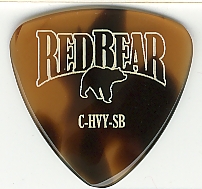
Imagine a pick shaped like the one to the left, but at 4 mm thick! That’s the Super Thick Gypsy Jazz Pick!
A couple of weeks ago, I was having a conversation with Dave Skowron, maker of Red Bear Trading picks, and said, “You know Dave, I just dig this Gypsy Jazz thick pick that I just bought. But as you know, for electrics, I play with a V-Picks Snake because I love the 4.1 mm thickness.” As background, I had just purchased a standard GJ thickness to replace the Heavy that I gave to a friend so she could try it out. I continued, “Do you have anything that is even close to that thickness? I would love to have that kind of thickness for playing acoustic.”
Dave replied, “Yeah, I have a sheet of the Tortis material that is pretty close to that thickness at about 4 mm. I did something even thicker for a guy once.”
“No, no any thicker, Dave, and I think it would be too much. But if you have a 4 mm thick pick, I’m all over it!”
“Okay, I’ll make up a prototype and send it to you to evaluate.”
All I can say after playing with “the prototype” for a couple of days is I hope that pick goes out of prototype because it is an incredible pick! You know how I love the feel and sound of Tortis, especially on acoustic guitar. In fact, I love the sound of Tortis with acoustic guitar that I won’t play any other type of pick on my acoustic. On electric, I dig my V-Picks Snake for its speed, tone, and thickness. Put all that together in one pick, and what you’ve got is a “Super Pick!”
The thicker you go with picks, the deeper and richer the sound. It’s not that you lose the highs; you don’t. It’s just that the thicker picks also bring out the lows, so what you get in a nice, even tonal presentation. That’s why I dig thick picks! On top of that, there is something magical with the way a Tortis pick interacts with an acoustic guitar’s strings. With me at least, playing a Tortis pick on acoustic evokes a certain visceral feeling that makes me want to close my eyes and just soak up all the tonal goodness. Not only that, Tortis, being made of a natural material, just feels natural. It’s the perfect complement for playing acoustic guitar!
So what about this super-thick Gyspy Jazz gauge? OMG!!! I am in guitar-playing heaven with this pick! It has the thickness of my beloved V-Picks snake, but all the feel and tone that I’ve come to love with my Tortis picks! To just call it “awesome” would be a complete understatement.
I first played the “Super Thick” last Friday at a gig that was primarily acoustic guitar. It started with playing some dinner entertainment music before a re-enactment of Christ’s passion. I was playing my Ovation Celebrity directly into a Genz-Benz 100 Watt upright. When I struck the first chord of the opening song. I actually had to pause and let the chord just ring and hang in the air. It was quiet enough in the room where I was playing that I could hear my guitar, as the amp was there for simple sound reinforcement. I thought my original GJ as awesome at 2.3 mm. What this pick did to the natural tone of my guitar was otherwordly!
I spent most of the day yesterday playing guitar, much to the chagrin of my wife! It feels so incredible!
In any case, if you’re interested in getting one of these, contact Dave Skowron at Red Bear Trading. I’m sure he’ll make one for you. Mind you, this thickness of pick won’t be cheap, but it’ll be well worth the investment!
If I could go higher, I would with this rating. But this pick gets my highest rating!
Summary:Made from an entirely new pick material, Tuff-Tone picks provide the same, high-quality sound you expect from Red Bear picks, but are much more durable than standard Tortis picks.
Pros: Get ’em wet, put ’em in your pocket with all your keys and change, put ’em in the washer and dryer. They won’t break or warp.
Cons: None.
Price: $10 direct from Red Bear Trading
Tone Bone Rating: 5.0 – The totally unique sound and feel of a Tuff-Tone pick makes it a winner in my book.
I love it when I get gear in the mail, and I especially love it when it’s a padded envelope from Red Bear Trading. I came home early from work yesterday afternoon to get ready to go to a gig in the early evening, and much to my extreme surprise and pleasure, a padded envelope from Red Bear Trading what waiting for me on the kitchen table. I immediately opened the envelope, poured out the contents into my hand and out dropped three pick packages: Two Tuff-Tone picks (a Tri-Tip and B-Style – both heavy gauge), and a super-super thick C Style Tortis measuring 4mm. I’ll be covering the Tortis in another review, so I’ll just mention it here.
I’ve been anticipating receiving these Tuff-Tone picks ever since I spoke to Dave Skowron – maker of Red Bear Picks – about them a few weeks ago, after I saw the announcement on his site. Rather than have me paraphrase the announcement, here’s an excerpt:
After a few years of research and development we have finally come up with a material which is an alternative to our standard pick material. The requirements we sought for this new line of picks were simple – deliver the same great tone and have the same comfortable feel as or regular picks while possessing unbeatable strength and warp-resistance. We feel that we have found that material. After months of beta-testing by some of the industry’s top players, we are ready to roll out the new line. The tone and feel have been confirmed in our tests. These picks are as good sounding as our standard line. They last and last, and are basically worry-free. In blind tests they were indiscernible from our standard line.
I have to disagree with Dave on the last line of the paragraph. To me at least, they aren’t indiscernible from the standard line. They’re similar in tonal response, in that they produce sound very quickly, but they are resoundingly not the same. I’ll get into more detail about this in just a bit. Where they are indiscernible is in their build quality. One of the things that has always impressed me about Red Bear picks is Dave’s attention to detail with respect to the build quality of his picks. To date, I have never received a single pick from Red Bear with any flaws. The bevels have always been perfect. Dave takes quality seriously, and all the picks I’ve had and evaluated have been flawless…
What about the sound?
In a word, awesome! But as I mentioned above, Tuff-Tones aren’t tonally indiscernible from the standard Tortis picks. Frankly, to me at least, they have a sound all their own. The material is much harder than Tortis, and to me sound just a bit brigher tonally. Or maybe I shouldn’t say brighter. The tone they produce is much more “chimey.” They produce the same rich tone you’d expect from standard Tortis, but I believe they bring out the high frequency tones much more than Tortis picks. If I were to make a comparison, tonally they sit right in the middle between a standard Tortis Heavy and a V-Picks heavy; the V-Picks heavy being the bright side.
But even then, these picks are tonally distinct, and no recording is going to capture the sound properly. I actually tried this morning, and it just didn’t work, probably due to my microphones, which double as stage mics, so the EQ tends to stay in the midrange. I could hear the differences in my amp, but just couldn’t capture the sound – sorry. You’ll have to buy a couple to see what I’m talking about. 🙂 Which you should – these picks rock!
How they feel…
Make no bones about it; not only are they tonally distinct they have a totally unique feel. Unlike Tortis or V-Picks picks, these aren’t glossy at all. They have a flat finish, and a rougher, almost tackier feel. But they feel so good! When I first held one of the Tuff-Tones I got, I was a little doubtful about them because of how they felt. I was wondering if they’d be slower. I’ve been so used to playing gloss-finish picks, that these were like sandpaper by comparison (mind you, that’s just flowery language – they actually have a smooth finish). But all my concerns were laid to rest when I started to play. Like Tortis and V-Picks picks, they just glide across the strings. I really love how they feel!
Even at the heavy gauge, which is 1.7mm, these have got to be the most rigid picks I’ve ever played. I love that about these picks. They really don’t give, so they give you immediate tactile feedback while you’re playing.
Overall Impressions
Talk about being torn! I love these picks. I kind of lean towards brighter tone, and these totally give it to me. But I also love the super-rich tones of my Tortis picks, and the chimey tones that my V-Picks Snake gives me. I’m chuckling right now because I would have never thought I’d look at a pick as a tone-shaping device. Most people just use a single pick – I was the same until I discovered the virtues of using high-end picks. But the thing with high-end picks is that they each bring something different to the table with respect to tone and feel, helping you dial in just the right kind of tone for the song you’re playing. I now look at picks much like a painter looks at brushes. I now have yet another brush to add to my collection of tone “brushes.”
I learned a really important lesson yesterday while I was recording some ideas in my studio: Where you place your amp; specifically, the speaker cabinet is very important. I never placed too much thought into this until I got my new amp. I had always had combos, and they just sat on the floor, so I never noticed the difference between having the amp on the floor and elevating it. But with my new amp, an Aracom VRX22, I got it as a separate head and 1 X 12 combo. Last night, I put the cabinet on top of a couple of PA speakers to prop it up, and I couldn’t believe how bright it sounded. Then I remembered Jeff saying that the bass response would be way better with the cab on the floor. He wasn’t kidding! Later this evening I’ll have some sound samples to prove the point.
Yeah, yeah, I know… My last few posts have pretty much centered around this amp, but hey! I just can’t contain my excitement about how good it sounds! This afternoon, I brought it to my weekly church gig to try it out in a live situation. I already loved it in my little home studio, but you just don’t get to really know what am amp can do until you play it live.
Today was one of the first days that I didn’t use my pedal board all that much. In fact, I only used my chorus on one soft song, and then only used my booster at the very end of last song to throw the gain over the top to finish off the service. Other than that, I just played the amp straight. Most of the songs I played were through Channel 1, and with my Strat, the VRX22 delivered gorgeous, bell-like tones that seemed to hang in the air, with so much presence that you could almost touch them – it doesn’t even have presence knob to up the mids and highs! Switching over to Channel 2 for a couple of numbers, I was rewarded with layers of open and complex overdrive that were so very smooth; none of that phasing in and out that you often get with lesser amps at high gain. It stayed nice and even. And the sustain and touch sensitivity at high gain was just to die for – all on a Strat, no less!
When I slammed the front-end with my booster pedal, I was in compression heaven! But luckily the 6V6’s don’t compress so much that they make the amp lose volume. The compression is noticeable, but the gain tone stays fairly open. It tightens up, but not too tight.
I’ve tested several Aracom amps, and they’re all very sweet sounding. But the higher wattage amps need tons of volume before they really start sounding good. The VRX22 is so versatile. With a 1 X 12 cabinet, it can be used with ease in small to medium-sized venues, like clubs and small halls. For larger venues, a bigger cab will get you the volume you need. On top of that, both the amp and cabinet are pretty light in weight, making lugging to and from a gig real easy!
Summary: At 3mm, this is the thickest gauge that Red Bear offers (though you can get thicker ones by special order).
Pros: All the tactile goodness of a Tortis pick, but with real beef. At this gauge the speed bevel is very pronounced, and that is a good thing!
Cons: Cons? What cons? None.
Price: $30
Tone Bone Rating: 5.0 – This is my favorite Red Bear pick yet!
I love both Red Bear and V-Picks picks so much, that I give them away – and I gave my last Red Bear pick away last Tuesday to my friend and fellow musician Christy Martin of “Four Shillings Short,” a very long-lived Celtic band. It was great to see her reaction to how good my B Heavy felt to her! But that left me with no Red Bear!
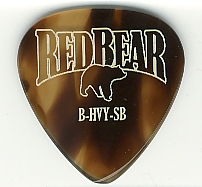
As work has a tendency to make forget things, I was on my way to my weekly gig today when I realized that I didn’t have a pick! Luckily, my gig was a few minutes away from Gryphon Stringed Instruments in Palo Alto, so I resolved to go to the shop and pick up a new Red Bear. Once I entered the store, I went right to the pick case, and asked the sales guy to pull out the Red Bear tray. I was all set to get my normal B Heavy, when I noticed a Red Bear pick that I hadn’t seen before, a B-GJ! The sales guy said that the GJ stood for “Gypsy Jazz.” Well, of course I had to take it out of its pouch, and feel it. Mistake! The damn thing was beefy – nice and beefy, just how I like my picks.
I asked to try it out, and picked up a Martin dreadnought. From the very first strum, I knew this was the pick for me. But I also compared it to my beloved B Heavy, and there was just no comparison! I really loved the B Heavy, but since I’ve been playing with the V-Picks Snake on electric, I’ve developed a real penchant for super-thick picks, and at 3mm, this B-GJ felt just too good to pass up. So I returned to the case, pulled out my bank card, bought the pick, and went to my gig.
All I can say is that tonally, this had to be the best gig I’ve had in years! At this particular gig, I play solo with just me singing and accompanying myself with acoustic guitar and piano. I think I only touched the piano four times tonight! I was loving playing with this pick!
First off, as I’ve mentioned in previous articles about thick picks, you actually hold them lighter, which relaxes your hand muscles; thus you play faster. But from tone standpoint, I was in total heaven!
As expected, light strumming with the B-GJ produces wonderful, chimey and ringy tones. But the big difference I found between my old B-Heavy and B-GJ was when I dug into the bottom strings with the pick while simultaneously partially palm muting on the saddle of my guitar. What that usually produces is a subdued low-freq boomy kind of sound. With the GJ, it produced that tone, but it was much more pronounced. It was freakin’ awesome.
Moreover, I could ellicit all sorts of different tones by changing the angle of the pick. I could do that pretty well with the B-Heavy, but the tone was so much more full and rich with the B-GJ! I was really at my creative best tonight. A customer, who said he was also a guitarist, walked up to me at the end of his meal, and remarked how good my guitar sounded, and that it sounded nothing like an Ovation. I told him it was the pick, and let him hold it. “You could do all that with this pick? Damn! I gotta me one of these.”
Folks, this is just a dynamite pick, and it’s worth every penny of the $30 you pay for it retail (though it’s $5 cheaper if you buy direct from Red Bear Trading). For what this pick does for my acoustic tone, I just can’t think of using any other kind of pick for playing my Ovation!
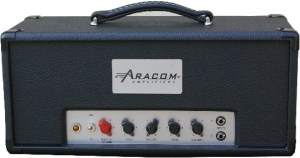
Summary: This brand-new 22 watter is the newest in the Aracom low-wattage amp series now called the Vintage Rox or VRX series, which includes the original RoxBox 18 (now called the VRX18). Loaded with a pair of 6V6 power tubes, this amp oozes vintage American clean and dirty tone ala Stevie Ray Vaughn.
Pros: More clean headroom in Channel 1 as compared to its EL84-based 18 Watt sibling. And despite its lower wattage rating, this amp is capable of getting LOUD! Plus the VRX series sports what I think are the best power switching and master volume in the business!
Cons: None.
Price: $895 Head / $995-$1095 for Combo (dep. on speaker)
Specs:
– (2) 6V6 Power Tubes
– (3) 12AX7 Preamp Tubes
– S.S. Rectifier with “sag” circuit
– Hi/Low B+ voltage switch (22/10 watts)
– On/Off Switch
– Indicator Lamp
– Custom Heavy Duty Aluminum Chassis
– Custom Wound Transformers
– 4, 8, 16 ohm Speaker Jacks
– Custom Handcrafted
Turret Board
– HandwiredTone Bone Rating: 5.0 – Jeff Aragaki has hit the ball out of the park with this amp! I loved the original RoxBox 18, and gave it a 4.75, but with this amp, Jeff “fixed” the harshness of the breakup at lower volumes. To me, it’s the perfect amp!
Let’s roll back the clock a couple of months. I get a call from Jeff Aragaki. The conversation went something like this…
“Hey Brendan! How’s it going?” asks Jeff.
“Not bad. Howzit with you?” I ask.
“It’s going good. Listen, I’m experimenting with a new tube compliment for the RoxBox and put a pair of 6V6’s in it to see how it sounds,” says Jeff.”
“Oh REALLY? Kinda tryin’ to get an American voicing, are ya…”
“Yeah, plus the output rating should be bit higher at around 22-25 Watts,” Jeff states.
“Okay,” I say, “Now you’ve got my attention. When can I try it out?” I ask.
<chuckle> “Well, I called to see if could bring it over to you for you try out and give me some feedback,” replies Jeff.
“Brand new amp? Experiment? Need you ask to see if I’d like to try it out? I’m free Saturday morning!” I exclaimed.
Fast-forward to the following Saturday, and Jeff lets me try the amp for a couple of days before he has to take it back, and I immediately start taking it through its paces. I even gig with it. I’d instantly fallen in love with it! I call Jeff and tell him that I think he’s onto something with this amp. He’s glad for the feedback, then a couple of days later, he picks it up to finish it out.
A few days later, he calls and tells me that he had to tweak the circuits a bit to handle the increased power. Uh-oh. So I asked, “Did it change the tone?”
“Hahaha… not at all. In fact it was actually running at way below 22 Watts. Since I reworked the circuitry, it has tons of power now, and it sounds even better. I even adjusted Channel 1 so you get even more clean headroom, and Channel 2 breaks up real nicely now. In any case, I’m going on a business trip to Indonesia and you can play with the amp for a couple of weeks while I’m gone.”
And play I did! That was one of the most exhausting two weeks of my life because I was up till late (like 2-3 am) playing that amp. I just couldn’t get enough of it, especially playing “Goldie” (a Saint Guitar Goldtop I recently reviewed) through the amp. And in all that time, I wanted to write a review of it, but I had agreed with Jeff to not talk about it (though I hinted a lot) until he got back from Indonesia and turned it into a production amp.
Once he returned from Indonesia a couple of weeks ago, he came over to pick the amp up. He asks me the usual questions about how I liked it, and I just said, “Jeff, this is a PERFECT amp! I can’t say anything bad about at all. Channel 1 is gorgeous and works great with pedals. Channel 2 just rocks the house! It’s the channel I used the most, and it’s also real pedal-friendly. And for once in my life, I’m at a total loss for words; that’s how much this amp affects me to the core.”
Jeff just laughed, and said, “Well, I’ve got a couple of other amps for you to try out…”
I cut him off, and told him that it’s fine if he wanted me to review them, but as far as what amp I’d choose to go with for my personal amp, the VRX22 was it. Search over. He laughed again, and said he’d get started on it….
Okay… fast forward to yesterday…
Jeff called me up to give me a status on my amp, and that he talked to someone this past week who is also getting one, choosing the VRX22 over a well-known boutique manufacturer. So it was definitely going into production, and he was almost done with the web page and announcement. Of course, I couldn’t keep my mouth shut and immediately wrote an announcement, despite his recommendation to wait until today). 🙂 I just promised I wouldn’t say too much, which I didn’t because I wanted to write a review.
What’s in a name…
To create alignment in the series, Jeff has renamed the “RoxBox” line to the “Vintage Rox” or VRX series. If you recall, the original RoxBox 18 sported a pair of EL84 power tubes and is now called the VRX18; and the only difference between the two amps is that the VRX22 employs 6V6’s and circuits that can deal with the increased power. In essence, with the VRX series, Jeff is providing both British (VRX 18) and an American (VRX 22) voicing options. The EL84-based VRX18 breaks up very similarly to a VOX AC15, with a lot of high-freq shimmer. The VRX22, on the other hand, breaks up like a classic Tweed. Frankly, once I have the bucks, playing both together will sound absolutely awesome!!! And priced at $895 each for the head models, that’s A LOT cheaper than a single hand-wired amp from most boutique manufacturers.
Hand-wired goodness at an affordable price
I can’t stress this enough: The thing that originally blew me away with Aracom Amps was the price of the RoxBox. I couldn’t believe Jeff could sell a hand-wired amp for less than a grand – even with a solid-state rectifier! As I’ve gotten to know Jeff, and I’ve come to understand one thing about him: He’s an incredibly shrewd businessman. As he shared with me this morning, “It’s a matter of philosophy. Some guys make boutique gear, give their stuff a nice paint job, then charge a bunch of money for their gear. Then there are other guys who just want to make a few bucks off their gear, but sell it at a lower price so more people will play it.”
The net result is that we consumers reap the rewards of that philosophy, and probably one of the reasons why Jeff’s amps are starting to gain a lot of traction in the industry. And artists have started to find out about Jeff’s amps. Gene Baker of B3 Guitars fame plays an early-model Evolver, and just recorded his new album using the Evolver in all the songs. Obviously, a guy like this who gigs all the time is a believer. I’m nowhere near Gene’s abilities, but I totally dig his amps – I think you can tell. 🙂
How It Sounds
I’m not going to rehash features here, since the features are the same as the original RoxBox 18 that I reviewed a few months ago. Again, the fundamental difference is the use of 6V6’s.
If you’re looking for a classic American tone, this amp is it. Yeah, you COULD go with a classic Tweed from Fender or other boutique manufacturers. But you’d pay way more for the sound. But I also need to qualify that. The tone is “American-like.” It has a voicing that whether Jeff stumbled onto it or not, is a voicing that is at once familiar, but all its own at the same time. To me, I don’t give a rat’s ass about the power rating of this amp. All I know is that it sounds like nothing I’ve played before. That’s the feeling I get with the Reason SM25, which is another 6V6 beauty, but has a sound all it own.
Channel 1 is bright and gorgeous. It’s chimey as you’d expect from a classic Tweed sound, but it’s amazingly very lush as well – which is where this amp is really distinct. The words that come to mind with this clean channel are “subltely sensuous.” It’s not like a hot chick dressed in a tight mini skirt. It’s more akin to a gorgeous woman dressed in a simple cotton summer dress who doesn’t need any makeup to enhance her looks, and she has nothing to prove. She just looks to be all-woman. The net result is that you’re just drawn into aura without really knowing why – nor caring. The clean channel of the VRX22 has a similar effect on me. It’s just a gorgeous tone with any guitar (though I especially loved play “Pearl,” my Strat through it. The raw tone just draws you in, and when you add effects, it just handles them beautifully.
Channel 2 is also bright and ballsy, but its breakup is incredibly smooth. This is the channel where I think Jeff has really hit the ball out of the park. One of the things that has bugged me about the power tube distortion in a lot of Tweed-types of amps is the harsh grind from the power tubes that you oftentimes have to tame with some filter cap and capacitor changes – it’s a bit too open. Not so with this amp. The “hidden” gain stage that acts as a tube overdrive pedal that’s always on helps smooth out the distortion by making it a bit tighter, but not so much that you lose that openness that you expect from a Tweed-type amp. I loved slamming the front-end of the amp with tons of input gain, and pushing both pre-amp and power tubes at the same time. Talk about compression and sustain!
Here’s a clip I used for my review of “Goldie.” The amp is in Channel 2 for the lead, and I added just a tad of Tube Screamer to get a more punchy midrange response. The TS overdrive was maybe at 10 am – not much at all. Plus I layered on some reverb with my Hardwire RV-7 Reverb. The bulk of the breakup came from the amp. The rhythm track was recorded with Pearl on Channel 1.
Man! I just listened to that track again, and can’t get over how great the amp sounds. Normally I record at bedroom levels, but I wanted the amp to move a bit more air this time, and I recorded it at gig levels (for me, that’s around 90-100db, so it’s fairly loud but not over the top), and I used a ribbon mic to pick up the ambient a bit better. The mic was placed at a 45 degree angle along the speaker cone about a foot and a half away from the amp.
Overall Impression
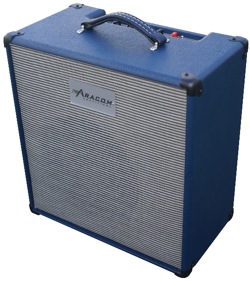
I just can’t rave about this amp more! To me, it’s the perfect balance of tone and power for practically all my needs! I’m getting the head with a 1X 12 cab, both wrapped in that awesome blue tolex that you see in the picture above!
Admittedly, the purist in me originally scoffed at the idea of a solid-state rectifier in the original RoxBox series. But as I told Jeff this morning, what people are typically after is the voltage sag you get with a tube rectifier. Jeff has built a custom “sag simulator” circuit that does the job so well that frankly, I can’t tell the difference. Besides, it’s what the amp sounds like that counts, not necessarily its components. Look at the classic Roland JC-120. That has to be one of my all-time favorite amps – even Satch played with one for years. It’s completely solid-state and it sounds freakin’ awesome!
But circling back to the VRX22. You can’t go wrong with this amp. Yes, it’s priced for value, but the tone that you get for that far surpasses anything that I’ve played at these lower wattages.
Gear-aholic. Tone Freak. Gear Maniac. At least that is what I have been called. I like to think of myself as a “Tone Crusader.”
I comb the ethers in search of implements to try to catch the unicorn called “Tone.” And since tone has so many faces, I need different kinds tools to help me catch the unicorn. Thus, I have an arsenal of axes, both custom and commonly available; a bank of sound amplification devices to announce my presence with special foot pedals to alter my sound to affect a different response.
I spend hours upon hours developing and honing my skills, and learning how to most effectively use my tools. I am a warrior who must constantly be at the ready to perform.
And like the Crusaders of old, my quest for the tone unicorn is a life-long pursuit that has been fraught with both times of extreme joy and with days of dark dispair. But despite its ups and downs, I cannot even begin to imagine abandoning this pursuit! I’ve seen the unicorn! I have even come close to touching it! And until I do touch it, I will never give up. Never!!!
I fully realize that I may go to my grave without ever catching the unicorn. But it is not the goal that matters to me in any case; it is the journey that matters.
I occasionally browse Red Bear Trading’s web site to see if Dave Skowron has come up with anything new, and much to my surprise, he has! Red Bear has come up with a new pick line called the Tuff-Tone line that apparently sound just as good as his originals. But the big difference is that these picks are made of a material that is much more durable than the Tortis material of the original Red Bear picks! Apparently, they also sound just as good as the originals. Could this be a death knell for Tortis? I doubt it. Dave’s Tortis picks are the absolute bomb, and the natural feel of the Tortis when you’re playing is absolutely to die for!
In any case, here’s an excerpt from the Tuff-Tone web page:
Are they tough enough? You bet. These picks aren’t going to warp or break on you anytime soon. They will pick up some discoloration from your guitar strings. When this happens, simply wash them with soap and water. Go ahead and run them through the washer and dryer! No problem! Keep them in your pocket full of change – see if we care! These picks are really tough!
I recently started a friendship with Vinni Smith at V-Picks – what a cool dude! Not only does he make great picks, but that man can make an axe sing! Anyway, I was e-mailing him this evening about how his “The Snake” pickup has changed my life, and it got me to thinking about specific pieces of gear that have had a drastic effect on how I approach the guitar. I’ll share them here in kind of a loose chronology:
1. The Kyser Capo
Yeah, lots of people call ’em “cheaters,” but screw ’em. I couldn’t play lots of songs without one. But the Kyser capo in particular really changed my approach, especially after I saw James Taylor playing with one. For years, I used a standard nylon strap type of capo that just basically stayed in place. But then I saw JT playing with a Kyser. I always wondered how he did his mid-song key changes. I used to think he just changed his hand position and played barre chords. But I’ll be damned if he didn’t just slide the capo up, then just played open chords in another key. That was it! I was sold.
2. Ovation Celebrity Deluxe
After my beloved “Betsy” (a Yamaha FG-335 acoustic) broke in a terrible fall, I immediately went in search of a new guitar. I played all sorts in this used gear store and came across this gorgeous sunset burst Ovation. I wasn’t much of an Ovation fan – thought they were really tinny sounding. But when I played this one, it had a much deeper sound than the Ovations I’d played up to that point, and it was a shallow body, no less. When I plugged it into an amp, it sounded even better! That guitar got me into amplified sound. So of course, in addition to buying the guitar, I also got a small Roland 25 Watt practice amp. What a life changer that was.
3. Fender Hot Rod Deluxe
This was my very first tube amp, and an amp that I still use because of how good it sounds… er… I’ve had some modifications done to it, but nevertheless, being my first tube amp, it exposed me to a whole new world of tonal possibilities. Up to that point, I’d played only solid state amps from a Roland JC-12o to a Line 6 Flextone III to a Roland Cube 60 (which I still have – it’s an awesome amp). The Hot Rod showed me the wonders and beauty of tube amp distortion which is nothing like what you get with solid state amps.
4. Ibanez Tube Screamer
There are overdrive boxes, and there are overdrive boxes. But the Tube Screamer is THE classic overdrive box, and the oldest pedal on my board. I’ve of course fallen in love with other OD’s like the Creation Audio Labs Holy Fire, but the Tube Screamer had a real huge effect on how I looked at tone and established what pleases me the most with respect to breakup. It’s a great pedal (though I’m really psyched about testing the Tone Freak Effects Abunai 2).
5. Blizzard Pearl Fender 60th Diamond Anniversary Stratocaster
I love that classic, vintage sound, and this guitar delivered it from the moment I played it. Yeah, it’s made in Mexico, it cost me less than $400 new, but I chose it over Strats five times its price. Why? Because it kicked the shit out of the other guitars. It was THE guitar that convinced me that it’s not the price you pay but the tone you produce that matters. Since I’ve gotten her, I play “Pearl” every day. She’s the first guitar I go to when working on a new song. What a wonderful instrument.
6. Saint Guitar Company “Baby Blue” Benchmark
This isn’t my guitar, and I no longer have it in my studio, but this was the very first guitar that was made to my personal specifications. There is nothing like playing a guitar that’s made to order. The experience is surreal, and started me down this path of playing a custom guitar. Adam’s going to be building me one in the next few months – I’m keeping that one. 🙂
7. Reason Amps SM25 Combo
Even though I love my Hot Rod, the SM25 marks a time when I’ve gotten super-serious about my tone. I’d played a bunch of amps, but this amp showed me that sometimes you do have to pay to get stellar tone – and it’s worth every penny. Lots of manufacturers have created amps that run their channels in series, but I haven’t come across one amp yet that does it as well as Obeid Kahn and Anthony Bonadio. They’ve come up with an amp, cab, and speaker combo that’s like nothing I’ve played before – and I’ve played some awesome amps.
8. Creation Audio Labs Mk.4.23 Clean Boost
I used to think clean boosts were just to help punch a solo through the mix. I didn’t know that they could be used to slam the pre-amps of a tube amp to produce super-overdrive in an amp that no distortion or overdrive pedal can give you. But this one’s very special in that it adds no tonal artifacts of its own – it’s uncanny. What it does is boost the natural sound of your guitar, and when slamming the front-end of amp, gives you the true overdriven tone of your amp. This is a piece of gear that I cannot do without any longer, and it now has a permanent place on my board.
9. Red Bear Picks
I never thought I’d buy a handmade pick, nor pay $20 for one no less. But Red Bear Trading TortisTM picks truly changed my life. I now use Red Bears exclusively for playing acoustic guitar. They sound great with electric as well – I’ll get to that below when I talk about V-Picks – but no pick I’ve ever played has made my Ovation sound so good. These picks look and feel like natural tortoise shell, but they’re made from a polymer of milk protein. No matter, they’re awesome picks!
10. Aracom Amps RoxBox 22 Watt (soon to be released)
This diminutive amp oozes 6V6 goodness. It’s still kind of in the prototype phase so I can’t really write too much about it, but I think my friend Jeff Aragaki has hit a real sweet spot with this amp. Get this: It’s hand-wired, though it uses a solid state rectifier, and it costs less than $1000! The profound thing about this is you can indeed get boutique caliber gear at a great price. But for me personally, this amp is the very first boutique amp I’m buying. Oh, I’ll eventually get the Reason SM25 to run in parallel with this one, 🙂 but this amp is special because it’s the first boutique amp I will ever have owned.
11. V-Picks “The Snake”
As I mentioned above, I’ve befriended Vinni Smith, and I just dig the dude! He knows so much about guitar, and we’ve shared a lot of the same experiences, and love the same kind of music (his favorite guitar solo is the lead break in the middel of Frampton’s Do You Feel Like We Do – my favorite as well). When we first met, Vinni sent me a large sample of his picks, which I compared head-to-head with my Red Bear picks. Of course, I love my Red Bear Classic B-style Heavy, but when I played the comparable V-Picks Standard on my electric guitars, I just couldn’t believe this sound and action I was getting! So I decided to use my Red Bears for acoustic – as I said, nothing sounds better than a Red Bear on acoustic. But for electric, it was going to be V-Picks all the way. Then during a conversation we were having a couple of weeks ago, Vinni told me he’d send me his Snake picks. These are a whopping 4.1 mm thick, with a different bevel than his others. Since I’ve gotten them, I’m never going to use anything on electric guitar than the Snake! I use the rounded for a smoother, fatter tone, and use the pointy for bright attack tones – especially when I’m doing stuff on the bridge pickup! These two picks have totally changed my approach to playing electric. Thick picks in general did that, but these are the thickest I’ve played, and they absolutely ROCK THE HOUSE!
12. May 30, 2010 – I know, a bit late on the uptake here with this one, but life-changing nonetheless, and that is my Aracom Power Rox PRX150-Pro attenuator. This is the first attenuator that I’ve used that truly stays transparent down to bedroom levels. It is the only attenuator that accurately gives me my cranked up tone at low volume levels, and it is absolutely wonderful! I know there are others out there, but knowing that they’re modeled after existing attenuator designs that I know don’t sound very good at low volume levels, it was a no-brainer for me to choose this one. As Doug Doppler said to me in a recent visit to his home, “This thing has saved my ears!” Even Joe Satriani uses one of these units and loves it! That’s how good it is!
Okay, that’s it for me… Anyone care to share what gear has changed their lives?
Saint Guitar Company just released its first set of inventory guitars to the public today on its site (http://www.stguitars.com)! OMG! These guitars are gorgeous! As I test guitars for Adam, I’ve had the privilege to play both Messengers (double-cut): the Vintage Metallic Green Messenger, and the Solid Walnut Baritone Messenger. Both of these guitars are just super sweet to play. The two Benchmark (single-cut) and the Green Messenger guitars actually hung on a rack at the Mesa Boogie store in Hollywood for a few months, but Adam decided to take them back for inventory to sell them directly from his site.
This is a huge step for Adam. For the last ten years, he’s been selling his guitars to individuals purely by word-of-mouth. With the new site, he’s opening up a whole new way to get these excellent pieces of playable art! I’m so excited for him.
In the next few days, Vinni Smith of V-Picks will be releasing a video review of one of Adam’s guitars. I’ll keep you posted!
 If I could go higher, I would with this rating. But this pick gets my highest rating!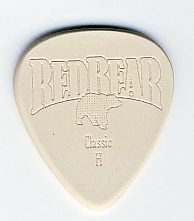

 Guitar Gear